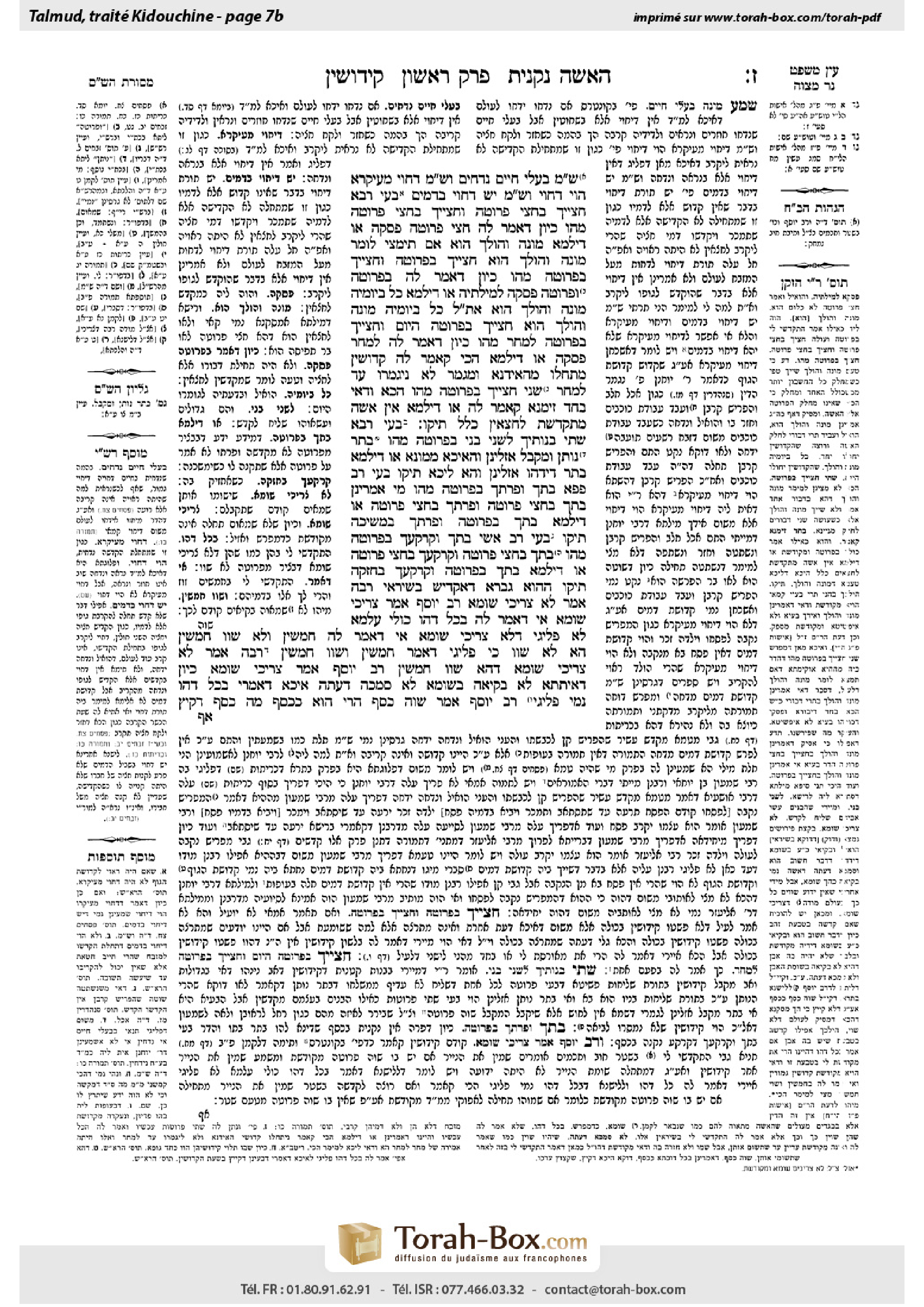
Kiddushin 7b: Talmud study for Daf Yomi
Daf Yomi is the daily study of one Talmud folio. Explore 37 tractates with scans, Hebrew text, Sefaria English and AI-generated French translations where annotated.
Passage selection and English or AI-generated French translation are available where the scan has annotations. Daf Study is independent of Torah-Box and Sefaria.
Browse Kiddushin · קידושין · All tractatesKiddushin 7b text and translations
This page of Kiddushin includes the Aramaic text, an English translation and an AI-generated French translation, alongside the scan above.
קידושין ז׳ ב · Aramaic and Hebrew text
שְׁמַע מִינַּהּ בַּעֲלֵי חַיִּים נִדְחִים,
וּשְׁמַע מִינַּהּ דָּחוּי מֵעִיקָּרָא הָוֵי דָּחוּי, וּשְׁמַע מִינַּהּ יֵשׁ דִּחוּי בְּדָמִים.
בָּעֵי רָבָא: ״חֶצְיֵיךְ בַּחֲצִי פְרוּטָה, וְחֶצְיֵיךְ בַּחֲצִי פְרוּטָה״ מַהוּ? כֵּיוָן דְּאָמַר לַהּ ״חֲצִי פְרוּטָה״ – פַּסְקַהּ, אוֹ דִילְמָא מוֹנֶה וְהוֹלֵךְ הוּא?
אִם תִּימְצֵי לוֹמַר מוֹנֶה וְהוֹלֵךְ הוּא, ״חֶצְיֵיךְ בִּפְרוּטָה וְחֶצְיֵיךְ בִּפְרוּטָה״ מַהוּ? כֵּיוָן דְּאָמַר לַהּ בִּפְרוּטָה וּפְרוּטָה – פַּסְקַהּ לְמִילְּתֵיהּ, אוֹ דִילְמָא כֹּל בְּיוֹמֵיהּ מוֹנֶה וְהוֹלֵךְ הוּא?
אִם תִּימְצֵי לוֹמַר כֹּל בְּיוֹמֵיהּ מוֹנֶה וְהוֹלֵךְ הוּא, ״חֶצְיֵיךְ בִּפְרוּטָה הַיּוֹם וְחֶצְיֵיךְ בִּפְרוּטָה לְמָחָר״ מַהוּ? כֵּיוָן דְּאָמַר לַהּ לְמָחָר – פַּסְקַהּ, אוֹ דִילְמָא הָכִי קָאָמַר לַהּ: ״קִדּוּשִׁין מַתְחֲלוּ מֵהָאִידָּנָא וּמִגְמָר לָא נִיגְמְרוּ עַד לִמְחַר״?
״שְׁנֵי חֲצָיַיִךְ בִּפְרוּטָה״ מַהוּ? הָכָא וַדַּאי בְּחַד זִימְנָא קָאָמַר לַהּ, אוֹ דִילְמָא אֵין אִשָּׁה מִתְקַדֶּשֶׁת לַחֲצָאִין כְּלָל? תֵּיקוּ.
בָּעֵי רָבָא: ״שְׁתֵּי בְנוֹתֶיךָ לִשְׁנֵי בָנַי בִּפְרוּטָה״ מַהוּ? בָּתַר נוֹתֵן וּמְקַבֵּל אָזְלִינַן וְהָאִיכָּא מָמוֹנָא, אוֹ דִילְמָא בָּתַר דִּידְהוּ אָזְלִינַן וְהָא לֵיכָּא? תֵּיקוּ.
בָּעֵי רַב פָּפָּא: ״בִּתְּךָ וּפָרָתְךָ בִּפְרוּטָה״ מַהוּ? מִי אָמְרִינַן בִּתְּךָ בַּחֲצִי פְרוּטָה וּפָרָתְךָ בַּחֲצִי פְרוּטָה, אוֹ דִילְמָא בִּתְּךָ בִּפְרוּטָה וּפָרָתְךָ בִּמְשִׁיכָה? תֵּיקוּ.
בָּעֵי רַב אָשֵׁי: ״בִּתְּךָ וְקַרְקָעֲךָ בִּפְרוּטָה״ מַהוּ? בִּתְּךָ בַּחֲצִי פְרוּטָה וְקַרְקָעֲךָ בַּחֲצִי פְרוּטָה, אוֹ דִילְמָא בִּתְּךָ בִּפְרוּטָה וְקַרְקָעֲךָ בַּחֲזָקָה? תֵּיקוּ.
הָהוּא גַּבְרָא דְּאקַדֵּישׁ בְּשִׁירָאֵי, רַבָּה אָמַר: לָא צְרִיכִי שׁוּמָא. רַב יוֹסֵף אָמַר: צְרִיכִי שׁוּמָא. אִי דְּאָמַר לַהּ בְּכֹל דְּהוּ, כּוּלֵּי עָלְמָא לָא פְּלִיגִי דְּלָא צְרִיכִי שׁוּמָא.
אִי דְּאָמַר לַהּ ״חַמְשִׁין״ וְלָא שָׁווּ חַמְשִׁין – הָא לָא שָׁווּ. כִּי פְּלִיגִי, דְּאָמַר ״חַמְשִׁין״ וְשָׁווּ חַמְשִׁין. רַבָּה אָמַר: לָא צְרִיכִי שׁוּמָא, דְּהָא שָׁווּ חַמְשִׁין. רַב יוֹסֵף אָמַר: צְרִיכִי שׁוּמָא, כֵּיוָן דְּאִיתְּתָא לָא בְּקִיאָה בְּשׁוּמָא לָא סָמְכָה דַּעְתַּהּ.
אִיכָּא דְּאָמְרִי בְּכֹל דְּהוּ נָמֵי פְּלִיגִי. רַב יוֹסֵף אָמַר: שָׁוֶה כֶּסֶף הֲרֵי הוּא כְּכֶסֶף, מָה כֶּסֶף דְּקִיץ –
Kiddushin 7b · English translation
Conclude from it that living things can be permanently deferred. Not only an offering that has already been slaughtered, but also a living animal that has been separated as an offering for which it is disqualified, is permanently deferred from being sacrificed on the altar. Likewise here, when he consecrated only half of it, the animal cannot be offered and is rejected. This ruling is in opposition to the claim that only slaughtered animals are permanently rejected.
And furthermore, learn from it that deferral at the outset, i.e., a condition disqualifying the animal from being sacrificed that was present when the animal was first consecrated, is considered a permanent deferral. One does not say that the halakha of deferral applies only to an animal that was eligible to be sacrificed at the time it was consecrated and later was deferred. And learn from it that there is deferral not only with regard to an offering itself, but also with regard to monetary value, i.e., deferral applies even to an animal whose value was consecrated. In this case, half of an animal is not consecrated to be sacrificed as an offering, and yet it can still be permanently deferred from the altar.
§ Rava raises a dilemma: If a man says to a woman: Half of you is betrothed with half of one peruta, and half of you with half of one peruta, what is the halakha? Does one say that since he said to her: Half of one peruta, he has divided his statement? In other words, by specifying half of one peruta he intended the betrothal to be performed in two stages, with one half-peruta for each stage, and half of one peruta does not effect betrothal. Or perhaps he was counting toward the full sum of the betrothal money, and intends for the betrothal to take effect at one time.
And if you say that in that case it is considered as though he were counting, then if he said to her: Half of you is betrothed with one peruta and half of you with one peruta, what is the halakha? Does one say that since he said to her: With one peruta and one peruta, he divided his statement and intended to betroth her two halves separately, and one cannot betroth half a woman? Or perhaps anything that he does on that day is considered as if he were counting, i.e., since he intended to complete the action that day it is as though she were betrothed with two perutot.
And if you say that everything he does on that day is considered as if he were counting, then if he said to her: Half of you is betrothed with one peruta today, and half of you is betrothed with one peruta tomorrow, what is the halakha? Does one say that since he said to her: Tomorrow, he has divided his statement, which prevents the days from being combined, or perhaps this is what he is saying to her: The betrothal begins from now, and it will not be completed until tomorrow.
Rava further inquires: If he said to her: Your two halves are betrothed with one peruta, what is the halakha? Here, he certainly spoke to her at one time, i.e., he did not divide his statement into two, and therefore it should be a valid betrothal, or perhaps a woman may not be betrothed in halves at all. No resolution was found for any of these questions, and therefore the Gemara says that the dilemmas shall stand unresolved.
Rava raises another dilemma. If one man said to another: Let your two daughters be betrothed to my two sons with one peruta, what is the halakha? The Gemara explains the two sides of the dilemma: Do we follow the giver and recipient, and as the giver bestows one peruta and the recipient receives one peruta there is money here, since one peruta is considered money and therefore the betrothal is valid. Or perhaps we follow them, i.e., those affected by the issue, in this case the sons and the daughters, and there is not one peruta for each of these individuals, and therefore the betrothal is not valid? This problem is also left unanswered, and therefore the Gemara says that the dilemma shall stand unresolved.
Rav Pappa raises a dilemma: If one man said to another: I hereby acquire your daughter and your cow with one peruta, what is the halakha? Do we say that he meant: Your daughter should be betrothed with half of one peruta and your cow purchased with half of one peruta? In that case neither the betrothal nor the acquisition take effect. Or perhaps he meant: Your daughter should be betrothed with one peruta and your cow should be acquired by pulling? No satisfactory answer was found in this case either, and the Gemara says that the dilemma shall stand unresolved.
Rav Ashi raises a dilemma: If he said: I hereby acquire your daughter and your land with one peruta, what is the halakha? Does this mean: Your daughter should be betrothed with half of one peruta and your land should be acquired with half of one peruta? Or perhaps it means: Your daughter should be betrothed with one peruta and your land should be acquired through the act of taking possession? This question is also left unanswered, and the Gemara again says that the dilemma shall stand unresolved.
§ The Gemara relates: There was a certain man who betrothed a woman with silk [beshira’ei] garments. Rabba said: An appraisal of the value of the garments is not necessary, as they are certainly worth more than one peruta. Rav Yosef said: An appraisal of the value of the garments is necessary, and as the man did not determine the value of the silk garments before the betrothal, the betrothal is invalid. The Gemara comments: If he said to her that she should become betrothed to him by any amount, regardless of the value of the silk garments, everyone agrees that the garments do not require appraisal, as they are undoubtedly worth more than one peruta.
Conversely, if he said to her that they are worth fifty dinars, and they are not worth fifty dinars, then everyone agrees that the betrothal is not valid, as they are not worth the amount he specified. They disagree when he said that they are worth fifty dinars, and in actuality they are worth fifty dinars. Rabba said: An appraisal of the value of the garments is not necessary before the betrothal, as they are worth fifty dinars. Rav Yosef said: An appraisal of the value of the garments is necessary, because the woman herself is not an expert in appraisal and she does not rely on his assessment. Since she is unsure if the garments are actually worth fifty dinars as he claimed, she does not agree to be betrothed.
There are those who say that even in a case where he says to her: Be betrothed to me with these silk garments, whatever they are worth, the amora’im disagree with regard to the halakha. The reason for the dispute in this case is as follows. Rav Yosef said: An item worth money is like money in every way. Just as money is set, i.e., it has a clearly defined value,
Kiddushin 7b · Traduction française (IA)
Concluez-en que les animaux vivants peuvent être définitivement écartés. Ce n’est pas seulement une offrande déjà égorgée qui peut être définitivement écartée : un animal vivant désigné comme offrande et qui est disqualifié est lui aussi définitivement écarté et ne peut être sacrifié sur l’autel. De même ici, lorsqu’il n’en a consacré que la moitié, l’animal ne peut pas être offert et est écarté. Cette conclusion va à l’encontre de l’affirmation selon laquelle seuls les animaux égorgés peuvent être définitivement écartés.
En outre, apprenez-en que l’écartement dès le départ — c’est-à-dire la présence, au moment de la consécration initiale de l’animal, d’une condition qui le disqualifie comme offrande — est considéré comme un écartement définitif. On ne dit pas que la halakha de l’écartement ne s’applique qu’à un animal qui pouvait être offert au moment de sa consécration et qui a été écarté par la suite. Apprenez-en également que l’écartement concerne non seulement l’offrande elle-même, mais aussi sa valeur monétaire : il s’applique même à un animal dont seule la valeur a été consacrée. Dans ce cas, la moitié d’un animal n’est pas consacrée pour être offerte, et pourtant elle peut tout de même être définitivement écartée de l’autel.
§ Rava soulève une difficulté : si un homme dit à une femme : « La moitié de toi est fiancée avec une demi-perouta, et l’autre moitié de toi avec une demi-perouta », quelle est la halakha ? Dit-on que, puisqu’il lui a dit « une demi-perouta », il a divisé sa déclaration ? Autrement dit, en précisant une demi-perouta, il entendait que les fiançailles se fassent en deux étapes, avec une demi-perouta pour chacune, et une demi-perouta ne suffit pas à réaliser les fiançailles. Ou peut-être comptait-il ainsi atteindre la somme totale requise pour les fiançailles et entendait-il qu’elles prennent effet en une seule fois ?
Et si vous dites que, dans ce cas, il est considéré comme s’il comptait, alors, s’il lui a dit : « La moitié de toi est fiancée avec une perouta et l’autre moitié de toi avec une perouta », quelle est la halakha ? Dit-on que, puisqu’il lui a dit « avec une perouta et avec une perouta », il a divisé sa déclaration et entendait fiancer séparément chacune de ses deux moitiés, alors qu’on ne peut pas fiancer la moitié d’une femme ? Ou peut-être tout ce qu’il fait ce jour-là est-il considéré comme s’il comptait, c’est-à-dire que, puisqu’il entendait achever l’acte ce jour-là, c’est comme si elle était fiancée avec deux peroutot ?
Et si vous dites que tout ce qu’il fait ce jour-là est considéré comme s’il comptait, alors, s’il lui a dit : « La moitié de toi est fiancée avec une perouta aujourd’hui, et l’autre moitié de toi avec une perouta demain », quelle est la halakha ? Dit-on que, puisqu’il lui a dit « demain », il a divisé sa déclaration, ce qui empêche de réunir les deux jours, ou peut-être lui dit-il : « Les fiançailles commencent dès maintenant et ne seront achevées que demain » ?
Rava pose une autre question : s’il lui a dit : « Tes deux moitiés sont fiancées avec une perouta », quelle est la halakha ? Ici, il lui a certainement parlé en une seule fois, c’est-à-dire qu’il n’a pas divisé sa déclaration en deux ; les fiançailles devraient donc être valides. Ou peut-être une femme ne peut-elle pas du tout être fiancée par moitiés ? Aucune réponse n’ayant été trouvée à ces questions, la Guemara dit qu’elles restent sans solution.
Rava soulève une autre difficulté. Si un homme dit à un autre : « Que tes deux filles soient fiancées à mes deux fils avec une perouta », quelle est la halakha ? La Guemara explique les deux possibilités : faut-il s’en tenir au donneur et au destinataire ? Puisque le donneur remet une perouta et que le destinataire reçoit une perouta, il y a bien ici une somme d’argent, car une perouta est considérée comme de l’argent ; les fiançailles sont donc valides. Ou peut-être faut-il s’en tenir aux personnes concernées par la question, en l’occurrence les fils et les filles ? Il n’y a alors pas une perouta pour chacun d’eux et, par conséquent, les fiançailles ne sont pas valides. Ce problème reste lui aussi sans réponse ; la Guemara dit donc qu’il demeure irrésolu.
Rav Pappa soulève une difficulté : si un homme dit à un autre : « J’acquiers par la présente ta fille et ta vache avec une perouta », quelle est la halakha ? Dit-on qu’il entend : « Que ta fille soit fiancée avec une demi-perouta et que ta vache soit achetée avec une demi-perouta » ? Dans ce cas, ni les fiançailles ni l’acquisition ne prennent effet. Ou peut-être entend-il : « Que ta fille soit fiancée avec une perouta et que ta vache soit acquise par traction » ? Aucune réponse satisfaisante n’a été trouvée dans ce cas non plus, et la Guemara dit que la question reste sans solution.
Rav Ashi soulève une difficulté : s’il a dit : « J’acquiers par la présente ta fille et ton terrain avec une perouta », quelle est la halakha ? Cela signifie-t-il : « Que ta fille soit fiancée avec une demi-perouta et que ton terrain soit acquis avec une demi-perouta » ? Ou peut-être cela signifie-t-il : « Que ta fille soit fiancée avec une perouta et que ton terrain soit acquis par prise de possession » ? Cette question reste elle aussi sans réponse, et la Guemara dit de nouveau qu’elle demeure irrésolue.
§ La Guemara rapporte : Un certain homme fiança une femme avec des vêtements de soie [beshira’ei]. Rabba dit : Il n’est pas nécessaire d’en faire estimer la valeur, car ils valent certainement plus d’une perouta. Rav Yosef dit : Il faut en faire estimer la valeur ; comme l’homme n’en a pas déterminé la valeur avant les fiançailles, celles-ci sont invalides. La Guemara précise : s’il lui a dit qu’elle serait fiancée à lui quelle que soit la valeur des vêtements de soie, tous conviennent qu’il n’est pas nécessaire d’en faire estimer la valeur, car ils valent sans aucun doute plus d’une perouta.
Inversement, s’il lui a dit que les vêtements valent cinquante dinars alors qu’ils ne valent pas cinquante dinars, tous conviennent que les fiançailles ne sont pas valides, puisqu’ils ne valent pas la somme qu’il a indiquée. Leur désaccord porte sur le cas où il lui a dit qu’ils valent cinquante dinars et où, en réalité, ils valent bien cinquante dinars. Rabba dit : Il n’est pas nécessaire de faire estimer la valeur des vêtements avant les fiançailles, puisqu’ils valent cinquante dinars. Rav Yosef dit : Il faut en faire estimer la valeur, car la femme n’est pas elle-même experte en estimation et ne se fie pas à son évaluation. Comme elle ne sait pas avec certitude si les vêtements valent réellement cinquante dinars, comme il le prétend, elle ne consent pas à être fiancée.
Certains disent que même dans le cas où il lui dit : « Sois fiancée à moi avec ces vêtements de soie, quelle que soit leur valeur », les amoraïm sont en désaccord sur la halakha. Voici la raison de leur désaccord dans ce cas : Rav Yosef dit qu’un objet ayant une valeur pécuniaire équivaut en tout point à de l’argent. De même que l’argent a une valeur fixe, c’est-à-dire une valeur clairement déterminée,
Traduction française générée par IA à partir de l’édition anglaise de Sefaria. Vérifie toujours un passage avec le texte source.
Text from Sefaria: William Davidson Edition - Vocalized Aramaic (CC BY NC); William Davidson Edition - English (CC BY NC).