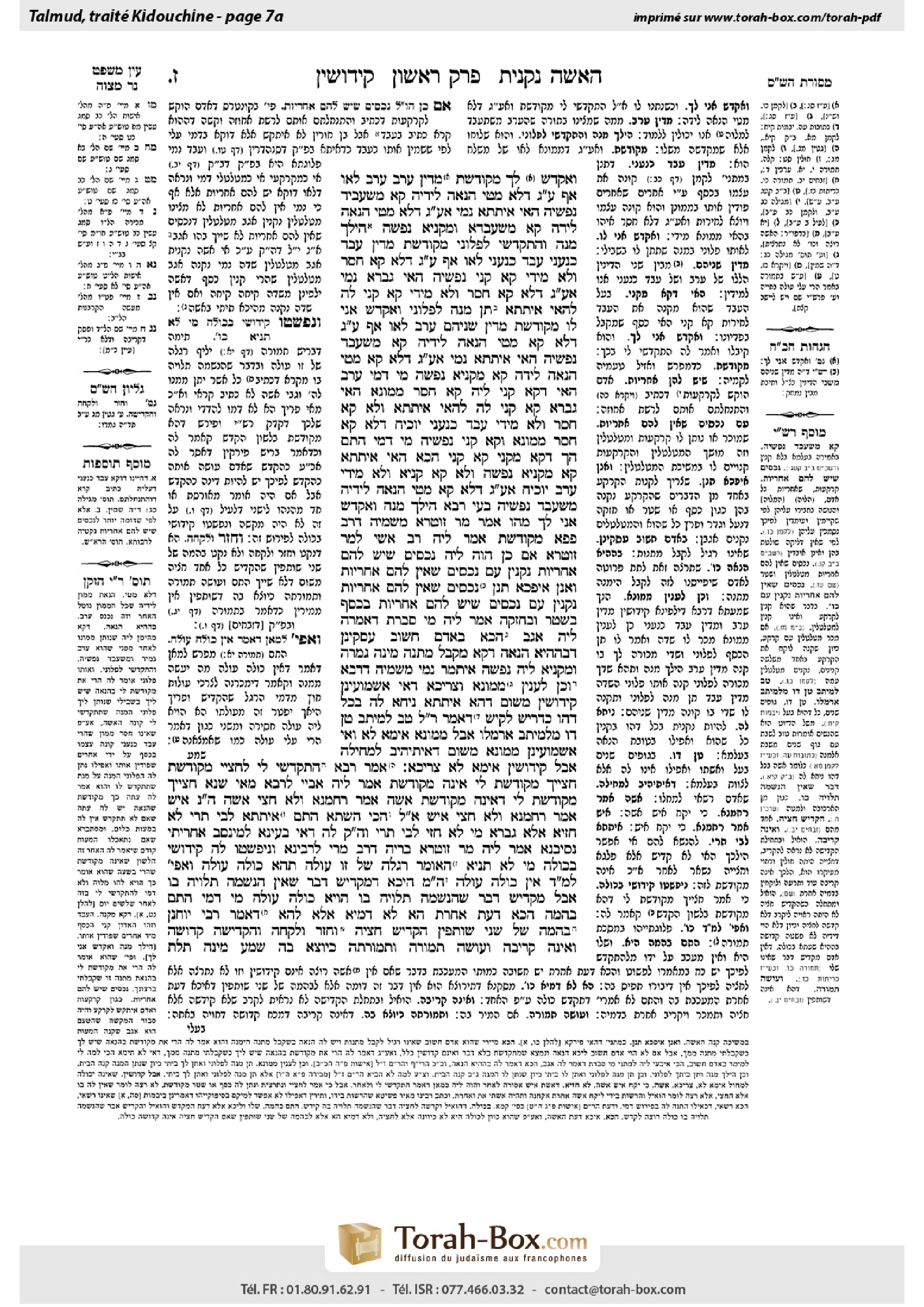
Kiddushin 7a: Talmud study for Daf Yomi
Daf Yomi is the daily study of one Talmud folio. Explore 37 tractates with scans, Hebrew text, Sefaria English and AI-generated French translations where annotated.
Passage selection and English or AI-generated French translation are available where the scan has annotations. Daf Study is independent of Torah-Box and Sefaria.
Browse Kiddushin · קידושין · All tractatesKiddushin 7a text and translations
This page of Kiddushin includes the Aramaic text, an English translation and an AI-generated French translation, alongside the scan above.
קידושין ז׳ א · Aramaic and Hebrew text
וְאֶקַּדֵּשׁ לָךְ״ – מְקוּדֶּשֶׁת, מִדִּין עָרֵב. עָרֵב, לָאו אַף עַל גַּב דְּלָא מָטֵי הֲנָאָה לִידֵיהּ – קָא מְשַׁעְבֵּיד נַפְשֵׁיהּ, הַאי אִיתְּתָא נָמֵי, אַף עַל גַּב דְּלָא מָטֵי הֲנָאָה לִידַהּ – קָא מְשַׁעְבְּדָא וּמַקְנְיָא נַפְשַׁהּ.
״הֵילָךְ מָנֶה וְהִתְקַדְּשִׁי לִפְלוֹנִי״ – מְקוּדֶּשֶׁת, מִדִּין עֶבֶד כְּנַעֲנִי. עֶבֶד כְּנַעֲנִי, לָאו אַף עַל גַּב דְּלָא קָא חָסֵר וְלָא מִידֵּי – קָא קָנֵי נַפְשֵׁיהּ, הַאי גַּבְרָא נָמֵי, אַף עַל גַּב דְּלָא קָא חָסֵר וְלָא מִידֵּי – קָא קָנֵי לַהּ לְהַאי אִיתְּתָא.
״תֵּן מָנֶה לִפְלוֹנִי וְאֶקַּדֵּשׁ אֲנִי לוֹ״ – מְקוּדֶּשֶׁת, מִדִּין שְׁנֵיהֶם. עָרֵב, לָאו אַף עַל גַּב דְּלָא קָא מָטֵי הֲנָאָה לִידֵיהּ – קָא מְשַׁעְבֵּד נַפְשֵׁיהּ, הַאי אִיתְּתָא נָמֵי, אַף עַל גַּב דְּלָא קָא מָטֵי הֲנָאָה לִידַהּ – קָא מַקְנְיָא נַפְשַׁהּ.
מִי דָּמֵי? עָרֵב, הַאי דְּקָא קָנֵי לֵיהּ קָא חָסַר מָמוֹנָא, הַאי גַּבְרָא קָא קָנֵי לַהּ לְהַאי אִיתְּתָא וְלָא קָא חָסַר וְלָא מִידֵּי! עֶבֶד כְּנַעֲנִי יוֹכִיחַ, דְּלָא קָא חָסַר מָמוֹנָא וְקָא קָנֵי נַפְשֵׁיהּ.
מִי דָּמֵי? הָתָם הָךְ דְּקָא מַקְנֵי קָא קָנֵי, הָכָא הַאי אִיתְּתָא קָא מַקְנְיָא נַפְשַׁהּ וְלָא קָא קָנְיָא וְלָא מִידֵּי! עָרֵב יוֹכִיחַ, אַף עַל גַּב דְּלָא קָא מָטֵי הֲנָאָה לִידֵיהּ מְשַׁעְבֵּד נַפְשֵׁיהּ.
בָּעֵי רָבָא: ״הֵילָךְ מָנֶה וְאֶקַּדֵּשׁ אֲנִי לָךְ״ מַהוּ? אָמַר מָר זוּטְרָא מִשְּׁמֵיהּ דְּרַב פָּפָּא: מְקוּדֶּשֶׁת. אֲמַר לֵיהּ רַב אָשֵׁי לְמָר זוּטְרָא: אִם כֵּן, הָוֵה לֵיהּ נְכָסִים שֶׁיֵּשׁ לָהֶם אַחְרָיוּת נִקְנִין עִם נְכָסִים שֶׁאֵין לָהֶם אַחְרָיוּת,
וַאֲנַן אִיפְּכָא תְּנַן: נְכָסִים שֶׁאֵין לָהֶם אַחְרָיוּת נִקְנִין עִם נְכָסִים שֶׁיֵּשׁ לָהֶם אַחְרָיוּת בְּכֶסֶף בִּשְׁטָר וּבַחֲזָקָה! אֲמַר לֵיהּ: מִי סָבְרַתְּ דְּאָמְרָה לֵיהּ ״אַגַּב״? הָכָא בְּאָדָם חָשׁוּב עָסְקִינַן, דִּבְהָהִיא הֲנָאָה דְּקָא מְקַבֵּל מַתָּנָה מִינַּהּ גָּמְרָה וּמַקְנְיָא לֵיהּ נַפְשַׁהּ.
אִיתְּמַר נָמֵי מִשְּׁמֵיהּ דְּרָבָא: וְכֵן לְעִנְיַן מָמוֹנָא. וּצְרִיכָא,
דְּאִי אַשְׁמוֹעִינַן קִידּוּשִׁין, מִשּׁוּם דְּהָא אִיתְּתָא נִיחָא לַהּ בְּכׇל דְּהוּ כִּדְרֵישׁ לָקִישׁ, דְּאָמַר רֵישׁ לָקִישׁ: ״טָב לְמֵיתַב טַן דּוּ מִלְּמֵיתַב אַרְמְלוּ.״ אֲבָל מָמוֹנָא – אֵימָא לָא.
וְאִי אַשְׁמוֹעִינַן מָמוֹנָא, מִשּׁוּם דְּאִיתְיְהִיב לִמְחִילָּה, אֲבָל קִידּוּשִׁין, אֵימָא לָא, צְרִיכָא.
אָמַר רָבָא: ״הִתְקַדְּשִׁי לִי לְחֶצְיִי״ – מְקוּדֶּשֶׁת. ״חֶצְיֵיךְ מְקוּדֶּשֶׁת לִי״ – אֵינָהּ מְקוּדֶּשֶׁת. אֲמַר לֵיהּ אַבָּיֵי לְרָבָא: מַאי שְׁנָא ״חֶצְיֵיךְ מְקוּדֶּשֶׁת לִי״ דְּאֵינָהּ מְקוּדֶּשֶׁת – ״אִשָּׁה״ אָמַר רַחֲמָנָא וְלֹא חֲצִי אִשָּׁה, הָכִי נָמֵי – ״אִישׁ״ אָמַר רַחֲמָנָא וְלֹא חֲצִי אִישׁ!
אֲמַר לֵיהּ: הָכִי הַשְׁתָּא?! הָתָם, אִיתְּתָא לְבֵי תְרֵי לָא חַזְיָא, אֶלָּא גַּבְרָא מִי לָא חֲזֵי לְבֵי תְרֵי? וְהָכִי קָאָמַר לַהּ – דְּאִי בָּעֵינָא לְמִינְסַב אַחֲרִיתִי – נָסֵיבְנָא.
אֲמַר לֵיהּ מָר זוּטְרָא בְּרֵיהּ דְּרַב מָרִי לְרָבִינָא: וְנִיפְשְׁטוּ לַהּ קִידּוּשֵׁי בְּכוּלַּהּ! מִי לָא תַּנְיָא: הָאוֹמֵר: ״רַגְלָהּ שֶׁל זוֹ עוֹלָה״ – תְּהֵא כּוּלָּהּ עוֹלָה?
וַאֲפִילּוּ לְמַאן דְּאָמַר אֵין כּוּלָּהּ עוֹלָה, הָנֵי מִילֵּי הֵיכָא דְּמַקְדִּישׁ דָּבָר שֶׁאֵין הַנְּשָׁמָה תְּלוּיָה בּוֹ, אֲבָל מַקְדִּישׁ דָּבָר שֶׁהַנְּשָׁמָה תְּלוּיָה בּוֹ – הָוְיָא כּוּלָּהּ עוֹלָה.
מִי דָּמֵי? הָתָם – בְּהֵמָה, הָכָא – דַּעַת אַחֶרֶת.
הָא לָא דָּמְיָא אֶלָּא לְהָא דְּאָמַר רַבִּי יוֹחָנָן: בְּהֵמָה שֶׁל שְׁנֵי שׁוּתָּפִין, הִקְדִּישׁ חֶצְיָהּ וְחָזַר וּלְקָחָהּ וְהִקְדִּישָׁהּ – קְדוֹשָׁה, וְאֵינָהּ קְרֵיבָה,
וְעוֹשָׂה תְּמוּרָה, וּתְמוּרָתָהּ כַּיּוֹצֵא בָּהּ.
שְׁמַע מִינַּהּ תְּלָת:
Kiddushin 7a · English translation
and I will be betrothed to you by means of these one hundred dinars that you give to that individual, she is betrothed, as derived from the halakha of a guarantor. How so? With regard to a guarantor, is it not the case that he commits himself to repaying the debt even though he receives no benefit, as the money from the loan is given to the debtor? And with regard to this woman too, even though she receives no benefit, as the one hundred dinars are given to someone else, nevertheless she commits and transfers herself to the man who gives the money.
The Gemara discusses a similar case: If a man gives one hundred dinars to a woman and says to her: Here are one hundred dinars for you, and with this money you become betrothed to so-and-so, she is betrothed, as derived from the halakha of emancipating a Canaanite slave. With regard to a Canaanite slave, is it not the case that he acquires himself and is freed when someone gives his master money to emancipate the slave, even though he loses nothing of his own? With regard to this man too, i.e., the third party, even though he loses nothing of his own, he acquires this woman by means of the other man’s payment.
The Gemara discusses a similar case: A woman says to a man: Give one hundred dinars to so-and-so and I will be betrothed to him. If he gives the money, she is betrothed, as is derived from a combination of the halakha of both of these cases, that of a guarantor and a Canaanite slave. How so? With regard to a guarantor, is it not the case that he commits himself to repaying the debt even though he receives no benefit? With regard to this woman too, even though she receives no benefit, nevertheless she commits and transfers herself.
This consideration alone is insufficient, as one could still ask: Are these cases comparable? In the case of a guarantor, the one who acquires the item in question, which in this case is the commitment of the guarantor, is the one who loses money when he gives the loan. By contrast, in the situation at hand, this man, the third party, acquires the woman and loses nothing of his own. Therefore, the Gemara comments: The emancipating of a Canaanite slave can prove it, as he does not lose his own money and nevertheless he acquires himself.
This consideration alone is insufficient, as one could still ask: Are these cases comparable? There, with regard to a slave, the one who transfers ownership is the one who acquires it, as the master transfers ownership of the slave to the slave, and he himself acquires the money from the donor. Here, this woman transfers herself and she does not acquire anything. Rather, in this regard the case of a guarantor can prove it, as even though he receives no benefit from the creditor, nevertheless, he commits himself, just like the woman in this case. In this manner one can derive that the woman is betrothed in this case from a combination of those two halakhot.
Rava raises a dilemma: If a woman said to a man: Here are one hundred dinars and I will be betrothed to you, what is the halakha? Mar Zutra said in the name of Rav Pappa: She is betrothed. Rav Ashi said to Mar Zutra: If so, this is an example of a case in which property that serves as a guarantee is acquired with property that is not guaranteed. Land is property that serves as a guarantee, and, as derived by way of a verbal analogy, the same applies to people. Money is property that does not serve as a guarantee. Through his acquisition of the money, this man acquires the woman as well.
Rav Ashi asks: But we learned the opposite in a mishna (26a): Property that does not serve as a guarantee can be acquired with property that serves as a guarantee through giving money, through giving a document, or through taking possession of them. By contrast, property that serves as a guarantee cannot be acquired by means of acquiring property that does not serve as a guarantee. Mar Zutra said to Rav Ashi: Do you maintain that she wants her acquisition to be performed by means of money, i.e., he will acquire her as well through monetary acquisition? Not so, as here we are dealing with an important man, as, due to the benefit she receives from the fact that he consents to accept a gift from her, she agrees to transfer herself to him.
The Gemara reverts back to the earlier discussion with regard to the derivation from the cases of a guarantor and a Canaanite slave. It was also stated in the name of Rava: And similarly, with regard to monetary matters, one can conduct a valid acquisition in the modes derived from the cases of a guarantor and a Canaanite slave. The Gemara comments: And it is necessary to state this halakha with regard to both betrothal and monetary acquisitions.
The Gemara elaborates: As, had he taught us only the case of betrothal, one would have said that this halakha applies specifically in that case, because a woman is amenable to be betrothed with any form of benefit, in accordance with the statement of Reish Lakish. As Reish Lakish said: There is a popular saying among women: It is better to sit as two bodies, i.e., be married, than to sit alone like a widow. A woman prefers any type of husband to being left alone. Consequently, she would be willing to commit herself to betrothal by any form of benefit. But with regard to monetary matters, one might say that these types of unusual acquisitions are not effective.
And conversely, if he had taught us only that this is the halakha with regard to monetary matters, one might have said that it applies solely to a case of this kind, because a monetary claim can be waived. One can relinquish his claim to money that is in someone else’s possession without receiving anything in return. But with regard to betrothal, which does not entirely depend on the will and agreement of the woman, as she must actually receive her betrothal money, one might say that the halakhot of a guarantor and a Canaanite slave are not comparable to this case. Therefore, it is necessary to state that this is the halakha in both cases.
§ Rava says that if a man says to a woman: Be betrothed to half of me, she is betrothed. But if he said to her: Half of you is betrothed to me, she is not betrothed. Abaye said to Rava: What is different between the two cases that if he says: Half of you is betrothed to me, she is not betrothed? Is it because the Merciful One states: “When a man takes a woman, and marries her” (Deuteronomy 24:1), indicating he must take “a woman,” and not half a woman? So too, the Merciful One states: “A man,” and not half a man.
Rava said to Abaye: How can these cases be compared? There, a woman is not eligible for two men. If one attempts to betroth half a woman it means he wants to leave her other half for someone else. This is impossible, as a woman cannot be married to two men. But isn’t a man eligible to marry two women? And when he declares: Be betrothed to half of me, this is what he is saying to her: If I wish to marry another woman, I will marry another woman.
Mar Zutra, son of Rav Mari, said to Ravina: But in a case where he says to her: Half of you is betrothed to me, let the betrothal spread through all of her, and she will be completely betrothed. Isn’t it taught in a baraita (Tosefta, Temura 1:5) that if one says about an animal: The leg of this animal is a burnt-offering, all of it is a burnt-offering, as the sanctity of the leg spreads throughout the animal’s entire body?
Mar Zutra adds: And even according to the one who says that it is not entirely a burnt-offering, that statement applies only where he consecrated the leg of the animal, which is not a matter upon which the animal’s life depends. It is possible for an animal to survive the removal of a leg. But if one consecrates a matter upon which the animal’s life depends, everyone agrees that all of it is a burnt-offering. Here too, as the woman cannot survive without half of her body, why doesn’t the betrothal spread throughout all of her?
The Gemara rejects this opinion: Is it comparable? There, in the case of the animal, it involves a creature without intellectual capacity. Here, the issue depends on another mind, that of the woman herself. The woman must indicate that she wants the betrothal to be effective.
This case is comparable only to that halakha which Rabbi Yoḥanan says: With regard to an animal that belongs to two partners, if one of them consecrated the half of it that belonged to him, and he goes back and acquires the other half from his partner and consecrates the other half, it is consecrated, despite the fact that it was consecrated on two separate occasions. But although it is consecrated, it may not be sacrificed, because when he first sanctified it the animal was not fit to be sacrificed. The consecration does not spread throughout the entire animal without the consent of the other partner. This flaw cannot be remedied and the animal is permanently disqualified from being sacrificed as an offering.
But, as it is consecrated now, this is enough to render a non-sacred animal that is exchanged with it a substitute. If one exchanges this animal with another, non-consecrated, animal, the second animal becomes consecrated as well. And yet its substitution is like it, i.e., it too is consecrated but may not be sacrificed either.
The Gemara comments: One can learn from the statement three halakhot.
Kiddushin 7a · Traduction française (IA)
« Et je serai fiancée à toi au moyen de ces cent dinars que tu donneras à cet individu » : elle est fiancée. Cela se déduit de la halakha du garant. Comment ? Le garant ne s’engage-t-il pas à rembourser la dette alors même qu’il ne reçoit aucun avantage, puisque l’argent du prêt est remis à l’emprunteur ? De même, cette femme, bien qu’elle ne reçoive aucun avantage puisque les cent dinars sont remis à quelqu’un d’autre, s’engage néanmoins et se donne à l’homme qui verse l’argent.
La Guemara examine un cas semblable : si un homme donne cent dinars à une femme et lui dit : « Voici cent dinars pour toi ; par cet argent, tu seras fiancée à untel », elle est fiancée. Cela se déduit de la halakha de l’affranchissement d’un esclave cananéen. L’esclave cananéen n’acquiert-il pas sa liberté et n’est-il pas affranchi lorsque quelqu’un donne de l’argent à son maître pour l’affranchir, alors même qu’il ne perd rien de son propre bien ? De même, cet homme, c’est-à-dire le tiers, bien qu’il ne perde rien de son propre bien, acquiert cette femme grâce au paiement de l’autre homme.
La Guemara examine un cas semblable : une femme dit à un homme : « Donne cent dinars à untel et je serai fiancée à lui. » S’il donne l’argent, elle est fiancée. Cela se déduit de la combinaison des deux halakhot, celle du garant et celle de l’esclave cananéen. Comment ? Le garant ne s’engage-t-il pas à rembourser la dette alors même qu’il ne reçoit aucun avantage ? De même, cette femme, bien qu’elle ne reçoive aucun avantage, s’engage néanmoins et se donne.
Cette considération à elle seule ne suffit pas, car on pourrait encore demander : ces cas sont-ils comparables ? Dans le cas du garant, celui qui acquiert l’objet en question — ici, l’engagement du garant — est celui qui perd de l’argent en accordant le prêt. En revanche, dans le cas présent, cet homme, le tiers, acquiert la femme sans perdre quoi que ce soit de son propre bien. La Guemara fait donc remarquer que l’affranchissement d’un esclave cananéen peut le démontrer : celui-ci ne perd pas son propre argent et acquiert néanmoins sa liberté.
Cette considération à elle seule ne suffit pas, car on pourrait encore demander : ces cas sont-ils comparables ? Dans le cas de l’esclave, celui qui transfère la propriété est aussi celui qui acquiert, puisque le maître transfère la propriété de l’esclave à l’esclave, tandis que lui-même acquiert l’argent du donateur. Ici, cette femme se donne elle-même et n’acquiert rien. À cet égard, le cas du garant peut le démontrer : bien qu’il ne reçoive aucun avantage du créancier, il s’engage néanmoins, tout comme la femme dans ce cas. Ainsi, on peut déduire que la femme est fiancée dans ce cas en combinant ces deux halakhot.
Rava soulève un dilemme : si une femme dit à un homme : « Voici cent dinars et je serai fiancée à toi », quelle est la halakha ? Mar Zutra a dit au nom de Rav Pappa : elle est fiancée. Rav Ashi dit à Mar Zutra : dans ce cas, il s’agit d’un exemple où un bien qui sert de garantie est acquis au moyen d’un bien qui ne sert pas de garantie. Un terrain est un bien qui sert de garantie et, comme on le déduit au moyen d’une analogie verbale, il en va de même des personnes. L’argent est un bien qui ne sert pas de garantie. En acquérant l’argent, cet homme acquiert également la femme.
Rav Ashi demande : mais nous avons appris le contraire dans une Michna (26a) : un bien qui ne sert pas de garantie peut être acquis au moyen d’un bien qui sert de garantie, par le versement d’argent, la remise d’un document ou la prise de possession du bien. En revanche, un bien qui sert de garantie ne peut pas être acquis au moyen d’un bien qui ne sert pas de garantie. Mar Zutra dit à Rav Ashi : penses-tu qu’elle veuille que son acquisition s’effectue au moyen de l’argent, c’est-à-dire qu’il l’acquière lui aussi par une acquisition monétaire ? Ce n’est pas le cas : ici, il s’agit d’un homme important et, en raison de l’avantage qu’elle tire du fait qu’il accepte de recevoir un don de sa part, elle consent à se donner à lui.
La Guemara revient à la discussion précédente sur la déduction tirée des cas du garant et de l’esclave cananéen. On a également rapporté au nom de Rava : de même, en matière pécuniaire, on peut effectuer une acquisition valide selon les modalités déduites des cas du garant et de l’esclave cananéen. La Guemara fait remarquer qu’il est nécessaire d’énoncer cette halakha aussi bien pour les fiançailles que pour les acquisitions pécuniaires.
La Guemara développe : car, s’il nous avait enseigné uniquement le cas des fiançailles, on aurait dit que cette halakha s’applique spécifiquement dans ce cas, puisqu’une femme accepte d’être fiancée en échange de toute forme d’avantage, conformément à l’enseignement de Reish Lakish. En effet, Reish Lakish a dit : il existe un dicton courant chez les femmes : « Mieux vaut être deux que seule, comme une veuve. » Une femme préfère avoir un mari, quel qu’il soit, plutôt que de rester seule. Par conséquent, elle serait disposée à s’engager dans des fiançailles en échange de toute forme d’avantage. Mais, en matière pécuniaire, on aurait pu dire que ces modalités d’acquisition inhabituelles ne sont pas valides.
À l’inverse, s’il nous avait enseigné uniquement que cette halakha s’applique en matière pécuniaire, on aurait pu dire qu’elle ne vaut que dans un cas de ce genre, car une créance pécuniaire peut être abandonnée. On peut renoncer à sa créance sur de l’argent détenu par quelqu’un d’autre sans rien recevoir en contrepartie. Mais, pour les fiançailles, qui ne dépendent pas entièrement de la volonté et du consentement de la femme, puisqu’elle doit effectivement recevoir l’argent des fiançailles, on aurait pu dire que les halakhot du garant et de l’esclave cananéen ne sont pas comparables à ce cas. Il est donc nécessaire d’énoncer cette halakha dans les deux cas.
§ Rava dit que si un homme dit à une femme : « Sois fiancée à la moitié de moi », elle est fiancée. Mais s’il lui dit : « La moitié de toi m’est fiancée », elle n’est pas fiancée. Abaye dit à Rava : pourquoi, dans le second cas, n’est-elle pas fiancée ? Est-ce parce que le Miséricordieux dit : « Lorsqu’un homme prend une femme et l’épouse » (Deutéronome 24, 1), ce qui indique qu’il doit prendre « une femme », et non la moitié d’une femme ? De même, le Miséricordieux dit : « Un homme », et non la moitié d’un homme.
Rava dit à Abaye : comment peut-on comparer ces cas ? Dans le premier cas, une femme ne peut pas être destinée à deux hommes. Si l’on tente de fiancer la moitié d’une femme, cela signifie qu’on veut laisser son autre moitié à quelqu’un d’autre. C’est impossible, car une femme ne peut pas être mariée à deux hommes. Mais un homme ne peut-il pas épouser deux femmes ? Lorsqu’il déclare : « Sois fiancée à la moitié de moi », voici ce qu’il lui dit : « Si je souhaite épouser une autre femme, j’en épouserai une autre. »
Mar Zutra, fils de Rav Mari, dit à Ravina : mais, dans le cas où il lui dit : « La moitié de toi m’est fiancée », que les fiançailles s’étendent à tout son être et qu’elle soit entièrement fiancée ! N’est-il pas enseigné dans une baraïta (Tosefta, Temoura 1, 5) que si quelqu’un dit au sujet d’un animal : « La patte de cet animal est un holocauste », l’animal tout entier est un holocauste, car la sainteté de la patte s’étend à tout le corps de l’animal ?
Mar Zutra ajoute : même selon celui qui dit que l’animal n’est pas entièrement un holocauste, cette affirmation ne s’applique que lorsqu’il a consacré la patte de l’animal, qui n’est pas un organe dont dépend la vie de l’animal. Un animal peut survivre à l’ablation d’une patte. Mais si quelqu’un consacre un organe dont dépend la vie de l’animal, tous conviennent que l’animal tout entier est un holocauste. De même ici, puisque la femme ne peut pas survivre sans la moitié de son corps, pourquoi les fiançailles ne s’étendent-elles pas à tout son être ?
La Guemara rejette cet avis : ces cas sont-ils comparables ? Dans le cas de l’animal, il s’agit d’un être dépourvu de faculté de discernement. Ici, la question dépend d’une autre volonté, celle de la femme elle-même. La femme doit indiquer qu’elle souhaite que les fiançailles prennent effet.
Ce cas est comparable uniquement à la halakha enseignée par Rabbi Yoḥanan : si un animal appartient à deux associés et que l’un d’eux consacre la moitié qui lui appartient, puis acquiert auprès de son associé l’autre moitié et la consacre, l’animal est consacré, bien qu’il ait été consacré en deux temps. Toutefois, bien qu’il soit consacré, il ne peut pas être offert, car, au moment où il l’a consacré pour la première fois, l’animal n’était pas apte à être offert. La consécration ne s’étend pas à l’animal tout entier sans le consentement de l’autre associé. Ce défaut ne peut pas être corrigé et l’animal est définitivement inapte à être offert en sacrifice.
Mais, puisqu’il est désormais consacré, cela suffit pour qu’un animal non consacré échangé contre lui devienne un substitut. Si l’on échange cet animal contre un autre animal non consacré, le second animal devient lui aussi consacré. Et pourtant, son substitut a le même statut que lui : il est lui aussi consacré, mais ne peut pas être offert.
La Guemara fait remarquer : on peut déduire de cette déclaration trois halakhot.
Traduction française générée par IA à partir de l’édition anglaise de Sefaria. Vérifie toujours un passage avec le texte source.
Text from Sefaria: William Davidson Edition - Vocalized Aramaic (CC BY NC); William Davidson Edition - English (CC BY NC).