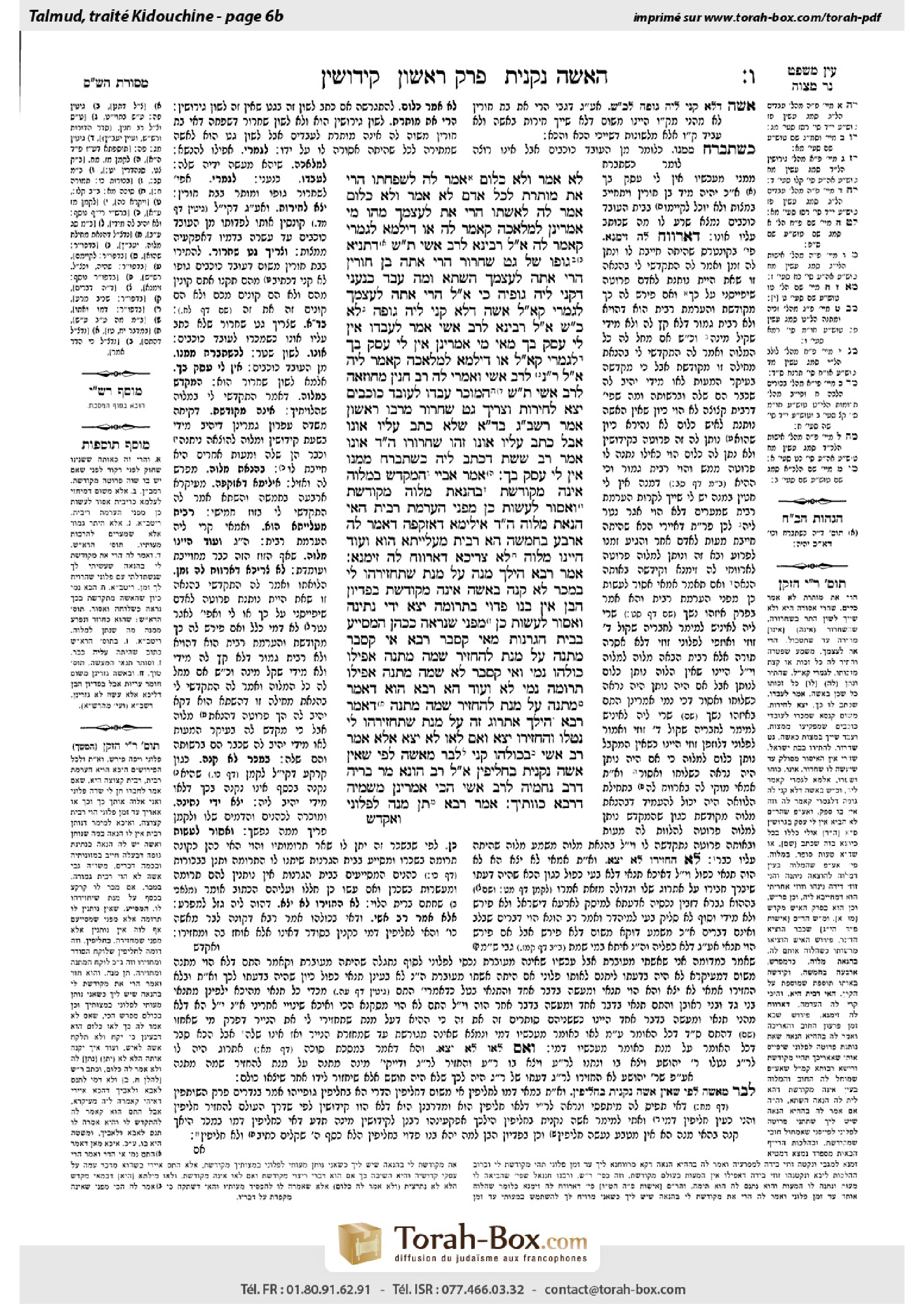
Kiddushin 6b: Talmud study for Daf Yomi
Daf Yomi is the daily study of one Talmud folio. Explore 37 tractates with scans, Hebrew text, Sefaria English and AI-generated French translations where annotated.
Passage selection and English or AI-generated French translation are available where the scan has annotations. Daf Study is independent of Torah-Box and Sefaria.
Browse Kiddushin · קידושין · All tractatesKiddushin 6b text and translations
This page of Kiddushin includes the Aramaic text, an English translation and an AI-generated French translation, alongside the scan above.
קידושין ו׳ ב · Aramaic and Hebrew text
– לֹא אָמַר וְלֹא כְּלוּם. אָמַר לָהּ לְשִׁפְחָתוֹ: ״הֲרֵי אַתְּ מוּתֶּרֶת לְכׇל אָדָם״ – לֹא אָמַר וְלֹא כְּלוּם.
אָמַר לָהּ לְאִשְׁתּוֹ: ״הֲרֵי אַתְּ לְעַצְמְךָ״ מַהוּ? מִי אָמְרִינַן לִמְלָאכָה קָאָמַר לַהּ, אוֹ דִילְמָא לִגְמָרֵי קָאָמַר לַהּ?
אֲמַר לֵיהּ רָבִינָא לְרַב אָשֵׁי: תָּא שְׁמַע, דְּתַנְיָא: גּוּפוֹ שֶׁל גֵּט שִׁחְרוּר: ״הֲרֵי אַתָּה בֶּן חוֹרִין״, ״הֲרֵי אַתָּה לְעַצְמְךָ״. הַשְׁתָּא וּמָה עֶבֶד כְּנַעֲנִי דִּקְנֵי לֵיהּ גּוּפֵיהּ, כִּי אָמַר לֵיהּ ״הֲרֵי אַתָּה לְעַצְמְךָ״ – לִגְמָרֵי קָאָמַר לֵיהּ, אִשָּׁה דְּלָא קְנֵי לֵיהּ גּוּפַהּ, לֹא כׇּל שֶׁכֵּן?
אֲמַר לֵיהּ רָבִינָא לְרַב אָשֵׁי: אָמַר לְעַבְדּוֹ ״אֵין לִי עֵסֶק בְּךָ״ מַאי? מִי אָמְרִינַן ״אֵין לִי עֵסֶק בְּךָ״ – לִגְמָרֵי קָאָמַר לֵיהּ, אוֹ דִילְמָא לִמְלָאכָה קָאָמַר לֵיהּ?
אֲמַר לֵיהּ רַב נַחְמָן לְרַב אָשֵׁי וְאָמְרִי לַהּ רַב חָנִין מָחוֹזָאָה לְרַב אָשֵׁי: תָּא שְׁמַע: הַמּוֹכֵר עַבְדּוֹ לְנׇכְרִי – יָצָא לְחֵירוּת, וְצָרִיךְ גֵּט שִׁחְרוּר מֵרַבּוֹ רִאשׁוֹן.
אָמַר רַבָּן שִׁמְעוֹן בֶּן גַּמְלִיאֵל: בַּמֶּה דְּבָרִים אֲמוּרִים – שֶׁלֹּא כָּתַב עָלָיו אוֹנוֹ, אֲבָל כָּתַב עָלָיו אוֹנוֹ – זֶהוּ שִׁחְרוּרוֹ. הֵיכִי דָּמֵי אוֹנוֹ? אָמַר רַב שֵׁשֶׁת: דִּכְתַב לֵיהּ: כְּשֶׁתִּבְרַח מִמֶּנּוּ – ״אֵין לִי עֵסֶק בְּךָ״.
אָמַר אַבָּיֵי: הַמְקַדֵּשׁ בְּמִלְוֶה – אֵינָהּ מְקוּדֶּשֶׁת. בַּהֲנָאַת מִלְוֶה – מְקוּדֶּשֶׁת, וְאָסוּר לַעֲשׂוֹת כֵּן מִפְּנֵי הַעֲרָמַת רִבִּית.
הַאי הֲנָאַת מִלְוֶה, הֵיכִי דָמֵי? אִילֵּימָא דְּאַזְקְפַהּ, דַּאֲמַר לַהּ אַרְבַּע בְּחַמְשָׁה – הָא רִבִּית מְעַלַּיְיתָא הוּא. וְעוֹד, הַיְינוּ מִלְוֶה!
לָא צְרִיכָא, דְּאַרְוַוח לַהּ זִימְנָא.
אָמַר רָבָא: ״הֵילָךְ מָנֶה עַל מְנָת שֶׁתַּחֲזִירֵהוּ לִי״ בְּמֶכֶר – לֹא קָנָה, בְּאִשָּׁה – אֵינָהּ מְקוּדֶּשֶׁת, בְּפִדְיוֹן הַבֵּן – אֵין בְּנוֹ פָּדוּי,
בִּתְרוּמָה – יָצָא יְדֵי נְתִינָה. וְאָסוּר לַעֲשׂוֹת כֵּן, מִפְּנֵי שֶׁנִּרְאֶה כְּכֹהֵן הַמְסַיֵּיעַ בְּבֵית הַגְּרָנוֹת.
מַאי קָסָבַר רָבָא? אִי קָסָבַר מַתָּנָה עַל מְנָת לְהַחֲזִיר שְׁמָהּ מַתָּנָה – אֲפִילּוּ כּוּלְּהוּ נָמֵי, וְאִי קָסָבַר לֹא שְׁמָהּ מַתָּנָה – אֲפִילּוּ תְּרוּמָה נָמֵי לָא.
וְעוֹד, הָא רָבָא הוּא דְּאָמַר: מַתָּנָה עַל מְנָת לְהַחֲזִיר שְׁמָהּ מַתָּנָה! דְּאָמַר רָבָא: ״הֵילָךְ אֶתְרוֹג זֶה עַל מְנָת שֶׁתַּחְזִירֵהוּ לִי״ – נְטָלוֹ וְהֶחְזִירוֹ – יָצָא. וְאִם לָאו – לֹא יָצָא!
אֶלָּא אָמַר רַב אָשֵׁי: בְּכוּלְּהוּ קָנֵי לְבַר מֵאִשָּׁה, לְפִי שֶׁאֵין אִשָּׁה נִקְנֵית בַּחֲלִיפִין. אֲמַר לֵיהּ רַב הוּנָא מָר בְּרֵיהּ דְּרַב נְחֶמְיָה לְרַב אָשֵׁי: הָכִי אָמְרִינַן מִשְּׁמֵיהּ דְּרָבָא כְּווֹתָיךְ.
אָמַר רָבָא: ״תֵּן מָנֶה לִפְלוֹנִי
Kiddushin 6b · English translation
he has said nothing, as this statement is not a valid expression of divorce. Similarly, if a master said to his female Canaanite slave upon emancipating her: You are hereby permitted to any man, he has not said anything.
The Gemara addresses a less straightforward case: If a man said to his wife: You are hereby for yourself, what is the halakha? Do we say that he said this to her only with regard to work? In other words, he might have meant that she may keep her earnings. Or perhaps he said to her that she is on her own entirely, i.e., she is divorced.
Ravina said to Rav Ashi: Come and hear a proof, as it is taught in a baraita: The essence of a bill of manumission is the expression: You are hereby a freeman, or: You are hereby for yourself. Now consider, if in the case of a Canaanite slave, whose body belongs to the master, even so, when the master says to him: You are hereby for yourself, this is considered as though he said to him that he is entirely on his own and is freed, then all the more so is it not clear that a wife, whose body is not owned by her husband, is divorced by means of this expression?
With regard to the same issue, Ravina said to Rav Ashi: If one said to his Canaanite slave: I have no business with you, what is the halakha? Do we say that when he said to him: I have no business with you, he meant entirely, and therefore the slave is freed? Or did he perhaps say this to him with regard to labor? In other words, it is possible that the master is relieving the slave of his obligation to perform labor without actually emancipating him from slavery.
Rav Naḥman said to Rav Ashi, and some say Rav Ḥanin from Meḥoza said to Rav Ashi: Come and hear: With regard to one who sells his Canaanite slave to a gentile, the slave is emancipated but nevertheless requires a bill [get] of manumission from his first master. In this manner the Sages penalized this owner for preventing the slave from fulfilling the mitzvot in which he is obligated.
Rabban Shimon ben Gamliel says in addition to this: In what case is this statement said? This is referring to a situation where he did not write a document [ono] for the slave when he sold him to the gentile. But if he wrote a document for him, this itself is his emancipation. The Gemara asks: What are the circumstances of this document? Rav Sheshet said that he writes to him: When you escape from him I have no business with you. This indicates that the formula: I have no business with you, is a valid expression of emancipation.
§ Abaye says: With regard to one who betroths a woman with a loan, i.e., he previously lent this woman money and he now says that she is betrothed to him by means of that loan, she is not betrothed. The reason is that a woman can be betrothed only through her acceptance of money, or an item that has monetary value, at the time of the betrothal. Although this woman owes the man money, at the time the man states that she is betrothed to him, the loan is not in fact money but an obligation. Therefore, he does not actually give her anything at the time of the betrothal. By contrast, if he betroths her by means of the benefit of the loan, she is betrothed. But it is prohibited to do so, due to the fact that betrothing a woman via the benefit of a loan is an artifice used to circumvent the prohibition of receiving interest, as this enables the husband to gain an additional benefit from the loan.
The Gemara clarifies: What is meant by this term: The benefit of the loan? If we say that it means that he established interest upon it when she took the loan, e.g., he said to her that he is lending her four coins in exchange for the repayment of five, and he betroths her by releasing her from the obligation to pay this additional coin, this is a case of full-fledged interest, not merely an artifice used to circumvent the prohibition of receiving interest. He is receiving full payment of the loan and an additional benefit. And furthermore, when he releases her from the obligation to pay this additional coin, he is simply forgoing another obligation she has toward him; he is not giving her anything. This is like a regular case of a betrothal with a loan, and therefore she should not be betrothed.
The Gemara answers: No, it is necessary in a case where he extended the time of the loan for her. When the time for her to repay the loan arrived he extended the deadline and betrothed her with the financial benefit she receives from the extra time he is giving her to use the money. In this case he does betroth her with the value he is giving her at that time, but it is similar to interest, as it is included in the prohibition of interest to pay the creditor for an extension of the time of a loan.
§ Rava says: With regard to one who says to another: Here are one hundred dinars for you that I am giving you on the condition that you return them to me, if he gave these one hundred dinars as part of a purchase, he does not acquire the item, as he has not given the seller any money. And similarly, with regard to a woman, if he gave her money for her betrothal on the condition that she return it, she is not betrothed. If one gave money in this manner for the redemption of his firstborn son, for which a priest must receive five sela, his son is not redeemed.
If one does this with regard to teruma, i.e., he gives produce to a priest as teruma on the condition that it will be returned, he has technically fulfilled his obligation of giving. Once he gets the teruma back it belongs to him, as he is the original owner, and although it is prohibited for him to partake of it, as he is a non-priest, he may sell it to a different priest. But it is prohibited to do this, i.e., give teruma in this manner, ab initio, because this priest receiving the teruma appears like a priest who assists at the threshing floor, as he presumably agrees to this arrangement in return for some gain.
The Gemara asks: What does Rava maintain? If he maintains that a gift given on the condition that it is returned is called a gift, this should apply not only to teruma but even to all the other cases, i.e., it should be considered a valid gift in all of the above cases. And if he maintains that a gift of this kind is not called a gift, then even with regard to teruma it should not be considered a legitimate form of giving.
And furthermore, Rava is the one who says: A gift given on the condition that it is later returned is called a gift. As Rava said that if one says to another on the first day of the festival of Sukkot: Take this etrog on the condition that you return it to me, and the recipient takes it, recites a blessing over it, and returns it, he has fulfilled his obligation, despite the fact that one must own the etrog he uses for the mitzva on the first day of Sukkot. And if he does not return it he has not fulfilled his obligation, as he gave him the gift only on the condition that it would be returned. This indicates that in the opinion of Rava, a gift that is given on the condition that it is returned is considered a gift.
Rather, Rav Ashi said: In all of these cases the gift is acquired, except for the betrothal of a woman, because a woman cannot be acquired by means of symbolic exchange. Rav Huna Mar, son of Rav Neḥemya, said to Rav Ashi: We say this in the name of Rava in accordance with your opinion, not in accordance with the previous ruling.
§ Rava says that if a woman said to a man: Give one hundred dinars to so-and-so
Kiddushin 6b · Traduction française (IA)
il n’a rien dit, car cette formule n’est pas une expression valable du divorce. De même, si un maître dit à son esclave cananéenne, au moment de l’affranchir : « Te voilà autorisée à tout homme », il n’a rien dit.
La Guemara examine un cas moins évident : si un homme dit à sa femme : « Te voilà à toi-même », quelle est la halakha ? Faut-il dire qu’il lui a dit cela uniquement au sujet du travail, c’est-à-dire qu’il voulait dire qu’elle pouvait garder ses revenus ? Ou bien lui a-t-il dit qu’elle était entièrement libre, autrement dit, qu’elle était divorcée ?
Ravina dit à Rav Ashi : « Viens et entends une preuve », car il est enseigné dans une baraïta : « La formule essentielle d’un acte d’affranchissement est : “Te voilà libre”, ou : “Te voilà à toi-même.” » Or, considère ceci : si, dans le cas d’un esclave cananéen, dont le corps appartient au maître, lorsque le maître lui dit : « Te voilà à toi-même », cela est néanmoins considéré comme s’il lui avait dit qu’il était entièrement libre et affranchi, à plus forte raison n’est-il pas évident qu’une femme, dont le corps n’appartient pas à son mari, est divorcée par cette formule ?
À propos de la même question, Ravina dit à Rav Ashi : Si quelqu’un dit à son esclave cananéen : « Je n’ai rien à faire avec toi », quelle est la halakha ? Faut-il dire que, lorsqu’il lui a dit : « Je n’ai rien à faire avec toi », il l’entendait au sens absolu, et que l’esclave est donc affranchi ? Ou bien le lui a-t-il dit au sujet du travail ? Autrement dit, il est possible que le maître décharge l’esclave de son obligation de travailler sans pour autant l’affranchir de l’esclavage.
Rav Naḥman dit à Rav Ashi — certains disent que c’est Rav Ḥanin de Meḥoza qui le lui dit : « Viens et entends : celui qui vend son esclave cananéen à un non-Juif affranchit l’esclave, mais celui-ci a néanmoins besoin d’un acte [get] d’affranchissement de la part de son premier maître. » De cette manière, les Sages ont infligé une pénalité à ce propriétaire, qui a empêché l’esclave d’accomplir les mitsvot auxquelles il est astreint.
Rabban Shimon ben Gamliel ajoute : « Dans quel cas cette déclaration a-t-elle été faite ? » Cela concerne une situation où le maître n’a pas rédigé de document [ono] pour l’esclave lorsqu’il l’a vendu au non-Juif. Mais s’il lui a rédigé un document, ce document constitue à lui seul son affranchissement. La Guemara demande : De quelle nature est ce document ? Rav Sheshet dit qu’il lui écrit : « Quand tu lui échapperas, je n’aurai rien à faire avec toi. » Cela indique que la formule « Je n’ai rien à faire avec toi » est une expression valable d’affranchissement.
§ Abaye dit : Celui qui épouse une femme au moyen d’un prêt — c’est-à-dire qu’il lui a auparavant prêté de l’argent et lui dit maintenant qu’elle lui est promise en vertu de ce prêt — ne l’épouse pas. En effet, une femme ne peut être épousée que par l’acceptation d’argent, ou d’un objet ayant une valeur monétaire, au moment du mariage. Bien que cette femme lui doive de l’argent, au moment où l’homme déclare qu’elle lui est promise, le prêt ne constitue pas réellement de l’argent, mais une obligation. Par conséquent, il ne lui donne rien au moment du mariage. En revanche, s’il l’épouse en lui accordant le bénéfice du prêt, elle lui est promise. Mais il est interdit d’agir ainsi, car épouser une femme grâce au bénéfice d’un prêt est un subterfuge destiné à contourner l’interdiction de percevoir des intérêts, puisque cela permet au mari de tirer un avantage supplémentaire du prêt.
La Guemara précise : Que signifie l’expression « le bénéfice du prêt » ? Si nous disons qu’il s’agit du fait qu’il a fixé des intérêts au moment où elle a contracté le prêt — par exemple, il lui a dit qu’il lui prêtait quatre pièces à condition qu’elle en rembourse cinq — et qu’il l’épouse en la libérant de l’obligation de payer cette pièce supplémentaire, il s’agit alors d’un véritable intérêt, et non d’un simple subterfuge destiné à contourner l’interdiction de percevoir des intérêts. Il reçoit le remboursement intégral du prêt ainsi qu’un avantage supplémentaire. De plus, lorsqu’il la libère de l’obligation de payer cette pièce supplémentaire, il renonce simplement à une autre obligation qu’elle a envers lui ; il ne lui donne rien. Cela revient à un cas ordinaire de mariage au moyen d’un prêt, et elle ne devrait donc pas lui être promise.
La Guemara répond : Non, ce cas est nécessaire lorsqu’il a prolongé la durée du prêt en sa faveur. Lorsque le moment est venu pour elle de rembourser le prêt, il a reporté l’échéance et l’a épousée grâce à l’avantage financier qu’elle tire du délai supplémentaire pendant lequel il lui permet d’utiliser l’argent. Dans ce cas, il l’épouse bien au moyen de la valeur qu’il lui accorde à ce moment-là, mais cela ressemble à un intérêt, car l’interdiction des intérêts comprend le fait de payer le créancier pour obtenir une prolongation de la durée d’un prêt.
§ Rava dit : Si quelqu’un dit à un autre : « Voici cent dinars que je te donne à condition que tu me les rendes », et qu’il lui donne ces cent dinars dans le cadre d’un achat, il n’acquiert pas l’objet, car il n’a donné aucun argent au vendeur. De même, s’il donne à une femme de l’argent pour l’épouser à condition qu’elle le lui rende, elle ne lui est pas promise. Si quelqu’un donne de l’argent de cette manière pour le rachat de son fils premier-né, pour lequel un prêtre doit recevoir cinq sela, son fils n’est pas racheté.
Si quelqu’un agit ainsi pour la terouma, c’est-à-dire qu’il donne des produits à un prêtre comme terouma à condition qu’ils lui soient rendus, il a techniquement rempli son obligation de donner. Une fois la terouma récupérée, elle lui appartient, puisqu’il en est le propriétaire initial ; bien qu’il lui soit interdit d’en consommer, car il n’est pas prêtre, il peut la vendre à un autre prêtre. Mais il est interdit d’agir ainsi, c’est-à-dire de donner la terouma de cette manière, a priori, car ce prêtre qui la reçoit a l’apparence d’un prêtre qui aide à l’aire de battage, puisqu’il accepte vraisemblablement cet arrangement en échange d’un avantage.
La Guemara demande : Quelle est l’opinion de Rava ? S’il estime qu’un cadeau donné à condition d’être rendu est considéré comme un cadeau, cela devrait s’appliquer non seulement à la terouma, mais aussi à tous les autres cas ; autrement dit, il devrait être considéré comme un cadeau valable dans tous les cas précédemment mentionnés. Et s’il estime qu’un cadeau de ce type n’est pas considéré comme un cadeau, alors même pour la terouma, il ne devrait pas être considéré comme une manière légitime de donner.
De plus, c’est Rava qui affirme qu’un cadeau donné à condition d’être rendu par la suite est considéré comme un cadeau. En effet, Rava a dit que si, le premier jour de la fête de Souccot, quelqu’un dit à un autre : « Prends cet étrog à condition de me le rendre », et que le destinataire le prend, récite une bénédiction à son sujet et le rend, il a rempli son obligation, bien qu’il faille être propriétaire de l’étrog que l’on utilise pour la mitsva le premier jour de Souccot. Et s’il ne le lui rend pas, il n’a pas rempli son obligation, car il ne lui a donné ce cadeau qu’à condition qu’il soit rendu. Cela indique que, selon Rava, un cadeau donné à condition d’être rendu est considéré comme un cadeau.
Rav Ashi a plutôt dit : Dans tous ces cas, le cadeau est acquis, à l’exception du mariage d’une femme, car une femme ne peut pas être acquise par un échange symbolique. Rav Huna Mar, fils de Rav Neḥemya, dit à Rav Ashi : Nous rapportons cela au nom de Rava conformément à ton opinion, et non conformément à la décision précédente.
§ Rava dit que si une femme dit à un homme : « Donne cent dinars à Untel »
Traduction française générée par IA à partir de l’édition anglaise de Sefaria. Vérifie toujours un passage avec le texte source.
Text from Sefaria: William Davidson Edition - Vocalized Aramaic (CC BY NC); William Davidson Edition - English (CC BY NC).