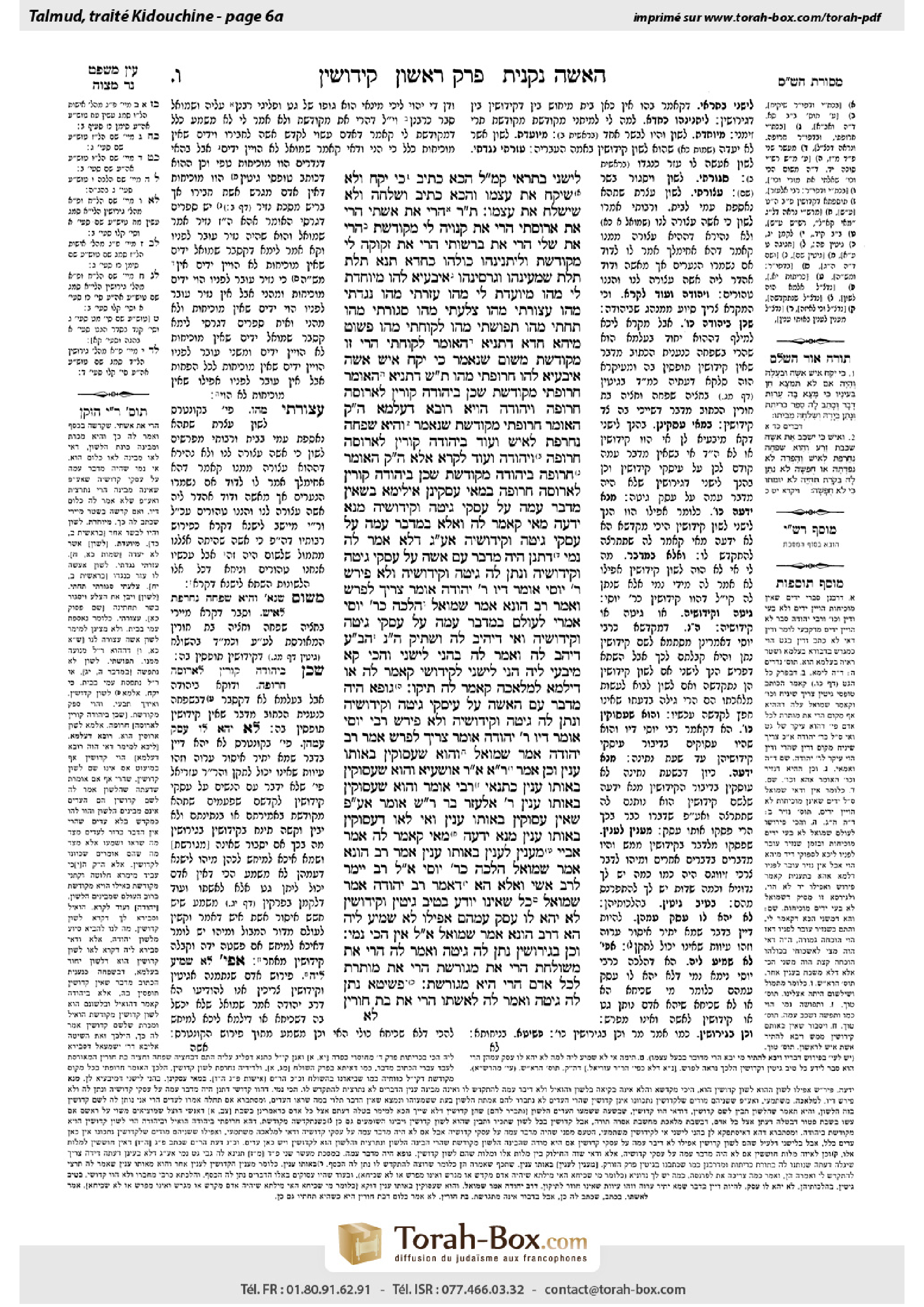
Kiddushin 6a: Talmud study for Daf Yomi
Daf Yomi is the daily study of one Talmud folio. Explore 37 tractates with scans, Hebrew text, Sefaria English and AI-generated French translations where annotated.
Passage selection and English or AI-generated French translation are available where the scan has annotations. Daf Study is independent of Torah-Box and Sefaria.
Browse Kiddushin · קידושין · All tractatesKiddushin 6a text and translations
This page of Kiddushin includes the Aramaic text, an English translation and an AI-generated French translation, alongside the scan above.
קידושין ו׳ א · Aramaic and Hebrew text
לִישָּׁנֵי בָּתְרָאֵי קָא מַשְׁמַע לַן: הָכָא כְּתִיב ״כִּי יִקַּח״ – וְלֹא שֶׁיַּקַּח אֶת עַצְמוֹ. וְהָכָא כְּתִיב ״וְשִׁלְּחָהּ״ – וְלֹא שֶׁיְּשַׁלַּח אֶת עַצְמוֹ.
תָּנוּ רַבָּנַן: ״הֲרֵי אַתְּ אִשְׁתִּי״, ״הֲרֵי אַתְּ אֲרוּסָתִי״, ״הֲרֵי אַתְּ קְנוּיָה לִי״ – מְקוּדֶּשֶׁת. ״הֲרֵי אַתְּ שֶׁלִּי״, ״הֲרֵי אַתְּ בִּרְשׁוּתִי״, ״הֲרֵי אַתְּ זְקוּקָה לִי״ – מְקוּדֶּשֶׁת. וְלִיתְנִינְהוּ כּוּלְּהוּ כַּחֲדָא! תַּנָּא תְּלָת תְּלָת, שַׁמְעִינְהוּ וְגַרְסִינְהוּ.
אִיבַּעְיָא לְהוּ: ״מְיוּחֶדֶת לִי״ מַהוּ? ״מְיוֹעֶדֶת לִי״ מַהוּ? ״עֶזְרָתִי״ מַהוּ? ״נֶגְדָּתִי״ מַהוּ? ״עֲצוּרָתִי״ מַהוּ? ״צַלְעָתִי״ מַהוּ? ״סְגוּרָתִי״ מַהוּ? ״תַּחְתַּי״ מַהוּ? ״תְּפוּשָׂתִי״ מַהוּ? ״לְקוּחָתִי״ מַהוּ?
פְּשׁוֹט מִיהָא חֲדָא, דְּתַנְיָא: הָאוֹמֵר ״לְקוּחָתִי״ – הֲרֵי זוֹ מְקוּדֶּשֶׁת, מִשּׁוּם ״שֶׁנֶּאֱמַר כִּי יִקַּח אִישׁ אִשָּׁה״.
אִיבַּעְיָא לְהוּ: ״חֲרוּפָתִי״ מַהוּ? תָּא שְׁמַע, דְּתַנְיָא: הָאוֹמֵר ״חֲרוּפָתִי״ – מְקוּדֶּשֶׁת, שֶׁכֵּן בִּיהוּדָה קוֹרִין לָאֲרוּסָה ״חֲרוּפָה״. וִיהוּדָה הָוְיָא רוּבָּא דְּעָלְמָא?
הָכִי קָאָמַר: הָאוֹמֵר ״חֲרוּפָתִי״ – מְקוּדֶּשֶׁת, שֶׁנֶּאֱמַר: ״וְהִיא שִׁפְחָה נֶחֱרֶפֶת לְאִישׁ״. וְעוֹד, בִּיהוּדָה קוֹרִין לָאֲרוּסָה ״חֲרוּפָה״. וִיהוּדָה וְעוֹד לִקְרָא? אֶלָּא הָכִי קָאָמַר: הָאוֹמֵר ״חֲרוּפָה״ בִּיהוּדָה – מְקוּדֶּשֶׁת, שֶׁכֵּן בִּיהוּדָה קוֹרִין לָאֲרוּסָה ״חֲרוּפָה״.
בְּמַאי עָסְקִינַן? אִילֵימָא בְּשֶׁאֵין מְדַבֵּר עִמָּהּ עַל עִסְקֵי גִּיטָּהּ וְקִידּוּשֶׁיהָ – מְנָא יָדְעָה מַאי קָאָמַר לַהּ? וְאֶלָּא בִּמְדַבֵּר עִמָּהּ עַל עִסְקֵי גִּיטָּהּ וְקִידּוּשֶׁיהָ – אַף עַל גַּב דְּלָא אָמַר לָהּ נָמֵי,
דִּתְנַן: הָיָה מְדַבֵּר עִם אִשָּׁה עַל עִסְקֵי גִּיטָּהּ וְקִידּוּשֶׁיהָ, וְנָתַן לָהּ גִּיטָּהּ וְקִידּוּשֶׁיהָ וְלֹא פֵּירֵשׁ – רַבִּי יוֹסֵי אוֹמֵר: דַּיּוֹ. רַבִּי יְהוּדָה אוֹמֵר: צָרִיךְ לְפָרֵשׁ. וְאָמַר רַב הוּנָא אָמַר שְׁמוּאֵל: הֲלָכָה כְּרַבִּי יוֹסֵי!
אָמְרִי: לְעוֹלָם בִּמְדַבֵּר עִמָּהּ עַל עִסְקֵי גִּיטָּהּ וְקִידּוּשֶׁיהָ, וְאִי דְּיָהֵיב לַהּ וְשָׁתֵיק הָכִי נָמֵי, הָכָא בְּמַאי עָסְקִינַן דִּיהַב לַהּ וַאֲמַר לַהּ בְּהָנֵי לִישָּׁנֵי,
וְהָכִי קָא מִיבְּעֵי לֵיהּ: הָנֵי לִישָּׁנֵי לְקִידּוּשֵׁי קָאָמַר לַהּ, אוֹ דִילְמָא לִמְלָאכָה קָאָמַר לַהּ? תֵּיקוּ.
גּוּפָא: הָיָה מְדַבֵּר עִם הָאִשָּׁה עַל עִיסְקֵי גִּיטָּהּ וְקִידּוּשֶׁיהָ, וְנָתַן לָהּ גִּיטָּהּ וְקִידּוּשֶׁיהָ וְלֹא פֵּירֵשׁ – רַבִּי יוֹסֵי אוֹמֵר: דַּיּוֹ. רַבִּי יְהוּדָה אוֹמֵר: צָרִיךְ לְפָרֵשׁ. אָמַר רַב יְהוּדָה אָמַר שְׁמוּאֵל: וְהוּא שֶׁעֲסוּקִין בְּאוֹתוֹ עִנְיָן.
וְכֵן אָמַר רַבִּי אֶלְעָזָר אָמַר רַבִּי אוֹשַׁעְיָא: וְהוּא שֶׁעֲסוּקִין בְּאוֹתוֹ עִנְיָן. כְּתַנָּאֵי: רַבִּי אוֹמֵר: וְהוּא שֶׁעֲסוּקִין בְּאוֹתוֹ עִנְיָן. רַבִּי אֶלְעָזָר בַּר רַבִּי שִׁמְעוֹן אוֹמֵר: אַף עַל פִּי שֶׁאֵין עֲסוּקִין בְּאוֹתוֹ עִנְיָן.
וְאִי לָאו דַּעֲסוּקִין בְּאוֹתוֹ עִנְיָן, מְנָא יָדְעָה מַאי קָאָמַר לַהּ? אָמַר אַבָּיֵי: מֵעִנְיָן לְעִנְיָן בְּאוֹתוֹ עִנְיָן.
אָמַר רַב הוּנָא אָמַר שְׁמוּאֵל: הֲלָכָה כְּרַבִּי יוֹסֵי. אֲמַר לֵיהּ רַב יֵימַר לְרַב אָשֵׁי: וְאֶלָּא הָא דְּאָמַר רַב יְהוּדָה אָמַר שְׁמוּאֵל: כׇּל שֶׁאֵינוֹ יוֹדֵעַ בְּטִיב גִּיטִּין וְקִידּוּשִׁין לֹא יְהֵא לוֹ עֵסֶק עִמָּהֶם, אֲפִילּוּ לָא שְׁמִיעַ לֵיהּ הָא דְּרַב הוּנָא אָמַר שְׁמוּאֵל? אֲמַר לֵיהּ: אִין, הָכִי נָמֵי.
וְכֵן בְּגֵירוּשִׁין, נָתַן לָהּ גִּיטָּהּ וְאָמַר לָהּ: ״הֲרֵי אַתְּ מְשׁוּלַּחַת״ ״הֲרֵי אַתְּ מְגוֹרֶשֶׁת״, ״הֲרֵי אַתְּ מוּתֶּרֶת לְכׇל אָדָם״ – הֲרֵי הִיא מְגוֹרֶשֶׁת. פְּשִׁיטָא נָתַן לָהּ גִּיטָּהּ, וְאָמַר לָהּ לְאִשְׁתּוֹ: ״הֲרֵי אַתְּ בַּת חוֹרִין״
Kiddushin 6a · English translation
last expressions are what he teaches us. The novelty of Shmuel’s statement is that with regard to the second set of pronouncements there is no concern at all that a valid betrothal or divorce might have been performed. The Gemara explains why according to Shmuel these pronouncements are not of concern. Here, in the case of betrothal, it is written: “When a man takes a woman” (Deuteronomy 24:1), which indicates that the man is acting to change the status of the woman, and it is not written that he takes himself or gives himself to her, as in the case of one who says: I am hereby your man. And likewise, it is written here, with regard to divorce: “And sends her” (Deuteronomy 24:1), and it is not written that he sends himself from her, as in the case of one who says: I am not your man.
The Sages taught in a baraita that if a man says to a woman: You are hereby my wife, or: You are hereby my betrothed, or: You are hereby acquired to me, then she is betrothed. If he said to her: You are hereby mine, or: You are hereby under my authority, or: You are hereby bound to me, then she is betrothed. The Gemara asks: But as the halakha is that she is betrothed with regard to both sets of statements, let the baraita teach all of them together. Why does the baraita divide these statements into two groups? The Gemara answers: The tanna heard them as two sets of three, and consequently he taught them in that form. He heard each sequence of three cases as a separate halakha from his teachers, and therefore he preserved them as two sets of three.
A dilemma was raised before the Sages: If a man betrothing a woman said: You are hereby unique to me, what is the halakha? Is this woman betrothed? Similarly, if he said to her: You are hereby designated to me, what is the halakha? If he said: You are hereby my helper, what is the halakha? If he said: You are hereby my counterpart, what is the halakha? If he said: You are hereby my gathered one, what is the halakha? If he said: You are hereby my rib, what is the halakha? If he said: You are hereby my closed one, what is the halakha? If he said: You are hereby beneath me, what is the halakha? If he said: You are hereby my seized one, what is the halakha? Finally, if he said: You are hereby my taken one, what is the halakha?
The Gemara suggests: Resolve at least one of these dilemmas, as it is taught in a baraita: With regard to one who says to a woman: You are hereby my taken one, she is betrothed, because it is stated: “When a man takes a woman” (Deuteronomy 24:1).
A dilemma was raised before the Sages: If a man says to a woman: You are hereby my espoused one [ḥarufati], what is the halakha? Come and hear, as it is taught in a baraita that with regard to one who says: You are hereby my espoused one, she is betrothed, as in Judea they call a betrothed woman a ḥarufa, an espoused woman. The Gemara asks: And is Judea most of the world? Even if this is true in Judea, why should a halakha that applies in all locations be based on this local custom?
The Gemara answers that this is what the baraita is saying: With regard to one who says: You are hereby my espoused one, she is betrothed, as it is stated: “Who is a maidservant espoused [neḥerefet] to a man” (Leviticus 19:20). This verse means that she is betrothed to a certain man. And furthermore, the baraita adds another proof for this claim: In Judea they call a betrothed woman a ḥarufa, an espoused woman. The Gemara asks: And is it reasonable to introduce the custom in Judea with the term: And furthermore, as proof to a halakha derived from a verse? Rather, the Gemara explains that this is what the baraita is saying: With regard to one who says: You are hereby espoused, in Judea, she is betrothed, as in Judea they call a betrothed woman a ḥarufa, an espoused woman.
The Gemara asks a general question with regard to all the previously mentioned expressions: With what are we dealing? If we say that these dilemmas are referring to a case where he was not speaking with her about matters of her bill of divorce or her betrothal, but suddenly issued this statement to her, from where does she know what he is saying to her? Out of context, these statements are not necessarily referring to betrothal. Rather, they are referring to a case where he was speaking to her about matters of her bill of divorce and her betrothal. But if so, even though he did not say anything, she would also be betrothed if he gave her money for the purpose of betrothal.
As we learned in a mishna (Ma’aser Sheni 4:7): If one was speaking with a woman about matters of her bill of divorce or her betrothal, and he gave her a bill of divorce or her betrothal, i.e., the money or a document of betrothal, but did not clarify his action, Rabbi Yosei says: This is sufficient for him, i.e., it is a valid divorce or betrothal because she will understand his intention from the context. Rabbi Yehuda says: He is required to clarify the meaning of his behavior. And Rav Huna says that Shmuel says: The halakha is in accordance with the opinion of Rabbi Yosei. If so, even if he said nothing to her she would still be betrothed, and this should certainly be the case if he says one of the statements under discussion.
The Sages say in explanation of this matter: Actually, we are dealing with cases where he was speaking to her about matters of her bill of divorce and her betrothal, and if it was referring to a case where he had given her the money and been silent, so too it would have been a valid betrothal. With what are we dealing here? This is a case where he gave her something and said to her one of these expressions.
And this is the dilemma raised before the Sages: These expressions, did he say them to her for the purpose of betrothal, or perhaps he said them to her for the purpose of labor? He might have intended to hire her, withdrawing his previous intention to betroth her. In other words, his statement in conjunction with his giving of an item renders the meaning of the expression less clear than if he had remained silent. The Gemara leaves most of these issues unanswered, and states that the dilemmas shall stand unresolved.
§ The Gemara discusses the matter itself: If he was speaking to the woman about matters of her bill of divorce or her betrothal, and he gave her bill of divorce or her betrothal to her and did not clarify his intention, Rabbi Yosei says: This is sufficient for him. Rabbi Yehuda says: He is required to clarify. Rav Yehuda says that Shmuel says: And this is the halakha provided that they were discussing the same issue and had not moved on to a different topic.
And likewise, Rabbi Elazar says that Rabbi Oshaya says: And this is the halakha provided that they were discussing the same issue. The Gemara comments: This disagreement is like a dispute between tanna’im on this topic. Rabbi Yehuda HaNasi says: And this is the halakha provided that they were discussing the same issue. Rabbi Elazar bar Rabbi Shimon says: This is the halakha despite the fact that they were not discussing the same issue.
The Gemara asks: And if they were not discussing the same issue, from where does she know what he is saying to her? They have already changed the topic of conversation, and these expressions on their own are ambiguous. Abaye said: They have not changed to an entirely different topic; rather, they changed from discussing one topic to discussing another topic within the same general topic. In other words, they were no longer speaking directly about divorce or betrothal, but they were still discussing related matters. Therefore, his intention was clear to her when he made his statement.
Rav Huna says that Shmuel says: The halakha is in accordance with the opinion of Rabbi Yosei. Rav Yeimar said to Rav Ashi: But if so, with regard to that which Rav Yehuda says that Shmuel says: Anyone who does not know the nature of bills of divorce and betrothals should have no dealings in them, i.e., he may not serve as a judge in cases of this kind lest he permit that which is prohibited, does this principle apply even if that individual did not hear this halakha that Rav Huna says that Shmuel says? Since this type of case is uncommon, should such an individual be considered unfamiliar with the halakhot of bills of divorce and betrothals? Rav Ashi said to him: Yes, it is indeed so; this person is considered to lack the requisite knowledge to deal with these cases. This ruling is an important matter with regard to the halakhot of betrothal, and one who is unaware of it might err.
The Gemara returns to Shmuel’s statement. And similarly, with regard to divorce: If a husband gave his wife her bill of divorce and said to her: You are hereby sent away, or: You are hereby divorced, or: You are hereby permitted to marry any man, then she is divorced. The Gemara comments: It is obvious that if a husband gave her a bill of divorce and said to his wife: You are hereby a free woman,
Kiddushin 6a · Traduction française (IA)
Ce sont les dernières expressions qu’il vient nous enseigner. La nouveauté de la déclaration de Chmouel est que, pour la seconde série de formulations, on ne craint absolument pas qu’un kiddouchine ou un divorce valide ait été effectué. La Guemara explique pourquoi, selon Chmouel, ces formulations ne suscitent aucune inquiétude. Ici, au sujet du kiddouchine, il est écrit : « Lorsqu’un homme prend une femme » (Deutéronome 24:1), ce qui indique que l’homme agit pour modifier le statut de la femme ; il n’est pas écrit qu’il se prend lui-même ou qu’il se donne à elle, comme dans le cas de celui qui dit : « Je suis désormais ton homme. » De même, au sujet du divorce, il est écrit : « Et la renvoie » (Deutéronome 24:1), et non qu’il se renvoie lui-même loin d’elle, comme dans le cas de celui qui dit : « Je ne suis pas ton homme. »
Les Sages ont enseigné dans une baraïta que si un homme dit à une femme : « Tu es désormais ma femme », ou : « Tu es désormais ma fiancée », ou : « Tu es désormais acquise à moi », elle est fiancée. S’il lui dit : « Tu es désormais à moi », ou : « Tu es désormais sous mon autorité », ou : « Tu es désormais liée à moi », elle est fiancée. La Guemara demande : Mais puisque, selon la halakha, elle est fiancée dans les deux séries de formulations, pourquoi la baraïta ne les enseigne-t-elle pas toutes ensemble ? Pourquoi répartit-elle ces formulations en deux groupes ? La Guemara répond : Le tanna les a entendues comme deux séries de trois et les a donc enseignées sous cette forme. Il a entendu de ses maîtres chacune des suites de trois cas comme une halakha distincte ; il les a donc conservées en deux séries de trois.
Les Sages ont soulevé un dilemme : si un homme qui fiance une femme lui dit : « Tu es désormais unique pour moi », quelle est la halakha ? La femme est-elle fiancée ? De même, quelle est la halakha s’il lui dit : « Tu es désormais désignée pour moi » ? Et s’il lui dit : « Tu es désormais mon aide » ? Ou : « Tu es désormais mon vis-à-vis » ? Ou : « Tu es désormais celle que j’ai recueillie » ? Ou : « Tu es désormais ma côte » ? Ou : « Tu es désormais celle qui m’est réservée » ? Ou : « Tu es désormais sous moi » ? Ou : « Tu es désormais celle que j’ai saisie » ? Enfin, quelle est la halakha s’il lui dit : « Tu es désormais celle que j’ai prise » ?
La Guemara propose : Résolvons au moins l’un de ces dilemmes, car il est enseigné dans une baraïta : Celui qui dit à une femme : « Tu es désormais celle que j’ai prise », la fiance, car il est dit : « Lorsqu’un homme prend une femme » (Deutéronome 24:1).
Les Sages ont soulevé un dilemme : quelle est la halakha si un homme dit à une femme : « Tu es désormais ma fiancée [ḥarufati] » ? Examinons la question : il est enseigné dans une baraïta que celui qui dit : « Tu es désormais ma fiancée » la fiance, car, en Judée, on appelle une femme fiancée une ḥarufa, une femme promise en mariage. La Guemara demande : La Judée représente-t-elle la majeure partie du monde ? Même si c’est le cas en Judée, pourquoi fonder une halakha applicable partout sur cette coutume locale ?
La Guemara répond que voici ce que dit la baraïta : Celui qui dit : « Tu es désormais ma fiancée » la fiance, comme il est dit : « Qui est une servante fiancée [neḥerefet] à un homme » (Lévitique 19:20). Ce verset signifie qu’elle est fiancée à un homme en particulier. En outre, la baraïta ajoute une autre preuve à l’appui de cette affirmation : en Judée, on appelle une femme fiancée une ḥarufa, une femme promise en mariage. La Guemara demande : Est-il raisonnable d’introduire la coutume de Judée par les mots « et en outre », comme preuve d’une halakha déduite d’un verset ? La Guemara explique plutôt que voici ce que dit la baraïta : Celui qui dit : « Tu es désormais fiancée », en Judée, la fiance, car les habitants de Judée appellent une femme fiancée une ḥarufa, une femme promise en mariage.
La Guemara pose une question générale au sujet de toutes les expressions mentionnées précédemment : De quel cas s’agit-il ? Si l’on suppose que ces dilemmes concernent un cas où il ne lui parlait pas de son acte de divorce ni de son kiddouchine, mais où il lui a soudainement adressé cette déclaration, comment peut-elle savoir ce qu’il veut lui dire ? Hors contexte, ces déclarations ne font pas nécessairement référence au kiddouchine. Il s’agit plutôt d’un cas où il lui parlait de son acte de divorce et de son kiddouchine. Mais alors, même s’il ne disait rien, elle serait également fiancée s’il lui donnait de l’argent en vue de la fiancer.
Comme nous l’avons appris dans une Michna (Maasser Chéni 4:7) : Si un homme parlait avec une femme de son acte de divorce ou de son kiddouchine, puis lui remettait un acte de divorce ou ce qui constitue son kiddouchine, c’est-à-dire l’argent ou un document de kiddouchine, sans préciser la signification de son geste, Rabbi Yossi dit : Cela lui suffit, c’est-à-dire que le divorce ou le kiddouchine est valide, car elle comprendra son intention d’après le contexte. Rabbi Yehouda dit : Il doit préciser le sens de son comportement. Rav Houna dit au nom de Chmouel : La halakha suit l’opinion de Rabbi Yossi. Dans ce cas, même s’il ne lui disait rien, elle serait tout de même fiancée ; à plus forte raison devrait-il en être ainsi s’il prononce l’une des déclarations en question.
Les Sages expliquent ainsi : En réalité, il s’agit de cas où il lui parlait de son acte de divorce et de son kiddouchine ; s’il lui avait donné l’argent en gardant le silence, le kiddouchine aurait également été valide. De quel cas s’agit-il ici ? D’un cas où il lui a donné quelque chose et lui a dit l’une de ces expressions.
Et voici le dilemme soumis aux Sages : lui a-t-il adressé ces expressions en vue de la fiancer, ou peut-être les lui a-t-il dites en vue d’un travail ? Il avait peut-être l’intention de l’employer, renonçant ainsi à son intention précédente de la fiancer. Autrement dit, le fait qu’il prononce ces mots en même temps qu’il lui donne un objet rend le sens de l’expression moins clair que s’il était resté silencieux. La Guemara laisse la plupart de ces questions sans réponse et conclut que les dilemmes restent sans solution.
§ La Guemara revient sur le sujet lui-même : S’il parlait avec la femme de son acte de divorce ou de son kiddouchine, puis lui remettait son acte de divorce ou ce qui constitue son kiddouchine sans préciser son intention, Rabbi Yossi dit : Cela lui suffit. Rabbi Yehouda dit : Il doit préciser son intention. Rav Yehouda dit au nom de Chmouel : Cela n’est la halakha que s’ils parlaient du même sujet et n’étaient pas passés à un autre.
De même, Rabbi Elazar dit au nom de Rabbi Ochaya : Cela n’est la halakha que s’ils parlaient du même sujet. La Guemara remarque que ce désaccord correspond à une controverse entre tannaim sur ce point. Rabbi Yehouda HaNassi dit : Cela n’est la halakha que s’ils parlaient du même sujet. Rabbi Elazar bar Rabbi Chimon dit : C’est la halakha même s’ils ne parlaient pas du même sujet.
La Guemara demande : Et s’ils ne parlaient pas du même sujet, comment peut-elle savoir ce qu’il veut lui dire ? Ils ont déjà changé de sujet de conversation, et ces expressions sont ambiguës à elles seules. Abayé dit : Ils ne sont pas passés à un sujet entièrement différent ; ils sont plutôt passés d’un sujet à un autre au sein du même domaine général. Autrement dit, ils ne parlaient plus directement de divorce ou de kiddouchine, mais discutaient encore de sujets apparentés. Par conséquent, lorsqu’il a prononcé sa déclaration, son intention était claire pour elle.
Rav Houna dit au nom de Chmouel : La halakha suit l’opinion de Rabbi Yossi. Rav Yeimar dit à Rav Achi : Mais, dans ce cas, au sujet de ce que Rav Yehouda dit au nom de Chmouel — quiconque ne connaît pas la nature des actes de divorce et des kiddouchine ne doit pas s’occuper de telles affaires, c’est-à-dire qu’il ne peut pas y exercer la fonction de juge, de peur d’autoriser ce qui est interdit —, ce principe s’applique-t-il même si cette personne n’a pas entendu la halakha que Rav Houna rapporte au nom de Chmouel ? Puisque ce type de cas est rare, une telle personne doit-elle être considérée comme ne connaissant pas les halakhot des actes de divorce et des kiddouchine ? Rav Achi lui répondit : Oui, c’est bien le cas ; cette personne est considérée comme ne possédant pas les connaissances requises pour traiter ces affaires. Cette décision est importante pour les halakhot du kiddouchine, et quelqu’un qui l’ignore risque de se tromper.
La Guemara revient à la déclaration de Chmouel. De même, au sujet du divorce : si un mari remet à sa femme son acte de divorce et lui dit : « Tu es désormais renvoyée », ou : « Tu es désormais divorcée », ou : « Tu es désormais autorisée à épouser n’importe quel homme », elle est divorcée. La Guemara remarque : Il est évident que si un mari remet un acte de divorce à sa femme et lui dit : « Tu es désormais une femme libre »,
Traduction française générée par IA à partir de l’édition anglaise de Sefaria. Vérifie toujours un passage avec le texte source.
Text from Sefaria: William Davidson Edition - Vocalized Aramaic (CC BY NC); William Davidson Edition - English (CC BY NC).