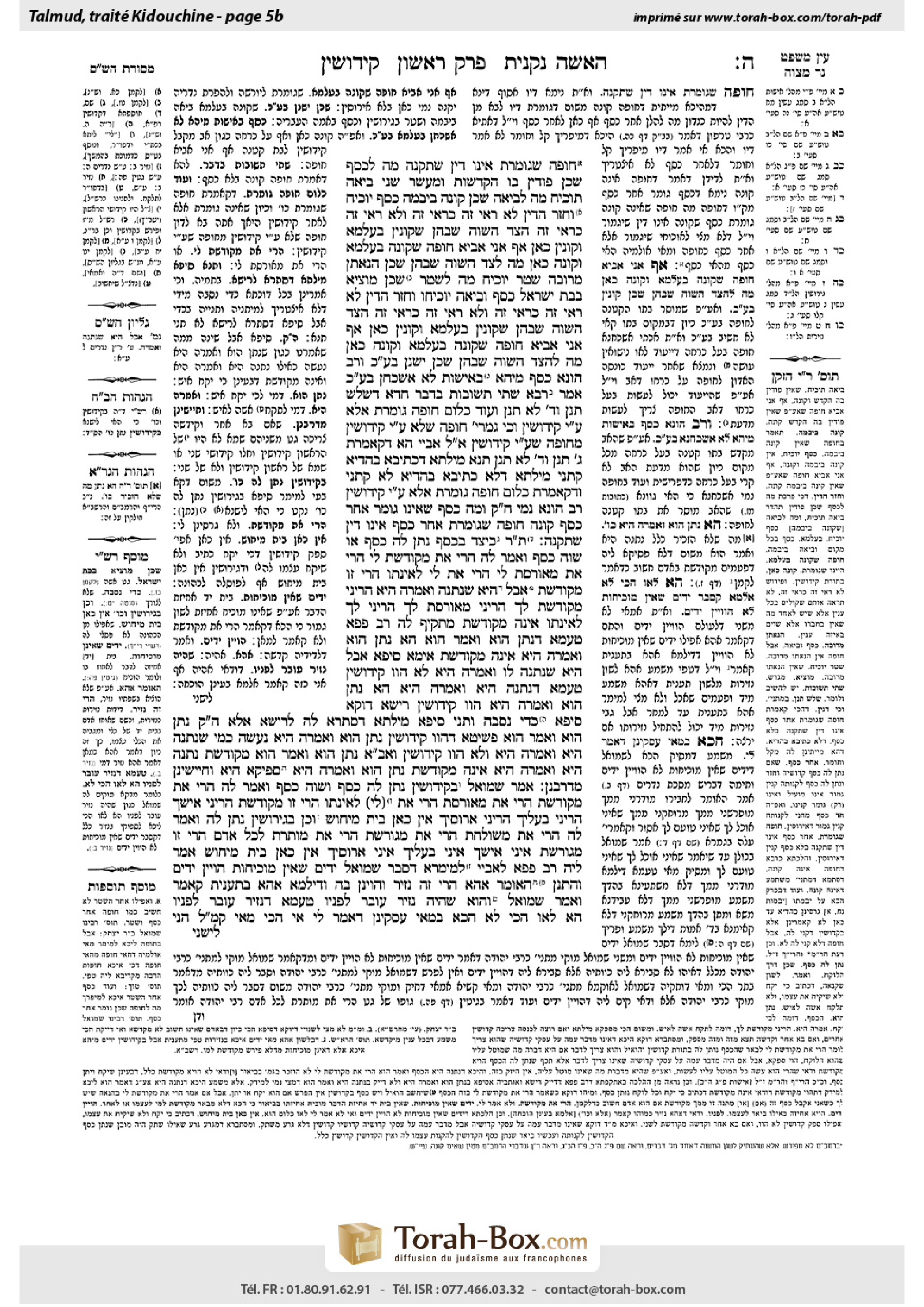
Kiddushin 5b: Talmud study for Daf Yomi
Daf Yomi is the daily study of one Talmud folio. Explore 37 tractates with scans, Hebrew text, Sefaria English and AI-generated French translations where annotated.
Passage selection and English or AI-generated French translation are available where the scan has annotations. Daf Study is independent of Torah-Box and Sefaria.
Browse Kiddushin · קידושין · All tractatesKiddushin 5b text and translations
This page of Kiddushin includes the Aramaic text, an English translation and an AI-generated French translation, alongside the scan above.
קידושין ה׳ ב · Aramaic and Hebrew text
חוּפָּה שֶׁגּוֹמֶרֶת – אֵינוֹ דִּין שֶׁתִּקְנֶה? מָה לְכֶסֶף, שֶׁכֵּן פּוֹדִין בּוֹ הֶקְדֵּשׁוֹת וּמַעֲשֵׂר שֵׁנִי. בִּיאָה תּוֹכִיחַ.
מָה לְבִיאָה, שֶׁכֵּן קוֹנָה בִּיבָמָה. כֶּסֶף יוֹכִיחַ. וְחָזַר הַדִּין: לֹא רְאִי זֶה כִרְאִי זֶה, וְלֹא רְאִי זֶה כִּרְאִי זֶה, הַצַּד הַשָּׁוֶה שֶׁבָּהֶן: שֶׁקּוֹנִין בְּעָלְמָא וְקוֹנִין כָּאן, אַף אֲנִי אָבִיא חוּפָּה שֶׁקּוֹנָה בְּעָלְמָא, וְקוֹנָה כָּאן.
מָה לְצַד הַשָּׁוֶה שֶׁבָּהֶן, שֶׁכֵּן הֲנָאָתָן מְרוּבָּה. שְׁטָר יוֹכִיחַ. מָה לִשְׁטָר, שֶׁכֵּן מוֹצִיא בְּבַת יִשְׂרָאֵל. כֶּסֶף וּבִיאָה יוֹכִיחוּ.
וְחָזַר הַדִּין: לֹא רְאִי זֶה כִּרְאִי זֶה, וְלֹא רְאִי זֶה כִּרְאִי זֶה, הַצַּד הַשָּׁוֶה שֶׁבָּהֶן: שֶׁקּוֹנִין בְּעָלְמָא וְקוֹנִין כָּאן – אַף אֲנִי אָבִיא חוּפָּה, שֶׁקּוֹנָה בְּעָלְמָא וְקוֹנָה כָּאן.
מָה לְהַצַּד הַשָּׁוֶה שֶׁבָּהֶן, שֶׁכֵּן יֶשְׁנָן בְּעַל כׇּרְחָהּ. וְרַב הוּנָא – כֶּסֶף מִיהָא בְּאִישׁוּת לָא אַשְׁכְּחַן בְּעַל כׇּרְחָהּ.
אָמַר רָבָא: שְׁתֵּי תְשׁוּבוֹת בַּדָּבָר. חֲדָא, דְּ״שָׁלֹשׁ״ תְּנַן וְ״אַרְבַּע״ לָא תְּנַן.
וְעוֹד: כְּלוּם חוּפָּה גּוֹמֶרֶת אֶלָּא עַל יְדֵי קִידּוּשִׁין, וְכִי גָּמְרִינַן חוּפָּה שֶׁלֹּא עַל יְדֵי קִידּוּשִׁין מֵחוּפָּה שֶׁעַל יְדֵי קִידּוּשִׁין?
אֲמַר לֵיהּ אַבָּיֵי: הָא דְּקָאָמְרַתְּ ״שָׁלֹשׁ״ תְּנַן וְ״אַרְבַּע״ לָא תְּנַן – תַּנָּא מִילְּתָא דִּכְתִיבָא בְּהֶדְיָא קָתָנֵי, מִילְּתָא דְּלָא כְּתִיבָא בְּהֶדְיָא לָא קָתָנֵי.
וּדְקָאָמְרַתְּ ״כְּלוּם חוּפָּה גּוֹמֶרֶת אֶלָּא עַל יְדֵי קִידּוּשִׁין״ – רַב הוּנָא נָמֵי הָכִי קָאָמַר: וּמָה כֶּסֶף שֶׁאֵינוֹ גּוֹמֵר אַחַר כֶּסֶף – קוֹנֶה, חוּפָּה שֶׁגּוֹמֶרֶת אַחַר כֶּסֶף – אֵינוֹ דִּין שֶׁתִּקְנֶה?
תָּנוּ רַבָּנַן: כֵּיצַד בְּכֶסֶף? נָתַן לָהּ כֶּסֶף אוֹ שָׁוֶה כֶּסֶף, וְאָמַר לָהּ: ״הֲרֵי אַתְּ מְקוּדֶּשֶׁת לִי״, ״הֲרֵי אַתְּ מְאוֹרֶסֶת לִי״, ״הֲרֵי אַתְּ לִי לְאִינְתּוּ״ – הֲרֵי זוֹ מְקוּדֶּשֶׁת. אֲבָל הִיא שֶׁנָּתְנָה, וְאָמְרָה הִיא: ״הֲרֵינִי מְקוּדֶּשֶׁת לְךָ״, ״הֲרֵינִי מְאוֹרֶסֶת לְךָ״, ״הֲרֵינִי לְךָ לְאִינְתּוּ״ – אֵינָהּ מְקוּדֶּשֶׁת.
מַתְקֵיף לַהּ רַב פָּפָּא: טַעְמָא דְּנָתַן הוּא וְאָמַר הוּא, הָא נָתַן הוּא וְאָמְרָה הִיא – אֵינָהּ מְקוּדֶּשֶׁת. אֵימָא סֵיפָא: אֲבָל הִיא שֶׁנָּתְנָה לוֹ וְאָמְרָה הִיא – לָא הָווּ קִידּוּשִׁין. טַעְמָא דְּנָתְנָה הִיא וְאָמְרָה הִיא, הָא נָתַן הוּא וְאָמְרָה הִיא – הָווּ קִידּוּשִׁין!
רֵישָׁא דַּוְקָא, סֵיפָא כְּדִי נַסְבַהּ. וְתָנֵי סֵיפָא מִילְּתָא דְּסָתְרָא לַהּ לְרֵישָׁא?
אֶלָּא הָכִי קָאָמַר: נָתַן הוּא וְאָמַר הוּא – פְּשִׁיטָא דְּהָווּ קִידּוּשִׁין. נָתַן הוּא וְאָמְרָה הִיא – נַעֲשָׂה כְּמִי שֶׁנָּתְנָה הִיא וְאָמְרָה הִיא, וְלָא הָווּ קִידּוּשִׁין. וְאִי בָּעֵית אֵימָא: נָתַן הוּא וְאָמַר הוּא – מְקוּדֶּשֶׁת. נָתְנָה הִיא וְאָמְרָה הִיא – אֵינָהּ מְקוּדֶּשֶׁת. נָתַן הוּא וְאָמְרָה הִיא – סְפֵיקָא הִיא וְחָיְישִׁינַן מִדְּרַבָּנַן.
אָמַר שְׁמוּאֵל: בְּקִידּוּשִׁין, נָתַן לָהּ כֶּסֶף וְשָׁוֶה כֶּסֶף וְאָמַר לָהּ: ״הֲרֵי אַתְּ מְקוּדֶּשֶׁת״, ״הֲרֵי אַתְּ מְאוֹרֶסֶת״, ״הֲרֵי אַתְּ (לִי) לְאִינְתּוּ״ – הֲרֵי זוֹ מְקוּדֶּשֶׁת. ״הֲרֵינִי אִישֵּׁךְ״, ״הֲרֵינִי בַּעְלֵיךְ״, ״הֲרֵינִי אֲרוּסֵיךְ״ – אֵין כָּאן בֵּית מֵיחוֹשׁ.
וְכֵן בְּגֵירוּשִׁין, נָתַן לָהּ וְאָמַר לָהּ: ״הֲרֵי אַתְּ מְשׁוּלַּחַת״, ״הֲרֵי אַתְּ מְגוֹרֶשֶׁת״, ״הֲרֵי אַתְּ מוּתֶּרֶת לְכׇל אָדָם״ – הֲרֵי זוֹ מְגוֹרֶשֶׁת. ״אֵינִי אִישֵּׁךְ״, ״אֵינִי בַּעְלֵיךְ״, ״אֵינִי אֲרוּסֵיךְ״ – אֵין כָּאן בֵּית מֵיחוֹשׁ.
אֲמַר לֵיהּ רַב פָּפָּא לְאַבָּיֵי: לְמֵימְרָא דְּסָבַר שְׁמוּאֵל יָדַיִם שֶׁאֵין מוֹכִיחוֹת, הָוְיָין יָדַיִם?
וְהָתְנַן: הָאוֹמֵר ״אֱהֵא״ – הֲרֵי זֶה נָזִיר. וְהָוֵינַן בַּהּ: וְדִילְמָא ״אֱהֵא בְּתַעֲנִית״ קָאָמַר? וְאָמַר שְׁמוּאֵל, וְהוּא שֶׁהָיָה נָזִיר עוֹבֵר לְפָנָיו. טַעְמָא דִּנְזִיר עוֹבֵר לְפָנָיו, הָא לָאו הָכִי – לָא!
הָכָא בְּמַאי עָסְקִינַן, דְּאָמַר ״לִי״. אִי הָכִי, מַאי קָמַשְׁמַע לַן? הָנֵי
Kiddushin 5b · English translation
is it not logical that a wedding canopy, which completes the marriage, since it entirely removes a young woman from her father’s authority, can effect acquisition for betrothal on its own? The Gemara rejects this claim: What is unique about money is that it can effect acquisition in many contexts, as one can redeem with it consecrated property and second tithe. This is not so with regard to a wedding canopy, which is ineffective in effecting any acquisition other than marriage. Therefore, in the case of betrothal, money can effect betrothal while a wedding canopy cannot. The Gemara counters: The halakha of sexual intercourse proves otherwise, as this act serves to effect acquisition of a woman despite the fact that it is not a valid mode of acquisition in any other case.
The Gemara counters: What is unique about sexual intercourse is that it effects acquisition of a yevama, whereas a yavam does not acquire her via a wedding canopy. The Gemara answers: Money proves otherwise, as money cannot be used to acquire a yevama, and yet it is a valid mode for acquiring a woman. And the derivation has reverted to its starting point: The aspect of this mode, money, is not like the aspect of that mode, intercourse, and the aspect of that mode, intercourse, is not like the aspect of this mode, money. Their common denominator is that they generally effect acquisition, and they effect acquisition here, with regard to betrothal. Likewise, I will bring the mode of a wedding canopy, which generally effects acquisition, rendering a woman as married, and therefore it should also effect acquisition here.
The Gemara rejects this: What about the fact that the common denominator of money and intercourse is that their benefit, i.e., pleasure, is great? The Gemara says: The case of a document proves otherwise, as no great pleasure is derived from receiving a document, and yet it can be used to acquire a woman. The Gemara answers: What is unique about a document is that it can release a Jewish woman from her husband in the form of a bill of divorce. The Gemara answers: Money and intercourse prove otherwise, as they do not release a woman and yet they are valid modes of acquisition for betrothal.
And once again, the derivation has reverted to its starting point: The aspect of this mode is not like the aspect of that mode, and the aspect of that mode is not like the aspect of this mode. Their common denominator is that they generally effect acquisition and they effect acquisition here, with regard to betrothal. Likewise, I will bring the mode of a wedding canopy, which generally effects acquisition, and therefore it should also effect acquisition here.
The Gemara again rejects this claim: What about the fact that the common denominator of all three modes of acquisition is that they are effective in certain situations against her will? A bill of divorce, sexual intercourse in the case of a yevama, and money with regard to a Hebrew maidservant all effect acquisition of a woman against her will. Therefore, the mode of a wedding canopy cannot be derived from these methods, as a wedding canopy is effective only when the woman enters it willingly. And in response to this claim Rav Huna would answer: In any event, with regard to marriage, we have not found a case in which a woman can be acquired through money against her will. Consequently, it is possible to learn from the modes of money, a document, and intercourse that a wedding canopy likewise effects betrothal.
Rava said: There are two refutations of this matter, i.e., it is possible to refute Rav Huna’s opinion in two ways. One opinion is that we learned in the mishna that a woman can be acquired through three modes of acquisition, and we did not learn that there are four modes. This indicates that there are no other ways to acquire a woman apart from the three listed in the mishna.
And furthermore, Rava disagrees with the main point of the proof, which was based on the fact that a wedding canopy completes a marriage: Doesn’t entering a wedding canopy complete a marriage only by means of an act of betrothal, which precedes the wedding canopy? And can one derive that entering a wedding canopy effects acquisition without betrothal from the case of entering a wedding canopy that effects acquisition by means of betrothal? Consequently, entering a wedding canopy alone cannot effect a betrothal.
Abaye said to Rava in response to his two claims: With regard to that which you said, that we learned in the mishna three modes and we did not learn that there are four modes, this is no proof, as the tanna teaches only a matter that is explicitly written in the Torah, and does not teach a matter that is not explicitly written in the Torah, such as a wedding canopy.
And with regard to that which you said: Doesn’t entering a wedding canopy complete a marriage only by means of an act of betrothal, this is also what Rav Huna is saying, i.e., Rav Huna incorporates this claim into his reasoning: If money, which does not complete a marriage after money, i.e., after a woman has been betrothed through money an additional monetary gift cannot render her a fully married woman, effects acquisition of the woman in the form of betrothal, is it not logical that entering a wedding canopy, which is more powerful than money in that it completes a marriage after money, should effect acquisition and be used to perform betrothal by itself?
§ After discussing the sources for the modes of acquisition listed in the mishna, the Gemara analyzes these halakhot in greater detail. The Sages taught in a baraita (Tosefta 1:1): How is betrothal performed through money? If a man gave a woman money or an item worth money, and he said to her: You are hereby betrothed [mekuddeshet] to me, or: You are hereby betrothed [me’oreset] to me, or: You are to me as a wife, then she is betrothed. But if she is the one who gave the money to him, and she said: I am hereby betrothed [mekuddeshet] to you, or: I am hereby betrothed [me’oreset] to you, or: I am hereby to you as a wife, then she is not betrothed.
Rav Pappa objects to this: This baraita contains an internal contradiction. The first part of the baraita states: If a man gave a woman money and said to her: You are hereby betrothed to me, from which it may be inferred that the reason the woman is betrothed is that he gave her money and he said the appropriate formula. This leads to the conclusion that if he gave her money and she said the formula, she is not betrothed. Now say the latter clause of the baraita: But if she is the one who gave the money to him, and she said: I am hereby betrothed to you, then it is not a valid betrothal. Rav Pappa infers: The reason that it is not a valid betrothal is that she gave money to him and she said the appropriate formula, from which it may be inferred that if he gave money to her and she said the appropriate formula, then this is a valid betrothal.
The Gemara explains: The first clause of the baraita is exact, and therefore it is correct to infer that which was not explicitly stated from this ruling. By contrast, the latter clause of the baraita was cited for no reason, i.e., it was simply formulated in the opposite manner of the first clause, and the baraita is not exact in the wording of this case. Therefore, one should not analyze this clause too carefully and infer halakhot from it. The Gemara asks: And would the baraita teach in the latter clause a matter that contradicts the first clause?
Rather, the Gemara retracts the previous explanation in favor of the following. This is what the baraita is saying: If he gave the money and he said the formula, it is obvious that it is a valid betrothal. If he gave the money and she said the formula, it is considered as though she gave the money and she said the formula, and therefore it is not a valid betrothal. And if you wish, say a different explanation of the baraita: If he gave the money and he said the formula, she is betrothed. If she gave the money and she said the formula, she is not betrothed at all. If he gave the money and she said the formula, the ruling is uncertain, and by rabbinic law we are concerned that this might actually be a betrothal.
The Gemara continues to discuss the language of betrothal. Shmuel says: With regard to betrothal, if he gave her money or an item worth money, and said to her: You are hereby betrothed [mekuddeshet], or: You are hereby betrothed [me’oreset], or: You are hereby as a wife, then she is betrothed. If he said: I am hereby your man, or: I am hereby your husband, or: I am hereby your betrothed, then there is no room for concern here. In these cases there is no possibility that it might be a valid betrothal, as betrothal is effective only if its formulation defines the relationship in terms of the woman’s connection to the man, not the reverse.
And similarly, with regard to divorce, if a husband gave his wife a bill of divorce and said to her: You are hereby sent away, or: You are hereby divorced, or: You are hereby permitted to marry any man, then she is divorced. If he said: I am not your man, or: I am not your husband, or: I am not your betrothed, then there is no room for concern, as a bill of divorce is effective only if its formulation defines the relationship in terms of the woman’s connection to the man, not the reverse.
Rav Pappa said to Abaye: Is this to say that Shmuel holds that ambiguous intimations, i.e., incomplete expressions that can be understood only from their context, are considered like unambiguous intimations? In the cases listed by Shmuel, the woman is betrothed despite the fact that the man did not say: You are hereby betrothed to me, but merely: You are hereby betrothed. The statement itself does not include the detail that the speaker intends to betroth her to himself, and yet Shmuel maintains that the betrothal is valid.
Rav Pappa asks: But didn’t we learn in a mishna (Nazir 2a) that one who says: I shall be, is a nazirite? And we discussed this ruling: But perhaps he meant to say: I will be in a fast? And Shmuel said that this mishna is referring to a particular set of circumstances, that he said: I shall be, when a nazirite was passing before him. In that context it is clear the individual meant that he too will be a nazirite. Rav Pappa analyzes this statement: The reason that he is a nazirite is only due to the fact that a nazirite passes before him. But if this were not the case, no, his statement would not be considered a naziriteship vow. This indicates that according to Shmuel, ambiguous intimations are not considered like unambiguous intimations.
The Gemara rejects this: With what are we dealing here? Shmuel is referring to a case where he said the formulation and added the phrase: To me. For example, he said to a woman: You are hereby betrothed to me. The Gemara asks: If so, what is Shmuel teaching us? If the man stated the full formula it is obvious that she is betrothed, as he used the standard expression of betrothal. The Gemara answers: These
Kiddushin 5b · Traduction française (IA)
N’est-il pas logique qu’un dais nuptial, qui achève le mariage puisqu’il soustrait entièrement une jeune femme à l’autorité de son père, puisse à lui seul réaliser une acquisition en vue des fiançailles ? La Guemara rejette cette affirmation : ce qui caractérise l’argent, c’est qu’il peut servir à réaliser une acquisition dans de nombreux contextes, puisqu’on peut l’utiliser pour racheter des biens consacrés et la seconde dîme. Il n’en va pas ainsi du dais nuptial, qui ne permet de réaliser aucune acquisition autre que le mariage. Par conséquent, en matière de fiançailles, l’argent peut réaliser les fiançailles, tandis que le dais nuptial ne le peut pas. La Guemara objecte : Les rapports sexuels prouvent le contraire, car ils permettent d’acquérir une femme, bien qu’ils ne constituent un mode d’acquisition valable dans aucun autre cas.
La Guemara objecte : ce qui caractérise les rapports sexuels, c’est qu’ils permettent d’acquérir une yevama, tandis qu’un yavam ne l’acquiert pas au moyen d’un dais nuptial. La Guemara répond : L’argent prouve le contraire, car il ne peut servir à acquérir une yevama et constitue pourtant un mode valable pour acquérir une femme. La déduction revient donc à son point de départ : ce qui caractérise ce mode, l’argent, ne caractérise pas l’autre mode, les rapports sexuels, et ce qui caractérise l’autre mode, les rapports sexuels, ne caractérise pas ce mode, l’argent. Leur dénominateur commun est qu’ils permettent généralement de réaliser une acquisition et qu’ils le permettent ici, en matière de fiançailles. De même, j’invoquerai le dais nuptial, qui permet généralement de réaliser une acquisition en rendant une femme mariée ; il devrait donc également permettre de réaliser une acquisition ici.
La Guemara rejette cette proposition : Mais qu’en est-il du fait que le dénominateur commun de l’argent et des rapports sexuels est que l’avantage qu’ils procurent, c’est-à-dire le plaisir, est considérable ? La Guemara dit : Le cas d’un document prouve le contraire, car recevoir un document ne procure pas de grand plaisir et permet pourtant d’acquérir une femme. La Guemara répond : Ce qui caractérise un document, c’est qu’il peut libérer une femme juive de son mari au moyen d’un acte de divorce. La Guemara répond : L’argent et les rapports sexuels prouvent le contraire, car ils ne libèrent pas une femme et constituent pourtant des modes valables d’acquisition en vue des fiançailles.
Et, une fois encore, la déduction revient à son point de départ : ce qui caractérise ce mode ne caractérise pas l’autre mode, et ce qui caractérise l’autre mode ne caractérise pas ce mode. Leur dénominateur commun est qu’ils permettent généralement de réaliser une acquisition et qu’ils le permettent ici, en matière de fiançailles. De même, j’invoquerai le dais nuptial, qui permet généralement de réaliser une acquisition ; il devrait donc également le permettre ici.
La Guemara rejette de nouveau cette affirmation : Mais qu’en est-il du fait que le dénominateur commun des trois modes d’acquisition est qu’ils sont efficaces, dans certaines situations, contre la volonté de la femme ? Un acte de divorce, les rapports sexuels dans le cas d’une yevama et l’argent dans le cas d’une servante hébraïque permettent tous d’acquérir une femme contre sa volonté. On ne peut donc pas déduire le mode du dais nuptial de ces méthodes, puisqu’il n’est efficace que lorsque la femme y entre de son plein gré. Rav Houna répondrait à cette objection : Quoi qu’il en soit, en matière de mariage, nous n’avons trouvé aucun cas où une femme puisse être acquise par de l’argent contre sa volonté. Par conséquent, on peut déduire des modes que sont l’argent, un document et les rapports sexuels que le dais nuptial permet lui aussi de réaliser les fiançailles.
Rava dit : Il y a deux réfutations de cet argument, c’est-à-dire qu’il est possible de réfuter l’opinion de Rav Houna de deux façons. Premièrement, nous avons appris dans la Michna qu’une femme peut être acquise selon trois modes d’acquisition, et non qu’il en existe quatre. Cela indique qu’il n’y a pas d’autre manière d’acquérir une femme que les trois énumérées dans la Michna.
De plus, Rava conteste le point central de la preuve, fondée sur le fait qu’un dais nuptial achève le mariage : l’entrée sous un dais nuptial n’achève-t-elle le mariage qu’au moyen d’un acte de fiançailles qui la précède ? Peut-on déduire que l’entrée sous un dais nuptial permet d’acquérir une femme sans fiançailles du cas où elle le permet par l’intermédiaire des fiançailles ? Par conséquent, l’entrée sous un dais nuptial ne peut, à elle seule, réaliser des fiançailles.
Abayé dit à Rava en réponse à ses deux arguments : Quant à ce que tu as dit — que nous avons appris dans la Michna trois modes et non quatre —, cela ne constitue pas une preuve, car le tanna n’enseigne que ce qui est explicitement écrit dans la Torah écrite ; il n’enseigne pas ce qui n’y est pas explicitement écrit, comme le dais nuptial.
Et quant à ce que tu as dit — l’entrée sous un dais nuptial n’achève-t-elle le mariage qu’au moyen d’un acte de fiançailles ? —, c’est précisément ce que dit Rav Houna : il intègre cet argument à son raisonnement. Si l’argent, qui ne permet pas d’achever un mariage après que de l’argent a déjà été donné — autrement dit, après qu’une femme a été fiancée au moyen d’argent, un don supplémentaire en argent ne peut pas la rendre pleinement mariée — permet d’acquérir la femme sous la forme des fiançailles, n’est-il pas logique que l’entrée sous un dais nuptial, plus puissante que l’argent en ce qu’elle achève le mariage après que de l’argent a été donné, permette d’acquérir la femme et de réaliser à elle seule les fiançailles ?
§ Après avoir examiné les sources des modes d’acquisition énumérés dans la Michna, la Guemara analyse ces halakhot plus en détail. Les Sages ont enseigné dans une baraïta (Tossefta 1:1) : Comment réalise-t-on les fiançailles au moyen d’argent ? Si un homme donne à une femme de l’argent ou un objet de valeur et lui dit : « Tu m’es désormais fiancée [mekuddeshet] », ou : « Tu m’es désormais fiancée [me’oreset] », ou : « Tu es pour moi comme une épouse », alors elle est fiancée. Mais si c’est elle qui lui donne l’argent et lui dit : « Je te suis désormais fiancée [mekuddeshet] », ou : « Je te suis désormais fiancée [me’oreset] », ou : « Je suis désormais à toi comme une épouse », alors elle n’est pas fiancée.
Rav Pappa objecte : Cette baraïta comporte une contradiction interne. Dans sa première partie, la baraïta dit : Si un homme donne de l’argent à une femme et lui dit : « Tu m’es désormais fiancée », ce qui permet de déduire que la femme est fiancée parce qu’il lui a donné de l’argent et a prononcé la formule appropriée. On en conclut que s’il lui a donné de l’argent et qu’elle a prononcé la formule, elle n’est pas fiancée. Considérons maintenant la dernière clause de la baraïta : « Mais si c’est elle qui lui donne l’argent et lui dit : “Je te suis désormais fiancée”, alors il ne s’agit pas de fiançailles valables. » Rav Pappa en déduit que les fiançailles ne sont pas valables parce qu’elle lui a donné l’argent et a prononcé la formule appropriée ; on peut donc en déduire que si c’est lui qui lui a donné l’argent et qu’elle a prononcé la formule appropriée, les fiançailles sont valables.
La Guemara explique : La première clause de la baraïta est formulée avec précision ; il est donc juste de déduire de cette décision ce qui n’a pas été explicitement énoncé. En revanche, la dernière clause de la baraïta a été citée sans raison particulière : elle a simplement été formulée à l’inverse de la première clause, et la baraïta n’est pas précise dans sa formulation de ce cas. Il ne faut donc pas analyser cette clause trop attentivement ni en déduire des halakhot. La Guemara demande : La baraïta enseignerait-elle, dans sa dernière clause, un cas qui contredit la première clause ?
La Guemara abandonne plutôt l’explication précédente au profit de la suivante. Voici ce que dit la baraïta : S’il a donné l’argent et prononcé la formule, il est évident que les fiançailles sont valables. S’il a donné l’argent et qu’elle a prononcé la formule, c’est comme si elle avait donné l’argent et prononcé la formule ; les fiançailles ne sont donc pas valables. Et si tu veux, on peut proposer une autre explication de la baraïta : S’il a donné l’argent et prononcé la formule, elle est fiancée. Si elle a donné l’argent et prononcé la formule, elle n’est pas fiancée du tout. Si lui a donné l’argent et qu’elle a prononcé la formule, le statut est incertain et, selon le droit rabbinique, nous devons craindre qu’il puisse effectivement s’agir de fiançailles.
La Guemara poursuit l’examen des formules de fiançailles. Chemouel dit : En matière de fiançailles, s’il lui a donné de l’argent ou un objet de valeur et lui a dit : « Tu m’es désormais fiancée [mekuddeshet] », ou : « Tu m’es désormais fiancée [me’oreset] », ou : « Tu es désormais comme une épouse », elle est fiancée. S’il a dit : « Je suis désormais ton homme », ou : « Je suis désormais ton mari », ou : « Je suis désormais ton fiancé », il n’y a pas lieu de craindre que les fiançailles soient valables. En effet, les fiançailles ne prennent effet que si la formule définit la relation du point de vue du lien de la femme avec l’homme, et non l’inverse.
De même, en matière de divorce, si un mari a remis à sa femme un acte de divorce et lui a dit : « Tu es désormais renvoyée », ou : « Tu es désormais divorcée », ou : « Tu es désormais autorisée à épouser n’importe quel homme », alors elle est divorcée. S’il a dit : « Je ne suis pas ton homme », ou : « Je ne suis pas ton mari », ou : « Je ne suis pas ton fiancé », il n’y a pas lieu de craindre que le divorce soit valable, car un acte de divorce ne prend effet que si sa formule définit la relation du point de vue du lien de la femme avec l’homme, et non l’inverse.
Rav Pappa dit à Abayé : Cela signifie-t-il que, selon Chemouel, les allusions ambiguës, c’est-à-dire les expressions incomplètes dont le sens ne peut être compris qu’à partir de leur contexte, sont considérées comme des allusions explicites ? Dans les cas énumérés par Chemouel, la femme est fiancée bien que l’homme n’ait pas dit : « Tu m’es désormais fiancée », mais seulement : « Tu es désormais fiancée ». La déclaration elle-même ne précise pas que le locuteur entend la fiancer à lui-même ; pourtant, Chemouel soutient que les fiançailles sont valables.
Rav Pappa demande : Mais n’avons-nous pas appris dans une Michna (Nazir 2a) que celui qui dit : « Je le serai » devient nazir ? Nous avons discuté de cette décision : Mais peut-être voulait-il dire : « Je serai en jeûne » ? Chemouel a répondu que cette Michna traite d’une situation particulière : il a dit : « Je le serai » alors qu’un nazir passait devant lui. Dans ce contexte, il est clair que l’homme voulait dire qu’il serait lui aussi nazir. Rav Pappa analyse cette déclaration : La seule raison pour laquelle il devient nazir est qu’un nazir passe devant lui. Si ce n’était pas le cas, sa déclaration ne serait donc pas considérée comme un vœu de naziréat. Cela indique que, selon Chemouel, les allusions ambiguës ne sont pas considérées comme des allusions explicites.
La Guemara rejette cette objection : De quel cas s’agit-il ? Chemouel parle d’un cas où l’homme a prononcé la formule en y ajoutant les mots : « à moi ». Par exemple, il a dit à une femme : « Tu m’es désormais fiancée. » La Guemara demande : Dans ce cas, que nous apprend Chemouel ? Si l’homme a prononcé la formule complète, il est évident qu’elle est fiancée, puisqu’il a employé la formule usuelle des fiançailles. La Guemara répond : Ces
Traduction française générée par IA à partir de l’édition anglaise de Sefaria. Vérifie toujours un passage avec le texte source.
Text from Sefaria: William Davidson Edition - Vocalized Aramaic (CC BY NC); William Davidson Edition - English (CC BY NC).