Kiddushin 10b: Talmud study for Daf Yomi
Daf Yomi is the daily study of one Talmud folio. Explore 37 tractates with scans, Hebrew text, Sefaria English and AI-generated French translations where annotated.
Passage selection and English or AI-generated French translation are available where the scan has annotations. Daf Study is independent of Torah-Box and Sefaria.
Browse Kiddushin · קידושין · All tractatesKiddushin 10b text and translations
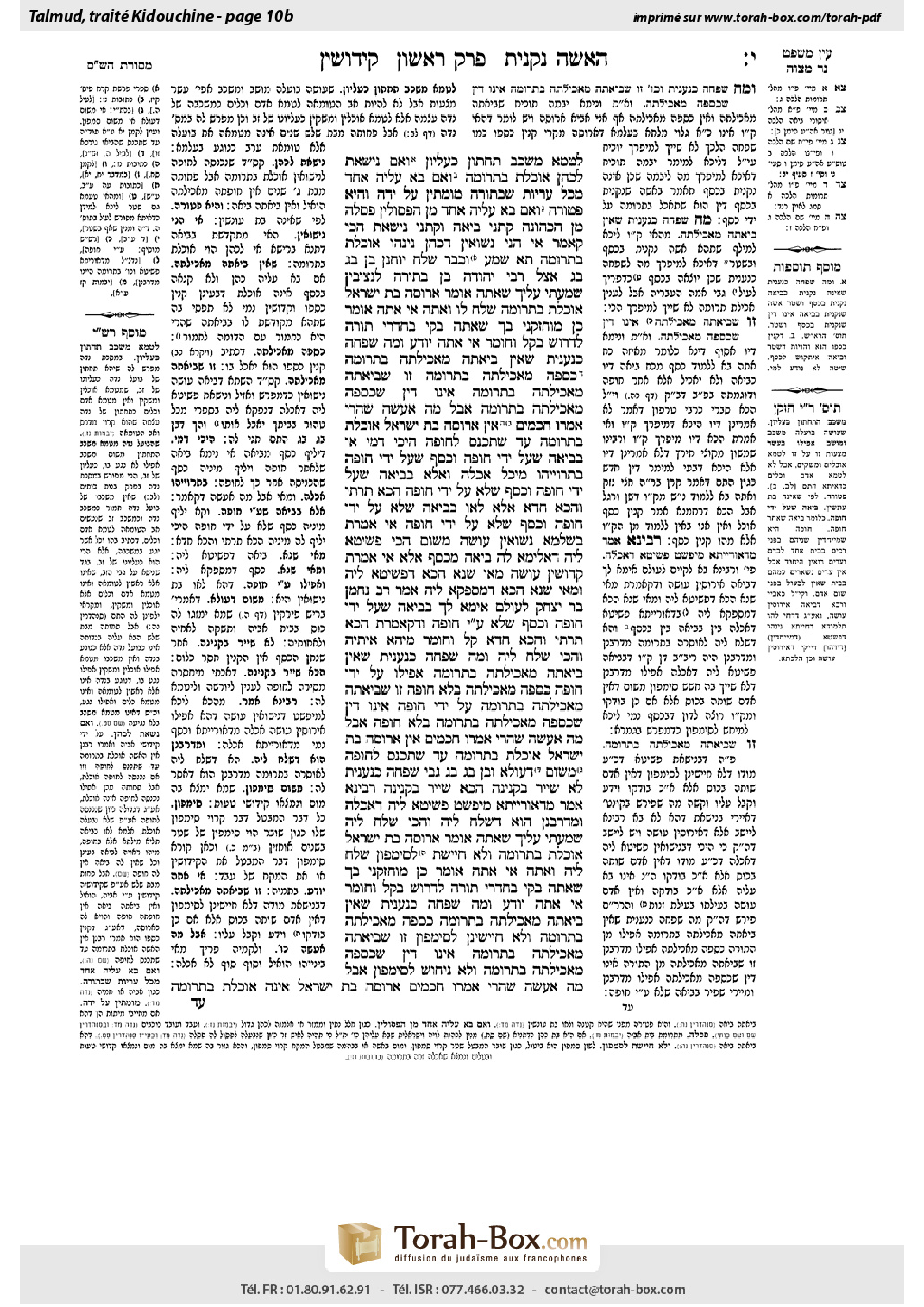
This page of Kiddushin includes the Aramaic text, an English translation and an AI-generated French translation, alongside the scan above.
קידושין י׳ ב · Aramaic and Hebrew text
לְטַמֵּא מִשְׁכָּב תַּחְתּוֹן כְּעֶלְיוֹן,
וְאִם נִישֵּׂאת לְכֹהֵן – אוֹכֶלֶת בִּתְרוּמָה, וְאִם בָּא עָלֶיהָ אֶחָד מִכׇּל עֲרָיוֹת שֶׁבַּתּוֹרָה – מוּמָתִין עַל יָדָהּ, וְהִיא פְּטוּרָה. וְאִם בָּא עָלֶיהָ אֶחָד מִן הַפְּסוּלִין – פְּסָלָהּ מִן הַכְּהוּנָּה.
קָתָנֵי ״בִּיאָה״, וְקָתָנֵי ״נִישֵּׂאת״! הָכִי קָאָמַר: אִי הָנֵי נִשּׂוּאִין דְּכֹהֵן נִינְהוּ – אוֹכֶלֶת בִּתְרוּמָה.
תָּא שְׁמַע: וּכְבָר שָׁלַח יוֹחָנָן בֶּן בַּג בַּג אֵצֶל רַבִּי יְהוּדָה בֶּן בְּתִירָה לִנְצִיבִין: שָׁמַעְתִּי עָלֶיךָ שֶׁאַתָּה אוֹמֵר אֲרוּסָה בַּת יִשְׂרָאֵל אוֹכֶלֶת בִּתְרוּמָה. שָׁלַח לוֹ: וְאַתָּה אִי אַתָּה אוֹמֵר כֵּן? מוּחְזְקַנִי בְּךָ שֶׁאַתָּה בָּקִי בְּחַדְרֵי תוֹרָה, לִדְרוֹשׁ בְּקַל וָחוֹמֶר אִי אַתָּה יוֹדֵעַ?!
וּמָה שִׁפְחָה כְּנַעֲנִית, שֶׁאֵין בִּיאָתָהּ מַאֲכִילָתָהּ בִּתְרוּמָה – כַּסְפָּהּ מַאֲכִילָתָהּ בִּתְרוּמָה, זוֹ, שֶׁבִּיאָתָהּ מַאֲכִילָתָהּ בִּתְרוּמָה – אֵינוֹ דִּין שֶׁכַּסְפָּהּ מַאֲכִילָתָהּ בִּתְרוּמָה? אֲבָל מָה אֶעֱשֶׂה שֶׁהֲרֵי אָמְרוּ חֲכָמִים: אֵין אֲרוּסָה בַּת יִשְׂרָאֵל אוֹכֶלֶת בִּתְרוּמָה עַד שֶׁתִּכָּנֵס לַחוּפָּה.
הֵיכִי דָמֵי? אִי בְּבִיאָה שֶׁעַל יְדֵי חוּפָּה, וְכֶסֶף שֶׁעַל יְדֵי חוּפָּה – בְּתַרְוַיְיהוּ מֵיכָל אָכְלָה!
וְאֶלָּא, בְּבִיאָה שֶׁעַל יְדֵי חוּפָּה, וְכֶסֶף שֶׁלֹּא עַל יְדֵי חוּפָּה – הָכָא תַּרְתֵּי, וְהָכָא חֲדָא! אֶלָּא לָאו בְּבִיאָה שֶׁלֹּא עַל יְדֵי חוּפָּה, וְכֶסֶף שֶׁלֹּא עַל יְדֵי חוּפָּה.
אִי אָמְרַתְּ בִּשְׁלָמָא נִשּׂוּאִין עוֹשָׂה – מִשּׁוּם הָכִי פְּשִׁיטָא לֵיהּ דַּאֲלִימָא לַהּ בִּיאָה מִכֶּסֶף. אֶלָּא אִי אָמְרַתְּ קִדּוּשִׁין עוֹשָׂה, מַאי שְׁנָא הָכָא דִּפְשִׁיטָא לֵיהּ, וּמַאי שְׁנָא הָכָא דִּמְסַפְּקָא לֵיהּ?
אָמַר רַב נַחְמָן בַּר יִצְחָק: לְעוֹלָם אֵימָא לָךְ בְּבִיאָה שֶׁעַל יְדֵי חוּפָּה וְכֶסֶף שֶׁלֹּא עַל יְדֵי חוּפָּה. וּדְקָאָמְרַתְּ: ״הָכָא תַּרְתֵּי וְהָכָא חֲדָא״ – קַל וָחוֹמֶר מִיהָא אִיתֵיהּ;
וְהָכִי שְׁלַח לֵיהּ: וּמָה שִׁפְחָה כְּנַעֲנִית, שֶׁאֵין בִּיאָתָהּ מַאֲכִילָתָהּ בִּתְרוּמָה אֲפִילּוּ עַל יְדֵי חוּפָּה – כַּסְפָּהּ מַאֲכִילָתָהּ בְּלֹא חוּפָּה, זוֹ, שֶׁבִּיאָתָהּ מַאֲכִילָתָהּ בִּתְרוּמָה עַל יְדֵי חוּפָּה – אֵינוֹ דִּין שֶׁכַּסְפָּהּ מַאֲכִילָתָהּ בִּתְרוּמָה בְּלֹא חוּפָּה?
אֲבָל מָה אֶעֱשֶׂה שֶׁהֲרֵי אָמְרוּ חֲכָמִים: אֵין אֲרוּסָה בַּת יִשְׂרָאֵל אוֹכֶלֶת בִּתְרוּמָה עַד שֶׁתִּכָּנֵס לַחוּפָּה, מִשּׁוּם דְּעוּלָּא.
וּבֶן בַּג בַּג? גַּבֵּי שִׁפְחָה כְּנַעֲנִית לָא שַׁיַּיר בְּקִנְיָנַהּ, הָכָא, שַׁיֵּיר בְּקִנְיָנַהּ.
רָבִינָא אָמַר: מִדְּאוֹרָיְיתָא – מִיפְשָׁט פְּשִׁיטָא לֵיהּ דְּאָכְלָה, וּמִדְּרַבָּנַן הוּא דִּשְׁלַח לֵיהּ.
וְהָכִי שְׁלַח לֵיהּ: שָׁמַעְתִּי עָלֶיךָ שֶׁאַתָּה אוֹמֵר אֲרוּסָה בַּת יִשְׂרָאֵל אוֹכֶלֶת בִּתְרוּמָה, וְלָא חָיְישַׁתְּ לְסִימְפּוֹן. שְׁלַח לֵיהּ: וְאַתָּה אִי אַתָּה אוֹמֵר כֵּן? מוּחְזְקַנִי בְּךָ שֶׁאַתָּה בָּקִי בְּחַדְרֵי תוֹרָה, לִדְרוֹשׁ בְּקַל וָחוֹמֶר אִי אַתָּה יוֹדֵעַ?!
וּמָה שִׁפְחָה כְּנַעֲנִית שֶׁאֵין בִּיאָתָהּ מַאֲכִילָתָהּ בִּתְרוּמָה – כַּסְפָּהּ מַאֲכִילָתָהּ בִּתְרוּמָה, וְלָא חָיְישִׁינַן לְסִימְפּוֹן, זוֹ שֶׁבִּיאָתָהּ מַאֲכִילָתָהּ בִּתְרוּמָה – אֵינוֹ דִּין שֶׁכַּסְפָּהּ מַאֲכִילָתָהּ בִּתְרוּמָה, וְלֹא נֵיחוּשׁ לְסִימְפּוֹן? אֲבָל מָה אֶעֱשֶׂה שֶׁהֲרֵי אָמְרוּ חֲכָמִים: אֲרוּסָה בַּת יִשְׂרָאֵל אֵינָהּ אוֹכֶלֶת בִּתְרוּמָה
Kiddushin 10b · English translation
And he renders impure the object upon which he lies like the upper one. One who engages in sexual intercourse with a menstruating woman renders the objects upon which he lies ritually impure even if he has no direct contact with them.
And if she marries a priest she may partake of teruma from that point onward. And if one of those with whom sexual relations are forbidden by the Torah (see Leviticus, chapter 18) engages in intercourse with her, he is put to death due to his sin with her, and she is exempt from punishment as a minor. And if someone of unfit lineage, i.e., a man who would disqualify her from marrying a priest if he engaged in sexual intercourse with her, engages in intercourse with her, he has disqualified her from marrying into the priesthood. This concludes the baraita.
The Gemara analyzes this source. It is taught in that baraita: She can be betrothed through sexual intercourse, and it is taught separately: And if she marries a priest. This indicates that intercourse does not effect marriage. The Gemara rejects this: This is what the baraita said: If this betrothal through intercourse is a marriage to a priest, she may partake of teruma. It is possible that there are not two separate stages here but a single action, as sexual intercourse effects marriage.
Come and hear a proof from a baraita: And Yoḥanan ben Bag Bag already sent a message to Rabbi Yehuda ben Beteira in the city of Netzivin: I heard about you that you say that the daughter of a non-priest betrothed to a priest may partake of teruma. Rabbi Yehuda ben Beteira sent back this reply to him: And do you not say so? I know about you that you are an expert in many areas of Torah; do you not know how to teach halakhot based on an a fortiori inference?
The a fortiori inference is as follows: If in the case of a Canaanite maidservant, whose sexual intercourse with a priest does not allow her to partake of teruma, as she is not betrothed to him, her money, i.e., if a priest acquires her through money, allows her to partake of teruma, is it not logical with regard to this betrothed woman, whose sexual intercourse with a priest allows her to partake of teruma, that her betrothal money from the priest should allow her to partake of teruma? If this is indeed the case, the daughter of a non-priest betrothed to a priest should be permitted to partake of teruma. But what can I do, as the Sages said: By rabbinic law, the daughter of a non-priest betrothed to a priest may not partake of teruma until she enters the wedding canopy.
The Gemara clarifies: What are the circumstances of the comparison between money and sexual intercourse? If it is referring to a case of sexual intercourse by means of a wedding canopy, i.e., after they are married, and betrothal through money where the marriage is then completed by means of a wedding canopy, in both cases she may partake of teruma even by rabbinic law, as she is a full-fledged married woman.
Or rather one could say that this comparison is referring to sexual intercourse by means of a wedding canopy, and betrothal through money not by means of a wedding canopy. If so, the a fortiori inference is not valid, as here, in the case of intercourse, there are two stages of acquisition, intercourse followed by the wedding canopy, and here, in the case of money, there is only one stage. Rather, is it not correct to say that the comparison between money and intercourse is referring to sexual intercourse not by means of a wedding canopy and also money not by means of a wedding canopy?
Granted, if you say that intercourse by itself effects marriage, it is due to that reason that it is obvious to Rabbi Yehuda ben Beteira that the mode of sexual intercourse is stronger than money, and allows her to partake of teruma. But if you say that sexual intercourse effects only betrothal, what is different here, in the case of betrothal through intercourse, that it is obvious to him that it allows her to partake of teruma, and what is different here, in the case of betrothal through money, that he is uncertain and must derive the matter through an a fortiori inference? In both cases she is only betrothed.
Rav Naḥman bar Yitzḥak said: Actually, I will say to you that he is speaking about sexual intercourse by means of a wedding canopy and money not by means of a wedding canopy. And as for that which you said in opposition to this a fortiori inference: Here there are two stages of acquisition, and here there is only one stage. In any event, there is a valid a fortiori inference.
And this is what Rabbi Yehuda ben Beteira sent him, i.e., his statement should be understood as follows: If a Canaanite maidservant, whose intercourse with a priest does not allow her to partake of teruma, even by means of a wedding canopy, and yet her money allows her to partake of teruma without the means of a wedding canopy, is it not logical with regard to this betrothed woman, whose intercourse with a priest allows her to partake of teruma by means of a wedding canopy, that her betrothal money from the priest should allow her to partake of teruma without the means of a wedding canopy?
But what can I do, as the Sages said: By rabbinic law, the daughter of a non-priest betrothed to a priest may not partake of teruma until she enters the wedding canopy, due to the reason stated by Ulla. According to Ulla, there is a concern that she may feed her siblings or members of her family teruma while she is still living in her father’s house.
And ben Bag Bag explains why one cannot accept this a fortiori inference involving a Canaanite maidservant: With regard to a Canaanite maidservant who is purchased with money, the buyer does not leave out anything from her acquisition, i.e., he completes the purchase in full. Here, in the case of betrothal, he leaves out part of her acquisition, as the stage of marriage has yet to be performed. Therefore, these two cases are dissimilar.
Ravina said that by Torah law, it is obvious to Yoḥanan ben Bag Bag that she may partake of teruma also when she is betrothed to a priest through money alone, as she is acquired with his money. And the question that he sent him is referring to the halakha by rabbinic law.
Ravina elaborates: And this is the question that he sent to him: I heard about you that you say that in practice the daughter of a non-priest betrothed to a priest may partake of teruma, and we are not concerned about an annulling factor [simfon], i.e., that he might find some blemish in her through which the betrothal would be considered retroactively invalid. If so, she would have eaten teruma when she was not permitted to do so. And it was with regard to this issue that Rabbi Yehuda ben Beteira sent to him: And do you not say this? I know about you that you are an expert in many areas of Torah; do you not know how to teach halakhot based on an a fortiori inference?
The a fortiori inference is as follows: If a Canaanite maidservant, whose engaging in intercourse with a priest does not allow her to partake of teruma, and yet her receiving purchase money allows her to partake of teruma, and we are not concerned about simfon, i.e., that the Canaanite maidservant may have some physical blemish that nullifies her purchase retroactively, is it not logical with regard to this betrothed woman, whose intercourse with a priest allows her to partake of teruma, that her receiving betrothal money from the priest should allow her to partake of teruma even before entering the wedding canopy, and we should not be concerned about simfon? But what can I do, as the Sages said: By rabbinic law the daughter of a non-priest betrothed to a priest may not partake of teruma
Kiddushin 10b · Traduction française (IA)
Et il rend impur l’objet sur lequel il est couché, comme le fait celui qui se trouve au-dessus. Celui qui a des relations sexuelles avec une femme menstruée rend rituellement impurs les objets sur lesquels il est couché, même s’il n’a aucun contact direct avec eux.
Et si elle épouse un prêtre, elle peut consommer de la terouma à partir de ce moment. Si l’un de ceux avec qui les relations sexuelles sont interdites par la Torah (voir Lévitique, chapitre 18) a des relations sexuelles avec elle, il est mis à mort pour son péché avec elle, tandis qu’elle est exemptée de toute peine, car elle est mineure. Et si un homme de lignée impropre, c’est-à-dire un homme qui l’empêcherait d’épouser un prêtre s’il avait des relations sexuelles avec elle, a des relations sexuelles avec elle, il l’a rendue inapte à épouser un membre de la prêtrise. La baraïta s’achève ici.
La Guemara analyse cette source. Cette baraïta enseigne : « Elle peut être fiancée par des relations sexuelles », puis, séparément : « Et si elle épouse un prêtre ». Cela indique que les relations sexuelles ne produisent pas le mariage. La Guemara rejette cette interprétation : voici ce que dit la baraïta : si ces fiançailles par des relations sexuelles constituent un mariage avec un prêtre, elle peut consommer de la terouma. Il est possible qu’il ne s’agisse pas de deux étapes distinctes, mais d’un seul acte, puisque les relations sexuelles produisent le mariage.
Viens entendre une preuve tirée d’une baraïta : Yoḥanan ben Bag Bag avait déjà envoyé un message à Rabbi Yehuda ben Beteira, dans la ville de Netzivin : « J’ai appris à ton sujet que tu dis que la fille d’un non-prêtre fiancée à un prêtre peut consommer de la terouma. » Rabbi Yehuda ben Beteira lui envoya cette réponse : « Et toi, ne dis-tu pas la même chose ? Je sais que tu es expert dans de nombreux domaines de la Torah ; ne sais-tu pas enseigner des halakhot à partir d’un raisonnement a fortiori ? »
Le raisonnement a fortiori est le suivant : si, dans le cas d’une servante cananéenne, dont les relations sexuelles avec un prêtre ne lui permettent pas de consommer de la terouma puisqu’elle n’est pas fiancée à lui, le fait qu’un prêtre l’acquière contre de l’argent lui permet d’en consommer, n’est-il pas logique que, dans le cas de cette femme fiancée, dont les relations sexuelles avec un prêtre lui permettent de consommer de la terouma, l’argent versé par le prêtre pour ses fiançailles lui permette également d’en consommer ? Si tel est bien le cas, la fille d’un non-prêtre fiancée à un prêtre devrait être autorisée à consommer de la terouma. Mais que puis-je faire, puisque les Sages ont dit que, selon la loi rabbinique, la fille d’un non-prêtre fiancée à un prêtre ne peut pas consommer de terouma avant d’entrer sous la houppa ?
La Guemara précise : dans quelles circonstances compare-t-on l’argent aux relations sexuelles ? S’il s’agit de relations sexuelles dans le cadre de la houppa, c’est-à-dire après leur mariage, et de fiançailles par l’argent, le mariage étant ensuite achevé par la houppa, dans les deux cas elle peut consommer de la terouma même selon la loi rabbinique, puisqu’elle est pleinement mariée.
Ou bien, on pourrait plutôt dire que cette comparaison porte sur des relations sexuelles dans le cadre de la houppa et sur des fiançailles par l’argent sans houppa. Dans ce cas, le raisonnement a fortiori n’est pas valable, car, dans le cas des relations sexuelles, l’acquisition comporte deux étapes, les relations sexuelles puis la houppa, tandis que, dans le cas de l’argent, elle n’en comporte qu’une. Ne faut-il pas plutôt dire que la comparaison entre l’argent et les relations sexuelles porte sur des relations sexuelles sans houppa et, de même, sur de l’argent sans houppa ?
On comprend que, si tu dis que les relations sexuelles à elles seules produisent le mariage, c’est pour cette raison qu’il est évident pour Rabbi Yehuda ben Beteira que le mode d’union par relations sexuelles est plus puissant que l’argent et lui permet de consommer de la terouma. Mais si tu dis que les relations sexuelles ne produisent que les fiançailles, qu’est-ce qui distingue ici le cas des fiançailles par relations sexuelles, où il lui paraît évident qu’elles lui permettent de consommer de la terouma, du cas des fiançailles par l’argent, où il hésite et doit déduire la règle par un raisonnement a fortiori ? Dans les deux cas, elle n’est que fiancée.
Rav Naḥman bar Yitzḥak dit : En réalité, je vais te dire qu’il parle de relations sexuelles dans le cadre de la houppa et d’argent sans houppa. Quant à ce que tu as objecté contre ce raisonnement a fortiori — ici, il y a deux étapes d’acquisition, et là, une seule —, le raisonnement a fortiori reste valable.
Et voici ce que Rabbi Yehuda ben Beteira lui a écrit, c’est-à-dire que sa déclaration doit être comprise ainsi : si une servante cananéenne, dont les relations sexuelles avec un prêtre ne lui permettent pas de consommer de la terouma, même dans le cadre d’une houppa, peut néanmoins en consommer grâce à l’argent versé pour son acquisition, sans houppa, n’est-il pas logique que, dans le cas de cette femme fiancée, dont les relations sexuelles avec un prêtre lui permettent de consommer de la terouma dans le cadre de la houppa, l’argent versé par le prêtre pour ses fiançailles lui permette d’en consommer sans houppa ?
Mais que puis-je faire, puisque les Sages ont dit que, selon la loi rabbinique, la fille d’un non-prêtre fiancée à un prêtre ne peut pas consommer de terouma avant d’entrer sous la houppa, pour la raison énoncée par Ulla. Selon Ulla, on craint qu’elle ne fasse consommer de la terouma à ses frères ou à d’autres membres de sa famille alors qu’elle vit encore dans la maison de son père.
Et ben Bag Bag explique pourquoi on ne peut pas accepter ce raisonnement a fortiori fondé sur le cas d’une servante cananéenne : lorsqu’une servante cananéenne est achetée contre de l’argent, l’acheteur ne laisse rien en suspens dans son acquisition, c’est-à-dire qu’il achève entièrement l’achat. Ici, dans le cas des fiançailles, il laisse une partie de son acquisition en suspens, car l’étape du mariage n’a pas encore eu lieu. Ces deux cas ne sont donc pas comparables.
Ravina dit que, selon la Torah, il est évident pour Yoḥanan ben Bag Bag qu’elle peut aussi consommer de la terouma lorsqu’elle est fiancée à un prêtre par le seul moyen de l’argent, puisqu’elle est acquise grâce à son argent. La question qu’il lui a adressée porte sur la halakha selon la loi rabbinique.
Ravina développe : voici la question qu’il lui a adressée : « J’ai appris à ton sujet que tu dis qu’en pratique, la fille d’un non-prêtre fiancée à un prêtre peut consommer de la terouma et que nous ne craignons pas l’existence d’un facteur d’annulation [simfon], c’est-à-dire que le prêtre puisse découvrir chez elle un défaut qui rendrait rétroactivement les fiançailles invalides. Dans ce cas, elle aurait consommé de la terouma alors qu’elle n’y était pas autorisée. » C’est à propos de cette question que Rabbi Yehuda ben Beteira lui répondit : « Et toi, ne dis-tu pas la même chose ? Je sais que tu es expert dans de nombreux domaines de la Torah ; ne sais-tu pas enseigner des halakhot à partir d’un raisonnement a fortiori ? »
Le raisonnement a fortiori est le suivant : si une servante cananéenne, dont les relations sexuelles avec un prêtre ne lui permettent pas de consommer de la terouma, peut néanmoins en consommer grâce à l’argent reçu pour son acquisition, et que nous ne craignons pas l’existence d’un simfon, c’est-à-dire que la servante cananéenne puisse avoir un défaut physique qui annulerait rétroactivement son acquisition, n’est-il pas logique que, dans le cas de cette femme fiancée, dont les relations sexuelles avec un prêtre lui permettent de consommer de la terouma, l’argent versé par le prêtre pour ses fiançailles lui permette d’en consommer même avant qu’elle n’entre sous la houppa, sans que nous craignions un simfon ? Mais que puis-je faire, puisque les Sages ont dit que, selon la loi rabbinique, la fille d’un non-prêtre fiancée à un prêtre ne peut pas consommer de terouma
Traduction française générée par IA à partir de l’édition anglaise de Sefaria. Vérifie toujours un passage avec le texte source.
Text from Sefaria: William Davidson Edition - Vocalized Aramaic (CC BY NC); William Davidson Edition - English (CC BY NC).