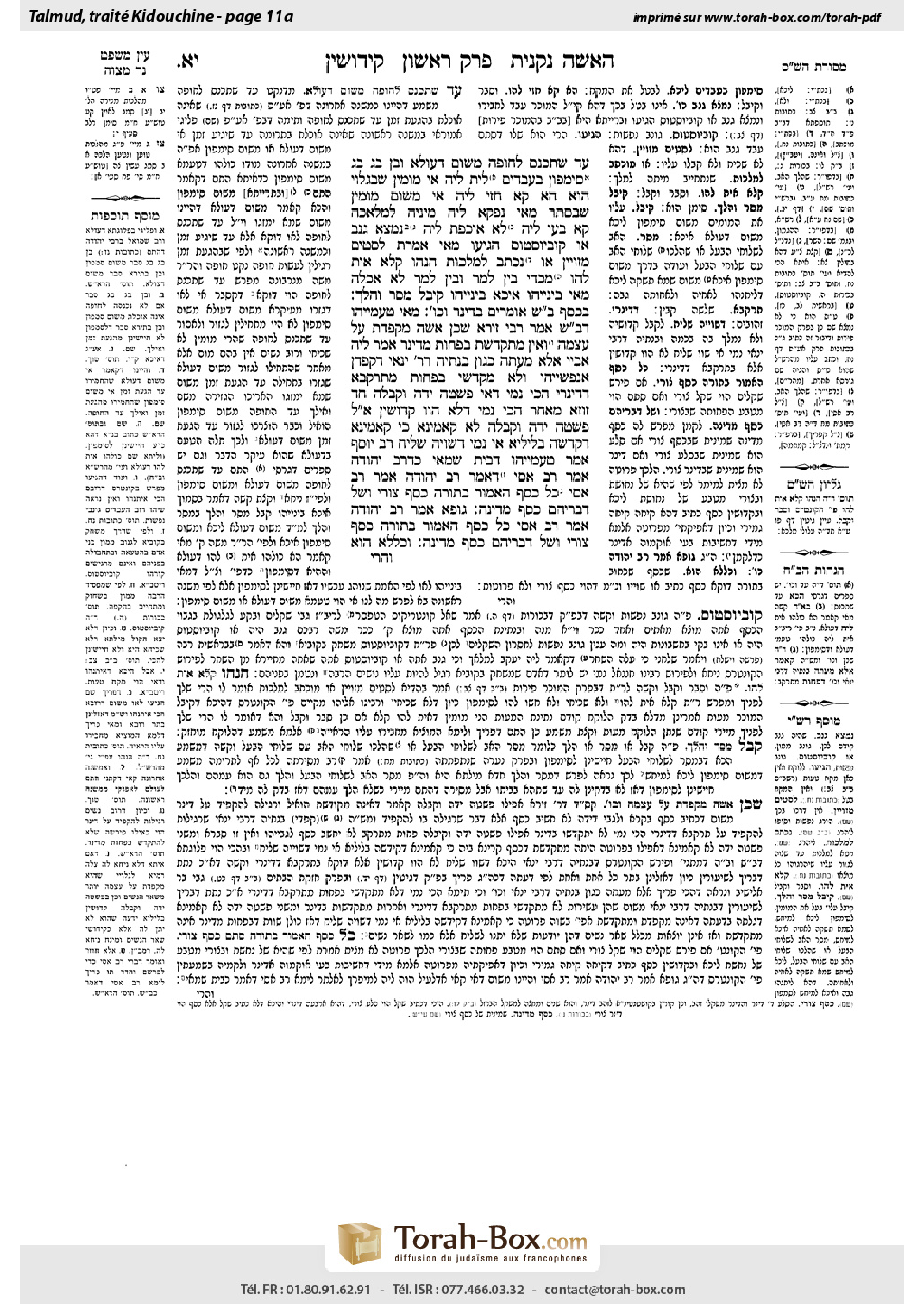
Kiddushin 11a: Talmud study for Daf Yomi
Daf Yomi is the daily study of one Talmud folio. Explore 37 tractates with scans, Hebrew text, Sefaria English and AI-generated French translations where annotated.
Passage selection and English or AI-generated French translation are available where the scan has annotations. Daf Study is independent of Torah-Box and Sefaria.
Browse Kiddushin · קידושין · All tractatesKiddushin 11a text and translations
This page of Kiddushin includes the Aramaic text, an English translation and an AI-generated French translation, alongside the scan above.
קידושין י״א א · Aramaic and Hebrew text
עַד שֶׁתִּכָּנֵס לַחוּפָּה, מִשּׁוּם דְּעוּלָּא.
וּבֶן בַּג בַּג? סִימְפּוֹן, בַּעֲבָדִים לֵית לֵיהּ. אִי מוּמִין שֶׁבַּגָּלוּי הוּא – הָא קָא חָזֵי לֵיהּ. אִי מִשּׁוּם מוּמִין שֶׁבַּסֵּתֶר – מַאי נָפְקָא לֵיהּ מִינֵּיהּ? לִמְלָאכָה קָא בָעֵי לֵיהּ לָא אִיכְפַּת לֵיהּ.
נִמְצָא גַּנָּב אוֹ קוּבְיוּסְטוּס – הִגִּיעוֹ. מַאי אָמְרַתְּ, לִסְטִים מְזוּיָּין אוֹ (נִכְתַּב) [מוּכְתָּב] לַמַּלְכוּת? הָנְהוּ קָלָא אִית לְהוּ!
מִכְּדִי, בֵּין לְמָר וּבֵין לְמָר לָא אָכְלָה, מַאי בֵּינַיְיהוּ?
אִיכָּא בֵּינַיְיהוּ: קִיבֵּל, מָסַר, וְהָלַךְ.
בְּכֶסֶף, בֵּית שַׁמַּאי אוֹמְרִים בְּדִינָר וְכו׳. מַאי טַעְמַיְיהוּ דְּבֵית שַׁמַּאי? אָמַר רַבִּי זֵירָא: שֶׁכֵּן אִשָּׁה מַקְפֶּדֶת עַל עַצְמָהּ, וְאֵין מִתְקַדֶּשֶׁת בְּפָחוֹת מִדִּינָר.
אֲמַר לֵיהּ אַבָּיֵי: אֶלָּא מֵעַתָּה, כְּגוֹן בְּנָתֵיהּ דְּרַבִּי יַנַּאי, דְּקָפְדָן אַנַּפְשַׁיְיהוּ, וְלָא מִקַּדְּשָׁן בְּפָחוֹת מִתַּרְקְבָא דְּדִינָרֵי, הָכִי נָמֵי דְּאִי פָּשְׁטָה יָדָהּ וְקִבְּלָה חַד זוּזָא מֵאַחֵר, הָכִי נָמֵי דְּלָא הָווּ קִדּוּשִׁין?
אֲמַר לֵיהּ: פָּשְׁטָה יָדָהּ וְקִבְּלָהּ לָא קָאָמֵינָא, כִּי קָאָמֵינָא, דְּקַדְּשַׁהּ בְּלֵילְיָא, אִי נָמֵי דְּשַׁוִּיָה שָׁלִיחַ.
רַב יוֹסֵף אָמַר: טַעְמַיְהוּ דְּבֵית שַׁמַּאי כִּדְרַב יְהוּדָה אָמַר רַב אַסִּי. דְּאָמַר רַב יְהוּדָה אָמַר רַב אַסִּי: כׇּל כֶּסֶף הָאָמוּר בַּתּוֹרָה – כֶּסֶף צוֹרִי, וְשֶׁל דִּבְרֵיהֶם – כֶּסֶף מְדִינָה.
גּוּפָא, אָמַר רַב יְהוּדָה אָמַר רַב אַסִּי: כׇּל כֶּסֶף הָאָמוּר בַּתּוֹרָה – כֶּסֶף צוֹרִי, וְשֶׁל דִּבְרֵיהֶם – כֶּסֶף מְדִינָה. וּכְלָלָא הוּא?
Kiddushin 11a · English translation
until she enters the wedding canopy, due to the reason of Ulla, lest she feed her non-priestly family members the teruma that her husband has given her.
The Gemara asks: And ben Bag Bag, what does he say about this a fortiori inference? The Gemara answers that he maintains that this a fortiori inference is invalid because he does not accept that there can be a claim of simfon with regard to the acquisition of slaves. The reason is that if it is an exposed blemish that the master found on the slave, he saw the blemish and purchased him regardless. Therefore, he cannot later claim that the transaction was unfair. If it is due to hidden blemishes on his slave, what difference does that make to him? Why should it matter if a slave has hidden blemishes? He needs him only for labor, and he does not care if he has hidden blemishes that do not impair his ability to perform labor.
And even if this slave is discovered to be a thief or a gambler [kuvyustus], which are considered hidden blemishes that affect his work, it has come to him, i.e., the slave is acquired by the one who purchased him and the transaction is non-refundable. The reason is that the buyer should have suspected behavior of this kind, which is common among slaves, and therefore he suffers the loss. What do you say? Perhaps he discovered that the slave is an armed bandit and subject to be killed by the government for this, or sentenced to death by the government for another reason, and is sought by the authorities. This is not a valid claim, since these matters generate publicity, and therefore he is assumed to have taken the risk into consideration.
The Gemara asks: Now, both according to the one Master, Yoḥanan ben Bag Bag, and according to the other Master, Rabbi Yehuda ben Beteira, the daughter of a non-priest betrothed to a priest may not partake of teruma by rabbinic decree. What, then, is the difference between them?
The Gemara answers: The difference between them involves three cases. The Gemara elaborates: If the husband initially accepted her blemishes, there is no concern that an annulling factor might lead to the nullification of the betrothal, but there is still concern that she might feed teruma to the members of her family. If her father transferred her to the betrothed husband’s agents, or if the father’s agents walked with the husband’s messenger, and therefore she is no longer in her father’s house, there is no concern that she might feed her family members teruma, but it remains possible that the betrothal will be nullified.
§ The Gemara returns to the halakhot of the mishna. The mishna teaches that if one betroths a woman with money, Beit Shammai say he must betroth her with at least one dinar, whereas according to the opinion of Beit Hillel even one peruta is sufficient. The Gemara asks: What is the reasoning of Beit Shammai? Rabbi Zeira says: Their reasoning is that a woman is particular about herself and considers it beneath her dignity to be acquired with a paltry sum, and therefore she will not agree to be betrothed with less than one dinar.
Abaye said to him: If that is so, with regard to Rabbi Yannai’s daughters, for example, who are very particular about themselves and their honor, and they will not agree to be betrothed with less than three kav of dinars due to their status, so too will you say that if she reaches out her hand and accepts one dinar from another man, so too, this is not a betrothal?
Rabbi Zeira said to Abaye: I did not say that this halakha includes a case where she reached out her hand and accepted a betrothal. She has the right to willingly relinquish her dignity. When I said this halakha I was referring to a case where he betrothed her at night and she did not see what she was being given. Alternatively, where she appointed an agent to betroth her but did not explicitly tell him how much she wished to receive for her betrothal. In these cases it is assumed that she is particular about her honor and will not agree to be betrothed for less than one dinar.
Rav Yosef said a different explanation: The reasoning of Beit Shammai is in accordance with that which Rav Yehuda says that Rav Asi says. As Rav Yehuda says that Rav Asi says: Every sum of money mentioned in the Torah is in Tyrian coinage, i.e., dinars from Tyre, which have a high value. And any amount of money set by rabbinic law is measured by provincial coinage. Local currency, i.e., that which existed at the time of the Sages of the Mishna, was worth about one-eighth of the value of Tyrian coinage. Beit Shammai follow the standard sum of the Torah, and the smallest possible amount in Tyrian currency is the silver coin, which is worth one dinar.
The Gemara discusses the matter itself. Rav Yehuda says that Rav Asi says: Every sum of money mentioned in the Torah is Tyrian coinage, and any amount of money set by rabbinic law is measured by provincial coinage. The Gemara asks: And is it an established principle that any mention of money in the Torah is referring to a silver coin worth at least one dinar?
Kiddushin 11a · Traduction française (IA)
jusqu’à ce qu’elle entre sous la houppa, conformément à la raison invoquée par Oula : de peur qu’elle ne nourrisse de terouma les membres de sa famille qui ne sont pas prêtres, avec la terouma que son mari lui a donnée.
La Guemara demande : Et que dit ben Bag Bag au sujet de ce raisonnement a fortiori ? La Guemara répond qu’il estime que ce raisonnement a fortiori n’est pas valable, car il n’admet pas qu’on puisse invoquer un simfon lors de l’acquisition d’esclaves. En effet, si le maître a découvert chez l’esclave un défaut apparent, il l’a vu et l’a néanmoins acheté. Il ne peut donc pas prétendre par la suite que la transaction était inéquitable. Et s’il s’agit de défauts cachés chez son esclave, en quoi cela le concerne-t-il ? Pourquoi devrait-il se soucier du fait qu’un esclave ait des défauts cachés ? Il n’en a besoin que pour le travail et ne se soucie pas de défauts cachés qui ne l’empêchent pas de travailler.
Même si l’on découvre que cet esclave est un voleur ou un joueur [kuvyustus], défauts cachés qui nuisent à son travail, il reste acquis à l’acheteur, c’est-à-dire que la transaction ne peut pas être annulée. En effet, l’acheteur aurait dû se méfier de ce genre de comportement, courant chez les esclaves, et il doit donc en supporter la perte. Que répondre ? Peut-être a-t-il découvert que l’esclave est un bandit armé, passible d’être tué par le gouvernement pour cette raison, ou qu’il a été condamné à mort par le gouvernement pour une autre raison et qu’il est recherché par les autorités. Cela ne constitue pas un motif valable, car ces faits sont connus de tous ; on présume donc qu’il avait pris ce risque en considération.
La Guemara demande : À présent, aussi bien selon le premier maître, Yoḥanan ben Bag Bag, que selon l’autre maître, Rabbi Yehuda ben Beteira, la fille d’un non-prêtre fiancée à un prêtre ne peut pas consommer de terouma en vertu d’un décret rabbinique. Quelle est donc la différence entre eux ?
La Guemara répond : Ils diffèrent dans trois cas. La Guemara précise : Si le mari a accepté ses défauts dès le départ, on ne craint pas qu’un élément susceptible d’invalider le mariage entraîne l’annulation des fiançailles, mais on craint toujours qu’elle ne donne de la terouma aux membres de sa famille. Si son père l’a remise aux mandataires de son fiancé, ou si les mandataires de son père ont accompagné le messager de son fiancé, de sorte qu’elle ne se trouve plus dans la maison de son père, on ne craint pas qu’elle donne de la terouma aux membres de sa famille, mais il reste possible que les fiançailles soient annulées.
§ La Guemara revient aux halakhot de la Michna. La Michna enseigne que si un homme fiance une femme avec de l’argent, Beit Shammaï disent qu’il doit la fiancer avec au moins un dinar, tandis que, selon Beit Hillel, même une perouta suffit. La Guemara demande : Quelle est la raison de Beit Shammaï ? Rabbi Zeira dit : Ils estiment qu’une femme est exigeante quant à sa personne et juge indigne d’elle d’être acquise pour une somme dérisoire ; elle n’acceptera donc pas d’être fiancée pour moins d’un dinar.
Abaye lui dit : Si tel est le cas, pour les filles de Rabbi Yannai, par exemple, qui sont très exigeantes quant à leur personne et à leur honneur et qui, en raison de leur statut, n’accepteraient pas d’être fiancées pour moins de trois kav de dinars, diras-tu également que si l’une d’elles tend la main et accepte un dinar d’un autre homme, il ne s’agit pas non plus de fiançailles ?
Rabbi Zeira dit à Abaye : Je n’ai pas dit que cette halakha s’applique au cas où elle tend la main et accepte les fiançailles. Elle a le droit de renoncer volontairement à sa dignité. En énonçant cette halakha, je faisais référence au cas où il l’a fiancée de nuit et où elle n’a pas vu ce qu’on lui donnait. Ou bien au cas où elle a désigné un mandataire pour la fiancer sans lui préciser explicitement quelle somme elle souhaitait recevoir pour ses fiançailles. Dans ces cas, on présume qu’elle tient à son honneur et qu’elle n’acceptera pas d’être fiancée pour moins d’un dinar.
Rav Yosef donne une autre explication : la raison de Beit Shammaï est conforme à ce que Rav Yehuda rapporte au nom de Rav Asi. En effet, Rav Yehuda rapporte au nom de Rav Asi : toute somme d’argent mentionnée dans la Torah est exprimée en monnaie tyrienne, c’est-à-dire en dinars de Tyr, qui ont une grande valeur. En revanche, toute somme d’argent fixée par la loi rabbinique est évaluée en monnaie provinciale. La monnaie locale, celle qui avait cours à l’époque des Sages de la Michna, valait environ un huitième de la monnaie tyrienne. Beit Shammaï suivent le montant de référence de la Torah, et la plus petite somme possible en monnaie tyrienne est la pièce d’argent, qui vaut un dinar.
La Guemara examine la question elle-même. Rav Yehuda rapporte au nom de Rav Asi : toute somme d’argent mentionnée dans la Torah est exprimée en monnaie tyrienne, tandis que toute somme d’argent fixée par la loi rabbinique est évaluée en monnaie provinciale. La Guemara demande : Est-il donc établi en principe que toute mention d’argent dans la Torah désigne une pièce d’argent valant au moins un dinar ?
Traduction française générée par IA à partir de l’édition anglaise de Sefaria. Vérifie toujours un passage avec le texte source.
Text from Sefaria: William Davidson Edition - Vocalized Aramaic (CC BY NC); William Davidson Edition - English (CC BY NC).