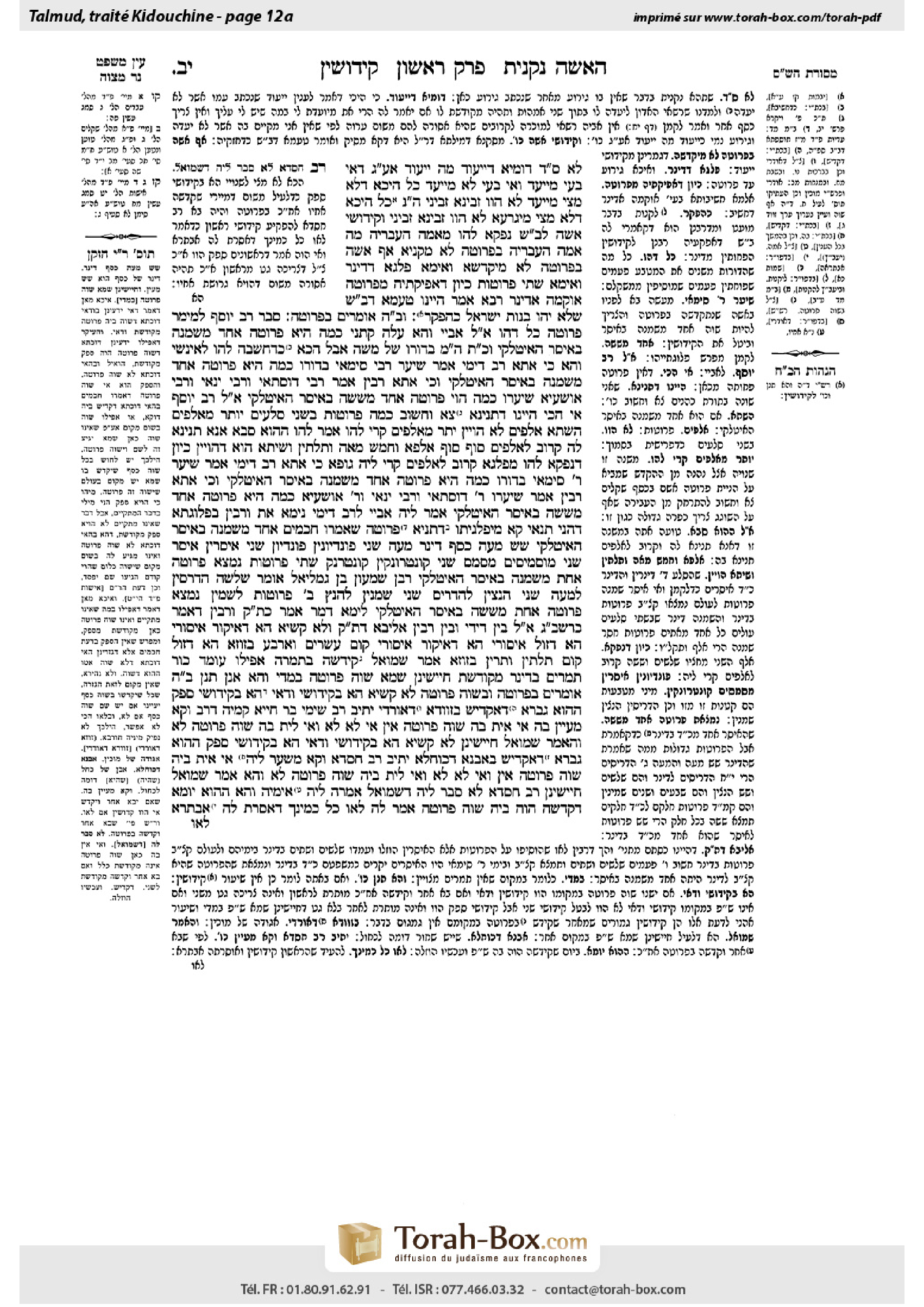
Kiddushin 12a: Talmud study for Daf Yomi
Daf Yomi is the daily study of one Talmud folio. Explore 37 tractates with scans, Hebrew text, Sefaria English and AI-generated French translations where annotated.
Passage selection and English or AI-generated French translation are available where the scan has annotations. Daf Study is independent of Torah-Box and Sefaria.
Browse Kiddushin · קידושין · All tractatesKiddushin 12a text and translations
This page of Kiddushin includes the Aramaic text, an English translation and an AI-generated French translation, alongside the scan above.
קידושין י״ב א · Aramaic and Hebrew text
לָא סָלְקָא דַּעְתָּךְ – דּוּמְיָא דְּיִיעוּד, מַה יִיעוּד, אַף עַל גַּב דְּאִי בָּעֵי מְיַיעֵד וְאִי בָּעֵי לָא מְיַיעֵד, כֹּל הֵיכָא דְּלָא מָצֵי מְיַיעֵד – לָא הָווּ זְבִינָא זְבִינֵי, הָכִי נָמֵי כֹּל הֵיכָא דְּלָא מָצְיָ[א] מְיגָרְעָא – לָא הָווּ זְבִינָא זְבִינֵי.
וְקִידּוּשֵׁי אִשָּׁה לְבֵית שַׁמַּאי נָפְקָא לְהוּ מֵאָמָה הָעִבְרִיָּה: מָה אָמָה הָעִבְרִיָּה בִּפְרוּטָה לָא מִקַּנְיָא, אַף אִשָּׁה בִּפְרוּטָה לָא מִיקַּדְּשָׁא.
וְאֵימָא פַּלְגָא דְּדִינָר, וְאֵימָא שְׁתֵּי פְּרוּטוֹת! כֵּיוָן דְּאַפִּיקְתֵּיהּ מִפְּרוּטָה – אוֹקְמַהּ אַדִּינָר.
רָבָא אָמַר: הַיְינוּ טַעְמָא דְּבֵית שַׁמַּאי: שֶׁלֹּא יְהוּ בְּנוֹת יִשְׂרָאֵל כְּהֶפְקֵר.
וּבֵית הִלֵּל אוֹמְרִים בִּפְרוּטָה. סָבַר רַב יוֹסֵף לְמֵימַר: פְּרוּטָה כָּל דְּהוּ. אֲמַר לֵיהּ אַבָּיֵי: וְהָא עֲלַהּ קָתָנֵי: כַּמָּה הִיא פְּרוּטָה – אֶחָד מִשְּׁמֹנָה בָּאִיסָּר הָאִיטַלְקִי.
וְכִי תֵּימָא: הָנֵי מִילֵּי בְּדוֹרוֹ שֶׁל מֹשֶׁה, אֲבָל הָכָא כְּדַחֲשִׁבָה לְהוּ לְאִינָשֵׁי – וְהָא כִּי אֲתָא רַב דִּימִי אָמַר: שִׁיעֵר רַבִּי סִימַאי בְּדוֹרוֹ כַּמָּה הִיא פְּרוּטָה: אֶחָד מִשְּׁמֹנָה בָּאִיסָּר הָאִיטַלְקִי, וְכִי אֲתָא רָבִין אָמַר: רַבִּי דּוֹסְתַּאי וְרַבִּי יַנַּאי וְרַבִּי אוֹשַׁעְיָא שִׁיעֲרוּ כַּמָּה הָוֵי פְּרוּטָה – אֶחָד מִשִּׁשָּׁה בְּאִיסָּר הָאִיטַלְקִי!
אֲמַר לֵיהּ רַב יוֹסֵף: אִי הָכִי, הַיְינוּ דְּתָנֵינָא: ״צֵא וַחֲשׁוֹב כַּמָּה פְּרוּטוֹת בִּשְׁנֵי סְלָעִים – יוֹתֵר מֵאַלְפַּיִם״ – הַשְׁתָּא אַלְפַּיִם לָא הָוְיָין, יָתֵר מֵאַלְפַּיִם קָרֵי לְהוּ? אֲמַר לְהוּ הַהוּא סָבָא: אֲנָא תְּנֵינָא לַהּ: ״קָרוֹב לְאַלְפַּיִם״. סוֹף סוֹף אַלְפָּא וַחֲמֵשׁ מְאָה וּתְלָתִין וְשִׁיתָּא הוּא דְּהָוְיָין! כֵּיוָן דְּנָפְקָא לְהוּ מִפַּלְגָא – קָרוֹב לְאַלְפַּיִם קָרֵי לֵיהּ.
גּוּפָא, כִּי אֲתָא רַב דִּימִי אָמַר: שִׁיעֵר רַבִּי סִימַאי בְּדוֹרוֹ כַּמָּה הִיא פְּרוּטָה – אֶחָד מִשְּׁמֹנָה בָּאִיסָּר הָאִיטַלְקִי, וְכִי אֲתָא רָבִין אָמַר: שִׁיעֲרוּ רַבִּי דּוֹסְתַּאי וְרַבִּי יַנַּאי וְרַבִּי אוֹשַׁעְיָא כַּמָּה הִיא פְּרוּטָה – אֶחָד מִשִּׁשָּׁה בָּאִיסָּר הָאִיטַלְקִי. אָמַר לֵיהּ אַבָּיֵי לְרַב דִּימִי: נֵימָא, אַתְּ וְרָבִין בִּפְלוּגְתָּא דְהָנֵי תַּנָּאֵי קָא מִיפַּלְגִיתוּ,
דְּתַנְיָא: פְּרוּטָה שֶׁאָמְרוּ חֲכָמִים – אֶחָד מִשְּׁמֹנָה בָּאִיסָּר הָאִיטַלְקִי, שֵׁשׁ מָעָה כֶּסֶף – דִּינָר, מָעָה – שְׁנֵי פּוּנְדְּיוֹנִין, פּוּנְדְּיוֹן – שְׁנֵי אִיסָּרִין, אִיסָּר – שְׁנֵי מִסְמֵיסִים, מִסְמֵס – שְׁנֵי קוּנְטְרוֹנְקִין, קוּנְטְרֹנְק – שְׁתֵּי פְרוּטוֹת. נִמְצָא, פְּרוּטָה – אֶחָד מִשְּׁמֹנָה בָּאִיסָּר הָאִיטַלְקִי.
רַבָּן שִׁמְעוֹן בֶּן גַּמְלִיאֵל אוֹמֵר: שְׁלֹשָׁה הַדְרֵסִין לְמָעָה, שְׁנֵי הַנְצִין לְהַדְרֵיס, שְׁנֵי שְׁמֵנִין לַהֲנֵץ, שְׁתֵּי פְרוּטוֹת לְשָׁמֵין, נִמְצָא, פְּרוּטָה – אֶחָד מִשִּׁשָּׁה בְּאִיסָּר הָאִיטַלְקִי. לֵימָא דְּמָר אָמַר כְּתַנָּא קַמָּא וְרָבִין דְּאָמַר כְּרַבָּן שִׁמְעוֹן בֶּן גַּמְלִיאֵל?
אֲמַר לֵיהּ: בֵּין דִּידִי וּבֵין רָבִין אַלִּיבָּא דְּתַנָּא קַמָּא, וְלָא קַשְׁיָא: הָא – דְּאִיַּקּוּר אִיסּוּרֵי, הָא – דְּזוּל אִיסּוּרֵי. הָא דְּאִיַּקּוּר אִיסּוּרֵי – קוּם עֶשְׂרִים וְאַרְבַּע בְּזוּזָא, הָא דְּזוּל – קוּם תְּלָתִין וּתְרֵין בְּזוּזָא.
אָמַר שְׁמוּאֵל: קִידְּשָׁהּ בִּתְמָרָה, אֲפִילּוּ עוֹמֵד כּוֹר תְּמָרִים בְּדִינָר – מְקוּדֶּשֶׁת; חָיְישִׁינַן שֶׁמָּא שָׁוֶה פְּרוּטָה בְּמָדַי.
וְהָא אֲנַן תְּנַן: בֵּית הִלֵּל אוֹמְרִים בִּפְרוּטָה וּבְשָׁוֶה פְּרוּטָה! לָא קַשְׁיָא, הָא בְּקִידּוּשֵׁי וַדַּאי, הָא בְּקִידּוּשֵׁי סָפֵק.
הָהוּא גַּבְרָא דְּאקַדֵּישׁ בִּזְווֹדָא דְּאוּדְרֵי, יָתֵיב רַב שִׁימִי בַּר חִיָּיא קַמֵּיהּ דְּרַב וְקָא מְעַיֵּין בַּהּ, אִי אִית בַּהּ שָׁוֶה פְּרוּטָה – אִין, אִי לָא – לָא. וְאִי לֵית בַּהּ שָׁוֶה פְּרוּטָה לָא? וְהָאָמַר שְׁמוּאֵל: חָיְישִׁינַן! לָא קַשְׁיָא, הָא בְּקִידּוּשֵׁי וַדַּאי, הָא בְּקִידּוּשֵׁי סָפֵק.
הָהוּא גַּבְרָא דְּאקַדֵּישׁ בְּאַבְנָא דְכוּחְלָא, יָתֵיב רַב חִסְדָּא וְקָא מְשַׁעֵר לַיהּ, אִי אִית בַּהּ שָׁוֶה פְּרוּטָה – אִין, וְאִי לָא – לָא. וְאִי לֵית בַּהּ שָׁוֶה פְּרוּטָה לָא? וְהָא אָמַר שְׁמוּאֵל: חָיְישִׁינַן! רַב חִסְדָּא לָא סָבַר לֵיהּ דִּשְׁמוּאֵל.
אֲמַרָה לֵיהּ אִימֵּיהּ: וְהָא הָהוּא יוֹמָא דְּקַדְּשַׁהּ הֲוָה בַּהּ שָׁוֶה פְּרוּטָה! אֲמַר לַהּ: לָאו כָּל כְּמִינָּךְ דְּאָסְרַתְּ לַהּ אַבָּתְרָא.
Kiddushin 12a · English translation
The Gemara rejects this suggestion: This cannot enter your mind, as the halakha of deduction must be similar to the halakha of designation, i.e., the process by which a master designates his Hebrew maidservant as a wife for him or his son (Exodus 21:8–9). Just as with designation, although the halakha is that if he desires, he may designate her and if he does not desire, he is not required to designate her, nevertheless anywhere that he cannot designate her, e.g., in a case where they are related and she is therefore forbidden to him, her sale is not a valid sale, so too here, with regard to her redemption, anywhere that she cannot deduct an amount from her purchase price, her sale is not a valid sale.
The Gemara notes: And according to the opinion of Beit Shammai the mode of betrothal of a woman by money is derived from the case of a Hebrew maidservant, as follows: Just as a Hebrew maidservant cannot be acquired with one peruta, so too a woman cannot be betrothed with one peruta.
The Gemara asks: Even if Beit Shammai derive their opinion from here, how does this prove that a woman can be betrothed only with a minimum of one dinar? But why not say she can be betrothed with half a dinar, or say that she can be betrothed with two perutot, as it is possible to fulfill the redemption of a Hebrew maidservant if her sale was for either of these amounts? The Gemara answers: Since this comparison excludes betrothal with one peruta, as it indicates that a woman can be betrothed only with money of significant value, the Sages established the minimum amount at one dinar, which is a coin of substantial value.
Rava said a different explanation: This is the reasoning of Beit Shammai, who hold that a woman can be betrothed only with a minimum of one dinar: The daughters of Israel should not be treated like ownerless property. Allowing women to be betrothed with such a small amount as one peruta is disrespectful to them.
§ The mishna teaches: And Beit Hillel say that a woman can be betrothed with one peruta, or with any item that is worth one peruta. Rav Yosef thought to say: One peruta means any amount. There is no defined value, as a woman may be betrothed with one peruta regardless of its value at the time. Abaye said to him: But isn’t it taught with regard to this in the mishna itself: How much is one peruta? It is one-eighth of the Italian issar. This shows there is a defined value for one peruta.
And if you would say: This statement applies only to the generation of Moses, i.e., this was the value of one peruta in the time of the Torah, but now, at any later time, its value is determined by that which people consider one peruta, that claim cannot be correct. As when Rav Dimi came from Eretz Yisrael he said: Rabbi Simai estimated in his generation: How much is one peruta? It is one-eighth of the Italian issar. And when Ravin came from Eretz Yisrael to Babylonia he said that Rabbi Dostai and Rabbi Yannai and Rabbi Oshaya estimated: How much is one peruta? It is one-sixth of the Italian issar.
Rav Yosef said to Abaye: If so, then this is in conflict with that which we learned in a baraita: Go and calculate how many perutot there are in two sela: More than two thousand. Now there are not even two thousand, and you call them: More than two thousand? Rather, the peruta is certainly worth less than one-eighth of the Italian issar. A certain old man said to them: I teach this baraita as saying: Close to two thousand. The Gemara asks: Ultimately, according to the calculation of one-eighth of an issar, the number of perutot in two sela is 1,536, which is nowhere near two thousand. The Gemara answers: Since it passes half of the second thousand it is called: Close to two thousand.
The Gemara discusses the matter itself. When Rav Dimi came from Eretz Yisrael he said: Rabbi Simai estimated in his generation: How much is one peruta? It is one-eighth of the Italian issar. And when Ravin came he said that Rabbi Dostai and Rabbi Yannai and Rabbi Oshaya estimated: How much is one peruta? It is one-sixth of the Italian issar. Abaye said to Rav Dimi: Shall we say that you and Ravin disagree with regard to the issue that is the subject of the dispute between these tanna’im.
As it is taught in a baraita: The peruta mentioned by the Sages is one-eighth of the Italian issar. Six silver ma’a are one dinar, and one ma’a is worth two pundeyon. In a pundeyon there are two issar, and an issar is two masmas. A masmas is worth two konterank, and a konterank is two perutot. By this calculation, one finds that one peruta is one-eighth of the Italian issar.
Rabban Shimon ben Gamliel says: This is not the case; rather, there are three hadreis to a ma’a, two henetz to a hadreis, two shamin to a henetz, and two perutot to a shamin. Consequently, one finds that one peruta is one-sixth of the Italian issar. Shall we say that one Master agrees with the first tanna, and Ravin, who said his ruling in the name of Rabbi Dostai and Rabbi Yannai and Rabbi Oshaya, agrees with Rabban Shimon ben Gamliel?
Rav Dimi said to Abaye: Both my statement and that of Ravin are in accordance with the opinion of the first tanna, and it is not difficult. This statement of mine is referring to when the issar increased in value in relation to silver coins, and this statement of Ravin is referring to when the issar decreased in value. The Gemara elaborates: When the issar increased in value, twenty-four issar stood at one dinar; when they decreased in value, thirty-two issar stood at one dinar. If so, there is a set ratio between the value of a peruta and the value of silver, and there are 192 perutot in one dinar. By contrast, the ratio between the value of a copper issar and silver dinars fluctuates, so that sometimes an issar will be worth eight perutot while at other times it is worth only six.
§ Shmuel says: If man betrothed a woman with a date, she is betrothed even if a kor of dates is worth one dinar, which would mean that one date is worth much less than one peruta. The reason is that although a date has little value here, we are concerned that perhaps it is worth one peruta in Media or in some other distant place where dates are expensive. Therefore, she is betrothed in this location as well.
The Gemara asks: But didn’t we learn in the mishna that Beit Hillel say: With one peruta or with an item worth one peruta, but not less? The Gemara explains: This is not difficult. This statement in the mishna is referring to betrothal whose status is certain. Betrothal with one peruta or an item worth one peruta is certainly valid. Conversely, this case stated by Shmuel is referring to betrothal whose status is uncertain. Although the item is not worth one peruta here, there is a concern that the betrothal might nevertheless be valid.
The Gemara relates: There was a certain man who betrothed a woman with a bundle of rags [zavda de’urdei]. Rav Shimi bar Ḥiyya sat before Rav and examined the bundle to see if it had the value of one peruta. If it was worth one peruta, yes, she was betrothed, and if not, no, she was not betrothed. The Gemara asks: And if it does not have the value of one peruta, is she not betrothed? But didn’t Shmuel say that we are concerned that the item might be worth one peruta in Media? The Gemara explains: This is not difficult. This ruling of Rav Shimi bar Ḥiyya is referring to betrothal whose status is certain, whereas this statement of Shmuel is referring to betrothal whose status is uncertain.
The Gemara further relates: There was a certain man who betrothed a woman with a blue marble stone. Rav Ḥisda sat and estimated whether it was worth one peruta. If it was worth one peruta, yes, she was betrothed, and if not, no, she was not betrothed. The Gemara asks: And if it does not have the value of one peruta, is she not betrothed? But didn’t Shmuel say that we are concerned that the item might be worth one peruta in Media? The Gemara answers: Rav Ḥisda does not hold in accordance with that opinion of Shmuel, as he holds that if the item is not worth one peruta in the place where the betrothal occurred, the betrothal is invalid.
The mother of the man who offered the betrothal said to Rav Ḥisda: But on that day that he betrothed her it was worth one peruta. He said to the mother: It is not in your power to render her forbidden to a later man. If another comes and betroths her, his betrothal is not dismissed due to this earlier act. Since the marble stone is not worth one peruta now, the betrothal of the second man may be valid.
Kiddushin 12a · Traduction française (IA)
La Guemara rejette cette proposition : cela ne peut pas te venir à l’esprit, car la halakha relative à la déduction doit être analogue à celle de la désignation, c’est-à-dire au processus par lequel un maître désigne sa servante hébreue comme épouse pour lui-même ou pour son fils (Exode 21, 8-9). De même que, pour la désignation, bien que la halakha soit que, s’il le souhaite, il peut la désigner, et que, s’il ne le souhaite pas, il n’y est pas tenu, néanmoins, partout où il ne peut pas la désigner — par exemple, s’ils sont parents et qu’elle lui est donc interdite —, sa vente n’est pas valide ; de même ici, concernant son rachat, partout où elle ne peut pas déduire une somme de son prix d’achat, sa vente n’est pas valide.
La Guemara fait remarquer : selon l’opinion de Beit Shammaï, le mode de consécration d’une femme par de l’argent est déduit du cas d’une servante hébreue, comme suit : de même qu’une servante hébreue ne peut pas être acquise pour une pérouta, une femme ne peut pas non plus être consacrée pour une pérouta.
La Guemara demande : même si Beit Shammaï déduit leur opinion de ce cas, comment cela prouve-t-il qu’une femme ne peut être consacrée qu’à partir d’un minimum d’un dinar ? Pourquoi ne pas dire qu’elle peut être consacrée pour un demi-dinar, ou pour deux péroutot, puisque le rachat d’une servante hébreue peut être effectué si sa vente a été conclue pour l’une ou l’autre de ces sommes ? La Guemara répond : puisque cette comparaison exclut la consécration pour une pérouta, indiquant qu’une femme ne peut être consacrée qu’avec de l’argent ayant une valeur significative, les Sages ont fixé le montant minimal à un dinar, une pièce de valeur substantielle.
Rava donna une autre explication : voici le raisonnement de Beit Shammaï, qui estime qu’une femme ne peut être consacrée qu’à partir d’un minimum d’un dinar : les filles d’Israël ne doivent pas être traitées comme des biens sans maître. Permettre de consacrer une femme pour une somme aussi faible qu’une pérouta leur manque de respect.
§ La Michna enseigne : Beit Hillel dit qu’une femme peut être consacrée pour une pérouta ou pour tout objet valant une pérouta. Rav Yossef pensa dire : « Une pérouta » signifie n’importe quelle somme. Il n’y a pas de valeur définie : une femme peut être consacrée pour une pérouta, quelle que soit sa valeur à l’époque. Abayé lui dit : Mais n’est-il pas enseigné à ce sujet dans la Michna elle-même : « Quelle est la valeur d’une pérouta ? Un huitième d’issar italien. » Cela montre que la valeur d’une pérouta est définie.
Et si tu dis que cette affirmation ne s’applique qu’à la génération de Moïse, c’est-à-dire que telle était la valeur d’une pérouta à l’époque de la Torah, mais qu’ensuite, à toute époque ultérieure, sa valeur est déterminée par ce que les gens considèrent comme une pérouta, cette interprétation ne peut être correcte. En effet, lorsque Rav Dimi vint de la terre d’Israël, il dit : Rabbi Simai estima, en sa génération, qu’une pérouta valait un huitième d’issar italien. Et lorsque Ravin vint de la terre d’Israël en Babylonie, il dit que Rabbi Dostai, Rabbi Yannai et Rabbi Oshaya estimèrent qu’une pérouta valait un sixième d’issar italien.
Rav Yossef dit à Abayé : si c’est ainsi, cela contredit ce que nous avons appris dans une baraïta : « Va et calcule combien il y a de péroutot dans deux sela : plus de deux mille. » Or, il n’y en a même pas deux mille, et tu les appelles « plus de deux mille » ? La pérouta vaut donc certainement moins d’un huitième d’issar italien. Un vieil homme leur dit : « J’enseigne cette baraïta ainsi : près de deux mille. » La Guemara demande : en définitive, selon le calcul d’un huitième d’issar, il y a 1 536 péroutot dans deux sela, ce qui est loin de deux mille. La Guemara répond : puisque ce nombre dépasse la moitié de la deuxième tranche de mille, on l’appelle « près de deux mille ».
La Guemara examine la question elle-même. Lorsque Rav Dimi vint de la terre d’Israël, il dit : Rabbi Simai estima, en sa génération, qu’une pérouta valait un huitième d’issar italien. Et lorsque Ravin vint, il dit que Rabbi Dostai, Rabbi Yannai et Rabbi Oshaya estimèrent qu’une pérouta valait un sixième d’issar italien. Abayé dit à Rav Dimi : doit-on dire que toi et Ravin êtes en désaccord sur la question qui fait l’objet du différend entre ces tannaïm ?
Car il est enseigné dans une baraïta : la pérouta mentionnée par les Sages vaut un huitième d’issar italien. Six ma’a d’argent font un dinar, et un ma’a vaut deux pundeyon. Un pundeyon contient deux issar, et un issar vaut deux masmas. Un masmas vaut deux konterank, et un konterank vaut deux péroutot. Selon ce calcul, une pérouta vaut un huitième d’issar italien.
Rabban Shimon ben Gamliel dit : ce n’est pas ainsi ; il y a plutôt trois hadreis dans un ma’a, deux henetz dans un hadreis, deux shamin dans un henetz et deux péroutot dans un shamin. On trouve donc qu’une pérouta vaut un sixième d’issar italien. Doit-on dire que l’un des Maîtres est d’accord avec le premier tanna, et que Ravin, qui a rapporté cet enseignement au nom de Rabbi Dostai, Rabbi Yannai et Rabbi Oshaya, est d’accord avec Rabban Shimon ben Gamliel ?
Rav Dimi dit à Abayé : mes propos et ceux de Ravin sont tous deux conformes à l’opinion du premier tanna, et il n’y a pas de difficulté. Mon affirmation se rapporte au cas où l’issar avait pris de la valeur par rapport aux pièces d’argent, tandis que celle de Ravin se rapporte au cas où l’issar avait perdu de sa valeur. La Guemara précise : lorsque l’issar avait pris de la valeur, vingt-quatre issar équivalaient à un dinar ; lorsqu’il avait perdu de sa valeur, trente-deux issar équivalaient à un dinar. Ainsi, il existe un rapport fixe entre la valeur d’une pérouta et celle de l’argent, et un dinar contient 192 péroutot. En revanche, le rapport entre la valeur d’un issar de cuivre et celle des dinars d’argent fluctue : parfois un issar vaut huit péroutot, et parfois seulement six.
§ Shmuel dit : si un homme a consacré une femme avec une datte, elle est consacrée même si un kor de dattes vaut un dinar, ce qui signifie qu’une seule datte vaut bien moins qu’une pérouta. La raison en est que, même si une datte a peu de valeur ici, nous craignons qu’elle ne vaille une pérouta en Médie ou dans quelque autre lieu éloigné où les dattes sont chères. Elle est donc également consacrée en ce lieu-ci.
La Guemara demande : mais n’avons-nous pas appris dans la Michna que Beit Hillel dit : « pour une pérouta ou pour un objet valant une pérouta », mais pas moins ? La Guemara explique : il n’y a pas de difficulté. Cette affirmation de la Michna porte sur une consécration dont le statut est certain : une consécration pour une pérouta ou pour un objet valant une pérouta est assurément valide. À l’inverse, le cas mentionné par Shmuel concerne une consécration dont le statut est incertain. Bien que l’objet ne vaille pas une pérouta ici, on craint néanmoins que la consécration ne soit valide.
La Guemara rapporte : un homme avait consacré une femme avec un lot de chiffons [zavda de’urdei]. Rav Shimi bar Ḥiyya était assis devant Rav et examina le lot pour déterminer s’il valait une pérouta. S’il valait une pérouta, alors oui, elle était consacrée ; sinon, non, elle ne l’était pas. La Guemara demande : et s’il ne vaut pas une pérouta, n’est-elle pas consacrée ? Mais Shmuel n’a-t-il pas dit que nous craignons que l’objet ne vaille une pérouta en Médie ? La Guemara explique : il n’y a pas de difficulté. La décision de Rav Shimi bar Ḥiyya concerne une consécration dont le statut est certain, tandis que l’affirmation de Shmuel concerne une consécration dont le statut est incertain.
La Guemara rapporte encore : un homme avait consacré une femme avec une bille de marbre bleue. Rav Ḥisda s’assit et en évalua la valeur pour déterminer si elle valait une pérouta. Si elle valait une pérouta, alors oui, elle était consacrée ; sinon, non, elle ne l’était pas. La Guemara demande : et si elle ne vaut pas une pérouta, n’est-elle pas consacrée ? Mais Shmuel n’a-t-il pas dit que nous craignons que l’objet ne vaille une pérouta en Médie ? La Guemara répond : Rav Ḥisda ne suit pas cette opinion de Shmuel, car il estime que si l’objet ne vaut pas une pérouta à l’endroit où la consécration a eu lieu, celle-ci est invalide.
La mère de l’homme qui avait proposé la consécration dit à Rav Ḥisda : mais, le jour où il l’a consacrée, cette pierre valait une pérouta. Il dit à la mère : il n’est pas en ton pouvoir de la rendre interdite à un homme qui viendrait ensuite. Si un autre homme vient la consacrer, sa consécration n’est pas écartée à cause de cet acte antérieur. Puisque la bille de marbre ne vaut pas une pérouta maintenant, la consécration du second homme peut être valide.
Traduction française générée par IA à partir de l’édition anglaise de Sefaria. Vérifie toujours un passage avec le texte source.
Text from Sefaria: William Davidson Edition - Vocalized Aramaic (CC BY NC); William Davidson Edition - English (CC BY NC).