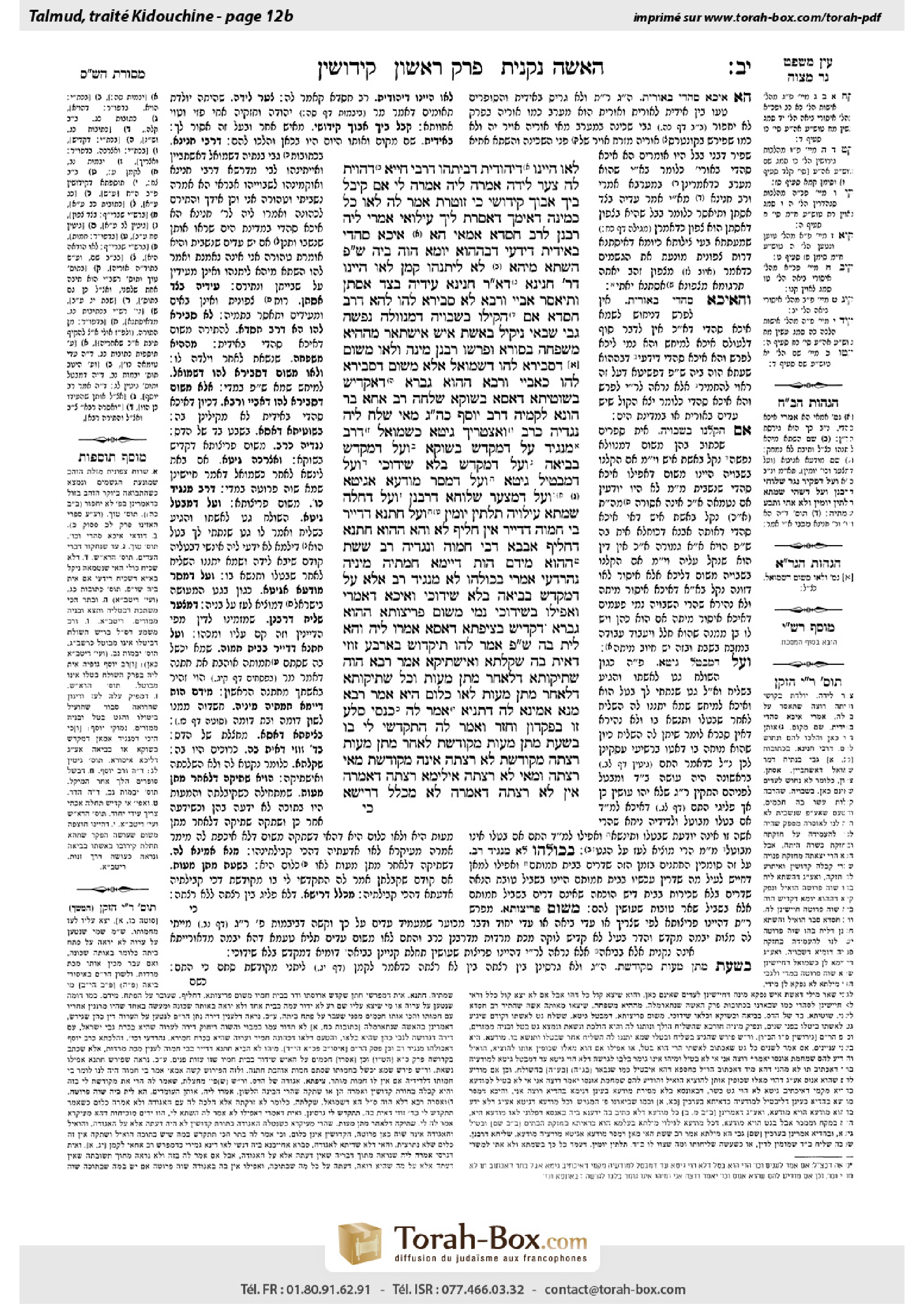
Kiddushin 12b: Talmud study for Daf Yomi
Daf Yomi is the daily study of one Talmud folio. Explore 37 tractates with scans, Hebrew text, Sefaria English and AI-generated French translations where annotated.
Passage selection and English or AI-generated French translation are available where the scan has annotations. Daf Study is independent of Torah-Box and Sefaria.
Browse Kiddushin · קידושין · All tractatesKiddushin 12b text and translations
This page of Kiddushin includes the Aramaic text, an English translation and an AI-generated French translation, alongside the scan above.
קידושין י״ב ב · Aramaic and Hebrew text
לָאו הַיְינוּ דִּיהוּדִית דְּבֵיתְהוּ דְּרַבִּי חִיָּיא, (דַּהֲוֵית) [דַּהֲוָה] לַהּ צַעַר לֵידָה, אֲמַרָה לֵיהּ: אֲמַרָה לִי אֵם: קַבֵּיל בִּיךְ אֲבוּךְ קִידּוּשֵׁי כִּי זוּטְרַתְּ. אֲמַר לַהּ: לָאו כָּל כְּמִינַּהּ דְּאִימָּךְ דְּאָסְרָה לִיךְ עִילָּוַאי.
אָמְרִי לֵיהּ רַבָּנַן לְרַב חִסְדָּא: אַמַּאי? הָא אִיכָּא סָהֲדִי בְּאִידִית, דְּיָדְעִי דִּבְהָהוּא יוֹמָא הֲוָה בַּיהּ שָׁוֶה פְּרוּטָה! הַשְׁתָּא מִיהָא לָא לֵיתַנְהוּ קַמַּן.
לָאו הַיְינוּ דְּרַבִּי חֲנִינָא, דְּאָמַר רַבִּי חֲנִינָא: עֵידֶיהָ בְּצַד אַסְתָּן, וְתֵיאָסֵר?!
אַבָּיֵי וְרָבָא לָא סְבִירָא לְהוּ לְהָא דְּרַב חִסְדָּא. אִם הֵקֵילּוּ בִּשְׁבוּיָה, דִּמְנַוְּולָה נַפְשַׁהּ גַּבֵּי שַׁבַּאי, נָיקֵיל בְּאֵשֶׁת אִישׁ?!
אִישְׁתְּאַר מֵהַהִיא מִשְׁפָּחָה בְּסוּרָא, וּפְרַשׁוּ רַבָּנַן מִינַּהּ. וְלָאו מִשּׁוּם דִּסְבִירָא לְהוּ דִּשְׁמוּאֵל, אֶלָּא מִשּׁוּם דִּסְבִירָא לְהוּ כְּאַבָּיֵי וְרָבָא.
הָהוּא גַּבְרָא דְּאקַדֵּישׁ בְּשׁוּטִיתָא דְאָסָא בְּשׁוּקָא, שַׁלְחַהּ רַב אַחָא בַּר הוּנָא לְקַמֵּיהּ דְּרַב יוֹסֵף: כְּהַאי גַּוְונָא מַאי? שְׁלַח לֵיהּ: נַגְּדֵיהּ כְּרַב, וְאַצְרֵיךְ גִּיטָּא כִּשְׁמוּאֵל.
דְּרַב מְנַגֵּיד עַל דִּמְקַדֵּשׁ בְּשׁוּקָא, וְעַל דִּמְקַדֵּשׁ בְּבִיאָה, וְעַל דִּמְקַדֵּשׁ בְּלָא שִׁידּוּכֵי.
וְעַל דִּמְבַטֵּיל גִּיטָּא, וְעַל דְּמָסַר מוֹדָעָא אַגִּיטָּא, וְעַל דִּמְצַעַר שְׁלוּחָא דְרַבָּנַן, וְעַל דְּחָלָה שַׁמְתָּא עִילָּוֵיהּ תְּלָתִין יוֹמִין,
וְעַל חַתְנָא דְּדָיַיר בֵּי חֲמוּהּ. דְּדָיַיר – אִין, חָלֵיף – לָא?! וְהָא הָהוּא חַתְנָא דַּחֲלֵיף אַבָּבָא דְּבֵי חֲמוּהּ וְנַגְּדֵיהּ רַב שֵׁשֶׁת! הָהוּא מֵידָם הֲוָת דָּיְימָא חֲמָתֵיהּ מִינֵּיהּ.
נְהַרְדָּעֵי אָמְרִי: בְּכוּלְּהוּ, לָא מְנַגֵּיד רַב אֶלָּא עַל דִּמְקַדֵּשׁ בְּבִיאָה בְּלָא שִׁידּוּכֵי. וְאִיכָּא דְּאָמְרִי: וַאֲפִילּוּ בְּשִׁידּוּכֵי נָמֵי מִשּׁוּם פְּרִיצוּתָא.
הָהוּא גַּבְרָא דְּקַדֵּישׁ בְּצִיפְּתָא דְאָסָא, אֲמַרוּ לֵיהּ: וְהָא לֵית בַּהּ שָׁוֶה פְּרוּטָה! אֲמַר לְהוּ: תִּיקְדּוֹשׁ בְּאַרְבַּע זוּזֵי דְּאִית בַּהּ. שְׁקַלְתַּהּ וְאִישְׁתִּיקָא. אָמַר רָבָא: הָוֵה שְׁתִיקוּתָא דִּלְאַחַר מַתַּן מָעוֹת, וְכֹל שְׁתִיקוּתָא דִּלְאַחַר מַתַּן מָעוֹת, לָאו כְּלוּם הִיא.
אָמַר רָבָא: מְנָא אָמֵינָא לַהּ, דְּתַנְיָא: אָמַר לָהּ: כִּנְסִי סֶלַע זוֹ בְּפִקָּדוֹן, וְחָזַר וְאָמַר לָהּ: הִתְקַדְּשִׁי לִי בּוֹ. בִּשְׁעַת מַתַּן מָעוֹת – מְקוּדֶּשֶׁת, לְאַחַר מַתַּן מָעוֹת, רָצְתָה – מְקוּדֶּשֶׁת, לֹא רָצְתָה – אֵינָהּ מְקוּדֶּשֶׁת.
מַאי ״רָצְתָה״ וּמַאי ״לֹא רָצְתָה״? אִילֵימָא ״רָצְתָה״ – דְּאָמְרָה: ״אִין״, לֹא רָצְתָה דְּאָמְרָה: ״לָא״, מִכְּלָל דְּרֵישָׁא,
Kiddushin 12b · English translation
Rav Ḥisda explained: Is this not similar to the case of Yehudit, wife of Rabbi Ḥiyya, who would have painful childbirths and therefore wished to leave Rabbi Ḥiyya? She said to Rabbi Ḥiyya: My mother told me: When you were young your father accepted betrothal on your behalf from another man, which would render Yehudit forbidden to Rabbi Ḥiyya. He said to her: It is not in your mother’s power to render you forbidden to me, as this testimony is insufficient.
Returning to the incident with the blue marble stone, the Gemara relates that the Sages said to Rav Ḥisda: Why do you say that she is not betrothed because the item is not worth one peruta in the place where the betrothal occurred? After all, there are witnesses in Idit who know that on that day it had the value of one peruta. Rav Ḥisda said to them: Now, in any event, they are not here, and therefore their potential testimony is disregarded.
Rav Ḥisda cites a proof for his statement: Isn’t this the same as the opinion of Rabbi Ḥanina? In the case of a woman who appeared before the court and said that she was taken captive but remained undefiled, if there are no witnesses that she was captured, her entire claim must be accepted, and therefore she is permitted to her husband. Although there are witnesses elsewhere who can testify that she was taken captive, and consequently, the court need not rely on her statement alone, as Rabbi Ḥanina says: When her witnesses are far away in the north [istan], will she be forbidden?
The Gemara comments: Abaye and Rava do not hold in accordance with this statement of Rav Ḥisda with regard to betrothal. In their opinion one cannot learn the halakha here from Rabbi Ḥanina’s statement, as there is a difference between the cases: If in the case of Rabbi Ḥanina the Sages were lenient with regard to a captive woman, who makes herself appear repulsive before her captor so that he will not rape her, and it is therefore believable that she was not violated, shall we be lenient with regard to the serious prohibition of a married woman?
The Gemara reports: Descendants of the family of the woman who had been betrothed with a blue marble stone remained in Sura, as after Rav Ḥisda ruled that that woman’s first betrothal was invalid, she married another man and had children. But the Sages avoided the family and refused to marry into it due to the concern that it was founded on a possibly adulterous relationship, which would render the descendants of the family mamzerim. The Gemara comments: And it was not because they maintained, in accordance with the opinion of Shmuel, that there is a concern that any item might be worth one peruta somewhere else. Rather, it was because they held in accordance with the opinion of Abaye and Rava, who said: Since there are witnesses in a different place, one must take them into account.
§ The Gemara relates: There was a certain man who betrothed a woman with a myrtle branch in the marketplace. Rav Aḥa bar Huna sent this dilemma before Rav Yosef: In a case like this, what is the halakha? Rav Yosef sent a response to him: Flog him, in accordance with the opinion of Rav, and require her to receive a bill of divorce, in accordance with the opinion of Shmuel, in case the myrtle branch is worth one peruta somewhere else.
The Gemara explains that Rav would flog a man for betrothing a woman in the marketplace, because this is disrespectful and crude, and for betrothing a woman through sexual intercourse, as it is unsavory to invite witnesses to observe a man and woman enter a room to engage in intercourse. And he would also flog a man for betrothing a woman without an arrangement [shiddukhei], i.e., if he did not discuss betrothal with the woman before betrothing her. Each of these acts is considered indecent behavior.
And likewise, Rav would flog a man for nullifying a bill of divorce he has already sent to his wife, and for issuing a declaration preemptively invalidating a bill of divorce. The latter case is referring to one who announces before giving a bill of divorce that he is divorcing his wife against his will, thereby rendering the document ineffective. This behavior might lead to a grave sin if the wife marries another man under the mistaken impression that she is divorced. And similarly, Rav would flog anyone for tormenting a messenger of the Sages, as this indicates a lack of regard for the Sages. And Rav would flog one who had an excommunication take effect on him for thirty days and yet does not repent or appeal to the Sages to annul his censure.
And Rav would flog a son-in-law who lives in his father-in-law’s house, as there is a concern that he might sin with his mother-in-law. The Gemara comments: This indicates that with regard to one who lives in his father-in-law’s house permanently, yes, he is flogged, whereas with regard to one who only passes by his father-in-law’s house, no, he is not flogged. But there was a certain son-in-law who passed by the entrance of his father-in-law’s house and Rav Sheshet flogged him due to licentiousness. The Gemara explains: In that case, there were suspicions [dayma] about him and his mother-in-law, i.e., about rumors of intimacy between them. In walking by the house he contributed to these rumors, which is why he was flogged.
The Sages of Neharde’a say: Rav would not flog a violator in all of the cases listed, but he would in fact flog a man for betrothing a woman through sexual intercourse without a prior arrangement. And there are those who say: Even if there was an arrangement beforehand, he would also flog a man for betrothing a woman with intercourse, due to licentiousness, as it is indecent to have witnesses observe a man and woman enter a room to engage in intercourse.
§ The Gemara relates: There was a certain man who betrothed a woman with a mat of myrtle branches. People who were present said to him: But it is not worth one peruta. He said to them: If so, let her be betrothed with the four dinars that are wrapped in the mat. The woman took the mat and was silent. Rava said: This is silence after the money is given, and any silence after the money is given is nothing. Since it was assumed at the time that he gave her an item worth less than one peruta, there is no proof that she acted in accordance with his subsequent statement. It is possible that she ignored him and did not intend to become betrothed with the four dinars.
Rava said: From where do I state this opinion? As it is taught in a baraita that in a case where a man said to a woman: Take this sela as a deposit, and he subsequently went back and said to her: Be betrothed to me with it, if he said this at the time the money was given, she is betrothed. In a case where he said this after the money was given, then if she wanted to be betrothed in this manner, she is betrothed. If she did not want it, she is not betrothed.
The Gemara inquires: What is the meaning of: She wanted, and what is the meaning of: She did not want? If we say that: She wanted, means that she said yes, she wishes to be betrothed, and: She did not want, means that she explicitly said no, one can learn by inference that in the first clause of the baraita, when he spoke as he gave her the money and no difference is suggested between her wanting or not wanting,
Kiddushin 12b · Traduction française (IA)
Rav Ḥisda expliqua : N’est-ce pas semblable au cas de Yehudit, l’épouse de Rabbi Ḥiyya, qui avait des accouchements douloureux et souhaitait donc quitter Rabbi Ḥiyya ? Elle lui dit : « Ma mère m’a dit que, lorsque tu étais jeune, ton père avait accepté en ton nom des kidouchin d’un autre homme », ce qui aurait rendu Yehudit interdite à Rabbi Ḥiyya. Il lui répondit : « Ta mère n’a pas le pouvoir de te rendre interdite à moi, car son témoignage ne suffit pas. »
Revenant à l’incident de la pierre bleue, la Guemara rapporte que les Sages dirent à Rav Ḥisda : « Pourquoi dis-tu qu’elle n’est pas fiancée, au motif que l’objet ne vaut pas une perouta à l’endroit où les kidouchin ont eu lieu ? Après tout, il y a à Idit des témoins qui savent que, ce jour-là, il valait une perouta. » Rav Ḥisda leur répondit : « Quoi qu’il en soit, ils ne sont pas ici à présent ; leur éventuel témoignage n’est donc pas pris en compte. »
Rav Ḥisda apporte une preuve à l’appui de son propos : N’est-ce pas la même position que celle de Rabbi Ḥanina ? Dans le cas d’une femme qui se présente devant le tribunal et déclare qu’elle a été faite prisonnière, mais qu’elle est restée intacte, s’il n’y a pas de témoins attestant qu’elle a été capturée, toute sa déclaration doit être acceptée, et elle est donc permise à son mari. Bien qu’il y ait ailleurs des témoins pouvant attester qu’elle a été capturée, de sorte que le tribunal n’ait pas à se fier à sa seule déclaration, Rabbi Ḥanina dit : « Si ses témoins sont loin, au nord [istan], sera-t-elle interdite ? »
La Guemara commente : Abaye et Rava ne sont pas d’accord avec cette affirmation de Rav Ḥisda au sujet des kidouchin. Selon eux, on ne peut pas déduire la halakha dans ce cas de l’affirmation de Rabbi Ḥanina, car les situations sont différentes : si, dans le cas de Rabbi Ḥanina, les Sages se sont montrés indulgents envers une femme captive, qui se rend repoussante aux yeux de son ravisseur afin qu’il ne la viole pas et dont on peut donc croire qu’elle n’a pas été violée, faut-il se montrer indulgent à propos de la grave interdiction concernant une femme mariée ?
La Guemara rapporte : Des descendants de la famille de la femme qui avait été fiancée avec une pierre bleue vivaient à Soura. En effet, après que Rav Ḥisda eut statué que les premiers kidouchin de cette femme étaient invalides, elle épousa un autre homme et eut des enfants. Mais les Sages évitaient cette famille et refusaient de s’y marier, par crainte qu’elle ne soit issue d’une relation adultère, ce qui aurait fait de ses descendants des mamzerim. La Guemara commente : Ce n’était pas parce qu’ils adoptaient l’opinion de Shmuel, selon laquelle il faut craindre que n’importe quel objet puisse valoir une perouta ailleurs. C’était plutôt parce qu’ils adoptaient l’opinion d’Abaye et de Rava, qui ont dit : « Puisqu’il y a des témoins dans un autre endroit, il faut en tenir compte. »
§ La Guemara rapporte : Un homme fiança une femme avec une branche de myrte sur la place du marché. Rav Aḥa bar Huna soumit cette question à Rav Yosef : « Quelle est la halakha dans un tel cas ? » Rav Yosef lui répondit : « Fais-le flageller, conformément à l’opinion de Rav, et exige qu’elle reçoive un acte de divorce, conformément à l’opinion de Shmuel, au cas où la branche de myrte vaudrait une perouta ailleurs. »
La Guemara explique que Rav faisait flageller un homme qui fiançait une femme sur la place du marché, car c’est irrespectueux et grossier, ainsi que celui qui la fiançait par des relations sexuelles, car il est inconvenant de faire venir des témoins pour observer un homme et une femme entrer dans une pièce afin d’y avoir des relations sexuelles. Il faisait également flageller un homme qui fiançait une femme sans arrangement préalable [shiddukhei], c’est-à-dire sans avoir discuté du projet de mariage avec elle avant de la fiancer. Chacun de ces actes est considéré comme une conduite indécente.
De même, Rav faisait flageller un homme qui annulait un acte de divorce qu’il avait déjà envoyé à sa femme, ainsi que celui qui déclarait à l’avance qu’un acte de divorce était invalide. Ce dernier cas concerne un homme qui annonce, avant de remettre un acte de divorce, qu’il répudie sa femme contre son gré, rendant ainsi le document inopérant. Une telle conduite peut entraîner une faute grave si la femme épouse un autre homme en croyant à tort être divorcée. De même, Rav faisait flageller quiconque tourmentait un émissaire des Sages, car cela témoignait d’un manque de respect envers les Sages. Rav faisait aussi flageller celui qui, frappé d’excommunication pour trente jours, ne se repentait pas et ne demandait pas aux Sages d’annuler sa censure.
Rav faisait flageller un gendre qui habitait chez son beau-père, car on craignait qu’il ne commette une faute avec sa belle-mère. La Guemara commente : Cela indique que celui qui habite en permanence chez son beau-père, oui, est flagellé, tandis que celui qui ne fait que passer devant la maison de son beau-père, non, ne l’est pas. Pourtant, un certain gendre passa devant la porte de la maison de son beau-père, et Rav Sheshet le fit flageller pour débauche. La Guemara explique : Dans ce cas, des soupçons [dayma] pesaient sur lui et sa belle-mère, c’est-à-dire que des rumeurs de relations intimes circulaient à leur sujet. En passant devant la maison, il alimentait ces rumeurs, ce qui explique pourquoi il fut flagellé.
Les Sages de Neharde’a disent que Rav ne faisait pas flageller un homme dans tous les cas énumérés, mais qu’il faisait effectivement flageller celui qui fiançait une femme par des relations sexuelles sans arrangement préalable. Selon certains, même s’il y avait eu un arrangement préalable, Rav faisait aussi flageller un homme qui fiançait une femme par des relations sexuelles, pour débauche, car il est inconvenant de faire observer par des témoins un homme et une femme entrant dans une pièce afin d’y avoir des relations sexuelles.
§ La Guemara rapporte : Un homme fiança une femme avec une natte de branches de myrte. Les personnes présentes lui dirent : « Mais elle ne vaut pas une perouta. » Il leur répondit : « Dans ce cas, qu’elle soit fiancée avec les quatre dinars enveloppés dans la natte. » La femme prit la natte et resta silencieuse. Rava dit : « C’est un silence après que l’argent a été donné, et tout silence après que l’argent a été donné ne vaut rien. » Puisqu’on supposait, au moment où il lui avait donné la natte, que l’objet valait moins d’une perouta, rien ne prouve qu’elle avait accepté sa déclaration ultérieure. Il est possible qu’elle l’ait ignoré et n’ait pas eu l’intention d’être fiancée avec les quatre dinars.
Rava dit : « Sur quoi est-ce que je fonde cette opinion ? » Sur ce qui est enseigné dans une baraïta : dans le cas où un homme dit à une femme : « Prends ce sela en dépôt », puis lui dit ensuite : « Sois fiancée à moi avec cette somme », si cette déclaration est faite au moment où l’argent lui est donné, elle est fiancée. S’il la fait après que l’argent a été donné, alors, si elle souhaite être fiancée de cette manière, elle est fiancée ; si elle ne le souhaite pas, elle n’est pas fiancée.
La Guemara demande : Que signifient « elle le souhaitait » et « elle ne le souhaitait pas » ? Si l’on dit que « elle le souhaitait » signifie qu’elle a répondu oui et souhaitait être fiancée, et que « elle ne le souhaitait pas » signifie qu’elle a explicitement répondu non, on peut en déduire que, dans la première partie de la baraïta, lorsqu’il a parlé au moment où il lui donnait l’argent et qu’aucune distinction n’est faite selon qu’elle le souhaitait ou non,
Traduction française générée par IA à partir de l’édition anglaise de Sefaria. Vérifie toujours un passage avec le texte source.
Text from Sefaria: William Davidson Edition - Vocalized Aramaic (CC BY NC); William Davidson Edition - English (CC BY NC).