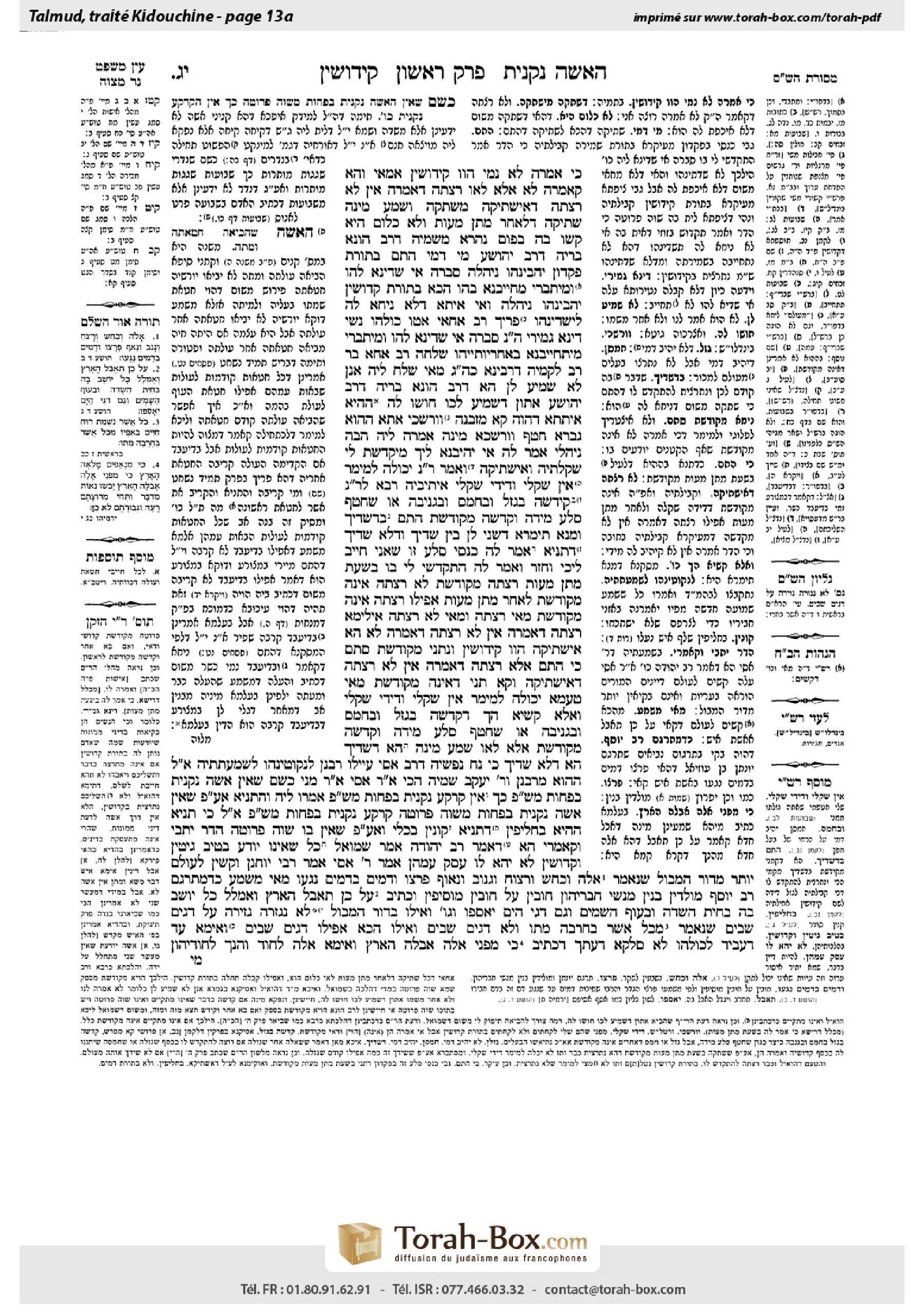
Kiddushin 13a: Talmud study for Daf Yomi
Daf Yomi is the daily study of one Talmud folio. Explore 37 tractates with scans, Hebrew text, Sefaria English and AI-generated French translations where annotated.
Passage selection and English or AI-generated French translation are available where the scan has annotations. Daf Study is independent of Torah-Box and Sefaria.
Browse Kiddushin · קידושין · All tractatesKiddushin 13a text and translations
This page of Kiddushin includes the Aramaic text, an English translation and an AI-generated French translation, alongside the scan above.
קידושין י״ג א · Aramaic and Hebrew text
כִּי אָמְרָה ״לָא״ נָמֵי הָווּ קִידּוּשִׁין? אַמַּאי, וְהָא קָאָמְרָה ״לָא״! אֶלָּא לָאו: ״רָצְתָה״ – דְּאָמְרָה: ״אִין״, לֹא רָצְתָה – דְּאִישְׁתִּיקָה מִשְׁתָּקה. וּשְׁמַע מִינַּהּ שְׁתִיקָה דִּלְאַחַר מַתַּן מָעוֹת – וְלֹא כְּלוּם הִיא.
קָשׁוּ בָּהּ בְּפוּם נַהֲרָא מִשְּׁמֵיהּ דְּרַב הוּנָא בְּרֵיהּ דְּרַב יְהוֹשֻׁעַ: מִי דָּמֵי? הָתָם בְּתוֹרַת פִּקָּדוֹן יַהֲבִינְהוּ נִיהֲלַהּ, סָבְרָה: אִי שָׁדֵינָא לְהוּ וּמִיתַּבְרִי – מְחַיַּיבְנָא בְּהוּ, הָכָא בְּתוֹרַת קִדּוּשִׁין יַהֲבִינְהוּ נִיהֲלַהּ, וְאִי אִיתָא דְּלָא נִיחָא לַהּ – (לִישְׁדִּינְהוּ)!
פָּרֵיךְ רַב אַחַאי: אַטּוּ כּוּלְּהוּ נְשֵׁי דִּינָא גְּמִירִי? הָכִי נָמֵי סַבְרַהּ: אִי שָׁדֵינָא לְהוּ וּמִיתַּבְרִי מִיתְחַיַּיבְנָא בְּאַחְרָיוּתַיְיהוּ. שְׁלַחָה רַב אַחָא בַּר רַב לְקַמֵּיהּ דְּרָבִינָא: כְּהַאי גַּוְונָא מַאי? שְׁלַח לֵיהּ: אֲנַן לָא שְׁמִיעַ לַן הָא דְּרַב הוּנָא בְּרֵיהּ דְּרַב יְהוֹשֻׁעַ, אַתּוּן דִּשְׁמִיעַ לְכוּ – חוּשׁוּ לַהּ.
הָהִיא אִיתְּתָא דַּהֲוָה קָא מְזַבְּנָה וַורְשְׁכֵי, אֲתָא הָהוּא גַּבְרָא חֲטַף וַורְשְׁכָא מִינַּהּ, אֲמַרָה לֵיהּ: הַבֵהּ נִיהֲלִי! אֲמַר לַהּ: אִי יָהֵיבְנָא לִיךְ מִיקַּדְּשַׁתְּ לִי? שְׁקַלְתֵּיהּ וְאִישְׁתִּיקָה. וְאָמַר רַב נַחְמָן: יְכֵולָה לְמֵימַר: אִין, שְׁקַלִי, וְדִידִי שְׁקַלִי.
אֵיתִיבֵיהּ רָבָא לְרַב נַחְמָן: קִידְּשָׁה בְּגָזֵל וּבְחָמָס, וּבִגְנֵיבָה, אוֹ שֶׁחָטַף סֶלַע מִיָּדָהּ וְקִדְּשָׁהּ – מְקוּדֶּשֶׁת! הָתָם בִּדְשַׁדֵּיךְ.
וּמְנָא תֵּימְרָא דְּשָׁנֵי לַן בֵּין שַׁדֵּיךְ וּדְלָא שַׁדֵּיךְ, דְּתַנְיָא: אָמַר לָהּ: ״כִּנְסִי סֶלַע זוֹ שֶׁאֲנִי חַיָּיב לִיכִי״ וְחָזַר וְאָמַר לָהּ: ״הִתְקַדְּשִׁי לִי בּוֹ״, בִּשְׁעַת מַתַּן מָעוֹת, רָצְתָה – מְקוּדֶּשֶׁת, לֹא רָצְתָה – אֵינָהּ מְקוּדֶּשֶׁת. לְאַחַר מַתַּן מָעוֹת, אֲפִילּוּ רָצְתָה – אֵינָהּ מְקוּדֶּשֶׁת.
מַאי ״רָצְתָה״ וּמַאי ״לֹא רָצְתָה״? אִילֵימָא ״רָצְתָה״ – דְּאָמְרָה אִין, לֹא רָצְתָה – דְּאָמְרָה לָא, הָא אִישְׁתִּיקָה – הָווּ קִידּוּשִׁין. וְנִתְנֵי ״מְקוּדֶּשֶׁת״ סְתָם, כִּי הָתָם!
אֶלָּא: ״רָצְתָה״ – דְּאָמְרָה ״אִין״, ״לֹא רָצְתָה״ – דְּאִישְׁתִּיקָה, וְקָא תָנֵי דְּאֵינָהּ מְקוּדֶּשֶׁת. מַאי טַעְמָא? יְכֵולָה לְמֵימַר: אִין, שְׁקַלִי, וְדִידִי שְׁקַלִי.
וְאֶלָּא קַשְׁיָא הָךְ דְּקִדְּשָׁהּ בְּגָזֵל וּבְחָמָס וּבִגְנֵיבָה אוֹ שֶׁחָטַף סֶלַע מִיָּדָהּ וְקִדְּשָׁהּ – מְקוּדֶּשֶׁת! אֶלָּא לָאו שְׁמַע מִינַּהּ: הָא – דְּשַׁדֵּיךְ, הָא – דְּלָא שַׁדֵּיךְ.
כִּי נָח נַפְשֵׁיהּ דְּרַבִּי אַסִּי, עֲיַילוּ רַבָּנַן לְנַקּוֹטִינְהוּ לִשְׁמַעְתָּתֵיהּ. אֲמַר לְהוּ הַהוּא מֵרַבָּנַן וְרַבִּי יַעֲקֹב שְׁמֵיהּ: הָכִי אָמַר רַבִּי אַסִּי אָמַר רַבִּי מָנִי: כְּשֵׁם שֶׁאֵין אִשָּׁה נִקְנֵית בְּפָחוֹת מִשָּׁוֶה פְּרוּטָה – כָּךְ אֵין קַרְקַע נִקְנֵית בְּפָחוֹת מִשָּׁוֶה פְּרוּטָה. אֲמַרוּ לֵיהּ: וְהָתַנְיָא: אַף עַל פִּי שֶׁאֵין אִשָּׁה נִקְנֵית בְּפָחוֹת מִשָּׁוֶה פְּרוּטָה – קַרְקַע נִקְנֵית בְּפָחוֹת מִשָּׁוֶה פְּרוּטָה!
אֲמַר לְהוּ: כִּי תַּנְיָא הָהִיא – בַּחֲלִיפִין, דְּתַנְיָא: קוֹנִין בִּכְלִי, וְאַף עַל פִּי שֶׁאֵין בּוֹ שָׁוֶה פְּרוּטָה.
הֲדַר יָתְבִי וְקָאָמְרִי, הָא דְּאָמַר רַב יְהוּדָה אָמַר שְׁמוּאֵל: כֹּל שֶׁאֵינוֹ יוֹדֵעַ בְּטִיב גִּיטִּין וְקִדּוּשִׁין לֹא יְהֵא לוֹ עֵסֶק עִמָּהֶן. אָמַר רַבִּי אַסִּי אָמַר רַבִּי יוֹחָנָן: וְקָשִׁין לְעוֹלָם יוֹתֵר מִדּוֹר הַמַּבּוּל, שֶׁנֶּאֱמַר: ״אָלֹה וְכַחֵשׁ וְרָצֹחַ וְגָנֹב וְנָאֹף פָּרָצוּ וְדָמִים בְּדָמִים נָגָעוּ״.
מַאי מַשְׁמַע? כְּדִמְתַרְגֵּם רַב יוֹסֵף: מוֹלְדִין בְּנִין מִנְּשֵׁי חַבְרֵיהוֹן חוֹבִין עַל חוֹבִין מוֹסִיפִין,
וּכְתִיב ״עַל כֵּן תֶּאֱבַל הָאָרֶץ וְאֻמְלַל כׇּל יוֹשֵׁב בָּהּ בְּחַיַּת הַשָּׂדֶה וּבְעוֹף הַשָּׁמָיִם וְגַם דְּגֵי הַיָּם יֵאָסֵפוּ וְגוֹ׳״, וְאִילּוּ בְּדוֹר הַמַּבּוּל לֹא נִגְזְרָה גְּזֵירָה עַל דָּגִים שֶׁבַּיָּם. שֶׁנֶּאֱמַר: ״מִכֹּל אֲשֶׁר בֶּחָרָבָה מֵתוּ״ – וְלֹא דָּגִים שֶׁבַּיָּם. וְאִילּוּ הָכָא, אֲפִילּוּ דָּגִים שֶׁבַּיָּם.
וְאֵימָא עַד דְּעָבֵיד לְכוּלְּהוּ! לָא סָלְקָא דַּעְתָּךְ, דִּכְתִיב: ״כִּי מִפְּנֵי אָלָה אָבְלָה הָאָרֶץ״.
וְאֵימָא: אָלָה לְחוּד, וְהָנָךְ לְחוּדֵיהוֹן!
Kiddushin 13a · English translation
that if she said: No, it would also be a betrothal. But why should that be the case? After all, she said: No. Rather, is it not to be explained in this manner, i.e., that the phrase: She wanted, means she said yes, and: She did not want, means that she remained silent. And one can learn from this that silence after the money is given is nothing. Her silence is not interpreted as an agreement to the betrothal.
In the city of Pum Nahara they raised a difficulty against Rava’s proof, in the name of Rav Huna, son of Rav Yehoshua: Is it comparable? There, in the baraita, he gave her the money as a deposit but they are his. She therefore thinks: If I throw them and they break I will be obligated to pay for them, as would anyone who destroys another person’s property. Consequently, her silence is interpreted as consent only to continue in her role of holding it as a deposit. By contrast, here he gives them to her as betrothal money so that they would belong to her. And if it is so, that she is not amenable to being betrothed, let her throw them away.
Rav Aḥai refutes this argument: Is that to say that all women are learned in halakha? In this case also, she thinks: If I throw them and they break I will be responsible for them. Therefore, I will not throw them. One cannot deduce from the fact that she does not throw the coins that she accepted them as betrothal money. Rav Aḥa bar Rav, sent this question to Ravina: In a case like this, what is the halakha? Ravina sent the following response to him: We did not hear this statement of Rav Huna, son of Rav Yehoshua. Therefore, we do not need to take it into consideration. You, who heard it, should be concerned about a possible betrothal.
§ The Gemara further relates: There was a certain woman who was selling belts. A certain man came and snatched a belt [varshekha] from her. She said to him: Give it to me. He said to her: If I give it to you will you be betrothed to me? She took it and was silent, and Rav Naḥman said: She could say: Yes, I took it, but I took my property. There is no proof that she agreed to accept it as a betrothal.
Rava raised an objection to the opinion of Rav Naḥman from a baraita: If a man betrothed a woman with property that was taken by robbery; or with property taken by a forced transaction, when the owner was reluctant to sell, or with property that was taken by theft; or if he grabbed a sela from her hand and betrothed her with it, she is betrothed. If so, why does Rav Naḥman say here that when he took it from her and betrothed her she is not betrothed? Rav Naḥman answered: There, it is referring to a case where he had previously arranged to marry her, and therefore if she remained silent she certainly agreed to the betrothal.
And from where do you say that there is a difference between a case where he had previously arranged to marry her and where he had not arranged to do so? As it is taught in a baraita that with regard to a man who said to a woman: Take this sela that I owe you, and he went back and said to her: Be betrothed to me with it, if he said this at the time the money was given and she wanted it, she is betrothed; if she did not want it, she is not betrothed. If he issued his statement after the money was given, then even if she wanted it, she is not betrothed.
Rav Naḥman clarifies: What is the meaning of: She wanted, and what is the meaning of: She did not want? If we say that: She wanted, means that she said yes, and: She did not want, means that she explicitly said no, it can be inferred that if she was silent it is a valid betrothal. But if so, let the baraita teach simply that she is betrothed, without specification, as it did there in the previous case, with regard to one who said: Take this sela as a deposit. It is obvious that if she explicitly said no, she is not betrothed.
Rather, the phrase: She wanted, means she said yes, and: She did not want, means that she remained silent. And in this case of silence the baraita taught that she is not betrothed. What is the reason that she is not betrothed if she remained silent? It is that she can say: Yes I took it, but I took my own property and did not intend to become betrothed.
But this is difficult with regard to that which we learned, that if a man betrothed her with property that was taken by robbery, or with property taken by a forced transaction, or with property that was taken by theft, or if he grabbed a sela from her hand and betrothed her with it, she is betrothed. Rather, isn’t it correct to conclude from it that this ruling, that she is betrothed if she was silent, is referring to a case where he arranged the marriage beforehand, whereas this ruling, that she is not betrothed when she remained silent, is referring to a situation where he did not arrange it beforehand?
§ The Gemara relates: When Rabbi Asi died, the Sages assembled to collect his statements, i.e., they wished to review his rulings of halakha lest they be forgotten. A certain member of the Sages, and Rabbi Ya’akov was his name, said to them: This is what Rabbi Asi said that Rabbi Mani said: Just as a woman cannot be acquired by less than the value of one peruta, so too land cannot be acquired by less than the value of one peruta. They said to him: But isn’t it taught in a baraita: Although a woman cannot be acquired by less than the value of one peruta, land can be acquired by less than the value of one peruta?
Rabbi Ya’akov said to them: When that baraita is taught to the effect that land can be acquired by less than the value of one peruta but a woman cannot, it was with regard to acquisition through symbolic exchange, i.e., a legal act of acquisition formalizing the transfer of ownership of an article. As it is taught in a baraita: One can acquire land and movable items through a symbolic exchange by giving a vessel, even though it is not worth one peruta.
They then sat and said additional statements in the name of Rabbi Asi. One statement concerned that which Rav Yehuda says that Shmuel says: Anyone who does not know the nature of bills of divorce and betrothals should have no dealings in them, as his ignorance might lead people to commit serious sins. In this context, Rabbi Asi says that Rabbi Yoḥanan says: And those who deal with these issues without proper knowledge are worse for the world than the generation of the flood, as it is stated: “Swearing and lying, and killing, and stealing, and committing adultery. They break all bounds, and blood touches blood” (Hosea 4:2).
The Gemara asks: From where may it be inferred that this verse is referring to individuals of this kind and that they are worse for the world than the generation of the flood? The Gemara explains: As Rav Yosef translated the phrase “and committing adultery, they break all bounds, and blood touches blood,” as: They give birth to children through the wives of others; they add sins upon sins.
And it is written in the next verse: “Therefore the land mourns and everyone who dwells there languishes, with the beasts of the field and the fowls of heaven, and the fishes of the sea are also taken away” (Hosea 4:3). This indicates that those who cause illegitimate children to be born lead to such a great tragedy that even the fish of the sea will die, whereas in the generation of the flood the decree was not imposed upon the fish in the sea, as it is stated: “Whatever was on dry land died” (Genesis 7:22). The explicit mention of dry land indicates that the fish in the sea did not die. But here, in the punishment described in the verses in Hosea, even the fish in the sea died.
The Gemara asks: But one can say that this punishment is not administered until they perform all of them, i.e., only if they commit all of the sins mentioned in the verse, including taking false oaths, committing murder, and stealing. The Gemara answers: It should not enter your mind to say this, as it is written: “For because of swearing the land mourns” (Jeremiah 23:10). This verse teaches that on account of taking false oaths alone the world can be destroyed, from which it may be inferred that each these acts on its own is enough to warrant destruction.
The Gemara further asks: But one can say that taking a false oath is distinct, as it involves the desecration of God’s name, and these other sins are distinct, i.e., they are less severe offenses that entail a less serious punishment. Therefore, it is possible that this great tragedy will result only if one performs all of them.
Kiddushin 13a · Traduction française (IA)
… que si elle avait dit non, cela aurait également constitué un kiddouchine. Mais pourquoi en serait-il ainsi ? Après tout, elle a dit non. Ne faut-il pas plutôt expliquer ainsi : l’expression « elle l’a voulu » signifie qu’elle a dit oui, et « elle ne l’a pas voulu » signifie qu’elle est restée silencieuse ? On peut donc en déduire que le silence après que l’argent a été donné ne signifie rien. Son silence n’est pas interprété comme un accord au kiddouchine.
Dans la ville de Pum Nahara, on souleva une difficulté contre la preuve de Rava, au nom de Rav Huna, fils de Rav Yehoshua : les deux cas sont-ils comparables ? Là, dans la baraïta, il lui a donné l’argent en dépôt, mais il lui appartient toujours. Elle pense donc : « Si je le jette et qu’il se brise, je serai tenue de le rembourser », comme toute personne qui détruit le bien d’autrui. Par conséquent, son silence est interprété comme un consentement à continuer de le garder en dépôt. En revanche, ici, il le lui donne comme argent de kiddouchine, afin qu’il lui appartienne. Et si elle ne consent pas à être épousée, qu’elle le jette donc.
Rav Aḥai réfute cet argument : faudrait-il croire que toutes les femmes connaissent la halakha ? Dans ce cas également, elle pense : « Si je le jette et qu’il se brise, j’en serai responsable. » C’est pourquoi elle ne le jette pas. On ne peut donc pas déduire du fait qu’elle ne jette pas les pièces qu’elle les a acceptées comme argent de kiddouchine. Rav Aḥa bar Rav adressa cette question à Ravina : dans un cas comme celui-ci, quelle est la halakha ? Ravina lui répondit : « Nous n’avons pas entendu cette déclaration de Rav Huna, fils de Rav Yehoshua. Nous n’avons donc pas à en tenir compte. Mais toi, qui l’as entendue, tu dois tenir compte de la possibilité qu’il y ait eu kiddouchine. »
§ La Guemara rapporte encore : une femme vendait des ceintures. Un homme vint et lui arracha une ceinture [varshekha]. Elle lui dit : « Rends-la-moi. » Il lui dit : « Si je te la rends, seras-tu épousée par moi ? » Elle la prit et resta silencieuse, et Rav Naḥman dit : « Elle pourrait dire : “Oui, je l’ai prise, mais j’ai repris mon propre bien.” » Rien ne prouve qu’elle ait consenti à l’accepter comme kiddouchine.
Rava souleva une objection contre l’opinion de Rav Naḥman à partir d’une baraïta : si un homme a betrothé une femme au moyen d’un bien qu’il avait pris par brigandage, ou d’un bien obtenu par une vente forcée alors que le propriétaire était réticent à vendre, ou d’un bien qu’il avait volé, ou s’il lui a arraché un séla de la main et l’a betrothée avec celui-ci, elle est betrothée. Pourquoi Rav Naḥman dit-il donc ici que, lorsqu’il le lui a pris et l’a betrothée avec, elle n’est pas betrothée ? Rav Naḥman répondit : là, il s’agit d’un cas où il avait auparavant convenu de l’épouser ; par conséquent, si elle est restée silencieuse, elle a certainement consenti au kiddouchine.
Et d’où savons-nous qu’il y a une différence entre le cas où il avait auparavant convenu de l’épouser et celui où il ne l’avait pas fait ? Car il est enseigné dans une baraïta qu’un homme dit à une femme : « Prends ce séla que je te dois », puis lui dit : « Sois betrothée à moi avec celui-ci. » S’il a dit cela au moment où l’argent lui a été donné et qu’elle l’a voulu, elle est betrothée ; si elle ne l’a pas voulu, elle n’est pas betrothée. S’il a fait cette déclaration après que l’argent lui a été donné, même si elle l’a voulu, elle n’est pas betrothée.
Rav Naḥman précise : que signifient « elle l’a voulu » et « elle ne l’a pas voulu » ? Si l’on dit que « elle l’a voulu » signifie qu’elle a dit oui, et que « elle ne l’a pas voulu » signifie qu’elle a explicitement dit non, on peut en déduire que, si elle était restée silencieuse, le kiddouchine serait valide. Mais dans ce cas, que la baraïta enseigne simplement qu’elle est betrothée, sans autre précision, comme elle l’a fait dans le cas précédent, à propos de celui qui lui a dit : « Prends ce séla en dépôt. » Il est évident que si elle a explicitement dit non, elle n’est pas betrothée.
Il faut plutôt dire que l’expression « elle l’a voulu » signifie qu’elle a dit oui, et que « elle ne l’a pas voulu » signifie qu’elle est restée silencieuse. Dans ce cas de silence, la baraïta enseigne qu’elle n’est pas betrothée. Pourquoi n’est-elle pas betrothée si elle est restée silencieuse ? Parce qu’elle peut dire : « Oui, je l’ai pris, mais j’ai repris mon propre bien et n’avais pas l’intention d’être betrothée. »
Mais cela soulève une difficulté au sujet de ce que nous avons appris : si un homme a betrothé une femme au moyen d’un bien qu’il avait pris par brigandage, d’un bien obtenu par une vente forcée, d’un bien qu’il avait volé, ou s’il lui a arraché un séla de la main et l’a betrothée avec celui-ci, elle est betrothée. Ne faut-il pas plutôt en conclure que cette décision, selon laquelle elle est betrothée si elle est restée silencieuse, concerne le cas où il avait convenu du mariage auparavant, tandis que cette décision, selon laquelle elle n’est pas betrothée lorsqu’elle est restée silencieuse, concerne une situation où il n’avait pas convenu du mariage auparavant ?
§ La Guemara rapporte : lorsque Rabbi Asi mourut, les Sages se réunirent pour recueillir ses enseignements, c’est-à-dire pour revoir ses décisions de halakha afin qu’elles ne soient pas oubliées. Un membre des Sages, nommé Rabbi Ya’akov, leur dit : « Voici ce que Rabbi Asi a rapporté au nom de Rabbi Mani : de même qu’une femme ne peut être acquise pour une valeur inférieure à une perouta, de même un terrain ne peut être acquis pour une valeur inférieure à une perouta. » Ils lui dirent : « Mais n’est-il pas enseigné dans une baraïta que, si une femme ne peut être acquise pour une valeur inférieure à une perouta, un terrain, lui, peut l’être ? »
Rabbi Ya’akov leur dit : « Lorsque cette baraïta enseigne qu’un terrain peut être acquis pour une valeur inférieure à une perouta, contrairement à une femme, elle parle d’une acquisition par échange symbolique, c’est-à-dire d’un acte juridique qui formalise le transfert de propriété d’un objet. Car il est enseigné dans une baraïta : on peut acquérir un terrain et des biens mobiliers par échange symbolique en donnant un récipient, même si celui-ci ne vaut pas une perouta. »
Ils s’assirent ensuite et énoncèrent d’autres enseignements au nom de Rabbi Asi. L’un d’eux concernait cette déclaration de Rav Yehuda au nom de Shmuel : quiconque ne connaît pas les règles des actes de divorce et des kiddouchine ne doit pas s’en occuper, car son ignorance pourrait conduire des personnes à commettre de graves péchés. Dans ce contexte, Rabbi Asi rapporte au nom de Rabbi Yoḥanan : « Ceux qui s’occupent de ces questions sans les connaître correctement sont plus nuisibles au monde que la génération du Déluge », comme il est écrit : « Les serments, le mensonge, le meurtre, le vol et l’adultère ; ils franchissent toutes les limites, et le sang touche le sang » (Osée 4:2).
La Guemara demande : d’où peut-on déduire que ce verset parle de personnes de cette sorte et qu’elles sont plus nuisibles au monde que la génération du Déluge ? La Guemara explique : Rav Yosef a traduit l’expression « et l’adultère, ils franchissent toutes les limites, et le sang touche le sang » ainsi : « Ils engendrent des enfants avec les femmes d’autrui ; ils ajoutent des péchés aux péchés. »
Et le verset suivant dit : « C’est pourquoi le pays sera en deuil et tous ceux qui y habitent dépériront, avec les animaux des champs et les oiseaux du ciel ; les poissons de la mer eux aussi seront emportés » (Osée 4:3). Cela indique que ceux qui font naître des enfants illégitimes provoquent une si grande catastrophe que même les poissons de la mer mourront, alors que, lors de la génération du Déluge, le décret ne frappa pas les poissons de la mer, comme il est dit : « Tout ce qui se trouvait sur la terre ferme mourut » (Genèse 7:22). La mention explicite de la terre ferme indique que les poissons de la mer ne moururent pas. Mais ici, dans le châtiment décrit par les versets d’Osée, même les poissons de la mer moururent.
La Guemara demande : mais ne peut-on pas dire que ce châtiment n’est appliqué que lorsqu’ils commettent tous ces actes, c’est-à-dire seulement s’ils commettent tous les péchés mentionnés dans le verset, notamment les faux serments, le meurtre et le vol ? La Guemara répond : il ne faut pas envisager cette possibilité, car il est écrit : « À cause des serments, le pays est en deuil » (Jérémie 23:10). Ce verset enseigne que les seuls faux serments peuvent détruire le monde ; on peut donc en déduire que chacun de ces actes, à lui seul, suffit à justifier une telle destruction.
La Guemara demande encore : mais ne peut-on pas dire que le faux serment est un cas particulier, puisqu’il implique la profanation du nom de Dieu, tandis que les autres péchés sont d’une autre nature, c’est-à-dire qu’ils sont moins graves et entraînent un châtiment moins sévère ? Il est donc possible que cette grande catastrophe ne survienne que si l’on commet tous ces actes.
Traduction française générée par IA à partir de l’édition anglaise de Sefaria. Vérifie toujours un passage avec le texte source.
Text from Sefaria: William Davidson Edition - Vocalized Aramaic (CC BY NC); William Davidson Edition - English (CC BY NC).