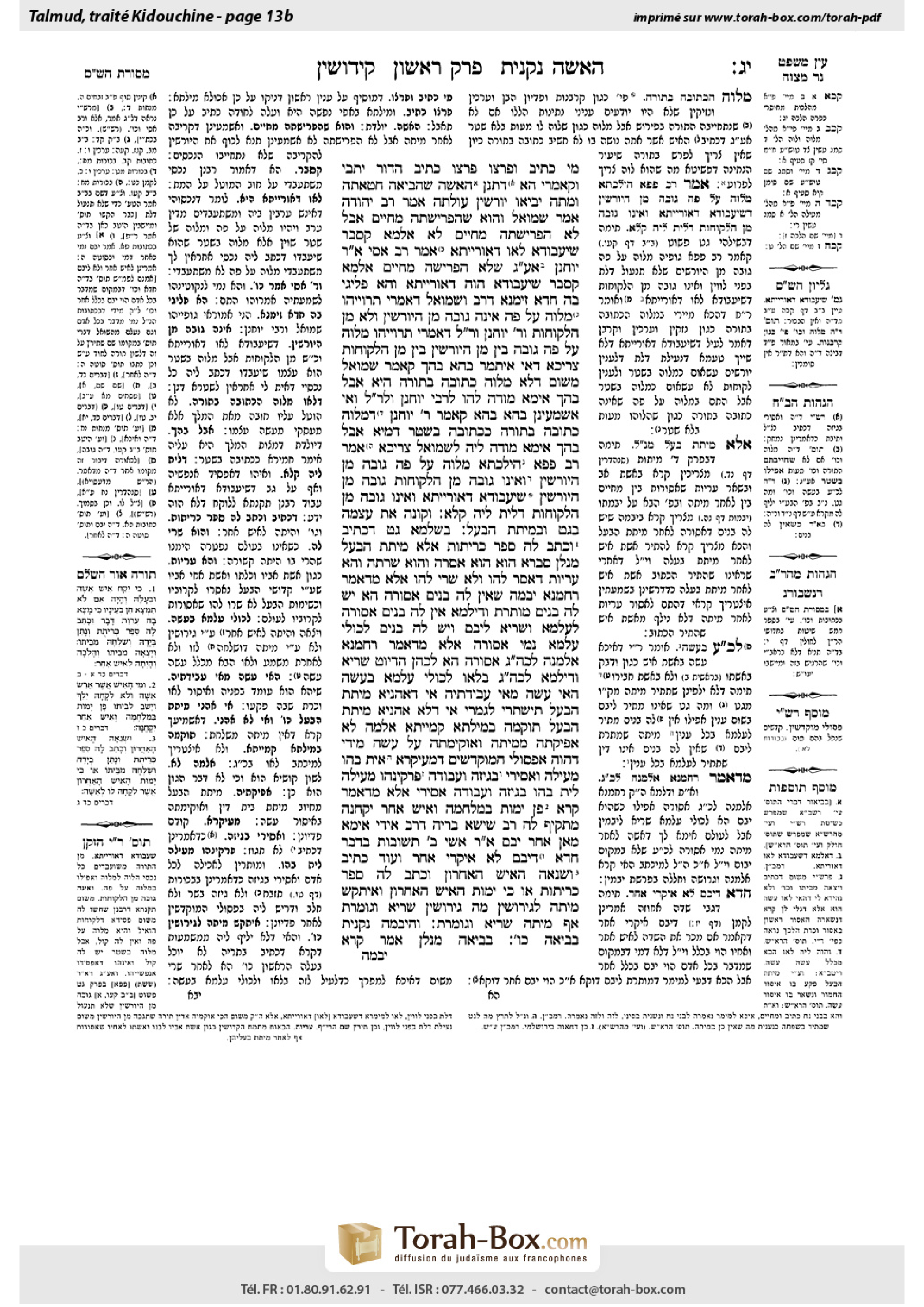
Kiddushin 13b: Talmud study for Daf Yomi
Daf Yomi is the daily study of one Talmud folio. Explore 37 tractates with scans, Hebrew text, Sefaria English and AI-generated French translations where annotated.
Passage selection and English or AI-generated French translation are available where the scan has annotations. Daf Study is independent of Torah-Box and Sefaria.
Browse Kiddushin · קידושין · All tractatesKiddushin 13b text and translations
This page of Kiddushin includes the Aramaic text, an English translation and an AI-generated French translation, alongside the scan above.
קידושין י״ג ב · Aramaic and Hebrew text
מִי כְּתִיב ״וּפָרָצוּ״? ״פָּרָצוּ״ כְּתִיב.
הֲדוּר יָתְבִי וְקָאָמְרִי: הָא דִּתְנַן: הָאִשָּׁה שֶׁהֵבִיאָה חַטָּאתָהּ וּמֵתָה – יָבִיאוּ יוֹרְשִׁין עוֹלָתָהּ. אָמַר רַב יְהוּדָה אָמַר שְׁמוּאֵל: וְהוּא שֶׁהִפְרִישַׁתָּה מֵחַיִּים. אֲבָל לֹא הִפְרִישַׁתָּה מֵחַיִּים – לָא.
אַלְמָא קָסָבַר שִׁיעְבּוּדָא לָאו דְּאוֹרָיְיתָא. אָמַר רַבִּי אַסִּי אָמַר רַבִּי יוֹחָנָן: אַף עַל גַּב שֶׁלֹּא הִפְרִישַׁתָּה מֵחַיִּים. אַלְמָא קָסָבַר: שִׁיעְבּוּדָא הָוֵה דְּאוֹרָיְיתָא.
וְהָא פְּלִיגִי בַּהּ חֲדָא זִימְנָא, דְּרַב וּשְׁמוּאֵל דְּאָמְרִי תַּרְוַיְיהוּ: מִלְוָה עַל פֶּה – אֵינָהּ גּוֹבָה מִן הַיּוֹרְשִׁין וְלֹא מִן הַלָּקוֹחוֹת. וְרַבִּי יוֹחָנָן וְרֵישׁ לָקִישׁ דְּאָמְרִי תַּרְוַיְיהוּ: מִלְוָה עַל פֶּה – גּוֹבָה בֵּין מִן הַיּוֹרְשִׁין, בֵּין מִן הַלָּקוֹחוֹת.
צְרִיכָא, דְּאִי אִיתְּמַר בְּהָא – בְּהָךְ קָאָמַר שְׁמוּאֵל, מִשּׁוּם דְּלָא מִלְוָה כְּתוּבָה בַּתּוֹרָה הִיא, אֲבָל בְּהָךְ – אֵימָא מוֹדֶה לְהוּ לְרַבִּי יוֹחָנָן וּלְרֵישׁ לָקִישׁ.
וְאִי אַשְׁמְעִינַן בְּהָא – בְּהָא קָאָמַר רַבִּי יוֹחָנָן, דְּמִלְוָה כְּתוּבָה בַּתּוֹרָה כִּכְתוּבָה בִּשְׁטָר דָּמְיָא, אֲבָל בְּהָךְ – אֵימָא מוֹדֶה לֵיהּ לִשְׁמוּאֵל, צְרִיכָא.
אָמַר רַב פָּפָּא: הִילְכְתָא, מִלְוָה עַל פֶּה – גּוֹבֶה מִן הַיּוֹרְשִׁין, וְאֵינוֹ גּוֹבֶה מִן הַלָּקוֹחוֹת. גּוֹבֶה מִן הַיּוֹרְשִׁין – שִׁיעְבּוּדָא דְּאוֹרָיְיתָא, וְאֵינוֹ גּוֹבֶה מִן הַלָּקוֹחוֹת – דְּלֵית לֵיהּ קָלָא.
וְקוֹנָה אֶת עַצְמָהּ בְּגֵט וּבְמִיתַת הַבַּעַל. בִּשְׁלָמָא גֵּט, דִּכְתִיב: ״וְכָתַב לָהּ סֵפֶר כְּרִיתֻת״.
אֶלָּא מִיתַת הַבַּעַל מְנָלַן? סְבָרָא הוּא: הוּא אַסְרַהּ וְהוּא שָׁרְתַהּ.
וְהָא עֲרָיוֹת, דְּאָסַר לְהוּ וְלָא שָׁרֵי לְהוּ! אֶלָּא מִדְּאָמַר רַחֲמָנָא יְבָמָה שֶׁאֵין לָהּ בָּנִים – אֲסוּרָה, הָא יֵשׁ לָהּ בָּנִים – מוּתֶּרֶת.
וְדִילְמָא: אֵין לָהּ בָּנִים – אֲסוּרָה לְעָלְמָא וְשַׁרְיָא לְיָבָם, וְיֵשׁ לָהּ בָּנִים – לְכוּלֵּי עָלְמָא נָמֵי אֲסוּרָה! אֶלָּא, מִדְּאָמַר רַחֲמָנָא אַלְמָנָה לְכֹהֵן גָּדוֹל – אֲסוּרָה, הָא לְכֹהֵן הֶדְיוֹט שַׁרְיָא.
וְדִילְמָא לְכֹהֵן גָּדוֹל בְּלָאו, לְכוּלֵּי עָלְמָא בַּעֲשֵׂה? הַאי עֲשֵׂה מַאי עֲבִידְתֵּיהּ? אִי דְּאַהַנְיָא מִיתַת הַבַּעַל – תִּישְׁתְּרֵי לִגְמָרֵי, אִי דְּלָא אַהַנְיָא מִיתַת הַבַּעַל – תּוֹקְמַהּ בְּמִילְּתָא קַמַּיְיתָא!
אַלְּמָה לָא? אַפִּיקְתַּהּ מִמִּיתָה וְאוֹקֵימְתַּהּ עַל עֲשֵׂה, מִידֵּי דְּהָוֵה אַפְּסוּלֵי הַמּוּקְדָּשִׁים,
דְּמֵעִיקָּרָא אִית בְּהוּ מְעִילָה, וַאֲסִירִי בְּגִיזָּה וַעֲבוֹדָה. פַּרְקִינְהוּ – מְעִילָה לֵית בְּהוּ, בְּגִיזָּה וַעֲבוֹדָה אֲסִירִי.
אֶלָּא מִדְּאָמַר קְרָא: ״פֶּן יָמוּת בַּמִּלְחָמָה וְאִישׁ אַחֵר יִקָּחֶנָּה״. מַתְקֵיף לַהּ רַב שִׁישָׁא בְּרֵיהּ דְּרַב אִידִי: אֵימָא, מַאן אַחֵר – יָבָם!
אָמַר רַב אָשֵׁי: שְׁתֵּי תְּשׁוּבוֹת בַּדָּבָר: חֲדָא, דְּיָבָם לָא אִיקְּרִי אַחֵר. וְעוֹד: כְּתִיב: ״וּשְׂנֵאָהּ הָאִישׁ הָאַחֲרוֹן וְכָתַב לָהּ סֵפֶר כְּרִיתֻת״ ״אוֹ כִי יָמוּת הָאִישׁ הָאַחֲרוֹן״, וְאִיתַּקַּשׁ מִיתָה לְגֵירוּשִׁין – מָה גֵּירוּשִׁין שַׁרְיָא וְגוֹמֶרֶת, אַף מִיתָה שַׁרְיָא וְגוֹמֶרֶת.
וְהַיְּבָמָה נִקְנֵית בְּבִיאָה כּוּ׳. בְּבִיאָה מְנָלַן? אָמַר קְרָא:
Kiddushin 13b · English translation
The Gemara explains: Is it written: And they break all bounds, with the conjunction: And, which would indicate that all the sins are included as one unit? Rather, it is written: “They break all bounds,” from which it may be inferred that this punishment is given separately for each one of these sins.
§ They then sat and said additional statements in the name of Rav Asi, one of which concerned that which we learned in a mishna (Kinnim 2:5): With regard to a woman after childbirth who brought her sin-offering for her ritual purification and died, the heirs bring her burnt-offering to fulfill her remaining sacrificial obligations. Rav Yehuda says that Shmuel says: And this is the halakha only when the woman herself had already separated, i.e., designated, the animal for the burnt-offering in her lifetime. But if she had not separated it in her lifetime, no, the heirs are not required to bring a burnt-offering on her behalf.
The Gemara concludes: Apparently, Shmuel maintains that the property of a debtor is not liened by Torah law. In other words, one does not say that because she was required to bring a burnt-offering there is a lien on her property and the debt must be paid even if she did not set aside the animal before her death. Rabbi Asi says that Rabbi Yoḥanan says: This is the halakha even though she did not separate the burnt-offering in her lifetime. Apparently, Rabbi Yoḥanan maintains that the property of a debtor is liened by Torah law.
The Gemara asks: But these Sages already disagreed about this issue once; why would they engage in the same dispute with regard to multiple applications? As Rav and Shmuel both say: With regard to a loan granted by oral agreement, i.e., without a document that places a lien on the land, if the debtor dies, the creditor cannot collect the loan from the heirs or from those who purchased the land. This is the halakha even if it is clear that there was a loan and the debtors do not dispute this fact. And Rabbi Yoḥanan and Reish Lakish both say: With regard to a loan by oral agreement, the creditor can collect from the heirs and from those who purchased from the debtor. This shows that those same Sages already disagreed as to whether a lien on a property exists by Torah law in the absence of a document.
The Gemara answers: It is necessary to teach both cases as, if it were stated only about this case of a loan, one might say: It is only with regard to this situation that Shmuel says there is no lien on property, because it is a loan that is not written in the Torah. This loan is merely a private agreement between two individuals. But with regard to this obligation of a woman to bring a burnt-offering, one might say that he concedes to Rabbi Yoḥanan and to Reish Lakish. Since this woman’s obligation to bring a burnt-offering is written in the Torah, perhaps it creates a lien on her property despite the fact that there is no document to that effect.
And conversely, had the amora’im taught us about their dispute only in this case of the burnt-offering of a woman following childbirth, one might say that Rabbi Yoḥanan says that the Torah imposes a lien only in this case of the burnt-offering, as a loan written in the Torah is like one written in a document. But with regard to this private loan, one might say that he concedes to Shmuel that the lien does not apply by Torah law. Therefore, it is necessary to state the dispute in both cases.
Rav Pappa said that the halakha is as follows: With regard to a loan by oral agreement, the creditor can collect from the heirs but he cannot collect from those who purchased from the debtor. The reason he can collect from the heirs is that the accepted opinion is that the property of a debtor is liened by Torah law. But he cannot collect from those who purchased from the debtor, because a loan by oral agreement does not generate publicity, i.e., people will not have heard about it. Therefore, they are not careful to avoid buying property from the debtor. These purchasers should not suffer due to a lien that was not well known.
§ The mishna teaches: And a woman acquires herself through a bill of divorce or through the death of the husband. The Gemara asks: Granted, this is the halakha with regard to a bill of divorce, as it is written explicitly in the Torah: “And he writes for her a scroll of severance, and gives it in her hand, and sends her out of his house; and she departs out of his house and she goes and becomes another man’s wife” (Deuteronomy 24:1–2). This indicates that a bill of divorce enables a woman to marry whomever she wishes after the divorce.
But from where do we derive that the death of the husband also enables a woman to remarry? The Gemara answers: This is based on logical reasoning: He, the husband, rendered her forbidden to every man, and he has permitted her. Since the husband is no longer alive, there is no one who renders her forbidden.
The Gemara asks: But consider the status of those with whom relations are forbidden, as he renders her forbidden to them, and yet he does not permit her to them when he dies. For example, one may not marry one’s father’s wife even after the father dies. Rather, from the fact that the Merciful One states that a yevama who does not have children from her deceased husband is prohibited from marrying anyone besides the yavam, it may be inferred that a widow who has children from her deceased husband is permitted to remarry.
The Gemara asks: But perhaps one should infer the following from that halakha: A woman who does not have children from her deceased husband is forbidden to everyone and permitted to the yavam, and a woman who has children from her deceased husband is forbidden to everyone also. Rather, the halakha that the death of the husband permits a woman to marry another man is derived from the fact that the Merciful One states that a widow is forbidden to a High Priest. This indicates that it is permitted for her to marry a common priest, and the same certainly applies to a non-priest.
The Gemara asks: But perhaps one can say that she is forbidden to a High Priest by a prohibition, whereas she is forbidden to everyone else only by dint of a positive mitzva. The Gemara asks: This positive mitzva, what is its purpose? If the death of the husband affects her status, she should be entirely permitted, and if the death of the husband does not affect her status she remains in her initial state when her husband was alive, and therefore those who engage in sexual intercourse with her would be liable to receive the death penalty.
The Gemara answers: And why is this suggestion not considered reasonable? One could argue that the death of the husband removed her from the class of people with whom one is punished with death for engaging in intercourse, and placed her in the class of people with whom one is prohibited to engage in intercourse due to a positive mitzva, just as it is with consecrated animals that have been disqualified. This is referring to animals that were designated as offerings but became invalid due to some blemish.
The Gemara explains: The halakha with regard to such animals is that initially, when they are unblemished, they are subject to the halakhot of misuse, i.e., if one benefited from them he has misused consecrated items. And likewise shearing them and performing labor with them is prohibited. Once these animals have developed a blemish and one has redeemed them, the prohibition against misuse of consecrated items does not apply to them, but shearing them and performing labor with them remains prohibited. Based on this example, it is possible that the death of the husband does not render the woman entirely permitted. If so, one cannot derive from here that it is permitted for a wife whose husband has passed away to marry another man.
Rather, the source that a widow may remarry is from that which the verse states: “Lest he die in battle and another man take her” (Deuteronomy 20:7). This indicates that a man may marry a widow. Rav Sheisha, son of Rav Idi, objects to this: One can say: Who is this other man mentioned by the verse? It is a yavam.
Rav Ashi said that there are two refutations of this statement: First, a yavam is not called “another,” as his relationship with her is not entirely separate from that of the first husband. And furthermore, it is written: “And the latter husband hates her, and writes her a scroll of severance and gives it in her hand and sends her out of his house, or if the latter husband dies” (Deuteronomy 24:3). In this manner the verse juxtaposes death to divorce: Just as divorce permits a woman to everyone and completes the severing of a husband from his wife, thereby allowing her to marry another man, so too, death permits her and completes the severing, allowing her to marry another man.
§ The mishna teaches: And a yevama can be acquired by the deceased husband’s brother, the yavam, only through intercourse. And she acquires herself through ḥalitza or through the death of the yavam. The Gemara asks: From where do we derive that she can be acquired through intercourse? The verse states:
Kiddushin 13b · Traduction française (IA)
La Guemara explique : Est-il écrit : « Et ils transgressent toutes les limites », avec la conjonction « et », ce qui indiquerait que tous les péchés sont inclus ensemble ? Il est plutôt écrit : « Ils transgressent toutes les limites », d’où l’on peut déduire que cette punition est infligée séparément pour chacun de ces péchés.
§ Ils s’assirent ensuite et énoncèrent d’autres enseignements au nom de Rav Asi, dont l’un concernait ce que nous avons appris dans une Michna (Kinnim 2:5) : à propos d’une femme qui, après un accouchement, a présenté son sacrifice expiatoire pour sa purification rituelle et qui est morte, ses héritiers présentent son holocauste afin de satisfaire à ses obligations sacrificielles restantes. Rav Yehouda dit au nom de Shmuel : cette halakha ne s’applique que si la femme elle-même avait déjà séparé, c’est-à-dire désigné, l’animal destiné à l’holocauste de son vivant. Mais si elle ne l’avait pas séparé de son vivant, alors non, les héritiers ne sont pas tenus de présenter un holocauste en son nom.
La Guemara conclut : Apparemment, Shmuel considère que les biens d’un débiteur ne sont pas grevés d’un privilège en vertu de la Torah. Autrement dit, on ne dit pas que, puisqu’elle était tenue de présenter un holocauste, ses biens sont grevés d’un privilège et que la dette doit être acquittée même si elle n’a pas mis l’animal à part avant sa mort. Rabbi Asi dit au nom de Rabbi Yoḥanan : cette halakha s’applique même si elle n’a pas séparé l’holocauste de son vivant. Apparemment, Rabbi Yoḥanan considère que les biens d’un débiteur sont grevés d’un privilège en vertu de la Torah.
La Guemara demande : Or, ces Sages ont déjà été en désaccord une fois sur cette question ; pourquoi reprendraient-ils le même désaccord à propos de plusieurs applications ? Rav et Shmuel disent tous deux : s’agissant d’un prêt consenti oralement, c’est-à-dire sans document grevant les biens immobiliers, si le débiteur meurt, le créancier ne peut recouvrer le prêt ni auprès des héritiers ni auprès des personnes qui ont acheté les biens immobiliers. Cette halakha s’applique même s’il est établi qu’un prêt a été consenti et que les débiteurs ne contestent pas ce fait. Rabbi Yoḥanan et Reish Lakish disent tous deux : s’agissant d’un prêt oral, le créancier peut recouvrer sa créance auprès des héritiers et des personnes qui ont acheté des biens au débiteur. Cela montre que ces mêmes Sages étaient déjà en désaccord sur la question de savoir si les biens sont grevés d’un privilège en vertu de la Torah en l’absence de document.
La Guemara répond : Il faut enseigner les deux cas, car si le désaccord n’était exposé qu’à propos de ce cas du prêt, on pourrait dire : Shmuel affirme seulement qu’il n’y a pas de privilège grevant les biens dans cette situation, parce qu’il s’agit d’un prêt qui n’est pas mentionné dans la Torah. Ce prêt n’est qu’un accord privé entre deux individus. Mais, concernant l’obligation d’une femme de présenter un holocauste, on pourrait dire qu’il est d’accord avec Rabbi Yoḥanan et Reish Lakish. Puisque l’obligation de cette femme de présenter un holocauste est mentionnée dans la Torah, peut-être grève-t-elle ses biens d’un privilège malgré l’absence de document à cet effet.
Inversement, si les amoraïm ne nous avaient enseigné leur désaccord qu’à propos de ce cas de l’holocauste d’une femme après un accouchement, on pourrait dire que Rabbi Yoḥanan affirme que la Torah impose un privilège uniquement dans ce cas de l’holocauste, car un prêt mentionné dans la Torah équivaut à un prêt consigné dans un document. Mais, concernant ce prêt privé, on pourrait dire qu’il est d’accord avec Shmuel : le privilège ne s’applique pas en vertu de la Torah. Il faut donc exposer le désaccord dans les deux cas.
Rav Pappa a dit que la halakha est la suivante : s’agissant d’un prêt oral, le créancier peut recouvrer sa créance auprès des héritiers, mais pas auprès des personnes qui ont acheté des biens au débiteur. Il peut recouvrer sa créance auprès des héritiers parce que l’opinion admise est que les biens d’un débiteur sont grevés d’un privilège en vertu de la Torah. Mais il ne peut pas la recouvrer auprès des personnes qui ont acheté des biens au débiteur, car un prêt oral n’est pas rendu public, c’est-à-dire que les gens n’en ont pas connaissance. Ils ne prennent donc pas la précaution d’éviter d’acheter des biens au débiteur. Ces acheteurs ne doivent pas subir les conséquences d’un privilège dont l’existence n’était pas connue.
§ La Michna enseigne : Une femme se libère aussi bien par un acte de divorce que par la mort de son mari. Concernant l’acte de divorce, cela se comprend, puisque c’est écrit explicitement dans la Torah : « Il écrira pour elle un acte de rupture, le lui remettra en main et la renverra de sa maison ; elle sortira de sa maison, s’en ira et deviendra la femme d’un autre homme » (Deutéronome 24:1–2). Cela indique qu’un acte de divorce permet à une femme d’épouser qui elle veut après le divorce.
Mais d’où déduisons-nous que la mort du mari permet aussi à une femme de se remarier ? La Guemara répond : cela repose sur un raisonnement logique : c’est lui, le mari, qui l’a rendue interdite à tout homme, et c’est lui qui l’a libérée. Puisque le mari n’est plus en vie, il n’y a personne pour la rendre interdite.
La Guemara demande : Mais considérons le statut des hommes avec lesquels les relations sont interdites : le mari la rend interdite à leur égard, et pourtant, à sa mort, il ne la leur permet pas. Par exemple, on ne peut pas épouser la femme de son père même après la mort de celui-ci. Il faut plutôt dire que, puisque le Miséricordieux déclare qu’une yevama qui n’a pas eu d’enfant de son mari défunt ne peut épouser personne d’autre que le yavam, on peut en déduire qu’une veuve qui a eu des enfants de son mari défunt peut se remarier.
La Guemara demande : Mais peut-être faut-il déduire cette halakha : une femme qui n’a pas eu d’enfant de son mari défunt est interdite à tous et permise au yavam, tandis qu’une femme qui a eu des enfants de son mari défunt est également interdite à tous. Il faut plutôt déduire que la mort du mari permet à une femme d’épouser un autre homme du fait que le Miséricordieux déclare qu’une veuve est interdite à un grand prêtre. Cela indique qu’elle peut épouser un prêtre ordinaire, et il en va à plus forte raison de même pour un non-prêtre.
La Guemara demande : Mais peut-être peut-on dire qu’elle est interdite à un grand prêtre par une interdiction, alors qu’elle n’est interdite à tous les autres qu’en vertu d’une mitsva positive. La Guemara demande : À quoi sert cette mitsva positive ? Si la mort du mari modifie son statut, elle devrait être entièrement permise ; et si la mort du mari ne modifie pas son statut, elle reste dans son état initial, celui où elle se trouvait lorsque son mari était vivant, et ceux qui ont des relations sexuelles avec elle seraient donc passibles de la peine de mort.
La Guemara répond : Pourquoi cette hypothèse ne serait-elle pas plausible ? On pourrait soutenir que la mort du mari l’a fait passer de la catégorie des personnes avec lesquelles les relations sexuelles sont punies de mort à celle des personnes avec lesquelles les relations sexuelles sont interdites en vertu d’une mitsva positive, comme c’est le cas des animaux consacrés devenus inaptes. Il s’agit d’animaux désignés comme offrandes, mais devenus invalides à cause d’un défaut.
La Guemara explique : La halakha concernant de tels animaux est la suivante : au départ, lorsqu’ils sont sans défaut, ils sont soumis aux lois du détournement d’objets consacrés, c’est-à-dire que celui qui en tire profit commet un détournement de biens consacrés. De même, il est interdit de les tondre et de les faire travailler. Une fois qu’ils ont contracté un défaut et qu’on les a rachetés, l’interdiction de détourner des biens consacrés ne s’applique plus à eux, mais il reste interdit de les tondre et de les faire travailler. À partir de cet exemple, il est possible que la mort du mari ne rende pas la femme entièrement permise. On ne peut donc pas en déduire que l’épouse dont le mari est décédé peut épouser un autre homme.
Il faut plutôt déduire la permission pour une veuve de se remarier de ce que dit le verset : « De peur qu’il ne meure à la guerre et qu’un autre homme ne la prenne » (Deutéronome 20:7). Cela indique qu’un homme peut épouser une veuve. Rav Sheisha, fils de Rav Idi, objecte : on peut dire que cet « autre homme » mentionné dans le verset est un yavam.
Rav Ashi dit qu’il y a deux réfutations de cette affirmation. Premièrement, un yavam n’est pas appelé « un autre », car son lien avec elle n’est pas entièrement distinct de celui du premier mari. En outre, il est écrit : « Le mari suivant la déteste, lui écrit un acte de rupture, le lui remet en main et la renvoie de sa maison, ou bien le mari suivant meurt » (Deutéronome 24:3). De cette manière, le verset rapproche la mort du divorce : de même que le divorce la rend permise à tous et achève la séparation entre un mari et sa femme, lui permettant ainsi d’épouser un autre homme, de même la mort la rend permise et achève cette séparation, lui permettant d’épouser un autre homme.
§ La Michna enseigne : Une yevama ne peut être acquise par le frère de son mari défunt, le yavam, que par la relation sexuelle. Elle se libère par la ḥalitza ou par la mort du yavam. La Guemara demande : D’où déduisons-nous qu’elle peut être acquise par la relation sexuelle ? Le verset dit :
Traduction française générée par IA à partir de l’édition anglaise de Sefaria. Vérifie toujours un passage avec le texte source.
Text from Sefaria: William Davidson Edition - Vocalized Aramaic (CC BY NC); William Davidson Edition - English (CC BY NC).