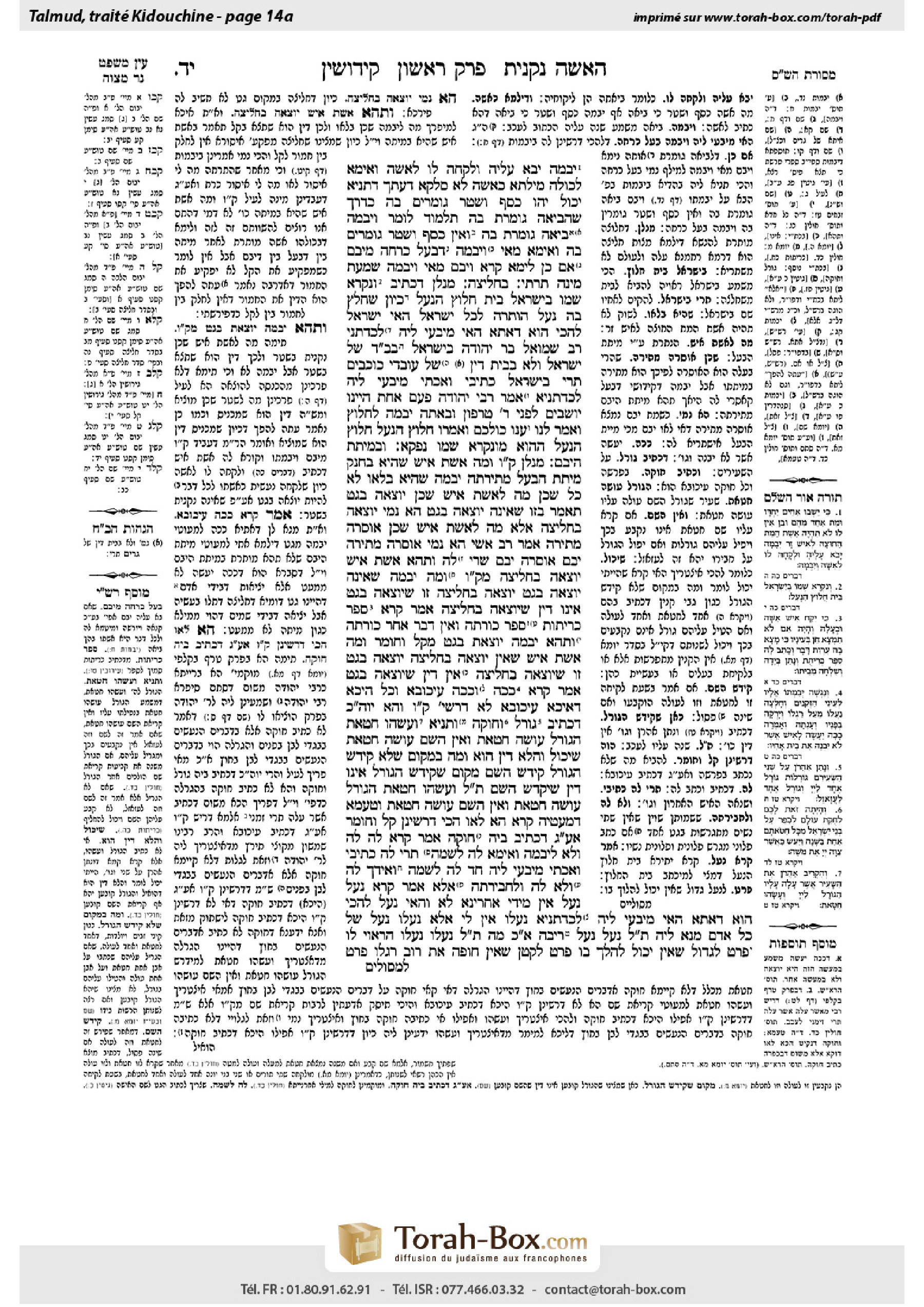
Kiddushin 14a: Talmud study for Daf Yomi
Daf Yomi is the daily study of one Talmud folio. Explore 37 tractates with scans, Hebrew text, Sefaria English and AI-generated French translations where annotated.
Passage selection and English or AI-generated French translation are available where the scan has annotations. Daf Study is independent of Torah-Box and Sefaria.
Browse Kiddushin · קידושין · All tractatesKiddushin 14a text and translations
This page of Kiddushin includes the Aramaic text, an English translation and an AI-generated French translation, alongside the scan above.
קידושין י״ד א · Aramaic and Hebrew text
״יְבָמָהּ יָבֹא עָלֶיהָ וּלְקָחָהּ לוֹ לְאִשָּׁה״. וְאֵימָא, לְכוּלַּהּ מִילְּתָא כְּאִשָּׁה! לָא סָלְקָא דַּעְתָּךְ, דְּתַנְיָא: יָכוֹל יְהוּ כֶּסֶף וּשְׁטָר גּוֹמְרִים בָּהּ, כְּדֶרֶךְ שֶׁהַבִּיאָה גּוֹמֶרֶת בָּהּ? תַּלְמוּד לוֹמַר: ״וְיִבְּמָהּ״ – בִּיאָה גּוֹמֶרֶת בָּהּ וְאֵין כֶּסֶף וּשְׁטָר גּוֹמְרִים בָּהּ.
וְאֵימָא: מַאי ״וְיִבְּמָהּ״? דִּבְעַל כֻּרְחַהּ מְיַבֵּם. אִם כֵּן, לֵימָא קְרָא: ״וְיִבֵּם״, מַאי ״וְיִבְּמָהּ״? שָׁמְעַתְּ מִינַּהּ תַּרְתֵּי.
בַּחֲלִיצָה. מְנָלַן? דִּכְתִיב: ״וְנִקְרָא שְׁמוֹ בְּיִשְׂרָאֵל בֵּית חֲלוּץ הַנָּעַל״ – כֵּיוָן שֶׁחָלַץ בָּהּ נַעַל, הוּתְּרָה לְכׇל יִשְׂרָאֵל.
הַאי ״יִשְׂרָאֵל״ לְהָכִי הוּא דַּאֲתָא? הַאי מִיבְּעֵי לֵיהּ לְכִדְתָנֵי רַב שְׁמוּאֵל בַּר יְהוּדָה: ״בְּיִשְׂרָאֵל״ – בְּבֵית דִּין שֶׁל יִשְׂרָאֵל, וְלֹא בְּבֵית דִּין שֶׁל נׇכְרִים! תְּרֵי ״בְּיִשְׂרָאֵל״ כְּתִיבִי.
וְאַכַּתִּי מִיבְּעֵי לֵיהּ לְכִדְתַנְיָא, אָמַר רַבִּי יְהוּדָה: פַּעַם אַחַת הָיִינוּ יוֹשְׁבִים לִפְנֵי רַבִּי טַרְפוֹן, וּבָאתָה יְבָמָה לַחְלוֹץ, וְאָמַר לָנוּ: עֲנוּ כּוּלְּכֶם וְאִמְרוּ: ״חֲלוּץ הַנַּעַל, חֲלוּץ הַנַּעַל״. הָהוּא, מִ״וְּנִקְרָא שְׁמוֹ״ נָפְקָא.
וּבְמִיתַת הַיָּבָם. מְנָלַן? קַל וָחוֹמֶר: וּמָה אֵשֶׁת אִישׁ שֶׁהִיא בְּחֶנֶק – מִיתַת הַבַּעַל מַתִּירָתָהּ, יְבָמָהּ שֶׁהִיא בְּלָאו – לֹא כׇּל שֶׁכֵּן?
מָה לְאֵשֶׁת אִישׁ, שֶׁכֵּן יוֹצְאָה בְּגֵט, תֹּאמַר בְּזוֹ שֶׁאֵינָהּ יוֹצְאָה בְּגֵט! הָא נָמֵי יוֹצְאָה בַּחֲלִיצָה.
אֶלָּא: מָה לְאֵשֶׁת אִישׁ שֶׁכֵּן אוֹסְרָהּ מַתִּירָהּ! אָמַר רַב אָשֵׁי: הָא נָמֵי אוֹסְרָהּ מַתִּירָהּ – יָבָם אוֹסְרָהּ, יָבָם שָׁרֵי לַהּ.
וּתְהֵא אֵשֶׁת אִישׁ יוֹצְאָה בַּחֲלִיצָה מִקַּל וָחוֹמֶר: וּמָה יְבָמָה שֶׁאֵינָהּ יוֹצְאָה בְּגֵט – יוֹצְאָה בַּחֲלִיצָה, זוֹ, שֶׁיּוֹצְאָה בְּגֵט – אֵינוֹ דִּין שֶׁיּוֹצְאָה בַּחֲלִיצָה? אָמַר קְרָא: ״סֵפֶר כְּרִיתֻת״ – סֵפֶר כּוֹרְתָהּ, וְאֵין דָּבָר אַחֵר כּוֹרְתָהּ.
וּתְהֵא יְבָמָה יוֹצֵאת בְּגֵט מִקַּל וָחוֹמֶר: וּמָה אֵשֶׁת אִישׁ שֶׁאֵין יוֹצְאָה בַּחֲלִיצָה – יוֹצְאָה בְּגֵט, זוֹ שֶׁיּוֹצְאָה בַּחֲלִיצָה – אֵין דִּין שֶׁיּוֹצְאָה בְּגֵט? אָמַר קְרָא: ״כָּכָה״, וְ״כָכָה״ עִיכּוּבָא.
וְכֹל הֵיכָא דְּאִיכָּא עִיכּוּבָא לָא דָּרְשִׁי קַל וָחוֹמֶר? וְהָא יוֹם הַכִּפּוּרִים דִּכְתִיב: ״גּוֹרָל״, וְ״חוּקָּה״,
וְתַנְיָא: ״וְעָשָׂהוּ חַטָּאת״ – הַגּוֹרָל עוֹשֶׂה חַטָּאת, וְאֵין הַשֵּׁם עוֹשֶׂה חַטָּאת.
שֶׁיָּכוֹל, וַהֲלֹא דִּין הוּא: וּמָה בִּמְקוֹם שֶׁלֹּא קִידֵּשׁ הַגּוֹרָל – קִידֵּשׁ הַשֵּׁם, מְקוֹם שֶׁקִּידֵּשׁ הַגּוֹרָל – אֵינוֹ דִּין שֶׁיְּקַדֵּשׁ הַשֵּׁם?
תַּלְמוּד לוֹמַר: ״וְעָשָׂהוּ חַטָּאת״ – הַגּוֹרָל עוֹשֶׂה חַטָּאת וְאֵין הַשֵּׁם עוֹשֶׂה חַטָּאת. וְטַעְמָא דְּמַעֲטֵיהּ קְרָא, הָא לָאו הָכִי דָּרְשִׁינַן קַל וָחוֹמֶר, אַף עַל גַּב דִּכְתִיב בֵּיהּ ״חוּקָּה״!
אָמַר קְרָא: ״לָהּ״, ״לָהּ״ – וְלֹא לִיבָמָהּ. וְאֵימָא ״לָהּ״ לִשְׁמָהּ!
תְּרֵי ״לָהּ״ כְּתִיבִי. וְאַכַּתִּי מִיבְּעֵי לֵיהּ חַד ״לָהּ״ לִשְׁמָהּ, וְאִידָּךְ ״לָהּ״ – וְלֹא לָהּ וְלַחֲבֶירְתָּהּ!
אֶלָּא, אָמַר קְרָא: ״נָעַל״ – נַעַל אִין, מִידֵּי אַחֲרִינָא – לָא.
וְהַאי ״נָעַל״ לְהָכִי הוּא דַּאֲתָא? הַאי מִיבְּעֵי לֵיהּ לְכִדְתַנְיָא: ״נַעֲלוֹ״ – אֵין לִי אֶלָּא נַעֲלוֹ, נַעַל שֶׁל כׇּל אָדָם מְנָא לֵיהּ?
תַּלְמוּד לוֹמַר: ״נַעַל״ ״נַעַל״ – רִיבָּה. אִם כֵּן מָה תַּלְמוּד לוֹמַר ״נַעֲלוֹ״? – נַעֲלוֹ הָרָאוּי לוֹ, פְּרָט לְגָדוֹל שֶׁאֵין יָכוֹל לְהַלֵּךְ בּוֹ, פְּרָט לְקָטָן שֶׁאֵין חוֹפֶה אֶת רוֹב רַגְלוֹ, פְּרָט
Kiddushin 14a · English translation
“Her brother-in-law will engage in sexual intercourse with her and take her to him as a wife, and perform levirate marriage with her” (Deuteronomy 25:5), which indicates that intercourse renders her his wife. The Gemara asks: But one can say that with regard to all matters she is like a wife, and therefore she can also be acquired with money or a document like any other woman. The Gemara answers: It could not enter your mind to say this, as it is taught in a baraita: One might have thought that money and a document can complete the acquisition of a yevama and cause her to be married, in the manner that intercourse completes her acquisition. Therefore, the verse states: “And perform levirate marriage with her” (Deuteronomy 25:5), which indicates that only intercourse completes her acquisition, but money or a document do not complete her acquisition.
The Gemara asks: But one can say: What is the meaning of: “And perform levirate marriage with her”? It teaches that he can perform levirate marriage without her consent, as unlike an ordinary marriage, a levirate marriage does not require the woman’s agreement. The Gemara answers: If so, let the verse say: And perform levirate marriage, and one would understand that the matter depends entirely on him. What is the meaning of: “And perform levirate marriage with her”? Learn two conclusions from this: First, that a levirate marriage can be performed against her will, and second, that the only way to acquire a yevama is through sexual intercourse.
§ The mishna teaches that the yevama acquires herself through ḥalitza. The Gemara asks: From where do we derive this halakha? The Gemara answers: As it is written with regard to levirate marriage, after the yavam has performed ḥalitza: “And his name shall be called in Israel: The house of him who had his shoe removed” (Deuteronomy 25:10). This indicates: Once his shoe is removed by her, she is permitted to all of Israel.
The Gemara asks: This term “Israel,” does it come to teach this halakha? It is required for that which is taught by Rav Shmuel bar Yehuda: The verse says “in Israel” to teach that ḥalitza may be performed only in a Jewish court, but not in a gentile court. The Gemara answers that the phrase “in Israel” is written twice in that chapter: “And his name shall be called in Israel” (Deuteronomy 25:10), and: “To establish a name for his brother in Israel” (Deuteronomy 25:7). A different halakha is derived from each of these instances.
The Gemara asks: But still, we also require the additional term “in Israel” for that which is taught in a baraita, that Rabbi Yehuda said: Once we were sitting before Rabbi Tarfon and a yevama came to perform ḥalitza. And Rabbi Tarfon said to us after the ḥalitza: All of you should answer and say: The one whose shoe was removed, the one whose shoe was removed. This indicates that the phrase: “And his name shall be called in Israel” (Deuteronomy 25:10), teaches that the matter must be announced and publicized throughout the nation. The Gemara answers: That halakha is not derived from the phrase “in Israel.” Rather, it is derived from: “And his name shall be called,” which indicates that it must be announced that this is his name.
§ The mishna further teaches that a yevama is released from levirate marriage and may remarry through the death of the yavam. The Gemara asks: From where do we derive this halakha? The Gemara answers that it is an a fortiori inference: If, with regard to a married woman, who is forbidden to other men by a prohibition punished with strangulation, and yet the death of her husband renders her permitted, is it not all the more so that with regard to a yevama, who is forbidden to other men while the yavam is alive by only a mere prohibition, that the death of the yavam should render her permitted?
The Gemara raises a difficulty against this a fortiori inference: What is unique about a married woman is that she can leave through a bill of divorce as well. Will you say the same with regard to this yevama, who does not leave through a bill of divorce? The Gemara answers: This is an insufficient refutation of the a fortiori inference, as this yevama also leaves through ḥalitza, which serves the same function as a bill of divorce.
Rather, one can challenge this a fortiori inference in the following manner. What is unique about a married woman is that the one who renders her forbidden to everyone else, i.e., her husband, also renders her permitted when he dies. This is not so with regard to a yevama, as she is rendered forbidden upon the death of her husband. Rav Ashi said: With regard to this yevama as well, he who renders her forbidden is also the one who renders her permitted: The yavam renders her forbidden, because if he was not alive she would automatically be permitted to other men. Likewise, the yavam renders her permitted through ḥalitza.
The Gemara asks: And let a married woman leave a marriage through ḥalitza, as derived by an a fortiori inference: If a yevama, who cannot leave through a bill of divorce, can leave through ḥalitza, is it not logical that this married woman, who can leave through a bill of divorce, can likewise leave through ḥalitza? The Gemara answers: The verse states with regard to a married woman: “A scroll of severance” (Deuteronomy 24:3), which indicates that a scroll, i.e., a written document, severs her from her husband and nothing else severs her from him. While the husband is alive only a bill of divorce can dissolve a marriage.
The Gemara further asks: And let a yevama leave through a bill of divorce, as derived by an a fortiori inference: If a married woman, who cannot leave through ḥalitza, can leave through a bill of divorce, is it not logical that this yevama, who can leave through ḥalitza, can also leave through a bill of divorce? The Gemara answers: The verse states: “So shall it be done to the man” (Deuteronomy 25:9), with regard to the ḥalitza of a yevama, and “so” precludes another option.
The Gemara asks: And is it true that anywhere that there is a term that precludes another option one cannot learn an a fortiori inference? But there is the case of the designation of the goats on Yom Kippur, as it is written: “The goat upon which the lot came up for the Lord” (Leviticus 16:9), and: “This shall be an everlasting statute to you” (Leviticus 16:34), which indicates that everything stated with regard to the mitzvot of Yom Kippur is critical to the performance of the service of the day.
And it is taught in a baraita that the verse states: “Aaron shall bring forward the goat upon which the lot came up for the Lord, and he shall offer it for a sin-offering” (Leviticus 16:9). The verse indicates that the lottery renders it a sin-offering, but a verbal designation of the goat with the status of a sin-offering does not render it a sin-offering.
The baraita continues: A verse is necessary to teach this halakha, as one might have thought that the opposite conclusion is correct: Could this not be derived through an a fortiori inference, as follows: Just as in a case in which the use of a lottery does not effect the consecration of the animals with a specific designation, e.g., with regard to a woman who has given birth and must bring two birds, one as a sin-offering and one as a burnt-offering, and nevertheless a verbal designation of the animals with the required status does effect the consecration of them, so too, in a case in which the use of a lottery does effect the consecration of the animals, is it not logically right that a verbal designation of the animals with the required status should effect the consecration of them?
To counter this reasoning, the verse states with regard to the goat: “He shall offer it for a sin-offering” (Leviticus 16:9), to indicate that the lottery renders it a sin-offering, but a verbal designation of the goat with the status of a sin-offering does not render it a sin-offering. And the reason that a verbal designation is ineffective is that the verse excluded this possibility, from which it may be inferred that if it were not so, one would learn an a fortiori inference, even though it is written with regard to it “statute.” The same logic should apply in the case of ḥalitza, i.e., the term “so” should not prevent one from learning an a fortiori inference, and therefore it might be argued that a yevama can be released through a bill of divorce.
Rather, the Gemara explains that here too, there is a limitation derived from a verse. The verse states with regard to a bill of divorce: “And write for her a scroll of severance” (Deuteronomy 24:3). “For her” is a limitation, which teaches: A bill of divorce is effective for a regular woman but not for a yevama. The Gemara asks: But one can say that the phrase “for her” indicates that the bill of divorce must be written for her sake.
The Gemara answers: “For her” is written twice (Deuteronomy 24:1, 3), and therefore both halakhot can be derived. The Gemara asks: And still, one instance of: “For her” is required to teach that the bill of divorce must be written for her sake, and the other “for her” is needed to teach: For her and not both for her and for another, i.e., her rival wife. One bill of divorce cannot be used for two women.
Rather, the Gemara suggests a different explanation as to why a bill of divorce is ineffective for a yevama. With regard to a yevama the verse states: “The house of him who had his shoe removed” (Deuteronomy 25:10), which teaches: If she is released by the ḥalitza of the shoe, yes, she is released from the yavam, but if she was released by means of something else, no, she is not released.
The Gemara asks: But this term “shoe,” does it come to teach this? It is necessary for that which is taught in a baraita: The verse said: “And remove his shoe” (Deuteronomy 25:9). I have derived only that his shoe may be used. From where do I derive that the shoe of any person may also be used for ḥalitza?
The verse states “shoe,” and states again in the next verse “shoe,” which includes any other shoe. If so, what is the meaning when the verse states “his shoe,” which is apparently referring to the shoe of that particular man? This teaches that it must be his shoe that is fit for him, excluding a shoe so large that he cannot walk in it, and excluding a shoe so small that it does not cover most of his foot, and excluding
Kiddushin 14a · Traduction française (IA)
« Son beau-frère s’unira à elle, la prendra pour épouse et accomplira avec elle le lévirat » (Deutéronome 25,5), ce qui indique que la relation sexuelle fait d’elle son épouse. La Guemara demande : Mais ne peut-on pas dire qu’à tous égards elle est comme une épouse et qu’elle peut donc aussi être acquise par de l’argent ou par un acte, comme toute autre femme ? La Guemara répond : Cela ne saurait venir à l’esprit, car il est enseigné dans une baraïta : On aurait pu penser que l’argent et un acte peuvent parachever l’acquisition d’une yevama et la rendre mariée, de la même manière que la relation sexuelle parachève son acquisition. Le verset dit donc : « Et accomplira avec elle le lévirat » (Deutéronome 25,5), ce qui indique que seule la relation sexuelle parachève son acquisition, tandis que l’argent ou un acte ne peuvent pas le faire.
La Guemara demande : Mais ne peut-on pas dire que « Et accomplira avec elle le lévirat » signifie qu’il peut accomplir le lévirat sans son consentement, car, contrairement à un mariage ordinaire, un mariage léviratique ne nécessite pas l’accord de la femme ? La Guemara répond : Si tel était le cas, que le verset dise : « Et accomplira le lévirat », et l’on comprendrait que la décision dépend entièrement de lui. Que signifie alors « Et accomplira avec elle le lévirat » ? Il faut en tirer deux conclusions : premièrement, le mariage léviratique peut être accompli contre sa volonté ; deuxièmement, une yevama ne peut être acquise que par la relation sexuelle.
§ La Michna enseigne que la yevama se libère par la ḥalitsa. La Guemara demande : D’où déduisons-nous cette halakha ? La Guemara répond : Il est écrit au sujet du lévirat, après que le yavam a accompli la ḥalitsa : « Son nom sera appelé en Israël : la maison de celui dont la chaussure a été retirée » (Deutéronome 25,10). Cela indique que, dès qu’elle lui a retiré sa chaussure, elle est permise à tout Israël.
La Guemara demande : Le terme « Israël » vient-il enseigner cette halakha ? Il est nécessaire pour ce qu’enseigne Rav Shmuel bar Yehuda : le verset dit « en Israël » pour enseigner que la ḥalitsa ne peut être accomplie que devant un tribunal juif, et non devant un tribunal non juif. La Guemara répond que l’expression « en Israël » apparaît deux fois dans ce chapitre : « Son nom sera appelé en Israël » (Deutéronome 25,10), et « établir un nom pour son frère en Israël » (Deutéronome 25,7). Une halakha différente est déduite de chacune de ces occurrences.
La Guemara demande : Mais il nous faut encore le terme supplémentaire « en Israël » pour ce qui est enseigné dans une baraïta, où Rabbi Yehuda a dit : Un jour, nous étions assis devant Rabbi Tarfon et une yevama vint accomplir la ḥalitsa. Après la ḥalitsa, Rabbi Tarfon nous dit : « Que chacun de vous réponde et dise : Celui dont la chaussure a été retirée, celui dont la chaussure a été retirée. » Cela indique que l’expression « Son nom sera appelé en Israël » (Deutéronome 25,10) enseigne que l’événement doit être annoncé et rendu public dans tout le peuple. La Guemara répond : Cette halakha n’est pas déduite de l’expression « en Israël », mais de « Son nom sera appelé », ce qui indique qu’il faut annoncer que tel est son nom.
§ La Michna enseigne en outre qu’une yevama est libérée du mariage léviratique et peut se remarier à la mort du yavam. La Guemara demande : D’où déduisons-nous cette halakha ? La Guemara répond qu’il s’agit d’une déduction a fortiori : si, dans le cas d’une femme mariée, interdite aux autres hommes par une prohibition punie de strangulation, la mort de son mari la rend pourtant permise, à plus forte raison la mort du yavam devrait-elle rendre permise une yevama, qui n’est interdite aux autres hommes tant que le yavam est vivant que par une simple prohibition.
La Guemara soulève une difficulté contre cette déduction a fortiori : Ce qui distingue une femme mariée, c’est qu’elle peut aussi se séparer par un acte de divorce. Peut-on en dire autant de cette yevama, qui ne se sépare pas par un acte de divorce ? La Guemara répond que cela ne réfute pas suffisamment la déduction a fortiori, car cette yevama peut aussi se séparer par la ḥalitsa, qui remplit la même fonction qu’un acte de divorce.
On peut plutôt contester cette déduction a fortiori de la manière suivante : Ce qui distingue une femme mariée, c’est que celui qui la rend interdite à tous les autres, c’est-à-dire son mari, la rend aussi permise à sa mort. Il n’en va pas ainsi pour une yevama, car elle devient interdite à la mort de son mari. Rav Ashi a dit : Dans le cas de cette yevama aussi, celui qui la rend interdite est également celui qui la rend permise : le yavam la rend interdite, car, s’il n’était pas vivant, elle serait automatiquement permise aux autres hommes. De même, le yavam la rend permise par la ḥalitsa.
La Guemara demande : Alors, qu’une femme mariée puisse se séparer par la ḥalitsa, selon une déduction a fortiori : si une yevama, qui ne peut se séparer par un acte de divorce, peut se séparer par la ḥalitsa, n’est-il pas logique que cette femme mariée, qui peut se séparer par un acte de divorce, puisse aussi se séparer par la ḥalitsa ? La Guemara répond : Au sujet d’une femme mariée, le verset dit : « Un acte de séparation écrit » (Deutéronome 24,3), ce qui indique qu’un écrit, c’est-à-dire un document écrit, la sépare de son mari et que rien d’autre ne la sépare de lui. Tant que le mari est en vie, seul un acte de divorce peut dissoudre le mariage.
La Guemara demande en outre : Alors, qu’une yevama puisse se séparer par un acte de divorce, selon une déduction a fortiori : si une femme mariée, qui ne peut se séparer par la ḥalitsa, peut se séparer par un acte de divorce, n’est-il pas logique que cette yevama, qui peut se séparer par la ḥalitsa, puisse aussi se séparer par un acte de divorce ? La Guemara répond : Le verset dit, au sujet de la ḥalitsa d’une yevama : « Ainsi sera-t-il fait à cet homme » (Deutéronome 25,9), et le terme « ainsi » exclut une autre possibilité.
La Guemara demande : Est-il vrai que partout où figure un terme qui exclut une autre possibilité, on ne peut pas faire de déduction a fortiori ? Pourtant, il y a le cas de la désignation des boucs à Yom Kippour, puisqu’il est écrit : « Le bouc sur lequel le sort est tombé pour le Seigneur » (Lévitique 16,9), et : « Ceci sera pour vous une loi perpétuelle » (Lévitique 16,34), ce qui indique que tout ce qui est dit au sujet des mitsvot de Yom Kippour est indispensable à l’accomplissement du service de ce jour.
Et il est enseigné dans une baraïta que le verset dit : « Aaron fera avancer le bouc sur lequel le sort est tombé pour le Seigneur, et il l’offrira en sacrifice expiatoire » (Lévitique 16,9). Le verset indique que le tirage au sort lui confère le statut de sacrifice expiatoire, mais qu’une désignation verbale du bouc comme sacrifice expiatoire ne lui confère pas ce statut.
La baraïta poursuit : Un verset est nécessaire pour enseigner cette halakha, car on aurait pu penser que la conclusion inverse est correcte. Ne peut-on pas le déduire a fortiori de la manière suivante ? Dans un cas où le tirage au sort ne confère pas aux animaux une désignation particulière — par exemple, pour une femme qui a accouché et doit apporter deux oiseaux, l’un en sacrifice expiatoire et l’autre en holocauste —, une désignation verbale des animaux selon le statut requis leur confère néanmoins ce statut. À plus forte raison, dans un cas où le tirage au sort confère ce statut aux animaux, n’est-il pas logique qu’une désignation verbale des animaux selon le statut requis le leur confère également ?
Pour réfuter ce raisonnement, le verset dit au sujet du bouc : « Il l’offrira en sacrifice expiatoire » (Lévitique 16,9), pour indiquer que le tirage au sort lui confère le statut de sacrifice expiatoire, mais qu’une désignation verbale du bouc comme sacrifice expiatoire ne lui confère pas ce statut. La désignation verbale est sans effet parce que le verset exclut cette possibilité. On peut en déduire que, sans cette exclusion, on aurait procédé à une déduction a fortiori, même si le terme « loi » figure à son sujet. Le même raisonnement devrait s’appliquer au cas de la ḥalitsa : le terme « ainsi » ne devrait pas empêcher une déduction a fortiori, et l’on pourrait donc soutenir qu’une yevama peut être libérée par un acte de divorce.
La Guemara explique plutôt qu’ici aussi, une restriction est déduite d’un verset. Au sujet de l’acte de divorce, le verset dit : « Et il écrira pour elle un acte de séparation » (Deutéronome 24,3). « Pour elle » est une restriction qui enseigne qu’un acte de divorce est valable pour une femme ordinaire, mais non pour une yevama. La Guemara demande : Mais ne peut-on pas dire que l’expression « pour elle » indique que l’acte de divorce doit être écrit pour elle ?
La Guemara répond : « Pour elle » apparaît deux fois (Deutéronome 24,1 et 3), et l’on peut donc en déduire les deux halakhot. La Guemara demande : Mais l’une des occurrences de « pour elle » est nécessaire pour enseigner que l’acte de divorce doit être écrit pour elle, et l’autre pour enseigner : pour elle, et non à la fois pour elle et pour une autre, c’est-à-dire sa coépouse. Un même acte de divorce ne peut pas servir pour deux femmes.
La Guemara propose plutôt une autre explication pour laquelle un acte de divorce est sans effet sur une yevama. À propos d’une yevama, le verset dit : « La maison de celui dont la chaussure a été retirée » (Deutéronome 25,10), ce qui enseigne que si elle est libérée par la ḥalitsa de la chaussure, alors oui, elle est libérée du yavam ; mais si elle est libérée par un autre moyen, alors non, elle n’est pas libérée.
La Guemara demande : Mais le terme « chaussure » vient-il enseigner cela ? Il est nécessaire pour ce qui est enseigné dans une baraïta : le verset dit : « Et lui retirer sa chaussure » (Deutéronome 25,9). Je n’ai déduit que sa propre chaussure pouvait être utilisée. D’où déduisons-nous que la chaussure de n’importe qui peut aussi être utilisée pour la ḥalitsa ?
Le verset dit « chaussure », puis répète « chaussure » au verset suivant, ce qui inclut toute autre chaussure. Dès lors, que signifie l’expression « sa chaussure », qui semble désigner la chaussure de cet homme en particulier ? Cela enseigne que sa chaussure doit être adaptée à lui, ce qui exclut une chaussure si grande qu’il ne peut pas marcher avec, une chaussure si petite qu’elle ne couvre pas la majeure partie de son pied, et exclut
Traduction française générée par IA à partir de l’édition anglaise de Sefaria. Vérifie toujours un passage avec le texte source.
Text from Sefaria: William Davidson Edition - Vocalized Aramaic (CC BY NC); William Davidson Edition - English (CC BY NC).