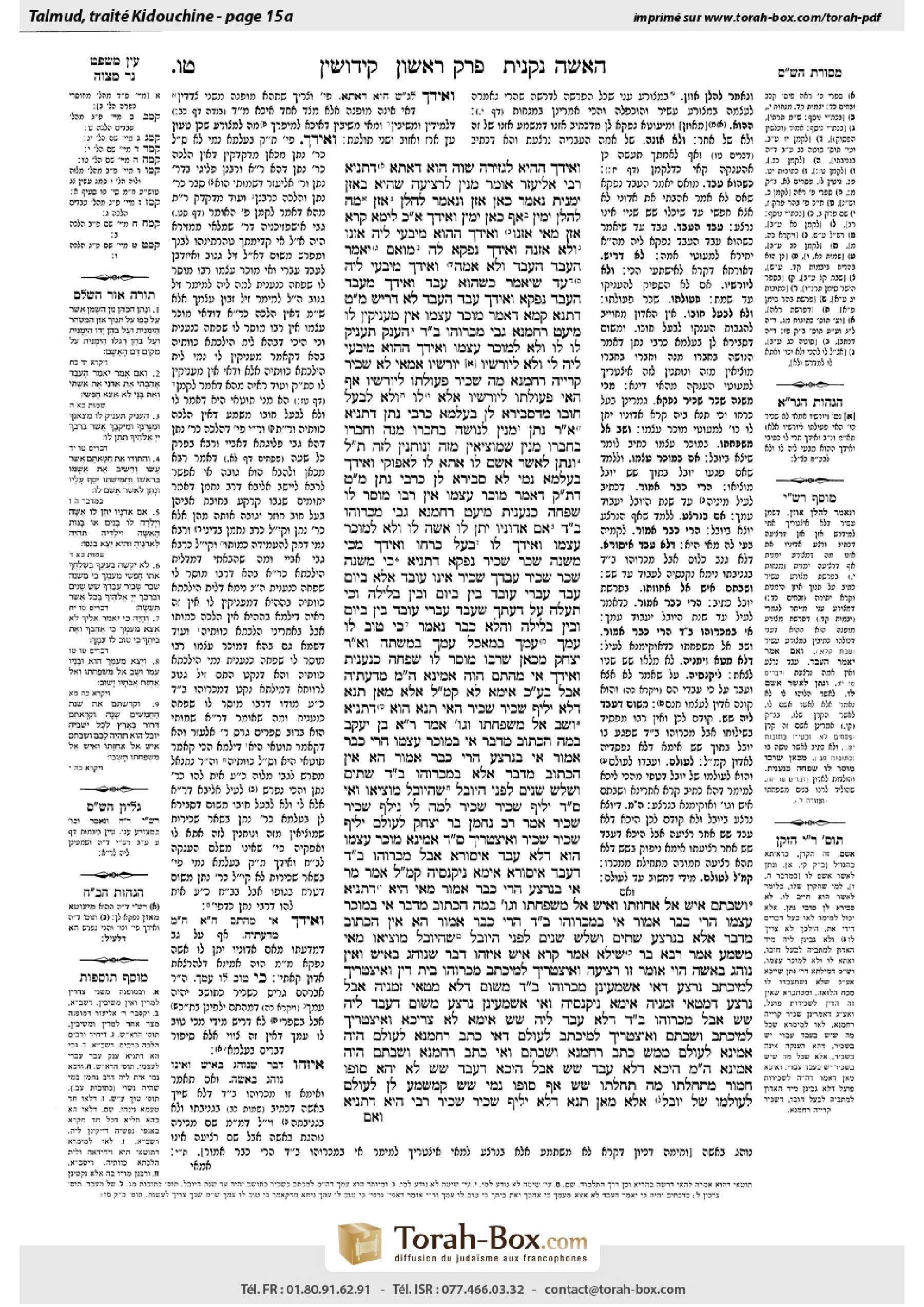
Kiddushin 15a: Talmud study for Daf Yomi
Daf Yomi is the daily study of one Talmud folio. Explore 37 tractates with scans, Hebrew text, Sefaria English and AI-generated French translations where annotated.
Passage selection and English or AI-generated French translation are available where the scan has annotations. Daf Study is independent of Torah-Box and Sefaria.
Browse Kiddushin · קידושין · All tractatesKiddushin 15a text and translations
This page of Kiddushin includes the Aramaic text, an English translation and an AI-generated French translation, alongside the scan above.
קידושין י״ה א · Aramaic and Hebrew text
וְאִידָּךְ? הָהִיא – לִגְזֵירָה שָׁוָה הוּא דַּאֲתָא. דְּתַנְיָא, רַבִּי אֱלִיעֶזֶר אוֹמֵר: מִנַּיִן לִרְצִיעָה שֶׁהִיא בְּאֹזֶן יָמָנִית? נֶאֱמַר כָּאן: ״אֹזֶן״, וְנֶאֱמַר לְהַלָּן: ״אֹזֶן״. מָה לְהַלָּן יָמִין – אַף כָּאן יָמִין.
וְאִידַּךְ? אִם כֵּן לֵימָא קְרָא ״אֹזֶן״, מַאי ״אׇזְנוֹ״?
וְאִידַּךְ? הַהוּא מִיבְּעֵי לֵיהּ: ״אׇזְנוֹ״ – וְלֹא אׇזְנָהּ. וְאִידַּךְ? נָפְקָא לַהּ מִ״וְּאִם יֹאמַר הָעֶבֶד״ – הָעֶבֶד וְלֹא אָמָה.
וְאִידַּךְ? מִיבְּעֵי לֵיהּ: עַד שֶׁיֹּאמַר כְּשֶׁהוּא עֶבֶד.
וְאִידַּךְ? מֵ״עֶבֶד״ ״הָעֶבֶד״ נָפְקָא. וְאִידַּךְ? ״עֶבֶד״ ״הָעֶבֶד״ לָא דָּרֵישׁ.
מַאי טַעְמָא דְּתַנָּא קַמָּא דְּאָמַר מוֹכֵר עַצְמוֹ אֵין מַעֲנִיקִין לוֹ? מִיעֵט רַחֲמָנָא גַּבֵּי מְכָרוּהוּ בֵּית דִּין: ״הַעֲנֵיק תַּעֲנִיק לוֹ״ – לוֹ, וְלֹא לְמוֹכֵר עַצְמוֹ.
וְאִידַּךְ? הַהוּא מִיבְּעֵי לֵיהּ: לוֹ, וְלֹא לְיוֹרְשָׁיו. יוֹרְשָׁיו אַמַּאי לָא? ״שָׂכִיר״ קַרְיֵיהּ רַחֲמָנָא, מָה שָׂכִיר פְּעוּלָּתוֹ לְיוֹרְשָׁיו – אַף הַאי פְּעוּלָּתוֹ לְיוֹרְשָׁיו! אֶלָּא: לוֹ, וְלֹא לְבַעַל חוֹבוֹ.
מִדִּסְבִירָא לַן בְּעָלְמָא כְּרַבִּי נָתָן, דְּתַנְיָא, אָמַר רַבִּי נָתָן: מִנַּיִן לַנּוֹשֶׁה בַּחֲבֵרוֹ מָנֶה, וַחֲבֵרוֹ בַּחֲבֵרוֹ – מִנַּיִן שֶׁמּוֹצִיאִין מִזֶּה וְנוֹתְנִין לָזֶה? תַּלְמוּד לוֹמַר: ״וְנָתַן לַאֲשֶׁר אָשַׁם לוֹ״.
אֲתָא ״לוֹ״ לְאַפּוֹקֵי. וְאִידַּךְ? בְּעָלְמָא נָמֵי לָא סְבִירָא לַן כְּרַבִּי נָתָן.
מַאי טַעְמָא דְּתַנָּא קַמָּא דְּאָמַר מוֹכֵר עַצְמוֹ אֵין רַבּוֹ מוֹסֵר לוֹ שִׁפְחָה כְּנַעֲנִית? מַיעֵט רַחֲמָנָא גַּבֵּי מְכָרוּהוּ בֵּית דִּין: ״אִם אֲדֹנָיו יִתֶּן לוֹ אִשָּׁה״ – לוֹ, וְלֹא לְמוֹכֵר עַצְמוֹ. וְאִידַּךְ? לוֹ – בְּעַל כׇּרְחוֹ.
וְאִידַּךְ? מִ״כִּי מִשְׁנֶה שְׂכַר שָׂכִיר״ נָפְקָא, דְּתַנְיָא: ״כִּי מִשְׁנֶה שְׂכַר שָׂכִיר עֲבָדְךָ״ – שָׂכִיר אֵינוֹ עוֹבֵד אֶלָּא בַּיּוֹם, עֶבֶד עִבְרִי עוֹבֵד בֵּין בַּיּוֹם וּבֵין בַּלַּיְלָה.
וְכִי תַעֲלֶה עַל דַּעְתְּךָ שֶׁעֶבֶד עִבְרִי עוֹבֵד בֵּין בַּיּוֹם וּבֵין בַּלַּיְלָה? וַהֲלֹא כְּבָר נֶאֱמַר: ״כִּי טוֹב לוֹ עִמָּךְ״ – עִמְּךָ בַּמַּאֲכָל, עִמְּךָ בַּמִּשְׁתֶּה. וְאָמַר רַבִּי יִצְחָק: מִכָּאן שֶׁרַבּוֹ מוֹסֵר לוֹ שִׁפְחָה כְּנַעֲנִית.
וְאִידַּךְ? אִי מֵהָתָם, הֲוָה אָמֵינָא הָנֵי מִילֵּי מִדַּעְתֵּיהּ, אֲבָל בְּעַל כֻּרְחֵיהּ אֵימָא לָא, קָא מַשְׁמַע לַן.
אֶלָּא, מַאן תַּנָּא דְּלָא יָלֵיף ״שָׂכִיר״ ״שָׂכִיר״? הַאי תַּנָּא הוּא, דְּתַנְיָא: ״וְשָׁב אֶל מִשְׁפַּחְתּוֹ וְגוֹ׳״ אָמַר רַבִּי אֱלִיעֶזֶר בֶּן יַעֲקֹב: בַּמָּה הַכָּתוּב מְדַבֵּר? אִי בְּמוֹכֵר עַצְמוֹ – הֲרֵי כְּבָר אָמוּר!
אִי בְּנִרְצָע – הֲרֵי כְּבָר אָמוּר! הָא אֵין הַכָּתוּב מְדַבֵּר אֶלָּא בִּמְכָרוּהוּ בֵּית דִּין שְׁתַּיִם וְשָׁלֹשׁ שָׁנִים לִפְנֵי הַיּוֹבֵל, שֶׁהַיּוֹבֵל מוֹצִיאוֹ. וְאִי סָלְקָא דַעְתָּךְ יָלֵיף ״שָׂכִיר״ ״שָׂכִיר״, לְמָה לִי? נֵילַף ״שָׂכִיר״ ״שָׂכִיר״!
אָמַר רַב נַחְמָן בַּר יִצְחָק: לְעוֹלָם יָלֵיף ״שָׂכִיר״ ״שָׂכִיר״, וְאִיצְטְרִיךְ, סָלְקָא דַּעְתָּךְ אָמֵינָא, מוֹכֵר עַצְמוֹ הוּא, דְּלָא עֲבַד אִיסּוּרָא, אֲבָל מְכָרוּהוּ בֵּית דִּין, דַּעֲבַד אִיסּוּרָא, אֵימָא נִיקְנְסֵיהּ, קָא מַשְׁמַע לַן.
אָמַר מָר: אִי בְּנִרְצָע – הֲרֵי כְּבָר אָמוּר. מַאי הִיא? דְּתַנְיָא: ״וְשַׁבְתֶּם אִישׁ אֶל אֲחֻזָּתוֹ וְאִישׁ אֶל מִשְׁפַּחְתּוֹ וְגוֹ׳״ בַּמָּה הַכָּתוּב מְדַבֵּר? אִי בְּמוֹכֵר עַצְמוֹ – הֲרֵי כְּבָר אָמוּר!
אִי בִּמְכָרוּהוּ בֵּית דִּין – הֲרֵי כְּבָר אָמוּר! הָא אֵין הַכָּתוּב מְדַבֵּר אֶלָּא בְּנִרְצַע שְׁתַּיִם וְשָׁלֹשׁ שָׁנִים לִפְנֵי הַיּוֹבֵל, שֶׁהַיּוֹבֵל מוֹצִיאוֹ. מַאי מַשְׁמַע? אָמַר רָבָא בַּר שֵׁילָא: אָמַר קְרָא: ״אִישׁ״, אֵיזֶהוּ דָּבָר שֶׁנּוֹהֵג בָּאִישׁ וְאֵין נוֹהֵג בָּאִשָּׁה – הֱוֵי אוֹמֵר זוֹ רְצִיעָה.
וְאִיצְטְרִיךְ לְמִיכְתַּב מְכָרוּהוּ בֵּית דִּין, וְאִיצְטְרִיךְ לְמִיכְתַּב נִרְצָע. דְּאִי אַשְׁמְעִינַן מְכָרוּהוּ בֵּית דִּין, מִשּׁוּם דְּלָא מְטַאי זִמְנֵיהּ, אֲבָל נִרְצָע, דִּמְטַאי זִמְנֵיהּ, אֵימָא נִיקְנְסֵיהּ.
וְאִי אַשְׁמְעִינַן נִרְצָע, מִשּׁוּם דַּעֲבַד לֵיהּ שֵׁשׁ, אֲבָל מְכָרוּהוּ בֵּית דִּין, דְּלָא עֲבַד לֵיהּ שֵׁשׁ, אֵימָא לָא, צְרִיכָא.
וְאִיצְטְרִיךְ לְמִיכְתַּב ״וְשַׁבְתֶּם״, וְאִיצְטְרִיךְ לְמִיכְתַּב ״לְעוֹלָם״. דְּאִי כְּתַב רַחֲמָנָא ״לְעוֹלָם״, הֲוָה אָמֵינָא לְעוֹלָם מַמָּשׁ, כְּתַב רַחֲמָנָא ״וְשַׁבְתֶּם״.
וְאִי כְּתַב רַחֲמָנָא ״וְשַׁבְתֶּם״, הֲוָה אָמֵינָא: הָנֵי מִילֵּי הֵיכָא דְּלָא עֲבַד שֵׁשׁ, אֲבָל הֵיכָא דַּעֲבַד שֵׁשׁ לֹא יְהֵא סוֹפוֹ חָמוּר מִתְּחִלָּתוֹ, מָה תְּחִלָּתוֹ שֵׁשׁ – אַף סוֹפוֹ נָמֵי שֵׁשׁ, קָמַשְׁמַע לַן: ״לְעוֹלָם״ – לְעוֹלָמוֹ שֶׁל יוֹבֵל.
אֶלָּא מַאן תַּנָּא דְּלָא יָלֵיף ״שָׂכִיר״ ״שָׂכִיר״? רַבִּי הִיא, דְּתַנְיָא:
Kiddushin 15a · English translation
And the other Sage, Rabbi Elazar, would say: That term, “his ear,” comes for a verbal analogy. As it is taught in a baraita that Rabbi Eliezer says: From where is it derived that the piercing of a Hebrew slave’s ear with an awl is performed on the right ear? It is stated: Ear, here, with regard to a Hebrew slave, and it is stated there, with regard to the ritual purification of a leper: “The right ear of he who is to be purified” (Leviticus 14:14). Just as there, with regard to a leper, it specifies the right ear explicitly, so too here, the piercing of a slave must be performed on the right ear.
The Gemara asks: And how does the other Sage, the first tanna, derive that this piercing can be performed only on the right ear? The Gemara answers: He would argue that if it is so that the word “ear” is stated only for the sake of the verbal analogy, let the verse say merely: Ear, and one would learn the halakha through a verbal analogy from the case of the leper’s ear. What is the reason that it states “his ear”? This serves to teach that one who sells himself may not be pierced.
And the other Sage, Rabbi Elazar, would answer: That formulation is necessary to teach that the mitzva of piercing applies to “his ear” but not her ear. He learns from the pronoun that piercing may be performed only on a male slave, not a maidservant. The Gemara asks: And from where does the other Sage, the first tanna, derive this halakha? The Gemara answers: He derives it from the verse: “But if the slave shall say” (Exodus 21:5). This indicates that piercing applies to the slave but not to a maidservant.
And the other Sage, Rabbi Elazar, who does not derive this ruling in the same manner as the first tanna, requires this verse for a different halakha: A slave may declare that he wishes to be pierced provided that he says this when he is still a slave. After he has been emancipated, he can no longer say that he wishes to remain with his master.
The Gemara asks: And from where does the other Sage, the first tanna, learn this halakha? The Gemara responds: He derives it from the terms: Slave, and “the slave.” If the verse had stated only: Slave, one would have learned that a slave may say this only while still a slave. Since it is actually written “the slave,” this teaches the other halakha as well, that a slave may be pierced but a maidservant may not. The Gemara comments: And the other Sage, Rabbi Elazar, does not learn a halakha from this slight difference between: Slave, and “the slave.”
The Gemara clarifies additional details with regard to this dispute: What is the reasoning of the first tanna, who says that one does not grant a severance gift to one who sells himself? With regard to one sold by the court, the Merciful One excludes a certain case by the verse: “You shall give a severance gift to him” (Deuteronomy 15:14). “To him” means to one who is sold by the court, but not to one who sells himself.
The Gemara asks: And what does the other Sage, Rabbi Elazar, derive from that verse? The Gemara answers: He requires that verse to teach the following: “To him” means that one grants a severance gift only to the slave himself but not to his heirs. The Gemara asks: Why not give this gift to his heirs? After all, the Merciful One calls a Hebrew slave “a hired worker.” Just as payment for the labor of a hired worker is given to his heirs when he dies, so too this severance gift for his labor should be given to his heirs when he dies. Rather, this verse teaches “to him,” but not to the slave’s creditor. One to whom the slave owes money may not collect the slave’s severance gift as repayment of the debt.
The Gemara asks: Why is it necessary to emphasize that a creditor has no rights to the severance gift? That is necessary due to the fact that we generally hold in accordance with the opinion of Rabbi Natan, as it is taught in a baraita that Rabbi Natan says: From where is it derived that in the case of one who lends one hundred dinars to another, and the other lends a similar sum to yet another, a third person, from where is it derived that the court appropriates the money from this one, the third person, and gives it to that one, the first creditor, without going through the second person, who owes money to the first and is owed that same amount by the third? The verse states: “And he shall give it to him whom he has wronged” (Numbers 5:7), which indicates that the loan should be repaid to the creditor to whom the money is ultimately owed.
Therefore, the term “to him” comes to exclude this possibility, as the severance gift is given to the slave and not to his creditor. And how does the other Sage, the first tanna, respond to this claim? He maintains that we generally do not hold in accordance with the opinion of Rabbi Natan. Consequently, this exposition is unnecessary.
The Gemara continues to ask: What is the reasoning of the first tanna, who says that if one sells himself his master does not provide him with a Canaanite maidservant? The Gemara answers: With regard to one sold by the court, the Merciful One excludes a certain case by the verse: “If his master give to him a wife” (Exodus 21:4). This serves to emphasize “to him” but not to one who sells himself. And the other Sage, Rabbi Elazar, explains: “To him” means even against his will.
And from where does the other Sage, the first tanna, derive that the slave must remain with this maidservant against his will? He derives it from the verse: “For double of the hire of a hired worker he has served you” (Deuteronomy 15:18). As it is taught in a baraita that this verse: “For double of the hire of a hired worker he has served you,” indicates that a hired worker works only during the day, whereas a Hebrew slave works both during the day and at night.
The Gemara clarifies: And can it enter your mind that a Hebrew slave actually works both during the day and at night? But isn’t it already stated: “Because he fares well with you” (Deuteronomy 15:16), which teaches that he must be with you in food and with you in drink? All of the slave’s needs must be fulfilled, and his living conditions must be equal to those of the master himself. If so, he cannot be forced to work under unreasonable conditions. And Rabbi Yitzḥak says in explanation of this halakha: From here it is derived that his master may provide him with a Canaanite maidservant against his will to produce children for the master. This is the service he performs at night.
And the other Sage, Rabbi Elazar, would say that this is no proof, because if it is derived from there alone I would say: This matter applies only with his consent; but as for his master forcing him to live with a maidservant against his will, I would say no, he cannot do this. Therefore, the term “to him” teaches us that the master can even provide him with a Canaanite maidservant against his will.
§ According to the above explanation, both Rabbi Elazar and the first tanna accept the verbal analogy between “hired worker” and “hired worker.” Rather, who is the tanna who does not derive the verbal analogy between “hired worker” and “hired worker”? It is this tanna, as it is taught in a baraita as follows with regard to the verse: “He shall labor with you until the Jubilee Year, then he shall go out from you, he and his children with him, and shall return to his own family and to the possession of his fathers he shall return” (Leviticus 25:40–41). Rabbi Eliezer ben Ya’akov says: What is the verse speaking of when it states: “And shall return to his own family”? If it is speaking of one who sold himself and the Jubilee Year arrived during his six years of slavery, this is already stated: “He shall labor with you until the Jubilee Year, then he shall go out from you” (Leviticus 25:40).
If it is speaking of a pierced slave, it is already stated, as will be explained. It must be that the verse is speaking of nothing other than a man sold by the court two or three years before the Jubilee Year, and it teaches that the Jubilee Year releases him from slavery. The Gemara analyzes this opinion: And if it would enter your mind that Rabbi Eliezer ben Ya’akov derives the verbal analogy between “hired worker” and “hired worker,” why do I need this verse? Let him derive that a man sold by the court is released in the Jubilee Year by the verbal analogy between “hired worker” and “hired worker,” from the case of one who sold himself.
Rav Naḥman bar Yitzḥak said that this claim can be refuted: Actually, Rabbi Eliezer ben Ya’akov derives the verbal analogy between “hired worker” and “hired worker” as well, and even so it was necessary for him to learn that halakha from a verse. The reason is that it might enter your mind to say that one who sells himself, who did not commit a transgression, is emancipated at the onset of the Jubilee Year even if six years have not passed, but with regard to one sold by the court, who did commit a transgression, as he was sold because he was unable to repay the value of his theft, one might say that we should penalize him and therefore he should not be emancipated in the Jubilee Year. Consequently, the verse teaches us that even this slave is emancipated in the Jubilee Year.
The Master said earlier, in the baraita: If it is speaking about a pierced slave, it is already stated. The Gemara asks: What is the verse that teaches that a pierced slave is released in the Jubilee Year? As it is taught in a baraita that the verse states: “And you shall return, each man to his land, and you shall return, each man to his family” (Leviticus 25:10). What is the verse speaking of? If it is speaking of one who sells himself, it is already stated: “He shall labor with you until the Jubilee Year” (Leviticus 25:40).
If it is speaking of one who was sold by the court, it is already stated: “Then he shall go out from you, he and his children with him, and shall return to his own family” (Leviticus 25:41). It must be that the verse is speaking of nothing other than a slave who is pierced two or three years before the Jubilee Year, and that the Jubilee Year releases him. The Gemara asks: From where may it be inferred that the verse is specifically referring to a pierced slave? Rava bar Sheila said that the verse states “man.” What matter applies to a man and does not apply to a woman? You must say that this is piercing a Hebrew slave’s ear with an awl.
The Gemara comments: And it was necessary for the Torah to write that one sold by the court leaves in the Jubilee Year, and it was also necessary to write the same with regard to a pierced slave, as neither case can be derived from the other. The Gemara elaborates: As, if the Torah had informed us only about one who was sold by the court, one might say that the Jubilee Year releases him because his time had not come to be freed. But with regard to a pierced slave, whose time had come but he did not wish to be freed, one might say that we should penalize him and he should remain a permanent slave.
And conversely, if the Torah had informed us only about a pierced slave, one might say that the Jubilee Year releases him because he has served the master for six years, as required, but with regard to one who was sold by the court, who has not yet served his master for six years, one might say that he should not be freed in the Jubilee Year. Therefore, it was necessary for the Torah to state this halakha with regard to both cases.
And likewise, it was necessary for the Torah to write with regard to the release of a pierced slave in the Jubilee Year: “And you shall return, each man to his land” (Leviticus 25:10), and it was necessary to write as well: “And he shall serve him forever” (Exodus 21:6), which is interpreted by the Sages as referring to until the Jubilee Year. As, if the Merciful One had written only “forever,” I would say that this actually means forever, i.e., for his entire life. Therefore, the Merciful One writes: “And you shall return.”
And if the Merciful One had written only “and you shall return,” I would say that this statement applies only where he did not serve six years after being pierced; but in a case where he did serve six years after he was pierced, one might argue as follows: His final stage, after he is pierced, should not be stricter than his initial stage, when he was first sold: Just as after his initial stage he serves only six years, so too in his final stage he serves only six years and no longer. Therefore, the verse teaches us “forever,” which means forever until the Jubilee Year, even if the Jubilee Year arrives many years later. In any case, with regard to the issue at hand there is no proof that Rabbi Eliezer ben Ya’akov does not derive the verbal analogy between “hired worker” and “hired worker.”
Rather, who is the tanna who does not derive the verbal analogy between “hired worker” and “hired worker”? It is Rabbi Yehuda HaNasi, as it is taught in a baraita:
Kiddushin 15a · Traduction française (IA)
Et l’autre Sage, Rabbi Elazar, disait : L’expression « son oreille » vient établir une analogie verbale. En effet, il est enseigné dans une baraïta que Rabbi Eliezer dit : D’où déduit-on que l’oreille d’un esclave hébreu doit être percée à l’aide d’un poinçon du côté droit ? Il est question ici de l’« oreille », au sujet de l’esclave hébreu, et là, au sujet de la purification rituelle d’un lépreux, il est question de « l’oreille droite de celui qui doit être purifié » (Lévitique 14:14). De même que là, au sujet du lépreux, l’oreille droite est explicitement précisée, de même, ici, l’oreille de l’esclave doit être percée du côté droit.
La Guemara demande : Et comment l’autre Sage, le premier tanna, déduit-il que ce percement ne peut se faire qu’à l’oreille droite ? La Guemara répond : Il soutiendrait que, si le mot « oreille » n’était mentionné qu’en vue de l’analogie verbale, le verset aurait pu dire simplement « oreille », et l’on aurait déduit la halakha par analogie verbale avec le cas de l’oreille du lépreux. Pourquoi donc est-il écrit « son oreille » ? Cela enseigne que celui qui se vend lui-même ne peut pas se faire percer l’oreille.
Et l’autre Sage, Rabbi Elazar, répondrait : Cette formulation est nécessaire pour enseigner que la mitsva du percement concerne « son oreille », et non celle d’une femme. Il déduit du pronom que l’oreille ne peut être percée que chez un esclave, et non chez une servante. La Guemara demande : Et d’où l’autre Sage, le premier tanna, déduit-il cette halakha ? La Guemara répond : Il la déduit du verset : « Mais si l’esclave dit » (Exode 21:5). Cela indique que le percement concerne l’esclave, mais non une servante.
Et l’autre Sage, Rabbi Elazar, qui ne déduit pas cette règle de la même manière que le premier tanna, a besoin de ce verset pour une autre halakha : un esclave peut déclarer qu’il souhaite se faire percer l’oreille à condition de le dire alors qu’il est encore esclave. Une fois affranchi, il ne peut plus déclarer qu’il souhaite rester auprès de son maître.
La Guemara demande : Et d’où l’autre Sage, le premier tanna, déduit-il cette halakha ? La Guemara répond : Il la déduit des termes « esclave » et « l’esclave ». Si le verset avait seulement dit « esclave », on aurait appris qu’un esclave ne peut le dire que tant qu’il est encore esclave. Mais puisqu’il est écrit « l’esclave », cela enseigne aussi l’autre halakha : l’oreille d’un esclave peut être percée, mais pas celle d’une servante. La Guemara fait remarquer : Quant à l’autre Sage, Rabbi Elazar, il ne déduit pas de halakha de cette légère différence entre « esclave » et « l’esclave ».
La Guemara précise d’autres éléments de cette controverse : Pour quelle raison le premier tanna dit-il qu’on ne donne pas de cadeau de libération à celui qui se vend lui-même ? Au sujet de celui qui est vendu par le tribunal, le Miséricordieux exclut un certain cas au moyen du verset : « Tu lui donneras un cadeau de libération » (Deutéronome 15:14). « À lui » désigne celui qui est vendu par le tribunal, mais non celui qui se vend lui-même.
La Guemara demande : Et que déduit l’autre Sage, Rabbi Elazar, de ce verset ? La Guemara répond : Il a besoin de ce verset pour enseigner ceci : « À lui » signifie que le cadeau de libération est accordé à l’esclave lui-même, mais non à ses héritiers. La Guemara demande : Pourquoi ne pas accorder ce cadeau à ses héritiers ? Après tout, le Miséricordieux désigne l’esclave hébreu comme un « salarié ». De même que la rémunération du travail d’un salarié revient à ses héritiers à sa mort, de même ce cadeau de libération, qui rémunère son travail, devrait leur revenir à sa mort. Le verset enseigne plutôt « à lui », mais non au créancier de l’esclave. Celui à qui l’esclave doit de l’argent ne peut pas percevoir son cadeau de libération en remboursement de la dette.
La Guemara demande : Pourquoi est-il nécessaire de préciser qu’un créancier n’a aucun droit sur le cadeau de libération ? C’est nécessaire parce que, de manière générale, nous suivons l’opinion de Rabbi Natan, comme il est enseigné dans une baraïta où Rabbi Natan dit : D’où déduit-on que, si quelqu’un prête cent dinars à un autre, lequel prête une somme semblable à un troisième, le tribunal prélève l’argent auprès de ce troisième et le remet au premier créancier, sans passer par le deuxième, qui doit de l’argent au premier et à qui le troisième doit cette même somme ? Le verset dit : « Il le donnera à celui qu’il a lésé » (Nombres 5:7), ce qui indique que le prêt doit être remboursé au créancier auquel l’argent est finalement dû.
Par conséquent, l’expression « à lui » vient exclure cette possibilité, car le cadeau de libération est remis à l’esclave et non à son créancier. Et que répond le premier tanna à cette objection ? Il soutient que, de manière générale, nous ne suivons pas l’opinion de Rabbi Natan. Cette interprétation n’est donc pas nécessaire.
La Guemara poursuit : Pour quelle raison le premier tanna dit-il que, si quelqu’un se vend lui-même, son maître ne lui fournit pas de servante cananéenne ? La Guemara répond : Au sujet de celui qui est vendu par le tribunal, le Miséricordieux exclut un certain cas au moyen du verset : « Si son maître lui donne une femme » (Exode 21:4). L’expression souligne « à lui », mais non à celui qui se vend lui-même. Quant à l’autre Sage, Rabbi Elazar, il explique : « À lui » signifie même contre son gré.
Et d’où le premier tanna déduit-il que l’esclave doit rester avec cette servante contre son gré ? Il le déduit du verset : « Car il t’a servi pour le double du salaire d’un salarié » (Deutéronome 15:18). En effet, il est enseigné dans une baraïta que ce verset indique qu’un salarié ne travaille que le jour, tandis qu’un esclave hébreu travaille le jour et la nuit.
La Guemara précise : Peut-on vraiment penser qu’un esclave hébreu travaille effectivement le jour et la nuit ? N’est-il pas déjà écrit : « Car il se porte bien auprès de toi » (Deutéronome 15:16), ce qui enseigne qu’il doit partager ta nourriture et ta boisson ? Tous les besoins de l’esclave doivent être satisfaits, et ses conditions de vie doivent être égales à celles de son maître. Il ne peut donc pas être contraint à des conditions de travail déraisonnables. Rabbi Yitzḥak explique cette halakha ainsi : On déduit d’ici que son maître peut lui fournir une servante cananéenne contre son gré afin qu’elle ait des enfants pour son maître. C’est là le service qu’il accomplit la nuit.
Et l’autre Sage, Rabbi Elazar, disait que cela ne constitue pas une preuve, car, si l’on se fondait uniquement sur ce passage, on pourrait dire que cela ne s’applique qu’avec son consentement. Quant au fait que son maître le contraigne à vivre avec une servante contre son gré, on pourrait dire qu’il ne peut pas le faire. C’est pourquoi l’expression « à lui » nous enseigne que le maître peut même lui fournir une servante cananéenne contre son gré.
§ Selon l’explication précédente, Rabbi Elazar et le premier tanna acceptent tous deux l’analogie verbale entre « salarié » et « salarié ». Mais alors, quel est le tanna qui ne déduit pas l’analogie verbale entre « salarié » et « salarié » ? C’est ce tanna, comme il est enseigné dans une baraïta au sujet du verset : « Il travaillera avec toi jusqu’à l’année du Jubilé ; alors il sortira de chez toi, lui et ses enfants avec lui, il retournera dans sa famille et il retournera à la possession de ses pères » (Lévitique 25:40–41). Rabbi Eliezer ben Ya’akov dit : De quoi parle le verset lorsqu’il dit : « Il retournera dans sa famille » ? S’il s’agit de celui qui s’est vendu lui-même et dont les six années de servitude incluent l’arrivée de l’année du Jubilé, cela a déjà été dit : « Il travaillera avec toi jusqu’à l’année du Jubilé ; alors il sortira de chez toi » (Lévitique 25:40).
S’il s’agit d’un esclave dont l’oreille a été percée, cela a déjà été dit, comme on l’expliquera. Le verset ne peut donc parler que d’un homme vendu par le tribunal deux ou trois ans avant l’année du Jubilé, et il enseigne que l’année du Jubilé le libère de l’esclavage. La Guemara analyse cette opinion : Si Rabbi Eliezer ben Ya’akov déduisait l’analogie verbale entre « salarié » et « salarié », pourquoi aurait-on besoin de ce verset ? Qu’il déduise, par l’analogie verbale entre « salarié » et « salarié », que l’homme vendu par le tribunal est libéré l’année du Jubilé, à partir du cas de celui qui s’est vendu lui-même.
Rav Naḥman bar Yitzḥak dit que cet argument peut être réfuté : En réalité, Rabbi Eliezer ben Ya’akov déduit lui aussi l’analogie verbale entre « salarié » et « salarié », et pourtant il lui fallait apprendre cette halakha d’un verset. En effet, on aurait pu penser que celui qui se vend lui-même, qui n’a commis aucune transgression, est affranchi dès le début de l’année du Jubilé, même si six années ne se sont pas écoulées. Mais au sujet de celui qui est vendu par le tribunal, qui a commis une transgression puisqu’il a été vendu parce qu’il ne pouvait pas rembourser la valeur de son vol, on aurait pu dire qu’il fallait le punir et qu’il ne devait donc pas être affranchi l’année du Jubilé. Le verset nous enseigne par conséquent que même cet esclave est affranchi l’année du Jubilé.
Le Maître a dit plus haut, dans la baraïta : S’il s’agit d’un esclave dont l’oreille a été percée, cela a déjà été dit. La Guemara demande : Quel verset enseigne qu’un esclave dont l’oreille a été percée est libéré l’année du Jubilé ? En effet, il est enseigné dans une baraïta que le verset dit : « Vous retournerez chacun à sa terre, et vous retournerez chacun à sa famille » (Lévitique 25:10). De quoi parle le verset ? S’il s’agit de celui qui s’est vendu lui-même, cela a déjà été dit : « Il travaillera avec toi jusqu’à l’année du Jubilé » (Lévitique 25:40).
S’il s’agit de celui qui a été vendu par le tribunal, cela a déjà été dit : « Alors il sortira de chez toi, lui et ses enfants avec lui, et il retournera dans sa famille » (Lévitique 25:41). Le verset ne peut donc parler que d’un esclave dont l’oreille a été percée deux ou trois ans avant l’année du Jubilé, et il enseigne que l’année du Jubilé le libère. La Guemara demande : D’où déduit-on que le verset fait précisément référence à un esclave dont l’oreille a été percée ? Rava bar Sheila dit que le verset emploie le terme « homme ». Quelle disposition s’applique à un homme, mais pas à une femme ? Il faut dire qu’il s’agit du percement, à l’aide d’un poinçon, de l’oreille d’un esclave hébreu.
La Guemara fait remarquer : Il était nécessaire que la Torah indique qu’un esclave vendu par le tribunal sort l’année du Jubilé, et il était également nécessaire qu’elle indique la même chose au sujet d’un esclave dont l’oreille a été percée, car aucun des deux cas ne peut être déduit de l’autre. La Guemara développe : Si la Torah nous avait informés uniquement du cas de celui qui a été vendu par le tribunal, on aurait pu dire que l’année du Jubilé le libère parce que le moment de sa libération n’était pas encore arrivé. Mais au sujet d’un esclave dont l’oreille a été percée, dont le moment de la libération était arrivé mais qui ne souhaitait pas être libéré, on aurait pu dire qu’il fallait le punir et qu’il devait rester esclave à vie.
Inversement, si la Torah nous avait informés uniquement du cas de l’esclave dont l’oreille a été percée, on aurait pu dire que l’année du Jubilé le libère parce qu’il a servi son maître pendant six ans, comme il le devait. Mais au sujet de celui qui a été vendu par le tribunal, qui n’a pas encore servi son maître pendant six ans, on aurait pu dire qu’il ne devait pas être libéré l’année du Jubilé. Il était donc nécessaire que la Torah énonce cette halakha pour les deux cas.
De même, il était nécessaire que la Torah écrive, au sujet de la libération d’un esclave dont l’oreille a été percée l’année du Jubilé : « Vous retournerez chacun à sa terre » (Lévitique 25:10), et il était également nécessaire qu’elle écrive : « Il le servira à jamais » (Exode 21:6), ce que les Sages interprètent comme signifiant jusqu’à l’année du Jubilé. En effet, si le Miséricordieux avait seulement écrit « à jamais », on aurait dit que cela signifie réellement à jamais, c’est-à-dire toute sa vie. C’est pourquoi le Miséricordieux écrit : « Vous retournerez ».
Et si le Miséricordieux avait seulement écrit « vous retournerez », on aurait dit que cela ne s’applique que lorsqu’il n’a pas servi pendant six ans après que son oreille a été percée. Mais s’il a effectivement servi pendant six ans après le percement, on aurait pu raisonner ainsi : Sa situation finale, après que son oreille a été percée, ne devrait pas être plus sévère que sa situation initiale, au moment où il a été vendu. De même qu’après cette situation initiale, il ne sert que six ans, de même, dans sa situation finale, il ne sert que six ans, pas davantage. Le verset nous enseigne donc « à jamais », c’est-à-dire jusqu’à l’année du Jubilé, même si celle-ci n’arrive que de nombreuses années plus tard. Quoi qu’il en soit, sur la question qui nous occupe, rien ne prouve que Rabbi Eliezer ben Ya’akov ne déduit pas l’analogie verbale entre « salarié » et « salarié ».
Mais alors, quel est le tanna qui ne déduit pas l’analogie verbale entre « salarié » et « salarié » ? C’est Rabbi Yehuda HaNasi, comme il est enseigné dans une baraïta :
Traduction française générée par IA à partir de l’édition anglaise de Sefaria. Vérifie toujours un passage avec le texte source.
Text from Sefaria: William Davidson Edition - Vocalized Aramaic (CC BY NC); William Davidson Edition - English (CC BY NC).