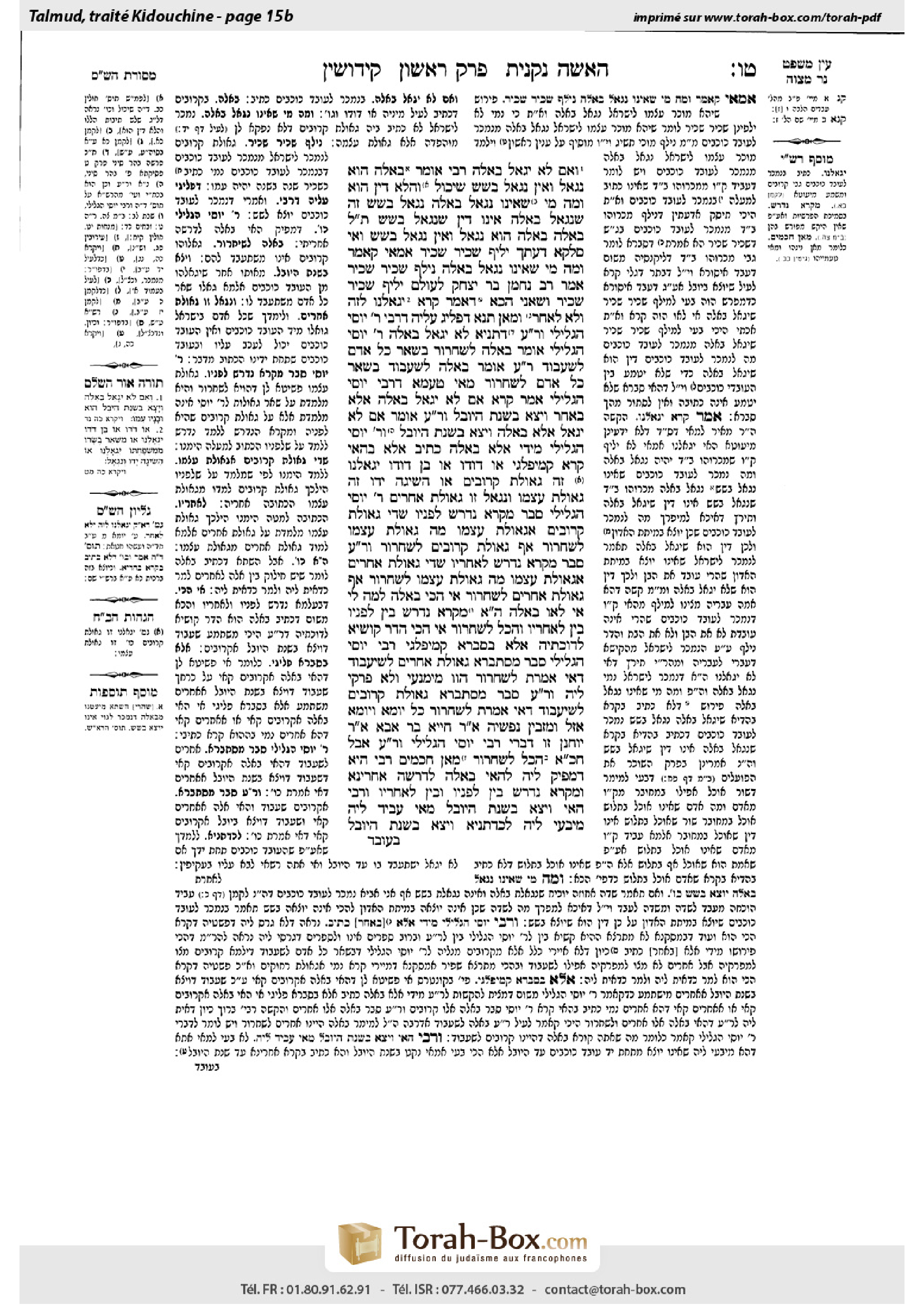
Kiddushin 15b: Talmud study for Daf Yomi
Daf Yomi is the daily study of one Talmud folio. Explore 37 tractates with scans, Hebrew text, Sefaria English and AI-generated French translations where annotated.
Passage selection and English or AI-generated French translation are available where the scan has annotations. Daf Study is independent of Torah-Box and Sefaria.
Browse Kiddushin · קידושין · All tractatesKiddushin 15b text and translations
This page of Kiddushin includes the Aramaic text, an English translation and an AI-generated French translation, alongside the scan above.
קידושין י״ה ב · Aramaic and Hebrew text
״וְאִם לֹא יִגָּאֵל בְּאֵלֶּה״ רַבִּי אוֹמֵר: בְּאֵלֶּה הוּא נִגְאָל, וְאֵין נִגְאָל בְּשֵׁשׁ.
שֶׁיָּכוֹל וַהֲלֹא דִּין הוּא, וּמָה מִי שֶׁאֵינוֹ נִגְאָל בְּאֵלֶּה – נִגְאָל בְּשֵׁשׁ, זֶה, שֶׁנִּגְאָל בְּאֵלֶּה – אֵינוֹ דִּין שֶׁנִּגְאָל בְּשֵׁשׁ? תַּלְמוּד לוֹמַר: ״בְּאֵלֶּה״ – בְּאֵלֶּה הוּא נִגְאָל, וְאֵין נִגְאָל בְּשֵׁשׁ.
וְאִי סָלְקָא דַעְתָּךְ יָלֵיף ״שָׂכִיר״ ״שָׂכִיר״, אַמַּאי קָאָמַר ״וּמָה מִי שֶׁאֵינוֹ נִגְאָל בְּאֵלֶּה״? נֵילַף ״שָׂכִיר״ ״שָׂכִיר״!
אָמַר רַב נַחְמָן בַּר יִצְחָק: לְעוֹלָם יָלֵיף ״שָׂכִיר״ ״שָׂכִיר״, וְשָׁאנֵי הָכָא דְּאָמַר קְרָא ״יִגְאָלֶנּוּ״ – לָזֶה, וְלֹא לְאַחֵר.
וּמַאן תַּנָּא דִּפְלִיג עֲלֵיהּ דְּרַבִּי? רַבִּי יוֹסֵי הַגְּלִילִי וְרַבִּי עֲקִיבָא. דְּתַנְיָא: ״לֹא יִגָּאֵל בְּאֵלֶּה״ רַבִּי יוֹסֵי הַגְּלִילִי אוֹמֵר: ״בְּאֵלֶּה״ – לְשִׁחְרוּר, בִּשְׁאָר כׇּל אָדָם – לְשִׁעְבּוּד. רַבִּי עֲקִיבָא אוֹמֵר: ״בְּאֵלֶּה״ – לְשִׁעְבּוּד, בִּשְׁאָר כׇּל אָדָם – לְשִׁחְרוּר.
מַאי טַעְמָא דְּרַבִּי יוֹסֵי הַגְּלִילִי? אָמַר קְרָא: ״אִם לֹא יִגָּאֵל בְּאֵלֶּה״ – אֶלָּא בְּאַחֵר – ״וְיָצָא בִּשְׁנַת הַיּוֹבֵל״. וְרַבִּי עֲקִיבָא אוֹמֵר: ״אִם לֹא יִגָּאֵל״ – אֶלָּא – ״בְּאֵלֶּה״, ״וְיָצָא בִּשְׁנַת הַיּוֹבֵל״. וְרַבִּי יוֹסֵי הַגְּלִילִי? מִידֵּי ״אֶלָּא בְּאֵלֶּה״ כְּתִיב?
אֶלָּא בְּהַאי קְרָא קָמִיפַּלְגִי: ״אוֹ דֹדוֹ אוֹ בֶן דֹּדוֹ יִגְאָלֶנּוּ״ – זוֹ גְּאוּלַּת קְרוֹבִים, ״אוֹ הִשִּׂיגָה יָדוֹ״ – זוֹ גְּאוּלַּת עַצְמוֹ, ״וְנִגְאָל״ – זוֹ גְּאוּלַּת אֲחֵרִים.
רַבִּי יוֹסֵי הַגְּלִילִי סָבַר: מִקְרָא נִדְרָשׁ לְפָנָיו, שְׁדִי גְּאוּלַּת קְרוֹבִים אַגְּאוּלַּת עַצְמוֹ, מָה גְּאוּלַּת עַצְמוֹ לְשִׁחְרוּר – אַף גְּאוּלַּת קְרוֹבִים לְשִׁחְרוּר. וְרַבִּי עֲקִיבָא סָבַר: מִקְרָא נִדְרָשׁ לְאַחֲרָיו, שְׁדִי גְּאוּלַּת אֲחֵרִים אַגְּאוּלַּת עַצְמוֹ, מָה גְּאוּלַּת עַצְמוֹ לְשִׁחְרוּר – אַף גְּאוּלַּת אֲחֵרִים לְשִׁחְרוּר.
אִי הָכִי, ״בְּאֵלֶּה״ לְמָה לִי? אִי לָאו ״בְּאֵלֶּה״ הֲוָה אָמֵינָא מִקְרָא נִדְרָשׁ בֵּין לְפָנָיו בֵּין לְאַחֲרָיו, וְהַכֹּל לְשִׁחְרוּר.
אִי הָכִי, הֲדַר קוּשְׁיָא לְדוּכְתֵּיהּ. אֶלָּא, בִּסְבָרָא קָמִיפַּלְגִי:
רַבִּי יוֹסֵי הַגְּלִילִי סָבַר: מִסְתַּבְּרָא גְּאוּלַּת אֲחֵרִים לְשִׁיעְבּוּד, דְּאִי אָמְרַתְּ לְשִׁחְרוּר, הֲווֹ מִימַּנְעִי וְלָא פָּרְקִי לֵיהּ. וְרַבִּי עֲקִיבָא סָבַר: מִסְתַּבְּרָא גְּאוּלַּת קְרוֹבִים לְשִׁיעְבּוּד, דְּאִי אָמְרַתְּ לְשִׁחְרוּר, כׇּל יוֹמָא וְיוֹמָא אֲזַל וּמְזַבֵּין נַפְשֵׁיהּ.
אָמַר רַבִּי חִיָּיא בַּר אַבָּא אָמַר רַבִּי יוֹחָנָן: זוֹ דִּבְרֵי רַבִּי יוֹסֵי הַגְּלִילִי וְרַבִּי עֲקִיבָא, אֲבָל חֲכָמִים אוֹמְרִים: הַכֹּל לְשִׁחְרוּר.
מַאן חֲכָמִים? רַבִּי הִיא, דְּמַפֵּיק לֵיהּ לְהַאי ״בְּאֵלֶּה״ לִדְרָשָׁה אַחֲרִינָא, וּמִקְרָא נִדְרָשׁ בֵּין לְפָנָיו וּבֵין לְאַחֲרָיו.
וְרַבִּי, הַאי ״וְיָצָא בִּשְׁנַת הַיֹּבֵל״ מַאי עָבֵיד לֵיהּ? מִיבְּעֵי לֵיהּ לְכִדְתַנְיָא: ״וְיָצָא בִּשְׁנַת הַיּוֹבֵל״
Kiddushin 15b · English translation
A Hebrew slave sold to a gentile can be redeemed by his relatives, as it is stated: “And if he is not redeemed by any of these, then he shall go out in the Jubilee Year” (Leviticus 25:54). Rabbi Yehuda HaNasi says: He can be redeemed only through these, i.e., the assistance of his relatives, and he is not redeemed after six years of labor.
Rabbi Yehuda HaNasi elaborates: As I might have argued that one sold to a gentile should be released after six years. Could this not be derived through an a fortiori inference: If one who cannot be redeemed by these relatives, i.e., a Hebrew slave who was sold to a Jew, as he cannot be redeemed by his relatives, nevertheless is redeemed after six years of labor, is it not logical that this Hebrew slave sold to a gentile, who can be redeemed by these relatives, can likewise be redeemed after six years of work? Therefore, the verse states “by any of these,” to emphasize that one sold to a gentile can be redeemed only through these relatives, and he cannot be redeemed after six years.
The Gemara explains the proof: And if it enters your mind that Rabbi Yehuda HaNasi derives the verbal analogy between “hired worker” and “hired worker,” why does he say: If one who cannot be redeemed by these, with regard to one who is sold to a Jew? Let him derive that halakha from the case of one sold to a gentile, through the verbal analogy between “hired worker” and “hired worker.” The term “hired worker” is used in reference to one sold to a gentile as well: “As a hired worker year by year he shall be with him” (Leviticus 25:53), and accordingly one can say that even one sold to a Jew can be redeemed by his relatives. The fact that he does not accept this claim indicates that Rabbi Yehuda HaNasi rejects the verbal analogy between “hired worker” and “hired worker.”
Rav Naḥman bar Yitzḥak said: This proof can be refuted, as one can say that actually Rabbi Yehuda HaNasi does derive the verbal analogy between “hired worker” and “hired worker,” and it is different here, with regard to one sold to a gentile, as the verse states: “Either his uncle or his uncle’s son may redeem him” (Leviticus 25:49). This emphasis of “him” teaches that redemption is an option only for this slave and not for another type of slave.
With regard to the dispute itself the Gemara inquires: And who is the tanna who disagrees with Rabbi Yehuda HaNasi with regard to this? It is Rabbi Yosei HaGelili and Rabbi Akiva. As it is taught in a baraita concerning the verse: “And if he is not redeemed by any of these” (Leviticus 25:54), that Rabbi Yosei HaGelili says: The expression “by any of these” indicates that redemption by one’s relatives is to freedom, i.e., one becomes an entirely free man. But if a slave is redeemed by anyone else who pays the gentile master, it is to slavery. The redeemed slave becomes indentured to his redeemer until he repays the cost of his redemption through his work. Rabbi Akiva says the opposite: By these relatives he is redeemed to slavery, whereas if he is redeemed by anyone else, it is to freedom.
The Gemara asks: What is the reasoning of Rabbi Yosei HaGelili? The verse states concerning a redeemed slave who is emancipated: “If he is not redeemed by any of these” relatives; but if he is redeemed by another, “then he shall go out in the Jubilee Year,” not earlier, as he becomes enslaved to him. And Rabbi Akiva says: “If he is not redeemed” in any other manner but only “by any of these,” “then he shall go out in the Jubilee Year,” i.e., if he is redeemed by relatives, he is emancipated only at the close of Yom Kippur of the Jubilee Year. By contrast, if he is redeemed by others he is emancipated immediately. And how does Rabbi Yosei HaGelili respond to this claim? He would ask: Is it written: Only by any of these?
Rather, as this suggested interpretation of the verse by Rabbi Akiva is clearly problematic, the Gemara retracts the previous explanation of the dispute and instead says that they disagree with regard to the precise meaning of this verse: “Either his uncle or his uncle’s son may redeem him, or any that is near of kin unto him of his family may redeem him; or if he becomes rich, and he is redeemed” (Leviticus 25:49). “Either his uncle or his uncle’s son may redeem him”; this is the redemption performed by relatives. “Or if he becomes rich”; this is redemption by himself. “And he is redeemed”; this is redemption by other people.
Rabbi Yosei HaGelili maintains: A verse is interpreted homiletically based on its juxtaposition to the verse immediately preceding it. Therefore, one should cast, i.e., compare, the case of redemption performed by relatives to the case of redemption performed by himself: Just as redemption performed by himself leads to complete freedom, so too, redemption performed by relatives leads to freedom. And Rabbi Akiva maintains that a verse is interpreted homiletically based on its juxtaposition to the verse immediately after it. Therefore one should cast the case of redemption performed by others to the case of redemption performed by himself: Just as redemption performed by himself is to freedom, so too, redemption performed by others is to freedom, whereas if he is redeemed by his relatives, he becomes enslaved to them.
The Gemara asks: If so, that this is their dispute, why do I need the phrase “by any of these,” according to both Rabbi Yosei HaGelili and Rabbi Akiva? The Gemara answers: If it were not for the phrase “by any of these,” I would say that a verse is interpreted homiletically based on its juxtaposition to the verse immediately preceding it as well as to the verse immediately after it, and therefore in every manner in which he is redeemed it is to freedom. The phrase “by any of these” limits this freedom either to relatives or other people, according to the respective opinions of Rabbi Yosei HaGelili and Rabbi Akiva.
The Gemara asks: If so, that the different opinions are based on the phrase “by any of these,” then the difficulty with the opinion of Rabbi Akiva, that the verse does not say: If he is not redeemed in any other manner but only by any of these, has returned to its place, i.e., it is still valid, as this phrase indicates that Rabbi Yosei HaGelili’s interpretation of the verse is correct. Rather, Rabbi Yosei HaGelili and Rabbi Akiva disagree with regard to reason. Their dispute is a matter of logic and does not concern textual interpretation.
The Gemara elaborates. Rabbi Yosei HaGelili maintains: It stands to reason that redemption performed by others is to slavery, as, if you say it is to freedom, they will refrain and will not redeem him. If the slave is required to serve them, and they incur no financial loss, they will redeem him. And Rabbi Akiva maintains: It stands to reason that redemption performed by relatives is to slavery, as, if you say it is to freedom, each and every day he will go and sell himself over and again, relying on his relatives to free him.
Rabbi Ḥiyya bar Abba says that Rabbi Yoḥanan says: This is the statement of Rabbi Yosei HaGelili and Rabbi Akiva, who hold that a slave is not invariably freed whenever he is redeemed from his gentile master. But the Rabbis say that in every case, when he is emancipated it is to freedom.
The Gemara inquires: Who are these Rabbis? It is Rabbi Yehuda HaNasi, who derives another exposition from this term “by any of these,” as stated above. And Rabbi Yehuda HaNasi maintains that a verse is interpreted homiletically based on its juxtaposition to the verse immediately preceding it as well as to the verse immediately after it. Consequently, the Hebrew slave of a gentile is emancipated regardless of whether he is redeemed by relatives or other people.
The Gemara asks: And Rabbi Yehuda HaNasi, what does he do with the verse: “And if he is not redeemed by any of these means, then he shall go out in the Jubilee Year” (Leviticus 25:54)? The Gemara answers: He requires this verse for that which is taught in a baraita with regard to the verse: “Then he shall go out in the Jubilee Year.” If the slave is not redeemed prior to this point in time he leaves his gentile master only in the Jubilee Year.
Kiddushin 15b · Traduction française (IA)
Un esclave hébreu vendu à un non-Juif peut être racheté par ses proches, comme il est dit : « S’il n’est racheté par aucun de ceux-ci, il sortira l’année du Jubilé » (Lévitique 25, 54). Rabbi Yehouda HaNassi dit : Il ne peut être racheté que par ceux-ci, c’est-à-dire avec l’aide de ses proches, et il n’est pas libéré au bout de six années de travail.
Rabbi Yehouda HaNassi développe : On aurait pu soutenir que celui qui est vendu à un non-Juif doit être libéré au bout de six ans. Ne peut-on pas le déduire par un raisonnement a fortiori ? Si celui qui ne peut pas être racheté par ces proches — c’est-à-dire un esclave hébreu vendu à un Juif, qui ne peut pas être racheté par ses proches — est néanmoins libéré au bout de six années de travail, n’est-il pas logique que cet esclave hébreu vendu à un non-Juif, qui peut être racheté par ces proches, puisse lui aussi être libéré au bout de six années de travail ? C’est pourquoi le verset dit « par aucun de ceux-ci », pour souligner que celui qui est vendu à un non-Juif ne peut être racheté que par ces proches et ne peut pas être libéré au bout de six ans.
La Guemara explique la preuve : Si l’on envisage que Rabbi Yehouda HaNassi déduit l’analogie verbale entre « salarié » et « salarié », pourquoi dit-il, au sujet de celui qui est vendu à un Juif : « celui qui ne peut pas être racheté par ceux-ci » ? Qu’il déduise cette halakha du cas de celui qui est vendu à un non-Juif, au moyen de l’analogie verbale entre « salarié » et « salarié ». L’expression « salarié » est également employée à propos de celui qui est vendu à un non-Juif : « Il sera avec lui comme un salarié, d’année en année » (Lévitique 25, 53). On pourrait donc dire que même celui qui est vendu à un Juif peut être racheté par ses proches. Le fait qu’il n’accepte pas cet argument indique que Rabbi Yehouda HaNassi rejette l’analogie verbale entre « salarié » et « salarié ».
Rav Naḥman bar Yitzḥak dit : Cette preuve peut être réfutée, car on peut dire qu’en réalité, Rabbi Yehouda HaNassi déduit bien l’analogie verbale entre « salarié » et « salarié », mais que le cas de celui qui est vendu à un non-Juif est différent, puisque le verset dit : « Son oncle ou le fils de son oncle pourra le racheter » (Lévitique 25, 49). L’insistance sur « le » enseigne que le rachat n’est possible que pour cet esclave, et non pour un autre type d’esclave.
À propos de cette controverse, la Guemara demande : Quel est le tanna qui est en désaccord avec Rabbi Yehouda HaNassi sur ce point ? Il s’agit de Rabbi Yossi HaGelili et de Rabbi Akiva. En effet, il est enseigné dans une baraïta, au sujet du verset : « S’il n’est racheté par aucun de ceux-ci » (Lévitique 25, 54), que Rabbi Yossi HaGelili dit : L’expression « par aucun de ceux-ci » indique que le rachat par ses proches le libère, c’est-à-dire qu’il devient entièrement libre. Mais si l’esclave est racheté par quelqu’un d’autre, qui paie son maître non juif, le rachat le rend esclave. L’esclave racheté est alors asservi à son libérateur jusqu’à ce qu’il rembourse le coût de son rachat par son travail. Rabbi Akiva dit le contraire : racheté par ses proches, il devient esclave, tandis que s’il est racheté par quelqu’un d’autre, il est libéré.
La Guemara demande : Quel est le raisonnement de Rabbi Yossi HaGelili ? Le verset parle de l’esclave racheté qui est libéré : « S’il n’est pas racheté par aucun de ces proches » ; mais s’il est racheté par quelqu’un d’autre, « alors il sortira l’année du Jubilé », et non plus tôt, puisqu’il devient son esclave. Rabbi Akiva, lui, dit : « S’il n’est pas racheté » d’une autre manière, mais seulement « par aucun de ceux-ci », « alors il sortira l’année du Jubilé », c’est-à-dire que s’il est racheté par ses proches, il n’est libéré qu’à la fin de Yom Kippour de l’année du Jubilé. En revanche, s’il est racheté par d’autres, il est libéré immédiatement. Et comment Rabbi Yossi HaGelili répond-il à cet argument ? Il demanderait : Est-il écrit « seulement par aucun de ceux-ci » ?
Cependant, puisque cette interprétation du verset proposée par Rabbi Akiva pose manifestement problème, la Guemara revient sur l’explication précédente de leur controverse et dit plutôt qu’ils sont en désaccord sur le sens précis de ce verset : « Son oncle ou le fils de son oncle pourra le racheter, ou l’un de ses proches parents de sa famille pourra le racheter ; ou, s’il s’enrichit, il sera racheté » (Lévitique 25, 49). « Son oncle ou le fils de son oncle pourra le racheter » : il s’agit du rachat par ses proches. « Ou, s’il s’enrichit » : il s’agit du rachat par lui-même. « Et il sera racheté » : il s’agit du rachat par d’autres personnes.
Rabbi Yossi HaGelili estime qu’un verset s’interprète de manière homilétique en fonction de sa juxtaposition au verset qui le précède immédiatement. Il faut donc rapprocher, c’est-à-dire comparer, le rachat par ses proches au rachat par lui-même : de même que le rachat par lui-même le rend entièrement libre, le rachat par ses proches le rend également libre. Rabbi Akiva estime qu’un verset s’interprète de manière homilétique en fonction de sa juxtaposition au verset qui le suit immédiatement. Il faut donc rapprocher le rachat par d’autres du rachat par lui-même : de même que le rachat par lui-même le libère, le rachat par d’autres le libère également, tandis que s’il est racheté par ses proches, il devient leur esclave.
La Guemara demande : Dans ce cas, à quoi sert, pour Rabbi Yossi HaGelili comme pour Rabbi Akiva, l’expression « par aucun de ceux-ci » ? La Guemara répond : Sans l’expression « par aucun de ceux-ci », on aurait dit qu’un verset s’interprète de manière homilétique aussi bien en fonction de sa juxtaposition au verset qui le précède immédiatement qu’en fonction de sa juxtaposition au verset qui le suit immédiatement. Par conséquent, quelle que soit la manière dont il est racheté, le rachat le rend libre. L’expression « par aucun de ceux-ci » limite cette libération aux proches ou aux autres personnes, selon les positions respectives de Rabbi Yossi HaGelili et de Rabbi Akiva.
La Guemara demande : Dans ce cas, puisque les avis divergents se fondent sur l’expression « par aucun de ceux-ci », la difficulté concernant l’opinion de Rabbi Akiva — à savoir que le verset ne dit pas : « S’il n’est racheté d’aucune autre manière, mais seulement par aucun de ceux-ci » — revient à son point de départ, c’est-à-dire qu’elle reste valable, puisque cette expression indique que l’interprétation du verset par Rabbi Yossi HaGelili est correcte. La Guemara répond plutôt que Rabbi Yossi HaGelili et Rabbi Akiva sont en désaccord sur le raisonnement : leur controverse relève de la logique et ne concerne pas l’interprétation du texte.
La Guemara développe : Rabbi Yossi HaGelili estime qu’il est logique que le rachat par d’autres conduise à l’esclavage, car si l’on disait qu’il conduit à la liberté, les gens s’abstiendraient de le racheter. Si l’esclave doit les servir et qu’ils ne subissent aucune perte financière, ils le rachèteront. Rabbi Akiva estime qu’il est logique que le rachat par ses proches conduise à l’esclavage, car si l’on disait qu’il conduit à la liberté, chaque jour il irait se vendre de nouveau, comptant sur ses proches pour le libérer.
Rabbi Ḥiyya bar Abba dit au nom de Rabbi Yoḥanan : Telle est l’opinion de Rabbi Yossi HaGelili et de Rabbi Akiva, qui estiment qu’un esclave n’est pas nécessairement libéré chaque fois qu’il est racheté à son maître non juif. Mais les Sages disent que dans tous les cas, lorsqu’il est libéré, il est affranchi.
La Guemara demande : Qui sont ces Sages ? Il s’agit de Rabbi Yehouda HaNassi, qui déduit une autre interprétation de cette expression « par aucun de ceux-ci », comme indiqué plus haut. Rabbi Yehouda HaNassi estime qu’un verset s’interprète de manière homilétique aussi bien en fonction de sa juxtaposition au verset qui le précède immédiatement qu’en fonction de sa juxtaposition au verset qui le suit immédiatement. Par conséquent, l’esclave hébreu d’un non-Juif est affranchi, qu’il soit racheté par ses proches ou par d’autres personnes.
La Guemara demande : Et Rabbi Yehouda HaNassi, que fait-il du verset : « S’il n’est racheté par aucun de ces moyens, alors il sortira l’année du Jubilé » (Lévitique 25, 54) ? La Guemara répond : Il a besoin de ce verset pour ce qui est enseigné dans une baraïta au sujet des mots : « Alors il sortira l’année du Jubilé. » Si l’esclave n’est pas racheté avant ce moment, il ne quitte son maître non juif que l’année du Jubilé.
Traduction française générée par IA à partir de l’édition anglaise de Sefaria. Vérifie toujours un passage avec le texte source.
Text from Sefaria: William Davidson Edition - Vocalized Aramaic (CC BY NC); William Davidson Edition - English (CC BY NC).