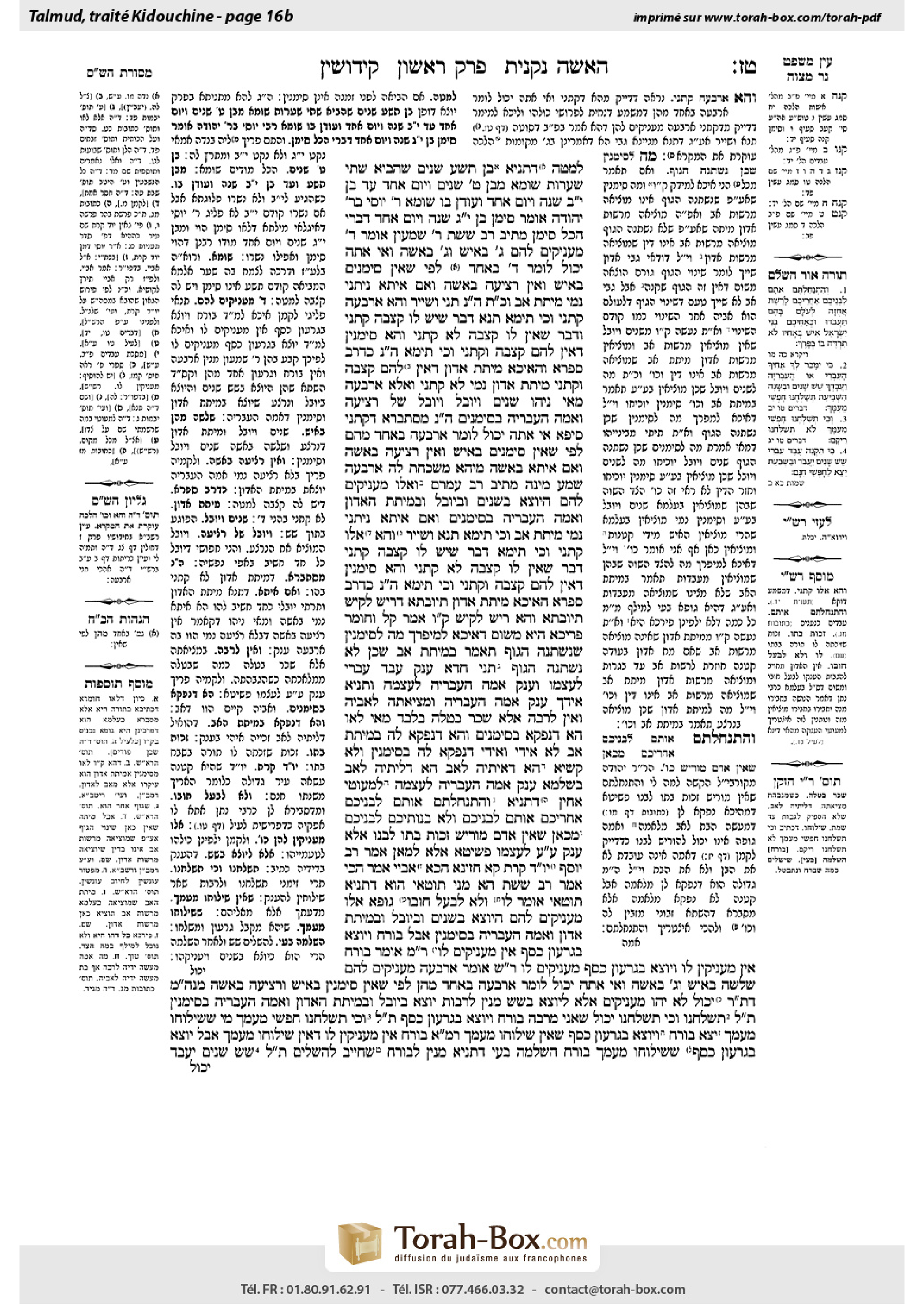
Kiddushin 16b: Talmud study for Daf Yomi
Daf Yomi is the daily study of one Talmud folio. Explore 37 tractates with scans, Hebrew text, Sefaria English and AI-generated French translations where annotated.
Passage selection and English or AI-generated French translation are available where the scan has annotations. Daf Study is independent of Torah-Box and Sefaria.
Browse Kiddushin · קידושין · All tractatesKiddushin 16b text and translations
This page of Kiddushin includes the Aramaic text, an English translation and an AI-generated French translation, alongside the scan above.
קידושין י״ו ב · Aramaic and Hebrew text
לְמַטָּה.
דְּתַנְיָא: בֶּן תֵּשַׁע שָׁנִים שֶׁהֵבִיא שְׁתֵּי שְׂעָרוֹת – שׁוּמָא, מִבֶּן תֵּשַׁע שָׁנִים וְיוֹם אֶחָד עַד בֶּן שְׁתֵּים עֶשְׂרֵה שָׁנָה וְיוֹם אֶחָד וְעוֹדָן בּוֹ – שׁוּמָא, רַבִּי יוֹסֵי בְּרַבִּי יְהוּדָה אוֹמֵר: סִימָן. בֶּן שְׁלֹשׁ עֶשְׂרֵה שָׁנָה וְיוֹם אֶחָד – דִּבְרֵי הַכֹּל סִימָן.
מֵתִיב רַב שֵׁשֶׁת: רַבִּי שִׁמְעוֹן אוֹמֵר: אַרְבָּעָה מַעֲנִיקִים לָהֶם, שְׁלֹשָׁה בָּאִישׁ, וּשְׁלֹשָׁה בָּאִשָּׁה. וְאִי אַתָּה יָכוֹל לוֹמַר אַרְבָּעָה בְּאֶחָד, לְפִי שֶׁאֵין סִימָנִים בָּאִישׁ, וְאֵין רְצִיעָה בָּאִשָּׁה.
וְאִם אִיתָא, נִיתְנֵי נָמֵי מִיתַת אָב! וְכִי תֵּימָא הָכָא נָמֵי תַּנָּא וְשַׁיַּיר, וְהָא אַרְבָּעָה קָתָנֵי! וְכִי תֵּימָא תַּנָּא דָּבָר שֶׁיֵּשׁ לוֹ קִצְבָה קָתָנֵי וְדָבָר שֶׁאֵין לוֹ קִצְבָה לָא קָתָנֵי, וְהָא סִימָנִין, דְּאֵין לָהֶם קִצְבָה, וְקָתָנֵי!
וְכִי תֵּימָא הָכָא נָמֵי כִּדְרַב סָפְרָא, וְהָאִיכָּא מִיתַת אָדוֹן, דְּאֵין לָהּ(ם) קִצְבָה, וְקָתָנֵי! מִיתַת אָדוֹן נָמֵי לָא קָתָנֵי.
וְאֶלָּא, אַרְבָּעָה מַאי נִיהוּ? שָׁנִים, וְיוֹבֵל, וְיוֹבֵל שֶׁל רְצִיעָה, וְאָמָה הָעִבְרִיָּה בְּסִימָנִים.
הָכִי נָמֵי מִסְתַּבְּרָא, דְּקָתָנֵי סֵיפָא: אִי אַתָּה יָכוֹל לוֹמַר אַרְבָּעָה בְּאֶחָד מֵהֶם, לְפִי שֶׁאֵין סִימָנִים בָּאִישׁ וְאֵין רְצִיעָה בָּאִשָּׁה. וְאִם אִיתָא, בְּאִשָּׁה מִיהָא מַשְׁכַּחַתְּ לַהּ אַרְבָּעָה, שְׁמַע מִינַּהּ.
מֵתִיב רַב עַמְרָם: וְאֵלּוּ מַעֲנִיקִים לָהֶם: הַיּוֹצֵא בְּשָׁנִים, וּבַיּוֹבֵל, וּבְמִיתַת הָאָדוֹן, וְאָמָה הָעִבְרִיָּה בְּסִימָנִים. וְאִם אִיתָא, נִיתְנֵי נָמֵי מִיתַת אָב! וְכִי תֵּימָא תְּנָא וְשַׁיַּיר, וְהָא ״אֵלּוּ״ קָתָנֵי!
וְכִי תֵּימָא: דָּבָר שֶׁיֵּשׁ לוֹ קִצְבָה קָתָנֵי, דָּבָר שֶׁאֵין לוֹ קִצְבָה לָא קָתָנֵי, וְהָא סִימָנִין, דְּאֵין לָהֶם קִצְבָה וְקָתָנֵי. וְכִי תֵּימָא הָכָא נָמֵי כִּדְרַב סָפְרָא, הָאִיכָּא מִיתַת אָדוֹן! תְּיוּבְתָּא דְּרֵישׁ לָקִישׁ! תְּיוּבְתָּא.
וְהָא רֵישׁ לָקִישׁ קַל וָחוֹמֶר אָמַר! קַל וָחוֹמֶר פְּרִיכָא הוּא, מִשּׁוּם דְּאִיכָּא לְמִיפְרַךְ: מָה לְסִימָנִין – שֶׁנִּשְׁתַּנָּה הַגּוּף, תֹּאמַר בְּמִיתַת אָב – שֶׁכֵּן לֹא נִשְׁתַּנָּה הַגּוּף.
תָּנֵי חֲדָא: עֶנֶק עֶבֶד עִבְרִי – לְעַצְמוֹ, וְעֶנֶק אָמָה הָעִבְרִיָּה – לְעַצְמָהּ. וְתַנְיָא אִידַּךְ: עֶנֶק אָמָה הָעִבְרִיָּה וּמְצִיאָתָהּ – לְאָבִיהָ, וְאֵין לְרַבָּה אֶלָּא שְׂכַר בַּטָּלָה בִּלְבָד.
מַאי לָאו, הָא – דְּנָפְקָא בְּסִימָנִים, וְהָא – דְּנָפְקָא לַהּ בְּמִיתַת אָב!
לָא, אִידִי וְאִידִי דְּנָפְקָא לַהּ בְּסִימָנִין, וְלָא קַשְׁיָא: הָא דְּאִיתֵיהּ לְאָב, הָא דְּלֵיתֵיהּ לְאָב.
בִּשְׁלָמָא עֶנֶק אָמָה הָעִבְרִיָּה לְעַצְמָהּ – לְמַעוֹטֵי אַחִין, דְּתַנְיָא: ״וְהִתְנַחַלְתֶּם אֹתָם לִבְנֵיכֶם אַחֲרֵיכֶם״ – אוֹתָם לִבְנֵיכֶם, וְלֹא בְּנוֹתֵיכֶם לִבְנֵיכֶם. מִכָּאן שֶׁאֵין אָדָם מוֹרִישׁ זְכוּת בִּתּוֹ לִבְנוֹ.
אֶלָּא עֶנֶק עֶבֶד עִבְרִי לְעַצְמוֹ – פְּשִׁיטָא! אֶלָּא לְמַאן? אָמַר רַב יוֹסֵף: יוֹד קֶרֶת קָא חָזֵינָא הָכָא.
אַבָּיֵי אָמַר: הָכִי אָמַר רַב שֵׁשֶׁת: הָא מַנִּי – תּוּטַאי הוּא. דְּתַנְיָא, תּוּטַאי אוֹמֵר: ״לוֹ״, וְלֹא לְבַעַל חוֹבוֹ.
גּוּפָא, אֵלּוּ מַעֲנִיקִים לָהֶם: הַיּוֹצֵא בְּשָׁנִים, וּבַיּוֹבֵל, וּבְמִיתַת אָדוֹן, וְאָמָה הָעִבְרִיָּה בְּסִימָנִין. אֲבָל בּוֹרֵחַ וְיוֹצֵא בְּגִרְעוֹן כֶּסֶף – אֵין מַעֲנִיקִים לוֹ. רַבִּי מֵאִיר אוֹמֵר: בּוֹרֵחַ – אֵין מַעֲנִיקִין לוֹ, וְיוֹצֵא בְּגִרְעוֹן כֶּסֶף – מַעֲנִיקִים לוֹ.
רַבִּי שִׁמְעוֹן אוֹמֵר: אַרְבָּעָה מַעֲנִיקִים לָהֶם, שְׁלֹשָׁה בָּאִישׁ וּשְׁלֹשָׁה בָּאִשָּׁה, וְאִי אַתָּה יָכוֹל לוֹמַר אַרְבָּעָה בְּאֶחָד מֵהֶן לְפִי שֶׁאֵין סִימָנִין בָּאִישׁ וּרְצִיעָה בָּאִשָּׁה.
מְנָא הָנֵי מִילֵּי? דְּתָנוּ רַבָּנַן: יָכוֹל לֹא יְהוּ מַעֲנִיקִים אֶלָּא לַיּוֹצֵא בְּשֵׁשׁ, מִנַּיִן לְרַבּוֹת יוֹצֵא בַּיּוֹבֵל וּבְמִיתַת הָאָדוֹן וְאָמָה הָעִבְרִיָּה בְּסִימָנִין? תַּלְמוּד לוֹמַר: ״תְּשַׁלְּחֶנּוּ״ ״וְכִי תְשַׁלְּחֶנּוּ״.
יָכוֹל שֶׁאֲנִי מְרַבֶּה בּוֹרֵחַ וְיוֹצֵא בְּגִרְעוֹן כֶּסֶף? תַּלְמוּד לוֹמַר: ״וְכִי תְשַׁלְּחֶנּוּ חׇפְשִׁי מֵעִמָּךְ״ – מִי שֶׁשִּׁילּוּחוֹ מֵעִמָּךְ, יָצָא בּוֹרֵחַ וְיוֹצֵא בְּגִרְעוֹן כֶּסֶף שֶׁאֵין שִׁילּוּחוֹ מֵעִמָּךְ. רַבִּי מֵאִיר אוֹמֵר: בּוֹרֵחַ אֵין מַעֲנִיקִין לוֹ, דְּאֵין שִׁילּוּחוֹ מֵעִמָּךְ, אֲבָל יוֹצֵא בְּגִרְעוֹן כֶּסֶף, שֶׁשִּׁילּוּחוֹ מֵעִמָּךְ.
בּוֹרֵחַ – הַשְׁלָמָה בָּעֵי! דְּתַנְיָא: מִנַּיִן לְבוֹרֵחַ שֶׁחַיָּיב לְהַשְׁלִים – תַּלְמוּד לוֹמַר: ״שֵׁשׁ שָׁנִים יַעֲבֹד״.
Kiddushin 16b · English translation
with regard to the minimum age at which these signs are taken into consideration. In other words, there is a lower limit, as any signs of puberty before a certain age are ignored.
As it is taught in a baraita: Everyone agrees with regard to a nine-year-old boy who developed two pubic hairs that this is not considered a sign of adulthood, as they are treated as hairs that grow on a mole. From the age of nine years and one day until the age of twelve years and one day, even if they are still on him and have not fallen out, this is still considered a mole. Rabbi Yosei, son of Rabbi Yehuda, says: It is a sign indicating puberty. If he is thirteen years and one day old and grows two hairs, everyone agrees that this is a sign indicating puberty.
Rav Sheshet raises an objection: It is taught in a baraita that Rabbi Shimon says: There are four different ways of emancipating slaves, and when they are emancipated one grants them a severance gift. Of these, three apply to a man, i.e., a Hebrew slave, and three apply to a woman, a Hebrew maidservant. And you cannot say that there are four ways for either one of them, because there is no emancipation through signs indicating puberty for a man, and there is no emancipation through piercing the ear for a woman. Consequently, there are only three modes of emancipation for each.
The Gemara clarifies the difficulty: And if it is so that a Hebrew maidservant acquires herself through her father’s death, as claimed by Reish Lakish, let him teach also that a Hebrew maidservant is emancipated at the death of the father. And if you would say, here too he taught some differences between a Hebrew slave and a Hebrew maidservant and omitted others, this cannot be the case, as he teaches: There are four ways of emancipating slaves. The mention of a number indicates that there is a set number of ways. And if you would say that the tanna teaches a matter that has a set time and does not teach a matter that does not have a set time, as there is the halakha of signs indicating puberty, which do not have a set time, and nevertheless he teaches it.
And if you would say that here, too, this is in accordance with the opinion of Rav Safra, that signs have a minimum set time, there is still the death of the master, which does not have a set time, and yet he taught it. The Gemara answers: The death of the master is not taught either, i.e., this mode of emancipation is not counted among the four modes mentioned in the baraita.
The Gemara asks: But if you do not count the death of the master, what are these four methods? The Gemara answers: A Hebrew slave or maidservant is emancipated after serving six years and in the Jubilee Year, even if it occurs within those six years. And the Jubilee Year also emancipates a slave, even after the act of piercing a Hebrew slave’s ear with an awl extended his term of slavery, and a Hebrew maidservant is emancipated with signs indicating puberty.
The Gemara adds: So too, it is reasonable that this is the correct interpretation of the baraita, as it teaches in the last clause: You cannot say that there are four modes for either one of them, because there is no emancipation through signs indicating puberty for a man, and there is no emancipation through piercing for a woman. And if it is so that the death of the master is included, in the case of a woman, at least, you find four ways that she can be freed: Six years of service, the Jubilee Year, signs of puberty, and the death of the master. The Gemara comments: Conclude from the baraita that it is so.
Rav Amram also raises an objection against the opinion of Reish Lakish from a baraita: And these are the slaves to whom one grants a severance gift: One who leaves through six years of service, and one who leaves in the Jubilee Year, and one who leaves through the death of the master, and a Hebrew maidservant who is released by signs indicating puberty. And if it is so that she is emancipated through her father’s death as well, as claimed by Reish Lakish, let the baraita also teach that she is released through the death of the father. And if you would say, here too, he taught some differences between a Hebrew slave and maidservant and omitted others, he teaches: These, which indicates that this halakha applies only to a slave freed in these ways and no others.
And if you would say that the tanna teaches a matter that has a set time and does not teach a matter that does not have a set time, but isn’t there the case of signs indicating puberty, which do not have a set time, and nevertheless he teaches it. And if you would say that here too, this is in accordance with the opinion of Rav Safra that signs have a minimum set time, there is the death of the master, which does not have a set time, and yet he taught it. Therefore, this is a conclusive refutation of the opinion of Reish Lakish. The Gemara affirms: The refutation of the opinion of Reish Lakish is indeed a conclusive refutation.
The Gemara asks: But the ruling of Reish Lakish is based on an a fortiori inference, and nothing has been said to contradict his reasoning. The Gemara answers: The a fortiori inference is refutable, because it can be refuted in the following manner: What is unique about signs indicating puberty is that they indicate that her body has changed, and perhaps she is emancipated because she is now considered a different person. Will you say the same with regard to the death of the father, as her body has not changed?
It is taught in one baraita: The severance gift bestowed upon a Hebrew slave when he is emancipated is given to the slave himself, and the severance gift bestowed upon a Hebrew maidservant is given to the maidservant herself. And it is taught in another baraita: The severance gift of a Hebrew maidservant and any lost items she finds belong to her father, and her master has only the reimbursement for her lost time. He is paid the money he would have earned if she had been working instead of carrying home the items she found.
The Gemara suggests: What, is it not correct to say that the difference between the two baraitot is that this baraita, which says that the severance gift is given to her father, is referring to when she leaves through signs indicating puberty, as she is a young woman and still under the authority of her father with regard to certain matters, and this baraita, which states that the severance gift is given to her, is referring to a case when she leaves through the death of the father. Since she does not have a father she keeps the severance gift herself. This explanation is in accordance with the opinion of Reish Lakish, that she is emancipated through the death of her father, and it contradicts the conclusion that his ruling should be rejected.
The Gemara rejects this claim: No, both this baraita and that baraita are referring to a maidservant who left through signs indicating puberty, and it is not difficult: This baraita is referring to a case where there is a father who can take the gift, and this baraita is referring to a case where there is no father, i.e., he died before she developed the signs of puberty. In that case she receives the severance gift herself.
The Gemara comments: Granted, one can understand the baraita that taught that the severance gift of a Hebrew maidservant is for herself, as this serves to exclude the maidservant’s brothers. These brothers do not receive the gifts after her father’s death, as it is taught in a baraita: “And you shall bequeath them to your children after you” (Leviticus 25:46). This verse indicates that they, Canaanite slaves, are bequeathed to your sons, but your daughters are not bequeathed to your sons. From here it is derived that a person may not bequeath his rights to profits generated by his daughter to his son.
But it is obvious that the severance gift of a Hebrew slave is for himself. Rather, to whom could it be given? Rav Yosef said: I see here a small letter yod that has been made into a large city. In other words, although it was not necessary for the tanna to teach this halakha, he stated it out of habit despite the fact that this ruling does not teach anything novel.
Abaye said that Rav Sheshet said like this: In accordance with whose opinion is this baraita? It is in accordance with the opinion of the Sage Tutai. As it is taught in a baraita that Tutai says: The verse: “You shall grant severance to him” (Deuteronomy 15:14), indicates that it is given to a Hebrew slave but not to his creditor. Even if the slave owes money, this gift is not given to the creditor.
The Gemara discusses the matter itself. And these are the Hebrew slaves to whom one grants a severance gift: One who leaves through completing six years of service, and one who leaves in the Jubilee Year, and one who leaves through the death of the master, and a Hebrew maidservant who is released by signs indicating the onset of puberty. But with regard to one who flees from his master or one who is released by deducting money, one does not grant a severance gift to him. Rabbi Meir says: With regard to one who flees, one does not grant a severance gift to him, but in the case of one who is released by deducting money, one does grant a severance gift to him.
Rabbi Shimon says: There are four different ways of emancipating a Hebrew slave, and when Hebrew slaves are emancipated one grants them a severance gift. Of these methods, three apply to a man and three apply to a woman. And you cannot say four modes apply for either one of them, because there is no emancipation through signs indicating puberty for a man, and there is no piercing for a woman. This concludes the baraita.
The Gemara asks: From where are these matters derived? The Gemara explains that this is as the Sages taught: One might have thought that one grants a severance gift only to a Hebrew slave who is released after six years. From where is it derived to include that one grants a severance gift to one who left in the Jubilee Year, and one freed through the death of the master, and a Hebrew maidservant who leaves through signs indicating puberty? The verse states: “You shall not send him,” and: “And when you send him” (Deuteronomy 15:13). These phrases serve to expand the halakha of severance to include any Hebrew slave who is emancipated.
I might have thought that I should include a Hebrew slave who flees and one who is released through the deduction of money. Therefore, the verse states: “And when you send him free from you” (Deuteronomy 15:13), which is referring to one who was sent from you with your knowledge and consent. This excludes a Hebrew slave who flees from his master and one who is released through the deduction of money, who are not sent away from you with your permission. Rabbi Meir says: One does not grant a severance gift to a Hebrew slave who flees, as he is not sent away from you, because he left on his own. But with regard to a Hebrew slave who is released through the deduction of money, who is sent from you, he is granted a severance gift, as this deduction payment requires the agreement of the master.
The Gemara asks: Isn’t a Hebrew slave who flees required to complete the remaining years of his contract, at which point he should be entitled to receive a severance gift? As it is taught in a baraita: From where is it derived with regard to a Hebrew slave who flees his master that he is obligated to complete his term? The verse states: “Six years he shall labor” (Exodus 21:2), and no less. Therefore, if a Hebrew slave runs away in the middle of this period, he is required to complete his six years of service.
Kiddushin 16b · Traduction française (IA)
concernant l’âge minimal à partir duquel ces signes sont pris en considération. Autrement dit, il existe une limite inférieure, car tout signe de puberté apparaissant avant un certain âge est ignoré.
Comme il est enseigné dans une baraïta : tous conviennent que, chez un garçon de neuf ans, l’apparition de deux poils pubiens ne constitue pas un signe de majorité, car ces poils sont considérés comme ceux qui poussent sur un grain de beauté. De neuf ans et un jour jusqu’à douze ans et un jour, même s’ils sont toujours présents et ne sont pas tombés, ils sont encore considérés comme des poils de grain de beauté. Rabbi Yosei, fils de Rabbi Yehuda, dit : c’est un signe de puberté. S’il a treize ans et un jour et que deux poils poussent, tous conviennent que c’est un signe de puberté.
Rav Sheshet soulève une objection : il est enseigné dans une baraïta que Rabbi Shimon dit : il existe quatre façons différentes d’affranchir des esclaves, et, lorsqu’ils sont affranchis, on leur accorde un don de libération. Parmi ces façons, trois s’appliquent à un homme, c’est-à-dire à un esclave hébreu, et trois à une femme, c’est-à-dire à une servante hébreue. On ne peut pas dire qu’il y ait quatre façons pour l’un ou l’autre, car un homme ne peut pas être affranchi par des signes de puberté, et une femme ne peut pas être affranchie par le percement de l’oreille. Il n’y a donc que trois modes d’affranchissement pour chacun.
La Guemara précise la difficulté : si une servante hébreue acquiert sa liberté à la mort de son père, comme l’affirme Reish Lakish, qu’il enseigne aussi qu’elle est affranchie à la mort de son père. Et si l’on disait qu’ici aussi, il a enseigné certaines différences entre l’esclave hébreu et la servante hébreue et en a omis d’autres, cela ne peut pas être le cas, puisqu’il enseigne : « Il existe quatre façons d’affranchir des esclaves. » La mention d’un nombre indique qu’il s’agit d’un nombre déterminé de façons. Et si l’on disait que le tanna enseigne un cas dont le moment est fixé, mais non un cas dont le moment ne l’est pas, il y a pourtant les signes de puberté, dont le moment n’est pas fixé, et il les enseigne néanmoins.
Et si l’on disait qu’ici aussi, il suit l’opinion de Rav Safra, selon laquelle les signes ont un âge minimal déterminé, il reste la mort du maître, dont le moment n’est pas fixé, et pourtant il l’a enseignée. La Guemara répond : la mort du maître n’est pas non plus enseignée, c’est-à-dire que ce mode d’affranchissement ne figure pas parmi les quatre modes mentionnés dans la baraïta.
La Guemara demande : mais si l’on ne compte pas la mort du maître, quelles sont ces quatre méthodes ? La Guemara répond : un esclave ou une servante hébreu est affranchi au terme de six années de service ou lors de l’année du Jubilé, même si celle-ci survient au cours de ces six années. L’année du Jubilé affranchit également un esclave même après que le percement de l’oreille de l’esclave hébreu avec un poinçon a prolongé sa période de servitude ; une servante hébreue, quant à elle, est affranchie par les signes de puberté.
La Guemara ajoute : il est également raisonnable que telle soit l’interprétation correcte de la baraïta, car sa dernière clause enseigne : « On ne peut pas dire qu’il y ait quatre modes pour l’un ou l’autre, car un homme ne peut pas être affranchi par des signes de puberté, et une femme ne peut pas l’être par le percement de l’oreille. » Or, si la mort du maître était incluse, une femme disposerait au moins de quatre façons d’être affranchie : six années de service, l’année du Jubilé, les signes de puberté et la mort du maître. La Guemara conclut : déduis de la baraïta qu’il en est bien ainsi.
Rav Amram soulève également une objection à l’opinion de Reish Lakish à partir d’une baraïta : « Voici les esclaves auxquels on accorde un don de libération : celui qui part au terme de six années de service, celui qui part lors de l’année du Jubilé, celui qui part à la mort du maître et la servante hébreue qui est libérée par les signes de puberté. » Or, si elle est également affranchie à la mort de son père, comme l’affirme Reish Lakish, que la baraïta enseigne aussi qu’elle est libérée à la mort de son père. Et si l’on disait qu’ici aussi, il a enseigné certaines différences entre l’esclave hébreu et la servante hébreue et en a omis d’autres, il enseigne : « ceux-ci », ce qui indique que cette halakha ne s’applique qu’à un esclave libéré de ces façons, et d’aucune autre.
Et si l’on disait que le tanna enseigne un cas dont le moment est fixé, mais non un cas dont le moment ne l’est pas, il y a pourtant les signes de puberté, dont le moment n’est pas fixé, et il les enseigne néanmoins. Et si l’on disait qu’ici aussi, il suit l’opinion de Rav Safra, selon laquelle les signes ont un âge minimal déterminé, il reste la mort du maître, dont le moment n’est pas fixé, et pourtant il l’a enseignée. Il s’agit donc d’une réfutation décisive de l’opinion de Reish Lakish. La Guemara confirme : la réfutation de l’opinion de Reish Lakish est bien décisive.
La Guemara demande : mais la règle de Reish Lakish repose sur un raisonnement a fortiori, et rien n’a été dit pour contredire son raisonnement. La Guemara répond : ce raisonnement a fortiori peut être réfuté de la manière suivante : ce qui caractérise les signes de puberté, c’est qu’ils témoignent d’un changement du corps ; peut-être est-elle affranchie parce qu’elle est désormais considérée comme une autre personne. Peut-on en dire autant de la mort du père, alors que son corps n’a pas changé ?
Il est enseigné dans une baraïta : le don de libération accordé à un esclave hébreu lorsqu’il est affranchi revient à l’esclave lui-même, et celui qui est accordé à une servante hébreue revient à la servante elle-même. Une autre baraïta enseigne : le don de libération d’une servante hébreue et tous les objets perdus qu’elle trouve reviennent à son père, et son maître ne reçoit que l’indemnisation du temps qu’elle a perdu. On lui verse l’argent qu’il aurait gagné si elle avait travaillé au lieu de rapporter chez elle les objets qu’elle a trouvés.
La Guemara suggère : n’est-il pas juste de dire que la différence entre les deux baraïtot est la suivante : la baraïta qui affirme que le don de libération revient à son père parle du cas où elle part en raison des signes de puberté, car c’est une jeune femme qui demeure sous l’autorité de son père pour certaines questions ; tandis que la baraïta qui affirme que le don de libération lui revient parle du cas où elle part à la mort de son père ? Puisqu’elle n’a plus de père, elle garde elle-même le don de libération. Cette explication est conforme à l’opinion de Reish Lakish, selon laquelle elle est affranchie à la mort de son père, et elle contredit la conclusion selon laquelle son avis doit être rejeté.
La Guemara rejette cette affirmation : non, les deux baraïtot parlent d’une servante qui est partie en raison des signes de puberté, et il n’y a pas de difficulté : l’une parle d’un cas où son père est vivant et peut recevoir le don, l’autre d’un cas où elle n’a plus de père, c’est-à-dire qu’il est mort avant qu’elle ne présente les signes de puberté. Dans ce cas, elle reçoit elle-même le don de libération.
La Guemara remarque : on comprend que la baraïta qui enseigne que le don de libération d’une servante hébreue lui revient sert à exclure ses frères. Ceux-ci ne reçoivent pas les dons après la mort de leur père, comme il est enseigné dans une baraïta : « Vous les transmettrez en héritage à vos enfants après vous » (Lévitique 25,46). Ce verset indique que ce sont eux, les esclaves cananéens, que vous transmettez en héritage à vos fils, mais que vos filles ne sont pas transmises en héritage à vos fils. On en déduit qu’un homme ne peut pas léguer à son fils ses droits sur les revenus produits par sa fille.
Mais il est évident que le don de libération d’un esclave hébreu lui revient. À qui d’autre pourrait-il revenir ? Rav Yosef dit : « Je vois ici un petit youd transformé en grande ville. » Autrement dit, bien qu’il ne fût pas nécessaire au tanna d’enseigner cette halakha, il l’a énoncée par habitude, alors que cette règle n’apporte rien de nouveau.
Abaye dit que Rav Sheshet s’est exprimé ainsi : selon l’opinion de qui cette baraïta est-elle ? Elle est conforme à l’opinion du sage Tutai. Car il est enseigné dans une baraïta que Tutai dit : le verset « Tu lui accorderas un don de libération » (Deutéronome 15,14) indique que celui-ci revient à l’esclave hébreu, mais pas à son créancier. Même si l’esclave doit de l’argent, ce don n’est pas remis au créancier.
La Guemara examine le sujet lui-même. « Voici les esclaves hébreux auxquels on accorde un don de libération : celui qui part au terme de six années de service, celui qui part lors de l’année du Jubilé, celui qui part à la mort du maître et la servante hébreue qui est libérée par les signes marquant le début de la puberté. Mais celui qui fuit son maître ou celui qui est libéré moyennant une déduction d’argent ne reçoit pas de don de libération. Rabbi Meir dit : celui qui fuit ne reçoit pas de don de libération, mais celui qui est libéré moyennant une déduction d’argent en reçoit un. »
Rabbi Shimon dit : il existe quatre façons différentes d’affranchir un esclave hébreu, et, lorsqu’ils sont affranchis, on leur accorde un don de libération. Parmi ces modes, trois s’appliquent à un homme et trois à une femme. On ne peut pas dire que quatre modes s’appliquent à l’un ou à l’autre, car un homme ne peut pas être affranchi par des signes de puberté et une femme ne peut pas être affranchie par le percement de l’oreille. La baraïta s’achève ici.
La Guemara demande : d’où déduit-on ces règles ? La Guemara explique que c’est ce que les Sages ont enseigné : on aurait pu penser qu’on accorde un don de libération uniquement à un esclave hébreu libéré au terme de six années. D’où déduit-on qu’on accorde aussi un don de libération à celui qui part lors de l’année du Jubilé, à celui qui est libéré à la mort du maître et à la servante hébreue qui part en raison des signes de puberté ? Le verset dit : « Tu ne le renverras pas » et « Quand tu le renverras » (Deutéronome 15,13). Ces expressions élargissent la règle du don de libération afin d’inclure tout esclave hébreu qui est affranchi.
On aurait pu penser qu’il fallait aussi inclure l’esclave hébreu qui s’enfuit et celui qui est libéré moyennant une déduction d’argent. Le verset dit donc : « Quand tu le renverras libre de chez toi » (Deutéronome 15,13), ce qui désigne celui que tu as renvoyé avec ta connaissance et ton consentement. Cela exclut l’esclave hébreu qui fuit son maître et celui qui est libéré moyennant une déduction d’argent, car ils ne sont pas renvoyés de chez toi avec ta permission. Rabbi Meir dit : on n’accorde pas de don de libération à l’esclave hébreu qui s’enfuit, car il n’est pas renvoyé de chez toi puisqu’il est parti de son propre chef. En revanche, l’esclave hébreu libéré moyennant une déduction d’argent, qui est renvoyé de chez toi, reçoit un don de libération, car cette déduction requiert l’accord du maître.
La Guemara demande : un esclave hébreu qui s’enfuit n’est-il pas tenu d’accomplir les années restantes de son contrat, auquel terme il devrait avoir droit à un don de libération ? Car il est enseigné dans une baraïta : d’où déduit-on qu’un esclave hébreu qui fuit son maître est tenu d’accomplir la durée de son engagement ? Le verset dit : « Il travaillera pendant six ans » (Exode 21,2), et pas moins. Par conséquent, si un esclave hébreu s’enfuit au milieu de cette période, il est tenu d’accomplir ses six années de service.
Traduction française générée par IA à partir de l’édition anglaise de Sefaria. Vérifie toujours un passage avec le texte source.
Text from Sefaria: William Davidson Edition - Vocalized Aramaic (CC BY NC); William Davidson Edition - English (CC BY NC).