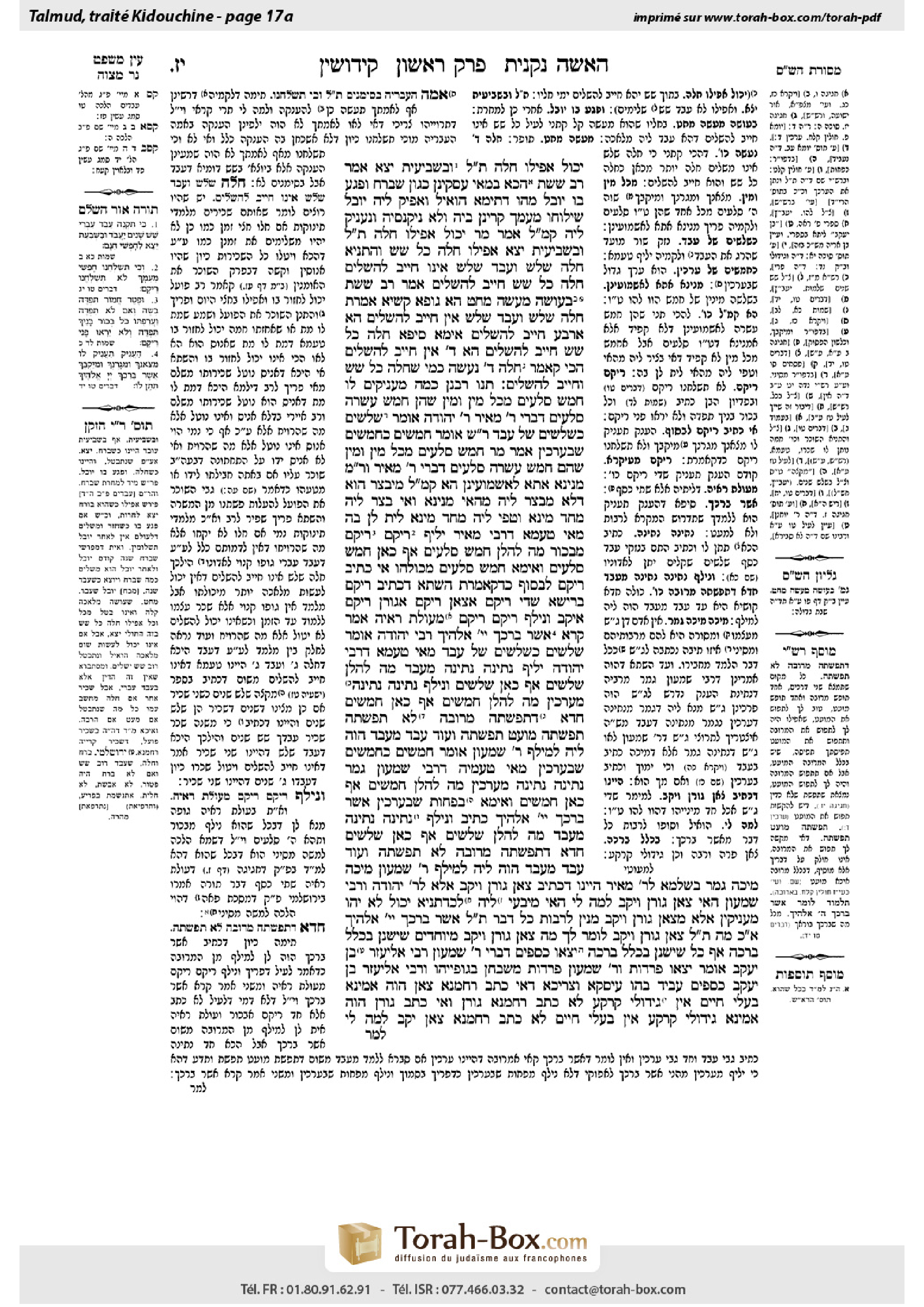
Kiddushin 17a: Talmud study for Daf Yomi
Daf Yomi is the daily study of one Talmud folio. Explore 37 tractates with scans, Hebrew text, Sefaria English and AI-generated French translations where annotated.
Passage selection and English or AI-generated French translation are available where the scan has annotations. Daf Study is independent of Torah-Box and Sefaria.
Browse Kiddushin · קידושין · All tractatesKiddushin 17a text and translations
This page of Kiddushin includes the Aramaic text, an English translation and an AI-generated French translation, alongside the scan above.
קידושין י״ז א · Aramaic and Hebrew text
יָכוֹל אֲפִילּוּ חָלָה? – תַּלְמוּד לוֹמַר: ״וּבַשְּׁבִעִת יֵצֵא״?
אָמַר רַב שֵׁשֶׁת: הָכָא בְּמַאי עָסְקִינַן, כְּגוֹן שֶׁבָּרַח וּפָגַע בּוֹ יוֹבֵל. מַהוּ דְּתֵימָא: הוֹאִיל וְאַפֵּיק לֵיהּ יוֹבֵל, ״שִׁילּוּחוֹ מֵעִמָּךְ״ קָרֵינַן בֵּיהּ, וְלָא נִיקְנְסֵיהּ, וְנַעֲנֵיק לֵיהּ, קָא מַשְׁמַע לַן.
אָמַר מָר: יָכוֹל אֲפִילּוּ חָלָה – תַּלְמוּד לוֹמַר: ״וּבַשְּׁבִעִת יֵצֵא״. אֲפִילּוּ חָלָה כׇּל שֵׁשׁ? וְהָתַנְיָא: חָלָה שָׁלֹשׁ וְעָבַד שָׁלֹשׁ – אֵינוֹ חַיָּיב לְהַשְׁלִים, חָלָה כׇּל שֵׁשׁ – חַיָּיב לְהַשְׁלִים! אָמַר רַב שֵׁשֶׁת: בְּעוֹשֶׂה מַעֲשֵׂה מַחַט.
הָא גוּפָא קַשְׁיָא – אָמְרַתְּ: חָלָה שָׁלֹשׁ וְעָבַד שָׁלֹשׁ – אֵין חַיָּיב לְהַשְׁלִים. הָא אַרְבַּע – חַיָּיב לְהַשְׁלִים. אֵימָא סֵיפָא: חָלָה כׇּל שֵׁשׁ – חַיָּיב לְהַשְׁלִים. הָא אַרְבַּע – אֵין חַיָּיב לְהַשְׁלִים! הָכִי קָאָמַר: חָלָה אַרְבַּע, נַעֲשָׂה כְּמִי שֶׁחָלָה כׇּל שֵׁשׁ וְחַיָּיב לְהַשְׁלִים.
תָּנוּ רַבָּנַן: כַּמָּה מַעֲנִיקִים לוֹ? חָמֵשׁ סְלָעִים מִכׇּל מִין וָמִין, שֶׁהֵן חֲמֵשׁ עֶשְׂרֵה סְלָעִים, דִּבְרֵי רַבִּי מֵאִיר. רַבִּי יְהוּדָה אוֹמֵר: שְׁלֹשִׁים, כִּשְׁלֹשִׁים שֶׁל עֶבֶד. רַבִּי שִׁמְעוֹן אוֹמֵר: חֲמִשִּׁים, כַּחֲמִשִּׁים שֶׁבָּעֲרָכִין.
אָמַר מָר: חָמֵשׁ סְלָעִים מִכׇּל מִין וָמִין, שֶׁהֵם חֲמֵשׁ עֶשְׂרֵה סְלָעִים, דִּבְרֵי רַבִּי מֵאִיר. וְרַבִּי מֵאִיר, מִנְיָנָא אֲתָא לְאַשְׁמוֹעִינַן? הָא קָא מַשְׁמַע לַן: מִיבְצָר הוּא דְּלָא (מְבַצַּר) [לִיבְצַר] לֵיהּ מֵהַאי מִנְיָנָא, וְאִי בָּצַר לֵיהּ מֵחַד מִינָא וְטָפֵי לֵיהּ מֵחַד מִינָא – לֵית לַן בַּהּ.
מַאי טַעְמָא דְּרַבִּי מֵאִיר? יָלֵיף ״רֵיקָם״ ״רֵיקָם״ מִבְּכוֹר. מָה לְהַלָּן חָמֵשׁ סְלָעִים – אַף כָּאן חָמֵשׁ סְלָעִים.
וְאֵימָא, חָמֵשׁ סְלָעִים מִכּוּלְּהוּ! אִי כְּתִיב ״רֵיקָם״ לְבַסּוֹף, כִּדְקָאָמְרַתְּ. הַשְׁתָּא דִּכְתִיב ״רֵיקָם״ בְּרֵישָׁא, שְׁדִי ״רֵיקָם״ אַ״צֹּאן״, ״רֵיקָם״ אַ״גּוֹרֶן״, ״רֵיקָם״ אַ״יֶּקֶב״.
וְנֵילַף ״רֵיקָם״ ״רֵיקָם״ מֵעוֹלַת רְאִיָּה! אָמַר קְרָא: ״אֲשֶׁר בֵּרַכְךָ ה׳ אֱלֹהֶיךָ״.
רַבִּי יְהוּדָה אוֹמֵר: שְׁלֹשִׁים כִּשְׁלֹשִׁים שֶׁל עֶבֶד. מַאי טַעְמָא דְּרַבִּי יְהוּדָה? יָלֵיף ״נְתִינָה״ ״נְתִינָה״ מֵעֶבֶד. מָה לְהַלָּן שְׁלֹשִׁים – אַף כָּאן שְׁלֹשִׁים.
וְנֵילַף ״נְתִינָה״ ״נְתִינָה״ מֵעֲרָכִין, מָה לְהַלָּן חֲמִשִּׁים – אַף כָּאן חֲמִשִּׁים!
חֲדָא, דְּתָפַשְׂתָּה מְרוּבֶּה לֹא תָּפַשְׂתָּה, תָּפַשְׂתָּה מוּעָט תָּפַשְׂתָּה. וְעוֹד, עֶבֶד מֵעֶבֶד הֲוָה לֵיהּ לְמֵילַף.
רַבִּי שִׁמְעוֹן אוֹמֵר: חֲמִשִּׁים כַּחֲמִשִּׁים שֶׁבָּעֲרָכִין. מַאי טַעְמֵיהּ דְּרַבִּי שִׁמְעוֹן? גָּמַר ״נְתִינָה״ ״נְתִינָה״ מֵעֲרָכִין, מָה לְהַלָּן חֲמִשִּׁים – אַף כָּאן חֲמִשִּׁים. וְאֵימָא: כַּפָּחוּת שֶׁבָּעֲרָכִין! ״אֲשֶׁר בֵּרַכְךָ ה׳ אֱלֹהֶיךָ״ כְּתִיב.
וְנֵילַף ״נְתִינָה״ ״נְתִינָה״ מֵעֶבֶד, מָה לְהַלָּן שְׁלֹשִׁים – אַף כָּאן שְׁלֹשִׁים; חֲדָא, דְּתָפַשְׂתָּה מְרוּבֶּה לֹא תָּפַשְׂתָּה, וְעוֹד, עֶבֶד מֵעֶבֶד הֲוָה לֵיהּ לְמֵילַף! רַבִּי שִׁמְעוֹן ״מִיכָה״ ״מִיכָה״ גָּמַר.
בִּשְׁלָמָא לְרַבִּי מֵאִיר, הַיְינוּ דִּכְתִיב צֹאן גּוֹרֶן וָיֶקֶב. אֶלָּא לְרַבִּי יְהוּדָה וְרַבִּי שִׁמְעוֹן הַאי צֹאן גּוֹרֶן וָיֶקֶב לְמָה לִי?
הַאי מִיבְּעֵי לֵיהּ לְכִדְתַנְיָא: יָכוֹל לֹא יְהוּ מַעֲנִיקִין אֶלָּא מִצֹּאן גּוֹרֶן וָיֶקֶב, מִנַּיִן לְרַבּוֹת כׇּל דָּבָר – תַּלְמוּד לוֹמַר: ״אֲשֶׁר בֵּרַכְךָ ה׳ אֱלֹהֶיךָ״. אִם כֵּן מָה תַּלְמוּד לוֹמַר צֹאן גּוֹרֶן וָיֶקֶב? לוֹמַר לָךְ: מָה צֹאן גּוֹרֶן וָיֶקֶב מְיוּחָדִים, שֶׁיֶּשְׁנָן בִּכְלַל בְּרָכָה – אַף כֹּל שֶׁיֶּשְׁנָן בִּכְלַל בְּרָכָה, יָצְאוּ כְּסָפִים, דִּבְרֵי רַבִּי שִׁמְעוֹן. רַבִּי אֱלִיעֶזֶר בֶּן יַעֲקֹב אוֹמֵר: יָצְאוּ פְּרָדוֹת.
וְרַבִּי שִׁמְעוֹן? פְּרָדוֹת מַשְׁבְּחָן בְּגוּפַיְיהוּ. וְרַבִּי אֱלִיעֶזֶר בֶּן יַעֲקֹב? כְּסָפִים עָבֵיד בְּהוּ עִיסְקָא.
וּצְרִיכָא, דְּאִי כְּתַב רַחֲמָנָא צֹאן, הֲוָה אָמֵינָא בַּעֲלֵי חַיִּים – אִין, גִּידּוּלֵי קַרְקַע – לָא, כְּתַב רַחֲמָנָא גּוֹרֶן. וְאִי כְּתַב גּוֹרֶן, הֲוָה אָמֵינָא: גִּידּוּלֵי קַרְקַע – אִין, בַּעֲלֵי חַיִּים – לָא, כְּתַב רַחֲמָנָא צֹאן. יֶקֶב לְמָה לִי?
Kiddushin 17a · English translation
One might have thought that even a slave who became sick and is unable to work must work additional time to compensate for the time missed. Therefore, the verse states: “And in the seventh he shall go out” (Exodus 21:2), which indicates that he leaves his master in any case, even if he has not worked the full six years.
Rav Sheshet said: With what are we dealing here? This concerns a case where he fled and the Jubilee Year arrived immediately afterward, and therefore he did not complete the six years of servitude. The novelty of this halakha is as follows. Lest you say: Since the Jubilee Year released him, he is considered sent away by you, the master, and therefore we should not penalize him but grant him the severance gift, the baraita teaches us that once he flees he forfeits his right to the severance gift.
The Master said above: One might have thought that even a slave who became sick and was unable to work must work additional time to compensate for the time missed. Therefore, the verse states: “And in the seventh he shall go out” (Exodus 21:2). The Gemara asks: Is he excused from working additional time even if he was sick for all six years? But isn’t it taught in a baraita: If he was sick for three years and served for three years, he is not obligated to complete the six years of actual labor, but if he was sick for all six years he is obligated to complete the six years of actual labor. Rav Sheshet said: This is referring to a case where he is unable to perform strenuous labor but can execute minor tasks, such as performing needlework or sewing clothes. Since he can perform work of some kind, this slave is not required to work additional time to compensate for the time missed, even if he was ill for all six years.
The Gemara comments: This matter itself is difficult, as the baraita is apparently self-contradictory. On the one hand, you said that if he was sick for three years and he served for the other three years he is not obligated to complete the six years of actual labor. This indicates that if he was ill for four years he is obligated to complete the six years of labor. On the other hand, say the last clause of the baraita: If he was sick for all six years he is obligated to complete the six years of actual labor. That indicates that if he was ill for four years he is not obligated to complete the six years of actual labor. The Gemara answers that this is what the baraita is saying: If he was sick for four years he becomes as one who was sick for all six years, and therefore he is required to complete the six years of actual labor.
§ The Sages taught: How much does one grant a freed slave as a severance gift? It is five sela in value of each and every type mentioned in this verse: “And you shall grant severance to him out of your flock, and out of your threshing floor, and out of your winepress” (Deuteronomy 15:14), which is a total of fifteen sela. This is the statement of Rabbi Meir. Rabbi Yehuda says: He is given thirty sela in total, like the thirty shekels of the fine that is paid for a slave (see Exodus 21:32). Rabbi Shimon says: The master gives him fifty shekels, like the sum of valuations, in which fifty shekels is the largest designated amount for a man (see Leviticus 27:3).
The Master said above: The master gives five sela of each and every type, which is fifteen sela; this is the statement of Rabbi Meir. The Gemara asks: And does Rabbi Meir come to teach us to count? His novelty certainly cannot be that three fives equal fifteen. The Gemara answers that Rabbi Meir teaches us this: The master may not give less than this total number, but if he gives him less of one type and more of one other type, we have no problem with it, and he has fulfilled the mitzva.
The Gemara asks: What is the reasoning of Rabbi Meir? The Gemara explains: He derives a verbal analogy from “empty” stated with regard to the severance gift: “You shall not send him away empty” (Deuteronomy 15:13), and “empty” stated with regard to a firstborn: “All the firstborn of your sons you shall redeem; and none shall appear before Me empty” (Exodus 34:20). Just as there, in the case of the firstborn, one must give five sela, so too here, in the case of severance gifts, one must give five sela.
The Gemara asks: But one can say that he is obligated to give only five sela in total from all of the three types listed in the verse. The Gemara answers: If “empty” were written at the end of the verse, i.e., Deuteronomy 15:14, the halakha would be as you said. But now that “empty” is written before the verse, i.e., at the end of Deuteronomy 15:13, apply the phrase “Do not send him away empty” to “flock,” and apply “empty” to “threshing floor,” and likewise apply “empty” to “winepress.” Consequently, there must be five sela for each type.
The Gemara asks: And let us derive a verbal analogy between “empty” and “empty” from the case of the burnt-offering of appearance in the Temple brought on the pilgrimage Festivals, with regard to which it is said: “And they shall not appear before the Lord empty” (Deuteronomy 16:16). The burnt-offering of appearance has no fixed value. The Gemara answers that the verse states: “Of that with which the Lord your God has blessed you” (Deuteronomy 15:14), which indicates that one must give a respectable amount as a severance gift.
The baraita states that Rabbi Yehuda says that a freed slave is given thirty sela in total, like the thirty shekels of the fine that is paid for a slave. The Gemara asks: What is the reasoning of Rabbi Yehuda? The Gemara answers: He derives a verbal analogy between giving, as stated with regard to the severance gift, from the expression of giving stated in connection to a Canaanite slave gored by an ox: “He shall give to their master thirty shekels of silver” (Exodus 21:32). Just as there, he must pay thirty shekels for the slave, so too here, in the case of a severance gift, he must pay thirty.
The Gemara asks: But let him derive a similar verbal analogy between “giving” stated with regard to the severance gift and “giving” from valuations (see Leviticus 27:23): Just as there, in the case of valuations, it is fifty shekels for an adult male, so too here, it should be fifty.
The Gemara responds: One answer is, as people say, that if you grasped too much, you did not grasp anything; if you grasped a bit, you grasped something. In other words, if there are two possible sources from which to derive the sum of the severance gift, then without conclusive proof one may not presume that the Torah intended to teach the larger amount. Consequently, the master should be required to give only thirty shekels, not fifty. And furthermore, one should derive the halakha of a slave, i.e., the severance gift, from another case involving a slave, i.e., the thirty shekels paid when a Canaanite slave is gored by an ox, rather than derive the halakha of the severance gift from valuations, which apply to all people.
The baraita further teaches that Rabbi Shimon says: The master gives him fifty shekels, like the fifty shekels of valuations for an adult male. The Gemara asks: What is the reasoning of Rabbi Shimon? He derived a verbal analogy between “giving” and “giving” from valuations (Leviticus 27:23): Just as there, he pays fifty, so too here, he pays fifty. The Gemara asks: But one can say that as this verbal analogy is referring to valuations in general, he should pay the smallest of the valuations, which is merely three sela. The Gemara answers that it is written: “Of that with which the Lord your God has blessed you” (Deuteronomy 15:14), which indicates that one must give a respectable amount as a severance gift.
The Gemara asks: But let Rabbi Shimon derive, like Rabbi Yehuda, the verbal analogy between “giving” and “giving” from the verses discussing the goring of a Canaanite slave, teaching that just as there he pays thirty, so too here, he pays thirty? The Gemara adds that there are two reasons to prefer this derivation, as stated above: One reason is that if you grasped too much, you did not grasp anything; if you grasped a bit, you grasped something. And furthermore, one should derive the halakha of a slave from another case involving a slave. The Gemara answers: Rabbi Shimon derives a verbal analogy between poverty and poverty. With regard to valuations the Torah states: “But if he is too poor” (Leviticus 27:8), and concerning a Hebrew slave the verse says: “And if your brother grows poor” (Leviticus 25:39).
Having ascertained the source for each of the opinions in the baraita, the Gemara analyzes their opinions. The Gemara asks: Granted, with regard to the opinion of Rabbi Meir, this is as it is written “flock,” “threshing floor,” and “winepress,” as he derives from these three terms that the severance gift must be worth fifteen sela. But according to the opinions of Rabbi Yehuda and Rabbi Shimon, why do I need these terms “flock,” “threshing floor,” and “winepress,” in light of the fact that one may give his slave any product?
The Gemara answers: These terms are necessary for that which is taught in a baraita: One might have thought that one grants severance gifts only from the flock, the threshing floor, and the winepress; from where is it derived to include every matter? The verse states: “Of that with which the Lord your God has blessed you” (Deuteronomy 15:14). If so, what is the meaning when the verse states “flock,” “threshing floor,” and “winepress”? This serves to tell you that just as a flock, a threshing floor, and a winepress are unique in that they are included in the category of blessing, i.e., they grow and multiply, so too all items that are included in the category of blessing may be given as a severance gift. This excludes money, which does not increase on its own. This is the statement of Rabbi Shimon. Rabbi Eliezer ben Ya’akov says: This excludes mules, which cannot reproduce.
The Gemara asks: And Rabbi Shimon, why does he exclude money but not mules? The Gemara answers: With regard to mules, their bodies grow and enhance. Although they do not reproduce, they still grow. And Rabbi Eliezer ben Ya’akov, why doesn’t he exclude money? He maintains that one can conduct business with money and thereby profit from it. In this manner money can increase.
The Gemara notes: And it is necessary for the Torah to mention a flock, a threshing floor, and a winepress, as, if the Merciful One had written only “flock,” I would say that animals, yes, the master may give them to his slave upon his release, but that which grows from the ground, no, he may not give them. Therefore, the Merciful One writes “threshing floor.” And if the Torah had written only “threshing floor,” I would say that that which grows from the ground, yes, he may give them, but animals, no, he may not give them. Therefore, the Merciful One writes “flock.” The Gemara asks: Since threshing floor is stated, why do I need the mention of a winepress?
Kiddushin 17a · Traduction française (IA)
On aurait pu penser que même un esclave tombé malade et incapable de travailler doit travailler plus longtemps pour compenser le temps perdu. C’est pourquoi le verset dit : « Et la septième année, il sortira » (Exode 21,2), ce qui indique qu’il quitte son maître dans tous les cas, même s’il n’a pas travaillé six années complètes.
Rav Chéchet dit : De quoi s’agit-il ici ? D’un cas où il s’est enfui et où l’année du Jubilé est arrivée juste après, de sorte qu’il n’a pas achevé ses six années de servitude. Voici la nouveauté de cette halakha : on aurait pu dire que, puisque l’année du Jubilé l’a libéré, il est considéré comme ayant été renvoyé par toi, le maître, et qu’il ne faut donc pas le pénaliser, mais lui accorder le cadeau de libération. La baraïta nous enseigne qu’en s’enfuyant, il perd son droit au cadeau de libération.
Le Maître a dit plus haut : On aurait pu penser que même un esclave tombé malade et incapable de travailler doit travailler plus longtemps pour compenser le temps perdu. C’est pourquoi le verset dit : « Et la septième année, il sortira » (Exode 21,2). La Guemara demande : Est-il dispensé de travailler plus longtemps même s’il a été malade pendant les six années entières ? N’est-il pas enseigné dans une baraïta : s’il a été malade pendant trois ans et a servi pendant les trois autres années, il n’est pas tenu d’accomplir six années de travail effectif ; mais s’il a été malade pendant les six années, il est tenu d’accomplir six années de travail effectif. Rav Chéchet dit : Il s’agit d’un cas où il est incapable d’effectuer un travail pénible, mais peut accomplir de petites tâches, comme des travaux d’aiguille ou coudre des vêtements. Puisqu’il peut effectuer un certain travail, cet esclave n’est pas tenu de travailler plus longtemps pour compenser le temps perdu, même s’il a été malade pendant les six années entières.
La Guemara fait remarquer que la baraïta se contredit apparemment elle-même. D’un côté, tu as dit que s’il a été malade pendant trois ans et a servi pendant les trois autres années, il n’est pas tenu d’accomplir six années de travail effectif. Cela implique que s’il a été malade pendant quatre ans, il est tenu d’accomplir six années de travail. Mais, d’un autre côté, considérons la dernière clause de la baraïta : s’il a été malade pendant les six années, il est tenu d’accomplir six années de travail effectif. Cela implique que s’il a été malade pendant quatre ans, il n’est pas tenu d’accomplir six années de travail effectif. La Guemara répond que voici ce que dit la baraïta : s’il a été malade pendant quatre ans, il est considéré comme ayant été malade pendant les six années entières ; il doit donc accomplir six années de travail effectif.
§ Les Sages ont enseigné : Quelle somme accorde-t-on à un esclave affranchi comme cadeau de libération ? Cinq sela pour chacun des produits mentionnés dans ce verset : « Tu lui accorderas un cadeau de libération provenant de ton troupeau, de ton aire et de ton pressoir » (Deutéronome 15,14), soit quinze sela au total. Telle est l’opinion de Rabbi Meïr. Rabbi Yehouda dit : On lui donne trente sela au total, comme les trente sicles d’argent de l’amende versée pour un esclave (voir Exode 21,32). Rabbi Shimon dit : Le maître lui donne cinquante sicles, comme le montant des évaluations, dont cinquante sicles est le montant maximal fixé pour un homme (voir Lévitique 27,3).
Le Maître a dit plus haut : Le maître donne cinq sela pour chacun des produits, soit quinze sela ; telle est l’opinion de Rabbi Meïr. La Guemara demande : Rabbi Meïr vient-il nous apprendre à compter ? Sa nouveauté ne peut certainement pas être que trois fois cinq font quinze. La Guemara répond que Rabbi Meïr nous enseigne ceci : le maître ne peut pas donner moins que cette somme totale ; mais s’il donne moins d’un produit et davantage d’un autre, cela ne pose aucun problème et il a accompli la mitsva.
La Guemara demande : Quel est le raisonnement de Rabbi Meïr ? La Guemara explique : Il établit une analogie verbale entre le terme « vide », employé à propos du cadeau de libération — « Tu ne le renverras pas les mains vides » (Deutéronome 15,13) — et le terme « vide », employé à propos du premier-né : « Tous les premiers-nés de tes fils, tu les rachèteras ; et nul ne se présentera devant Moi les mains vides » (Exode 34,20). De même que, dans le cas du premier-né, il faut donner cinq sela, de même ici, dans le cas du cadeau de libération, il faut donner cinq sela.
La Guemara demande : Mais on pourrait dire qu’il est tenu de donner seulement cinq sela au total, parmi les trois produits énumérés dans le verset. La Guemara répond : Si le terme « vide » était écrit à la fin du verset, c’est-à-dire en Deutéronome 15,14, la halakha serait comme tu le dis. Mais puisque le terme « vide » est écrit avant ce verset, c’est-à-dire à la fin de Deutéronome 15,13, il faut rattacher l’expression « Ne le renvoie pas les mains vides » au « troupeau », puis appliquer « vide » à l’« aire », et de même au « pressoir ». Par conséquent, il faut donner cinq sela pour chaque produit.
La Guemara demande : Pourquoi ne pas établir une analogie verbale entre « vide » et « vide » à partir de l’holocauste de comparution au Temple, offert lors des fêtes de pèlerinage, au sujet duquel il est dit : « Ils ne se présenteront pas devant le Seigneur les mains vides » (Deutéronome 16,16) ? L’holocauste de comparution n’a pas de valeur fixe. La Guemara répond que le verset dit : « Selon ce dont le Seigneur ton Dieu t’a béni » (Deutéronome 15,14), ce qui indique qu’il faut donner une somme convenable comme cadeau de libération.
La baraïta affirme que Rabbi Yehouda dit qu’on donne à un esclave affranchi trente sela au total, comme les trente sicles d’argent de l’amende versée pour un esclave. La Guemara demande : Quel est le raisonnement de Rabbi Yehouda ? La Guemara répond : Il établit une analogie verbale entre le terme « donner », employé à propos du cadeau de libération, et le terme « donner », employé à propos d’un esclave cananéen encorné par un bœuf : « Il donnera à leur maître trente sicles d’argent » (Exode 21,32). De même que, dans ce cas, il doit payer trente sicles pour l’esclave, de même ici, pour le cadeau de libération, il doit en donner trente.
La Guemara demande : Mais qu’il établisse une analogie verbale semblable entre « donner », employé à propos du cadeau de libération, et « donner », employé à propos des évaluations (voir Lévitique 27,23) : de même que là, dans le cas des évaluations, le montant est de cinquante sicles pour un homme adulte, de même ici, il devrait être de cinquante.
La Guemara répond : D’abord, comme on dit, si tu as saisi trop, tu n’as rien saisi ; si tu as saisi un peu, tu as saisi quelque chose. Autrement dit, s’il existe deux sources possibles pour déduire le montant du cadeau de libération, alors, en l’absence de preuve décisive, on ne peut pas présumer que la Torah entend imposer le montant le plus élevé. Par conséquent, le maître doit donner seulement trente sicles, et non cinquante. En outre, il faut déduire la halakha relative à un esclave, c’est-à-dire le cadeau de libération, d’un autre cas concernant un esclave, à savoir les trente sicles versés lorsqu’un esclave cananéen est encorné par un bœuf, plutôt que de déduire la halakha du cadeau de libération des évaluations, qui s’appliquent à tous.
La baraïta enseigne également que Rabbi Shimon dit : Le maître lui donne cinquante sicles, comme les cinquante sicles des évaluations pour un homme adulte. La Guemara demande : Quel est le raisonnement de Rabbi Shimon ? Il établit une analogie verbale entre « donner » et « donner », à partir des évaluations (Lévitique 27,23) : de même que là, il paie cinquante, de même ici, il paie cinquante. La Guemara demande : Mais on pourrait dire que, puisque cette analogie verbale renvoie aux évaluations en général, il doit payer le montant le plus bas des évaluations, qui n’est que de trois sela. La Guemara répond que le verset dit : « Selon ce dont le Seigneur ton Dieu t’a béni » (Deutéronome 15,14), ce qui indique qu’il faut donner une somme convenable comme cadeau de libération.
La Guemara demande : Mais pourquoi Rabbi Shimon ne déduirait-il pas, comme Rabbi Yehouda, l’analogie verbale entre « donner » et « donner » à partir des versets concernant l’esclave cananéen encorné, ce qui enseignerait que, de même que là il paie trente, de même ici il paie trente ? La Guemara ajoute qu’il y a deux raisons de privilégier cette déduction, comme indiqué plus haut : premièrement, si tu as saisi trop, tu n’as rien saisi ; si tu as saisi un peu, tu as saisi quelque chose. En outre, il faut déduire la halakha relative à un esclave d’un autre cas concernant un esclave. La Guemara répond : Rabbi Shimon établit une analogie verbale entre « pauvreté » et « pauvreté ». À propos des évaluations, la Torah dit : « Mais s’il est trop pauvre » (Lévitique 27,8), et, à propos d’un esclave hébreu, le verset dit : « Si ton frère devient pauvre » (Lévitique 25,39).
Après avoir établi la source de chacune des opinions de la baraïta, la Guemara les examine. Elle demande : Il est compréhensible que, selon l’opinion de Rabbi Meïr, les termes « troupeau », « aire » et « pressoir » soient écrits, puisqu’il déduit de ces trois termes que le cadeau de libération doit valoir quinze sela. Mais, selon les opinions de Rabbi Yehouda et de Rabbi Shimon, pourquoi ces termes « troupeau », « aire » et « pressoir » sont-ils nécessaires, étant donné qu’on peut donner à l’esclave n’importe quel produit ?
La Guemara répond : Ces termes sont nécessaires en raison de ce qui est enseigné dans une baraïta : On aurait pu penser qu’on n’accorde le cadeau de libération qu’au moyen du troupeau, de l’aire et du pressoir. D’où déduit-on qu’il faut inclure toute chose ? Le verset dit : « Selon ce dont le Seigneur ton Dieu t’a béni » (Deutéronome 15,14). Si tel est le cas, que signifie la mention, dans le verset, du « troupeau », de l’« aire » et du « pressoir » ? Elle vient t’enseigner que, de même que le troupeau, l’aire et le pressoir ont ceci de particulier qu’ils relèvent de la catégorie de la bénédiction, c’est-à-dire qu’ils croissent et se multiplient, de même, tout bien relevant de la catégorie de la bénédiction peut être donné comme cadeau de libération. Cela exclut l’argent, qui ne croît pas de lui-même. Telle est l’opinion de Rabbi Shimon. Rabbi Eliezer ben Yaakov dit : Cela exclut les mulets, qui ne peuvent pas se reproduire.
La Guemara demande : Et Rabbi Shimon, pourquoi exclut-il l’argent, mais pas les mulets ? La Guemara répond : En ce qui concerne les mulets, leur corps grandit et se développe. Bien qu’ils ne se reproduisent pas, ils grandissent tout de même. Et Rabbi Eliezer ben Yaakov, pourquoi n’exclut-il pas l’argent ? Il estime qu’on peut faire du commerce avec l’argent et en tirer un bénéfice. De cette manière, l’argent peut augmenter.
La Guemara fait remarquer qu’il était nécessaire que la Torah mentionne le troupeau, l’aire et le pressoir. En effet, si le Miséricordieux n’avait écrit que « troupeau », j’aurais dit que le maître peut donner des animaux à son esclave au moment de sa libération, oui, mais pas des produits de la terre. C’est pourquoi le Miséricordieux écrit « aire ». Et si la Torah n’avait écrit que « aire », j’aurais dit qu’il peut lui donner des produits de la terre, oui, mais pas des animaux. C’est pourquoi le Miséricordieux écrit « troupeau ». La Guemara demande : Puisque l’« aire » est mentionnée, pourquoi faut-il mentionner le « pressoir » ?
Traduction française générée par IA à partir de l’édition anglaise de Sefaria. Vérifie toujours un passage avec le texte source.
Text from Sefaria: William Davidson Edition - Vocalized Aramaic (CC BY NC); William Davidson Edition - English (CC BY NC).