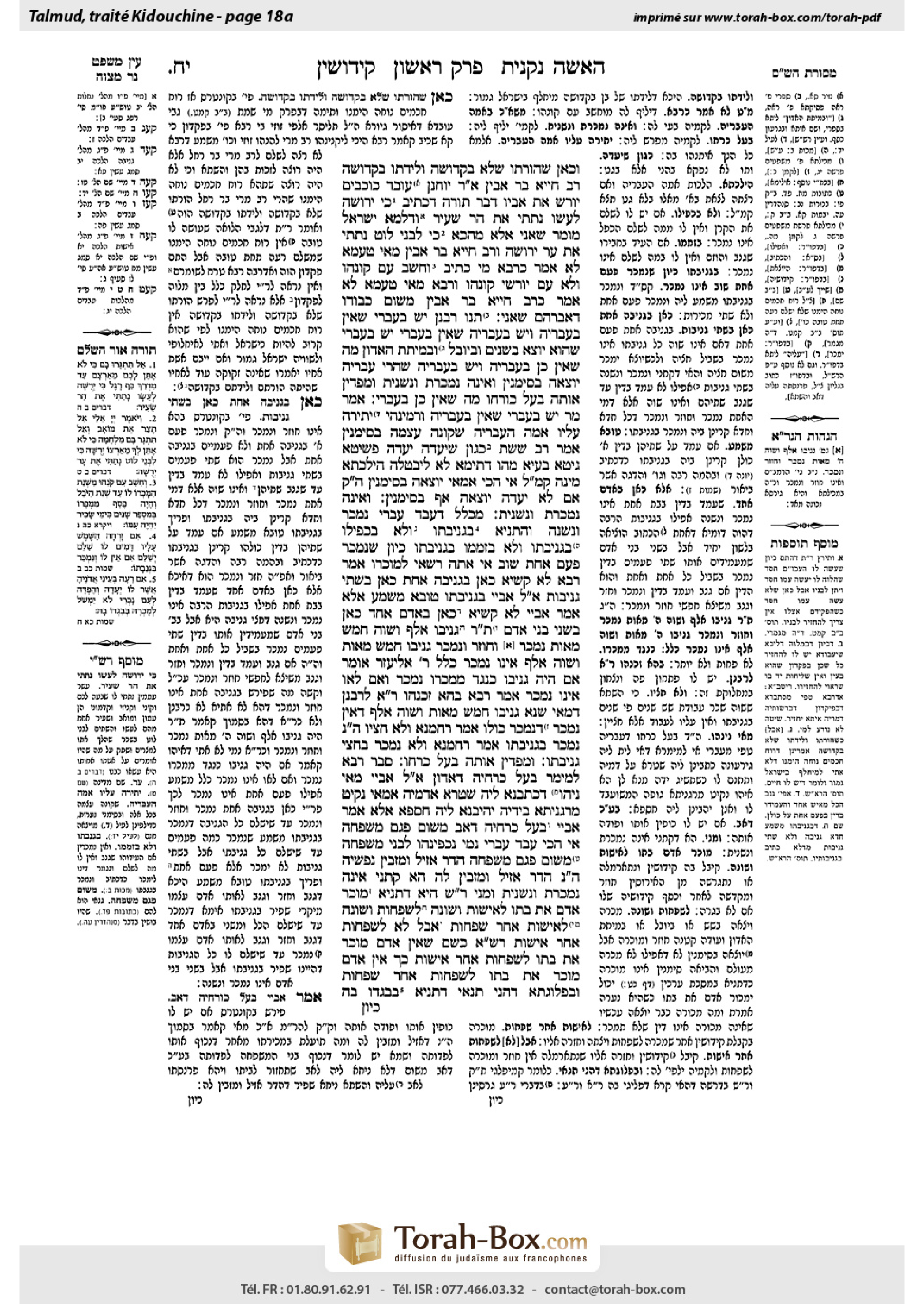
Kiddushin 18a: Talmud study for Daf Yomi
Daf Yomi is the daily study of one Talmud folio. Explore 37 tractates with scans, Hebrew text, Sefaria English and AI-generated French translations where annotated.
Passage selection and English or AI-generated French translation are available where the scan has annotations. Daf Study is independent of Torah-Box and Sefaria.
Browse Kiddushin · קידושין · All tractatesKiddushin 18a text and translations
This page of Kiddushin includes the Aramaic text, an English translation and an AI-generated French translation, alongside the scan above.
קידושין י״ח א · Aramaic and Hebrew text
וְכָאן שֶׁהוֹרָתוֹ שֶׁלֹּא בִּקְדוּשָּׁה, וְלֵידָתוֹ בִּקְדוּשָּׁה.
רַב חִיָּיא בַּר אָבִין אָמַר רַבִּי יוֹחָנָן: נׇכְרִי יוֹרֵשׁ אֶת אָבִיו דְּבַר תּוֹרָה, דִּכְתִיב: ״כִּי יְרֻשָּׁה לְעֵשָׂו נָתַתִּי אֶת הַר שֵׂעִיר״. וְדִלְמָא יִשְׂרָאֵל מְשׁוּמָּד שָׁאנֵי? אֶלָּא מֵהָכָא: ״כִּי לִבְנֵי לוֹט נָתַתִּי אֶת עָר יְרֻשָּׁה״.
וְרַב חִיָּיא בַּר אָבִין, מַאי טַעְמָא לָא אָמַר כְּרָבָא? מִי כְּתִיב ״וְחִשַּׁב עִם קֹנֵהוּ וְלֹא עִם יוֹרְשֵׁי קוֹנֵהוּ״?
וְרָבָא, מַאי טַעְמָא לָא אָמַר כְּרַב חִיָּיא בַּר אָבִין? מִשּׁוּם כְּבוֹדוֹ דְּאַבְרָהָם שָׁאנֵי.
תָּנוּ רַבָּנַן: יֵשׁ בָּעִבְרִי שֶׁאֵין בָּעִבְרִיָּה, וְיֵשׁ בָּעִבְרִיָּה שֶׁאֵין בָּעִבְרִי. יֵשׁ בָּעִבְרִי שֶׁהוּא יוֹצֵא בְּשָׁנִים, וּבַיּוֹבֵל, וּבְמִיתַת הָאָדוֹן – מַה שֶּׁאֵין כֵּן בָּעִבְרִיָּה, וְיֵשׁ בָּעִבְרִיָּה, שֶׁהֲרֵי עִבְרִיָּה יוֹצְאָה בְּסִימָנִין וְאֵינָהּ נִמְכֶּרֶת וְנִשְׁנֵית, וּמַפְדִּין אוֹתָהּ, בְּעַל כּוֹרְחוֹ, מַה שֶּׁאֵין כֵּן בָּעִבְרִי.
אָמַר מָר: יֵשׁ בָּעִבְרִי שֶׁאֵין בָּעִבְרִיָּה. וּרְמִינְהִי: יְתֵירָה עָלָיו אָמָה הָעִבְרִיָּה, שֶׁקּוֹנָה עַצְמָהּ בְּסִימָנִין! אָמַר רַב שֵׁשֶׁת: כְּגוֹן שֶׁיְּעָדָה.
יְעָדָה, פְּשִׁיטָא! גִּיטָּא בָּעֲיָא! מַהוּ דְּתֵימָא לָא (לִיבְטְלָה) [לִיבְטְלָן] הִילְכָתָא מִינַּהּ, קָא מַשְׁמַע לַן. אִי הָכִי, אַמַּאי יוֹצְאָה בְּסִימָנִין? הָכִי קָאָמַר: אִם לֹא יְעָדָה, יוֹצְאָה אַף בְּסִימָנִין.
וְאֵינָהּ נִמְכֶּרֶת וְנִשְׁנֵית. מִכְּלַל דְּעֶבֶד עִבְרִי נִמְכָּר וְנִשְׁנֶה? וְהָתַנְיָא: ״בִּגְנֵבָתוֹ״ – וְלֹא בִּכְפֵילוֹ. ״בִּגְנֵיבָתוֹ״ – וְלֹא בִּזְמָמוֹ. ״בִּגְנֵיבָתוֹ״ – כֵּיוָן שֶׁנִּמְכַּר פַּעַם אַחַת שׁוּב אִי אַתָּה רַשַּׁאי לְמוֹכְרוֹ.
אָמַר רָבָא: לָא קַשְׁיָא, כָּאן בִּגְנֵיבָה אַחַת, כָּאן בִּשְׁתֵּי גְּנֵיבוֹת.
אֲמַר לֵיהּ אַבָּיֵי: ״בִּגְנֵיבָתוֹ״ – טוּבָא מַשְׁמַע! אֶלָּא אָמַר אַבָּיֵי: לָא קַשְׁיָא, כָּאן בְּאָדָם אֶחָד, כָּאן בִּשְׁנֵי בְּנֵי אָדָם.
תָּנוּ רַבָּנַן: גְּנֵיבוֹ אֶלֶף, וְשָׁוֶה חֲמֵשׁ מֵאוֹת – נִמְכָּר וְחוֹזֵר וְנִמְכָּר. גְּנֵיבוֹ חֲמֵשׁ מֵאוֹת, וְשָׁוֶה אֶלֶף – אֵינוֹ נִמְכָּר כְּלָל. רַבִּי אֱלִיעֶזֶר אוֹמֵר: אִם הָיָה גְּנֵיבוֹ כְּנֶגֶד מִמְכָּרוֹ – נִמְכָּר, וְאִם לָאו – אֵינוֹ נִמְכָּר.
אָמַר רָבָא: בְּהָא זְכָנְהוּ רַבִּי אֱלִיעֶזֶר לְרַבָּנַן, דְּמַאי שְׁנָא גְּנֵיבוֹ חֲמֵשׁ מֵאוֹת וְשָׁוֶה אֶלֶף דְּאֵין נִמְכָּר, דְּנִמְכַּר כּוּלּוֹ אָמַר רַחֲמָנָא, וְלֹא חֶצְיוֹ, הָכִי נָמֵי: נִמְכַּר בִּגְנֵיבָתוֹ אָמַר רַחֲמָנָא וְלֹא נִמְכַּר בַּחֲצִי גְנֵיבָתוֹ.
וּמַפְדִּין אוֹתָהּ בְּעַל כׇּרְחוֹ. סְבַר רָבָא לְמֵימַר בְּעַל כֻּרְחֵיהּ דְּאָדוֹן. אֲמַר לֵיהּ אַבָּיֵי: מַאי נִיהוּ – דְּכָתֵבְנָא לֵיהּ שְׁטָרָא אַדְּמֶיהָ? אַמַּאי? נָקֵיט מַרְגָּנִיתָא בִּידֵיהּ, יָהֵיבְנָא לֵיהּ חַסְפָּא?
אֶלָּא אָמַר אַבָּיֵי: בְּעַל כֻּרְחֵיהּ דְּאָב, מִשּׁוּם פְּגַם מִשְׁפָּחָה. אִי הָכִי, עֶבֶד עִבְרִי נָמֵי, נִכְפִּינְהוּ לִבְנֵי מִשְׁפָּחָה מִשּׁוּם פְּגַם מִשְׁפָּחָה! הָדַר אָזֵיל וּמְזַבֵּין נַפְשֵׁיהּ.
הָכָא נָמֵי הָדַר אָזֵיל וּמְזַבֵּין לַהּ! הָא קָתָנֵי: אֵינָהּ נִמְכֶּרֶת וְנִשְׁנֵית. וּמַנִּי – רַבִּי שִׁמְעוֹן הִיא. דְּתַנְיָא: מוֹכֵר אָדָם אֶת בִּתּוֹ לְאִישׁוּת וְשׁוֹנֶה, לְשִׁפְחוּת וְשׁוֹנֶה, לְאִישׁוּת אַחַר שִׁפְחוּת, אֲבָל לֹא לְשִׁפְחוּת אַחַר אִישׁוּת. רַבִּי שִׁמְעוֹן אוֹמֵר: כְּשֵׁם שֶׁאֵין אָדָם מוֹכֵר אֶת בִּתּוֹ לְשִׁפְחוּת אַחַר אִישׁוּת כָּךְ אֵין אָדָם מוֹכֵר אֶת בִּתּוֹ לְשִׁפְחוּת אַחַר שִׁפְחוּת.
וּבִפְלוּגְתָּא דְּהָנֵי תַּנָּאֵי דְּתַנְיָא: ״בְּבִגְדוֹ בָּהּ״ –
Kiddushin 18a · English translation
And here it is referring to a case where he was not conceived in sanctity, i.e., his mother conceived him before she converted, and only his birth was in sanctity, as she converted when pregnant. It is appropriate to return money to this individual.
Rav Ḥiyya bar Avin says that Rabbi Yoḥanan says: By Torah law a gentile inherits from his father, as it is written: “Because I have given mount Seir to Esau as an inheritance” (Deuteronomy 2:5). The Gemara asks: But perhaps it is different with regard to an apostate Jew? In other words, it is possible that Esau was not considered a gentile but rather Jewish, like the Patriarchs. Consequently, he is categorized as an apostate Jew. Rather, the proof is from here: “Because I have given Ar to the children of Lot as an inheritance” (Deuteronomy 2:9), and the descendants of Lot were certainly gentiles.
The Gemara asks: And Rav Ḥiyya bar Avin, what is the reason that he did not state his opinion in accordance with the explanation of Rava, who derives the inheritance of gentiles from the verse: “And he shall reckon with his purchaser” (Leviticus 25:50)? The Gemara answers: Is it written explicitly in the Torah: And he shall reckon with his purchaser and not with the heirs of his purchaser? This proof is based on an exposition, not on an explicit source.
The Gemara further asks: And Rava, what is the reason that he did not state his opinion in accordance with the explanation of Rav Ḥiyya bar Avin? The Gemara answers: Perhaps due to the honor of Abraham it is different. It is possible that for the sake of Abraham an inheritance was given to the members of his family. The same may not apply to gentiles in general.
§ The Sages taught: There are details of the halakhot of a Hebrew slave that do not apply to the case of a Hebrew maidservant and there are details of the halakhot of a Hebrew maidservant that do not apply to a Hebrew slave. The baraita elaborates: There are unique details in the halakhot of emancipating a Hebrew slave, as he leaves through serving a term of six years, and he leaves through the Jubilee Year, and he leaves through the death of the master, which is not the case for a Hebrew maidservant. And there are unique details in the halakhot of emancipating a Hebrew maidservant, as a Hebrew maidservant leaves through signs indicating puberty, and she is not sold for a second time, and one can redeem her against his will, as the Gemara will explain, which is not the case for a Hebrew slave.
The Gemara analyzes this baraita. The Master said above: There are details of the halakhot of emancipating a Hebrew slave that do not apply to the case of a Hebrew maidservant. And the Gemara raises a contradiction from the mishna: A Hebrew maidservant has one mode of emancipation more than him, as she acquires herself through signs indicating puberty. The expression: More than him, indicates that all of the modes through which a Hebrew slave can be freed apply to a Hebrew maidservant as well. Rav Sheshet said: This baraita is referring to a case where the master designated her to marry him during the six years. Consequently, she cannot be released from his authority by all of the modes through which a Hebrew slave can be freed, as she is his wife.
The Gemara asks: If he designated her, it is obvious that she cannot be released in the manner of a slave, as she is his wife and therefore requires a bill of divorce. The Gemara says: It is necessary to state this explicitly, lest you say that the primary halakha is not nullified with regard to her, i.e., even after she has been designated she can still be freed as a slave would be, without a bill of divorce. Therefore, the baraita teaches us that this is not the case. The Gemara asks: If so, that this is referring to a case where he designated her, why does she leave through signs indicating puberty? If he designated her she becomes his wife, and signs indicating the onset of puberty should not affect her status. The Gemara answers: This is what the baraita is saying: If he did not designate her, she leaves also through signs indicating puberty.
§ The baraita teaches: And a Hebrew maidservant is not sold a second time. The Gemara comments: From the fact that the baraita says this about a Hebrew maidservant, it can be inferred that a Hebrew slave can be sold a second time. But isn’t it taught in a baraita that the verse: “And he is sold for his theft” (Exodus 22:2), means that he can be sold to pay for the items that he has stolen but not to pay for his double payment? Although one can be sold into slavery to reimburse the owner for the principal of his theft, he cannot be sold to pay the fine. Furthermore, “for his theft” indicates: But not to pay for his conspiring testimony. If he is a conspiring witness, who is required to pay the value of what he testified that another had stolen but he does not have the money to do so, he is not sold as a slave. Additionally, the phrase “for his theft” teaches that he can be sold for stealing only once, and once he has been sold one time you may not sell him again.
Rava said: This is not difficult. Here, in the second baraita, it is referring to one theft, i.e., he stole a large amount but he is not worth enough as a slave for the proceeds of his sale to repay his entire debt. In that case he cannot be sold a second time. There, in the first baraita, it is referring to two thefts, as he may be sold a second time if he stole once, was sold, and subsequently stole again.
Abaye said to Rava: The expression “for his theft” indicates even many thefts. Rather, Abaye said: This is not difficult. Here, in the second baraita, it is referring to one who stole from one person. This thief cannot be sold a second time even for several thefts. There, in the first baraita, it is referring to thefts from two people.
The Sages taught: If the property he stole was worth one thousand and as a slave he is worth only five hundred, he is sold and sold again. If the property he stole was worth five hundred and he is worth one thousand, he is not sold at all. Rabbi Eliezer says: If the property he stole was exactly equal to his value if he were sold, he is sold; and if not, he is not sold.
Rava said: In this case Rabbi Eliezer triumphed over the Rabbis, as what is different in a case where the property he stole is worth five hundred and he is worth one thousand that they concede that he is not sold? The reason is that the Merciful One states that he is sold in his entirety, and not part of him. So too, if he is worth less than the value of the property he stole, one can say: The Merciful One states that he is sold for his theft, and he is not sold for part of his theft.
§ The baraita further teaches: And one can redeem a Hebrew maidservant against his will. Rava thought to say that this means against the will of the master, i.e., she can be redeemed even if he refuses. Abaye said to him: What is the mechanism for emancipating her against the will of her master? Is it that one writes a document to him for her value, and when she has the money she repays this debt? Why should it be possible to force the master to free her in this manner? He is holding a pearl [marganita] in his hand and one gives him a shard instead, as this document is currently useless.
Rather, Abaye said: She can be redeemed against the will of her father, due to the family flaw, i.e., the harm caused to the family name by her status. The court pressures the father as much as possible to redeem her, as it is disgraceful to a family if one of its daughters is a maidservant. The Gemara asks: If so, one should force the family of a Hebrew slave to redeem him also, due to the family flaw. The Gemara answers: There is a concern that he will go back and sell himself and earn money in this manner at his family’s expense.
The Gemara asks: Here too, in the case of a Hebrew maidservant, the father might go back and sell her as a maidservant again and receive money for her a second time. The Gemara answers that it is taught: A maidservant is not sold a second time. And whose opinion is this? It is that of Rabbi Shimon, as it is taught in a baraita: One can sell, i.e., transfer, his young daughter in marriage and go back and betroth her again if she was divorced or widowed. Likewise, he can sell her into slavery and transfer her again, this time for marriage, after he sold her into slavery. But one cannot sell his daughter into slavery after marriage. Rabbi Shimon says: Just as a person cannot sell his daughter into slavery after marriage, so too, a person cannot sell his daughter into slavery after slavery.
The Gemara comments: And this issue is taught in the dispute between these tanna’im, as it is taught in a baraita with regard to the verse: “He shall have no power to sell her to a foreign people, seeing that he has dealt deceitfully with her [bevigdo vah]” (Exodus 21:8).
Kiddushin 18a · Traduction française (IA)
Et ici, il s’agit d’un cas où il n’a pas été conçu dans la sainteté, c’est-à-dire que sa mère l’a conçu avant de se convertir, et où seule sa naissance a eu lieu dans la sainteté, puisqu’elle s’est convertie alors qu’elle était enceinte. Il convient de restituer de l’argent à cet individu.
Rav Ḥiyya bar Avin dit au nom de Rabbi Yoḥanan : selon la Torah, un non-Juif hérite de son père, comme il est écrit : « Car j’ai donné le mont Séïr à Ésaü en héritage » (Deutéronome 2, 5). La Guemara demande : Mais peut-être en va-t-il autrement d’un Juif apostat ? Autrement dit, il est possible qu’Ésaü n’ait pas été considéré comme un non-Juif, mais comme un Juif, à l’instar des Patriarches. Il serait donc classé parmi les Juifs apostats. La preuve vient plutôt de ce verset : « Car j’ai donné Ar aux enfants de Lot en héritage » (Deutéronome 2, 9), et les descendants de Lot étaient assurément des non-Juifs.
La Guemara demande : Et Rav Ḥiyya bar Avin, pourquoi n’a-t-il pas énoncé son avis conformément à l’explication de Rava, qui déduit l’héritage des non-Juifs du verset : « Il fera le compte avec son acheteur » (Lévitique 25, 50) ? La Guemara répond : Est-il écrit explicitement dans la Torah : « Il fera le compte avec son acheteur, et non avec les héritiers de son acheteur » ? Cette preuve repose sur une interprétation, et non sur une source explicite.
La Guemara demande encore : Et Rava, pourquoi n’a-t-il pas énoncé son avis conformément à l’explication de Rav Ḥiyya bar Avin ? La Guemara répond : Peut-être est-ce différent en raison de l’honneur d’Abraham. Il est possible qu’un héritage ait été accordé aux membres de sa famille en considération d’Abraham. Cela ne s’applique peut-être pas aux non-Juifs en général.
§ Les Sages ont enseigné : Certains détails des halakhot de l’esclave hébreu ne s’appliquent pas à la servante hébreue, et certains détails des halakhot de la servante hébreue ne s’appliquent pas à l’esclave hébreu. La baraïta développe : Il existe des modalités particulières d’affranchissement de l’esclave hébreu : il est libéré au terme de six années de service, il est libéré l’année du Jubilé et il est libéré à la mort de son maître, contrairement à la servante hébreue. Il existe également des modalités particulières d’affranchissement de la servante hébreue : elle est libérée par les signes de la puberté, elle ne peut pas être vendue une seconde fois et on peut la racheter contre la volonté de son père, comme la Guemara l’expliquera, contrairement à l’esclave hébreu.
La Guemara analyse cette baraïta. Le Maître a dit plus haut : Certains détails des halakhot de l’affranchissement de l’esclave hébreu ne s’appliquent pas à la servante hébreue. La Guemara soulève une contradiction à partir de la Michna : La servante hébreue a un mode d’affranchissement de plus que lui, puisqu’elle acquiert sa liberté par les signes de la puberté. L’expression « de plus que lui » indique que toutes les modalités permettant de libérer l’esclave hébreu s’appliquent également à la servante hébreue. Rav Sheshet a dit : Cette baraïta parle d’un cas où le maître l’a désignée pour l’épouser pendant les six années. Par conséquent, elle ne peut pas être libérée de son autorité selon toutes les modalités permettant de libérer un esclave hébreu, puisqu’elle est son épouse.
La Guemara demande : S’il l’a désignée, il est évident qu’elle ne peut pas être libérée comme une esclave, puisqu’elle est son épouse et a donc besoin d’un acte de divorce. La Guemara répond : Il fallait le préciser, de peur que tu ne dises que la halakha fondamentale n’est pas annulée à son égard, c’est-à-dire qu’après avoir été désignée, elle peut encore être libérée comme une esclave, sans acte de divorce. La baraïta nous enseigne donc qu’il n’en est pas ainsi. La Guemara demande : Si c’est le cas, si cela concerne un cas où il l’a désignée, pourquoi est-elle libérée par les signes de la puberté ? S’il l’a désignée, elle devient son épouse, et les signes de la puberté ne devraient pas modifier son statut. La Guemara répond : Voici ce que dit la baraïta : s’il ne l’a pas désignée, elle est également libérée par les signes de la puberté.
§ La baraïta enseigne : Une servante hébreue ne peut pas être vendue une seconde fois. La Guemara fait remarquer : Du fait que la baraïta dit cela au sujet d’une servante hébreue, on peut en déduire qu’un esclave hébreu peut être vendu une seconde fois. Mais n’enseigne-t-on pas dans une baraïta que le verset « Il sera vendu pour son vol » (Exode 22, 2) signifie qu’il peut être vendu pour payer les biens qu’il a volés, mais non pour payer le double de leur valeur ? Bien qu’on puisse le vendre comme esclave afin de rembourser au propriétaire le principal de son vol, on ne peut pas le vendre pour payer l’amende. De plus, l’expression « pour son vol » signifie : mais non pour payer le montant correspondant à son faux témoignage concerté. S’il est un témoin comploteur, tenu de payer la valeur de ce qu’il a témoigné qu’un autre avait volé, mais qu’il n’a pas l’argent pour le faire, il n’est pas vendu comme esclave. Enfin, l’expression « pour son vol » enseigne qu’il ne peut être vendu que pour un seul vol ; une fois qu’il a été vendu, on ne peut pas le vendre une nouvelle fois.
Rava a dit : Il n’y a pas de difficulté. Ici, dans la seconde baraïta, il s’agit d’un seul vol : il a volé une somme importante, mais sa valeur comme esclave est insuffisante pour que le produit de sa vente rembourse toute sa dette. Dans ce cas, il ne peut pas être vendu une seconde fois. Là, dans la première baraïta, il s’agit de deux vols : il peut être vendu une seconde fois s’il a volé une première fois, a été vendu, puis a volé de nouveau.
Abaye dit à Rava : L’expression « pour son vol » indique que cela s’applique même à de nombreux vols. Abaye dit plutôt : Il n’y a pas de difficulté. Ici, dans la seconde baraïta, il s’agit de quelqu’un qui a volé une seule personne. Ce voleur ne peut pas être vendu une seconde fois, même pour plusieurs vols. Là, dans la première baraïta, il s’agit de vols commis contre deux personnes.
Les Sages ont enseigné : Si les biens qu’il a volés valaient mille et qu’il ne vaut que cinq cents comme esclave, il est vendu, puis vendu de nouveau. Si les biens qu’il a volés valaient cinq cents et qu’il vaut mille, il n’est pas vendu du tout. Rabbi Eliezer dit : Si la valeur des biens qu’il a volés est exactement égale à sa valeur comme esclave, il est vendu ; sinon, il n’est pas vendu.
Rava a dit : Dans ce cas, Rabbi Eliezer l’a emporté sur les Rabbins. En effet, en quoi le cas où les biens qu’il a volés valent cinq cents et où lui-même vaut mille diffère-t-il, puisque les Rabbins reconnaissent qu’il n’est pas vendu ? C’est parce que le Miséricordieux déclare qu’il est vendu dans son intégralité, et non en partie. De même, si sa valeur est inférieure à celle des biens qu’il a volés, on peut dire : le Miséricordieux déclare qu’il est vendu pour son vol, et non pour une partie de son vol.
§ La baraïta enseigne encore : On peut racheter une servante hébreue contre la volonté de son père. Rava pensa que cela signifiait contre la volonté du maître, c’est-à-dire qu’elle peut être rachetée même s’il refuse. Abaye lui dit : Quel est le moyen de la libérer contre la volonté de son maître ? Faudrait-il lui remettre un document pour sa valeur, puis, une fois qu’elle aura l’argent, qu’elle rembourse cette dette ? Pourquoi serait-il possible de contraindre le maître à la libérer de cette manière ? Il tient une perle [marganita] dans sa main, et on lui donne à la place un éclat de poterie, puisque ce document est actuellement sans valeur.
Abaye dit plutôt : Elle peut être rachetée contre la volonté de son père, en raison du défaut familial, c’est-à-dire du tort causé à la réputation de la famille par son statut. Le tribunal exerce autant de pression que possible sur le père pour qu’il la rachète, car il est honteux pour une famille que l’une de ses filles soit une servante. La Guemara demande : Dans ce cas, ne devrait-on pas également contraindre la famille d’un esclave hébreu à le racheter, en raison du défaut familial ? La Guemara répond : On craint qu’il ne retourne se vendre lui-même comme esclave et ne gagne ainsi de l’argent aux dépens de sa famille.
La Guemara demande : Ici aussi, dans le cas d’une servante hébreue, le père pourrait la vendre de nouveau comme servante et recevoir une seconde fois de l’argent pour elle. La Guemara répond qu’il est enseigné qu’une servante ne peut pas être vendue une seconde fois. Et de qui est-ce l’opinion ? De Rabbi Shimon, comme l’enseigne une baraïta : On peut vendre, c’est-à-dire donner en mariage, sa jeune fille, puis la fiancer de nouveau si elle a été divorcée ou est devenue veuve. De même, on peut la vendre comme esclave, puis la transférer une nouvelle fois, cette fois en mariage, après l’avoir vendue comme esclave. Mais on ne peut pas vendre sa fille comme esclave après son mariage. Rabbi Shimon dit : De même qu’une personne ne peut pas vendre sa fille comme esclave après son mariage, elle ne peut pas non plus la vendre comme esclave après qu’elle a été esclave.
La Guemara fait remarquer que cette question fait aussi l’objet d’une discussion entre ces tannaïm, comme l’enseigne une baraïta à propos du verset : « Il n’aura pas le pouvoir de la vendre à un peuple étranger, puisqu’il l’a traitée avec perfidie [bevigdo vah] » (Exode 21, 8).
Traduction française générée par IA à partir de l’édition anglaise de Sefaria. Vérifie toujours un passage avec le texte source.
Text from Sefaria: William Davidson Edition - Vocalized Aramaic (CC BY NC); William Davidson Edition - English (CC BY NC).