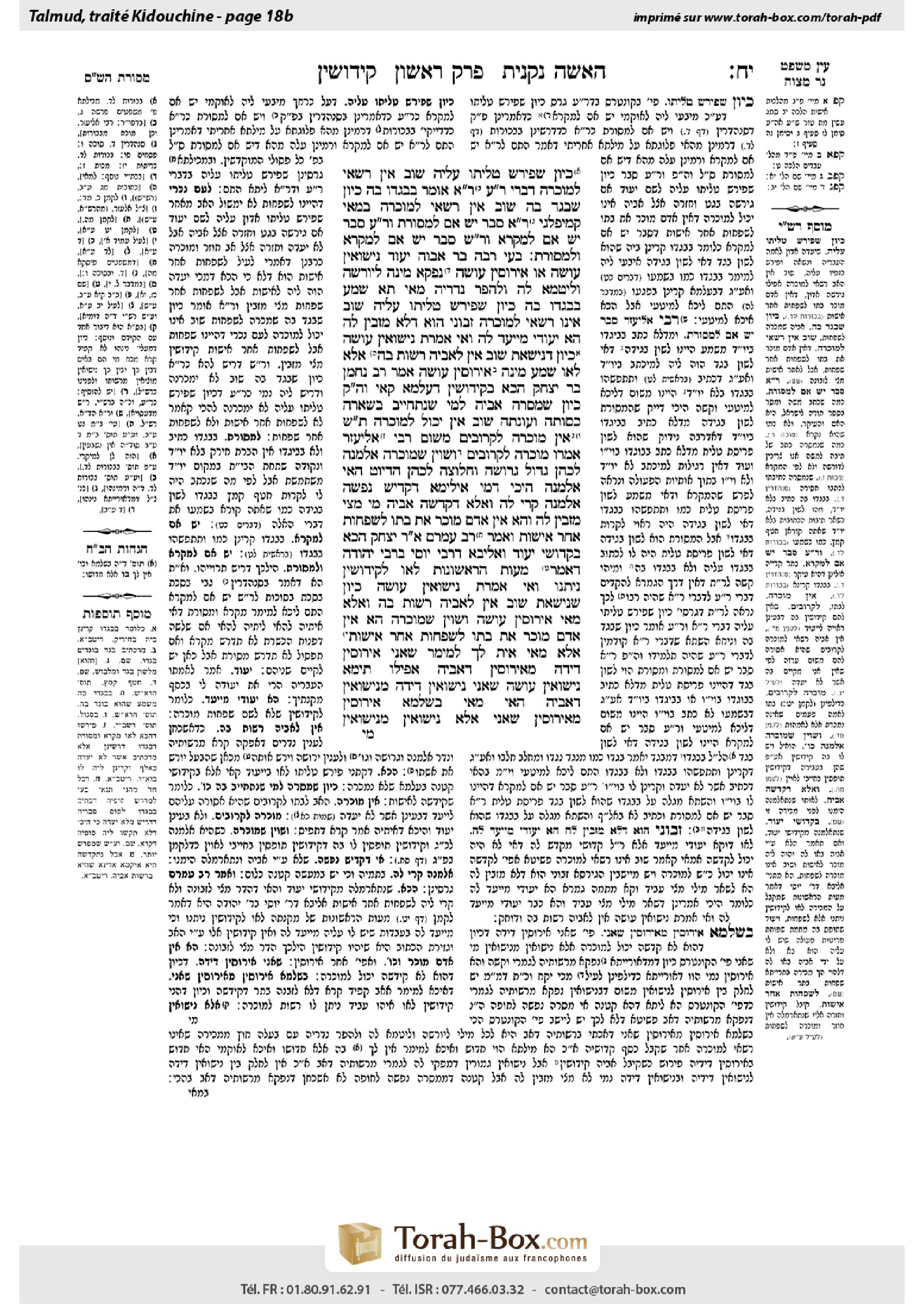
Kiddushin 18b: Talmud study for Daf Yomi
Daf Yomi is the daily study of one Talmud folio. Explore 37 tractates with scans, Hebrew text, Sefaria English and AI-generated French translations where annotated.
Passage selection and English or AI-generated French translation are available where the scan has annotations. Daf Study is independent of Torah-Box and Sefaria.
Browse Kiddushin · קידושין · All tractatesKiddushin 18b text and translations
This page of Kiddushin includes the Aramaic text, an English translation and an AI-generated French translation, alongside the scan above.
קידושין י״ח ב · Aramaic and Hebrew text
כֵּיוָן שֶׁפֵּירַשׂ טַלִּיתוֹ עָלֶיהָ, שׁוּב אֵין רַשַּׁאי לְמוֹכְרָהּ, דִּבְרֵי רַבִּי עֲקִיבָא. רַבִּי אֱלִיעֶזֶר אוֹמֵר: ״בְּבִגְדוֹ בָּהּ״ – כֵּיוָן שֶׁבָּגַד בָּהּ, שׁוּב אֵין רַשַּׁאי לְמוֹכְרָהּ.
בְּמַאי קָמִיפַּלְגִי? רַבִּי אֱלִיעֶזֶר סָבַר: יֵשׁ אֵם לַמָּסוֹרֶת, וְרַבִּי עֲקִיבָא סָבַר: יֵשׁ אֵם לַמִּקְרָא, וְרַבִּי שִׁמְעוֹן סָבַר: יֵשׁ אֵם לַמִּקְרָא וְלַמָּסוֹרֶת.
בָּעֵי רַבָּה בַּר אֲבוּהּ: יִעוּד נִישּׂוּאִין עוֹשֶׂה, אוֹ אֵירוּסִין עוֹשֶׂה? נָפְקָא מִינַּהּ לְיוֹרְשָׁהּ, וְלִיטַמֵּא לָהּ, וּלְהָפֵר נְדָרֶיהָ. מַאי?
תָּא שְׁמַע: ״בְּבִגְדוֹ בָּהּ״ – כֵּיוָן שֶׁפֵּירַשׂ טַלִּיתוֹ עָלֶיהָ שׁוּב אֵינוֹ רַשַּׁאי לְמוֹכְרָהּ. זַבּוֹנֵי הוּא דְּלָא מְזַבֵּין לַהּ, הָא יַעוֹדֵי מְיַיעֵד לַהּ, וְאִי אָמְרַתְּ נִישּׂוּאִין עוֹשֶׂה, כֵּיוָן דְּנִישֵּׂאת שׁוּב אֵין לְאָבִיהָ רְשׁוּת בָּהּ! אֶלָּא לָאו שְׁמַע מִינַּהּ אֵירוּסִין עוֹשֶׂה.
אָמַר רַב נַחְמָן בַּר יִצְחָק: הָכָא בְּקִידּוּשִׁין דְּעָלְמָא קָאֵי. וְהָכִי קָאָמַר: כֵּיוָן שֶׁמְּסָרָהּ אָבִיהָ לְמִי שֶׁנִּתְחַיֵּיב בִּשְׁאֵרָהּ כְּסוּתָהּ וְעוֹנָתָהּ – שׁוּב אֵין יָכוֹל לְמוֹכְרָהּ.
תָּא שְׁמַע: אֵין מוֹכְרָהּ לִקְרוֹבִים. מִשּׁוּם רַבִּי אֱלִיעֶזֶר אָמְרוּ: מוֹכְרָהּ לִקְרוֹבִים. וְשָׁוִין שֶׁמּוֹכְרָהּ אַלְמָנָה לְכֹהֵן גָּדוֹל, גְּרוּשָׁה וַחֲלוּצָה לְכֹהֵן הֶדְיוֹט.
הַאי אַלְמָנָה הֵיכִי דָּמֵי? אִילֵּימָא דְּקַדִּישׁ נַפְשַׁהּ, אַלְמָנָה קָרֵי לַהּ? וְאֶלָּא דְּקַדְּשַׁהּ אָבִיהָ. מִי מָצֵי מְזַבֵּין לַהּ? וְהָא אֵין אָדָם מוֹכֵר אֶת בִּתּוֹ לְשִׁפְחוּת אַחַר אִישׁוּת.
וְאָמַר רַב עַמְרָם אָמַר רַבִּי יִצְחָק: הָכָא בְּקִדּוּשֵׁי יִעוּד, וְאַלִּיבָּא דְּרַבִּי יוֹסֵי בְּרַבִּי יְהוּדָה דְּאָמַר: מָעוֹת הָרִאשׁוֹנוֹת לָאו לְקִידּוּשִׁין נִיתְּנוּ. וְאִי אָמְרַתְּ נִישּׂוּאִין עוֹשֶׂה, כֵּיוָן שֶׁנִּישֵּׂאת שׁוּב אֵין לְאָבִיהָ רְשׁוּת בָּהּ!
וְאֶלָּא מַאי, אֵירוּסִין עוֹשֶׂה? – וְשָׁוִין שֶׁמּוֹכְרָהּ?! הָא אֵין אָדָם מוֹכֵר אֶת בִּתּוֹ לְשִׁפְחוּת אַחַר אִישׁוּת! אֶלָּא מַאי אִית לָךְ לְמֵימַר: שָׁאנֵי אֵירוּסִין דִּידַהּ מֵאֵירוּסִין דְּאָבִיהָ? – אֲפִילּוּ תֵּימָא נִישּׂוּאִין עוֹשֶׂה, שָׁאנֵי נִישּׂוּאִין דִּידַהּ מִנִּישּׂוּאִין דְּאָבִיהָ.
הַאי מַאי? בִּשְׁלָמָא אֵירוּסִין מֵאֵירוּסִין שָׁאנֵי, אֶלָּא נִישּׂוּאִין מִנִּישּׂוּאִין,
Kiddushin 18b · English translation
This verse indicates that once the master has spread his garment over her, thereby designating her as his wife, her father may no longer sell her. This is the statement of Rabbi Akiva, who interprets bevigdo as related to beged, meaning garment. Rabbi Eliezer says: “Bevigdo vah” means that since the father dealt deceitfully [bagad] with her and sold her once, he cannot sell her again.
The Gemara asks: With regard to what principle do they disagree? Rabbi Eliezer maintains that the tradition of the manner in which the verses in the Torah are written is authoritative, and one derives halakhot based on the spelling of the words. One relies on the way a word is written, without the traditional vocalization, and therefore it is read as though it were vocalized as bevagdo, which refers to betrayal, not a garment. And Rabbi Akiva maintains that the vocalization of the Torah is authoritative, meaning that one derives halakhot based on the pronunciation of the words, although it diverges from the spelling, and since one pronounces the term as bevigdo, it is related to the word beged, meaning garment. And Rabbi Shimon maintains that both the vocalization of the Torah and the tradition of the manner in which the verses in the Torah are written are authoritative. Consequently, she cannot be sold as a slave after she has been taken as a wife, nor can she be sold again after she has already been sold once.
Rabba bar Avuh raises a dilemma: Does designation of a Hebrew maidservant for betrothal by her master effect marriage or does it effect only betrothal? The practical difference of the outcome of this dilemma is whether he inherits her property, i.e., does her husband inherit her property if she dies as he would if she were married to him; and whether he is obligated to become impure to bury her when she dies, if he is a priest; and whether he can nullify her vows on his own without her father, as is the case with a married woman. What is the halakha?
The Gemara suggests: Come and hear a solution to this dilemma. “Bevigdo vah” means: Once her master has spread his garment over her, the father may no longer sell her. The Gemara analyzes this statement: This indicates that her father cannot sell her afterward, but he can designate her for another man if the master dies or divorces her. And if you say that designation effects marriage, once she is married her father no longer has authority over her. Rather, is it not correct to learn from this that designation effects only betrothal?
Rav Naḥman bar Yitzḥak said that this argument can be refuted. Here, the baraita is dealing with the ordinary betrothal of one’s daughter, not to one who sells his daughter as a maidservant. And this is what the baraita is saying: Since her father gave her, i.e., betrothed her, to one who is obligated to provide her food, her clothing, and fulfill her conjugal rights, he can no longer sell her. Therefore, this baraita proves nothing with regard to the issue of whether or not designation effects marriage.
The Gemara cites another relevant source. Come and hear: A father cannot sell his daughter as a maidservant to relatives with whom she is prohibited from engaging in sexual intercourse, as they cannot fulfill the mitzva of designation. They said in the name of Rabbi Eliezer: He can sell her to relatives, because designation is merely an option and its inapplicability does not negate the possibility of a sale. And they agree that he can sell her to a High Priest if she is a widow, or to a common priest if she is a divorcée or a yevama who performed ḥalitza [ḥalutza]. Although it is prohibited for her to marry these men, their betrothal is effective, and therefore designation is not entirely impossible in these cases.
The Gemara clarifies: What are the circumstances of this widow? If we say that she betrothed herself when she was a minor and her husband died, is she called a widow? Since the initial betrothal was entirely ineffective, as a minor cannot accept betrothal independently, she would not be considered his wife. Rather, one must say that her father betrothed her and she was subsequently widowed. But if that is the case, can he sell her? But it was taught that a person cannot sell his daughter into slavery after marriage.
And Rav Amram says that Rabbi Yitzḥak says: Here, it is referring to a woman widowed from betrothal of designation, and this is in accordance with the opinion of Rabbi Yosei, son of Rabbi Yehuda, who says: The original money of the sale of the maidservant was not given for the purpose of betrothal but as payment for her work, and if the master wishes to designate her he must give her additional money for that purpose. The relevance of this assertion will be clarified below. The Gemara explains the proof from this baraita: And if you say that designation effects marriage, once she is married her father no longer has authority over her. How can he sell her a second time after the death of her first husband?
The Gemara asks from the other perspective: Rather, what will you say, that designation effects only betrothal? If so, why does the baraita state: And they agree that he can sell her? After all, a person cannot sell his daughter into slavery after matrimony. This baraita also refers to a case where a woman was betrothed but the marriage was not consummated. Rather, what have you to say? Betrothal effected by her is different from betrothal effected by her father. Since the marriage was not performed through her father but by the master giving her additional money, as held by Rabbi Yosei, son of Rabbi Yehuda, the principle that one cannot sell his daughter into slavery after betrothal does not apply. But by the same reasoning, even if you say that designation effects marriage, you can argue that marriage effected by her is different from marriage effected by her father.
This challenge is rejected: What is this comparison? Granted, one form of betrothal is different from the other betrothal, i.e., there is a difference between standard betrothal with the father’s consent and betrothal through designation, which is performed upon the master’s initiative. After that type of betrothal the father can, in fact, sell her a second time. But with regard to one mode of effecting marriage in relation to another mode of effecting marriage,
Kiddushin 18b · Traduction française (IA)
Ce verset indique que, dès lors que le maître a étendu son vêtement sur elle, la désignant ainsi comme son épouse, son père ne peut plus la vendre. C'est l'avis de Rabbi Akiva, qui interprète bevigdo comme étant lié à beged, signifiant vêtement. Rabbi Eliezer dit : « Bevigdo vah » signifie que, puisque le père a agi de manière trompeuse [bagad] à son égard et l'a vendue une fois, il ne peut pas la revendre.
La Guemara demande : Sur quel principe sont-ils en désaccord ? Rabbi Eliezer soutient que la tradition concernant la manière dont les versets de la Torah sont écrits fait autorité, et l'on déduit des halakhot à partir de l'orthographe des mots. On s'appuie sur la façon dont un mot est écrit, sans la vocalisation traditionnelle, et il est donc lu comme s'il était vocalisé bevagdo, ce qui fait référence à la trahison, et non à un vêtement. Et Rabbi Akiva soutient que la vocalisation de la Torah fait autorité, ce qui signifie que l'on déduit des halakhot à partir de la prononciation des mots, bien qu'elle diverge de l'orthographe, et comme on prononce le terme bevigdo, il est lié au mot beged, signifiant vêtement. Et Rabbi Shimon soutient que tant la vocalisation de la Torah que la tradition concernant la manière dont les versets de la Torah sont écrits font autorité. En conséquence, elle ne peut pas être vendue comme servante après avoir été prise comme épouse, ni être revendue après avoir déjà été vendue une fois.
Rabba bar Avuh soulève une difficulté : la désignation d'une servante hébraïque par son maître pour la fiancer produit-elle un mariage ou uniquement des fiançailles ? La différence pratique découlant de cette difficulté réside dans le fait de savoir s'il hérite de ses biens, c'est-à-dire si son mari hérite de ses biens en cas de décès, comme ce serait le cas s'il était marié avec elle ; et s'il est obligé de se rendre impur pour l'enterrer en cas de décès, s'il est un Cohen ; et s'il peut annuler ses vœux seul, sans son père, comme c'est le cas pour une femme mariée. Quelle est la halakha ?
La Guemara propose : Venez écouter une solution à cette difficulté. « Bevigdo vah » signifie : Dès lors que son maître a étendu son vêtement sur elle, le père ne peut plus la vendre. La Guemara analyse cette déclaration : Cela indique que son père ne peut pas la vendre par la suite, mais il peut la désigner pour un autre homme si le maître meurt ou la répudie. Et si vous dites que la désignation produit un mariage, dès qu'elle est mariée, son père n'a plus d'autorité sur elle. Au contraire, n'est-il pas correct d'en déduire que la désignation produit uniquement des fiançailles ?
Rav Naḥman bar Yitzḥak a dit que cet argument peut être réfuté. Ici, la baraïta traite des fiançailles ordinaires de sa fille, et non de celles d'une personne qui vend sa fille comme servante. Et c'est ce que dit la baraïta : Puisque son père l'a donnée, c'est-à-dire fiancée, à un homme qui est obligé de lui fournir sa nourriture, ses vêtements et d'accomplir ses droits conjugaux, il ne peut plus la vendre. Par conséquent, cette baraïta ne prouve rien concernant la question de savoir si la désignation produit un mariage ou non.
La Guemara cite une autre source pertinente. Écoutez : Un père ne peut pas vendre sa fille comme servante à des parents avec lesquels elle est interdite de relations sexuelles, car ils ne peuvent pas accomplir la mitsva de désignation. Ils ont dit au nom de Rabbi Eliezer : Il peut la vendre à des parents, car la désignation n'est qu'une option et son inapplicabilité n'annule pas la possibilité d'une vente. Et ils sont d'accord pour dire qu'il peut la vendre à un Grand Prêtre si elle est veuve, ou à un prêtre commun si elle est divorcée ou une yevama qui a accompli la ḥalitza [ḥalutza]. Bien qu'il lui soit interdit de se marier avec ces hommes, leurs fiançailles sont effectives, et par conséquent la désignation n'est pas entièrement impossible dans ces cas.
La Guemara précise : Quelles sont les circonstances de cette veuve ? Si nous disons qu'elle s'est fiancée alors qu'elle était mineure et que son mari est mort, est-elle appelée veuve ? Puisque les fiançailles initiales étaient entièrement inefficaces, car une mineure ne peut pas accepter des fiançailles indépendamment, elle ne serait pas considérée comme son épouse. Au contraire, on doit dire que son père l'a fiancée et qu'elle est devenue veuve par la suite. Mais si c'est le cas, peut-il la vendre ? Or, il a été enseigné qu'une personne ne peut pas vendre sa fille en esclavage après le mariage.
Et Rav Amram dit que Rabbi Yitzḥak dit : Ici, il s'agit d'une femme devenue veuve par la désignation, et cela est conforme à l'avis de Rabbi Yosei, fils de Rabbi Yehuda, qui dit : L'argent initial de la vente de la servante n'a pas été donné dans le but de fiançailles, mais comme paiement pour son travail, et si le maître souhaite la désigner, il doit lui donner de l'argent supplémentaire à cet effet. La pertinence de cette affirmation sera clarifiée ci-dessous. La Guemara explique la preuve tirée de cette baraïta : Et si vous dites que la désignation produit un mariage, dès qu'elle est mariée, son père n'a plus d'autorité sur elle. Comment peut-il la vendre une seconde fois après la mort de son premier mari ?
La Guemara interroge sous l'angle inverse : Plutôt, que direz-vous, que la désignation ne produit que des fiançailles ? Si tel est le cas, pourquoi la baraïta énonce-t-elle : Et ils sont d'accord pour dire qu'il peut la vendre ? Après tout, une personne ne peut pas vendre sa fille en esclavage après le mariage. Cette baraïta fait également référence à un cas où une femme était fiancée mais que le mariage n'avait pas été consommé. Plutôt, que pouvez-vous dire ? Les fiançailles effectuées par elle sont différentes des fiançailles effectuées par son père. Puisque le mariage n'a pas été effectué par son père, mais par le maître en lui donnant de l'argent supplémentaire, comme le soutient Rabbi Yosei, fils de Rabbi Yehuda, le principe selon lequel on ne peut pas vendre sa fille en esclavage après les fiançailles ne s'applique pas. Mais par le même raisonnement, même si vous dites que la désignation produit un mariage, vous pouvez argumenter que le mariage effectué par elle est différent du mariage effectué par son père.
Cette objection est écartée : Quelle est cette comparaison ? Certes, une forme de fiançailles diffère d'une autre, c'est-à-dire qu'il existe une différence entre les fiançailles standard avec le consentement du père et les fiançailles par désignation, qui sont effectuées à l'initiative du maître. Après ce type de fiançailles, le père peut en effet la vendre une seconde fois. Mais en ce qui concerne un mode d'accomplissement du mariage par rapport à un autre mode d'accomplissement du mariage,
Traduction française générée par IA à partir de l’édition anglaise de Sefaria. Vérifie toujours un passage avec le texte source.
Text from Sefaria: William Davidson Edition - Vocalized Aramaic (CC BY NC); William Davidson Edition - English (CC BY NC).