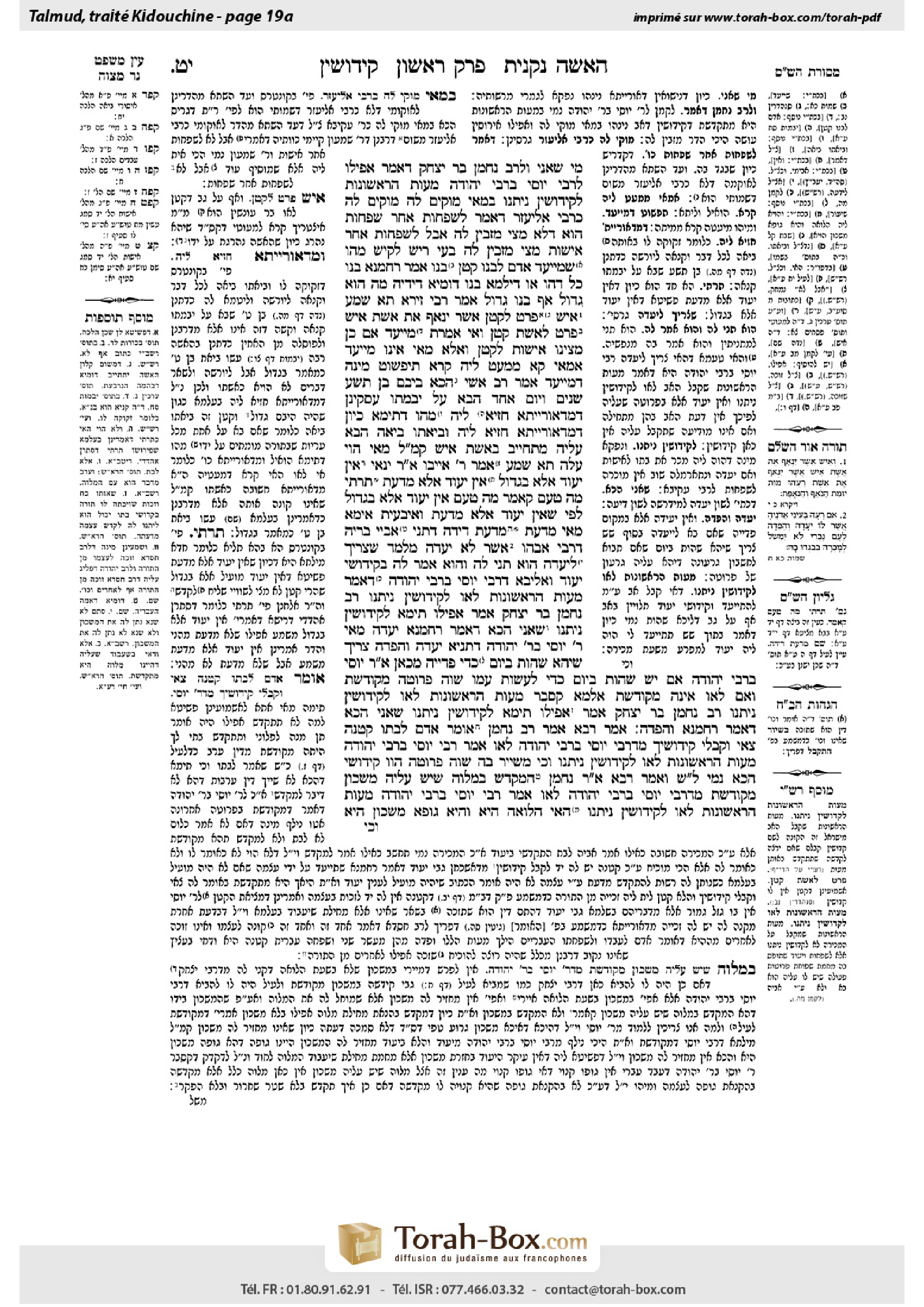
Kiddushin 19a: Talmud study for Daf Yomi
Daf Yomi is the daily study of one Talmud folio. Explore 37 tractates with scans, Hebrew text, Sefaria English and AI-generated French translations where annotated.
Passage selection and English or AI-generated French translation are available where the scan has annotations. Daf Study is independent of Torah-Box and Sefaria.
Browse Kiddushin · קידושין · All tractatesKiddushin 19a text and translations
This page of Kiddushin includes the Aramaic text, an English translation and an AI-generated French translation, alongside the scan above.
קידושין י״ט א · Aramaic and Hebrew text
מִי שָׁאנֵי?
וּלְרַב נַחְמָן בַּר יִצְחָק דְּאָמַר: אֲפִילּוּ לְרַבִּי יוֹסֵי בְּרַבִּי יְהוּדָה מָעוֹת הָרִאשׁוֹנוֹת לְקִידּוּשִׁין נִיתְּנוּ, בְּמַאי מוֹקֵים לַהּ? מוֹקֵים לַהּ כְּרַבִּי אֱלִיעֶזֶר דְּאָמַר: לְשִׁפְחוּת אַחַר שִׁפְחוּת הוּא דְּלָא מָצֵי מְזַבֵּין לַהּ, אֲבָל לְשִׁפְחוּת אַחַר אִישׁוּת – מָצֵי מְזַבֵּין לַהּ.
בָּעֵי רֵישׁ לָקִישׁ: מַהוּ שֶׁמְּיַיעֵד אָדָם לִבְנוֹ קָטָן? ״בְּנוֹ״ אָמַר רַחֲמָנָא, בְּנוֹ כָּל דְּהוּ, אוֹ דִילְמָא בְּנוֹ דּוּמְיָא דִידֵיהּ, מָה הוּא גָּדוֹל – אַף בְּנוֹ גָּדוֹל?
אָמַר רַבִּי זֵירָא: תָּא שְׁמַע: ״אִישׁ״ – פְּרָט לְקָטָן. ״אֲשֶׁר יִנְאַף אֶת אֵשֶׁת אִישׁ״ – פְּרָט לְאֵשֶׁת קָטָן. וְאִי אָמְרַתְּ מְיַיעֵד, אִם כֵּן מָצִינוּ אִישׁוּת לְקָטָן.
וְאֶלָּא מַאי, אֵינוֹ מְיַיעֵד? אַמַּאי קָא מְמַעֵט לֵיהּ קְרָא? תִּיפְשׁוֹט מִינַּהּ דִּמְיַיעֵד. אָמַר רַב אָשֵׁי: הָכָא בְּיָבָם בֶּן תֵּשַׁע שָׁנִים וְיוֹם אֶחָד הַבָּא עַל יְבִמְתּוֹ עָסְקִינַן,
דְּמִדְּאוֹרָיְיתָא חַזְיָא לֵיהּ, מַהוּ דְּתֵימָא: כֵּיוָן דְּמִדְּאוֹרָיְיתָא חַזְיָא לֵיהּ וּבִיאָתוֹ בִּיאָה, הַבָּא עָלֶיהָ מִתְחַיֵּיב בְּאֵשֶׁת אִישׁ, קָא מַשְׁמַע לַן.
מַאי הָוֵי עֲלַהּ? תָּא שְׁמַע, אָמַר רַבִּי אַיְיבוּ אָמַר רַבִּי יַנַּאי: אֵין יִעוּד אֶלָּא בְּגָדוֹל, אֵין יִעוּד אֶלָּא מִדַּעַת. תַּרְתֵּי? ״מָה טַעַם״ קָאָמַר. מָה טַעַם אֵין יִעוּד אֶלָּא בְּגָדוֹל – לְפִי שֶׁאֵין יִעוּד אֶלָּא מִדַּעַת.
וְאִיבָּעֵית אֵימָא: מַאי מִדַּעַת – מִדַּעַת דִּידַהּ. דְּתָנֵי אַבָּיֵי בְּרֵיהּ דְּרַבִּי אֲבָהוּ: ״אֲשֶׁר לֹא יְעָדָהּ״ – מְלַמֵּד שֶׁצָּרִיךְ לְיַעֲדָהּ.
הוּא תָּנֵי לַהּ, וְהוּא אָמַר לַהּ: בְּקִידּוּשֵׁי יִעוּד, וְאַלִּיבָּא דְּרַבִּי יוֹסֵי בְּרַבִּי יְהוּדָה דְּאָמַר: מָעוֹת הָרִאשׁוֹנוֹת לָאו לְקִידּוּשִׁין נִיתְּנוּ. רַב נַחְמָן בַּר יִצְחָק אָמַר: אֲפִילּוּ תֵּימָא לְקִידּוּשִׁין נִיתְּנוּ, שָׁאנֵי הָכָא דְּאָמַר רַחֲמָנָא ״יְעָדָהּ״.
מַאי רַבִּי יוֹסֵי בְּרַבִּי יְהוּדָה? דְּתַנְיָא: ״יְעָדָהּ, וְהֶפְדָּהּ״ – צָרִיךְ שֶׁיְּהֵא שְׁהוּת בַּיּוֹם כְּדֵי פְדִיָּיה.
מִכָּאן אָמַר רַבִּי יוֹסֵי בְּרַבִּי יְהוּדָה: אִם יֵשׁ שְׁהוּת בַּיּוֹם כְּדֵי לַעֲשׂוֹת עִמּוֹ שָׁוֶה פְּרוּטָה – מְקוּדֶּשֶׁת, וְאִם לָאו – אֵינָהּ מְקוּדֶּשֶׁת. אַלְמָא קָסָבַר: מָעוֹת הָרִאשׁוֹנוֹת – לָאו לְקִידּוּשִׁין נִיתְּנוּ.
רַב נַחְמָן בַּר יִצְחָק אָמַר: אֲפִילּוּ תֵּימָא לְקִידּוּשִׁין נִיתְּנוּ, שָׁאנֵי הָכָא דְּאָמַר רַחֲמָנָא ״וְהֶפְדָּהּ״.
אָמַר רָבָא אָמַר רַב נַחְמָן: אוֹמֵר אָדָם לְבִתּוֹ קְטַנָּה ״צְאִי וְקַבְּלִי קִידּוּשַׁיִךְ״, מִדְּרַבִּי יוֹסֵי בְּרַבִּי יְהוּדָה.
לָאו אָמַר רַבִּי יוֹסֵי בְּרַבִּי יְהוּדָה מָעוֹת הָרִאשׁוֹנוֹת לָאו לְקִידּוּשִׁין נִיתְּנוּ, וְכִי מְשַׁיַּיר בַּהּ שָׁוֶה פְּרוּטָה – הָווּ קִידּוּשֵׁי, הָכָא נָמֵי לָא שְׁנָא.
וְאָמַר רָבָא אָמַר רַב נַחְמָן: הַמְקַדֵּשׁ בְּמִלְוָה שֶׁיֵּשׁ עָלֶיהָ מַשְׁכּוֹן – מְקוּדֶּשֶׁת, מִדְּרַבִּי יוֹסֵי בְּרַבִּי יְהוּדָה. לָאו אָמַר רַבִּי יוֹסֵי בְּרַבִּי יְהוּדָה מָעוֹת הָרִאשׁוֹנוֹת לָאו לְקִידּוּשִׁין נִיתְּנוּ, הַאי הַלְוָאָה הִיא, וְהִיא גּוּפַהּ מַשְׁכּוֹן הִיא,
Kiddushin 19a · English translation
is the matter different? In both cases she is fully released from her father’s authority by Torah law, and therefore he should not be able to sell her again afterward.
The Gemara asks: And according to the explanation of Rav Naḥman bar Yitzḥak, who says that even according to Rabbi Yosei, son of Rabbi Yehuda, the original money of the sale of the maidservant was given for the purpose of betrothal, in accordance with whose opinion does he establish the baraita that permits a father to sell his widowed daughter? After giving her in marriage a father may no longer sell his daughter into slavery. The Gemara explains: He establishes it in accordance with the opinion of Rabbi Eliezer, who says: It is for slavery after slavery that he is not able to sell her, but he is able to sell her into slavery after marriage.
§ Reish Lakish raises a dilemma: With regard to the possibility that a person can designate a Hebrew maidservant for his minor son, what is the halakha? The Gemara clarifies the sides of this dilemma. Does one learn from the verse: “And if he designates her for his son” (Exodus 21:9), that the Merciful One states that this applies to any son, even if he is too young to be married? Or perhaps it means his son who is similar to him: Just as he is an adult man, so too, his son must be an adult man.
Rabbi Zeira said: Come and hear a solution to this dilemma from the verse: “And the man who commits adultery with the wife of another man, even he that commits adultery with his neighbor’s wife, both the adulterer and the adulteress shall surely be put to death” (Leviticus 20:10). The Sages expounded that the term “man” serves to exclude a minor who commits adultery. The phrase “who commits adultery with the wife of another man” serves to exclude the wife of a minor, as the marriage of a minor is invalid. And if you say that a father can designate a wife for his minor son, and designation effects betrothal or marriage, we find that there is marriage for a minor.
The Gemara challenges this proof: But rather, what will you say, that a master cannot designate a maidservant for his son who is a minor? If so, why does the verse exclude him? If the marriage of a minor is never valid, why is it necessary for the verse to exclude him? On the contrary, resolve from here that one can designate for his minor son. Rav Ashi said: One could say that here, when this verse excludes the wife of a minor, we are dealing with a yavam who is nine years and one day old who engaged in sexual intercourse with his yevama, and his intercourse is considered valid.
The unique feature of this case is that by Torah law she is fit for him. The halakhot of levirate marriage do not stipulate the minimum age of the yavam. Sexual intercourse with a boy aged nine years and one day is legally considered intercourse, and therefore this verse is necessary, lest you say: Since by Torah law she is fit for him, and his sexual intercourse is considered proper intercourse; therefore, he acquires her and she is his wife in all regards. Consequently, one who engages in intercourse with her becomes liable for violating the prohibition against engaging in intercourse with a married woman. Therefore, the verse teaches us that despite this consideration, she is not considered a full-fledged married woman.
The Gemara asks: Ultimately, what halakhic conclusion was reached about this matter of designation for a minor son? Come and hear, as Rabbi Aivu says that Rabbi Yannai says: Designation applies only to an adult man, and designation applies only with consent. The Gemara asks: Why is it necessary to teach these two halakhot with regard to this matter? It can be derived from the statement that designation requires consent that it applies only to an adult, as a minor is legally incapable of consent. The Gemara answers: Rabbi Yannai is saying: What is the reason, i.e., what is the reason that designation applies only to an adult man? It is because designation applies only with consent.
And if you wish, say an alternative explanation. What is the meaning of the term: With consent? It means with her consent. As Abaye, son of Rabbi Abbahu, taught: The verse “who did not designate her [ye’adah]” (Exodus 21:8), teaches that he is required to inform her [ya’adah].
He teaches it and he says it: This is referring to betrothal through designation, and it is in accordance with the opinion of Rabbi Yosei, son of Rabbi Yehuda, who said: The original money of the sale of the maidservant was not given for the purpose of betrothal. For this reason, an additional act of betrothal must be performed with her consent. Rav Naḥman bar Yitzḥak said: Even if you say that the original money was given for betrothal, it is different here, as the Merciful One states “designate her [ye’adah].” This unusual expression alludes to the halakha that this act must be performed with her consent.
After mentioning the opinion of Rabbi Yosei, son of Rabbi Yehuda, several times, the Gemara asks: What is the source in which the opinion of Rabbi Yosei, son of Rabbi Yehuda, is stated? The Gemara answers: As it is taught in a baraita with regard to the verse: “Who did not designate her, then he shall let her be redeemed” (Exodus 21:8). This juxtaposition indicates that designation applies only when she can be redeemed. Consequently, if she is at the end of her service it is necessary that when he designates her there must be enough time remaining in the day for redemption. There must be sufficient time for her to be redeemed, and if only a short amount of time remains, during which she would be unable to perform work worth one peruta, the master does not have the option of redeeming her.
From here Rabbi Yosei, son of Rabbi Yehuda, says: If there is enough time left in the day for her to perform work that is worth one peruta for him, she is betrothed, as he betroths her with the amount she owes him for her work, which is the value of one peruta. And if not, she is not betrothed. Apparently, he maintains that the original money of the sale of the maidservant was not given for the purpose of betrothal.
Rav Naḥman bar Yitzḥak said: Even if you say that the original money was given for betrothal, one can explain this halakha as follows: It is different here, as the Merciful One states by means of the juxtaposition: “Who did not designate her, then he shall let her be redeemed,” that by a Torah edict the designation must be performed at a stage when she can still be redeemed.
§ Rava says that Rav Naḥman says: A person may say to his minor daughter: Go out and accept your betrothal, and when she accepts the betrothal it is as though she were appointed the father’s agent for her betrothal, despite the fact she is not halakhically competent. From where is this derived? It is derived from that which Rabbi Yosei, son of Rabbi Yehuda said.
The Gemara elaborates: Didn’t Rabbi Yosei, son of Rabbi Yehuda, say that the original money of the sale of the maidservant was not given for the purpose of betrothal, and if enough time for her to perform work worth one peruta remains, it is a betrothal? This indicates that when the father sells his daughter he effectively appoints her as her own agent to receive her betrothal, if the master wishes to designate her for himself. At the time of the designation the father receives nothing, while the daughter accepts the value of one peruta for her work as betrothal. Here too, it is no different, and therefore a minor can accept her betrothal with the consent of her father.
And Rava says that Rav Naḥman says: With regard to one who betroths a woman with a loan for which there is collateral, i.e., he relinquishes his claim to a loan that she owes him and he returns the collateral she gave him, she is betrothed. This is derived from that which Rabbi Yosei, son of Rabbi Yehuda, said. Didn’t Rabbi Yosei, son of Rabbi Yehuda, say that the original money of the sale of the maidservant was not given for the purpose of betrothal? If so, this daughter’s requirement to serve is similar to a loan, as there is no actual money but only an obligation, and she herself is the collateral. In other words, her body is the security that the loan will be repaid.
Kiddushin 19a · Traduction française (IA)
La situation est-elle différente ? Dans les deux cas, elle est entièrement libérée de l’autorité de son père selon la Torah ; celui-ci ne devrait donc pas pouvoir la vendre de nouveau par la suite.
La Guemara demande : Et selon l’explication de Rav Naḥman bar Yitzḥak, qui affirme que même selon Rabbi Yosei, fils de Rabbi Yehuda, l’argent initial de la vente de la servante avait été donné en vue des qiddouchin, selon l’opinion de qui établit-il la baraïta qui permet à un père de vendre sa fille devenue veuve ? Après l’avoir donnée en mariage, un père ne peut plus vendre sa fille comme esclave. La Guemara explique : Il l’établit selon l’opinion de Rabbi Eliezer, qui dit : Il ne peut pas la vendre pour un nouvel esclavage après un premier esclavage, mais il peut la vendre comme esclave après un mariage.
§ Reish Lakish soulève une question : quelle est la halakha concernant la possibilité, pour un homme, de désigner une servante hébreue pour son fils mineur ? La Guemara précise les deux côtés de cette question. Déduit-on du verset : « Et s’il la désigne pour son fils » (Exode 21, 9), que le Miséricordieux indique que cela s’applique à n’importe quel fils, même s’il est trop jeune pour se marier ? Ou peut-être s’agit-il de son fils qui lui ressemble : de même qu’il est un homme adulte, son fils doit lui aussi être un homme adulte.
Rabbi Zeira dit : Venez entendre une réponse à cette question à partir du verset : « L’homme qui commet l’adultère avec la femme d’un autre homme, celui qui commet l’adultère avec la femme de son prochain, l’homme adultère et la femme adultère seront certainement mis à mort » (Lévitique 20, 10). Les Sages ont interprété le terme « homme » comme excluant le mineur qui commet un adultère. L’expression « qui commet l’adultère avec la femme d’un autre homme » sert à exclure l’épouse d’un mineur, car le mariage d’un mineur est invalide. Or, si l’on dit qu’un père peut désigner une épouse pour son fils mineur et que cette désignation produit des qiddouchin ou un mariage, on constate qu’un mineur peut se marier.
La Guemara conteste cette preuve : Mais alors, que diras-tu ? Qu’un maître ne peut pas désigner une servante pour son fils mineur ? Dans ce cas, pourquoi le verset l’exclurait-il ? Si le mariage d’un mineur n’est jamais valide, pourquoi le verset aurait-il besoin de l’exclure ? Au contraire, déduis-en qu’on peut désigner une servante pour son fils mineur. Rav Ashi dit : On pourrait répondre qu’ici, lorsque ce verset exclut l’épouse d’un mineur, il s’agit d’un yavam âgé de neuf ans et un jour, qui a eu des rapports sexuels avec sa yevama, et dont les rapports sont considérés comme valides.
La particularité de ce cas est que, selon la Torah, elle lui est permise. Les halakhot du mariage léviratique ne fixent pas d’âge minimum pour le yavam. Les rapports sexuels d’un garçon âgé de neuf ans et un jour sont juridiquement considérés comme des rapports sexuels ; le verset est donc nécessaire, de peur que l’on dise : Puisque, selon la Torah, elle lui est permise et que ses rapports sexuels sont considérés comme de véritables rapports, il l’acquiert et elle est son épouse à tous égards. Par conséquent, celui qui a des rapports avec elle serait passible de la peine prévue pour avoir eu des rapports avec une femme mariée. Le verset nous enseigne donc que, malgré cette considération, elle n’est pas considérée comme une femme pleinement mariée.
La Guemara demande : En définitive, quelle conclusion halakhique a-t-on tirée au sujet de la désignation pour un fils mineur ? Venez entendre ce que dit Rabbi Aivu au nom de Rabbi Yannai : La désignation ne s’applique qu’à un homme adulte, et elle ne s’applique qu’avec consentement. La Guemara demande : Pourquoi est-il nécessaire d’enseigner ces deux halakhot à ce sujet ? On peut déduire de l’affirmation selon laquelle la désignation exige un consentement qu’elle ne s’applique qu’à un adulte, puisqu’un mineur est juridiquement incapable de consentir. La Guemara répond : Rabbi Yannai veut dire : Quelle est la raison, c’est-à-dire pourquoi la désignation ne s’applique-t-elle qu’à un homme adulte ? Parce qu’elle ne s’applique qu’avec consentement.
Et si tu le souhaites, on peut proposer une autre explication. Que signifie l’expression « avec consentement » ? Elle signifie : avec son consentement à elle. Car Abaye, fils de Rabbi Abbahu, a enseigné que le verset « qui ne l’a pas désignée [ye’adah] » (Exode 21, 8) enseigne qu’il doit la consulter [ya’adah].
Il enseigne cela et l’explique ainsi : il s’agit des qiddouchin par désignation, et cela correspond à l’opinion de Rabbi Yosei, fils de Rabbi Yehuda, qui a dit que l’argent initial de la vente de la servante n’avait pas été donné en vue des qiddouchin. C’est pourquoi un acte supplémentaire de qiddouchin doit être accompli avec son consentement. Rav Naḥman bar Yitzḥak dit : Même si tu affirmes que l’argent initial a été donné en vue des qiddouchin, le cas est différent ici, car le Miséricordieux dit : « désigne-la [ye’adah] ». Cette expression inhabituelle fait allusion à la halakha selon laquelle cet acte doit être accompli avec son consentement.
Après avoir cité à plusieurs reprises l’opinion de Rabbi Yosei, fils de Rabbi Yehuda, la Guemara demande : Quelle est la source de cette opinion ? La Guemara répond : Comme il est enseigné dans une baraïta à propos du verset : « S’il ne l’a pas désignée, alors il la laissera être rachetée » (Exode 21, 8). Cette juxtaposition indique que la désignation ne s’applique que lorsqu’elle peut être rachetée. Par conséquent, si elle arrive à la fin de sa période de service, il faut qu’il reste assez de temps dans la journée, au moment où il la désigne, pour qu’elle puisse être rachetée. Il doit rester suffisamment de temps pour qu’elle soit rachetée ; s’il ne reste que peu de temps, au point qu’elle ne puisse effectuer un travail d’une valeur d’une perouta, le maître n’a pas la possibilité de la racheter.
De là, Rabbi Yosei, fils de Rabbi Yehuda, déduit : S’il reste assez de temps dans la journée pour qu’elle effectue pour lui un travail d’une valeur d’une perouta, elle est promise en mariage, car il la prend en mariage au moyen de la somme qu’il lui doit pour son travail, laquelle équivaut à une perouta. Sinon, elle n’est pas promise en mariage. Il apparaît qu’il soutient que l’argent initial de la vente de la servante n’avait pas été donné en vue des qiddouchin.
Rav Naḥman bar Yitzḥak dit : Même si tu affirmes que l’argent initial a été donné en vue des qiddouchin, on peut expliquer cette halakha ainsi : le cas est différent ici, car le Miséricordieux indique, par la juxtaposition des mots « S’il ne l’a pas désignée, alors il la laissera être rachetée », que, par décret de la Torah, la désignation doit avoir lieu à un moment où elle peut encore être rachetée.
§ Rava dit au nom de Rav Naḥman : Un homme peut dire à sa fille mineure : « Va accepter tes qiddouchin », et, lorsqu’elle les accepte, c’est comme si elle avait été désignée mandataire de son père pour les recevoir, bien qu’elle ne soit pas juridiquement apte à le faire. D’où cela se déduit-il ? De ce qu’a dit Rabbi Yosei, fils de Rabbi Yehuda.
La Guemara développe : Rabbi Yosei, fils de Rabbi Yehuda, n’a-t-il pas dit que l’argent initial de la vente de la servante n’avait pas été donné en vue des qiddouchin et que, s’il reste assez de temps pour qu’elle effectue un travail d’une valeur d’une perouta, il y a qiddouchin ? Cela indique que, lorsque le père vend sa fille, il la désigne effectivement comme mandataire chargée de recevoir ses propres qiddouchin, si le maître souhaite la désigner pour lui-même. Au moment de la désignation, le père ne reçoit rien, tandis que la fille accepte la valeur d’une perouta pour son travail en guise de qiddouchin. Ici aussi, il en va de même ; une mineure peut donc accepter ses qiddouchin avec le consentement de son père.
Et Rava dit au nom de Rav Naḥman : Celui qui prend une femme en mariage au moyen d’un prêt garanti par un gage — c’est-à-dire qu’il renonce à sa créance sur un prêt qu’elle lui doit et lui restitue le gage qu’elle lui avait donné — la prend en mariage. Cela se déduit de ce qu’a dit Rabbi Yosei, fils de Rabbi Yehuda. Rabbi Yosei, fils de Rabbi Yehuda, n’a-t-il pas dit que l’argent initial de la vente de la servante n’avait pas été donné en vue des qiddouchin ? Dans ce cas, l’obligation de cette fille de servir est semblable à un prêt, puisqu’il n’y a pas d’argent effectif, mais seulement une obligation, et qu’elle-même constitue le gage. Autrement dit, son corps garantit le remboursement du prêt.
Traduction française générée par IA à partir de l’édition anglaise de Sefaria. Vérifie toujours un passage avec le texte source.
Text from Sefaria: William Davidson Edition - Vocalized Aramaic (CC BY NC); William Davidson Edition - English (CC BY NC).