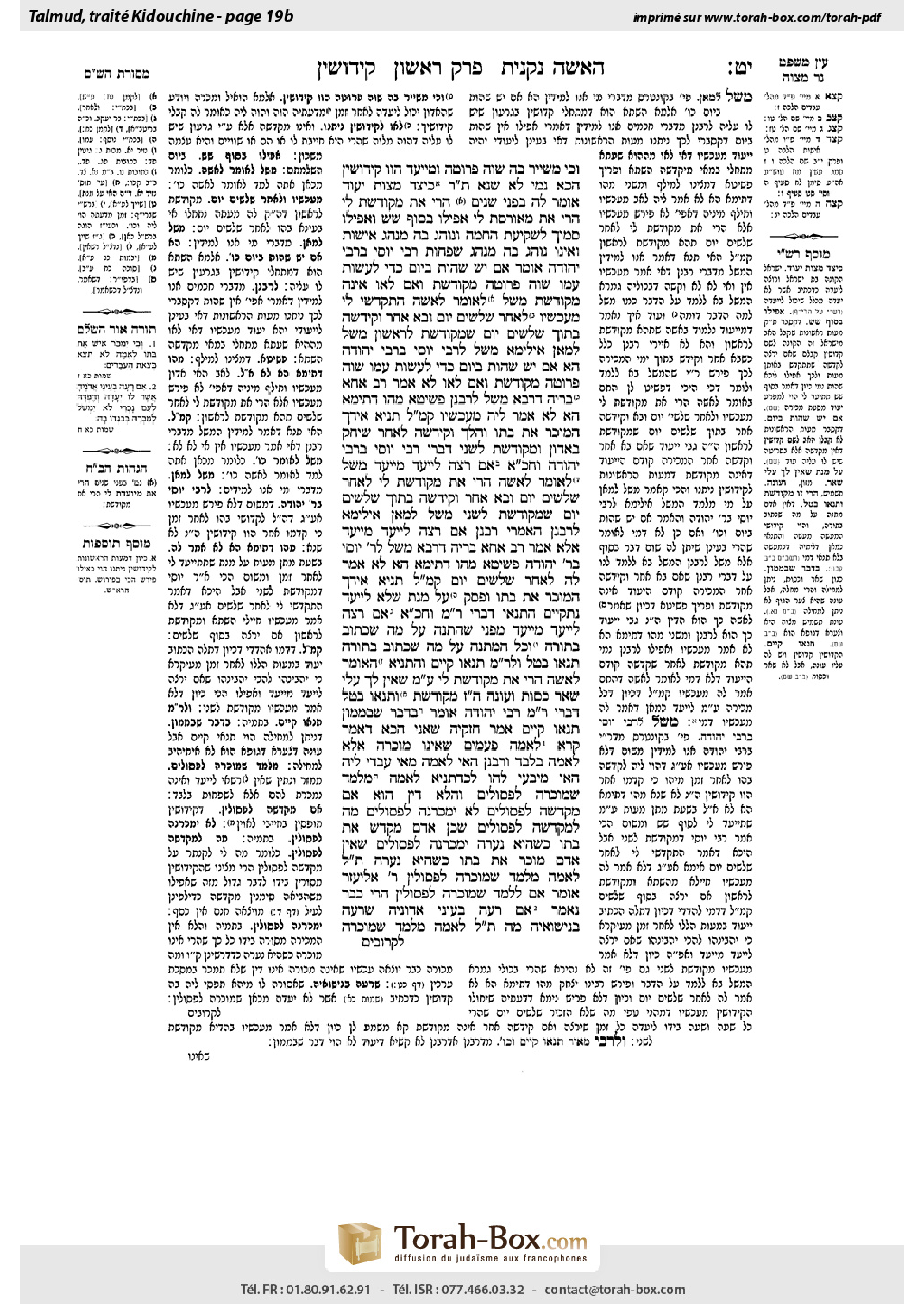
Kiddushin 19b: Talmud study for Daf Yomi
Daf Yomi is the daily study of one Talmud folio. Explore 37 tractates with scans, Hebrew text, Sefaria English and AI-generated French translations where annotated.
Passage selection and English or AI-generated French translation are available where the scan has annotations. Daf Study is independent of Torah-Box and Sefaria.
Browse Kiddushin · קידושין · All tractatesKiddushin 19b text and translations
This page of Kiddushin includes the Aramaic text, an English translation and an AI-generated French translation, alongside the scan above.
קידושין י״ט ב · Aramaic and Hebrew text
וְכִי מְשַׁיַּיר בַּהּ שָׁוֶה פְּרוּטָה וּמְיַיעֵד – הָווּ קִידּוּשִׁין, הָכָא נָמֵי לָא שְׁנָא.
תָּנוּ רַבָּנַן: כֵּיצַד מִצְוַת יִעוּד? אוֹמֵר לָהּ בִּפְנֵי שְׁנַיִם ״הֲרֵי אַתְּ מְקוּדֶּשֶׁת לִי״, ״הֲרֵי אַתְּ מְאוֹרֶסֶת לִי״ אֲפִילּוּ בְּסוֹף שֵׁשׁ, וַאֲפִילּוּ סָמוּךְ לִשְׁקִיעַת הַחַמָּה. וְנוֹהֵג בָּהּ מִנְהַג אִישׁוּת וְאֵינוֹ נוֹהֵג בָּהּ מִנְהַג שִׁפְחוּת. רַבִּי יוֹסֵי בְּרַבִּי יְהוּדָה אוֹמֵר: אִם יֵשׁ שְׁהוּת בְּיוֹם כְּדֵי לַעֲשׂוֹת עִמּוֹ שָׁוֶה פְּרוּטָה – מְקוּדֶּשֶׁת, וְאִם לָאו – אֵינָהּ מְקוּדֶּשֶׁת.
מָשָׁל לְאוֹמֵר לְאִשָּׁה ״הִתְקַדְּשִׁי לִי מֵעַכְשָׁיו לְאַחַר שְׁלֹשִׁים יוֹם״ וּבָא אַחֵר וְקִידְּשָׁהּ בְּתוֹךְ שְׁלֹשִׁים יוֹם – שֶׁמְּקוּדֶּשֶׁת לָרִאשׁוֹן. מָשָׁל לְמַאן?
אִילֵימָא מָשָׁל לְרַבִּי יוֹסֵי בְּרַבִּי יְהוּדָה – הָא אִם יֵשׁ שְׁהוּת בְּיוֹם כְּדֵי לַעֲשׂוֹת עִמּוֹ שָׁוֶה פְּרוּטָה – מְקוּדֶּשֶׁת, וְאִם לָאו – לֹא!
אָמַר רַב אַחָא בְּרֵיהּ דְּרָבָא: מָשָׁל לְרַבָּנַן. פְּשִׁיטָא!
מַהוּ דְּתֵימָא, הָא לָא אֲמַר לֵיהּ ״מֵעַכְשָׁיו״, קָא מַשְׁמַע לַן.
תַּנְיָא אִידַּךְ: הַמּוֹכֵר אֶת בִּתּוֹ, וְהָלַךְ וְקִידְּשָׁהּ לְאַחֵר – שִׂיחֵק בָּאָדוֹן, וּמְקוּדֶּשֶׁת לַשֵּׁנִי, דִּבְרֵי רַבִּי יוֹסֵי בְּרַבִּי יְהוּדָה. וַחֲכָמִים אוֹמְרִים: אִם רָצָה לְיַיעֵד – מְיַיעֵד.
מָשָׁל לָאוֹמֵר לְאִשָּׁה ״הֲרֵי אַתְּ מְקוּדֶּשֶׁת לִי לְאַחַר שְׁלֹשִׁים יוֹם״ וּבָא אַחֵר וְקִידְּשָׁהּ בְּתוֹךְ שְׁלֹשִׁים יוֹם – שֶׁמְּקוּדֶּשֶׁת לַשֵּׁנִי. מָשָׁל לְמַאן?
אִילֵּימָא לְרַבָּנַן, הָאָמְרִי רַבָּנַן: אִם רָצָה לְיַיעֵד – מְיַיעֵד!
אֶלָּא אָמַר רַב אַחָא בְּרֵיהּ דְּרָבָא: מָשָׁל לְרַבִּי יוֹסֵי בְּרַבִּי יְהוּדָה. פְּשִׁיטָא!
מַהוּ דְּתֵימָא, הָא לָא אֲמַר לַהּ ״לְאַחַר שְׁלֹשִׁים יוֹם״, קָא מַשְׁמַע לַן.
תַּנְיָא אִידַּךְ: הַמּוֹכֵר אֶת בִּתּוֹ, וּפָסַק עַל מְנָת שֶׁלֹּא לְיַיעֵד – נִתְקַיֵּים הַתְּנַאי, דִּבְרֵי רַבִּי מֵאִיר. וַחֲכָמִים אוֹמְרִים: אִם רָצָה לְיַיעֵד – מְיַיעֵד, מִפְּנֵי שֶׁהִתְנָה עַל מַה שֶּׁכָּתוּב בַּתּוֹרָה, וְכׇל הַמַּתְנֶה עַל מַה שֶּׁכָּתוּב בַּתּוֹרָה – תְּנָאוֹ בָּטֵל.
וּלְרַבִּי מֵאִיר תְּנָאוֹ קַיָּים? וְהָתַנְיָא: הָאוֹמֵר לְאִשָּׁה ״הֲרֵי אַתְּ מְקוּדֶּשֶׁת לִי עַל מְנָת שֶׁאֵין לְךָ עָלַי שְׁאֵר כְּסוּת וְעוֹנָה״ – הֲרֵי זוֹ מְקוּדֶּשֶׁת, וּתְנָאוֹ בָּטֵל, דִּבְרֵי רַבִּי מֵאִיר. רַבִּי יְהוּדָה אוֹמֵר: בְּדָבָר שֶׁבְּמָמוֹן – תְּנָאוֹ קַיָּים.
אָמַר חִזְקִיָּה: שָׁאנֵי הָכָא, דְּאָמַר קְרָא ״לְאָמָה״ – פְּעָמִים שֶׁאֵינוֹ מוֹכְרָהּ אֶלָּא לְאָמָה בִּלְבָד.
וְרַבָּנַן, הַאי ״לְאָמָה״ מַאי עָבְדִי לֵיהּ? הַאי מִיבְּעֵי לְהוּ לְכִדְתַנְיָא: ״לְאָמָה״ – מְלַמֵּד שֶׁמּוֹכְרָהּ לִפְסוּלִים.
וַהֲלֹא דִּין הוּא: אִם מְקַדְּשָׁהּ לִפְסוּלִים, לֹא יִמְכְּרֶנָּה לִפְסוּלִים? מָה לִמְקַדְּשָׁהּ לִפְסוּלִים, שֶׁכֵּן אָדָם מְקַדֵּשׁ אֶת בִּתּוֹ כְּשֶׁהִיא נַעֲרָה, יִמְכְּרֶנָּה לִפְסוּלִים, שֶׁאֵין אָדָם מוֹכֵר אֶת בִּתּוֹ כְּשֶׁהִיא נַעֲרָה? תַּלְמוּד לוֹמַר: ״לְאָמָה״ – מְלַמֵּד שֶׁמּוֹכְרָהּ לִפְסוּלִין.
רַבִּי אֱלִיעֶזֶר אוֹמֵר: אִם לְלַמֵּד שֶׁמּוֹכְרָהּ לִפְסוּלִין, הֲרֵי כְּבָר נֶאֱמַר ״אִם רָעָה בְּעֵינֵי אֲדֹנֶיהָ״ – שֶׁרָעָה בְּנִישּׂוּאֶיהָ. מָה תַּלְמוּד לוֹמַר ״לְאָמָה״? מְלַמֵּד שֶׁמּוֹכְרָהּ
Kiddushin 19b · English translation
And yet if time for her to perform work worth one peruta remains, and he designates her, it is a betrothal. This shows that he can betroth her with a loan, i.e., the value of the remaining time of her servitude, for which she herself is collateral. Here too, it is no different, and in general one may betroth a woman with a loan for which there is collateral.
§ The Sages taught: How is the mitzva of designation performed? The master says to her before two witnesses: You are hereby betrothed [mekuddeshet] to me, or: You are hereby betrothed [me’oreset] to me. The designation is effective even if he said this at the end of six years of work, and even if it is close to sunset on the last day of her term. And once he designates her he treats her in the manner of marriage and may not treat her in the manner of slavery. Rabbi Yosei, son of Rabbi Yehuda, says: If there is enough time left in that day for her to perform for him work worth one peruta, she is betrothed, and if not, she is not betrothed.
The baraita continues: This can be understood by way of a parable comparing this halakha to the halakha of one who says to a woman: Be betrothed to me from now after thirty days, and another man came and betrothed her within thirty days. In this case the halakha is that she is betrothed to the first man. The Gemara inquires: According to whom is this parable suggested? Of the two opinions cited in the baraita, whose opinion accords with the halakha in the case of the parable?
If we say that the halakha in the case of the parable is compared to the opinion of Rabbi Yosei, son of Rabbi Yehuda, didn’t he say: If there is enough time on that day for her to perform for him work worth one peruta, she is betrothed, and if not, she is not betrothed? Rabbi Yosei, son of Rabbi Yehuda, maintains that she is not considered betrothed conditionally when she is initially acquired as a Hebrew maidservant. Rather, the betrothal takes effect only when he designates her. This is evident from the fact that enough time must remain for her to perform work worth one peruta, as she is betrothed with that amount. If so, one cannot compare his ruling to the case of the parable, where the betrothal of the first was given before that of the second.
Rav Aḥa, son of Rava, said: The halakha in the case of the parable is compared to the opinion of the Rabbis, i.e., the first opinion cited in the baraita, who say that when she was initially acquired as a Hebrew maidservant it is as though he had betrothed her on condition that she would be retroactively betrothed whenever her master desired. This indicates that retroactive betrothal is possible. The Gemara asks: Isn’t it obvious that this comparison is correct? Why would the baraita need to state a parable?
The Gemara explains: The baraita needs to state a parable lest you say that the Rabbis hold she is betrothed to the master even if the master did not say to the father that she is betrothed to him from now. The parable therefore teaches us that the case of the master is comparable to a case where the first man said to her: From now, and if the master did not state this term when acquiring her as a Hebrew maidservant, then she is not betrothed to him.
It is taught in another baraita: With regard to one who first sells his daughter as a Hebrew maidservant and then goes and betroths her to another man, he mocks the master, and she is betrothed to the second man. Although he sold her as a Hebrew maidservant, he can remove her from the authority of the master, and this is seen as mocking him. This is the statement of Rabbi Yosei, son of Rabbi Yehuda. And the Rabbis say: If the master wants to designate her, he can designate her, and the second man’s betrothal is void.
The baraita continues: This can be understood by way of a parable comparing this halakha to the halakha of one who says to a woman: Be betrothed to me after thirty days, and another man came and betrothed her within thirty days. In this case the halakha is that she is betrothed to the second man. The Gemara inquires: According to whom is this parable suggested? Of the two opinions cited in the baraita, whose opinion accords with the halakha in the case of the parable?
If we say that the halakha in the case of the parable is compared to the opinion of the Rabbis, don’t the Rabbis say that if the master wants to designate her, he may designate her, and the second man’s betrothal does not take effect? In the case of the parable, she is betrothed to the second man, and the first cannot prevent this.
Rather, Rav Aḥa, son of Rava, said: The halakha in the case of the parable is compared to the opinion of Rabbi Yosei, son of Rabbi Yehuda. The Gemara asks: Isn’t it obvious that this comparison is correct? Why would the baraita need to state a parable?
The Gemara explains: The baraita needs to state a parable lest you say that the case of the Hebrew maidservant is different, as he did not say to her when he acquired her: After thirty days. One might argue that the reason Rabbi Yosei, son of Rabbi Yehuda, holds that she is not betrothed to the master is that he did not state when he acquired her that she should be designated at a specific time in the future, but if he would have stated this at the time he acquired her as a Hebrew maidservant, the designation would then take effect. By comparing this case to the case of the parable, the baraita teaches us that Rabbi Yosei, son of Rabbi Yehuda, would hold that the designation does not take effect even if the master had said at the time of the acquisition that designation should take effect in thirty days, provided that her father betroths her to another in the interim.
§ It is taught in another baraita: With regard to one who sells his daughter and stipulates with the buyer that the sale applies on the condition that he does not designate her, the condition stands. This is the statement of Rabbi Meir. And the Rabbis say: If the master wants to designate her he may designate her, because the father stipulated counter to that which is written in the Torah, as the Torah permits the designation of a Hebrew maidservant. And with regard to anyone who stipulates counter to that which is written in the Torah, his condition is void.
The Gemara asks: And according to the opinion of Rabbi Meir, does his condition stand in that case? But isn’t it taught in a baraita: One who says to a woman: You are hereby betrothed to me on the condition that you do not have against me any claims of food, clothing, and conjugal rights, she is betrothed and his condition is void; this is the statement of Rabbi Meir. Rabbi Yehuda says: With regard to monetary matters, e.g., food and clothing, his condition stands. This indicates that Rabbi Meir maintains that one cannot stipulate counter to that which is written in the Torah.
Ḥizkiyya said: It is different here, as the verse states: “And if a man sells his daughter as a maidservant” (Exodus 21:7), from which it is derived: There are times when he sells her only as a maidservant, not for the sake of marriage. This indicates that the designation of a maidservant is not a Torah obligation but is optional. Therefore, one can issue a stipulation that runs counter to the master designating her.
The Gemara asks: And the Rabbis, what do they do with this phrase: “As a maidservant”? How do they interpret it? The Gemara answers: This expression is necessary for them for that which is taught in a baraita: The verse states “as a maidservant.” This teaches that he can sell her to people of flawed lineage, e.g., a mamzer, whom she is prohibited from marrying but whose betrothal is effective.
The baraita asks: Why is it necessary to derive that halakha from the verse? But could this not be derived through logical inference: If her father can betroth her to people of flawed lineage, can he not sell her to people of flawed lineage? The baraita answers: The verse is necessary, as what is unique about betrothal to people of flawed lineage is that a person can betroth his daughter even when she is a young woman, i.e., between the ages of twelve and twelve and a half. Therefore, one cannot learn from this that he can also sell her to people of flawed lineage because that case is different, as a person cannot sell his daughter when she is a young woman. The halakha that a person can betroth his daughter even when she is a young woman demonstrates that the rights that a father has with regard to his daughter’s betrothal are more extensive than his right to sell her. Therefore, the verse states “as a maidservant,” which teaches that he can, in fact, sell her to disqualified people.
The baraita continues: Rabbi Eliezer says: If that verse serves to teach that he can sell her to people of flawed lineage, it is unnecessary, as it is already stated: “If she does not please her master, who designated her” (Exodus 21:8). This indicates that she is displeasing in her marriage, i.e., marriage to him was forbidden, and yet the sale is valid. If so, what is the meaning when the verse states “as a maidservant”? This teaches that he can sell her
Kiddushin 19b · Traduction française (IA)
Et pourtant, s’il lui reste assez de temps pour effectuer un travail d’une valeur d’une perouta et qu’il la désigne, les kidouchin prennent effet. Cela montre qu’il peut la fiancer au moyen d’une dette, c’est-à-dire la valeur du temps restant de son service, pour laquelle elle-même sert de garantie. Ici aussi, il en va de même : en général, on peut fiancer une femme au moyen d’une dette garantie par un gage.
§ Les Sages ont enseigné : Comment accomplit-on la mitsva de la désignation ? Le maître lui dit devant deux témoins : « Tu m’es désormais consacrée [mekuddeshet] », ou : « Tu m’es désormais fiancée [me’oreset]. » La désignation prend effet même s’il le dit à la fin des six années de service, et même si le soleil est sur le point de se coucher le dernier jour de son terme. Dès qu’il la désigne, il la traite comme son épouse et ne peut plus la traiter comme une esclave. Rabbi Yossé, fils de Rabbi Yehouda, dit : S’il reste assez de temps dans cette journée pour qu’elle effectue à son profit un travail d’une valeur d’une perouta, elle est fiancée ; sinon, elle ne l’est pas.
La baraïta poursuit : On peut comprendre cela au moyen d’une parabole comparant cette halakha à celle d’un homme qui dit à une femme : « Sois fiancée à moi dès maintenant, les kidouchin prenant effet dans trente jours », puis un autre homme vient la fiancer au cours de ces trente jours. Dans ce cas, la halakha est qu’elle est fiancée au premier homme. La Guemara demande : À l’opinion de qui cette parabole renvoie-t-elle ? Laquelle des deux opinions citées dans la baraïta concorde avec la halakha dans le cas de la parabole ?
Si l’on dit que la halakha dans le cas de la parabole correspond à l’opinion de Rabbi Yossé, fils de Rabbi Yehouda, n’a-t-il pas dit : S’il reste assez de temps ce jour-là pour qu’elle effectue à son profit un travail d’une valeur d’une perouta, elle est fiancée ; sinon, elle ne l’est pas ? Rabbi Yossé, fils de Rabbi Yehouda, soutient qu’elle n’est pas considérée comme fiancée sous condition dès le moment où elle est initialement acquise comme servante hébreue. Au contraire, les kidouchin ne prennent effet qu’au moment où il la désigne. Cela ressort du fait qu’il faut qu’il reste assez de temps pour qu’elle effectue un travail d’une valeur d’une perouta, puisqu’elle est fiancée au moyen de cette valeur. Si tel est le cas, on ne peut pas comparer sa décision au cas de la parabole, où le premier homme l’a fiancée avant que le second ne le fasse.
Rav Aḥa, fils de Rava, dit : La halakha dans le cas de la parabole correspond à l’opinion des Rabbins, c’est-à-dire la première opinion citée dans la baraïta. Selon eux, lorsqu’elle a été initialement acquise comme servante hébreue, c’est comme si le maître l’avait fiancée à condition que les kidouchin prennent effet rétroactivement dès qu’il le désirerait. Cela indique qu’un engagement rétroactif est possible. La Guemara demande : N’est-il pas évident que cette comparaison est correcte ? Pourquoi la baraïta aurait-elle besoin d’énoncer une parabole ?
La Guemara explique : La baraïta doit énoncer une parabole, de peur que tu ne dises que, selon les Rabbins, elle est fiancée au maître même si celui-ci n’a pas dit à son père qu’elle lui était fiancée dès maintenant. La parabole nous enseigne donc que le cas du maître est comparable à celui où le premier homme lui a dit : « Dès maintenant. » Si le maître n’a pas précisé cela au moment où il l’a acquise comme servante hébreue, elle ne lui est pas fiancée.
Il est enseigné dans une autre baraïta : Si un homme vend d’abord sa fille comme servante hébreue, puis va la fiancer à un autre homme, il se moque du maître, et elle est fiancée au second homme. Bien qu’il l’ait vendue comme servante hébreue, il peut la soustraire à l’autorité du maître, ce qui revient à se moquer de lui. Telle est la déclaration de Rabbi Yossé, fils de Rabbi Yehouda. Mais les Rabbins disent : Si le maître veut la désigner, il le peut, et les kidouchin du second homme sont sans effet.
La baraïta poursuit : On peut comprendre cela au moyen d’une parabole comparant cette halakha à celle d’un homme qui dit à une femme : « Sois fiancée à moi dans trente jours », puis un autre homme vient la fiancer au cours de ces trente jours. Dans ce cas, la halakha est qu’elle est fiancée au second homme. La Guemara demande : À l’opinion de qui cette parabole renvoie-t-elle ? Laquelle des deux opinions citées dans la baraïta concorde avec la halakha dans le cas de la parabole ?
Si l’on dit que la halakha dans le cas de la parabole correspond à l’opinion des Rabbins, les Rabbins ne disent-ils pas que, si le maître veut la désigner, il le peut, et que les kidouchin du second homme ne prennent pas effet ? Or, dans le cas de la parabole, elle est fiancée au second homme, et le premier ne peut pas l’en empêcher.
Rav Aḥa, fils de Rava, dit plutôt : La halakha dans le cas de la parabole correspond à l’opinion de Rabbi Yossé, fils de Rabbi Yehouda. La Guemara demande : N’est-il pas évident que cette comparaison est correcte ? Pourquoi la baraïta aurait-elle besoin d’énoncer une parabole ?
La Guemara explique : La baraïta doit énoncer une parabole, de peur que tu ne dises que le cas de la servante hébreue est différent, puisqu’il ne lui a pas dit, au moment où il l’a acquise : « Dans trente jours. » On pourrait soutenir que Rabbi Yossé, fils de Rabbi Yehouda, estime qu’elle n’est pas fiancée au maître parce que celui-ci n’a pas précisé, au moment de l’acquisition, qu’il la désignerait à une date ultérieure déterminée ; mais que, s’il l’avait précisé au moment où il l’a acquise comme servante hébreue, la désignation aurait alors pris effet. En comparant ce cas à celui de la parabole, la baraïta nous enseigne que, selon Rabbi Yossé, fils de Rabbi Yehouda, la désignation ne prendrait pas effet même si le maître avait dit, au moment de l’acquisition, qu’elle prendrait effet dans trente jours, à condition que son père la fiance à un autre entre-temps.
§ Il est enseigné dans une autre baraïta : Si un homme vend sa fille et stipule avec l’acheteur que la vente est conclue à condition qu’il ne la désigne pas, la condition est valable. Telle est la déclaration de Rabbi Meïr. Mais les Rabbins disent : Si le maître veut la désigner, il le peut, car le père a stipulé contrairement à ce qui est écrit dans la Torah, puisque la Torah permet la désignation d’une servante hébreue. Or, toute personne qui stipule contrairement à ce qui est écrit dans la Torah voit sa condition annulée.
La Guemara demande : Et selon l’opinion de Rabbi Meïr, sa condition est-elle valable dans ce cas ? N’est-il pas enseigné dans une baraïta : Si un homme dit à une femme : « Tu m’es désormais fiancée à condition que tu ne réclames de moi ni nourriture, ni vêtements, ni droits conjugaux », elle est fiancée et sa condition est annulée ; telle est la déclaration de Rabbi Meïr. Rabbi Yehouda dit : Pour les questions d’argent, par exemple la nourriture et les vêtements, sa condition est valable. Cela indique que Rabbi Meïr soutient qu’on ne peut pas stipuler contrairement à ce qui est écrit dans la Torah.
Ḥizkiyya dit : Ici, c’est différent, car le verset dit : « Si un homme vend sa fille comme servante » (Exode 21:7), d’où l’on déduit qu’il arrive qu’il la vende uniquement comme servante, et non en vue du mariage. Cela indique que la désignation d’une servante n’est pas une obligation imposée par la Torah, mais une faculté. On peut donc formuler une stipulation qui empêche le maître de la désigner.
La Guemara demande : Et que font les Rabbins de l’expression « comme servante » ? Comment l’interprètent-ils ? La Guemara répond : Cette expression leur est nécessaire pour ce qui est enseigné dans une baraïta : Le verset dit « comme servante ». Cela enseigne qu’il peut la vendre à des personnes de filiation irrégulière, par exemple un mamzer, qu’il lui est interdit d’épouser, mais dont les kidouchin sont néanmoins valides.
La baraïta demande : Pourquoi est-il nécessaire de déduire cette halakha du verset ? Ne pourrait-on pas la déduire par raisonnement logique : si son père peut la fiancer à des personnes de filiation irrégulière, ne peut-il pas la vendre à des personnes de filiation irrégulière ? La baraïta répond : Le verset est nécessaire, car ce qui distingue le fait de la fiancer à des personnes de filiation irrégulière, c’est qu’un homme peut fiancer sa fille même lorsqu’elle est une jeune femme, c’est-à-dire entre douze ans et douze ans et demi. On ne peut donc pas en déduire qu’il peut aussi la vendre à des personnes de filiation irrégulière, puisque ce cas est différent : un homme ne peut pas vendre sa fille lorsqu’elle est une jeune femme. La halakha selon laquelle un homme peut fiancer sa fille même lorsqu’elle est une jeune femme montre que les droits du père concernant les kidouchin de sa fille sont plus étendus que son droit de la vendre. Le verset dit donc « comme servante », ce qui enseigne qu’il peut effectivement la vendre à des personnes inaptes à l’épouser.
La baraïta poursuit : Rabbi Eliezer dit : Si ce verset sert à enseigner qu’il peut la vendre à des personnes de filiation irrégulière, cela est inutile, puisqu’il est déjà dit : « Si elle déplaît à son maître, qui l’a désignée » (Exode 21:8). Cela indique qu’elle lui déplaît dans le mariage, c’est-à-dire que le mariage avec lui était interdit, et pourtant la vente est valide. Si tel est le cas, que signifie l’expression « comme servante » dans le verset ? Cela enseigne qu’il peut la vendre à des
Traduction française générée par IA à partir de l’édition anglaise de Sefaria. Vérifie toujours un passage avec le texte source.
Text from Sefaria: William Davidson Edition - Vocalized Aramaic (CC BY NC); William Davidson Edition - English (CC BY NC).