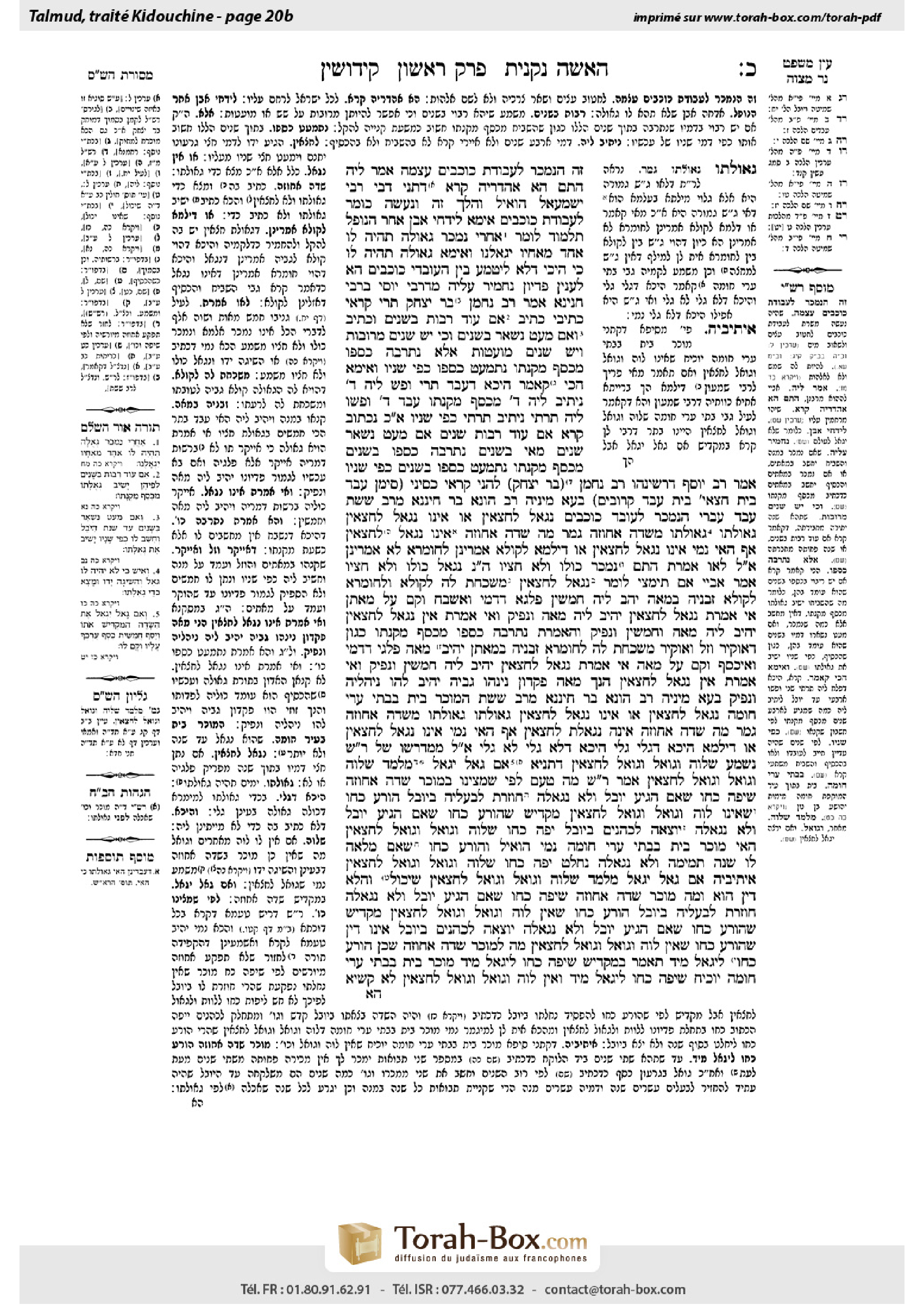
Kiddushin 20b: Talmud study for Daf Yomi
Daf Yomi is the daily study of one Talmud folio. Explore 37 tractates with scans, Hebrew text, Sefaria English and AI-generated French translations where annotated.
Passage selection and English or AI-generated French translation are available where the scan has annotations. Daf Study is independent of Torah-Box and Sefaria.
Browse Kiddushin · קידושין · All tractatesKiddushin 20b text and translations
This page of Kiddushin includes the Aramaic text, an English translation and an AI-generated French translation, alongside the scan above.
קידושין כ׳ ב · Aramaic and Hebrew text
– זֶה הַנִּמְכָּר לַעֲבוֹדָה זָרָה עַצְמָהּ.
אֲמַר לֵיהּ: הָתָם, הָא אַהְדְּרֵיהּ קְרָא, דְּתָנֵי דְּבֵי רַבִּי יִשְׁמָעֵאל: הוֹאִיל וְהָלַךְ זֶה וְנַעֲשָׂה כּוֹמֶר לַעֲבוֹדָה זָרָה, אֵימָא: לִידְחֵי אֶבֶן אַחַר הַנּוֹפֵל – תַּלְמוּד לוֹמַר: ״אַחֲרֵי נִמְכַּר גְּאֻלָּה תִּהְיֶה לּוֹ אֶחָד מֵאֶחָיו יִגְאָלֶנּוּ״.
וְאֵימָא: ״גְּאוּלָּה תִּהְיֶה לוֹ״ – כִּי הֵיכִי דְּלָא לִיטַּמַּע בֵּין הַנׇּכְרִים, הָא לְעִנְיַן פִּדְיוֹן נַחְמִיר עֲלֵיהּ, מִדְּרַבִּי יוֹסֵי בְּרַבִּי חֲנִינָא!
אָמַר רַב נַחְמָן בַּר יִצְחָק: תְּרֵי קְרָאֵי כְּתִיבִי. כְּתִיב: ״אִם עוֹד רַבּוֹת בַּשָּׁנִים״ וּכְתִיב: ״וְאִם מְעַט נִשְׁאַר בַּשָּׁנִים״. וְכִי יֵשׁ שָׁנִים מְרוּבּוֹת וְיֵשׁ שָׁנִים מוּעָטוֹת? אֶלָּא, נִתְרַבָּה כַּסְפּוֹ – ״מִכֶּסֶף מִקְנָתוֹ״, נִתְמַעֵט כַּסְפּוֹ – ״כְּפִי שָׁנָיו״.
וְאֵימָא הָכִי קָאָמַר: הֵיכָא דַּעֲבַד תְּרֵי וּפֻשׁ לֵיהּ אַרְבַּע – נִיתֵּיב לֵיהּ אַרְבַּע ״מִכֶּסֶף מִקְנָתוֹ״, עֲבַד אַרְבַּע וּפֻשׁו לֵיהּ תַּרְתֵּי – נִיתֵּיב תַּרְתֵּי ״כְּפִי שָׁנָיו״?
אִם כֵּן, נִכְתּוֹב קְרָא: ״אִם עוֹד רַבּוֹת שָׁנִים״, ״אִם מְעַט נִשְׁאַר שָׁנִים״, מַאי ״בַּשָּׁנִים״ – נִתְרַבָּה כַּסְפּוֹ בַּשָּׁנִים, ״מִכֶּסֶף מִקְנָתוֹ״ – נִתְמַעֵט כַּסְפּוֹ בַּשָּׁנִים ״כְּפִי שָׁנָיו״. אָמַר רַב יוֹסֵף: דַּרְשִׁינְהוּ רַב נַחְמָן בַּר יִצְחָק לְהָנֵי קְרָאֵי כְּסִינַי.
(סִימַן: עֶבֶד, בַּיִת, חֲצָאִין, בַּיִת עֶבֶד, קְרוֹבִים). בְּעָא מִינֵּיהּ רַב הוּנָא בַּר חִינָּנָא מֵרַב שֵׁשֶׁת: עֶבֶד עִבְרִי הַנִּמְכָּר לְנׇכְרִי, נִגְאָל לַחֲצָאִין, אוֹ אֵינוֹ נִגְאָל לַחֲצָאִין?
״גְּאֻלָּתוֹ״ ״גְּאֻלָּתוֹ״ מִשְּׂדֵה אֲחוּזָּה גָּמַר: מָה שְׂדֵה אֲחוּזָּה אֵינוֹ נִגְאָל לַחֲצָאִין – אַף הַאי נָמֵי אֵינוֹ נִגְאָל לַחֲצָאִין, אוֹ דִילְמָא לְקוּלָּא אָמְרִינַן, לְחוּמְרָא לָא אָמְרִינַן?
אֲמַר לֵיהּ: לָאו אָמְרַתְּ הָתָם: ״נִמְכַּר״ – כּוּלּוֹ וְלֹא חֶצְיוֹ, הָכִי נָמֵי, ״נִגְאָל״ – כּוּלּוֹ וְלֹא חֶצְיוֹ.
אָמַר אַבָּיֵי: אִם תִּימְצֵי לוֹמַר נִגְאָל לַחֲצָאִין, מַשְׁכַּחַתְּ לַהּ לְקוּלָּא וּלְחוּמְרָא. לְקוּלָּא: זַבְנֵיהּ בִּמְאָה, יְהַב לֵיהּ חַמְשִׁין, פַּלְגָא דְּדָמֵי, וְאַשְׁבַּח וְקָם עַל מָאתַן, אִי אָמְרַתְּ נִגְאָל לַחֲצָאִין – יָהֵיב לֵיהּ מְאָה וְנָפֵיק, וְאִי אָמְרַתְּ אֵין נִגְאָל לַחֲצָאִין – יָהֵיב לֵיהּ מְאָה וְחַמְשִׁין וְנָפֵיק.
וְהָאָמְרַתְּ נִתְרַבָּה כַּסְפּוֹ – ״מִכֶּסֶף מִקְנָתוֹ״! כְּגוֹן דְּאוֹקִיר וְזָל וְאוֹקִיר.
מַשְׁכַּחַתְּ לַהּ לְחוּמְרָא: זַבְנֵיהּ בְּמָאתַן, יְהַיב מְאָה, פַּלְגֵי דִּדְמֵי, וְאִיכְּסִף וְקָם עַל מְאָה, אִי אָמְרַתְּ נִגְאָל לַחֲצָאִין – יָהֵיב לֵיהּ חַמְשִׁין וְנָפֵיק, וְאִי אָמְרַתְּ אֵין נִגְאָל לַחֲצָאִין – הָנָךְ מְאָה פִּקָּדוֹן נִינְהוּ גַּבֵּיהּ, יָהֵיב לְהוּ נִיהֲלֵיהּ וְנָפֵיק.
בְּעָא מִינֵּיהּ רַב הוּנָא בַּר חִינָּנָא מֵרַב שֵׁשֶׁת: הַמּוֹכֵר בַּיִת בְּבָתֵּי עָרֵי חוֹמָה, נִגְאָל לַחֲצָאִין, אוֹ אֵינוֹ נִגְאָל לַחֲצָאִין? ״גְּאֻלָּתוֹ״ ״גְּאֻלָּתוֹ״ מִשְּׂדֵה אֲחוּזָּה גָּמַר: מָה שְׂדֵה אֲחוּזָּה אֵינָהּ נִגְאֶלֶת לַחֲצָאִין – אַף הַאי נָמֵי אֵינוֹ נִגְאָל לַחֲצָאִין,
אוֹ דִילְמָא: הֵיכָא דְּגַלִּי – גַּלִּי, הֵיכָא דְּלָא גַּלִּי – לָא גַּלִּי?
אֲמַר לֵיהּ: מִמִּדְרָשׁוֹ שֶׁל רַבִּי שִׁמְעוֹן נִשְׁמַע, שֶׁלֹּוֶה וְגוֹאֵל וְגוֹאֵל לַחֲצָאִין, דְּתַנְיָא: ״אִם גָּאֹל יִגְאַל״ – מְלַמֵּד שֶׁלֹּוֶה וְגוֹאֵל וְגוֹאֵל לַחֲצָאִין.
אָמַר רַבִּי שִׁמְעוֹן: מָה טַעַם, לְפִי שֶׁמָּצִינוּ בְּמוֹכֵר שְׂדֵה אֲחוּזָּה שֶׁיִּפָּה כֹּחוֹ, שֶׁאִם הִגִּיעַ יוֹבֵל וְלֹא נִגְאֲלָה – חוֹזֶרֶת לִבְעָלֶיהָ בַּיּוֹבֵל, הוֹרַע כֹּחוֹ – שֶׁאֵינוֹ לֹוֶה וְגוֹאֵל וְגוֹאֵל לַחֲצָאִין.
מַקְדִּישׁ, שֶׁהוֹרַע כֹּחוֹ, שֶׁאִם הִגִּיעַ יוֹבֵל וְלֹא נִגְאֲלָה – יוֹצְאָה לְכֹהֲנִים בַּיּוֹבֵל, יִפָּה כֹּחוֹ – שֶׁלֹּוֶה וְגוֹאֵל וְגוֹאֵל לַחֲצָאִין.
הַאי מוֹכֵר בַּיִת בְּבָתֵּי עָרֵי חוֹמָה נָמֵי, הוֹאִיל וְהוֹרַע כֹּחוֹ, שֶׁאִם מָלְאָה לוֹ שָׁנָה תְּמִימָה וְלֹא נִגְאֲלָה נֶחְלָט – יִפָּה כֹּחוֹ, שֶׁלֹּוֶה וְגוֹאֵל וְגוֹאֵל לַחֲצָאִין.
אֵיתִיבֵיהּ: ״אִם גָּאֹל יִגְאַל״ – מְלַמֵּד שֶׁלֹּוֶה וְגוֹאֵל וְגוֹאֵל לַחֲצָאִין.
שֶׁיָּכוֹל, וַהֲלֹא דִּין הוּא: וּמָה מוֹכֵר שְׂדֵה אֲחוּזָּה שֶׁיִּפָּה כֹּחוֹ, שֶׁאִם הִגִּיעַ יוֹבֵל וְלֹא נִגְאֲלָה חוֹזֶרֶת לִבְעָלֶיהָ בַּיּוֹבֵל – הוֹרַע כֹּחוֹ, שֶׁאֵין לֹוֶה וְגוֹאֵל וְגוֹאֵל לַחֲצָאִין, מַקְדִּישׁ, שֶׁהוֹרַע כֹּחוֹ, שֶׁאִם הִגִּיעַ יוֹבֵל וְלֹא נִגְאֲלָה יוֹצְאָה לְכֹהֲנִים בַּיּוֹבֵל – אֵינוֹ דִּין שֶׁהוֹרַע כֹּחוֹ שֶׁאֵין לֹוֶה וְגוֹאֵל וְגוֹאֵל לַחֲצָאִין?
מָה לְמוֹכֵר שְׂדֵה אֲחוּזָּה, שֶׁכֵּן הוֹרַע כֹּחוֹ לִיגָּאֵל מִיָּד, תֹּאמַר בְּמַקְדִּישׁ שֶׁיִּפָּה כֹּחוֹ לִיגָּאֵל מִיָּד.
מוֹכֵר בַּיִת בְּבָתֵּי עָרֵי חוֹמָה יוֹכִיחַ, שֶׁיִּפָּה כֹּחוֹ לִיגָּאֵל מִיָּד וְאֵין לֹוֶה וְגוֹאֵל וְגוֹאֵל לַחֲצָאִין! לָא קַשְׁיָא:
Kiddushin 20b · English translation
this is referring to one sold for idol worship itself, i.e., he is forced to sell himself as a slave to work in a temple of idol worship. The baraita teaches that it is only due to a person’s sins that he reaches a point where he has to sell himself as a slave. Therefore, one should be stringent with him with regard to his redemption and not allow him to be redeemed easily.
Abaye said to that Sage: There, the verse brings him back, i.e., one must strive to redeem a Jew who has been sold as a slave. As the school of Rabbi Yishmael taught: Since this person who sold himself as a slave has gone and become a priest for idol worship, one might say: Let us throw a stone after the fallen, that is, since he has reached this nadir one should abandon him. Therefore, the verse states: “After he is sold he shall be redeemed; one of his brothers may redeem him” (Leviticus 25:48).
The Gemara further asks: But one can say as follows: “He shall be redeemed,” so that he will not be assimilated among the gentiles. But with regard to the matter of his redemption and freedom, let us act strictly with him, as derived from that which Rabbi Yosei, son of Rabbi Ḥanina, said, that one is sold as a slave due to his sins.
Rav Naḥman bar Yitzḥak said: Two verses are written with regard to the redemption of a slave sold to a gentile. It is written: “If there be yet many of the years, according to them he shall give back the price of his redemption out of the money that he was bought for” (Leviticus 25:51), and it is written: “And if there remain but few of the years until the Jubilee Year, and he shall reckon with him, according to his years” (Leviticus 25:52). But how can there be both many years and few years when, in any case, he will not serve for more than six years? Rather, this means that as the money of his value increased with the passage of time, he is redeemed “out of the money that he was bought for,” i.e., the price for which he was originally sold, which is the lower sum. And if his monetary value decreased over time, one determines his value “according to his years,” i.e., according to his current value.
The Gemara asks: But one can say that this is what the Torah is saying: In a case where he served for two years and an additional four years remain for his service, as indicated by the phrase “if there be yet many of the years,” let him give his redemption money for the four years he owes him “out of the money that he was bought for.” If he served four years and two years remain for his service, as is stated “and if there remain but few of the years,” let him give his redemption money the value of the two years, “according to his years.”
The Gemara rejects this suggestion: If so, let the verse write: If there be yet many years, and: If there remain but few years. What is the meaning of the phrase “of the years”? This teaches that if his monetary value increased over the years of his servitude, he is redeemed “out of the money that he was bought for,” which is the lower sum. And if his monetary value decreased over the years of his servitude, one determines his value “according to his years.” Upon hearing this statement, Rav Yosef said: Rav Naḥman bar Yitzḥak homiletically interpreted these verses like Sinai. His exposition reflects the truth of Torah as it was given at Mount Sinai, as every matter is fully resolved.
The Gemara records a mnemonic device for the upcoming discussions: Slave, house, partial, house, slave, and relatives. Rav Huna bar Ḥinnana raised a dilemma before Rav Sheshet: With regard to a Hebrew slave who is sold to a gentile, can he be partially redeemed, or can he not be partially redeemed? Does this slave have the option of paying part of his value and thereby reducing his remaining period of service?
The Gemara analyzes the sides of the dilemma: With regard to a Hebrew slave sold to a gentile, the verse states: “According to his years he shall give back the price of his redemption [ge’ullato]” (Leviticus 25:52), and the meaning of the term “ge’ullato” can be derived from the same term stated with regard to the redemption of an ancestral field: “And he becomes rich and finds sufficient means to redeem it [ge’ullato]” (Leviticus 25:26). Accordingly, just as an ancestral field cannot be partially redeemed, but is either fully redeemed or not at all, so too, this slave cannot be partially redeemed. Or perhaps we say that he cannot be partially redeemed only if that leads to a leniency, but we do not say that he cannot be redeemed if it leads to a stringency.
Rav Sheshet said to him: Didn’t you say there, with regard to a thief who is sold to repay what he stole, that the verse: “And he is sold” (Exodus 22:2), teaches that all of him is sold but not part of him? If he is worth one thousand, and he owes five hundred for theft, he cannot be sold. So too, in the case of one who was sold to a gentile, the phrase “he is redeemed” (Leviticus 25:49) means all of him and not part of him.
Abaye said: If you say that he is partially redeemed, you find elements of leniency and stringency. This ruling can lead to a leniency in the following case: A master purchased a Hebrew slave for one hundred and the redeemer gives him fifty, which is half of his value, and afterward the slave increased in value and stood at two hundred. If you say that he can be partially redeemed he is already half-redeemed. Consequently, the redeemer gives him one hundred, half of his current value, and the slave goes out, i.e., is redeemed. And if you say that he cannot be partially redeemed, the redeemer gives the owner an additional one hundred and fifty and the slave goes out, as the initial fifty serves merely as the first payment, and he is now worth two hundred.
The Gemara asks: But you said that if the money of his value increased, one always pays “out of the money that he was bought for” (Leviticus 25:51), i.e., one calculates the value of the slave in accordance with his value at the time when he was acquired, even if that is less than his present value. Why, then, should one have to pay the full two hundred? The Gemara answers: This is referring to a case where he initially, before being sold, increased in value, was then sold for two hundred, and afterward decreased in value to one hundred, and subsequently he again increased in value so that he was worth the same amount as he was originally. In this case, his value of two hundred remains determinative.
Abaye proceeds to describe how you find a case that leads to a stringency. A master purchased a Hebrew slave for two hundred and the redeemer gave one hundred, which is half of his value, and the slave decreased in value and stood at a value of one hundred. If you say that he can be partially redeemed, the redeemer gives fifty and the slave goes out, i.e., is redeemed. And if you say that he cannot be partially redeemed, these one hundred are a deposit with him. Therefore, the redeemer gives it to him at the time of the redemption and the slave goes out. There is no reason to pay him more money, as he is now worth one hundred.
Rav Huna bar Ḥinnana raised a dilemma before Rav Sheshet with regard to a similar topic: In the case of one who sells a house from among the houses of walled cities, which can be redeemed only during the first year after the sale, can it be partially redeemed, or can it not be partially redeemed? The Gemara explains the sides of the dilemma: Does he derive the verbal analogy of “ge’ullato” (Leviticus 25:29) and “ge’ullato” (Leviticus 25:26) from the case of an ancestral field and say that just as ancestral land cannot be partially redeemed, so too, this house cannot be partially redeemed?
Or perhaps one should say: In a case where the verse explicitly revealed that it cannot be redeemed partially, as it does in the context of an ancestral field, it revealed it. With regard to one who redeems an ancestral field, it is written: “And he becomes rich and finds sufficient means to redeem it” (Leviticus 25:26), indicating that he has enough money to redeem the whole field, not part of it. By contrast, in a case where the Torah did not reveal that it cannot be redeemed, it did not reveal it, and therefore a house from a walled city can be partially redeemed, as the verse does not state this condition in that context.
Rav Sheshet said to him: From Rabbi Shimon’s interpretation one learns that with regard to houses in walled cities, one can borrow money and redeem them, and similarly that one can partially redeem them. As it is taught in a baraita with regard to a verse that describes one who consecrates his field: “And if he will redeem [ga’ol yigal] the field” (Leviticus 27:19). The repetition of the verb teaches that one can borrow money and redeem houses in walled cities and that one can also partially redeem them.
Rabbi Shimon said: What is the reason for this halakha? This is because we find with regard to one who sells his ancestral field that his power is enhanced, as, if the Jubilee Year arrives and it is not redeemed, the ancestral field returns to its owners in the Jubilee Year without them having to pay for it. Therefore, the power of the seller is diminished in that he cannot borrow money and redeem the field but must have the money to do so on his own, and he cannot partially redeem it.
By contrast, if one consecrates his field his power is diminished, as, if the Jubilee Year arrives and he did not redeem it in the meantime, and the Temple treasurer sold it to someone else, the ancestral field goes out and becomes the property of the priests in the Jubilee Year and does not return to its original owners. Consequently, in order to offset this stringency his power is enhanced in that he may borrow money and redeem the field, and partially redeem it.
According to this explanation, with regard to this one who sells a house from among the houses of walled cities, since his power is also diminished, as, if a full year passes and the house has not been redeemed it remains the permanent property of the buyer, in order to offset this stringency, his power should be enhanced in that he may borrow money and redeem the house, and partially redeem it.
Rava bar Ḥinnana raised an objection to this opinion from a baraita. The verse states with regard to one who consecrates his field: “And if he will redeem [ga’ol yigal] the field” (Leviticus 27:19). This teaches that he may borrow money and redeem it, and partially redeem it.
The baraita continues: As one might have thought: Could this not be derived through an a fortiori inference: Just as with regard to one who sells an ancestral field that his power is enhanced, as if the Jubilee Year arrives and it is not redeemed, it returns to its owners in the Jubilee Year, and yet his power is diminished in that he cannot borrow money and redeem the field and he cannot partially redeem it; with regard to one who consecrates a field, where his power is diminished, for if the Jubilee Year arrives and it was not redeemed it goes out to the priests in the Jubilee Year, is it not logical that his power is diminished in that he cannot borrow money and redeem the field and he cannot partially redeem it?
The baraita raises a difficulty against this a fortiori inference: What is unique about one who sells his ancestral field is that his power is diminished with regard to redeeming it immediately, as he cannot redeem his field right away but must wait at least two years. Shall you say that the same halakhot apply with regard to one who consecrates his field, as his power is enhanced with regard to redeeming it immediately? One who has consecrated his field can redeem it as soon as he has the money to do so. If so, the a fortiori inference is not valid.
The baraita responds: The case of one who sells a house from among the houses of walled cities can prove otherwise, as his power is enhanced with regard to redeeming it immediately, and yet he cannot borrow money and redeem the house and he cannot partially redeem it. In any case, with regard to the issue at hand, the baraita indicates the opposite of the previous conclusion: One who sells a house in a walled city cannot partially redeem it. Rav Sheshet answers: This is not difficult.
Kiddushin 20b · Traduction française (IA)
Cela fait référence à celui qui s’est vendu pour servir le culte idolâtre lui-même, c’est-à-dire qu’il est contraint de se vendre comme esclave pour travailler dans un temple idolâtre. La baraïta enseigne que ce n’est qu’en raison de ses péchés qu’un homme en vient à devoir se vendre comme esclave. Il faut donc se montrer strict à son égard concernant son rachat et ne pas le laisser se faire facilement.
Abayé dit à ce Sage : Là, le verset le ramène, c’est-à-dire qu’il faut s’efforcer de racheter un Juif qui a été vendu comme esclave. En effet, l’école de Rabbi Yichmaël a enseigné : Puisque cet homme, qui s’est vendu comme esclave, est allé jusqu’à devenir prêtre du culte idolâtre, on pourrait dire : « Jetons une pierre après celui qui est tombé », c’est-à-dire que, puisqu’il a atteint un tel abîme, il faut l’abandonner. Le verset dit donc : « Après avoir été vendu, il pourra être racheté ; l’un de ses frères pourra le racheter » (Lévitique 25,48).
La Guemara demande encore : Mais on pourrait dire : « Il sera racheté », afin qu’il ne soit pas assimilé parmi les non-Juifs. Toutefois, pour ce qui est de son rachat et de sa libération, soyons stricts à son égard, conformément à ce qu’a dit Rabbi Yossé, fils de Rabbi Ḥanina : un homme est vendu comme esclave en raison de ses péchés.
Rav Naḥman bar Yitsḥak dit : Deux versets sont écrits au sujet du rachat d’un esclave vendu à un non-Juif. Il est écrit : « S’il reste encore beaucoup d’années, il rendra le prix de son rachat, sur la somme pour laquelle il a été acheté » (Lévitique 25,51), et il est écrit : « S’il ne reste que peu d’années jusqu’à l’année du Jubilé, il fera le compte avec lui selon le nombre de ses années » (Lévitique 25,52). Mais comment peut-il rester à la fois beaucoup d’années et peu d’années, alors qu’en tout état de cause il ne servira pas plus de six ans ? Il faut plutôt comprendre que, si sa valeur monétaire a augmenté avec le temps, il est racheté « sur la somme pour laquelle il a été acheté », c’est-à-dire au prix auquel il avait été vendu à l’origine, qui est la somme la plus basse. En revanche, si sa valeur monétaire a diminué avec le temps, on détermine sa valeur « selon le nombre de ses années », c’est-à-dire selon sa valeur actuelle.
La Guemara demande : Mais on pourrait dire que voici ce qu’enseigne la Torah : s’il a servi pendant deux ans et qu’il lui reste quatre années de service, comme l’indique l’expression « s’il reste encore beaucoup d’années », qu’il verse pour son rachat, au titre des quatre années de service qui lui restent, « sur la somme pour laquelle il a été acheté ». S’il a servi pendant quatre ans et qu’il lui en reste deux, comme il est dit : « s’il ne reste que peu d’années », qu’il verse pour son rachat la valeur des deux années, « selon le nombre de ses années ».
La Guemara rejette cette proposition : Si c’était le cas, que le verset dise : « S’il reste encore beaucoup d’années » et « s’il ne reste que peu d’années ». Que signifie l’expression « des années » ? Cela enseigne que, si sa valeur monétaire a augmenté au cours de ses années de servitude, il est racheté « sur la somme pour laquelle il a été acheté », qui est la somme la plus basse. Et si sa valeur monétaire a diminué au cours de ses années de servitude, on détermine sa valeur « selon le nombre de ses années ». En entendant cette déclaration, Rav Yossef dit : Rav Naḥman bar Yitsḥak a interprété ces versets de manière homilétique, comme au Sinaï. Son explication reflète la vérité de la Torah telle qu’elle fut donnée au mont Sinaï, car chaque question est entièrement résolue.
La Guemara donne un moyen mnémotechnique pour les discussions à venir : esclave, maison, partiel, maison, esclave et proches. Rav Houna bar Ḥinnana posa à Rav Chéchet la question suivante : Dans le cas d’un esclave hébreu vendu à un non-Juif, peut-il être racheté partiellement, ou ne peut-il pas l’être ? Cet esclave a-t-il la possibilité de payer une partie de sa valeur et de réduire ainsi la durée de service qui lui reste ?
La Guemara examine les deux aspects de la question : au sujet d’un esclave hébreu vendu à un non-Juif, le verset dit : « Selon le nombre de ses années, il rendra le prix de son rachat [ge’ullato] » (Lévitique 25,52), et on peut rapprocher le terme « ge’ullato » du même terme employé au sujet du rachat d’un champ ancestral : « S’il s’enrichit et trouve de quoi le racheter [ge’ullato] » (Lévitique 25,26). Par conséquent, de même qu’un champ ancestral ne peut pas être racheté partiellement, mais doit être racheté entièrement ou pas du tout, de même cet esclave ne peut pas être racheté partiellement. Ou peut-être dit-on qu’il ne peut pas être racheté partiellement uniquement lorsque cela entraîne un allègement, mais pas lorsque cela entraîne une aggravation.
Rav Chéchet lui dit : N’as-tu pas dit là-bas, au sujet d’un voleur vendu afin de rembourser ce qu’il a volé, que le verset « et il sera vendu » (Exode 22,2) enseigne qu’il est vendu tout entier et non en partie ? S’il vaut mille et doit cinq cents pour son vol, il ne peut pas être vendu. De même, dans le cas de celui qui a été vendu à un non-Juif, l’expression « il sera racheté » (Lévitique 25,49) signifie qu’il est racheté tout entier et non en partie.
Abayé dit : Si tu dis qu’il peut être racheté partiellement, tu trouves des cas d’allègement et d’aggravation. Voici un cas où cela entraîne un allègement : un maître a acheté un esclave hébreu pour cent, et le racheteur lui en donne cinquante, soit la moitié de sa valeur ; ensuite, la valeur de l’esclave augmente et atteint deux cents. Si tu dis qu’il peut être racheté partiellement, il est déjà racheté à moitié. Par conséquent, le racheteur lui donne cent, soit la moitié de sa valeur actuelle, et l’esclave est libéré, c’est-à-dire racheté. En revanche, si tu dis qu’il ne peut pas être racheté partiellement, le racheteur verse au propriétaire cent cinquante de plus et l’esclave est libéré, car les cinquante initiaux ne constituent qu’un premier paiement, et il vaut maintenant deux cents.
La Guemara demande : Mais tu as dit que si sa valeur monétaire augmente, on paie toujours « sur la somme pour laquelle il a été acheté » (Lévitique 25,51), c’est-à-dire qu’on calcule la valeur de l’esclave d’après sa valeur au moment où il a été acquis, même si elle est inférieure à sa valeur actuelle. Pourquoi faudrait-il alors payer la totalité des deux cents ? La Guemara répond : Il s’agit d’un cas où, avant d’être vendu, sa valeur avait d’abord augmenté ; il a ensuite été vendu pour deux cents, puis sa valeur a diminué jusqu’à cent, et elle a par la suite augmenté de nouveau, au point qu’il a retrouvé sa valeur initiale. Dans ce cas, la valeur de deux cents reste déterminante.
Abayé décrit ensuite un cas qui entraîne une aggravation. Un maître a acheté un esclave hébreu pour deux cents, et le racheteur lui en a donné cent, soit la moitié de sa valeur ; la valeur de l’esclave a ensuite diminué et est tombée à cent. Si tu dis qu’il peut être racheté partiellement, le racheteur lui donne cinquante et l’esclave est libéré, c’est-à-dire racheté. En revanche, si tu dis qu’il ne peut pas être racheté partiellement, ces cent constituent un dépôt auprès de lui. Le racheteur les lui remet donc au moment du rachat, et l’esclave est libéré. Il n’y a aucune raison de lui verser davantage, puisqu’il ne vaut plus que cent.
Rav Houna bar Ḥinnana posa à Rav Chéchet une question sur un sujet similaire : dans le cas de celui qui vend une maison parmi les maisons des villes fortifiées, qui ne peut être rachetée que durant la première année suivant la vente, peut-elle être rachetée partiellement, ou ne le peut-elle pas ? La Guemara explique les deux aspects de la question : rapproche-t-il, par une analogie verbale, les termes « ge’ullato » (Lévitique 25,29) et « ge’ullato » (Lévitique 25,26), à partir du cas d’un champ ancestral, et en déduit-il que, de même qu’un champ ancestral ne peut pas être racheté partiellement, cette maison ne peut pas non plus l’être ?
Ou peut-être faut-il dire : le verset a explicitement établi qu’un rachat partiel est impossible dans le cas où il l’a indiqué, comme pour un champ ancestral ; dans ce cas, il l’a établi. Au sujet de celui qui rachète un champ ancestral, il est écrit : « S’il s’enrichit et trouve de quoi le racheter » (Lévitique 25,26), ce qui indique qu’il a assez d’argent pour racheter le champ entier, et non une partie. En revanche, dans un cas où la Torah n’a pas établi qu’un rachat partiel est impossible, elle ne l’a pas établi ; par conséquent, une maison d’une ville fortifiée peut être rachetée partiellement, car le verset ne précise pas cette condition dans ce contexte.
Rav Chéchet lui dit : On apprend de l’interprétation de Rabbi Chimon qu’au sujet des maisons des villes fortifiées, on peut emprunter de l’argent pour les racheter et qu’on peut également les racheter partiellement. En effet, une baraïta enseigne, à propos d’un verset décrivant celui qui consacre son champ : « Et s’il rachète [ga’ol yigal] le champ » (Lévitique 27,19). La répétition du verbe enseigne qu’on peut emprunter de l’argent pour racheter les maisons des villes fortifiées et qu’on peut aussi les racheter partiellement.
Rabbi Chimon dit : Quelle est la raison de cette halakha ? C’est que nous constatons que, pour celui qui vend son champ ancestral, sa position est plus favorable : si l’année du Jubilé arrive et que le champ n’a pas été racheté, il revient à ses propriétaires durant l’année du Jubilé sans qu’ils aient à le payer. En contrepartie, la position du vendeur est moins favorable en ce qu’il ne peut pas emprunter de l’argent pour racheter le champ, mais doit disposer lui-même de l’argent nécessaire ; il ne peut pas non plus le racheter partiellement.
En revanche, si quelqu’un consacre son champ, sa position est moins favorable : si l’année du Jubilé arrive sans qu’il l’ait racheté entre-temps, et que le trésorier du Temple l’a vendu à quelqu’un d’autre, le champ ancestral devient la propriété des prêtres durant l’année du Jubilé et ne revient pas à ses propriétaires d’origine. Par conséquent, pour compenser cette aggravation, sa position est plus favorable : il peut emprunter de l’argent pour racheter le champ et le racheter partiellement.
Selon cette explication, celui qui vend une maison parmi les maisons des villes fortifiées se trouve également dans une position moins favorable, car, si une année entière s’écoule sans que la maison ait été rachetée, elle devient la propriété permanente de l’acheteur. Pour compenser cette aggravation, sa position devrait être plus favorable : il devrait pouvoir emprunter de l’argent pour racheter la maison et la racheter partiellement.
Rava bar Ḥinnana souleva une objection contre cette opinion à partir d’une baraïta. Le verset dit au sujet de celui qui consacre son champ : « Et s’il rachète [ga’ol yigal] le champ » (Lévitique 27,19). Cela enseigne qu’il peut emprunter de l’argent pour le racheter et le racheter partiellement.
La baraïta poursuit : On aurait pu penser : Ne peut-on pas déduire cela par un raisonnement a fortiori ? De même que, pour celui qui vend un champ ancestral, sa position est plus favorable — car, si l’année du Jubilé arrive sans que le champ ait été racheté, il revient à ses propriétaires durant l’année du Jubilé —, et pourtant sa position est moins favorable en ce qu’il ne peut pas emprunter de l’argent pour racheter le champ ni le racheter partiellement ; à plus forte raison, pour celui qui consacre un champ, dont la position est moins favorable, puisque, si l’année du Jubilé arrive sans que le champ ait été racheté, il devient la propriété des prêtres durant l’année du Jubilé, n’est-il pas logique que sa position soit moins favorable, en ce qu’il ne peut pas emprunter de l’argent pour racheter le champ ni le racheter partiellement ?
La baraïta soulève une difficulté contre ce raisonnement a fortiori : ce qui distingue celui qui vend son champ ancestral, c’est que sa position est moins favorable quant à la possibilité de le racheter immédiatement, puisqu’il ne peut pas racheter son champ tout de suite et doit attendre au moins deux ans. Peut-on dire que les mêmes halakhot s’appliquent à celui qui consacre son champ, alors que sa position est plus favorable quant à la possibilité de le racheter immédiatement ? Celui qui a consacré son champ peut le racheter dès qu’il a l’argent nécessaire. Si c’est le cas, le raisonnement a fortiori n’est pas valable.
La baraïta répond : le cas de celui qui vend une maison parmi les maisons des villes fortifiées peut démontrer le contraire, car sa position est plus favorable quant à la possibilité de la racheter immédiatement ; pourtant, il ne peut pas emprunter de l’argent pour racheter la maison ni la racheter partiellement. Quoi qu’il en soit, sur la question examinée, la baraïta indique le contraire de la conclusion précédente : celui qui vend une maison dans une ville fortifiée ne peut pas la racheter partiellement. Rav Chéchet répond : Il n’y a pas de difficulté.
Traduction française générée par IA à partir de l’édition anglaise de Sefaria. Vérifie toujours un passage avec le texte source.
Text from Sefaria: William Davidson Edition - Vocalized Aramaic (CC BY NC); William Davidson Edition - English (CC BY NC).