Kiddushin 21a: Talmud study for Daf Yomi
Daf Yomi is the daily study of one Talmud folio. Explore 37 tractates with scans, Hebrew text, Sefaria English and AI-generated French translations where annotated.
Passage selection and English or AI-generated French translation are available where the scan has annotations. Daf Study is independent of Torah-Box and Sefaria.
Browse Kiddushin · קידושין · All tractatesKiddushin 21a text and translations
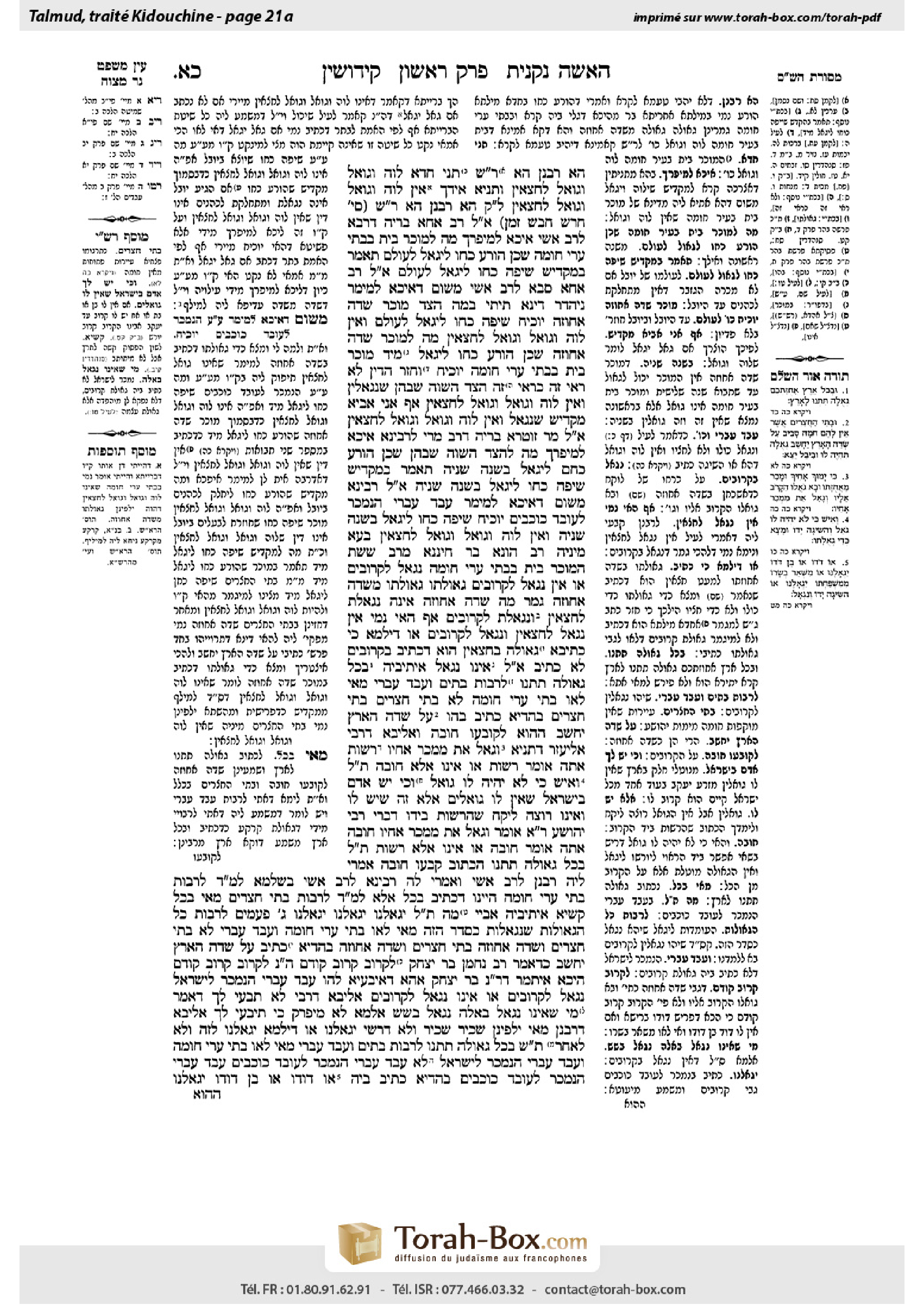
This page of Kiddushin includes the Aramaic text, an English translation and an AI-generated French translation, alongside the scan above.
קידושין כ״א א · Aramaic and Hebrew text
הָא רַבָּנַן, הָא רַבִּי שִׁמְעוֹן.
תָּנֵי חֲדָא: לֹוֶה וְגוֹאֵל וְגוֹאֵל לַחֲצָאִין, וְתַנְיָא אִידַּךְ: אֵין לֹוֶה וְגוֹאֵל וְגוֹאֵל לַחֲצָאִין. לָא קַשְׁיָא, הָא רַבָּנַן, הָא רַבִּי שִׁמְעוֹן.
(סִימָן: חָרַשׁ חָבַשׁ זְמַן)
אֲמַר לֵיהּ רַב אַחָא בְּרֵיהּ דְּרָבָא לְרַב אָשֵׁי: אִיכָּא לְמִיפְרַךְ: מָה לְמוֹכֵר בַּיִת בְּבָתֵּי עָרֵי חוֹמָה – שֶׁכֵּן הוֹרַע כֹּחוֹ לִיגָּאֵל לְעוֹלָם, תֹּאמַר בְּמַקְדִּישׁ – שֶׁיִּפָּה כֹּחוֹ לִיגָּאֵל לְעוֹלָם!
אֲמַר לֵיהּ רַב אַחָא סָבָא לְרַב אָשֵׁי: מִשּׁוּם דְּאִיכָּא לְמֵימַר נֶיהְדַּר דִּינָא, תֵּיתֵי בְּמָה הַצַּד: מוֹכֵר שְׂדֵה אֲחוּזָּה יוֹכִיחַ, שֶׁיִּפָּה כֹּחוֹ לִיגָּאֵל לְעוֹלָם וְאֵין לֹוֶה וְגוֹאֵל וְגוֹאֵל לַחֲצָאִין. מָה לְמוֹכֵר שְׂדֵה אֲחוּזָּה, שֶׁכֵּן הוֹרַע כֹּחוֹ לִיגָּאֵל מִיָּד. מוֹכֵר בַּיִת בְּבָתֵּי עָרֵי חוֹמָה יוֹכִיחַ.
וְחָזַר הַדִּין, לֹא רְאִי זֶה כִּרְאִי זֶה, הַצַּד הַשָּׁוֶה שֶׁבָּהֶן – שֶׁנִּגְאָלִין, וְאֵין לֹוֶה וְגוֹאֵל וְגוֹאֵל לַחֲצָאִין, אַף אֲנִי אָבִיא מַקְדִּישׁ – שֶׁנִּגְאָל, וְאֵין לֹוֶה וְגוֹאֵל וְגוֹאֵל לַחֲצָאִין.
אֲמַר לֵיהּ מָר זוּטְרָא בְּרֵיהּ דְּרַב מָרִי לְרָבִינָא: אִיכָּא לְמִיפְרַךְ: מָה לְהַצַּד הַשָּׁוֶה שֶׁבָּהֶן – שֶׁכֵּן הוֹרַע כֹּחָם לִיגָּאֵל בְּשָׁנָה שְׁנִיָּה, תֹּאמַר בְּמַקְדִּישׁ שֶׁיִּפָּה כֹּחוֹ לִיגָּאֵל בְּשָׁנָה שְׁנִיָּה!
אֲמַר לֵיהּ רָבִינָא: מִשּׁוּם דְּאִיכָּא לְמֵימַר: עֶבֶד עִבְרִי הַנִּמְכָּר לְנׇכְרִי יוֹכִיחַ, שֶׁיִּפָּה כֹּחוֹ לִיגָּאֵל בְּשָׁנָה שְׁנִיָּה וְאֵין לֹוֶה וְגוֹאֵל וְגוֹאֵל לַחֲצָאִין.
בְּעָא מִינֵּיהּ רַב הוּנָא בַּר חִינָּנָא מֵרַב שֵׁשֶׁת: הַמּוֹכֵר בַּיִת בְּבָתֵּי עָרֵי חוֹמָה, נִגְאָל לִקְרוֹבִים אוֹ אֵין נִגְאָל לִקְרוֹבִים? ״גְּאֻלָּתוֹ״ ״גְּאֻלָּתוֹ״ מִשְּׂדֵה אֲחוּזָּה גָּמַר: מָה שְׂדֵה אֲחוּזָּה אֵינָהּ נִגְאֶלֶת לַחֲצָאִין וְנִגְאֶלֶת לִקְרוֹבִים – אַף הַאי נָמֵי אֵין נִגְאָל לַחֲצָאִין וְנִגְאָל לִקְרוֹבִים.
אוֹ דִילְמָא: כִּי כְּתִיבָא ״גְּאוּלָּה״ – בַּחֲצָאִין הוּא דִּכְתִיבָ[א], בִּקְרוֹבִים לָא כְּתִיבָ[א]? אֲמַר לֵיהּ: אֵינוֹ נִגְאָל.
אֵיתִיבֵיהּ: ״בְּכֹל גְּאֻלָּה תִּתְּנוּ״ – לְרַבּוֹת בָּתִּים וְעֶבֶד עִבְרִי. מַאי לָאו בָּתֵּי עָרֵי חוֹמָה? לָא, בָּתֵּי חֲצֵרִים.
בָּתֵּי חֲצֵרִים בְּהֶדְיָא כְּתִיב בְּהוּ: ״עַל שְׂדֵה הָאָרֶץ יֵחָשֵׁב״! הָהוּא לְקוֹבְעוֹ חוֹבָה, וְאַלִּיבָּא דְּרַבִּי אֱלִיעֶזֶר.
דְּתַנְיָא: ״וְגָאַל אֵת מִמְכַּר אָחִיו״ – רְשׁוּת. אַתָּה אוֹמֵר רְשׁוּת, אוֹ אֵינוֹ אֶלָּא חוֹבָה? תַּלְמוּד לוֹמַר: ״וְאִישׁ כִּי לֹא יִהְיֶה לּוֹ גֹּאֵל״ – וְכִי יֵשׁ אָדָם בְּיִשְׂרָאֵל שֶׁאֵין לוֹ גּוֹאֲלִים? אֶלָּא זֶה שֶׁיֵּשׁ לוֹ וְאֵינוֹ רוֹצֶה לִיקַּח, שֶׁהָרְשׁוּת בְּיָדוֹ, דִּבְרֵי רַבִּי יְהוֹשֻׁעַ.
רַבִּי אֱלִיעֶזֶר אוֹמֵר: ״וְגָאַל אֵת מִמְכַּר אָחִיו״ – חוֹבָה. אַתָּה אוֹמֵר חוֹבָה אוֹ אֵינוֹ אֶלָּא רְשׁוּת? תַּלְמוּד לוֹמַר: ״בְּכֹל... גְּאֻלָּה תִּתְּנוּ״ – הַכָּתוּב קְבָעוֹ חוֹבָה.
אָמְרִי לֵיהּ רַבָּנַן לְרַב אָשֵׁי, וְאָמְרִי לַהּ רָבִינָא לְרַב אָשֵׁי: בִּשְׁלָמָא לְמַאן דְּאָמַר לְרַבּוֹת בָּתֵּי עָרֵי חוֹמָה – הַיְינוּ דִּכְתִיב ״בְּכֹל״, אֶלָּא לְמַאן דְּאָמַר לְרַבּוֹת בָּתֵּי חֲצֵרִים – מַאי ״בְּכֹל״? קַשְׁיָא.
אֵיתִיבֵיהּ אַבָּיֵי: מָה תַּלְמוּד לוֹמַר: ״יִגְאָלֶנּוּ״ ״יִגְאָלֶנּוּ״ ״יִגְאָלֶנּוּ״ שָׁלֹשׁ פְּעָמִים? לְרַבּוֹת כׇּל הַגְּאוּלּוֹת שֶׁנִּגְאָלוֹת כַּסֵּדֶר הַזֶּה. מַאי לָאו בָּתֵּי עָרֵי חוֹמָה, וְעֶבֶד עִבְרִי? לָא, בָּתֵּי חֲצֵרִים וּשְׂדֵה אֲחוּזָּה.
בָּתֵּי חֲצֵרִים וּשְׂדֵה אֲחוּזָּה בְּהֶדְיָא כְּתִיב: ״עַל שְׂדֵה הָאָרֶץ יֵחָשֵׁב״! כִּדְאָמַר רַב נַחְמָן בַּר יִצְחָק: לְקָרוֹב קָרוֹב קוֹדֵם, הָכִי נָמֵי לְקָרוֹב קָרוֹב קוֹדֵם.
הֵיכָא אִיתְּמַר דְּרַב נַחְמָן בַּר יִצְחָק? אַהָא, דְּאִיבַּעְיָא לְהוּ: עֶבֶד עִבְרִי הַנִּמְכָּר לְיִשְׂרָאֵל נִגְאָל לִקְרוֹבִים אוֹ אֵינוֹ נִגְאָל לִקְרוֹבִים? אַלִּיבָּא דְּרַבִּי לָא תִּבְּעֵי לָךְ, דְּאָמַר: מִי שֶׁאֵינוֹ נִגְאָל בְּאֵלֶּה – נִגְאָל בְּשֵׁשׁ, אַלְמָא לָא מִיפְּרֵק.
כִּי תִּיבְּעֵי לָךְ, אַלִּיבָּא דְּרַבָּנַן מַאי? יָלְפִינַן ״שָׂכִיר״ ״שָׂכִיר״, וְלָא דָּרְשִׁי ״יִגְאָלֶנּוּ״, אוֹ דִילְמָא ״יִגְאָלֶנּוּ״ – לָזֶה וְלֹא לְאַחֵר?
תָּא שְׁמַע: ״בְּכֹל... גְּאוּלָּה תִּתְּנוּ״ – לְרַבּוֹת בָּתִּים וְעֶבֶד עִבְרִי. מַאי לָאו בָּתֵּי עָרֵי חוֹמָה וְעֶבֶד עִבְרִי הַנִּמְכָּר לְיִשְׂרָאֵל? לָא, עֶבֶד עִבְרִי הַנִּמְכָּר לְנׇכְרִי.
עֶבֶד עִבְרִי הַנִּמְכָּר לְנׇכְרִי בְּהֶדְיָא כְּתִיב בֵּיהּ: ״אוֹ דֹדוֹ אוֹ בֶן דֹּדוֹ יִגְאָלֶנּוּ״!
Kiddushin 21a · English translation
This second baraita is in accordance with the opinion of the Rabbis, and that baraita, which teaches that one can borrow money and redeem the house and partially redeem it, is in accordance with the opinion of Rabbi Shimon.
The Gemara states: It is taught in one baraita with regard to the houses of walled cities: One can borrow money and redeem it, and one can partially redeem it, and it is taught in another baraita: One cannot borrow money and redeem it, nor can one partially redeem. Apparently, there is a contradiction between these two baraitot. The Gemara answers as above: This is not difficult. This baraita is in accordance with the opinion of the Rabbis, and that baraita is in accordance with the opinion of Rabbi Shimon.
The Gemara provides a mnemonic device for the names of the Sages who raise the dilemmas cited below and those to whom the questions are addressed: Ḥeresh, ḥavash, zeman. They allude to the following interlocutors: Ḥeresh alludes to Rav Aḥa, son of Rava, and Rav Ashi; ḥavash alludes to Rav Aḥa Sava and Rav Ashi; and zeman alludes to Mar Zutra, son of Rav Mari, and Ravina.
Rav Aḥa, son of Rava, said to Rav Ashi: The comparison detailed earlier (20b) between one who sells a house and one who consecrates a field, can be refuted as follows: What is unique about one who sells a house among the houses of walled cities is that his power is diminished, in that he is not able to redeem it forever, since he cannot redeem it after a year has passed (see Leviticus 25:30). Shall you say the same with regard to one who consecrates his field, as his power is enhanced in that he is able to redeem forever?
Rav Aḥa Sava said to Rav Ashi: The comparison is valid, because it can be said that the argument returns, as one can learn in a different manner. Let this matter be derived by an analogy derived from the common factor of two sources: The halakha of one who sells an ancestral field can prove it, as his power is enhanced in that he is able to redeem the field forever, and he cannot borrow money and redeem it, and he cannot partially redeem it. And if you say: What is unique about one who sells an ancestral field is that his power is diminished in that he is not able to redeem it immediately, the case of one who sells a house from among houses of walled cities can prove otherwise. Although one can redeem the house immediately, he cannot borrow money and redeem it, nor partially redeem it.
And the derivation has reverted to its starting point, as one could alternate the explanations for each side with their respective refutations. Ultimately, the aspect of this case, an ancestral field, is not like the aspect of that case, a house from among houses of walled cities. Their common denominator is that they can be redeemed, and one cannot borrow money and redeem them, and likewise, one cannot partially redeem them. I will also bring the case of one who consecrates his field and rule that it may be redeemed, but one cannot borrow money and redeem it, and one cannot partially redeem it.
Mar Zutra, son of Rav Mari, said to Ravina: This derivation, based on the common denominator, can be refuted as follows: What is unique to their common denominator is that their power is diminished in that they are unable to redeem the respective properties during the second year, as in neither case can they be redeemed in the second year. One who sells a house in a walled city cannot redeem it beyond the first year, while one who sells an ancestral field cannot redeem it during the first two years. Shall you say the same with regard to one who consecrated his field, as his power is enhanced in that he is able to redeem the field in the second year?
Ravina said to him that the derivation is valid because it can be said that the case of a Hebrew slave sold to a gentile can prove otherwise, as his power enhanced in that he is able to redeem himself in the second year, and nevertheless he cannot borrow money and redeem himself, and he cannot partially redeem himself.
The Gemara discusses a similar matter. Rav Huna bar Ḥinnana raised a dilemma before Rav Sheshet: In the case of one who sells a house from among the houses of walled cities, can it be redeemed by relatives or can it not be redeemed by relatives? Is the ability to redeem a house limited to the seller himself? The Gemara presents the two sides of the dilemma: Does one derive the verbal analogy of “ge’ullato” (Leviticus 25:29) and “ge’ullato” (Leviticus 25:26) from an ancestral field in this manner: Just as an ancestral field cannot be partially redeemed and yet it can be redeemed by relatives, so too, this house also cannot be partially redeemed and yet it can be redeemed by relatives?
Or perhaps, when the word ge’ula is written in the case of an ancestral field, it is written with regard to partial redemption; but the word redemption is not written with regard to relatives. If so, the verbal analogy does not apply to the halakha of redemption by relatives. Rav Sheshet said to him: The house cannot be redeemed by relatives.
Rav Huna bar Ḥinnana raised an objection to the ruling of Rav Sheshet from a baraita that deals with the verse: “And in all of your ancestral land you shall grant redemption for the land” (Leviticus 25:24). This verse serves to include houses and a Hebrew slave. What, is it not correct to say that the term houses is referring to houses of walled cities, indicating that they can also be redeemed by relatives? The Gemara rejects this suggestion: No, this is referring to houses in open areas without walls.
The Gemara asks: With regard to houses in open areas without walls, it is explicitly written: “Shall be reckoned with the field of the country” (Leviticus 25:31), meaning that they are like ancestral fields. If so, there is no need for another verse to teach this halakha. The Gemara answers: That verse: “And in all of your ancestral land you shall grant redemption for the land” (Leviticus 25:24), serves to establish that redemption by relatives is an obligation, and this is in accordance with the opinion of Rabbi Eliezer.
As it is taught in a baraita, with regard to a verse that deals with one who sells ancestral land: “And he shall redeem that which his brother has sold” (Leviticus 25:25), this redemption is optional, i.e., if he wishes to do so he may redeem the land. Do you say that it is optional or is it nothing other than an obligation? The verse states concerning an ancestral field that was sold: “And if a man has no one to redeem it” (Leviticus 25:26). This verse is puzzling: But is there a man in Israel who does not have redeemers? Every Jew has a relative of some sort, even if he must trace his family tree back all the way to Jacob. Rather, this is referring to one who has a relative who does not want to purchase, i.e., redeem, the land, as he has permission to refrain from doing so, since this redemption is optional. This is the statement of Rabbi Yehoshua.
Rabbi Eliezer says that when the verse states: “And he shall redeem that which his brother has sold,” this redemption is an obligation. Do you say that it is an obligation, or is it only optional? The verse states: “And in all of your ancestral land you shall grant redemption for the land” (Leviticus 25:24). Here the verse established it as obligatory. This is the interpretation of the verses according to Rabbi Eliezer.
The Sages said to Rav Ashi, and some say Ravina said this to Rav Ashi: Granted, according to the one who says that the verse serves to include houses of walled cities, this is as it is written “in all.” “In all” serves to include a case omitted by the phrase “you shall grant a redemption for the land.” But according to the one who says that it serves to include houses in open areas without walls, what is meant by the term “in all”? It was already taught that these houses are included in the category of ancestral fields, and therefore they are referred to by the expression “redemption for the land.” No answer was found to this question and the Gemara states that it is a difficulty.
Abaye raised an objection to this opinion that houses in walled cities cannot be redeemed by relatives. It is taught in a baraita: What does it mean when the verse states: “May redeem him,” “may redeem him,” and “may redeem him” (Leviticus 25:48–49), three times? This serves to include all redemptions, and that they are redeemed in this order: In the case of a Hebrew slave sold to a gentile, if he does not redeem himself he can be redeemed by a brother; if he is not redeemed by a brother, then he can be redeemed by an uncle or some other relative. What, is it not correct to say that this inclusion is referring to houses of walled cities and a Hebrew slave, that they too can be redeemed by relatives? The Gemara rejects this interpretation: No, it includes houses in open areas and an ancestral field.
The Gemara asks: But the cases of houses in open areas and the case of an ancestral field are written explicitly: “Shall be reckoned with the field of the country” (Leviticus 25:31). The Gemara answers: This is as Rav Naḥman bar Yitzḥak said, that the verse detailing the redemption by relatives stated with regard to an ancestral field teaches that the closer of a relative one is to the seller, the earlier one is in the order of redeeming the ancestral field. The obligation or merit to redeem the field applies first to one who is more closely related to the seller. So too, with regard to houses in open areas, this verse teaches that the closer of a relative one is to the seller, the earlier one is in the order of redeeming the house.
The Gemara asks: Where was this opinion of Rav Naḥman bar Yitzḥak originally stated? The Gemara answers that it was stated with regard to this issue, as a dilemma was raised before the Sages: Can a Hebrew slave sold to a Jew be redeemed by his relatives or can he not be redeemed by his relatives? The Gemara comments: According to the opinion of Rabbi Yehuda HaNasi, you should not raise the dilemma, as he says: One who is not redeemed by these relatives is redeemed by six years of service. Evidently, Rabbi Yehuda HaNasi holds that a Hebrew slave sold to a gentile cannot be redeemed by his relatives.
When you raise the dilemma, it is according to the opinion of the Rabbis. What is the halakha? Does one derive the verbal analogy comparing “hired worker” (Leviticus 25:40) and “hired worker” (Leviticus 25:53) from the case of a Jew sold to a gentile, and say that just as one can be redeemed by one’s relatives if sold to a gentile, so too, one can be redeemed if sold to a Jew? And at the same time one does not interpret homiletically the phrase “may redeem him” (Leviticus 25:48), stated with regard to one sold to a gentile, as a restricting term. Or perhaps the phrase “may redeem him” is in fact a restricting term, which indicates that this halakha applies only to this slave, i.e., only one sold to a gentile can be redeemed by relatives, and it does not apply to another slave, one sold to a Jew.
Come and hear a baraita: “And in all of your ancestral land you shall grant redemption for the land” (Leviticus 25:24). The inclusive expression “in all” serves to include houses and a Hebrew slave. What, is it not correct to say that this includes houses of walled cities and a Hebrew slave sold to a Jew? The Gemara rejects this interpretation: No, one can say that this is referring to a Hebrew slave sold to a gentile.
The Gemara asks: It is explicitly written with regard to a Hebrew slave sold to a gentile: “Either his uncle or his uncle’s son may redeem him” (Leviticus 25:49). If so, it is unnecessary to derive the option of redemption by a relative from an inclusive expression in a different verse.
Kiddushin 21a · Traduction française (IA)
Cette seconde baraïta est conforme à l’opinion des Rabbins, tandis que l’autre baraïta, qui enseigne qu’on peut emprunter de l’argent pour racheter la maison et la racheter partiellement, est conforme à l’opinion de Rabbi Shimon.
La Guemara dit : Il est enseigné dans une baraïta, à propos des maisons des villes fortifiées : on peut emprunter de l’argent pour les racheter et on peut les racheter partiellement. Une autre baraïta enseigne : on ne peut pas emprunter de l’argent pour les racheter ni les racheter partiellement. Il semble donc y avoir une contradiction entre ces deux baraïtot. La Guemara répond comme précédemment : il n’y a pas de difficulté. Cette baraïta est conforme à l’opinion des Rabbins, tandis que l’autre baraïta est conforme à l’opinion de Rabbi Shimon.
La Guemara donne un moyen mnémotechnique pour retenir les noms des Sages qui soulèvent les questions citées ci-dessous et ceux de leurs interlocuteurs : ḥeresh, ḥavash, zeman. Ces termes font allusion aux interlocuteurs suivants : ḥeresh évoque Rav Aḥa, fils de Rava, et Rav Ashi ; ḥavash évoque Rav Aḥa Sava et Rav Ashi ; et zeman évoque Mar Zutra, fils de Rav Mari, et Ravina.
Rav Aḥa, fils de Rava, dit à Rav Ashi : La comparaison exposée précédemment (20b) entre celui qui vend une maison et celui qui consacre un champ peut être réfutée ainsi : ce qui caractérise celui qui vend une maison parmi les maisons des villes fortifiées, c’est que son pouvoir est limité, puisqu’il ne peut pas la racheter à perpétuité et ne peut plus la racheter une fois écoulée une année (voir Lévitique 25,30). Peut-on en dire autant de celui qui consacre son champ, alors que son pouvoir est accru, puisqu’il peut le racheter à perpétuité ?
Rav Aḥa Sava dit à Rav Ashi : La comparaison est valable, car on peut répondre que l’argument revient à son point de départ et que la déduction peut être menée autrement. Déduisons cette règle par une analogie fondée sur le dénominateur commun de deux cas : le cas de celui qui vend un champ ancestral peut le démontrer, car son pouvoir est accru, puisqu’il peut racheter le champ à perpétuité, et pourtant il ne peut ni emprunter de l’argent pour le racheter ni le racheter partiellement. Et si tu dis : ce qui caractérise celui qui vend un champ ancestral, c’est que son pouvoir est limité, puisqu’il ne peut pas le racheter immédiatement, le cas de celui qui vend une maison parmi les maisons des villes fortifiées peut le démontrer. Bien que la maison puisse être rachetée immédiatement, on ne peut ni emprunter de l’argent pour la racheter ni la racheter partiellement.
La déduction est ainsi revenue à son point de départ, car on pourrait inverser les explications de chaque cas et leur opposer leurs réfutations respectives. En définitive, le trait propre à ce cas, celui du champ ancestral, n’est pas le même que celui de l’autre cas, celui d’une maison parmi les maisons des villes fortifiées. Ils ont en commun de pouvoir être rachetés, mais de ne pouvoir être rachetés ni au moyen d’un emprunt ni partiellement. J’inclurai également le cas de celui qui consacre son champ et statuerai qu’il peut être racheté, mais qu’on ne peut ni emprunter de l’argent pour le racheter ni le racheter partiellement.
Mar Zutra, fils de Rav Mari, dit à Ravina : Cette déduction fondée sur le dénominateur commun peut être réfutée ainsi : ce qui caractérise leur dénominateur commun, c’est que leur pouvoir est limité, puisqu’on ne peut racheter les biens concernés au cours de la deuxième année dans aucun des deux cas. Celui qui vend une maison dans une ville fortifiée ne peut pas la racheter après la première année, tandis que celui qui vend un champ ancestral ne peut pas le racheter au cours des deux premières années. Peut-on en dire autant de celui qui a consacré son champ, alors que son pouvoir est accru, puisqu’il peut racheter le champ au cours de la deuxième année ?
Ravina lui répondit que la déduction est valable, car le cas de l’esclave hébreu vendu à un non-Juif peut démontrer le contraire : son pouvoir est accru, puisqu’il peut se racheter au cours de la deuxième année, et pourtant il ne peut ni emprunter de l’argent pour se racheter ni se racheter partiellement.
La Guemara examine une question similaire. Rav Huna bar Ḥinnana posa une question à Rav Sheshet : Dans le cas de celui qui vend une maison parmi les maisons des villes fortifiées, ses proches peuvent-ils la racheter ? Le droit de racheter la maison est-il réservé au vendeur lui-même ? La Guemara présente les deux aspects de la question : déduit-on, par l’analogie verbale entre « ge’ullato » (Lévitique 25,29) et « ge’ullato » (Lévitique 25,26), le principe suivant à partir du cas du champ ancestral : de même qu’un champ ancestral ne peut pas être racheté partiellement, mais peut être racheté par des proches, cette maison aussi ne peut pas être rachetée partiellement, mais peut être rachetée par des proches ?
Ou peut-être que, dans le cas du champ ancestral, le terme ge’ula est employé à propos du rachat partiel, mais que le terme « rachat » n’est pas employé à propos des proches. Si tel est le cas, l’analogie verbale ne s’applique pas à la halakha du rachat par les proches. Rav Sheshet lui dit : Les proches ne peuvent pas racheter la maison.
Rav Huna bar Ḥinnana souleva une objection contre la décision de Rav Sheshet à partir d’une baraïta portant sur le verset : « Dans tout le territoire de votre héritage, vous accorderez le rachat du pays » (Lévitique 25,24). Ce verset vient inclure les maisons et l’esclave hébreu. N’est-il pas juste de comprendre que le terme « maisons » désigne les maisons des villes fortifiées, ce qui indiquerait qu’elles aussi peuvent être rachetées par des proches ? La Guemara rejette cette suggestion : non, il s’agit des maisons situées dans des régions ouvertes, sans murailles.
La Guemara demande : À propos des maisons situées dans des régions ouvertes, sans murailles, il est explicitement écrit : « Sera compté avec le champ du pays » (Lévitique 25,31), ce qui signifie qu’elles sont assimilées aux champs ancestraux. Il n’est donc pas nécessaire qu’un autre verset enseigne cette halakha. La Guemara répond : Le verset « Dans tout le territoire de votre héritage, vous accorderez le rachat du pays » (Lévitique 25,24) établit que le rachat par les proches est une obligation, conformément à l’opinion de Rabbi Eliezer.
En effet, une baraïta enseigne, à propos du verset concernant celui qui vend un champ ancestral : « Il rachètera ce que son frère a vendu » (Lévitique 25,25) : ce rachat est facultatif, c’est-à-dire qu’il peut racheter le champ s’il le souhaite. Est-il facultatif, ou bien s’agit-il nécessairement d’une obligation ? Le verset dit, à propos d’un champ ancestral vendu : « Si un homme n’a personne pour le racheter » (Lévitique 25,26). Ce verset est étonnant : existe-t-il en Israël un homme qui n’ait aucun proche susceptible de racheter le champ ? Tout Juif a un parent ou un autre, même s’il doit remonter sa généalogie jusqu’à Jacob. Il s’agit plutôt de celui dont le proche ne veut pas acheter, c’est-à-dire racheter, le champ ; ce proche est autorisé à s’en abstenir, puisque ce rachat est facultatif. Telle est l’opinion de Rabbi Yehoshua.
Rabbi Eliezer dit : Lorsque le verset dit : « Il rachètera ce que son frère a vendu », ce rachat est une obligation. Est-il obligatoire, ou bien seulement facultatif ? Le verset dit : « Dans tout le territoire de votre héritage, vous accorderez le rachat du pays » (Lévitique 25,24). Ce verset l’établit comme une obligation. Telle est l’interprétation des versets selon Rabbi Eliezer.
Les Sages dirent à Rav Ashi — et certains disent que Ravina le lui dit : Admettons que, selon celui qui affirme que le verset vient inclure les maisons des villes fortifiées, cela corresponde à l’expression « dans tout » : « dans tout » sert à inclure un cas omis par les mots « vous accorderez le rachat du pays ». Mais selon celui qui affirme que le verset vient inclure les maisons situées dans des régions ouvertes, sans murailles, que signifie l’expression « dans tout » ? Il a déjà été enseigné que ces maisons sont incluses dans la catégorie des champs ancestraux et sont donc désignées par l’expression « rachat du pays ». Aucune réponse n’a été trouvée à cette question, et la Guemara conclut qu’elle pose une difficulté.
Abaye souleva une objection contre l’opinion selon laquelle les maisons des villes fortifiées ne peuvent pas être rachetées par des proches. Une baraïta enseigne : Que signifie la répétition par trois fois, dans le verset, de l’expression « il pourra le racheter » (Lévitique 25,48–49) ? Elle vient inclure tous les cas de rachat et établir l’ordre suivant : dans le cas d’un esclave hébreu vendu à un non-Juif, s’il ne se rachète pas lui-même, son frère peut le racheter ; si son frère ne le rachète pas, son oncle ou un autre proche peut le racheter. N’est-il pas juste de comprendre que cette inclusion concerne les maisons des villes fortifiées et l’esclave hébreu, indiquant qu’eux aussi peuvent être rachetés par des proches ? La Guemara rejette cette interprétation : non, elle inclut les maisons situées dans des régions ouvertes et le champ ancestral.
La Guemara demande : Mais les maisons situées dans des régions ouvertes et le champ ancestral sont mentionnés explicitement : « Sera compté avec le champ du pays » (Lévitique 25,31). La Guemara répond : C’est ce que Rav Naḥman bar Yitzḥak a dit : le verset relatif au rachat par les proches, énoncé à propos d’un champ ancestral, enseigne que plus un proche est étroitement apparenté au vendeur, plus il est prioritaire dans l’ordre de rachat du champ ancestral. Le droit ou le mérite de racheter le champ revient d’abord au proche qui a le lien de parenté le plus étroit avec le vendeur. De même, à propos des maisons situées dans des régions ouvertes, ce verset enseigne que plus un proche est étroitement apparenté au vendeur, plus il est prioritaire dans l’ordre de rachat de la maison.
La Guemara demande : Où cette opinion de Rav Naḥman bar Yitzḥak a-t-elle été énoncée à l’origine ? La Guemara répond qu’elle a été énoncée à propos de la question suivante, soumise aux Sages : un esclave hébreu vendu à un Juif peut-il être racheté par ses proches ? La Guemara fait remarquer : selon l’opinion de Rabbi Yehuda HaNasi, il n’y a pas lieu de poser cette question, car il dit : Celui qui n’est pas racheté par ces proches l’est au terme de six années de service. Il ressort que Rabbi Yehuda HaNasi estime qu’un esclave hébreu vendu à un non-Juif ne peut pas être racheté par ses proches.
La question se pose selon l’opinion des Rabbins. Quelle est la halakha ? Déduit-on, par l’analogie verbale entre « salarié » (Lévitique 25,40) et « salarié » (Lévitique 25,53), le principe applicable au Juif vendu à un non-Juif, et dit-on que, de même qu’il peut être racheté par ses proches s’il a été vendu à un non-Juif, il peut aussi l’être s’il a été vendu à un Juif ? Et, en même temps, n’interprète-t-on pas de manière homilétique l’expression « il pourra le racheter » (Lévitique 25,48), énoncée à propos de celui qui a été vendu à un non-Juif, comme une expression restrictive ? Ou peut-être l’expression « il pourra le racheter » est-elle effectivement restrictive, indiquant que cette halakha ne s’applique qu’à cet esclave, c’est-à-dire que seul celui qui a été vendu à un non-Juif peut être racheté par ses proches, et qu’elle ne s’applique pas à un autre esclave, vendu à un Juif.
Viens et écoute une baraïta : « Dans tout le territoire de votre héritage, vous accorderez le rachat du pays » (Lévitique 25,24). L’expression inclusive « dans tout » vient inclure les maisons et l’esclave hébreu. N’est-il pas juste de comprendre qu’elle inclut les maisons des villes fortifiées et l’esclave hébreu vendu à un Juif ? La Guemara rejette cette interprétation : non, on peut dire qu’il s’agit d’un esclave hébreu vendu à un non-Juif.
La Guemara demande : À propos d’un esclave hébreu vendu à un non-Juif, il est explicitement écrit : « Son oncle ou le fils de son oncle pourra le racheter » (Lévitique 25,49). Si tel est le cas, il n’est pas nécessaire de déduire la possibilité d’un rachat par un proche à partir d’une expression inclusive figurant dans un autre verset.
Traduction française générée par IA à partir de l’édition anglaise de Sefaria. Vérifie toujours un passage avec le texte source.
Text from Sefaria: William Davidson Edition - Vocalized Aramaic (CC BY NC); William Davidson Edition - English (CC BY NC).