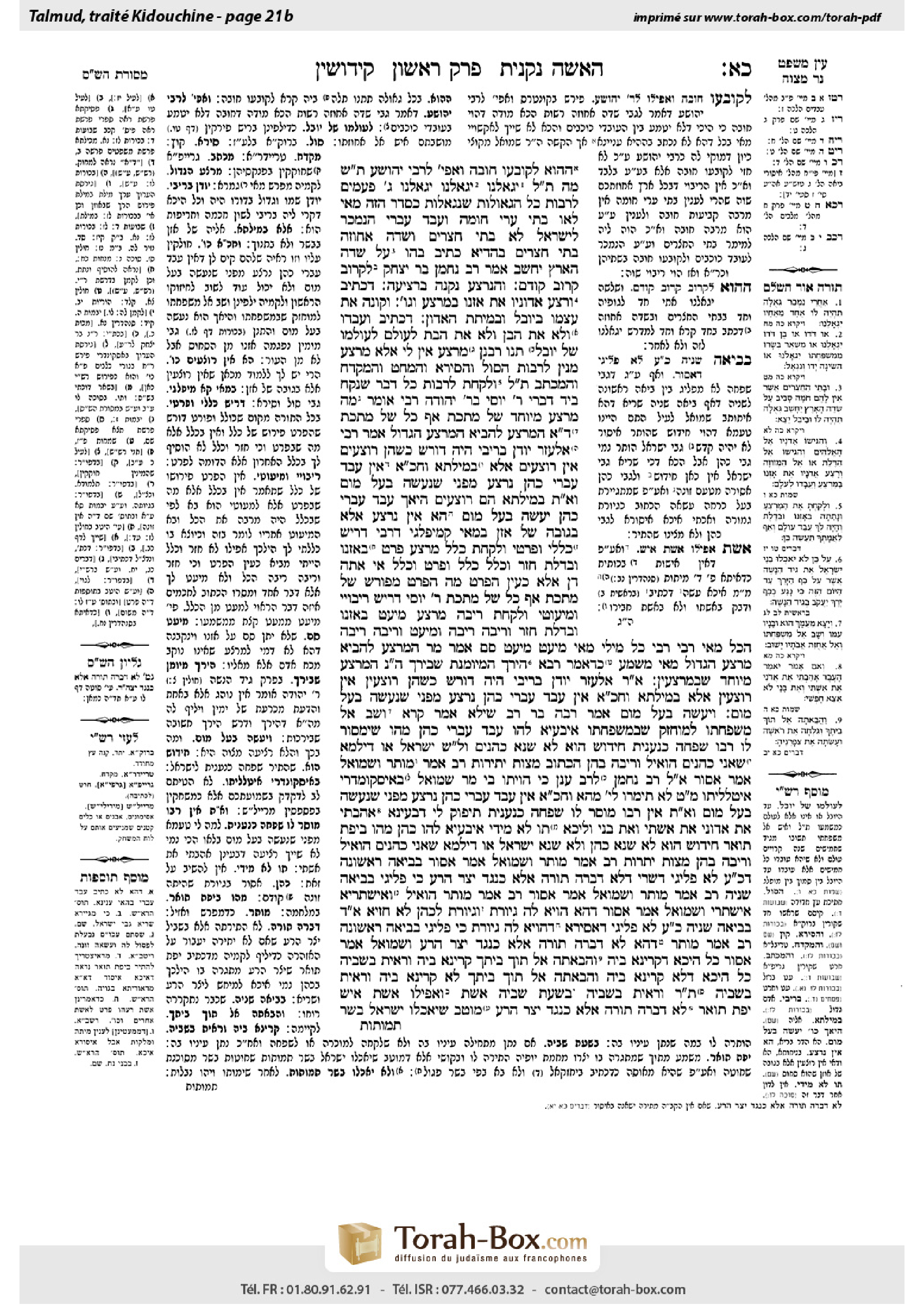
Kiddushin 21b: Talmud study for Daf Yomi
Daf Yomi is the daily study of one Talmud folio. Explore 37 tractates with scans, Hebrew text, Sefaria English and AI-generated French translations where annotated.
Passage selection and English or AI-generated French translation are available where the scan has annotations. Daf Study is independent of Torah-Box and Sefaria.
Browse Kiddushin · קידושין · All tractatesKiddushin 21b text and translations
This page of Kiddushin includes the Aramaic text, an English translation and an AI-generated French translation, alongside the scan above.
קידושין כ״א ב · Aramaic and Hebrew text
הָהוּא לְקוֹבְעוֹ חוֹבָה, וַאֲפִילּוּ לְרַבִּי יְהוֹשֻׁעַ.
תָּא שְׁמַע: מָה תַּלְמוּד לוֹמַר ״יִגְאָלֶנּוּ״ ״יִגְאָלֶנּוּ״ ״יִגְאָלֶנּוּ״ שָׁלֹשׁ פְּעָמִים? לְרַבּוֹת כׇּל הַגְּאוּלּוֹת שֶׁנִּגְאָלוֹת כַּסֵּדֶר הַזֶּה. מַאי לָאו בָּתֵּי עָרֵי חוֹמָה וְעֶבֶד עִבְרִי הַנִּמְכָּר לְיִשְׂרָאֵל? לָא, בָּתֵּי חֲצֵרִים וּשְׂדֵה אֲחוּזָּה. בָּתֵּי חֲצֵרִים בְּהֶדְיָא כְּתִיב בְּהוּ: ״עַל שְׂדֵה הָאָרֶץ יֵחָשֵׁב״! אָמַר רַב נַחְמָן בַּר יִצְחָק: לְקָרוֹב קָרוֹב קוֹדֵם.
וְהַנִּרְצָע נִקְנֶה בִּרְצִיעָה. דִּכְתִיב: ״וְרָצַע אֲדֹנָיו אֶת אׇזְנוֹ בַּמַּרְצֵעַ וְגוֹ׳״
וְקוֹנֶה אֶת עַצְמוֹ בַּיּוֹבֵל וּבְמִיתַת הָאָדוֹן. דִּכְתִיב: ״וַעֲבָדוֹ״ – וְלֹא אֶת הַבֵּן וְלֹא אֶת הַבַּת. ״לְעֹלָם״ – לְעוֹלָמוֹ שֶׁל יוֹבֵל.
תָּנוּ רַבָּנַן: ״מַרְצֵעַ״ – אֵין לִי אֶלָּא מַרְצֵעַ, מִנַּיִן לְרַבּוֹת הַסּוֹל וְהַסִּירָא וְהַמַּחַט וְהַמַּקְדֵּחַ וְהַמַּכְתֵּב? תַּלְמוּד לוֹמַר: ״וְלָקַחְתָּ״ – לְרַבּוֹת כׇּל דָּבָר שֶׁנִּקַּח בַּיָּד, דִּבְרֵי רַבִּי יוֹסֵי בְּרַבִּי יְהוּדָה.
רַבִּי אוֹמֵר: מָה מַרְצֵעַ מְיוּחָד שֶׁל מַתֶּכֶת – אַף כֹּל שֶׁל מַתֶּכֶת. דָּבָר אַחֵר: ״הַמַּרְצֵעַ״ – לְהָבִיא הַמַּרְצֵעַ הַגָּדוֹל.
אָמַר רַבִּי אֶלְעָזָר: יוּדָן בְּרִיבִּי הָיָה דּוֹרֵשׁ: כְּשֶׁהֵן רוֹצְעִים אֵין רוֹצְעִים אֶלָּא בַּמִּילְתָא. וַחֲכָמִים אוֹמְרִים: אֵין עֶבֶד עִבְרִי כֹּהֵן נִרְצָע, מִפְּנֵי שֶׁנַּעֲשֶׂה בַּעַל מוּם. וְאִם תֹּאמַר: בְּמִילְּתָא הֵם רוֹצְעִים – הֵיאַךְ עֶבֶד עִבְרִי כֹּהֵן יֵעָשֶׂה בַּעַל מוּם? הָא אֵין נִרְצָע אֶלָּא בְּגוֹבַהּ שֶׁל אֹזֶן. בְּמַאי קָמִיפַּלְגִי?
דְּרַבִּי דָּרֵישׁ כְּלָלֵי וּפְרָטֵי: ״וְלָקַחְתָּ״ – כָּלַל. ״מַרְצֵעַ״ – פָּרַט. ״בְּאׇזְנוֹ וּבַדֶּלֶת״ – חָזַר וְכָלַל. כְּלָל וּפְרָט וּכְלָל, אִי אַתָּה דָן אֶלָּא כְּעֵין הַפְּרָט. מָה הַפְּרָט מְפוֹרָשׁ שֶׁל מַתֶּכֶת, אַף כֹּל שֶׁל מַתֶּכֶת.
רַבִּי יוֹסֵי דָּרֵישׁ רִיבּוּיֵי וּמִיעוּטֵי: ״וְלָקַחְתָּ״ – רִיבָּה. ״מַרְצֵעַ״ – מִיעֵט. ״בְּאׇזְנוֹ וּבַדֶּלֶת״ – חָזַר וְרִיבָּה. רִיבָּה וּמִיעֵט וְרִיבָּה, רִיבָּה הַכֹּל.
מַאי רַבִּי – רַבִּי כֹּל מִילֵּי, מַאי מַיעֵט – מַיעֵט סַם.
אָמַר מָר: ״הַמַּרְצֵעַ״ – לְהָבִיא מַרְצֵעַ הַגָּדוֹל. מַאי מַשְׁמַע? כִּדְאָמַר רָבָא: ״הַיָּרֵךְ״ – הַמְיוּמֶּנֶת שֶׁבַּיָּרֵךְ, הָכָא נָמֵי: ״הַמַּרְצֵעַ״ – מְיוּחָד שֶׁבַּמַּרְצְעִין.
אָמַר רַבִּי אֶלְעָזָר, יוּדָן בְּרִיבִּי הָיָה דּוֹרֵשׁ: כְּשֶׁהֵן רוֹצְעִין, אֵין רוֹצְעִין אֶלָּא בְּמִילְתָא, וַחֲכָמִים אוֹמְרִים: אֵין עֶבֶד עִבְרִי כֹּהֵן נִרְצָע מִפְּנֵי שֶׁנַּעֲשֶׂה בַּעַל מוּם. וְיֵעָשֶׂה בַּעַל מוּם! אָמַר רַבָּה בַּר רַב שֵׁילָא: אָמַר קְרָא: ״וְשָׁב אֶל מִשְׁפַּחְתּוֹ״ – לְמוּחְזָק שֶׁבְּמִשְׁפַּחְתּוֹ.
אִיבַּעְיָא לְהוּ: עֶבֶד עִבְרִי כֹּהֵן, מַהוּ שֶׁיִּמְסוֹר לוֹ רַבּוֹ שִׁפְחָה כְּנַעֲנִית? חִידּוּשׁ הוּא, לָא שְׁנָא כֹּהֲנִים וְלָא שְׁנָא יִשְׂרָאֵל,
אוֹ דִילְמָא: שָׁאנֵי כֹּהֲנִים הוֹאִיל וְרִיבָּה בָּהֶן הַכָּתוּב מִצְוֹת יְתֵירוֹת? רַב אָמַר: מוּתָּר, וּשְׁמוּאֵל אָמַר: אָסוּר.
אֲמַר לֵיהּ רַב נַחְמָן לְרַב עָנָן: כִּי הֲוֵיתוּ בֵּי מָר שְׁמוּאֵל, בְּאִיסְקוּמְדְּרֵי אִיטַּלְּלִיתוּ? מַאי טַעְמָא לָא תֵּימְרוּ לֵיהּ מֵהָא: וַחֲכָמִים אוֹמְרִים: אֵין עֶבֶד עִבְרִי כֹּהֵן נִרְצָע מִפְּנֵי שֶׁנַּעֲשֶׂה בַּעַל מוּם.
וְאִם תֹּאמַר אֵין רַבּוֹ מוֹסֵר לוֹ שִׁפְחָה כְּנַעֲנִית, תִּיפּוֹק לִי דְּבָעֵינָא: ״אָהַבְתִּי אֶת אֲדֹנִי אֶת אִשְׁתִּי וְאֶת בָּנָי״ וְלֵיכָּא, תּוּ לָא מִידִּי.
אִיבַּעְיָא לְהוּ: כֹּהֵן, מַהוּ בִּיפַת תּוֹאַר? חִידּוּשׁ הוּא, לָא שְׁנָא כֹּהֵן וְלָא שְׁנָא יִשְׂרָאֵל, אוֹ דִילְמָא שָׁאנֵי כֹּהֲנִים, הוֹאִיל וְרִיבָּה בָּהֶן מִצְוֹת יְתֵרוֹת? רַב אָמַר: מוּתָּר, וּשְׁמוּאֵל אָמַר: אָסוּר.
בְּבִיאָה רִאשׁוֹנָה דְּכוּלֵּי עָלְמָא לָא פְּלִיגִי דִּשְׁרֵי, דְּלֹא דִּבְּרָה תּוֹרָה אֶלָּא כְּנֶגֶד יֵצֶר הָרָע.
כִּי פְּלִיגִי בְּבִיאָה שְׁנִיָּה, רַב אָמַר: מוּתָּר, וּשְׁמוּאֵל אָמַר: אָסוּר. רַב אָמַר: מוּתָּר, הוֹאִיל וְאִישְׁתְּרַיא – אִישְׁתְּרַי. וּשְׁמוּאֵל אָמַר: אָסוּר, דְּהָא הָוְיָא לַהּ גִּיּוֹרֶת, וְגִיּוֹרֶת לְכֹהֵן לָא חַזְיָא.
אִיכָּא דְּאָמְרִי: בְּבִיאָה שְׁנִיָּה כּוּלֵּי עָלְמָא לָא פְּלִיגִי דַּאֲסִירָא, דְּהָוְיָא לַהּ גִּיּוֹרֶת. כִּי פְּלִיגִי בְּבִיאָה רִאשׁוֹנָה, רַב אָמַר: מוּתָּר, דְּהָא לֹא דִּבְּרָה תּוֹרָה אֶלָּא כְּנֶגֶד יֵצֶר הָרָע, וּשְׁמוּאֵל אָמַר: אָסוּר, כֹּל הֵיכָא דְּקָרֵינָא בַּיהּ: ״וַהֲבֵאתָהּ אֶל תּוֹךְ בֵּיתֶךָ״ – קָרֵינָא בַּיהּ: ״וְרָאִיתָ בַּשִּׁבְיָה״. כֹּל הֵיכָא דְּלָא קָרֵינָא בַּיהּ: ״וַהֲבֵאתָהּ אֶל תּוֹךְ בֵּיתֶךָ״ – לָא קָרֵינָא בַּיהּ: ״וְרָאִיתָ בַּשִּׁבְיָה״.
תָּנוּ רַבָּנַן: ״וְרָאִיתָ בַּשִּׁבְיָה״ – בִּשְׁעַת שִׁבְיָהּ. ״אֵשֶׁת״ – וַאֲפִילּוּ אֵשֶׁת אִישׁ. ״יְפַת תּוֹאַר״ – לֹא דִּבְּרָה תּוֹרָה אֶלָּא כְּנֶגֶד יֵצֶר הָרָע. מוּטָב שֶׁיֹּאכְלוּ יִשְׂרָאֵל בְּשַׂר
Kiddushin 21b · English translation
The Gemara answers: That verse serves to establish that redeeming him is an obligation. And even according to the opinion of Rabbi Yehoshua, who says that there is no requirement to redeem land, this case is different, as it is proper to redeem him to prevent him from being assimilated by gentiles.
Come and hear a proof from a baraita: What is the meaning when the verse states: “May redeem him,” “may redeem him,” and “may redeem him” (Leviticus 25:48–49), three times? This serves to include all redemptions, and that they are redeemed in this order. What, is it not correct to say that this inclusion is referring both to houses of walled cities and a Hebrew slave sold to a Jew, that they can be redeemed by relatives? The Gemara rejects this interpretation: No, it includes houses in open areas and an ancestral field. The Gemara asks: Concerning houses in open areas and an ancestral field, it is written explicitly: “Shall be reckoned with the field of the country” (Leviticus 25:31). Rav Naḥman bar Yitzḥak said: This teaches that the closer of a relative one is to the seller, the earlier one is in the order of redeeming the house or the field. This is the context of Rav Naḥman bar Yitzḥak’s statement.
§ The Gemara returns to the mishna, which teaches: And a Hebrew slave who is pierced after serving six years is acquired as a slave for a longer period through piercing his ear with an awl. The Gemara explains that this is as it is written: “And his master shall pierce his ear with an awl, and he shall serve him forever” (Exodus 21:6).
The mishna further teaches that a pierced slave acquires himself through the advent of the Jubilee Year and through the master’s death. The Gemara explains that this is as it is written: “And he shall serve him forever” (Exodus 21:6). This term indicates that he serves only the master, but not the son and not the daughter. The term “forever” is referring to the forever represented by the Jubilee Year. The word “forever” does not mean for eternity, but refers to the end of the cycle of the Jubilee Year.
The Sages taught: From the term “an awl” I have derived only that a master can pierce the ear of a Hebrew slave with an awl. From where do I derive that a sharp thorn [sol], a thorn [sira], a needle, an auger, and a stylus used to engrave in wax may be used? The verse states: “And you shall take the awl” (Deuteronomy 15:17). This term “and you shall take” serves to include any implement that can be taken in the master’s hand. This is the statement of Rabbi Yosei, son of Rabbi Yehuda.
Rabbi Yehuda HaNasi says: Not all of these utensils may be used for piercing. Just as an awl is unique in that it is made of metal, so too any tool made of metal can be used; one may not pierce a slave’s ear with non-metal implements. Alternatively, the verse states: “And you shall take the awl,” to include the large awl for piercing.
Rabbi Elazar said: Yudan the Distinguished would teach as follows: When they pierce, they pierce only the earlobe. And the Rabbis say: The piercing is not performed on the earlobe, as the halakha is that a Hebrew slave who is a priest is not pierced at all because the piercing renders him blemished and unfit to serve in the Temple. And if you say that they pierce a slave’s earlobe, how does a Hebrew slave who is a priest become blemished through piercing? A pierced earlobe is not considered a blemish. This indicates that he is pierced only on the upper part of the ear through the cartilage. The Gemara inquires: With regard to what principle do Rabbi Yehuda HaNasi and Rabbi Yosei, son of Rabbi Yehuda, disagree?
The Gemara explains: Rabbi Yehuda HaNasi expounds the verses by means of the hermeneutical principle of reading the verse as consisting of generalizations and details. Accordingly, he maintains that the term “and you shall take” is a generalization that indicates piercing may be performed with any implement. “An awl” is a detail, and when the verse states: “Through his ear and into the door” (Deuteronomy 15:17), it then generalized again. When the verse writes a generalization and a detail and a generalization, you may deduce that the verse is referring only to items similar to the detail: Just as the explicit detail mentions an awl, which is made of metal, so too, any utensil used for piercing must be made of metal.
By contrast, Rabbi Yosei expounds the verses by means of the hermeneutical principle of reading the verse as consisting of amplifications and restrictions. Accordingly, he learns that the term “and you shall take” amplifies, i.e., it includes any item that can be taken in one’s hand. The term “an awl” restricts. When the verse states “through his ear and into the door,” it then amplifies again. When the verse amplifies, restricts, and amplifies, it has amplified the halakha to include everything except one item.
What has it amplified, i.e., included beyond an awl? It has amplified the category to include everything that can pierce an ear. What has it restricted from inclusion in the category? It excludes only the method that is most dissimilar to the use of an awl, which is a corrosive substance. Producing a hole in the slave’s ear with a substance of this kind is not a valid form of piercing.
The Master said above: “The awl,” this serves to include the large awl for piercing. The Gemara asks: From where may it be inferred that this expression is referring to a large awl? The Gemara answers that this is as Rava said with regard to the verse: “The sinew of the thigh vein which is upon the hollow of the thigh” (Genesis 32:33), that this is referring to the most important [meyummenet] part of the thigh. The definite article indicates something clear and obvious. Here too, the term “the awl” is referring to a special awl.
It was further stated in the above baraita that Rabbi Elazar said: Yudan the Distinguished would teach: When they pierce a slave they pierce only the earlobe. And the Rabbis say: A Hebrew slave who is a priest is not pierced at all, because piercing renders him blemished. The Gemara asks: And let him be pierced and be rendered blemished and disqualified for Temple service. Why is it prohibited to do this? Rabba bar Rav Sheila says: The verse states concerning a Hebrew slave at the end of his servitude: “And he shall return to his own family” (Leviticus 25:41), i.e., to his status in his family. He must be able to return to the position he had as a member of his family. If he was rendered a blemished priest while a slave, once he is emancipated he can no longer return to his status as a priest who can perform the Temple service.
A dilemma was raised before the Sages: With regard to a Hebrew slave who is a priest, what is the halakha concerning the permissibility for his master to provide him with a Canaanite maidservant with whom to engage in sexual intercourse? The Gemara analyzes the two sides of the dilemma: Does one say that the halakha permitting a Hebrew slave to engage in intercourse with a Canaanite maidservant is a halakhic novelty, as a Jew is generally prohibited from engaging in intercourse with a gentile, and in light of this novelty, it is no different in the case of priests and no different in the case of an Israelite?
Or perhaps the case of priests is different from Israelites, since the Torah includes additional mitzvot for them, which do not apply to all Jews. Therefore, it is prohibited for a priest to engage in sexual intercourse with a Canaanite maidservant, despite the fact she is permitted to a non-priest. The amora’im disagreed with regard to this issue. Rav said: It is permitted for the master to provide him with a Canaanite maidservant, and Shmuel said it is prohibited.
Rav Naḥman said to Rav Anan: When you were studying in the house of Mar Shmuel did you play with tokens [iskumadri]? Didn’t you take your studies seriously? What is the reason that you do not say a proof to him from that which we learned: And the Rabbis say: A Hebrew slave who is a priest is not pierced at all because piercing renders him blemished.
Rav Naḥman explains the proof: And if you say that if his master cannot provide him with a Canaanite maidservant, it is not even relevant to suggest that a slave of priestly lineage could be pierced, as the fact that he cannot be pierced could be derived from another point, as I require the slave to say: “I love my master, my wife, and my children” (Exodus 21:5), and that declaration cannot be issued by a priest if his master may not provide him with a Canaanite maidservant. And nothing more can be answered to this proof. The reason given by the Rabbis proves that a Canaanite maidservant can be provided even to a priest.
Similarly, a dilemma was raised before them: What is the halakha with regard to the permissibility for a priest who goes to war to engage in intercourse with a beautiful woman captured in that war? Does one say that the case of a beautiful woman is a novelty in that the Torah permits a man to engage in intercourse with a gentile woman? Consequently, it is no different in the case of a priest and no different in the case of an Israelite, as both are permitted to engage in intercourse with this woman. Or perhaps the case of priests is different, since the Torah includes additional mitzvot for them? Rav said: It is permitted, and Shmuel said: It is prohibited.
The Gemara comments: With regard to the first act of sexual intercourse between the soldier priest and the gentile woman, everyone agrees that it is permitted, as the Torah spoke only in response to the evil inclination, and the evil inclination of a priest is as strong as that of an Israelite. This passage serves to prevent intercourse performed in a prohibited manner, which is relevant to a priest as well.
When they disagree it is with regard to the second act of sexual intercourse. Is a priest permitted to bring the captive into his house, convert her, and marry her? Rav said it is permitted, and Shmuel said it is prohibited. Their reasoning is as follows: Rav said it is permitted: Since she was permitted to him once, she remains permitted to him. And Shmuel said it is prohibited, as ultimately she is a convert, and a convert is not fit to marry a priest.
There are those who say a different version of this dispute. With regard to the second act of intercourse everyone agrees that it is prohibited, as she is a convert, and a priest may not marry a convert. When they disagree it is with regard to the first act of intercourse. Rav said it is permitted, as the Torah spoke only in response to the evil inclination. And Shmuel said it is prohibited, as any situation that one can read with regard to it: “Then you shall bring her home to your house” (Deuteronomy 21:12), one can also read and fulfill with regard to the earlier command of: “And see among the captives a beautiful woman, and you have a desire for her, and would take her to you as a wife” (Deuteronomy 21:11). Conversely, any situation that one cannot read with regard to it: “Then you shall bring her home to your house,” i.e., if the soldier may not marry her, one does not read with regard to it: “And sees among the captives,” and one may not engage in sexual intercourse with her.
The Sages taught: With regard to a beautiful captive, the verse states: “And sees among the captives,” teaching that this halakha applies only if he notices her when she is a captive. The expression “a woman” teaches that she is permitted even if she is a married woman. The phrase “a beautiful woman” indicates that the Torah here spoke only in response to the evil inclination, as it is due to her beauty that he desired her. And why does the Torah permit this? It is preferable for Jews to eat the meat
Kiddushin 21b · Traduction française (IA)
La Guemara répond : Ce verset sert à établir que le rachat de l’esclave est une obligation. Même selon l’opinion de Rabbi Yehoshua, qui affirme qu’il n’est pas nécessaire de racheter un terrain, ce cas est différent, car il convient de le racheter afin d’éviter qu’il ne s’assimile aux non-Juifs.
Viens entendre une preuve d’une baraïta : Que signifie la répétition à trois reprises de l’expression « pourra le racheter », « pourra le racheter » et « pourra le racheter » (Lévitique 25:48-49) ? Elle sert à inclure tous les cas de rachat et à enseigner qu’ils sont rachetés dans cet ordre. N’est-il pas juste de dire que cette inclusion concerne à la fois les maisons situées dans des villes fortifiées et l’esclave hébreu vendu à un Juif, qui peuvent être rachetés par des proches ? La Guemara rejette cette interprétation : Non, elle inclut les maisons situées dans des lieux non fortifiés et le champ ancestral. La Guemara demande : Au sujet des maisons situées dans des lieux non fortifiés et du champ ancestral, il est écrit explicitement : « Il sera évalué comme le champ de la campagne » (Lévitique 25:31). Rav Naḥman bar Yitzḥak dit : Cela enseigne que plus un proche est proche du vendeur, plus tôt il intervient dans l’ordre de rachat de la maison ou du champ. Tel est le contexte de la déclaration de Rav Naḥman bar Yitzḥak.
§ La Guemara revient à la Michna, qui enseigne : L’esclave hébreu qui se fait percer l’oreille après avoir servi six ans devient esclave pour une période plus longue. La Guemara explique que cela correspond à ce qui est écrit : « Son maître lui percera l’oreille avec un poinçon, et il le servira pour toujours » (Exode 21:6).
La Michna enseigne également qu’un esclave dont l’oreille a été percée recouvre sa liberté à l’avènement de l’année du Jubilé et à la mort de son maître. La Guemara explique que cela correspond à ce qui est écrit : « Et il le servira pour toujours » (Exode 21:6). Cette expression indique qu’il sert uniquement son maître, et non le fils ni la fille de celui-ci. Le terme « pour toujours » désigne la durée correspondant à l’année du Jubilé. Il ne signifie pas « pour l’éternité », mais renvoie à la fin du cycle du Jubilé.
Les Sages ont enseigné : Du terme « poinçon », je déduis seulement qu’un maître peut percer l’oreille d’un esclave hébreu avec un poinçon. D’où déduis-je qu’on peut utiliser une épine pointue [sol], une épine [sira], une aiguille, une vrille et un stylet servant à graver dans la cire ? Le verset dit : « Tu prendras le poinçon » (Deutéronome 15:17). L’expression « tu prendras » sert à inclure tout instrument que le maître peut tenir dans sa main. Telle est l’opinion de Rabbi Yosei, fils de Rabbi Yehuda.
Rabbi Yehuda HaNasi dit : On ne peut pas utiliser tous ces ustensiles pour percer. De même que le poinçon se distingue en ce qu’il est fait de métal, de même tout outil utilisé doit être en métal ; on ne peut pas percer l’oreille d’un esclave avec un instrument non métallique. Autre interprétation : le verset dit « Tu prendras le poinçon » afin d’inclure le grand poinçon utilisé pour percer.
Rabbi Elazar dit : Yudan le Distingué enseignait ainsi : Lorsqu’ils percent, ils ne percent que le lobe de l’oreille. Les Sages disent : Le percement n’est pas effectué sur le lobe, car, selon la halakha, un esclave hébreu qui est prêtre n’est pas percé du tout, puisque le percement le rend infirme et inapte au service dans le Temple. Or, si tu dis qu’ils percent le lobe de l’oreille d’un esclave, comment un esclave hébreu qui est prêtre devient-il infirme par le percement ? Un lobe percé n’est pas considéré comme une infirmité. Cela indique qu’on ne le perce que dans la partie supérieure de l’oreille, à travers le cartilage. La Guemara demande : Sur quel principe Rabbi Yehuda HaNasi et Rabbi Yosei, fils de Rabbi Yehuda, sont-ils en désaccord ?
La Guemara explique : Rabbi Yehuda HaNasi interprète les versets selon le principe herméneutique qui les lit comme une succession de généralités et de détails. Il estime donc que l’expression « tu prendras » est une généralité, qui indique qu’on peut percer avec n’importe quel instrument. « Un poinçon » est un détail, puis le verset formule de nouveau une généralité lorsqu’il dit : « À travers son oreille et jusque dans la porte » (Deutéronome 15:17). Lorsqu’un verset présente une généralité, un détail, puis une généralité, on peut en déduire qu’il ne vise que les éléments semblables au détail : de même que le détail explicite mentionne un poinçon, qui est en métal, de même tout ustensile utilisé pour percer doit être en métal.
En revanche, Rabbi Yosei interprète les versets selon le principe herméneutique qui les lit comme une succession d’extensions et de restrictions. Il déduit donc que l’expression « tu prendras » étend la règle, c’est-à-dire qu’elle inclut tout objet que l’on peut prendre dans sa main. Le terme « un poinçon » restreint la règle. Lorsque le verset dit « à travers son oreille et jusque dans la porte », il l’étend de nouveau. Lorsqu’un verset étend, restreint, puis étend, la halakha est étendue à tout, sauf un élément.
Qu’inclut cette extension au-delà du poinçon ? Elle étend la catégorie à tout ce qui peut percer une oreille. Qu’exclut-elle de la catégorie ? Elle exclut uniquement la méthode qui diffère le plus de l’usage d’un poinçon : une substance corrosive. Faire un trou dans l’oreille de l’esclave avec une substance de ce type ne constitue pas un percement valable.
Le Maître a dit plus haut : « Le poinçon » sert à inclure le grand poinçon utilisé pour percer. La Guemara demande : D’où peut-on déduire que cette expression désigne un grand poinçon ? La Guemara répond que cela correspond à ce que Rava a dit au sujet du verset : « Le nerf de la cuisse qui est sur le creux de la cuisse » (Genèse 32:33) : il désigne la partie la plus importante [meyummenet] de la cuisse. L’article défini indique quelque chose de clair et d’évident. Ici aussi, le terme « le poinçon » désigne un poinçon particulier.
Il a également été dit dans la baraïta citée plus haut que Rabbi Elazar a déclaré : Yudan le Distingué enseignait qu’on ne perce que le lobe de l’oreille d’un esclave. Les Sages disent qu’un esclave hébreu qui est prêtre n’est pas percé du tout, car le percement le rend infirme. La Guemara demande : Qu’on le perce donc, qu’il devienne infirme et soit disqualifié pour le service dans le Temple. Pourquoi serait-il interdit de le faire ? Rabba bar Rav Sheila dit : À propos de l’esclave hébreu, le verset dit qu’à la fin de sa servitude, « il retournera dans sa famille » (Lévitique 25:41), c’est-à-dire qu’il retrouvera son statut au sein de sa famille. Il doit pouvoir retrouver la position qu’il occupait comme membre de sa famille. S’il a été rendu infirme en tant que prêtre pendant qu’il était esclave, une fois affranchi, il ne peut plus retrouver son statut de prêtre apte à accomplir le service dans le Temple.
Une question fut soulevée devant les Sages : Pour un esclave hébreu qui est prêtre, son maître a-t-il le droit de lui procurer une servante cananéenne avec laquelle il puisse avoir des relations sexuelles ? La Guemara examine les deux aspects de la question : faut-il dire que la permission accordée à un esclave hébreu d’avoir des relations avec une servante cananéenne constitue une innovation juridique, puisqu’un Juif n’a généralement pas le droit d’avoir des relations avec une non-Juive, et qu’au vu de cette innovation, il n’y a pas de différence entre le cas des prêtres et celui des Israélites ?
Ou peut-être le cas des prêtres diffère-t-il de celui des Israélites, puisque la Torah leur impose des mitsvot supplémentaires qui ne s’appliquent pas à tous les Juifs. Il serait donc interdit à un prêtre d’avoir des relations sexuelles avec une servante cananéenne, bien qu’elle soit permise à un non-prêtre. Les amoraïm sont en désaccord sur cette question. Rav dit qu’il est permis au maître de lui procurer une servante cananéenne, tandis que Shmuel dit que cela est interdit.
Rav Naḥman dit à Rav Anan : Quand tu étudiais chez Mar Shmuel, jouais-tu avec des jetons [iskumadri] ? Ne prenais-tu pas tes études au sérieux ? Pourquoi ne lui as-tu pas apporté comme preuve ce que nous avons appris : Les Sages disent qu’un esclave hébreu qui est prêtre n’est pas percé du tout, car le percement le rend infirme.
Rav Naḥman explique la preuve : Si tu dis que, lorsque son maître ne peut pas lui procurer une servante cananéenne, il n’est même pas pertinent de proposer qu’un esclave de lignée sacerdotale puisse se faire percer, puisque l’interdiction de le percer pourrait se déduire d’un autre point — l’esclave doit déclarer : « J’aime mon maître, ma femme et mes enfants » (Exode 21:5), et un prêtre ne peut pas faire cette déclaration si son maître n’a pas le droit de lui procurer une servante cananéenne —, on ne peut rien répondre de plus à cette preuve. Le motif donné par les Sages prouve qu’on peut procurer une servante cananéenne même à un prêtre.
De même, une question fut soulevée devant eux : Un prêtre qui part à la guerre a-t-il le droit d’avoir des relations avec une belle femme capturée au cours de cette guerre ? Faut-il dire que le cas d’une belle captive constitue une innovation, puisque la Torah permet à un homme d’avoir des relations avec une non-Juive ? Par conséquent, il n’y a pas de différence entre le cas d’un prêtre et celui d’un Israélite, car tous deux sont autorisés à avoir des relations avec cette femme. Ou peut-être le cas des prêtres diffère-t-il, puisque la Torah leur impose des mitsvot supplémentaires ? Rav dit que cela est permis, et Shmuel dit que cela est interdit.
La Guemara fait remarquer : Tout le monde convient que le premier rapport sexuel entre le prêtre soldat et la femme non juive est permis, car la Torah n’a parlé qu’en réponse au mauvais penchant, et le mauvais penchant d’un prêtre est aussi fort que celui d’un Israélite. Ce passage vise à prévenir des relations sexuelles pratiquées de manière interdite, ce qui concerne également un prêtre.
Le désaccord porte sur le second rapport sexuel. Un prêtre est-il autorisé à faire entrer la captive chez lui, à la convertir et à l’épouser ? Rav dit que cela est permis, et Shmuel dit que cela est interdit. Voici leur raisonnement : Rav dit que cela est permis : puisqu’elle lui a été permise une fois, elle le reste. Shmuel dit que cela est interdit, car, en définitive, elle est une convertie, et une convertie ne peut pas épouser un prêtre.
Certains rapportent une version différente de ce désaccord. Tous conviennent que le second rapport sexuel est interdit, car elle est une convertie et un prêtre ne peut pas épouser une convertie. Le désaccord porte sur le premier rapport sexuel. Rav dit que cela est permis, car la Torah n’a parlé qu’en réponse au mauvais penchant. Shmuel dit que cela est interdit, car toute situation à laquelle s’applique le verset « Alors tu la feras entrer chez toi » (Deutéronome 21:12) permet également d’appliquer et d’accomplir le commandement antérieur : « Tu verras parmi les captives une belle femme, tu la désireras et tu la prendras pour femme » (Deutéronome 21:11). À l’inverse, toute situation à laquelle ne s’applique pas le verset « Alors tu la feras entrer chez toi », c’est-à-dire si le soldat ne peut pas l’épouser, ne relève pas non plus du verset « Il voit parmi les captives » ; il ne peut alors pas avoir de relations sexuelles avec elle.
Les Sages ont enseigné : Au sujet d’une belle captive, le verset dit : « Il voit parmi les captives », pour enseigner que cette halakha ne s’applique que s’il la remarque alors qu’elle est captive. L’expression « une femme » enseigne qu’elle est permise même s’il s’agit d’une femme mariée. L’expression « une belle femme » indique que la Torah n’a parlé ici qu’en réponse au mauvais penchant, puisque c’est sa beauté qui lui a inspiré du désir pour elle. Et pourquoi la Torah permet-elle cela ? Il vaut mieux que les Juifs mangent la viande
Traduction française générée par IA à partir de l’édition anglaise de Sefaria. Vérifie toujours un passage avec le texte source.
Text from Sefaria: William Davidson Edition - Vocalized Aramaic (CC BY NC); William Davidson Edition - English (CC BY NC).