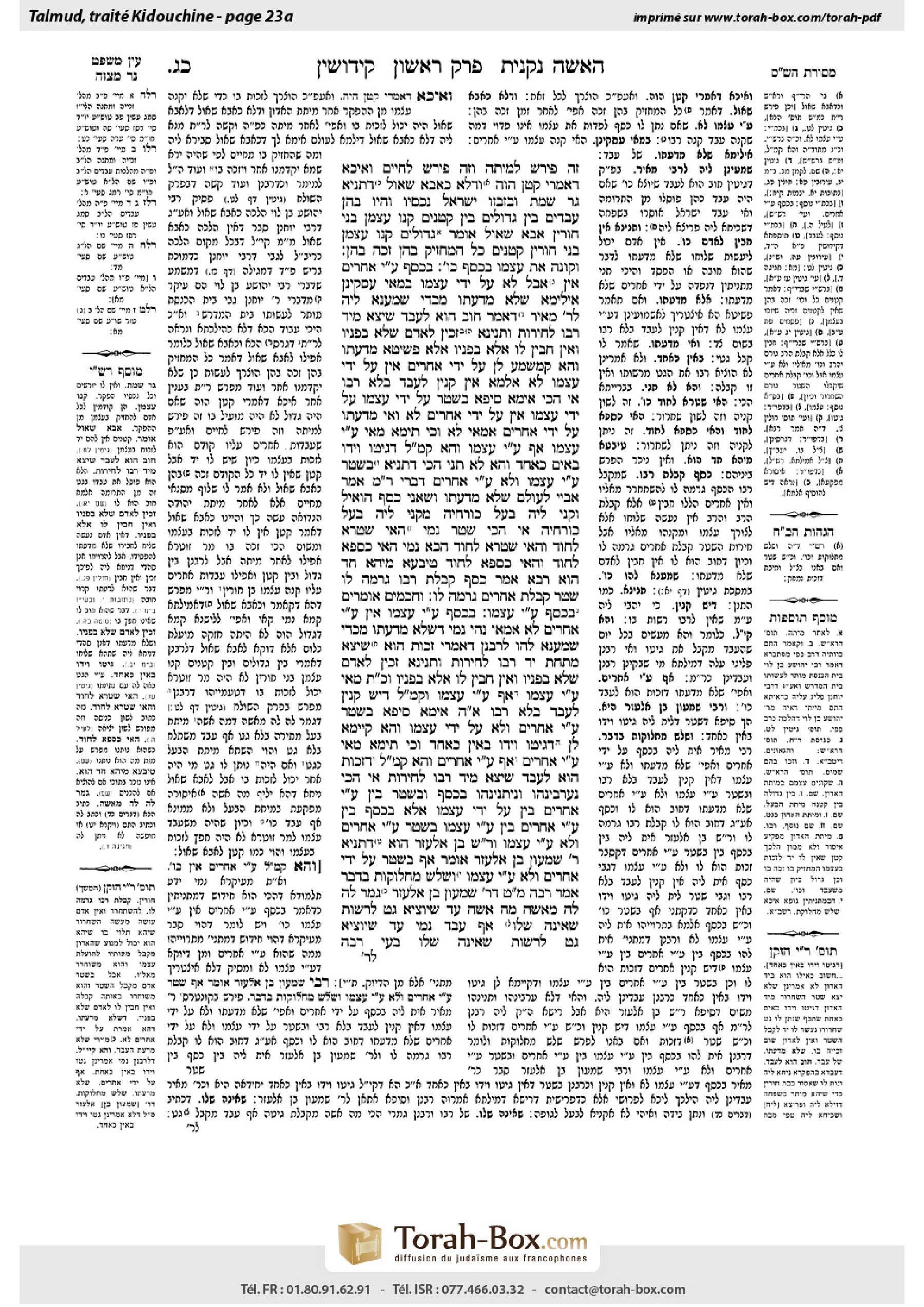
Kiddushin 23a: Talmud study for Daf Yomi
Daf Yomi is the daily study of one Talmud folio. Explore 37 tractates with scans, Hebrew text, Sefaria English and AI-generated French translations where annotated.
Passage selection and English or AI-generated French translation are available where the scan has annotations. Daf Study is independent of Torah-Box and Sefaria.
Browse Kiddushin · קידושין · All tractatesKiddushin 23a text and translations
This page of Kiddushin includes the Aramaic text, an English translation and an AI-generated French translation, alongside the scan above.
קידושין כ״ג א · Aramaic and Hebrew text
זֶה פֵּירַשׁ לְמִיתָה, וְזֶה פֵּירַשׁ לְחַיִּים.
וְאִיכָּא דְּאָמְרִי קָטָן הֲוָה, וּדְלָא כְּאַבָּא שָׁאוּל, דְּתַנְיָא: גֵּר שֶׁמֵּת וּבִזְבְּזוּ יִשְׂרָאֵל נְכָסָיו, וְהָיוּ בָּהֶן עֲבָדִים, בֵּין גְּדוֹלִים בֵּין קְטַנִּים – קָנוּ עַצְמָן בְּנֵי חוֹרִין. אַבָּא שָׁאוּל אוֹמֵר: גְּדוֹלִים – קָנוּ עַצְמָן בְּנֵי חוֹרִין, קְטַנִּים – כׇּל הַמַּחְזִיק בָּהֶן זָכָה בָּהֶן.
וְקוֹנֶה עַצְמוֹ בְּכֶסֶף כּוּ׳ בְּכֶסֶף עַל יְדֵי אֲחֵרִים. אִין, אֲבָל לֹא עַל יְדֵי עַצְמוֹ. בְּמַאי עָסְקִינַן? אִילֵימָא שֶׁלֹּא מִדַּעְתּוֹ, מִכְּדֵי שְׁמַעְנָא לֵיהּ לְרַבִּי מֵאִיר דְּאָמַר: חוֹב הוּא לְעֶבֶד שֶׁיֵּצֵא מִיַּד רַבּוֹ לְחֵירוּת. וּתְנֵינָא: זָכִין לָאָדָם שֶׁלֹּא בְּפָנָיו, וְאֵין חָבִין לוֹ אֶלָּא בְּפָנָיו.
אֶלָּא פְּשִׁיטָא מִדַּעְתּוֹ, וְהָא קָמַשְׁמַע לַן: עַל יְדֵי אֲחֵרִים – אִין, עַל יְדֵי עַצְמוֹ – לָא. אַלְמָא אֵין קִנְיָן לְעֶבֶד בְּלֹא רַבּוֹ.
אִי הָכִי, אֵימָא סֵיפָא: בִּשְׁטָר עַל יְדֵי עַצְמוֹ. עַל יְדֵי עַצְמוֹ – אִין, עַל יְדֵי אֲחֵרִים – לָא. וְאִי מִדַּעְתּוֹ, עַל יְדֵי אֲחֵרִים אַמַּאי לָא?
וְכִי תֵּימָא: מַאי עַל יְדֵי עַצְמוֹ – אַף עַל יְדֵי עַצְמוֹ, וְהָא קָא מַשְׁמַע לַן: דְּגִיטּוֹ וְיָדוֹ בָּאִים כְּאֶחָד, וְהָא לָא תָּנֵי הָכִי, דְּתַנְיָא: בִּשְׁטָר עַל יְדֵי עַצְמוֹ וְלֹא עַל יְדֵי אֲחֵרִים, דִּבְרֵי רַבִּי מֵאִיר!
אָמַר אַבָּיֵי: לְעוֹלָם שֶׁלֹּא מִדַּעְתּוֹ, וְשָׁאנֵי כֶּסֶף, הוֹאִיל וְקָנֵי לֵיהּ בְּעַל כּוּרְחֵיהּ – מַקְנֵי לֵיהּ בְּעַל כּוּרְחֵיהּ.
אִי הָכִי, שְׁטָר נָמֵי! הַאי שְׁטָרָא לְחוֹד וְהַאי שְׁטָרָא לְחוֹד.
הָכָא נָמֵי, הַאי כַּסְפָּא לְחוֹד וְהַאי כַּסְפָּא לְחוֹד? טִיבְעָא מִיהָא חַד הוּא.
רָבָא אָמַר: כֶּסֶף – קַבָּלַת רַבּוֹ גָּרְמָה לוֹ, שְׁטָר – קַבָּלַת אֲחֵרִים גָּרְמָה לוֹ.
וַחֲכָמִים אוֹמְרִים: בְּכֶסֶף עַל יְדֵי עַצְמוֹ. בְּכֶסֶף עַל יְדֵי עַצְמוֹ – אִין, עַל יְדֵי אֲחֵרִים – לָא. אַמַּאי? נְהִי נָמֵי דְּשֶׁלֹּא מִדַּעְתּוֹ, מִכְּדֵי שְׁמַעְנָא לְהוּ לְרַבָּנַן דְּאָמְרִי: זְכוּת הוּא שֶׁיֵּצֵא מִתַּחַת יָד רַבּוֹ לְחֵירוּת, וּתְנֵינָא: זָכִין לְאָדָם שֶׁלֹּא בְּפָנָיו, וְאֵין חָבִין לוֹ אֶלָּא בְּפָנָיו.
וְכִי תֵּימָא: מַאי עַל יְדֵי עַצְמוֹ – אַף עַל יְדֵי עַצְמוֹ, וְקָא מַשְׁמַע לַן דְּיֵשׁ קִנְיָן לְעֶבֶד בְּלֹא רַבּוֹ – אִי הָכִי, אֵימָא סֵיפָא: בִּשְׁטָר עַל יְדֵי אֲחֵרִים – וְלֹא עַל יְדֵי עַצְמוֹ, וְהָא קַיְימָא לַן דְּגִיטּוֹ וְיָדוֹ בָּאִין כְּאֶחָד?
וְכִי תֵּימָא: מַאי עַל יְדֵי אֲחֵרִים – אַף עַל יְדֵי אֲחֵרִים, וְהָא קָא מַשְׁמַע לַן דִּזְכוּת הוּא לְעֶבֶד שֶׁיֵּצֵא מִיַּד רַבּוֹ לְחֵירוּת, אִי הָכִי, נְעָרְבִינְהוּ וְנִיתְנִינְהוּ: בְּכֶסֶף וּבִשְׁטָר בֵּין עַל יְדֵי אֲחֵרִים בֵּין עַל יְדֵי עַצְמוֹ!
אֶלָּא: בְּכֶסֶף – בֵּין עַל יְדֵי אֲחֵרִים בֵּין עַל יְדֵי עַצְמוֹ, בִּשְׁטָר – עַל יְדֵי אֲחֵרִים וְלֹא עַל יְדֵי עַצְמוֹ. וְרַבִּי שִׁמְעוֹן בֶּן אֶלְעָזָר הוּא, דְּתַנְיָא רַבִּי שִׁמְעוֹן בֶּן אֶלְעָזָר אוֹמֵר: אַף בִּשְׁטָר עַל יְדֵי אֲחֵרִים וְלֹא עַל יְדֵי עַצְמוֹ. וְשָׁלֹשׁ מַחְלוֹקוֹת בַּדָּבָר.
אָמַר רַבָּה: מַאי טַעְמָא דְּרַבִּי שִׁמְעוֹן בֶּן אֶלְעָזָר – גָּמַר ״לָהּ״ ״לָהּ״ מֵאִשָּׁה: מָה אִשָּׁה עַד שֶׁיּוֹצִיא גֵּט לִרְשׁוּת שֶׁאֵינָהּ שֶׁלּוֹ, אַף עֶבֶד נָמֵי עַד שֶׁיּוֹצִיא גֵּט לִרְשׁוּת שֶׁאֵינָהּ שֶׁלּוֹ.
בָּעֵי רַבָּה:
Kiddushin 23a · English translation
and this person, Rabbi Yehuda from India, departed to death, and that individual, Mar Zutra, departed to life by receiving a slave.
And there are those who say that this slave was a minor, and Mar Zutra did not act in accordance with the opinion of Abba Shaul. As it is taught in a baraita: With regard to a convert who dies without heirs and Jews plundered his property, as it is considered ownerless, and among his possessions were slaves, then, whether the slaves were adults or minors, they acquire ownership of themselves and become freemen, as they can acquire themselves from the ownerless property. Abba Shaul says: Adult slaves acquire ownership of themselves and become freemen. But with regard to minor slaves, anyone who takes possession of them acquires them. According to the opinion of Abba Shaul, Mar Zutra did not have to hasten to acquire the slave during Rabbi Yehuda’s lifetime before the slave would acquire himself. He could have waited until Rabbi Yehuda died before acquiring the slave.
§ The mishna teaches that a slave can acquire himself by means of money, and Rabbi Meir rules that this money must be given by others. The Gemara comments: This ruling indicates that with money given by others, yes, the slave can be freed in this manner, but not by giving money himself. The Gemara inquires: With what are we dealing? If we say that this is referring to emancipating the Canaanite slave without his consent, that creates a difficulty. After all, we have heard that Rabbi Meir is the one who says: It is against the slave’s interest to leave his master’s authority for freedom, as he thereby loses out on certain benefits; and we learned in a baraita: One can act in a person’s interest in his absence, but one can act against a person’s interest only in his presence. How can one act against the slave’s interest and free him without his consent?
Rather, it is obvious that this slave was freed with his consent, and the mishna teaches us this: With money given by others, yes, the slave can be freed in this manner, but by giving money himself, no, he cannot be freed in this manner, despite his consent. Evidently, a slave has no acquisition without his master. It is impossible for a slave to perform an independent act of acquisition, as everything acquired by him immediately belongs to his master. Consequently, he cannot be in possession of money with which he can acquire himself. Instead, the money must be given to his owner by somebody else.
The Gemara asks: If so, say the latter clause of the mishna: He can be freed by means of a bill of manumission if he accepts it by himself. The Gemara analyzes this ruling: If he accepts it by himself, yes, but if it is accepted by others, no, he cannot acquire his freedom in this manner. And if this document is produced with the slave’s consent, as claimed above, why is it not effective if it is accepted by others?
The Gemara adds: And if you would say in response: What is the meaning of: If he accepts it by himself? This means that in addition to being freed if the bill of manumission is accepted by others, he can also be freed if he accepts it by himself, and according to this interpretation the mishna teaches us this, that his bill of manumission and his ability to acquire himself come simultaneously. In other words, although he did not have the legal power to acquire himself while he was still a slave, when he receives his bill of manumission he attains this ability at that same moment. The Gemara explains why this interpretation of the mishna is problematic: But Rabbi Meir did not teach this ruling, as it is taught in a baraita: A slave can be freed by means of a bill of manumission if he accepts it by himself, but not if it is accepted by others; this is the statement of Rabbi Meir.
Abaye said: Actually, according to Rabbi Meir the mishna is referring to a case where the master received money without the slave’s consent, and acquisition effected with the giving of money is different: Since it acquires him against his will from another master, as the slave’s consent is not necessary in that case, it likewise acquires him for himself against his will. His consent is not required, despite the fact that it is against his interest to be freed.
The Gemara asks: If so, that the halakha that a slave can be freed with the giving of money without his consent is predicated on the halakha that he can be acquired by means of the giving of money to his previous master without his consent, he should also be freed with a document if it is accepted by others without his consent. The Gemara answers: This document is discrete, and this document is discrete, i.e., the comparison between the acquisition of a slave and his emancipation is invalid in the case of a document, as a document of sale is not similar to a bill of manumission.
The Gemara asks: Here too, this money is discrete and this money is discrete, as the money is given for a different purpose in the cases of acquisition and manumission. The Gemara answers: In any event, the coin itself is one, i.e., there is no noticeable difference between the coin used for acquisition of a slave and one that would be used for emancipating him. The same cannot be said with regard to documents, as particular texts serve specific purposes, and the same document could not be used for both acquiring a slave and emancipating him.
Rava said the following distinction: With regard to emancipation by means of money, his master’s receipt of the money causes him to be freed, not the giving of the money by others. Therefore, they are not considered to have harmed the slave without his consent. By contrast, in the case of a document, the receipt of the document by others on behalf of the slave causes him to be freed, and one can incur liability for another person only in his presence.
§ The mishna teaches: And the Rabbis say: The slave can be freed by means of money given by himself. The Gemara analyzes this ruling: By means of money given by himself, yes, he can be emancipated in this manner, but with money given by others, no, he cannot be emancipated in this manner. The Gemara asks: Why not? Although this was indeed performed without the slave’s consent, after all, we heard that the Rabbis say: It is in a slave’s interest to go out from the master’s authority to freedom. And we learned in a baraita: One can act in a person’s interest in his absence, but one can act against a person’s interest only in his presence. Why, then, isn’t he freed when others give the money, considering that this change of status is to his advantage?
And if you would say: What is the meaning of the phrase: By means of money given by himself? This means that not only can he be redeemed by means of money given to others but he can be redeemed even by means of money given to himself, and it teaches us that a slave has the ability to receive an acquisition without his master. If so, say the latter clause of the mishna: He can be freed by means of a bill of manumission if it is accepted by others. This indicates: If it is accepted by others but not if he accepts it by himself. And yet we maintain that according to the Rabbis his bill of manumission and his ability to acquire his freedom come simultaneously. If so, why can’t he be freed through a document he accepts by himself?
And if you would say: What is the meaning of: If it is accepted by others? This means that not only can he be emancipated if he accepts the bill of manumission by himself, but he can even be freed if it is accepted by others, and the mishna teaches us this: That it is in a slave’s interest to go out from the master’s authority to freedom. If so, there is no difference between emancipation by means of money and emancipation by means of a document, and therefore let us combine them and teach them together and say: A slave can be freed by means of money and by means of a bill of manumission, whether by others or whether by himself.
Rather, it is clear that there is a difference between money and a document. When he is emancipated by means of money, a slave can be freed whether by means of money given by others or whether by means of money given by himself. In the case of a bill of manumission, he can be emancipated if it is accepted by others but not if he accepts it by himself. And this latter clause is the opinion of Rabbi Shimon ben Elazar. As it is taught in a baraita that Rabbi Shimon ben Elazar says: A slave can also be freed with a bill of manumission if it is accepted by others but not if he accepts it by himself. And there are three disputes with regard to the matter. There are the opinions of Rabbi Meir, the Rabbis, and Rabbi Shimon ben Elazar.
Rabba said: What is the reason of Rabbi Shimon ben Elazar? He derives this by means of a verbal analogy, understanding the meaning of “to her [lah],” written with regard to a maidservant in the verse: “Nor was freedom given to her” (Leviticus 19:20), from the meaning of “for her [lah],” written with regard to a wife: “And he writes for her a bill of divorce” (Deuteronomy 24:3). Just as a woman is not divorced until the husband moves the bill of divorce from his domain to a domain that is not his, and the bill of divorce is ineffective as long as it remains in his domain; so too, a slave is not freed unless the master moves the bill of manumission to a domain that is not his. Since the slave belongs to him, the document will remain the master’s even if he gives it to the slave. Therefore, he can be freed by means of a document only through other people who receive the document on his behalf.
Rabba raises a dilemma:
Kiddushin 23a · Traduction française (IA)
Et cet homme, Rabbi Yehouda d’Inde, alla vers la mort, tandis que cet autre, Mar Zutra, alla vers la vie en recevant un esclave.
Et certains disent que cet esclave était mineur et que Mar Zutra n’a pas suivi l’opinion d’Abba Shaoul. En effet, il est enseigné dans une baraïta : Lorsqu’un converti meurt sans héritiers et que des Juifs s’emparent de ses biens, ceux-ci étant considérés comme sans propriétaire, si ses possessions comprennent des esclaves, ceux-ci, qu’ils soient adultes ou mineurs, acquièrent leur liberté et deviennent des hommes libres, puisqu’ils peuvent acquérir eux-mêmes les biens sans propriétaire. Abba Shaoul dit : Les esclaves adultes acquièrent leur liberté et deviennent des hommes libres. Quant aux esclaves mineurs, quiconque s’en empare les acquiert. Selon l’opinion d’Abba Shaoul, Mar Zutra n’avait pas besoin de se hâter d’acquérir l’esclave du vivant de Rabbi Yehouda, avant que l’esclave ne s’acquière lui-même. Il aurait pu attendre la mort de Rabbi Yehouda pour acquérir l’esclave.
§ La Michna enseigne qu’un esclave peut s’affranchir au moyen d’argent, et Rabbi Meïr statue que cet argent doit être donné par d’autres. La Guemara fait remarquer : cela indique que l’esclave peut être libéré de cette manière lorsque l’argent est donné par d’autres, mais pas lorsqu’il donne lui-même l’argent. La Guemara demande : De quel cas s’agit-il ? Si l’on dit qu’il s’agit de libérer l’esclave cananéen sans son consentement, cela pose une difficulté. En effet, nous avons appris que Rabbi Meïr est celui qui dit qu’il est contraire à l’intérêt de l’esclave de quitter l’autorité de son maître pour accéder à la liberté, car il perd ainsi certains avantages ; et nous avons appris dans une baraïta : On peut agir dans l’intérêt d’une personne en son absence, mais on ne peut agir à son détriment qu’en sa présence. Comment peut-on agir au détriment de l’esclave et le libérer sans son consentement ?
Il est donc évident qu’il s’agit d’un esclave libéré avec son consentement, et la Michna nous enseigne ceci : l’esclave peut être libéré de cette manière lorsque l’argent est donné par d’autres, mais il ne peut pas l’être lorsqu’il donne lui-même l’argent, malgré son consentement. De toute évidence, un esclave ne possède rien indépendamment de son maître. Il lui est impossible d’effectuer un acte d’acquisition de façon autonome, car tout ce qu’il acquiert appartient immédiatement à son maître. Par conséquent, il ne peut être en possession de l’argent qui lui permettrait de s’acquérir lui-même. L’argent doit donc être donné à son propriétaire par quelqu’un d’autre.
La Guemara demande : Si tel est le cas, considérons la dernière partie de la Michna : « Il peut être libéré au moyen d’un acte d’affranchissement s’il le reçoit lui-même. » La Guemara examine cette règle : il peut être libéré de cette manière s’il le reçoit lui-même, mais pas si d’autres le reçoivent. Or, si ce document est établi avec le consentement de l’esclave, comme on l’a affirmé plus haut, pourquoi n’est-il pas efficace lorsqu’il est reçu par d’autres ?
La Guemara ajoute : Et si tu répondais : quel est le sens de « s’il le reçoit lui-même » ? Cela signifie qu’en plus d’être libéré lorsque l’acte d’affranchissement est reçu par d’autres, il peut aussi l’être lorsqu’il le reçoit lui-même. Selon cette interprétation, la Michna nous enseigne que son acte d’affranchissement et sa capacité à s’acquérir lui-même adviennent simultanément. Autrement dit, bien qu’il n’ait pas le pouvoir juridique de s’acquérir tant qu’il est encore esclave, il acquiert cette capacité au moment même où il reçoit son acte d’affranchissement. La Guemara explique pourquoi cette interprétation de la Michna pose problème : Rabbi Meïr n’a pourtant pas enseigné cette règle, car il est enseigné dans une baraïta : « Un esclave peut être libéré au moyen d’un acte d’affranchissement s’il le reçoit lui-même, mais pas si d’autres le reçoivent » ; telle est l’opinion de Rabbi Meïr.
Abayé dit : En réalité, selon Rabbi Meïr, la Michna traite d’un cas où le maître a reçu de l’argent sans le consentement de l’esclave. L’acquisition réalisée par le versement d’argent est différente : puisque l’esclave est acquis auprès d’un autre maître contre sa volonté — son consentement n’étant pas nécessaire dans ce cas —, il est également acquis pour lui-même contre sa volonté. Son consentement n’est pas requis, bien qu’il soit contraire à son intérêt d’être libéré.
La Guemara demande : Si tel est le cas, puisque la halakha selon laquelle un esclave peut être libéré par le versement d’argent sans son consentement repose sur la halakha selon laquelle il peut être acquis par le versement d’argent à son ancien maître sans son consentement, il devrait également être libéré par un document reçu par d’autres sans son consentement. La Guemara répond : Ce document est une chose distincte, et cet autre document en est une autre. Autrement dit, la comparaison entre l’acquisition d’un esclave et son affranchissement ne s’applique pas dans le cas d’un document, car un acte de vente n’est pas comparable à un acte d’affranchissement.
La Guemara demande : Ici aussi, cet argent est une chose distincte et cet autre argent en est une autre, puisque l’argent est donné à des fins différentes dans les cas de l’acquisition et de l’affranchissement. La Guemara répond : Quoi qu’il en soit, la pièce elle-même est la même, autrement dit, il n’existe aucune différence visible entre la pièce utilisée pour acquérir un esclave et celle qui servirait à l’affranchir. On ne peut pas en dire autant des documents, car des textes précis servent à des fins spécifiques et un même document ne peut être utilisé à la fois pour acquérir un esclave et pour l’affranchir.
Rava établit la distinction suivante : dans le cas de l’affranchissement au moyen d’argent, c’est la réception de l’argent par son maître qui entraîne la libération de l’esclave, et non le versement de l’argent par d’autres. Par conséquent, on ne considère pas que ces derniers ont porté préjudice à l’esclave sans son consentement. En revanche, dans le cas d’un document, c’est sa réception par d’autres au nom de l’esclave qui entraîne sa libération ; or, on ne peut porter préjudice à une autre personne qu’en sa présence.
§ La Michna enseigne : « Et les Sages disent : L’esclave peut être libéré au moyen d’argent donné par lui-même. » La Guemara examine cette règle : il peut être affranchi de cette manière lorsque l’argent est donné par lui-même, mais pas lorsqu’il est donné par d’autres. La Guemara demande : Pourquoi pas ? Certes, cela a été fait sans le consentement de l’esclave, mais nous avons appris que les Sages disent qu’il est dans l’intérêt d’un esclave de quitter l’autorité de son maître pour accéder à la liberté. Et nous avons appris dans une baraïta : On peut agir dans l’intérêt d’une personne en son absence, mais on ne peut agir à son détriment qu’en sa présence. Pourquoi donc n’est-il pas libéré lorsque d’autres versent l’argent, puisque ce changement de statut est à son avantage ?
Et si tu répondais : quel est le sens de l’expression « au moyen d’argent donné par lui-même » ? Cela signifie qu’il peut être affranchi non seulement au moyen d’argent donné à d’autres, mais aussi au moyen d’argent donné à lui-même ; cela nous enseigne qu’un esclave a la capacité de recevoir une acquisition sans son maître. Si tel est le cas, considérons la dernière partie de la Michna : « Il peut être libéré au moyen d’un acte d’affranchissement si d’autres le reçoivent. » Cela indique qu’il peut l’être si d’autres le reçoivent, mais pas s’il le reçoit lui-même. Pourtant, nous soutenons que, selon les Sages, son acte d’affranchissement et sa capacité à acquérir sa liberté adviennent simultanément. Si tel est le cas, pourquoi ne peut-il pas être libéré par un document qu’il reçoit lui-même ?
Et si tu répondais : quel est le sens de « s’il est reçu par d’autres » ? Cela signifie qu’il peut être affranchi non seulement s’il reçoit lui-même l’acte d’affranchissement, mais aussi si d’autres le reçoivent ; et la Michna nous enseigne ainsi qu’il est dans l’intérêt d’un esclave de quitter l’autorité de son maître pour accéder à la liberté. Si tel est le cas, il n’y a aucune différence entre l’affranchissement au moyen d’argent et l’affranchissement au moyen d’un document. Il faut donc les réunir et les enseigner ensemble, en disant : « Un esclave peut être libéré au moyen d’argent et au moyen d’un acte d’affranchissement, que ce soit par d’autres ou par lui-même. »
Il est donc clair qu’il existe une différence entre l’argent et un document. Lorsqu’il est affranchi au moyen d’argent, un esclave peut être libéré aussi bien au moyen d’argent donné par d’autres qu’au moyen d’argent donné par lui-même. Dans le cas d’un acte d’affranchissement, il peut être libéré si d’autres le reçoivent, mais pas s’il le reçoit lui-même. Cette dernière partie exprime l’opinion de Rabbi Shimon ben Elazar. En effet, il est enseigné dans une baraïta que Rabbi Shimon ben Elazar dit : « Un esclave peut également être libéré au moyen d’un acte d’affranchissement si d’autres le reçoivent, mais pas s’il le reçoit lui-même. » Il existe donc trois opinions sur la question : celles de Rabbi Meïr, des Sages et de Rabbi Shimon ben Elazar.
Rabba dit : Quelle est la raison de Rabbi Shimon ben Elazar ? Il le déduit par une analogie verbale, en rapprochant le sens de « à elle [lah] », écrit au sujet d’une servante dans le verset : « La liberté ne lui a pas été accordée » (Lévitique 19, 20), du sens de « pour elle [lah] », écrit au sujet d’une épouse : « Et il lui écrit un acte de divorce » (Deutéronome 24, 3). De même qu’une femme n’est divorcée que lorsque son mari fait passer l’acte de divorce de son domaine à un domaine qui n’est pas le sien, et que l’acte de divorce est sans effet tant qu’il demeure dans son domaine, de même, un esclave n’est libéré que si son maître fait passer l’acte d’affranchissement dans un domaine qui n’est pas le sien. Puisque l’esclave lui appartient, le document demeure dans le domaine du maître même si celui-ci le remet à l’esclave. Par conséquent, l’esclave ne peut être libéré au moyen d’un document que par l’intermédiaire d’autres personnes, qui reçoivent le document en son nom.
Rabba soulève un dilemme :
Traduction française générée par IA à partir de l’édition anglaise de Sefaria. Vérifie toujours un passage avec le texte source.
Text from Sefaria: William Davidson Edition - Vocalized Aramaic (CC BY NC); William Davidson Edition - English (CC BY NC).