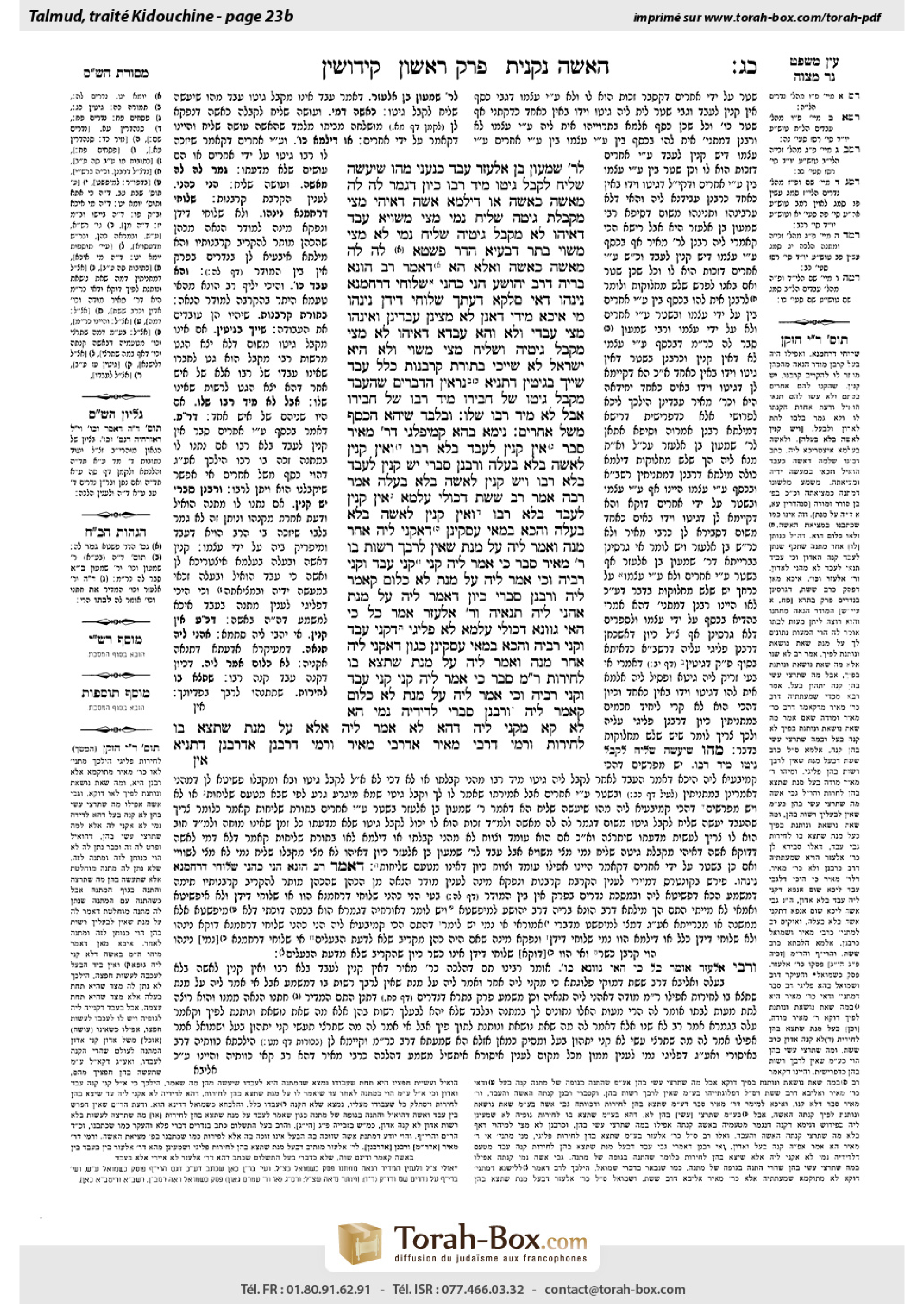
Kiddushin 23b: Talmud study for Daf Yomi
Daf Yomi is the daily study of one Talmud folio. Explore 37 tractates with scans, Hebrew text, Sefaria English and AI-generated French translations where annotated.
Passage selection and English or AI-generated French translation are available where the scan has annotations. Daf Study is independent of Torah-Box and Sefaria.
Browse Kiddushin · קידושין · All tractatesKiddushin 23b text and translations
This page of Kiddushin includes the Aramaic text, an English translation and an AI-generated French translation, alongside the scan above.
קידושין כ״ג ב · Aramaic and Hebrew text
לְרַבִּי שִׁמְעוֹן בֶּן אֶלְעָזָר, עֶבֶד כְּנַעֲנִי מַהוּ שֶׁיַּעֲשֶׂה שָׁלִיחַ לְקַבֵּל גִּיטּוֹ מִיָּד רַבּוֹ? כֵּיוָן דְּגָמַר ״לָהּ״ ״לָהּ״ מֵאִשָּׁה, כְּאִשָּׁה,
אוֹ דִילְמָא אִשָּׁה דְּאִיהִי מָצֵי מְקַבֶּלֶת גִּיטָּהּ – שָׁלִיחַ נָמֵי מָצֵי מְשַׁוְּיָא. עֶבֶד דְּאִיהוּ לָא מְקַבֵּל גִּיטֵּיהּ – שָׁלִיחַ נָמֵי לָא מָצֵי מְשַׁוֵּי. בָּתַר דְּבַעְיָא הֲדַר פַּשְׁטַהּ: ״לָהּ״ ״לָהּ״ מֵאִשָּׁה, כְּאִשָּׁה.
וְאֶלָּא הָא דְּאָמַר רַב הוּנָא בְּרֵיהּ דְּרַב יְהוֹשֻׁעַ: הָנֵי כָּהֲנֵי שְׁלוּחֵי דְרַחֲמָנָא נִינְהוּ. דְּאִי סָלְקָא דַעְתָּךְ שְׁלוּחֵי דִידַן נִינְהוּ, מִי אִיכָּא מִידֵּי דַּאֲנַן לָא מָצֵינַן עָבְדִינַן וְאִינְהוּ מָצֵי עָבְדִי?
וְלָא?! וְהָא עַבְדָּא, דְּאִיהוּ לָא מָצֵי מְקַבֵּל גִּיטֵּיהּ וּשְׁלִיחַ מָצֵי מְשַׁוֵּי!
וְלָא הִיא, יִשְׂרָאֵל לָא שָׁיְכִי בְּתוֹרַת קׇרְבָּנוֹת כְּלָל, עֶבֶד שָׁיֵיךְ בְּגִיטִּין. דְּתַנְיָא: נִרְאִין הַדְּבָרִים שֶׁהָעֶבֶד מְקַבֵּל גִּיטּוֹ שֶׁל חֲבֵירוֹ מִיַּד רַבּוֹ שֶׁל חֲבֵירוֹ, אֲבָל לֹא מִיַּד רַבּוֹ שֶׁלּוֹ.
וּבִלְבַד שֶׁיְּהֵא הַכֶּסֶף מִשֶּׁל אֲחֵרִים. נֵימָא בְּהָא קָמִיפַּלְגִי: דְּרַבִּי מֵאִיר סָבַר: אֵין קִנְיָן לְעֶבֶד בְּלֹא רַבּוֹ, וְאֵין קִנְיָן לְאִשָּׁה בְּלֹא בַּעְלָהּ. וְרַבָּנַן סָבְרִי: יֵשׁ קִנְיָן לְעֶבֶד בְּלֹא רַבּוֹ, וְיֵשׁ קִנְיָן לְאִשָּׁה בְּלֹא בַּעְלָהּ.
אָמַר רַבָּה אָמַר רַב שֵׁשֶׁת: דְּכוּלֵּי עָלְמָא אֵין קִנְיָן לְעֶבֶד בְּלֹא רַבּוֹ, וְאֵין קִנְיָן לְאִשָּׁה בְּלֹא בַּעְלָהּ. וְהָכָא בְּמַאי עָסְקִינַן, דְּאַקְנִי לֵיהּ אַחֵר מָנֶה, וַאֲמַר לֵיהּ: ״עַל מְנָת שֶׁאֵין לְרַבָּךְ רְשׁוּת בּוֹ״.
רַבִּי מֵאִיר סָבַר: כִּי אָמַר לֵיהּ ״קְנִי״ – קָנֵי עֶבֶד וְקָנֵי רַבֵּיהּ. וְכִי אָמַר לֵיהּ ״עַל מְנָת״ – לֹא כְּלוּם קָאָמַר לֵיהּ. וְרַבָּנַן סָבְרִי: כֵּיוָן דְּאָמַר לֵיהּ ״עַל מְנָת״ – אַהֲנִי לֵיהּ תְּנָאֵיהּ.
וְרַבִּי אֶלְעָזָר אָמַר: כֹּל כִּי הַאי גַוְונָא דְּכוּלֵּי עָלְמָא לָא פְּלִיגִי דְּקָנֵי עֶבֶד וְקָנֵי רַבֵּיהּ, וְהָכָא בְּמַאי עָסְקִינַן, כְּגוֹן דְּאַקְנִי לֵיהּ אַחֵר מָנֶה וַאֲמַר לֵיהּ: ״עַל מְנָת שֶׁתֵּצֵא בּוֹ לְחֵירוּת״.
רַבִּי מֵאִיר סָבַר: כִּי אֲמַר לֵיהּ ״קְנִי״ – קָנֵי עֶבֶד וְקָנֵי רַבֵּיהּ. וְכִי אֲמַר לֵיהּ ״עַל מְנָת״ – לֹא כְּלוּם קָאָמַר לֵיהּ. וְרַבָּנַן סָבְרִי: לְדִידֵיהּ נָמֵי הָא לָא קָא מַקְנֵי לֵיהּ, דְּהָא לָא אֲמַר לֵיהּ אֶלָּא ״עַל מְנָת שֶׁתֵּצֵא בּוֹ לְחֵירוּת״.
וּרְמִי דְּרַבִּי מֵאִיר אַדְּרַבִּי מֵאִיר, וּרְמִי דְּרַבָּנַן אַדְּרַבָּנַן, דְּתַנְיָא:
Kiddushin 23b · English translation
According to the opinion of Rabbi Shimon ben Elazar, in the case of a Canaanite slave, what is the halakha with regard to the possibility that a slave can appoint an agent to accept his bill of manumission from the hand of his master? Does one say that since Rabbi Shimon ben Elazar derives the verbal analogy of “lah” and “lah” from a woman, which teaches that a slave can be freed with a document, therefore, a slave is also like a woman in that he too can appoint an agent?
Or perhaps, in the case of a woman, as she can accept her bill of divorce herself, she can also appoint an agent, whereas a slave is different, as he cannot accept his bill of manumission himself, and consequently he cannot appoint an agent either. After raising the dilemma, Rabba subsequently resolved it: Since Rabbi Shimon ben Elazar derives the verbal analogy of “lah” and “lah” from a woman, a slave is also treated like a woman with regard to his ability to appoint an agent.
The Gemara comments: But consider that which Rav Huna, son of Rav Yehoshua, says with regard to the service in the Temple: These priests are the agents of the Merciful One, i.e., they perform the Temple service as the emissaries of God. As if it enters your mind that they are our agents, is there anything that we cannot do but agents can do on our behalf? Since it is prohibited for non-priests to serve in the Temple, priests cannot be considered the agents of the Jewish people.
This statement leads to the following question: But is it not true that an agent can be appointed to perform a task that cannot be done by the one who sent him? But according to Rava’s conclusion there is the case of a slave, who is unable to accept his bill of manumission himself, and yet he can appoint an agent to receive it for him.
The Gemara rejects this suggestion: And that is not so. The difference between the cases is that an Israelite is not involved in the halakhot of offerings at all, as a non-priest is never permitted to sacrifice offerings. By contrast, a slave is somewhat involved in bills of manumission, as it is taught in a baraita: It seems that a slave can accept the bill of manumission of another slave from the hand of the master of that other slave. But he cannot accept a bill of manumission from the hand of his own master, who wishes to free another of his slaves. In this case there is no acquisition, as the document has not left the master’s property, as anything given to a slave is considered the property of his master. With regard to the issue at hand, since a slave can accept a bill of manumission, at least on behalf of another slave, the halakhot of these documents are relevant to him, and therefore he can appoint an agent to receive his bill of manumission.
§ The mishna teaches that according to Rabbi Meir the slave can be freed by means of money given by others, while the Rabbis hold that he can be freed by means of money given by himself, provided that the money he gives belongs to others. The Gemara suggests: Shall we say that they disagree with regard to this principle, and that Rabbi Meir maintains: There is no acquisition for a slave without his master, i.e., a slave has no personal property and therefore his master immediately owns whatever the slave acquires, which means a slave cannot receive his redemption money himself. And similarly there is no acquisition for a woman without her husband. And the Rabbis maintain: There is acquisition for a slave without his master, and there is acquisition for a woman without her husband.
Rabba said that Rav Sheshet said: Everyone agrees that there is no acquisition for a slave without his master, and there is no acquisition for a woman without her husband, and so, with what are we dealing here? This is a unique case in which another individual transferred one hundred dinars to a slave and said to him: I am giving this to you on the condition that your master has no rights to it.
The Gemara clarifies the two opinions according to this explanation. Rabbi Meir maintains that when this third party said to the Canaanite slave: Acquire the money, the slave acquires it and his master immediately acquires it. And when he said to him: On the condition that your master has no rights to it, he has said nothing to him, i.e., his condition is ineffective. And the Rabbis maintain that since he said to him: On the condition, his condition is effective and the master does not acquire the money. Therefore, the slave owns this money, with which he can redeem himself.
And Rabbi Elazar said: In a case like this, everyone agrees that the slave acquires the money, and his master automatically acquires that which was acquired by the slave. And with what are we dealing here, in the dispute between the Sages and Rabbi Meir? This is referring to a case where another person transferred one hundred dinars to him and said to him: On the condition that you are emancipated with it.
The Gemara explains the dispute according to this interpretation. Rabbi Meir maintains that when he said to him: Acquire the money, the slave acquires it, and his master immediately acquires the one hundred dinars from him. And when he said to him: On the condition, he has said nothing to him. And the Rabbis maintain: He does not transfer the money to the slave himself, as he said to him only: On the condition that you are emancipated with it. In other words, he gave it to the slave only for him to hand over the money to his master for his emancipation. His condition is valid and the slave is emancipated.
And the Gemara raises a contradiction between one statement of Rabbi Meir and a second statement of Rabbi Meir, and it raises a contradiction between one statement of the Rabbis and a second statement of the Rabbis. As it is taught in a baraita:
Kiddushin 23b · Traduction française (IA)
Selon l’opinion de Rabbi Shimon ben Elazar, quelle est la halakha concernant la possibilité, pour un esclave cananéen, de désigner un mandataire chargé de recevoir son acte d’affranchissement des mains de son maître ? Faut-il dire que, puisque Rabbi Shimon ben Elazar déduit de la femme, au moyen du rapprochement verbal « lah » et « lah », qu’un esclave peut être affranchi par un document, l’esclave est également assimilé à la femme en ce qu’il peut, lui aussi, désigner un mandataire ?
Ou peut-être que, dans le cas d’une femme, puisqu’elle peut recevoir elle-même son acte de divorce, elle peut aussi désigner un mandataire, tandis qu’un esclave est différent : il ne peut pas recevoir lui-même son acte d’affranchissement et ne peut donc pas non plus désigner de mandataire. Après avoir soulevé cette question, Rabba la trancha ainsi : puisque Rabbi Shimon ben Elazar déduit de la femme, au moyen du rapprochement verbal « lah » et « lah », un esclave est également assimilé à une femme quant à sa capacité de désigner un mandataire.
La Guemara fait remarquer : Mais considérez ce que dit Rav Huna, fils de Rav Yehoshua, au sujet du service au Temple : « Ces prêtres sont les mandataires du Miséricordieux », c’est-à-dire qu’ils accomplissent le service au Temple en tant qu’émissaires de Dieu. Car, si l’on pouvait penser qu’ils sont nos mandataires, y a-t-il quelque chose que nous ne puissions pas faire nous-mêmes, mais que des mandataires pourraient faire pour nous ? Puisqu’il est interdit aux non-prêtres d’accomplir le service au Temple, les prêtres ne peuvent pas être considérés comme les mandataires du peuple juif.
Cette déclaration soulève la question suivante : n’est-il pas vrai qu’on peut désigner un mandataire pour accomplir une tâche que celui qui l’a envoyé ne peut pas accomplir lui-même ? Pourtant, selon la conclusion de Rava, il y a le cas d’un esclave, qui ne peut pas recevoir lui-même son acte d’affranchissement et qui peut néanmoins désigner un mandataire pour le recevoir en son nom.
La Guemara rejette cette suggestion : il n’en est pas ainsi. La différence entre les cas est qu’un Israélite n’est aucunement concerné par les lois relatives aux sacrifices, puisqu’un non-prêtre n’est jamais autorisé à offrir de sacrifices. En revanche, un esclave est quelque peu concerné par les actes d’affranchissement, comme l’enseigne une baraïta : il semble qu’un esclave puisse recevoir l’acte d’affranchissement d’un autre esclave des mains du maître de cet autre esclave. Mais il ne peut pas recevoir un acte d’affranchissement des mains de son propre maître lorsque celui-ci souhaite affranchir un autre de ses esclaves. Dans ce cas, il n’y a pas d’acquisition, car le document n’a pas quitté le domaine du maître : tout ce qui est donné à un esclave est considéré comme appartenant à son maître. Pour ce qui est de la question examinée ici, puisque l’esclave peut recevoir un acte d’affranchissement, au moins pour le compte d’un autre esclave, les lois relatives à ces documents le concernent ; il peut donc désigner un mandataire chargé de recevoir son propre acte d’affranchissement.
§ La Michna enseigne que, selon Rabbi Meir, l’esclave peut être affranchi au moyen d’argent donné par d’autres, tandis que les Sages soutiennent qu’il peut être affranchi au moyen d’argent qu’il donne lui-même, à condition que cet argent appartienne à d’autres. La Guemara propose : faut-il dire qu’ils sont en désaccord sur ce principe, et que Rabbi Meir soutient qu’un esclave ne peut rien acquérir indépendamment de son maître, c’est-à-dire qu’il ne possède aucun bien personnel et que son maître devient donc immédiatement propriétaire de tout ce que l’esclave acquiert, si bien que l’esclave ne peut pas recevoir lui-même son argent de rachat ? De même, une femme ne peut rien acquérir indépendamment de son mari. Les Sages, quant à eux, soutiennent qu’un esclave peut acquérir indépendamment de son maître et qu’une femme peut acquérir indépendamment de son mari.
Rabba a dit au nom de Rav Sheshet : tout le monde convient qu’un esclave ne peut rien acquérir indépendamment de son maître et qu’une femme ne peut rien acquérir indépendamment de son mari. Alors, de quoi s’agit-il ici ? D’un cas particulier où une autre personne a remis cent dinars à un esclave en lui disant : « Je te donne cet argent à condition que ton maître n’ait aucun droit dessus. »
La Guemara précise les deux opinions selon cette explication. Rabbi Meir soutient que, lorsque ce tiers a dit à l’esclave cananéen : « Acquiers cet argent », l’esclave l’acquiert et son maître l’acquiert aussitôt. Et lorsque le tiers lui a dit : « À condition que ton maître n’ait aucun droit dessus », cela n’a aucun effet. Les Sages, eux, soutiennent que, puisqu’il lui a dit « à condition que », cette condition est valable et le maître n’acquiert pas l’argent. L’esclave est donc propriétaire de cet argent, avec lequel il peut se racheter.
Et Rabbi Elazar a dit : dans un cas comme celui-ci, tout le monde convient que l’esclave acquiert l’argent et que son maître acquiert automatiquement ce que l’esclave a acquis. Alors, de quoi s’agit-il dans le désaccord entre les Sages et Rabbi Meir ? D’un cas où une autre personne lui a remis cent dinars en lui disant : « À condition que tu sois affranchi avec cet argent. »
La Guemara explique le désaccord selon cette interprétation. Rabbi Meir soutient que, lorsqu’on a dit à l’esclave : « Acquiers cet argent », il l’acquiert et son maître acquiert aussitôt les cent dinars. Et lorsqu’on lui a dit : « À condition que », cela n’a aucun effet. Les Sages, quant à eux, soutiennent que l’argent n’est pas transféré à l’esclave lui-même, car on lui a seulement dit : « À condition que tu sois affranchi avec cet argent. » Autrement dit, l’argent lui a été donné uniquement pour qu’il le remette à son maître en vue de son affranchissement. Cette condition est valable et l’esclave est affranchi.
La Guemara soulève ensuite une contradiction entre une déclaration de Rabbi Meir et une autre déclaration de Rabbi Meir, ainsi qu’entre une déclaration des Sages et une autre déclaration des Sages. En effet, il est enseigné dans une baraïta :
Traduction française générée par IA à partir de l’édition anglaise de Sefaria. Vérifie toujours un passage avec le texte source.
Text from Sefaria: William Davidson Edition - Vocalized Aramaic (CC BY NC); William Davidson Edition - English (CC BY NC).