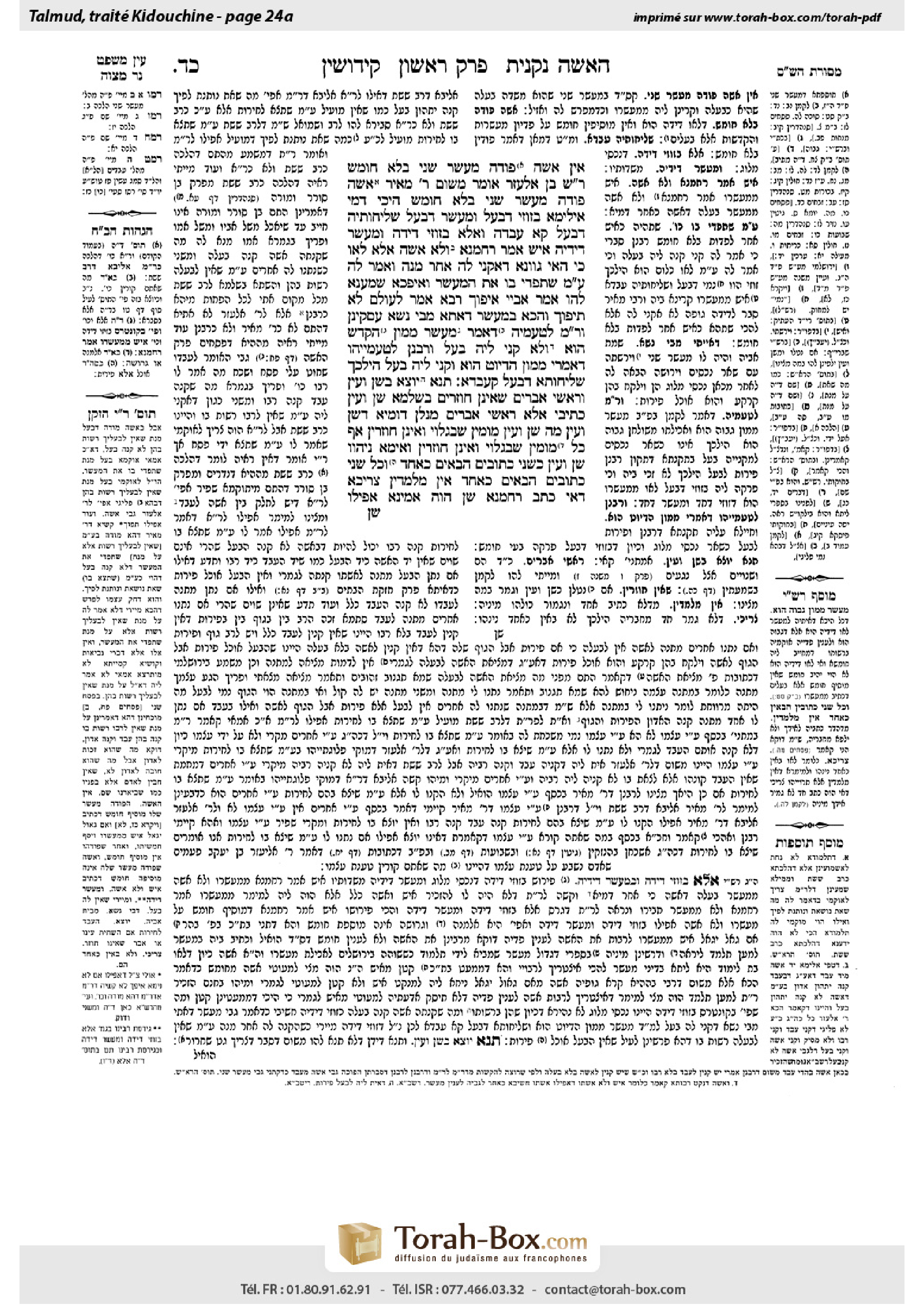
Kiddushin 24a: Talmud study for Daf Yomi
Daf Yomi is the daily study of one Talmud folio. Explore 37 tractates with scans, Hebrew text, Sefaria English and AI-generated French translations where annotated.
Passage selection and English or AI-generated French translation are available where the scan has annotations. Daf Study is independent of Torah-Box and Sefaria.
Browse Kiddushin · קידושין · All tractatesKiddushin 24a text and translations
This page of Kiddushin includes the Aramaic text, an English translation and an AI-generated French translation, alongside the scan above.
קידושין כ״ד א · Aramaic and Hebrew text
אֵין אִשָּׁה פּוֹדָה מַעֲשֵׂר שֵׁנִי בְּלֹא חוֹמֶשׁ. רַבִּי שִׁמְעוֹן בֶּן אֶלְעָזָר אוֹמֵר מִשּׁוּם רַבִּי מֵאִיר: אִשָּׁה פּוֹדָה מַעֲשֵׂר שֵׁנִי בְּלֹא חוֹמֶשׁ. הֵיכִי דָּמֵי? אִילֵּימָא בְּזוּזֵי דְבַעַל, וּמַעֲשֵׂר דְּבַעַל – שְׁלִיחוּתֵיהּ דְּבַעַל קָא עָבְדָה?!
וְאֶלָּא בְּזוּזֵי דִידַהּ וּמַעֲשֵׂר דִּידֵיהּ – ״אִישׁ״ אָמַר רַחֲמָנָא, וְלֹא אִשָּׁה!
אֶלָּא לָאו כִּי הַאי גַוְונָא, דְּאַקְנִי לַהּ אַחֵר מָנֶה, וַאֲמַר לַהּ: ״עַל מְנָת שֶׁתִּפְדִּי בּוֹ אֶת הַמַּעֲשֵׂר״, וְאִיפְּכָא שְׁמַעְנָא לְהוּ!
אָמַר אַבָּיֵי: אֵיפוֹךְ. רָבָא אָמַר: לְעוֹלָם לָא תֵּיפוֹךְ, וְהָכָא בְּמַעֲשֵׂר דַּאֲתָא מִבֵּי נָשָׁא עָסְקִינַן, וְרַבִּי מֵאִיר לְטַעְמֵיהּ, דְּאָמַר: מַעֲשֵׂר מָמוֹן הֶקְדֵּשׁ הוּא, וְלָא קָנֵי לֵיהּ בַּעַל.
וְרַבָּנַן לְטַעְמַיְיהוּ, דְּאָמְרִי: מָמוֹן הֶדְיוֹט הוּא, וְקָנֵי לֵיהּ בַּעַל, הִילְכָּךְ שְׁלִיחוּתָא דְבַעַל קָעָבְדָא.
תָּנָא: יוֹצֵא בְּשֵׁן וָעַיִן וְרָאשֵׁי אֵבָרִים שֶׁאֵינָן חוֹזְרִים. בִּשְׁלָמָא שֵׁן וָעַיִן – כְּתִיבִי. אֶלָּא רָאשֵׁי אֵבָרִים מְנָלַן? דּוּמְיָא דְשֵׁן וָעַיִן, מָה שֵׁן וָעַיִן מוּמִין שֶׁבַּגָּלוּי וְאֵינָן חוֹזְרִין – אַף כֹּל מוּמִין שֶׁבַּגָּלוּי וְאֵינָן חוֹזְרִין.
וְאֵימָא נִיהְווֹ שֵׁן וָעַיִן כִּשְׁנֵי כְתוּבִים הַבָּאִים כְּאֶחָד, וְכֹל שְׁנֵי כְתוּבִים הַבָּאִים כְּאֶחָד אֵין מְלַמְּדִין! צְרִיכָא, דְּאִי כְּתַב רַחֲמָנָא ״שֵׁן״, הֲוָה אָמֵינָא אֲפִילּוּ
Kiddushin 24a · English translation
A woman may not redeem her husband’s second tithe without adding one-fifth of its value to the redemption money, as is required from all those who redeem their own second tithe. Rabbi Shimon ben Elazar said in the name of Rabbi Meir: A woman may redeem second tithe without adding one-fifth. The Gemara inquires: What are the circumstances? If we say that she redeems second tithe with her husband’s money, which he gave her for this purpose, and the tithe belongs to her husband, in this case she acts with the agency of her husband. Just as he is required to add one-fifth when he redeems his own second tithe, it is clear that she too must add one-fifth.
But rather, one might say that this is referring to a case where she uses her money and it is his tithe. This is also difficult, as in this case the Rabbis would agree that she is exempt from paying the additional fifth, as the Merciful One states: “And if a man shall redeem any of his tithe” (Leviticus 27:31). The emphasis of the term “man” teaches: This applies to a man, but this does not apply to a woman who redeems her husband’s tithe.
Rather, is it not correct to say that we are dealing with a case like this following one: Where another person transferred one hundred dinars to her, and said to her: I am giving this to you on the condition that you redeem your husband’s tithe with it? And if so, we heard them say the opposite with regard to the issue of whether such a condition is effective. According to Rabbi Meir’s reasoning presented in the case of a slave, anything a woman acquires should be acquired by her husband, which would mean that it is as though her husband himself redeemed it. How, then, could Rabbi Meir rule that a woman redeems second tithe without adding one-fifth? Additionally, the Rabbis said that the money received by the slave is not immediately acquired by his master, and yet here they consider the money received by the wife as belonging to her husband.
Abaye said: Reverse the opinions in the case of redemption of tithes. Rava said: Actually do not reverse them, and here, with regard to tithes, we are dealing with tithe she received from her father’s house as an inheritance. And Rabbi Meir conforms to his standard line of reasoning, as he says: Tithe is property that belongs to the Temple treasury, and therefore the husband does not acquire it, unlike the regular property a woman brings to her marriage. Consequently, a woman can redeem it with her husband’s money without adding one-fifth, as the husband is not the owner of the tithe.
And the Rabbis conform to their standard line of reasoning, as they say: Tithe is common, i.e., non-sacred, property. It is not owned by the Temple treasury. And consequently, the husband acquires it like other property of his wife, to whose profits he is entitled. Therefore, she performs with the agency of her husband and must add the fifth.
§ A Sage taught: A Canaanite slave is emancipated through a tooth and an eye and through permanent damage to other extremities that do not regenerate if they are severed. The Gemara asks: Granted, a tooth and an eye, these body parts are explicitly written, as the Torah states clearly that if a master damages a tooth or blinds an eye the slave is emancipated (Exodus 21:26–27). But from where do we derive that if the master permanently damages other extremities the slave is likewise emancipated? The Gemara answers: These extremities are similar to a tooth and an eye: Just as the removal of a tooth and an eye leads to exposed, i.e., external, blemishes that do not regenerate, so too, the same applies to all blemishes caused by the slave’s master that are exposed and that do not regenerate.
The Gemara asks: But one can say that the examples of a tooth and an eye are like two verses that come as one, i.e., they teach the same matter, and there is a principle that any two verses that come as one do not teach their halakha so that it can be applied to other cases. If so, a slave should be emancipated only for an injury to a tooth or an eye. The Gemara answers: It is necessary to mention both a tooth and an eye, as neither halakha could be derived from the other. Consequently, they are not considered to be like two verses that come as one. The Gemara elaborates: As, if the Merciful One had written only tooth, I would say that even
Kiddushin 24a · Traduction française (IA)
Une femme ne peut pas racheter la seconde dîme de son mari sans ajouter un cinquième au montant du rachat, comme doivent le faire tous ceux qui rachètent leur propre seconde dîme. Rabbi Shimon ben Elazar a dit au nom de Rabbi Meir : Une femme peut racheter la seconde dîme sans ajouter un cinquième. La Guemara demande : Dans quelles circonstances ? Si l’on suppose qu’elle rachète la seconde dîme avec l’argent de son mari, qu’il lui a donné à cette fin, et que la dîme appartient à son mari, elle agit alors en tant que mandataire de celui-ci. Puisqu’il doit ajouter un cinquième lorsqu’il rachète sa propre seconde dîme, il est évident qu’elle doit, elle aussi, ajouter un cinquième.
Mais on pourrait plutôt dire qu’il s’agit d’un cas où elle utilise son propre argent et où la dîme appartient à son mari. Cela pose également une difficulté, car dans ce cas, les Sages conviendraient qu’elle est dispensée de payer le cinquième supplémentaire, puisque le Miséricordieux dit : « Et si un homme rachète une partie de sa dîme » (Lévitique 27,31). L’accent mis sur le terme « homme » enseigne que cela s’applique à un homme, mais non à une femme qui rachète la dîme de son mari.
Ne faut-il donc pas plutôt dire que nous parlons d’un cas comme le suivant : une autre personne lui a remis cent dinars et lui a dit : « Je te donne cette somme à condition que tu rachètes la dîme de ton mari avec cet argent. » Si tel est le cas, nous les avons entendus soutenir la position inverse sur la question de savoir si une telle condition prend effet. Selon le raisonnement de Rabbi Meir exposé dans le cas d’un esclave, tout ce qu’une femme acquiert revient à son mari ; cela signifierait que son mari a lui-même procédé au rachat. Comment Rabbi Meir pourrait-il donc décider qu’une femme rachète la seconde dîme sans ajouter un cinquième ? En outre, les Sages ont dit que l’argent reçu par l’esclave n’est pas immédiatement acquis par son maître, et pourtant, ici, ils considèrent que l’argent reçu par l’épouse appartient à son mari.
Abaye a dit : Inverse les positions dans le cas du rachat des dîmes. Rava a dit : En réalité, ne les inverse pas ; ici, concernant les dîmes, il s’agit d’une dîme qu’elle a reçue en héritage de la maison de son père. Rabbi Meir reste fidèle à sa position habituelle, car il dit que la dîme est un bien appartenant au Trésor du Temple ; le mari ne l’acquiert donc pas, contrairement aux biens ordinaires qu’une femme apporte à son mariage. Par conséquent, une femme peut la racheter avec l’argent de son mari sans ajouter un cinquième, puisque le mari n’est pas propriétaire de la dîme.
Les Sages restent fidèles à leur position habituelle, car ils disent que la dîme est un bien ordinaire, c’est-à-dire non consacré. Elle n’appartient pas au Trésor du Temple. Le mari l’acquiert donc, comme les autres biens de son épouse, dont il a droit aux revenus. Elle agit alors en tant que mandataire de son mari et doit ajouter le cinquième.
§ Un Sage a enseigné : Un esclave cananéen est affranchi par la perte d’une dent ou d’un œil, ainsi que par une atteinte permanente à d’autres extrémités qui ne se régénèrent pas lorsqu’elles sont sectionnées. La Guemara demande : On comprend que ce soit le cas pour une dent et un œil, puisque ces parties du corps sont explicitement mentionnées : la Torah dit clairement que si un maître abîme une dent ou crève un œil, l’esclave est affranchi (Exode 21,26-27). Mais d’où déduit-on que si le maître cause une atteinte permanente à d’autres extrémités, l’esclave est également affranchi ? La Guemara répond : Ces extrémités sont comparables à une dent et à un œil. De même que la perte d’une dent ou d’un œil entraîne des lésions visibles, c’est-à-dire externes, qui ne se régénèrent pas, il en va de même de toutes les lésions causées par le maître de l’esclave qui sont visibles et ne se régénèrent pas.
La Guemara demande : Mais on pourrait dire que les exemples de la dent et de l’œil constituent deux versets qui enseignent une seule et même chose, et qu’il existe un principe selon lequel deux versets qui enseignent une seule et même chose ne permettent pas d’appliquer leur halakha à d’autres cas. Dans ce cas, un esclave ne devrait être affranchi que si sa dent ou son œil est atteint. La Guemara répond : Il est nécessaire de mentionner à la fois la dent et l’œil, car aucune de ces deux halakhot ne pourrait être déduite de l’autre. On ne peut donc pas les considérer comme deux versets qui enseignent une seule et même chose. La Guemara précise : En effet, si le Miséricordieux n’avait mentionné que la dent, j’aurais dit que même
Traduction française générée par IA à partir de l’édition anglaise de Sefaria. Vérifie toujours un passage avec le texte source.
Text from Sefaria: William Davidson Edition - Vocalized Aramaic (CC BY NC); William Davidson Edition - English (CC BY NC).