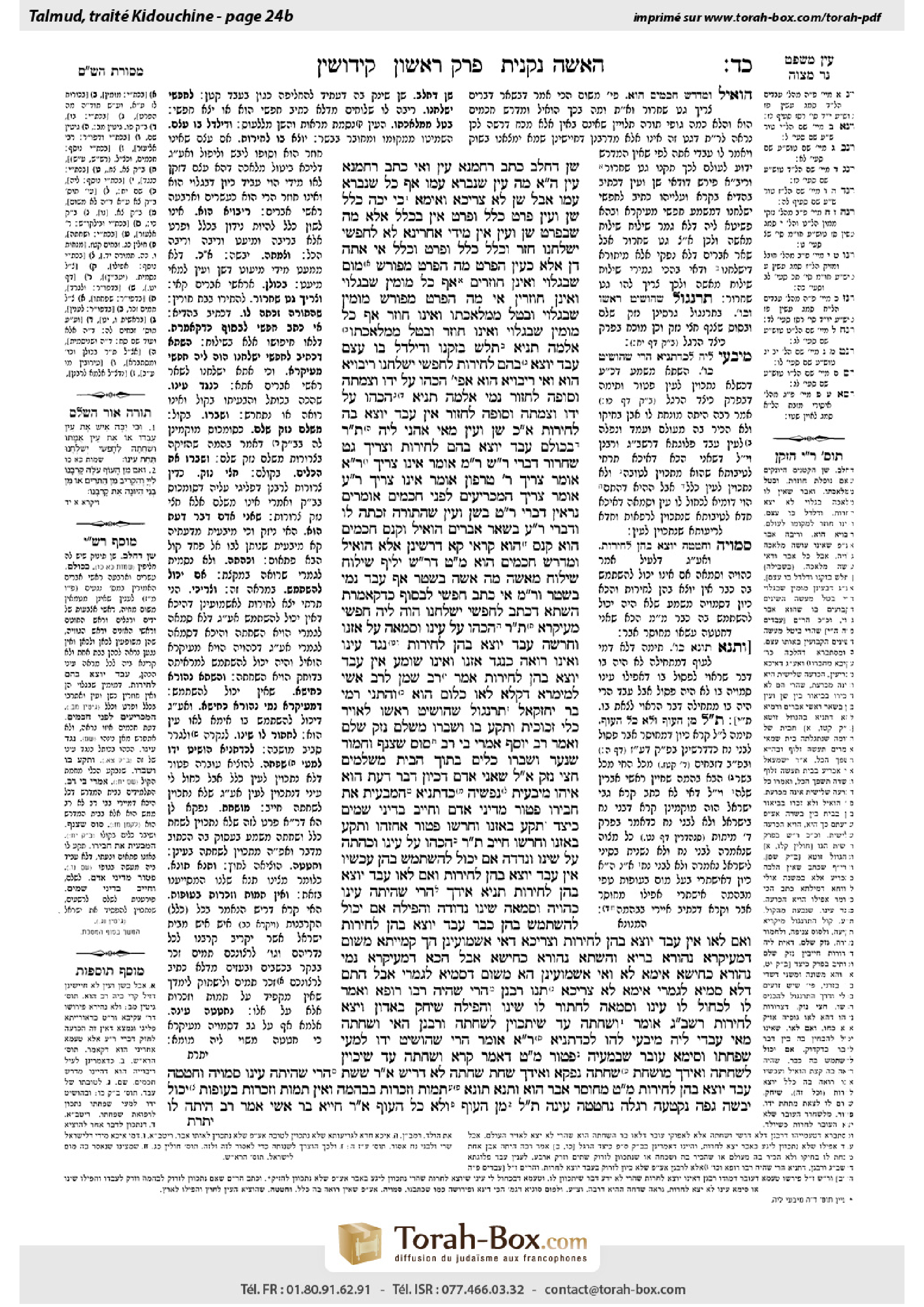
Kiddushin 24b: Talmud study for Daf Yomi
Daf Yomi is the daily study of one Talmud folio. Explore 37 tractates with scans, Hebrew text, Sefaria English and AI-generated French translations where annotated.
Passage selection and English or AI-generated French translation are available where the scan has annotations. Daf Study is independent of Torah-Box and Sefaria.
Browse Kiddushin · קידושין · All tractatesKiddushin 24b text and translations
This page of Kiddushin includes the Aramaic text, an English translation and an AI-generated French translation, alongside the scan above.
קידושין כ״ד ב · Aramaic and Hebrew text
שֵׁן דְּחָלָב, כְּתַב רַחֲמָנָא ״עַיִן״. וְאִי כְּתַב רַחֲמָנָא ״עַיִן״ הֲוָה אָמֵינָא מָה עַיִן שֶׁנִּבְרָא עִמּוֹ – אַף כֹּל שֶׁנִּבְרָא עִמּוֹ, אֲבָל שֵׁן – לָא, צְרִיכָא.
וְאֵימָא: ״כִּי יַכֶּה״ – כָּלַל, ״שֵׁן וָעַיִן״ – פָּרַט. כְּלָל וּפְרָט, אֵין בַּכְּלָל אֶלָּא מַה שֶּׁבַּפְּרָט. שֵׁן וָעַיִן – אִין, מִידֵּי אַחֲרִינָא – לָא!
״לַחׇפְשִׁי יְשַׁלְּחֶנּוּ״ – חָזַר וְכָלַל. כְּלָל וּפְרָט וּכְלָל, אִי אַתָּה דָן אֶלָּא כְּעֵין הַפְּרָט, מָה הַפְּרָט מְפוֹרָשׁ מוּם שֶׁבַּגָּלוּי וְאֵינָן חוֹזְרִים – אַף כֹּל מוּמִין שֶׁבַּגָּלוּי וְאֵינָן חוֹזְרִין.
אִי מָה הַפְּרָט מְפוֹרָשׁ – מוּמִין שֶׁבַּגָּלוּי וּבָטֵל מִמְּלַאכְתּוֹ וְאֵינוֹ חוֹזֵר – אַף כֹּל מוּמִין שֶׁבַּגָּלוּי וְאֵינוֹ חוֹזֵר וּבָטֵל מִמְּלַאכְתּוֹ. אַלְּמָה תַּנְיָא: תָּלַשׁ בִּזְקָנוֹ וְדִילְדֵּל בּוֹ עֶצֶם – עֶבֶד יוֹצֵא בָּהֶם לְחֵירוּת! ״לַחׇפְשִׁי יְשַׁלְּחֶנּוּ״ – רִיבּוּיָא הוּא.
וְאִי רִיבּוּיָא הוּא, אֲפִילּוּ הִכָּהוּ עַל יָדוֹ וְצָמְתָה וְסוֹפָהּ לַחְזוֹר נָמֵי, אַלְּמָה תַּנְיָא: הִכָּהוּ עַל יָדוֹ וְצָמְתָה וְסוֹפָהּ לַחְזוֹר – אֵין עֶבֶד יוֹצֵא בָּהּ לְחֵירוּת? אִם כֵּן, שֵׁן וָעַיִן מַאי אַהֲנִי לֵיהּ?
תָּנוּ רַבָּנַן: בְּכוּלָּם, עֶבֶד יוֹצֵא בָּהֶם לְחֵירוּת, וְצָרִיךְ גֵּט שִׁחְרוּר, דִּבְרֵי רַבִּי שִׁמְעוֹן. רַבִּי מֵאִיר אוֹמֵר: אֵינוֹ צָרִיךְ. רַבִּי אֱלִיעֶזֶר אוֹמֵר: צָרִיךְ. רַבִּי טַרְפוֹן אוֹמֵר: אֵינוֹ צָרִיךְ. רַבִּי עֲקִיבָא אוֹמֵר: צָרִיךְ.
הַמַּכְרִיעִים לִפְנֵי חֲכָמִים אוֹמְרִים: נִרְאִין דִּבְרֵי רַבִּי טַרְפוֹן בְּשֵׁן וָעַיִן, שֶׁהַתּוֹרָה זִכְּתָה לוֹ, וְדִבְרֵי רַבִּי עֲקִיבָא בִּשְׁאָר אֵבָרִים, הוֹאִיל וּקְנַס חֲכָמִים הוּא. קְנָס הוּא?! קְרָאֵי קָא דָרְשִׁינַן! אֶלָּא: הוֹאִיל וּמִדְרַשׁ חֲכָמִים הוּא.
מַאי טַעְמָא דְּרַבִּי שִׁמְעוֹן? יָלֵיף ״שִׁילּוּחַ״ ״שִׁילּוּחַ״ מֵאִשָּׁה. מָה אִשָּׁה בִּשְׁטָר – אַף עֶבֶד נָמֵי בִּשְׁטָר. וְרַבִּי מֵאִיר: אִי כְּתַב ״חׇפְשִׁי״ לְבַסּוֹף – כִּדְקָאָמְרַתְּ. הַשְׁתָּא דִּכְתַב ״לַחׇפְשִׁי יְשַׁלְּחֶנּוּ״ – הֲוָה לֵיהּ חׇפְשִׁי מֵעִיקָּרָא.
תָּנוּ רַבָּנַן: הִכָּהוּ עַל עֵינוֹ וְסִמְּאָהּ, עַל אׇזְנוֹ וְחֵרְשָׁהּ – עֶבֶד יוֹצֵא בָּהֶן לְחֵירוּת. נֶגֶד עֵינוֹ וְאֵינוֹ רוֹאֶה, כְּנֶגֶד אׇזְנוֹ וְאֵינוֹ שׁוֹמֵעַ – אֵין עֶבֶד יוֹצֵא בָּהֶן לְחֵירוּת. אָמַר רַב שֶׁמֶן לְרַב אָשֵׁי: לְמֵימְרָא דְּקָלָא לָאו כְּלוּם הוּא?
וְהָתָנֵי רָמֵי בַּר יְחֶזְקֵאל: תַּרְנְגוֹל שֶׁהוֹשִׁיט רֹאשׁוֹ לַאֲוִיר כְּלִי זְכוּכִית, וְתָקַע בּוֹ וּשְׁבָרוֹ מְשַׁלֵּם נֶזֶק שָׁלֵם. וְאָמַר רַב יוֹסֵף, אָמְרִי בֵּי רַב: סוּס שֶׁצָּנַף וַחֲמוֹר שֶׁנָּעַר, וְשָׁבְרוּ כֵּלִים בְּתוֹךְ הַבַּיִת – מְשַׁלְּמִים חֲצִי נֶזֶק.
אֲמַר לֵיהּ: שָׁאנֵי אָדָם, דְּכֵיוָן דְּבַר דַּעַת הוּא – אִיהוּ מְיבַעֵית נַפְשֵׁיהּ. כִּדְתַנְיָא: הַמַּבְעִית אֶת חֲבֵירוֹ – פָּטוּר מִדִּינֵי אָדָם וְחַיָּיב בְּדִינֵי שָׁמַיִם. כֵּיצַד? תָּקַע בְּאׇזְנוֹ וְחֵרְשׁוֹ – פָּטוּר, אֲחָזָהוּ וְתָקַע בְּאׇזְנוֹ וְחֵרְשׁוֹ – חַיָּיב.
תָּנוּ רַבָּנַן: הִכָּהוּ עַל עֵינוֹ וְכָהֲתָה, עַל שִׁינּוֹ וְנָדְדָה, אִם יָכוֹל לְהִשְׁתַּמֵּשׁ בָּהֶן עַכְשָׁיו – אֵין עֶבֶד יוֹצֵא בָּהֶן לְחֵירוּת, וְאִם לָאו – עֶבֶד יוֹצֵא בָּהֶן לְחֵירוּת. תַּנְיָא אִידַּךְ: הֲרֵי שֶׁהָיְתָה עֵינוֹ כְּהוּיָה וְסִמְּאָהּ, שִׁינּוֹ נְדוּדָה וְהִפִּילָהּ, אִם יָכוֹל לְהִשְׁתַּמֵּשׁ בָּהֶן כְּבָר – עֶבֶד יוֹצֵא בָּהֶן לְחֵירוּת, וְאִם לָאו – אֵין עֶבֶד יוֹצֵא בָּהֶן לְחֵירוּת.
וּצְרִיכָא, דְּאִי אַשְׁמוֹעִינַן הָךְ קַמַּיְיתָא, מִשּׁוּם דְּמֵעִיקָּרָא נְהוֹרָא בְּרִיָּא וְהַשְׁתָּא נְהוֹרָא כְּחִישָׁא. אֲבָל הָכָא, דְּמֵעִיקָּרָא נָמֵי נְהוֹרָא כְּחִישָׁא – אֵימָא לָא.
וְאִי אַשְׁמוֹעִינַן הָא, מִשּׁוּם דְּסַמְּיַהּ לִגְמָרֵי, אֲבָל הָתָם, דְּלָא סַמְּיַהּ לִגְמָרֵי אֵימָא לָא, צְרִיכָא.
תָּנוּ רַבָּנַן: הֲרֵי שֶׁהָיָה רַבּוֹ רוֹפֵא, וְאָמַר לוֹ לִכְחוֹל לוֹ עֵינוֹ וְסִמְּאָהּ, לַחְתּוֹר לוֹ שִׁינּוֹ וְהִפִּילָהּ – שִׂיחֵק בָּאָדוֹן, וְיָצָא לְחֵירוּת. רַבָּן שִׁמְעוֹן בֶּן גַּמְלִיאֵל אוֹמֵר: ״וְשִׁחֲתָהּ״ – עַד שֶׁיִּתְכַּוֵּין לְשַׁחֲתָהּ.
וְרַבָּנַן, הַאי ״וְשִׁחֲתָהּ״, מַאי עָבְדִי לֵיהּ? מִיבְּעֵי לְהוּ לְכִדְתַנְיָא, רַבִּי אֶלְעָזָר אוֹמֵר: הֲרֵי שֶׁהוֹשִׁיט יָדוֹ לִמְעֵי שִׁפְחָתוֹ וְסִימֵּא עוּבָּר שֶׁבְּמֵעֶיהָ – פָּטוּר. מַאי טַעְמָא? דְּאָמַר קְרָא: ״וְשִׁחֲתָהּ״ – עַד שֶׁיְּכַוֵּין לְשַׁחֲתָהּ.
וְאִידָּךְ? מִ״וְשִׁחֵת״ ״שִׁחֲתָהּ״ נָפְקָא. וְאִידַּךְ? ״שִׁחֵת״ ״שִׁחֲתָהּ״ לָא דָּרֵישׁ.
אָמַר רַב שֵׁשֶׁת: הֲרֵי שֶׁהָיְתָה עֵינוֹ סְמוּיָה, וַחֲטָטָהּ – עֶבֶד יוֹצֵא בָּהֶן לְחֵירוּת. מַאי טַעְמָא? מְחוּסָּר אֵבֶר הוּא.
וְתַנָּא תּוּנָא: תַּמּוּת וְזַכְרוּת בִּבְהֵמָה, וְאֵין תַּמּוּת וְזַכְרוּת בְּעוֹפוֹת.
יָכוֹל יָבְשָׁה גַּפָּהּ, נִקְטְעָה רַגְלָהּ, נֶחְטְטָה עֵינָהּ? תַּלְמוּד לוֹמַר: ״מִן הָעוֹף״ – וְלֹא כׇּל הָעוֹף.
אָמַר רַב חִיָּיא בַּר אָשֵׁי אָמַר רַב: הָיְתָה לוֹ
Kiddushin 24b · English translation
a milk tooth, a child’s tooth that will eventually fall out to be replaced by another, is included in this halakha. Therefore the Merciful One writes “eye,” to teach that this halakha applies only to a body part that does not regenerate, like an eye. And if the Merciful One had written only “eye,” I would say that just as an eye was created with him in the womb, so too, this halakha applies to anything that was created with him in the womb. But with regard to a tooth, which grows later, perhaps he would not be emancipated if his master knocked it out. Therefore, it is necessary to mention both cases.
The Gemara asks: But one can say the following argument: “If a man smites” (Exodus 21:26), is a generalization; “a tooth” and “an eye” are each a detail. If so, this should be read as a generalization and a detail, and the hermeneutical principle in a case of this kind is that the generalization includes only what is mentioned explicitly in the detail. Consequently, a tooth and an eye are included, but not other matters.
The Gemara answers that when each verse states: “To freedom shall he send him” (Exodus 21:26, 27), it then generalized again. Consequently, this should be read as a generalization and a detail and a generalization. In this case, the hermeneutical principle is that you may deduce that the verse is referring only to items similar to the detail: Just as the explicit detail is an exposed blemish that does not regenerate itself, so too, any body parts that are exposed blemishes and that do not regenerate themselves are included in this halakha.
The Gemara asks: If so, one can limit this category even further: Just as with the explicit details, they are referring to exposed blemishes and the body part is prevented from performing its regular function and does not regenerate, so too, a slave should be emancipated as a result of an injury to all exposed blemishes that do not regenerate and where the body part is prevented from performing its regular function. Why, then, is it taught in a baraita: If the master pulled out his beard and dislocated a bone in the slave’s jaw, the slave is emancipated by means of this injury. In this case there is no loss of function. The Gemara answers: “To freedom shall he send him” (Exodus 21:26–27), is an amplification, which includes an injury that is not exactly the same as the detail.
The Gemara asks: But if it is an amplification, which includes additional injuries, the slave should also be emancipated even if he struck him on his hand and it withered, i.e., became temporarily paralyzed, but would eventually be expected to regenerate. Why, then, is it taught in a baraita: If he struck him on his hand and the hand withered but it will eventually regenerate, the slave is not emancipated by means of this injury? The Gemara answers: If so, that even limbs that will eventually regain their function are included in this halakha, what purpose do the examples of tooth and eye serve? These two items that are explicitly stated in the verse would not exclude anything. Rather, only injuries similar to the details of an tooth and an eye are included, but not temporary injuries.
The Sages taught: With regard to any of the twenty-four extremities, if a master strikes his slave and injures him there, the slave is emancipated by means of these injuries, and he requires a bill of manumission from his master. This is the statement of Rabbi Shimon. Rabbi Meir says: He does not require a bill of manumission. Rabbi Eliezer says: He requires one. Rabbi Tarfon says: He does not require one. Rabbi Akiva says: He requires one.
Those who discuss matters and decide before the Sages say the following compromise: Rabbi Tarfon’s statement appears correct with regard to a tooth and an eye, since in these cases the Torah explicitly benefitted him. Because his right to emancipation is stated explicitly in the verse, the slave does not require a bill of manumission. And Rabbi Akiva’s statement is reasonable with regard to other limbs, since it is a rabbinic penalty. The Gemara is puzzled by this claim: Is it a rabbinic penalty? We interpret the verses, and therefore this halakha applies to the other limbs by Torah law. Rather, these Sages meant that is necessary to give a bill of manumission since it is a rabbinic interpretation and is not written explicitly in the Torah.
The Gemara asks: What is the reason of Rabbi Shimon? He derives a verbal analogy between: Sending away, “to freedom shall he send him” (Exodus 21:26, 27), and: Sending away, “and sends her out of his house” (Deuteronomy 24:1), from the case of a woman. Just as a woman can be released from her husband only by means of a document, so too, a slave can also be released from his master only by means of a document. And Rabbi Meir would say that if the term “freedom” was written at the end of the phrase, i.e., if the verse had stated: He shall send him away to freedom, it would be as you said, that he must be given a bill of manumission before he can be emancipated. Now that it is written “to freedom shall he send him,” this indicates that he is free from the beginning, i.e., no additional act of emancipation is required.
The Sages taught in a baraita (Tosefta, Bava Kamma 9:26): If a slave owner struck his slave on his eye and blinded him, or on his ear and deafened him, the slave is emancipated by means of these injuries. If he struck near his eye and as a result he does not see, or near his ear and he does not hear, the slave is not emancipated by means of these injuries. Rav Shemen said to Rav Ashi: Is this to say that a sound that causes damage is nothing?
But didn’t Rami bar Yeḥezkel teach a baraita: With regard to a rooster that stuck its head into the airspace of a glass vessel and crowed into it and the noise broke it, its owner pays the full cost of the damage like a regular case of damage. And Rav Yosef said that the Sages of Rav’s study hall say: With regard to a horse that neighed or a donkey that brayed and they thereby broke vessels in the house, their owners must pay for half of the damage. Although these two examples are different, as one results in full payment and the other in half payment, it is clear that sound can be a source of liability for damages.
Rav Ashi said to him: A person is different, as, since he is mentally competent it is he who frightened himself. It was not the physical sound that caused the damage but the slave’s subjective fear, which is not a direct result of the action. As it is taught in a baraita (Tosefta, Bava Kamma 6:16) that injury can result from being frightened: One who frightens another and causes him injury is exempt according to human laws but liable according to the laws of Heaven. How so? If one shouted into another’s ear and deafened him, he is exempt. But if he held him and shouted into his ear and deafened him, he is liable according to human laws as well, as he took physical hold of him. Once he physically took hold of him, he is liable for all the resultant damage.
The Sages taught in a baraita (Tosefta, Bava Kamma 9:9): In a case where the master struck him on his eye and weakened his vision without blinding him, or he struck him on his tooth and loosened it, if he can use the eye or the tooth now, the slave is not emancipated by means of them. And if he can no longer use them at all, then the slave is emancipated by means of them. It is taught in another clause in that baraita: In a case where the slave’s eye was weak prior to this incident, and the master blinded it entirely, or if the slave’s tooth was loose and his master knocked it out, if he was able to use them before the master struck him, the slave is emancipated by means of them, and if not, then the slave is not emancipated by means of them.
The Gemara comments: And it is necessary to state both halakhot, despite the fact that they apparently teach the same halakha that a weakened eye is not considered a significant injury, as, if the tanna had taught us only this first halakha, I would say that he is emancipated, because at the outset his vision was strong and now his vision is weak. But here, in the second baraita, where his vision was also weak at the outset, I would say he is not emancipated if the master blinded him entirely, as his eye did not function properly even beforehand.
And conversely, if the tanna had taught us only this second halakha, I would say that he is emancipated because he blinded him entirely. But there, where he did not blind him entirely I would say no, he is not emancipated, despite the fact that he weakened his vision. Therefore, it is necessary to state both halakhot.
The Sages taught in a baraita (Tosefta, Bava Kamma 9:9): In a case where his master was a doctor and the slave said to him to paint his eye with a medicament, and the master blinded it in the process, or he asked him to drill his aching tooth, and the master knocked it out, the slave laughs at the master and is emancipated. Rabban Shimon ben Gamliel says that the verse: “And if a man smites the eye of his slave, or the eye of his maidservant, and destroys it, to freedom shall he send him for his eye’s sake” (Exodus 21:26), means that the slave is not emancipated unless the master intends to destroy it. If he intended to heal him, the slave is not freed, even if the master did, in fact, injure him.
The Gemara asks: And the Rabbis, what do they do with this verse “and destroys it”? What do they derive from this phrase? The Gemara answers: They require it for that which is taught in a baraita: Rabbi Elazar says that in a case where the master stuck his hand into the womb of his maidservant to assist her in giving birth and he blinded the fetus in her womb, he is exempt and the fetus is not emancipated when born. What is the reason for this? As the verse states “and destroys it,” meaning unless he intends to destroy it, and in this case he did not mean to touch the fetus’s eye.
And the other Sage, Rabban Shimon ben Gamliel, would say that that halakha is derived from the fact that the verse could have said: And destroys, and instead said “destroys it.” And the other Sage, i.e., the Rabbis, how do they respond to this argument? They do not expound the difference between “destroys” and “destroys it,” i.e., they maintain that this is not a significant deviation from which one can derive a halakha.
Rav Sheshet says: In a case where the slave’s eye was blind and the master removed it entirely, the slave is emancipated by means of this injury. What is the reason for this? He is now lacking a limb, which is worse than a mere blemish.
And the tanna of a baraita also taught: The halakha of unblemished status, i.e., that an offering must not contain a blemish, and the halakha of male status apply to animal offerings, but the halakha of unblemished status and the halakha of male status do not apply to bird offerings.
The Gemara comments: One might have thought that if one brings a bird whose wing is dried, or whose leg is severed, or whose eye was removed, that it too is acceptable as an offering. Therefore, the verse states: “And if his offering to the Lord is a burnt-offering from birds” (Leviticus 1:14). This phrase indicates that only some birds can be sacrificed as offerings, but not all birds. This teaches that a bird can be disqualified due to a blemish. For example, if a significant part of the bird is missing, e.g., a limb, the bird is not acceptable as an offering. This indicates that the actual loss of an eye is considered a greater blemish than blindness. Consequently, if his master takes out the slave’s blind eye, he is emancipated.
Rabbi Ḥiyya bar Ashi says that Rav says: If the slave had
Kiddushin 24b · Traduction française (IA)
Une dent de lait, c’est-à-dire une dent d’enfant qui finira par tomber pour être remplacée par une autre, est incluse dans cette halakha. Le Miséricordieux mentionne donc « l’œil » pour enseigner que cette halakha ne s’applique qu’à une partie du corps qui ne se régénère pas, comme l’œil. Et si le Miséricordieux avait mentionné uniquement « l’œil », j’aurais dit que, de même que l’œil s’est formé avec lui dans le ventre maternel, cette halakha s’applique également à tout ce qui s’est formé avec lui dans le ventre maternel. Mais s’agissant d’une dent, qui pousse plus tard, peut-être ne serait-il pas affranchi si son maître la lui avait arrachée. Il est donc nécessaire de mentionner les deux cas.
La Guemara demande : Mais on pourrait avancer l’argument suivant : « Si un homme frappe » (Exode 21,26) est une généralité ; « une dent » et « un œil » sont chacun un détail. Il faudrait donc lire ces termes comme une généralité suivie d’un détail, et le principe herméneutique applicable dans un tel cas est que la généralité ne comprend que ce qui est explicitement mentionné dans le détail. Par conséquent, une dent et un œil sont inclus, mais pas les autres cas.
La Guemara répond que, dans chaque verset, après avoir dit : « Il le renverra en liberté » (Exode 21,26-27), le texte énonce de nouveau une généralité. Il faut donc lire cela comme une généralité, un détail, puis une généralité. Dans ce cas, le principe herméneutique permet de déduire que le verset ne vise que des éléments semblables au détail : de même que le détail explicite est une lésion visible qui ne se régénère pas, toutes les parties du corps qui sont des lésions visibles et ne se régénèrent pas sont également incluses dans cette halakha.
La Guemara demande : Dans ce cas, on pourrait limiter encore davantage cette catégorie : de même que les détails explicites concernent des lésions visibles, où la partie du corps ne peut plus remplir sa fonction habituelle et ne se régénère pas, un esclave ne devrait être affranchi qu’en raison d’une blessure présentant ces mêmes caractéristiques. Pourquoi enseigne-t-on alors dans une baraïta que si le maître lui a arraché la barbe et déboîté un os de la mâchoire, l’esclave est affranchi du fait de cette blessure ? Dans ce cas, aucune fonction n’est perdue. La Guemara répond : « Il le renverra en liberté » (Exode 21,26-27) constitue une amplification, qui inclut une blessure ne correspondant pas exactement au détail.
La Guemara demande : Mais s’il s’agit d’une amplification qui inclut des blessures supplémentaires, l’esclave devrait également être affranchi si le maître l’a frappé à la main et que celle-ci s’est paralysée temporairement, mais devait finir par se régénérer. Pourquoi enseigne-t-on alors dans une baraïta que s’il l’a frappé à la main et que celle-ci s’est paralysée, mais devait finir par se régénérer, l’esclave n’est pas affranchi du fait de cette blessure ? La Guemara répond : Dans ce cas, si même les membres dont la fonction devait finir par se rétablir étaient inclus dans cette halakha, à quoi serviraient les exemples de la dent et de l’œil ? Ces deux éléments explicitement mentionnés dans le verset n’excluraient rien. Il faut plutôt dire que seules sont incluses les blessures semblables aux détails de la dent et de l’œil, et non les blessures temporaires.
Les Sages ont enseigné : Pour chacune des vingt-quatre extrémités du corps, si un maître frappe son esclave et le blesse à cet endroit, l’esclave est affranchi du fait de ces blessures et doit recevoir de son maître un acte d’affranchissement. Telle est la déclaration de Rabbi Shimon. Rabbi Meïr dit : Il n’a pas besoin d’un acte d’affranchissement. Rabbi Eliezer dit : Il en a besoin. Rabbi Tarfon dit : Il n’en a pas besoin. Rabbi Akiva dit : Il en a besoin.
Ceux qui discutent des sujets et tranchent devant les Sages proposent le compromis suivant : la position de Rabbi Tarfon semble juste pour la dent et l’œil, puisque, dans ces cas, la Torah lui a explicitement accordé un avantage. Comme son droit à l’affranchissement est énoncé explicitement dans le verset, l’esclave n’a pas besoin d’un acte d’affranchissement. Et la position de Rabbi Akiva semble raisonnable pour les autres membres, puisque c’est une sanction rabbinique. La Guemara s’étonne de cette affirmation : Est-ce une sanction rabbinique ? Nous interprétons les versets ; cette halakha s’applique donc aux autres membres en vertu de la Torah. Il faut plutôt comprendre que ces Sages voulaient dire qu’un acte d’affranchissement est nécessaire, car il s’agit d’une interprétation rabbinique qui n’est pas écrite explicitement dans la Torah.
La Guemara demande : Quelle est la raison de Rabbi Shimon ? Il déduit une analogie verbale entre « renvoyer », dans « il le renverra en liberté » (Exode 21,26-27), et « renvoyer », dans « et la renvoie de sa maison » (Deutéronome 24,1), à partir du cas d’une femme. De même qu’une femme ne peut être libérée de son mari qu’au moyen d’un document, de même un esclave ne peut être libéré de son maître qu’au moyen d’un document. Rabbi Meïr dirait que si le terme « liberté » avait été écrit à la fin de l’expression, c’est-à-dire si le verset avait dit : « Il le renverra en liberté », vous auriez raison : il faudrait lui remettre un acte d’affranchissement avant qu’il puisse être affranchi. Mais puisque le texte dit « en liberté, il le renverra », cela indique qu’il est libre dès le départ, c’est-à-dire qu’aucun acte d’affranchissement supplémentaire n’est nécessaire.
Les Sages ont enseigné dans une baraïta (Tosefta, Baba Kama 9,26) : Si un propriétaire d’esclave a frappé son esclave à l’œil et l’a rendu aveugle, ou à l’oreille et l’a rendu sourd, l’esclave est affranchi du fait de ces blessures. S’il l’a frappé près de l’œil et qu’en conséquence il ne voit plus, ou près de l’oreille et qu’il n’entend plus, l’esclave n’est pas affranchi du fait de ces blessures. Rav Shemen dit à Rav Ashi : Faut-il en déduire qu’un son qui cause un dommage ne compte pour rien ?
Mais Rami bar Yeḥezkel n’a-t-il pas enseigné une baraïta : Si un coq a introduit sa tête dans l’espace intérieur d’un récipient en verre et y a chanté, et que le bruit l’a brisé, son propriétaire paie le coût total du dommage, comme dans un cas ordinaire de dommage ? Et Rav Yossef a dit que les Sages de la maison d’étude de Rav enseignent : Si un cheval a henni ou un âne a brai et qu’ils ont ainsi brisé des récipients dans la maison, leurs propriétaires doivent payer la moitié du dommage. Bien que ces deux exemples diffèrent, puisque l’un entraîne un paiement intégral et l’autre le paiement de la moitié, il est clair qu’un son peut engager la responsabilité pour des dommages.
Rav Ashi lui dit : Le cas d’une personne est différent, car, puisqu’elle est douée de raison, c’est elle qui s’est effrayée elle-même. Ce n’est pas le son lui-même qui a causé le dommage, mais la peur subjective de l’esclave, qui ne découle pas directement de l’action. En effet, une baraïta (Tosefta, Baba Kama 6,16) enseigne qu’une blessure peut résulter d’une frayeur : Celui qui effraie autrui et lui cause une blessure est exempt selon le droit humain, mais responsable devant le Ciel. Comment cela ? Si quelqu’un a crié dans l’oreille d’autrui et l’a rendu sourd, il est exempt. Mais s’il l’a tenu et a crié dans son oreille, le rendant sourd, il est également responsable selon le droit humain, puisqu’il l’a physiquement saisi. Dès lors qu’il l’a physiquement saisi, il est responsable de tous les dommages qui en résultent.
Les Sages ont enseigné dans une baraïta (Tosefta, Baba Kama 9,9) : Si le maître l’a frappé à l’œil et a affaibli sa vue sans le rendre aveugle, ou s’il l’a frappé à la dent et l’a déchaussée, l’esclave n’est pas affranchi du fait de ces blessures s’il peut encore se servir de l’œil ou de la dent. Mais s’il ne peut plus du tout s’en servir, l’esclave en est affranchi. Une autre clause de cette baraïta enseigne : Si l’œil de l’esclave était faible avant cet incident et que le maître l’a rendu complètement aveugle, ou si la dent de l’esclave était branlante et que son maître la lui a arrachée, l’esclave en est affranchi s’il pouvait s’en servir avant que le maître le frappe ; sinon, il n’en est pas affranchi.
La Guemara fait remarquer : Il est nécessaire d’énoncer les deux halakhot, bien qu’elles semblent enseigner la même halakha, à savoir qu’un œil affaibli n’est pas considéré comme une blessure importante. En effet, si le tanna nous avait enseigné uniquement cette première halakha, j’aurais dit qu’il est affranchi, car au départ sa vue était bonne et elle est maintenant affaiblie. Mais ici, dans la seconde baraïta, où sa vue était déjà faible au départ, j’aurais dit qu’il n’est pas affranchi si le maître l’a rendu complètement aveugle, puisque son œil ne fonctionnait déjà pas correctement auparavant.
Inversement, si le tanna nous avait enseigné uniquement cette seconde halakha, j’aurais dit qu’il est affranchi parce que le maître l’a rendu complètement aveugle. Mais dans l’autre cas, où il ne l’a pas rendu complètement aveugle, j’aurais dit que non, il n’est pas affranchi, bien que sa vue ait été affaiblie. Il est donc nécessaire d’énoncer les deux halakhot.
Les Sages ont enseigné dans une baraïta (Tosefta, Baba Kama 9,9) : Si son maître était médecin et que l’esclave lui a demandé de lui appliquer un médicament sur l’œil, mais que le maître l’a rendu aveugle en le faisant, ou s’il lui a demandé de percer sa dent douloureuse et que le maître la lui a arrachée, l’esclave se moque de son maître et est affranchi. Rabban Shimon ben Gamliel dit que le verset : « Si un homme frappe l’œil de son esclave ou l’œil de sa servante et le détruit, il le renverra en liberté pour son œil » (Exode 21,26), signifie que l’esclave n’est affranchi que si le maître avait l’intention de détruire l’œil. S’il avait l’intention de le soigner, l’esclave n’est pas libéré, même si le maître l’a effectivement blessé.
La Guemara demande : Et que font les Rabbins de l’expression « et le détruit » ? Que déduisent-ils de cette expression ? La Guemara répond : Ils en ont besoin pour ce qu’enseigne une baraïta : Rabbi Elazar dit que si le maître a introduit sa main dans le ventre de sa servante pour l’aider à accoucher et a rendu aveugle le fœtus dans son ventre, il est exempt et le fœtus n’est pas affranchi à sa naissance. Pour quelle raison ? Car le verset dit « et le détruit », c’est-à-dire que l’affranchissement ne s’applique que s’il avait l’intention de le détruire ; or, dans ce cas, il n’avait pas l’intention de toucher l’œil du fœtus.
L’autre Sage, Rabban Shimon ben Gamliel, dirait que cette halakha se déduit du fait que le verset aurait pu dire « et détruit », mais qu’il dit au lieu de cela « et le détruit ». Et l’autre Sage, c’est-à-dire les Rabbins, que répond-il à cet argument ? Ils ne tirent pas d’enseignement de la différence entre « détruit » et « le détruit » ; autrement dit, ils estiment que cette différence n’est pas une variation significative permettant de déduire une halakha.
Rav Sheshet dit : Si l’œil de l’esclave était aveugle et que le maître l’a entièrement retiré, l’esclave est affranchi du fait de cette blessure. Pour quelle raison ? Il lui manque désormais un membre, ce qui est plus grave qu’une simple lésion.
Le tanna d’une baraïta a également enseigné : Les règles relatives à l’absence de défaut, c’est-à-dire qu’une offrande ne doit comporter aucun défaut, et au statut de mâle s’appliquent aux offrandes animales ; mais les règles relatives à l’absence de défaut et au statut de mâle ne s’appliquent pas aux offrandes d’oiseaux.
La Guemara fait remarquer : On aurait pu penser que si quelqu’un apporte un oiseau dont l’aile est desséchée, dont la patte est coupée ou dont l’œil a été retiré, celui-ci est lui aussi acceptable comme offrande. Le verset dit donc : « Si son offrande à l’Éternel est un holocauste d’oiseaux » (Lévitique 1,14). Cette expression indique que seuls certains oiseaux peuvent être offerts, mais pas tous. Cela enseigne qu’un oiseau peut être disqualifié en raison d’un défaut. Par exemple, s’il lui manque une partie importante, comme un membre, l’oiseau n’est pas acceptable comme offrande. Cela indique que la perte effective d’un œil constitue un défaut plus grave que la cécité. Par conséquent, si son maître retire l’œil aveugle de l’esclave, celui-ci est affranchi.
Rabbi Ḥiyya bar Ashi dit au nom de Rav : Si l’esclave avait
Traduction française générée par IA à partir de l’édition anglaise de Sefaria. Vérifie toujours un passage avec le texte source.
Text from Sefaria: William Davidson Edition - Vocalized Aramaic (CC BY NC); William Davidson Edition - English (CC BY NC).