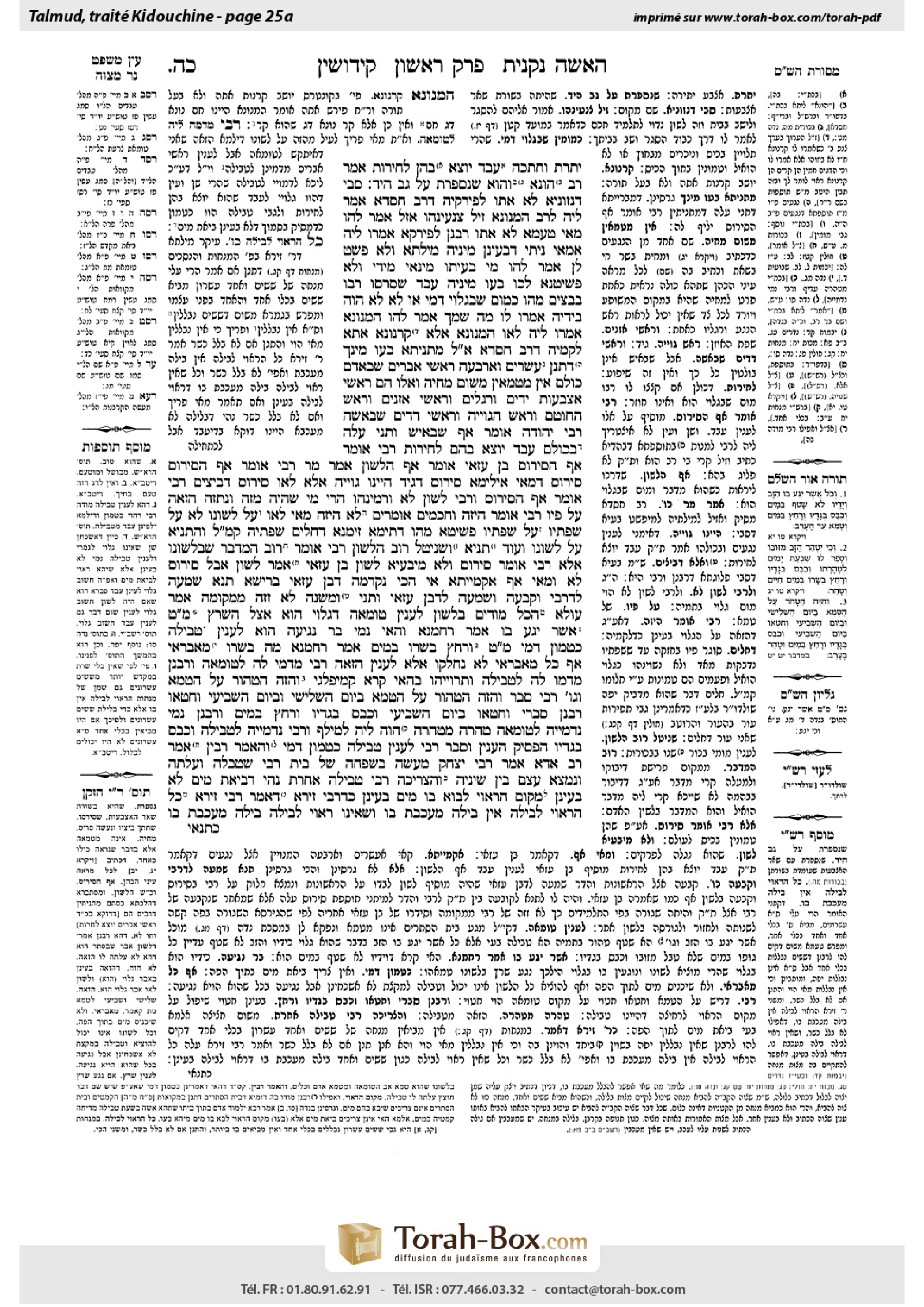
Kiddushin 25a: Talmud study for Daf Yomi
Daf Yomi is the daily study of one Talmud folio. Explore 37 tractates with scans, Hebrew text, Sefaria English and AI-generated French translations where annotated.
Passage selection and English or AI-generated French translation are available where the scan has annotations. Daf Study is independent of Torah-Box and Sefaria.
Browse Kiddushin · קידושין · All tractatesKiddushin 25a text and translations
This page of Kiddushin includes the Aramaic text, an English translation and an AI-generated French translation, alongside the scan above.
קידושין כ״ה א · Aramaic and Hebrew text
יְתֶרֶת, וַחֲתָכָהּ – עֶבֶד יוֹצֵא בָּהֶן לְחֵירוּת. אָמַר רַב הוּנָא: וְהוּא שֶׁנִּסְפֶּרֶת עַל גַּב הַיָּד.
סָבֵי דְנָזוֹנְיָא לָא אֲתוֹ לְפִירְקֵיהּ דְּרַב חִסְדָּא, אֲמַר לֵיהּ לְרַב הַמְנוּנָא: זִיל צַנְּעִינְהוּ. אֲזַל אֲמַר לְהוּ: מַאי טַעְמָא לָא אֲתוֹ רַבָּנַן לְפִירְקָא? אֲמַרוּ לֵיהּ: אַמַּאי נֵיתֵי? דִּבְעֵינַן מִינֵּיהּ מִילְּתָא וְלָא פְּשַׁט לַן. אֲמַר לְהוּ: מִי בְּעֵיתוּ מִינַּאי מִידֵּי וְלָא פָּשֵׁיטְנָא לְכוּ?
בְּעוֹ מִינֵּיהּ: עֶבֶד שֶׁסֵּרְסוֹ רַבּוֹ בַּבֵּצִים, מַהוּ? כְּמוּם שֶׁבַּגָּלוּי דָּמֵי, אוֹ לָא? לָא הֲוָה בִּידֵיהּ. אָמְרוּ לוֹ: מָה שְׁמָךְ? אֲמַר לְהוּ: הַמְנוּנָא. אֲמַרוּ לֵיהּ: לָאו הַמְנוּנָא, אֶלָּא קַרְנוּנָא.
אֲתָא לְקַמֵּיהּ דְּרַב חִסְדָּא. אֲמַר לֵיהּ: מַתְנִיתָא בְּעוֹ מִינָּךְ. דִּתְנַן: עֶשְׂרִים וְאַרְבָּעָה רָאשֵׁי אֵבָרִים שֶׁבָּאָדָם כּוּלָּם אֵין מְטַמְּאִין מִשּׁוּם מִחְיָה,
וְאֵלּוּ הֵם: רָאשֵׁי אֶצְבָּעוֹת יָדַיִם וְרַגְלַיִם, וְרָאשֵׁי אׇזְנַיִם, וְרֹאשׁ הַחוֹטֶם, וְרֹאשׁ הַגְּוִיָּיה וְרָאשֵׁי דַדִּים שֶׁבָּאִשָּׁה. רַבִּי יְהוּדָה אוֹמֵר: אַף שֶׁבָּאִישׁ. וְתָנֵי עֲלַהּ: בְּכוּלָּם עֶבֶד יוֹצֵא בָּהֶם לְחֵירוּת. רַבִּי אוֹמֵר: אַף הַסֵּירוּס. בֶּן עַזַּאי אוֹמֵר: אַף הַלָּשׁוֹן.
אָמַר מָר: רַבִּי אוֹמֵר אַף הַסֵּירוּס. סֵירוּס דְּמַאי? אִילֵּימָא סֵירוּס דְּגִיד, הַיְינוּ גְּוִיָּיה. אֶלָּא לָאו: סֵירוּס דְּבֵיצִים?
רַבִּי אוֹמֵר אַף הַסֵּירוּס. וְרַבִּי, לָשׁוֹן לָא? וּרְמִינְהוּ: הֲרֵי מִי שֶׁהָיָה מַזֶּה וְנִתְּזָה הַזָּאָה עַל פִּיו, רַבִּי אוֹמֵר: הִיזָּה. וַחֲכָמִים אוֹמְרִים: לֹא הִיזָּה.
מַאי לָאו עַל לְשׁוֹנוֹ? לֹא, עַל שְׂפָתָיו. עַל שְׂפָתָיו פְּשִׁיטָא! מַהוּ דְּתֵימָא זִימְנָא דְּחָלֵים שִׂפְוָתֵיהּ, קָא מַשְׁמַע לַן.
וְהָתַנְיָא: עַל לְשׁוֹנוֹ! וְעוֹד תַּנְיָא: וְשֶׁנִּיטַּל רוֹב הַלָּשׁוֹן, רַבִּי אוֹמֵר: רוֹב הַמְדַבֵּר שֶׁבִּלְשׁוֹנוֹ!
אֶלָּא, רַבִּי אוֹמֵר: סֵירוּס, וְלָא מִיבַּעְיָא לָשׁוֹן. בֶּן עַזַּאי אָמַר: לָשׁוֹן, אֲבָל סֵירוּס – לָא. וּמַאי ״אַף״? אַקַּמַּיְיתָא. אִי הָכִי, נַקְדְּמַהּ דְּבֶן עַזַּאי בְּרֵישָׁא!
תַּנָּא שַׁמְעַהּ לִדְרַבִּי וְקַבְעַהּ, וְשַׁמְעַהּ לִדְבֶן עַזַּאי וְתַנְיַ[הּ], וּמִשְׁנָה לֹא זָזָה מִמְּקוֹמָהּ.
אָמַר עוּלָּא: הַכֹּל מוֹדִים בְּלָשׁוֹן לְעִנְיַן טוּמְאָה דְּגָלוּי הוּא אֵצֶל הַשֶּׁרֶץ. מַאי טַעְמָא? ״אֲשֶׁר יִגַּע בּוֹ״ אָמַר רַחֲמָנָא, וְהַאי נָמֵי בַּר נְגִיעָה הוּא.
לְעִנְיַן טְבִילָה – כְּטָמוּן דָּמֵי. מַאי טַעְמָא: ״וְרָחַץ בְּשָׂרוֹ בְּמַיִם״ אָמַר רַחֲמָנָא, מָה בְּשָׂרוֹ מֵאַבָּרַאי – אַף כֹּל מֵאַבָּרַאי.
לֹא נֶחְלְקוּ אֶלָּא לְעִנְיַן הַזָּאָה. רַבִּי מְדַמֵּי לַהּ לְטוּמְאָה, וְרַבָּנַן מְדַמּוּ לַהּ לִטְבִילָה.
וְתַרְוַיְיהוּ בְּהַאי קְרָא קָמִיפַּלְגִי: ״וְהִזָּה הַטָּהֹר עַל הַטָּמֵא וְגוֹ׳״ רַבִּי סָבַר: ״וְהִזָּה הַטָּהֹר עַל הַטָּמֵא בַּיּוֹם הַשְּׁלִישִׁי וּבַיּוֹם הַשְּׁבִיעִי וְחִטְּאוֹ״,
רַבָּנַן סָבְרִי: ״וְחִטְּאוֹ בַּיּוֹם הַשְּׁבִיעִי וְכִבֶּס בְּגָדָיו וְרָחַץ בַּמַּיִם״.
וְרַבָּנַן נָמֵי, נְדַמְּיַיהּ לְטוּמְאָה? טׇהֳרָה מִטׇּהֳרָהּ הֲוָה לֵיהּ לְמֵילַף. וְרַבִּי, נְדַמְּיַיהּ לִטְבִילָה? ״וְכִבֶּס בְּגָדָיו״ – הִפְסִיק הָעִנְיָן.
וְסָבַר רַבִּי לְעִנְיַן טְבִילָה כְּטָמוּן דָּמֵי? וְהָאָמַר רָבִין אָמַר רַב אַדָּא אָמַר רַבִּי יִצְחָק: מַעֲשֶׂה בְּשִׁפְחָה שֶׁל בֵּית רַבִּי שֶׁטָּבְלָה, וְעָלְתָה וְנִמְצָא עֶצֶם בֵּין שִׁינֶּיהָ, וְהִצְרִיכָהּ רַבִּי טְבִילָה אַחֶרֶת.
נְהִי דְּבִיאַת מַיִם לָא בָּעֵינַן, מְקוֹם הָרָאוּי לָבוֹא בּוֹ מַיִם בָּעֵינַן,
כִּדְרַבִּי זֵירָא. דְּאָמַר רַבִּי זֵירָא: כׇּל הָרָאוּי לְבִילָּה – אֵין בִּילָּה מְעַכֶּבֶת בּוֹ. וְשֶׁאֵינוֹ רָאוּי לְבִילָּה – בִּילָּה מְעַכֶּבֶת בּוֹ.
Kiddushin 25a · English translation
an extra finger, i.e., six fingers on his hand, and the master severed it, the slave is emancipated by means of this injury. Rav Huna says: And this halakha applies when the finger can be counted along the back of the hand, i.e., the extra finger is on the same line as the others. If it protrudes from another spot, then it is not classified as a finger but a mere growth, and destroying it is not considered the removal of a limb.
§ The Gemara relates: The Elders of the city of Nezonya did not come to Rav Ḥisda’s lecture. Rav Ḥisda said to Rav Hamnuna: Go and ostracize them [tzaninhu] because they act disrespectfully toward the Sages. Rav Hamnuna went and said to the Elders of Nezonya: What is the reason that the rabbis did not come to the lecture? They said to him: Why should we come, as we asked him about a matter and he did not resolve it for us. We have nothing to learn from him. Rav Hamnuna said to them: Have you asked me anything that I did not resolve for you? Ask me your question.
They raised the following dilemma before him: With regard to a slave whose master castrates his testicles, what is the halakha? Is that considered an exposed blemish that is sufficient to emancipate him or not? An answer to their dilemma was not available to Rav Hamnuna. They said to him: What is your name? He said to them: Hamnuna. They said to him in jest: You should not be called Hamnuna, a good hot fish; rather, your name should be Karnuna, a cold fish that is no longer tasty.
After this encounter Rav Hamnuna came before Rav Ḥisda and told him what had happened. Rav Ḥisda said to him: They raised before you a dilemma that can be resolved from a baraita, which was cited in connection to a mishna, and you did not know how to answer them. As we learned in a mishna (Nega’im 6:7): There are twenty-four extremities in a person, none of which can become ritually impure due to unaffected skin. The Torah states that if a leprous spot contains some healthy flesh, the person is immediately rendered impure (Leviticus 13:14). The halakha of unaffected skin does not apply to the extremities because the priest must be able to see the entirety of the untainted area at once. Due to the shape of the twenty-four extremities, it is impossible to see the entirety of the area from a single vantage point. Consequently, the halakha of unaffected skin does not apply to them.
And these are the twenty-four extremities: The extremities of the fingers and toes, twenty in total, and the extremities of the ears, and the extremity of the nose, and the extremity of the penis, and the extremities of the nipples of a woman. Rabbi Yehuda says: Even the nipples of a man are included. And it is taught in that regard in a baraita: A slave is emancipated for injuries to all of them. The body parts listed with regard to leprosy are the same ones that, when injured, lead to the emancipation of a slave. Rabbi Yehuda HaNasi says: Also, the castration of a slave by his master entails his freedom. Ben Azzai says: The tongue is also considered an exposed body part, as it is exposed when one speaks. Consequently, if the master severs his slave’s tongue, the slave goes free.
The Master said above that Rabbi Yehuda HaNasi says: Also castration. The Gemara asks: Castration of what? If we say that it is referring to castration of the penis, i.e., that the master severed the slave’s penis, this is the same as the mishna that already mentioned a penis. What, then, does Rabbi Yehuda HaNasi add? Rather, is it not correct to say that Rabbi Yehuda HaNasi is referring to castration of the testicles? If so, this baraita resolves the dilemma raised by the Elders of Nezonya.
The Gemara further analyzes the baraita. Rabbi Yehuda HaNasi says: Also castration, but he does not include the tongue, unlike ben Azzai. The Gemara inquires: And according to Rabbi Yehuda HaNasi, is the tongue not considered exposed? And the Gemara raises a contradiction from the following: In a case where one was sprinkling the purification water of the red heifer on another person in order to purify him from ritual impurity imparted by a corpse, and a sprinkling of water landed on his mouth, Rabbi Yehuda HaNasi says: He has sprinkled, i.e., this is a valid form of sprinkling and the impure person is purified. And the Rabbis say: He has not sprinkled, i.e., this is an invalid form of sprinkling because water of purification must be sprinkled on exposed limbs.
The Gemara clarifies the difficulty from this baraita: What, is it not the case that this is referring to a situation where water was sprinkled on his tongue, which would indicate that Rabbi Yehuda HaNasi maintains that the tongue is an exposed limb? The Gemara rejects this suggestion: No, this is referring to one who had water sprinkled on his lips. The Gemara asks: If it was sprinkled on his lips, isn’t it obvious that he is ritually pure, as the lips are exposed? The Gemara answers: It is necessary to state this, lest you say that at times, he closes his lips tightly, and consequently they should be considered an unexposed part of the body. Therefore, the baraita teaches us that according to Rabbi Yehuda HaNasi one’s lips are considered exposed.
The Gemara further asks: But isn’t it taught explicitly in a baraita that if one had water sprinkled on his tongue he is ritually pure according to Rabbi Yehuda HaNasi? And it is further taught in a baraita dealing with the blemishes of priests and offerings that if most of his tongue was removed, this is a blemish; and Rabbi Yehuda HaNasi says: This is referring to a case where the part removed was most of the part of his tongue that he uses for speaking and pronouncing words, which is the tip of the tongue, not most of its length. This indicates that Rabbi Yehuda HaNasi maintains that if the tongue is removed, that is considered a blemish.
Rather, the baraita should be explained as follows. Rabbi Yehuda HaNasi says: Castration is included, and it is not necessary to say that if the slave’s tongue is removed he is emancipated, as the tongue is exposed. Ben Azzai says: The loss of his tongue emancipates him, but castration does not. And what is the meaning of the term: Also, in the baraita, which indicates that ben Azzai is adding to Rabbi Yehuda HaNasi’s statement? He is adding to the first statement of the first tanna, not to the immediately preceding ruling of Rabbi Yehuda HaNasi. The Gemara asks: If so, the statement of ben Azzai should be first, as he adds one item, i.e., the tongue, to the ruling of the first tanna, while Rabbi Yehuda HaNasi further adds the case of castration to ben Azzai’s opinion.
The Gemara answers: The baraita should have been formulated in this manner, but the tanna first heard the opinion of Rabbi Yehuda HaNasi and set it in his version of the baraita, and afterward he heard the opinion of ben Azzai and taught it at the end. And although it would be appropriate to change the order of the statements, he did not do so because a mishna does not move from its place. Once it has been taught in a certain manner, the tanna will not change the text of a mishna, in order to avoid confusion.
Ulla says: All concede with regard to a tongue that in the matter of ritual impurity it is considered exposed with respect to a dead creeping animal and other items that impart impurity. In other words, if an individual comes into contact with a source of ritual impurity with his tongue, he is rendered impure. What is the reason for this? The Merciful One states: “Whom he touches” (Leviticus 15:11), and this tongue can also touch. It is possible for one to touch objects with his tongue.
Similarly, all agree about a tongue with regard to the matter of immersion that the tongue is considered concealed, and therefore one need not open his mouth so that the water touches his tongue. For an immersion to be valid, the water must come into contact with the entire outside of one’s body. Ulla teaches that this does not include the tongue. What is the reason for this? The Merciful One states: “And he shall immerse his flesh in water” (Leviticus 15:13). Just as his flesh is on the outside, so too everything that requires immersion is on the outside, and this does not include what is ordinarily on the inside.
They disagreed only with regard to whether the tongue is considered exposed or concealed in the matter of sprinkling. Rabbi Yehuda HaNasi compares sprinkling to impurity, where the tongue is considered exposed, and the Rabbis compare it to immersion, where the tongue is considered concealed.
The Gemara comments: And the two of them disagree with regard to the meaning of this verse: “And the pure person shall sprinkle upon the impure person on the third day and on the seventh day, and he shall purify him on the seventh day and he shall wash his clothes and immerse in water and he shall become pure in the evening” (Numbers 19:19). Rabbi Yehuda HaNasi maintains that the verse should be read as: “And the pure person shall sprinkle upon the impure person on the third day and on the seventh day, and he shall purify him.” This indicates that sprinkling is compared to ritual impurity, which means that it is effective if the water lands on any part of the body that can become impure.
Conversely, the Rabbis maintain that one should read the phrase “and he shall purify him” with the last part of the verse, as follows: “And he shall purify him on the seventh day and he shall wash his clothes and immerse in water.” According to this reading, sprinkling is compared to immersion, which means that the water must be sprinkled on part of the body that requires immersion.
The Gemara asks: And with regard to the opinion of the Rabbis as well, let us compare sprinkling to impurity. The Gemara answers: One should derive purification from purification. Just as immersion is a method of purification, so too sprinkling is a method of purification, and therefore it is appropriate to compare these two cases. The Gemara asks from the other perspective: And with regard to the opinion of Rabbi Yehuda HaNasi, let us compare sprinkling to immersion. The Gemara answers that the phrase “and he shall wash his clothes” concludes the discussion of that matter, i.e., this expression indicates that a new clause begins from here, and therefore sprinkling should not be compared to immersion but to impurity, which is mentioned prior to it.
The Gemara asks: But does Rabbi Yehuda HaNasi maintain with regard to the matter of immersion that the tongue is considered concealed? But doesn’t Ravin say that Rav Adda says that Rabbi Yitzḥak says: There was an incident involving a maidservant of the household of Rabbi Yehuda HaNasi who immersed herself, and she ascended from her immersion and a bone was found between her teeth, and Rabbi Yehuda HaNasi required her to perform another immersion? This indicates that according to Rabbi Yehuda HaNasi one may not have a foreign object even inside one’s mouth during immersion. If so, the tongue should require immersion as well.
The Gemara answers: That is no proof, as it is granted that we do not require immersion in water, i.e., the water need not actually enter one’s mouth. But we require that the mouth be a place that is fit for water to enter. If there is a foreign object, the water cannot enter that spot.
This is in accordance with that statement of Rabbi Zeira. As Rabbi Zeira says with regard to meal-offerings: For any amount of flour suitable for mingling with oil in a meal-offering, mingling is not indispensable for it. Although it is a mitzva to mingle the flour and oil ab initio, if they were not mingled the meal-offering is still valid. But for any amount of flour not suitable for mingling, mingling is indispensable for it, and such a meal-offering is invalid. The principle is: Ab initio requirements prevent the fulfillment of a mitzva in situations where they are not merely absent but impossible. Here too, although there is no need for the water to actually enter the concealed spaces of the body, it is still necessary that these places be fit for immersion without the interposition of a foreign object.
Kiddushin 25a · Traduction française (IA)
un doigt supplémentaire, c’est-à-dire qu’il avait six doigts à la main, et le maître le lui a coupé : l’esclave est affranchi à la suite de cette blessure. Rav Houna dit : Cette halakha s’applique lorsque le doigt peut être compté dans le prolongement du dos de la main, c’est-à-dire lorsque le doigt supplémentaire est aligné avec les autres. S’il fait saillie à un autre endroit, il n’est alors pas considéré comme un doigt, mais comme une simple excroissance, et son ablation n’est pas considérée comme la perte d’un membre.
§ La Guemara rapporte : Les Anciens de la ville de Nezonya ne vinrent pas assister au cours de Rav Ḥisda. Rav Ḥisda dit à Rav Hamnouna : « Va les mettre au ban [tzaninhu], car ils manquent de respect envers les Sages. » Rav Hamnouna se rendit auprès des Anciens de Nezonya et leur demanda : « Pourquoi les rabbins ne sont-ils pas venus au cours ? » Ils lui répondirent : « Pourquoi viendrions-nous ? Nous lui avons posé une question et il n’a pas su la résoudre. Nous n’avons rien à apprendre de lui. » Rav Hamnouna leur dit : « M’avez-vous posé une question à laquelle je n’ai pas su répondre ? Posez-moi votre question. »
Ils lui soumirent le dilemme suivant : Quel est le statut d’un esclave dont le maître a castré les testicules ? Cela constitue-t-il un défaut visible suffisant pour l’affranchir, ou non ? Rav Hamnouna ne connaissait pas la réponse à leur dilemme. Ils lui demandèrent : « Quel est ton nom ? » Il leur répondit : « Hamnouna. » Ils lui dirent en plaisantant : « Tu ne devrais pas t’appeler Hamnouna, un bon poisson chaud ; tu devrais plutôt t’appeler Karnouna, un poisson froid qui n’a plus de saveur. »
Après cette rencontre, Rav Hamnouna se présenta devant Rav Ḥisda et lui raconta ce qui s’était passé. Rav Ḥisda lui dit : « Ils t’ont soumis un dilemme auquel on peut répondre à partir d’une baraïta citée en lien avec une Michna, et tu n’as pas su leur répondre. Car nous avons appris dans une Michna (Negaïm 6:7) : Il y a vingt-quatre extrémités du corps humain, dont aucune ne peut être déclarée rituellement impure en raison de chair saine. La Torah stipule que si une tache de tsaraat contient de la chair saine, la personne est immédiatement déclarée impure (Lévitique 13:14). La halakha relative à la chair saine ne s’applique pas aux extrémités, car le prêtre doit pouvoir voir toute la zone saine en une seule fois. En raison de la forme des vingt-quatre extrémités, il est impossible d’en voir toute la surface depuis un seul point de vue. Par conséquent, la halakha relative à la chair saine ne s’applique pas à ces extrémités. »
Et voici les vingt-quatre extrémités : celles des doigts des mains et des pieds, au nombre de vingt, celles des oreilles, celle du nez, celle du pénis et celles des mamelons d’une femme. Rabbi Yehouda dit : Les mamelons d’un homme sont également inclus. Et une baraïta enseigne à ce sujet : Un esclave est affranchi si l’une de ces parties est blessée. Les parties du corps énumérées à propos de la tsaraat sont les mêmes que celles dont la blessure entraîne l’affranchissement d’un esclave. Rabbi Yehouda HaNassi dit : La castration d’un esclave par son maître entraîne également son affranchissement. Ben Azaï dit : La langue est également considérée comme une partie exposée, puisqu’elle est visible lorsqu’on parle. Par conséquent, si le maître coupe la langue de son esclave, celui-ci est affranchi.
Le Maître a dit plus haut que Rabbi Yehouda HaNassi dit : « La castration également. » La Guemara demande : « La castration de quoi ? » Si l’on dit qu’il s’agit de la castration du pénis, c’est-à-dire que le maître a coupé le pénis de l’esclave, cela revient à ce que dit déjà la Michna, qui a mentionné le pénis. Qu’ajoute donc Rabbi Yehouda HaNassi ? Ne faut-il pas plutôt dire que Rabbi Yehouda HaNassi parle de la castration des testicules ? Si tel est le cas, cette baraïta résout le dilemme soulevé par les Anciens de Nezonya.
La Guemara examine encore la baraïta. Rabbi Yehouda HaNassi dit : « La castration également », mais il ne mentionne pas la langue, contrairement à Ben Azaï. La Guemara demande : « Selon Rabbi Yehouda HaNassi, la langue n’est-elle donc pas considérée comme une partie exposée ? » La Guemara soulève une contradiction à partir de l’enseignement suivant : si quelqu’un aspergeait une autre personne avec l’eau de purification de la vache rousse afin de la purifier de l’impureté transmise par un cadavre, et qu’une aspersion tombait sur sa bouche, Rabbi Yehouda HaNassi dit : « Il a aspergé », c’est-à-dire que l’aspersion est valide et que la personne impure est purifiée. Les Sages disent : « Il n’a pas aspergé », c’est-à-dire que l’aspersion est invalide, car l’eau de purification doit être aspergée sur des parties exposées du corps.
La Guemara précise la difficulté soulevée par cette baraïta : ne s’agit-il pas d’un cas où l’eau a été aspergée sur sa langue, ce qui indiquerait que Rabbi Yehouda HaNassi considère la langue comme une partie exposée ? La Guemara rejette cette interprétation : « Non, il s’agit de quelqu’un sur les lèvres duquel on a aspergé de l’eau. » La Guemara demande : « Si l’aspersion a eu lieu sur ses lèvres, n’est-il pas évident qu’il est rituellement pur, puisque ses lèvres sont exposées ? » La Guemara répond : « Il fallait le préciser, de peur que tu ne dises qu’il lui arrive de serrer les lèvres et qu’elles doivent donc être considérées comme une partie du corps non exposée. » La baraïta nous enseigne donc que, selon Rabbi Yehouda HaNassi, les lèvres sont considérées comme exposées.
La Guemara demande encore : « Mais une baraïta n’enseigne-t-elle pas explicitement que si l’on a aspergé la langue d’une personne, celle-ci est rituellement pure selon Rabbi Yehouda HaNassi ? » Une autre baraïta, qui traite des défauts des prêtres et des offrandes, enseigne que si la majeure partie de sa langue a été enlevée, cela constitue un défaut ; Rabbi Yehouda HaNassi précise que cela se rapporte au cas où la partie enlevée représente la majeure partie de la portion de sa langue qu’il utilise pour parler et prononcer les mots, c’est-à-dire la pointe de la langue, et non la majeure partie de sa longueur. Cela indique que, selon Rabbi Yehouda HaNassi, l’ablation de la langue est considérée comme un défaut.
Il faut plutôt expliquer la baraïta ainsi : Rabbi Yehouda HaNassi dit que la castration est incluse, et il va sans dire que si l’on enlève la langue de l’esclave, celui-ci est affranchi, puisque la langue est exposée. Ben Azaï dit que la perte de sa langue l’affranchit, mais que la castration ne le fait pas. Que signifie alors le terme « également » dans la baraïta, qui indique que Ben Azaï ajoute quelque chose à la déclaration de Rabbi Yehouda HaNassi ? Il ajoute quelque chose à la première déclaration du premier tanna, et non à la décision qui vient d’être énoncée par Rabbi Yehouda HaNassi. La Guemara demande : « Si tel est le cas, la déclaration de Ben Azaï devrait venir en premier, puisqu’il ajoute un élément — la langue — à la décision du premier tanna, tandis que Rabbi Yehouda HaNassi ajoute ensuite le cas de la castration à l’avis de Ben Azaï. »
La Guemara répond : La baraïta aurait dû être formulée ainsi, mais le tanna a d’abord entendu l’avis de Rabbi Yehouda HaNassi et l’a intégré à sa version de la baraïta ; ensuite, il a entendu l’avis de Ben Azaï et l’a enseigné à la fin. Bien qu’il aurait été approprié de modifier l’ordre des déclarations, il ne l’a pas fait, car une Michna ne quitte pas sa place. Une fois qu’elle a été enseignée d’une certaine manière, le tanna n’en modifie pas le texte, afin d’éviter toute confusion.
Oulla dit : Tous conviennent que, du point de vue de l’impureté rituelle due à un reptile mort ou à d’autres sources d’impureté, la langue est considérée comme une partie exposée. Autrement dit, si une personne entre en contact avec une source d’impureté rituelle au moyen de sa langue, elle devient impure. Pour quelle raison ? Le Miséricordieux dit : « Celui qu’il touche » (Lévitique 15:11), et la langue aussi peut toucher. Il est possible de toucher des objets avec sa langue.
De même, tous conviennent qu’en matière d’immersion, la langue est considérée comme une partie cachée ; il n’est donc pas nécessaire d’ouvrir la bouche pour que l’eau touche la langue. Pour qu’une immersion soit valide, l’eau doit entrer en contact avec toute la surface extérieure du corps. Oulla enseigne que cela n’inclut pas la langue. Pour quelle raison ? Le Miséricordieux dit : « Et il baignera sa chair dans l’eau » (Lévitique 15:13). De même que sa chair se trouve à l’extérieur, tout ce qui doit être immergé se trouve également à l’extérieur ; cela n’inclut donc pas ce qui se trouve habituellement à l’intérieur.
Ils ne sont en désaccord que sur la question de savoir si, en matière d’aspersion, la langue est considérée comme une partie exposée ou cachée. Rabbi Yehouda HaNassi compare l’aspersion à l’impureté, en ce que la langue y est considérée comme exposée, tandis que les Sages la comparent à l’immersion, en ce que la langue y est considérée comme cachée.
La Guemara fait remarquer que leur désaccord porte sur le sens du verset suivant : « L’homme pur aspergera l’homme impur le troisième jour et le septième jour, et il le purifiera le septième jour ; il lavera ses vêtements, s’immergera dans l’eau et sera pur le soir » (Nombres 19:19). Rabbi Yehouda HaNassi estime qu’il faut lire le verset ainsi : « L’homme pur aspergera l’homme impur le troisième jour et le septième jour, et il le purifiera. » Cela indique que l’aspersion est comparée à l’impureté rituelle, ce qui signifie qu’elle est efficace si l’eau tombe sur toute partie du corps susceptible de devenir impure.
À l’inverse, les Sages estiment qu’il faut rattacher l’expression « et il le purifiera » à la suite du verset, et lire : « Et il le purifiera le septième jour ; il lavera ses vêtements et s’immergera dans l’eau. » Selon cette lecture, l’aspersion est comparée à l’immersion, ce qui signifie que l’eau doit être aspergée sur une partie du corps qui doit être immergée.
La Guemara demande : « Pourquoi les Sages, eux aussi, ne compareraient-ils pas l’aspersion à l’impureté ? » La Guemara répond : « Il faut déduire une purification d’une autre purification. » De même que l’immersion est un moyen de purification, l’aspersion est elle aussi un moyen de purification ; il convient donc de comparer ces deux cas. La Guemara interroge l’autre approche : « Pourquoi, selon Rabbi Yehouda HaNassi, ne comparerait-on pas l’aspersion à l’immersion ? » La Guemara répond que l’expression « il lavera ses vêtements » clôt le propos sur cette question, c’est-à-dire qu’elle indique qu’une nouvelle proposition commence à cet endroit ; l’aspersion ne doit donc pas être comparée à l’immersion, mais à l’impureté, mentionnée auparavant.
La Guemara demande : « Mais Rabbi Yehouda HaNassi considère-t-il, en matière d’immersion, que la langue est une partie cachée ? » Ravin ne dit-il pas que Rav Adda a dit au nom de Rabbi Yitzḥak : « Un incident s’est produit avec une servante de la maison de Rabbi Yehouda HaNassi qui s’était immergée. Lorsqu’elle sortit de l’eau, on trouva un os entre ses dents ; Rabbi Yehouda HaNassi lui demanda de procéder à une nouvelle immersion. » Cela indique que, selon Rabbi Yehouda HaNassi, on ne peut pas avoir de corps étranger dans la bouche pendant l’immersion. Si tel est le cas, la langue devrait elle aussi devoir être immergée.
La Guemara répond : Cela ne prouve rien, car il est admis que l’on n’exige pas que l’eau pénètre dans la bouche, c’est-à-dire que l’eau n’a pas besoin d’y entrer effectivement. Mais il faut que la bouche soit un endroit où l’eau puisse pénétrer. En présence d’un corps étranger, l’eau ne peut pas atteindre cette zone.
Cela concorde avec l’enseignement de Rabbi Zeira. En effet, Rabbi Zeira dit au sujet des offrandes de farine : Pour toute quantité de farine qu’il convient de mêler à l’huile dans une offrande de farine, le mélange n’est pas indispensable à sa validité. Bien qu’il soit une mitsva de mêler la farine et l’huile a priori, si elles n’ont pas été mélangées, l’offrande de farine reste valide. Mais pour toute quantité de farine qu’il ne convient pas de mêler, le mélange est indispensable à sa validité, et une telle offrande de farine est invalide. Le principe est le suivant : les exigences a priori empêchent l’accomplissement d’une mitsva lorsqu’elles ne sont pas simplement absentes, mais impossibles à satisfaire. De même ici, bien qu’il ne soit pas nécessaire que l’eau pénètre effectivement dans les parties cachées du corps, il faut néanmoins que ces endroits puissent être immergés sans qu’un corps étranger fasse obstacle.
Traduction française générée par IA à partir de l’édition anglaise de Sefaria. Vérifie toujours un passage avec le texte source.
Text from Sefaria: William Davidson Edition - Vocalized Aramaic (CC BY NC); William Davidson Edition - English (CC BY NC).