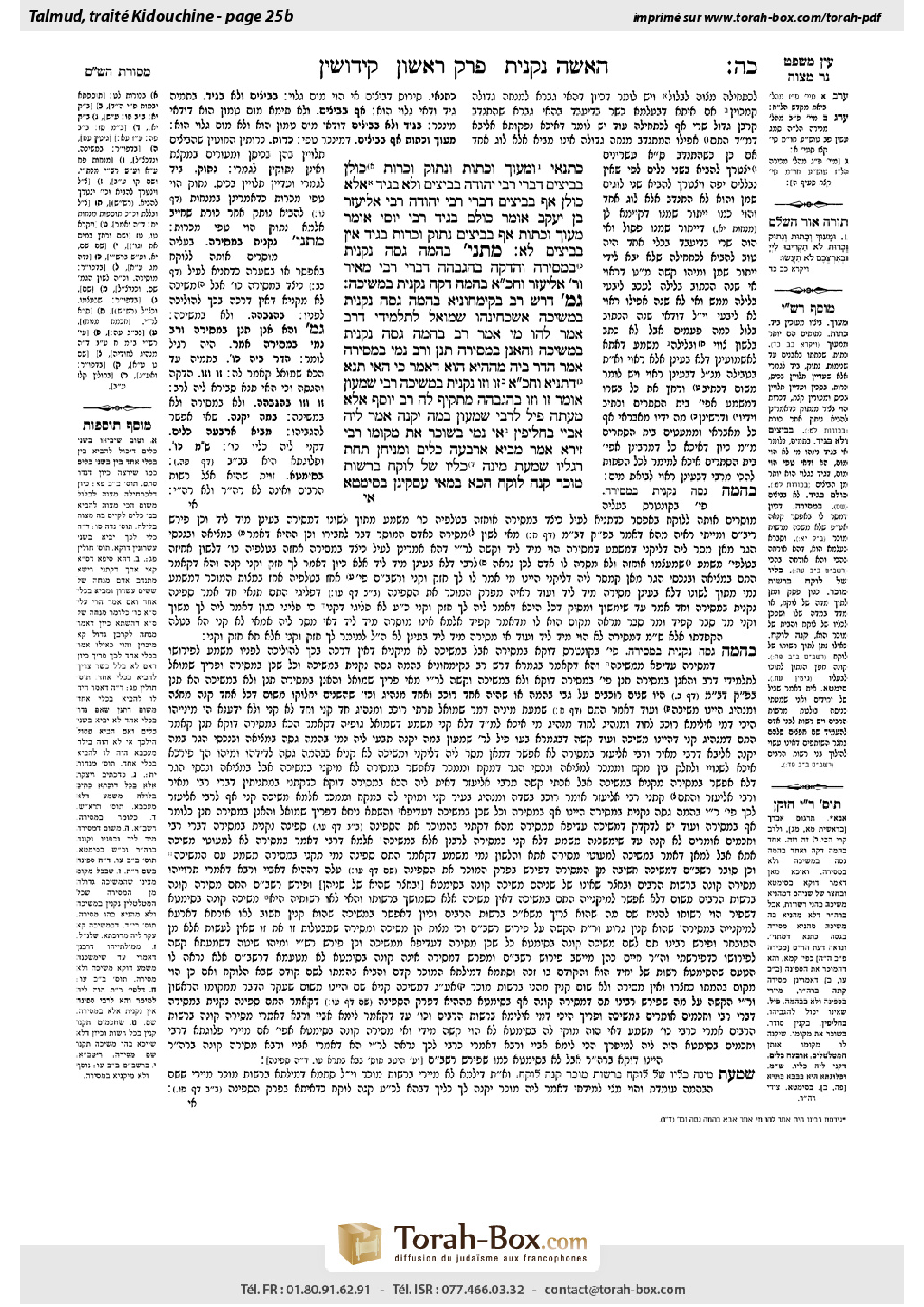
Kiddushin 25b: Talmud study for Daf Yomi
Daf Yomi is the daily study of one Talmud folio. Explore 37 tractates with scans, Hebrew text, Sefaria English and AI-generated French translations where annotated.
Passage selection and English or AI-generated French translation are available where the scan has annotations. Daf Study is independent of Torah-Box and Sefaria.
Browse Kiddushin · קידושין · All tractatesKiddushin 25b text and translations
This page of Kiddushin includes the Aramaic text, an English translation and an AI-generated French translation, alongside the scan above.
קידושין כ״ה ב · Aramaic and Hebrew text
כְּתַנָּאֵי: ״וּמָעוּךְ וְכָתוּת וְנָתוּק וְכָרוּת״ – כּוּלָּן בַּבֵּיצִים, דִּבְרֵי רַבִּי יְהוּדָה.
בַּבֵּיצִים וְלֹא בַּגִּיד? אֶלָּא: כּוּלָּן אַף בַּבֵּיצִים, דִּבְרֵי רַבִּי יְהוּדָה. רַבִּי אֱלִיעֶזֶר בֶּן יַעֲקֹב אוֹמֵר: כּוּלָּם בַּגִּיד. רַבִּי יוֹסֵי אוֹמֵר: ״מָעוּךְ וְכָתוּת״ – אַף בַּבֵּיצִים, ״נָתוּק וְכָרוּת״ – בְּגִיד – אִין, בְּבֵיצִים – לָא.
מַתְנִי׳ בְּהֵמָה גַּסָּה נִקְנֵית בִּמְסִירָה, וְהַדַּקָּה בְּהַגְבָּהָה, דִּבְרֵי רַבִּי מֵאִיר וְרַבִּי אֱלִיעֶזֶר. וַחֲכָמִים אוֹמְרִים: בְּהֵמָה דַּקָּה נִקְנֵית בִּמְשִׁיכָה.
גְּמָ׳ דָּרֵשׁ רַב בְּקִימְחוֹנְיָא: בְּהֵמָה גַּסָּה נִקְנֵית בִּמְשִׁיכָה. אַשְׁכְּחִינְהוּ שְׁמוּאֵל לְתַלְמִידֵי דְּרַב, אֲמַר לְהוּ: מִי אָמַר רַב בְּהֵמָה גַּסָּה נִקְנֵית בִּמְשִׁיכָה? וְהָאֲנַן בִּמְסִירָה תְּנַן! וְרַב נָמֵי בִּמְסִירָה אָמַר, הֲדַר בֵּיהּ מֵהַהִיא? הוּא דְּאָמַר כִּי הַאי תַּנָּא, דְּתַנְיָא: וַחֲכָמִים אוֹמְרִים: זוֹ וְזוֹ נִקְנֵית בִּמְשִׁיכָה. רַבִּי שִׁמְעוֹן אוֹמֵר: זוֹ וְזוֹ בְּהַגְבָּהָה.
מַתְקֵיף לַהּ רַב יוֹסֵף: אֶלָּא מֵעַתָּה, פִּיל לְרַבִּי שִׁמְעוֹן בַּמֶּה יִקָּנֶה? אֲמַר לֵיהּ אַבָּיֵי: בַּחֲלִיפִין. אִי נָמֵי בְּשׂוֹכֵר אֶת מְקוֹמוֹ.
רַבִּי זֵירָא אָמַר: מֵבִיא אַרְבָּעָה כֵּלִים וּמַנִּיחָן תַּחַת רַגְלָיו. שָׁמְעַתְּ מִינַּהּ: כִּלְיוֹ שֶׁל לוֹקֵחַ בִּרְשׁוּת מוֹכֵר – קָנָה לוֹקֵחַ? הָכָא בְּמַאי עָסְקִינַן, בְּסִימְטָא.
Kiddushin 25b · English translation
The Gemara comments that the first question with regard to castration of the testicles is like a dispute between tanna’im. It is stated with regard to animals that cannot be used as offerings due to blemishes: “That whose stones are bruised, or crushed, or torn, or cut you shall not sacrifice to the Lord” (Leviticus 22:24). All of these blemishes are referring to the animal’s testicles; this is the statement of Rabbi Yehuda.
The Gemara asks: Could Rabbi Yehuda possibly mean that these blemishes apply only to the testicles and not to the penis? Certainly these should also be considered blemishes if they affect the penis, which is more exposed than the testicles. Rather, this is what the baraita is saying: All of these blemishes apply to the testicles also; this is the statement of Rabbi Yehuda. Rabbi Eliezer ben Ya’akov says: All of them apply only to the penis. Rabbi Yosei states the following distinction: “Bruised or crushed” applies to the testicles also. Conversely, when there are areas that are “broken or cut” on the penis, yes, these are considered a blemish, but on the testicles, no, they are not a blemish.
MISHNA: A large domesticated animal is acquired by passing, when its current owner transfers it to a buyer by giving him the reins or the bit. And a small domesticated animal is acquired by lifting. This is the statement of Rabbi Meir and Rabbi Eliezer. And the Rabbis say: A small domesticated animal can be acquired by pulling also, and there is no need to lift it.
GEMARA: Rav taught in the town of Kimḥonya: A large domesticated animal is acquired by pulling. Shmuel found Rav’s students and said to them: Did Rav actually say that a large domesticated animal is acquired by pulling? But didn’t we learn in the mishna that it is acquired by passing? And several times I also heard Rav say that it is acquired by passing. Did he retract that ruling? Rav’s students replied: In fact, Rav retracted that ruling and he states his opinion in accordance with the opinion of that tanna, i.e., the Rabbis, as it is taught in a baraita: And the Rabbis say: Both small and large domesticated animals are acquired by pulling. Rabbi Shimon says: Both are acquired by lifting.
Rav Yosef objects to this: If that is so, by what mode of acquisition can an elephant be acquired, according to the opinion of Rabbi Shimon? It is impossible to lift an elephant. Abaye said to him: It is possible to acquire it by the mode of acquisition of symbolic exchange, a legal act of acquisition formalizing the transfer of ownership of an article. Alternatively, one can acquire an elephant by renting its place temporarily and acquiring the elephant by means of the ground upon which it is standing.
Rabbi Zeira says that there is another method: One brings four vessels and places them under the elephant’s feet, and he thereby acquires it like any other item that is inside the buyer’s vessels. The Gemara asks: Can you learn from Rabbi Zeira’s statement that if the buyer’s vessels, being used to acquire an item from the seller, are in the seller’s domain, the buyer acquires the item? The Gemara rejects this: This is no proof, as with what are we dealing here? The case in question is one where the vessels are not in the seller’s domain but in an alley [simta], which is neither a public nor a private domain. In a place of this kind the buyer’s vessels certainly effect acquisition for him.
Kiddushin 25b · Traduction française (IA)
La Guemara fait remarquer que la première question concernant la castration des testicules fait l’objet d’une controverse entre tannaïm. À propos des animaux inaptes à être offerts en sacrifice en raison de défauts, il est dit : « Celui dont les testicules sont meurtris, écrasés, arrachés ou coupés, vous ne l’offrirez pas au Seigneur » (Lévitique 22, 24). Tous ces défauts concernent les testicules de l’animal ; telle est l’opinion de Rabbi Yehouda.
La Guemara demande : Rabbi Yehouda peut-il vraiment vouloir dire que ces défauts concernent uniquement les testicules et non le pénis ? Ils devraient certainement aussi être considérés comme des défauts lorsqu’ils touchent le pénis, qui est plus exposé que les testicules. Il faut plutôt comprendre ainsi l’enseignement de la baraïta : tous ces défauts concernent aussi les testicules ; telle est l’opinion de Rabbi Yehouda. Rabbi Eliezer ben Ya’akov dit : ils concernent tous uniquement le pénis. Rabbi Yossei établit la distinction suivante : « Meurtri ou écrasé » s’applique aussi aux testicules. En revanche, si des parties du pénis sont « brisées ou coupées », cela constitue un défaut, mais dans le cas des testicules, cela ne constitue pas un défaut.
MICHNA : Un grand animal domestique s’acquiert par conduite, lorsque son propriétaire actuel le cède à un acheteur en lui remettant les rênes ou le mors. Un petit animal domestique s’acquiert par soulèvement. Telle est l’opinion de Rabbi Meïr et de Rabbi Eliezer. Les Sages disent : un petit animal domestique peut aussi s’acquérir par traction, sans qu’il soit nécessaire de le soulever.
GUEMARA : Rav enseignait dans la ville de Kimḥonya : un grand animal domestique s’acquiert par traction. Shmuel rencontra les élèves de Rav et leur dit : Rav a-t-il vraiment dit qu’un grand animal domestique s’acquiert par traction ? N’avons-nous pas appris dans la Michna qu’il s’acquiert par conduite ? Et j’ai moi aussi entendu Rav dire à plusieurs reprises qu’il s’acquiert par conduite. A-t-il renoncé à cette décision ? Les élèves de Rav lui répondirent : En réalité, Rav a renoncé à cette décision et exprime son opinion conformément à celle de ce tanna, c’est-à-dire les Sages, comme l’enseigne une baraïta : Les Sages disent que les petits et les grands animaux domestiques s’acquièrent par traction. Rabbi Shimon dit que les uns et les autres s’acquièrent par soulèvement.
Rav Yossef objecte : Si tel est le cas, par quel mode d’acquisition peut-on acquérir un éléphant, selon l’opinion de Rabbi Shimon ? Il est impossible de soulever un éléphant. Abayé lui répondit : On peut l’acquérir par échange symbolique, un acte juridique qui formalise le transfert de propriété d’un objet. On peut aussi acquérir un éléphant en louant temporairement l’emplacement où il se trouve, puis l’acquérir par le terrain sur lequel il se tient.
Rabbi Zeira dit qu’il existe une autre méthode : on apporte quatre récipients et on les place sous les pattes de l’éléphant ; on l’acquiert ainsi comme tout autre objet qui se trouve dans les récipients de l’acheteur. La Guemara demande : Peut-on déduire de la déclaration de Rabbi Zeira que si les récipients de l’acheteur, utilisés pour acquérir un objet auprès du vendeur, se trouvent dans le domaine du vendeur, l’acheteur acquiert l’objet ? La Guemara rejette cette déduction : ce n’est pas une preuve, car de quel cas s’agit-il ici ? Les récipients ne se trouvent pas dans le domaine du vendeur, mais dans une ruelle [simta], qui n’est ni un domaine public ni un domaine privé. Dans un lieu de ce genre, les récipients de l’acheteur réalisent certainement l’acquisition en sa faveur.
Traduction française générée par IA à partir de l’édition anglaise de Sefaria. Vérifie toujours un passage avec le texte source.
Text from Sefaria: William Davidson Edition - Vocalized Aramaic (CC BY NC); William Davidson Edition - English (CC BY NC).