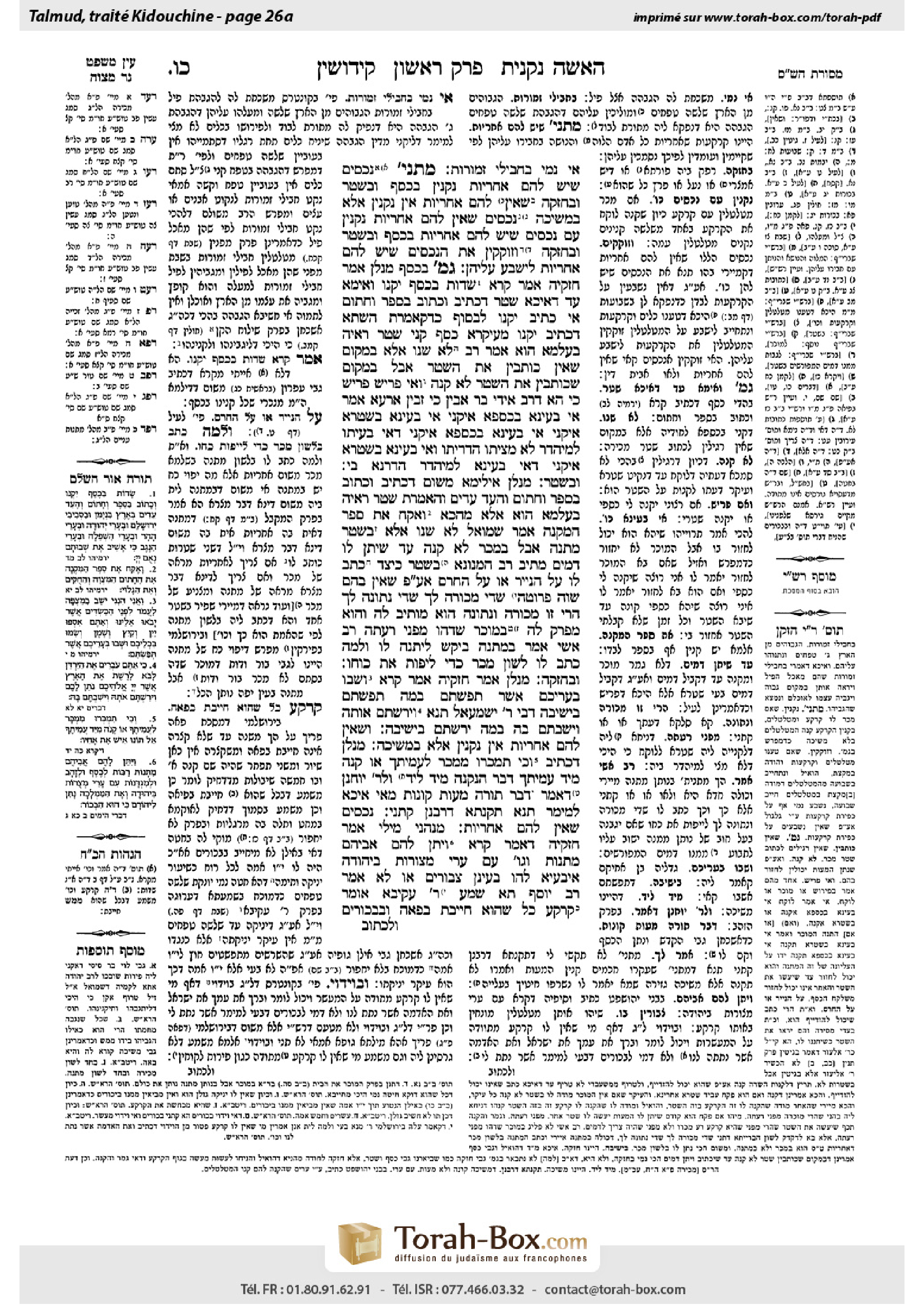
Kiddushin 26a: Talmud study for Daf Yomi
Daf Yomi is the daily study of one Talmud folio. Explore 37 tractates with scans, Hebrew text, Sefaria English and AI-generated French translations where annotated.
Passage selection and English or AI-generated French translation are available where the scan has annotations. Daf Study is independent of Torah-Box and Sefaria.
Browse Kiddushin · קידושין · All tractatesKiddushin 26a text and translations
This page of Kiddushin includes the Aramaic text, an English translation and an AI-generated French translation, alongside the scan above.
קידושין כ״ו א · Aramaic and Hebrew text
אִי נָמֵי: בַּחֲבִילֵי זְמוֹרוֹת.
מַתְנִי׳ נְכָסִים שֶׁיֵּשׁ לָהֶם אַחְרָיוּת – נִקְנִין בְּכֶסֶף וּבִשְׁטָר וּבַחֲזָקָה. שֶׁאֵין לָהֶם אַחְרָיוּת – אֵין נִקְנִין אֶלָּא בִּמְשִׁיכָה. נְכָסִים שֶׁאֵין לָהֶם אַחְרָיוּת נִקְנִין עִם נְכָסִים שֶׁיֵּשׁ לָהֶם אַחְרָיוּת בְּכֶסֶף וּבִשְׁטָר וּבַחֲזָקָה,
וְזוֹקְקִין אֶת הַנְּכָסִים שֶׁיֵּשׁ לָהֶם אַחְרָיוּת לִישָּׁבַע עֲלֵיהֶן.
גְּמָ׳ בְּכֶסֶף מְנָלַן? אָמַר חִזְקִיָּה: אָמַר קְרָא: ״שָׂדוֹת בַּכֶּסֶף יִקְנוּ״. וְאֵימָא עַד דְּאִיכָּא שְׁטָר, דִּכְתִיב: ״וְכָתוֹב בַּסֵּפֶר וְחָתוֹם״! אִי כְּתִיב ״יִקְנוּ״ לְבַסּוֹף – כִּדְקָאָמְרַתְּ, הַשְׁתָּא דִּכְתִיב ״יִקְנוּ״ מֵעִיקָּרָא, כֶּסֶף – קָנֵי, שְׁטָר – רְאָיָה בְּעָלְמָא הוּא.
אָמַר רַב: לֹא שָׁנוּ אֶלָּא בִּמְקוֹם שֶׁאֵין כּוֹתְבִין אֶת הַשְּׁטָר, אֲבָל בִּמְקוֹם שֶׁכּוֹתְבִין אֶת הַשְּׁטָר – לֹא קָנָה. וְאִי פָּרֵישׁ – פָּרֵישׁ.
כִּי הָא דְּרַב אִידִי בַּר אָבִין כִּי זָבֵין אַרְעָא, אָמַר: אִי בָּעֵינָא בְּכַסְפָּא – אִיקְנֵי, אִי בָּעֵינָא בִּשְׁטָרָא – אִיקְנֵי. אִי בָּעֵינָא בְּכַסְפָּא – אִיקְנֵי, דְּאִי בָּעֵיתוּ לְמִיהְדַּר, לָא מָצִיתוּ הָדְרִיתוּ. וְאִי בָּעֵינָא בִּשְׁטָרָא – אִיקְנֵי, דְּאִי בָּעֵינָא לְמִיהְדַּר, הָדַרְנָא בִּי.
וּבִשְׁטָר. מְנָלַן? אִילֵּימָא מִשּׁוּם דִּכְתִיב: ״וְכָתוֹב בַּסֵּפֶר וְחָתוֹם וְהָעֵד עֵדִים״, וְהָאָמְרַתְּ שְׁטָר רְאָיָה בְּעָלְמָא הוּא! אֶלָּא מֵהָכָא, ״וָאֶקַּח אֶת סֵפֶר הַמִּקְנָה״. אָמַר שְׁמוּאֵל: לֹא שָׁנוּ אֶלָּא בִּשְׁטַר מַתָּנָה, אֲבָל בְּמֶכֶר לֹא קָנָה עַד שֶׁיִּתֵּן לוֹ דָּמִים.
מֵתִיב רַב הַמְנוּנָא: בִּשְׁטָר כֵּיצַד? כָּתַב לוֹ עַל הַנְּיָיר אוֹ עַל הַחֶרֶס, אַף עַל פִּי שֶׁאֵין בָּהֶם שָׁוֶה פְּרוּטָה, ״שָׂדִי מְכוּרָה לָךְ״, ״שָׂדִי נְתוּנָה לְךָ״ – הֲרֵי זוֹ מְכוּרָה וּנְתוּנָה. הוּא מוֹתֵיב לַהּ וְהוּא מְפָרֵק לַהּ: בְּמוֹכֵר שָׂדֵהוּ מִפְּנֵי רָעָתָהּ.
רַב אָשֵׁי אָמַר: בְּמַתָּנָה בִּיקֵּשׁ לִיתְּנָהּ לוֹ, וְלָמָּה כָּתַב לוֹ לְשׁוֹן מֶכֶר – כְּדֵי לְיַפּוֹת אֶת כּוֹחוֹ.
וּבַחֲזָקָה. מְנָלַן? אָמַר חִזְקִיָּה: אָמַר קְרָא: ״וּשְׁבוּ בְּעָרֵיכֶם אֲשֶׁר תְּפַשְׂתֶּם״, בַּמֶּה תְּפַשְׂתֶּם – בִּישִׁיבָה. דְּבֵי רַבִּי יִשְׁמָעֵאל תָּנָא: ״וִירִשְׁתֶּם אֹתָהּ וִישַׁבְתֶּם בָּהּ״, בַּמֶּה יְרַשְׁתֶּם – בִּישִׁיבָה.
וְשֶׁאֵין לָהֶם אַחְרָיוּת אֵין נִקְנִין אֶלָּא בִּמְשִׁיכָה. מְנָלַן? דִּכְתִיב: ״וְכִי תִמְכְּרוּ מִמְכָּר לַעֲמִיתֶךָ אוֹ קָנֹה מִיַּד עֲמִיתֶךָ״ – דָּבָר הַנִּקְנֶה מִיָּד לְיָד.
וּלְרַבִּי יוֹחָנָן דְּאָמַר: דְּבַר תּוֹרָה מָעוֹת קוֹנוֹת, מַאי אִיכָּא לְמֵימַר? תַּנָּא תַּקַּנְתָּא דְרַבָּנַן קָתָנֵי.
נְכָסִים שֶׁאֵין לָהֶם אַחְרָיוּת. מְנָהָנֵי מִילֵּי? אָמַר חִזְקִיָּה: דְּאָמַר קְרָא: ״וַיִּתֵּן לָהֶם אֲבִיהֶם מַתָּנוֹת וְגוֹ׳ עִם עָרֵי מְצֻרוֹת בִּיהוּדָה״.
אִיבַּעְיָא לְהוּ: בָּעֵינַן צְבוּרִים, אוֹ לָא? אָמַר רַב יוֹסֵף: תָּא שְׁמַע: רַבִּי עֲקִיבָא אוֹמֵר: קַרְקַע כׇּל שֶׁהוּא חַיֶּיבֶת בַּפֵּאָה, וּבַבִּכּוּרִים,
Kiddushin 26a · English translation
Alternatively, the buyer can lift an elephant by using bundles of vines. He leads the elephant to them, and when the elephant stands on the bundles of vines this is considered lifting the elephant.
MISHNA: Property that serves as a guarantee, i.e., land or other items that are fixed in the earth, can be acquired by means of giving money, by means of giving a document, or by means of taking possession of it. Property that does not serve as a guarantee, i.e., movable property, can be acquired only by pulling. Property that does not serve as a guarantee can be acquired along with property that serves as a guarantee by means of giving money, by means of giving a document, or by means of taking possession of them. The movable property is transferred to the buyer’s possession when it is purchased together with the land, by means of an act of acquisition performed on the land.
Generally, one is not obligated to take an oath concerning the denial of a claim with regard to land. The mishna continues: And in a legal dispute involving both land and movable property, if the defendant makes a partial admission of the claim with regard to the movable property, thereby rendering himself obligated to take an oath denying any responsibility for the remaining property, the movable property binds the property that serves as a guarantee, i.e., the land, so that he is forced to take an oath concerning the land as well, despite the fact that one is generally not obligated to take an oath for a claim involving land.
GEMARA: The Gemara inquires: From where do we derive that land can be acquired by means of money? Ḥizkiyya said that the verse states: “They shall acquire fields with money” (Jeremiah 32:44). The Gemara asks: But if the proof is from that verse, one can say that the acquisition is not valid unless there is a document as well, as it is written in the same verse: “And write a document and sign” (Jeremiah 32:44). The Gemara answers: If it were written: They shall acquire fields with money, at the end of the verse, it would be as you said, that one must also write a document so that he can acquire the land with money. Now that it is written “they shall acquire” at the beginning of the verse, this teaches that the money itself effects acquisition of the land, and the document is merely a proof.
Rav says: They taught that land can be acquired by means of money alone, i.e., without a document, only in a place where the custom is that they do not write documents; but in a place where the custom is that they write documents one does not acquire land until a document is given to him. And if he specified that he wishes to acquire the land from the time of the money transfer, then he has specified his wishes, and the land is acquired once the money is given.
The Gemara comments: This is like that which Rav Idi bar Avin would do. When purchasing land, Rav Idi bar Avin would say: If I wish to acquire it by means of money, I will acquire it in that manner, and if I wish to acquire it by means of a document, I will acquire it by that method. He would stipulate at the outset that he reserves the right to choose how the transaction will be finalized. The Gemara elaborates: If I wish to acquire it by means of money, I will acquire it in that way, as, if you wish to retract your participation in the sale you cannot retract it, because the money has already changed hands. And if I wish to acquire the land by means of a document, I will acquire it in that way, as, if I wish to retract my participation in the sale I can retract it provided that I have not received a document of purchase.
§ The mishna teaches that land can be purchased by means of a document. The Gemara asks: From where do we derive this? If we say that it is because it is written: “And write in a document and sign, and witnesses shall testify” (Jeremiah 32:44), but didn’t you say that the document mentioned in the verse is merely a document of proof? Rather, it is derived from here: “And I took the deed of purchase” (Jeremiah 32:11), an expression that indicates that the document itself effects the acquisition. Shmuel said: The Sages taught that the document itself effects acquisition only in the case of a deed of a gift. But with regard to a sale, it does not effect acquisition until the buyer gives the seller money. The document itself does not effect the acquisition.
Rav Hamnuna raises an objection to this from a baraita: How is acquisition performed by means of a document? If he wrote for him on paper or earthenware, even though the paper or the earthenware is not worth one peruta: My field is sold to you, or: My field is given to you as a gift, it is thereby sold or given. This indicates that a document is sufficient to effect acquisition both in the case of a sale and in the case of a gift. Rav Hamnuna raised the objection and he resolved it: The baraita is referring to one who sells his field due to its poor quality. The seller wants to be rid of his field due to its decreasing value and would like to transfer ownership of it as quickly as possible. In this case writing a document is enough to complete the acquisition.
Rav Ashi says: It can be claimed that the entire baraita is referring to one case, that of a gift one wished to give another. The baraita does not deal with a sale at all. And why does he write for him a deed for a gift containing the language of a sale? He does it in order to enhance his power. If it turns out that there was a lien on this land, the beneficiary can collect the value of the field from the giver’s other property, as though this land had been sold to him. In other words, by writing that it is a sale, the giver grants the beneficiary the acquisition power of a buyer, but since the transaction is actually a gift, the document itself completes the acquisition.
§ The mishna further teaches that land can be acquired by means of taking possession of it. The Gemara asks: From where do we derive this? Ḥizkiyya said that the verse states: “And dwell in your cities that you have taken” (Jeremiah 40:10). In what manner have you taken these cities? They are taken by dwelling, which indicates that taking possession of a plot of land and dwelling there is an act demonstrating ownership, and it is itself a valid act of acquisition. A Sage from the school of Rabbi Yishmael taught a different proof: “And you shall possess it and dwell there” (Deuteronomy 11:31). How have you possessed it? You have done so by dwelling there. This teaches that land can be acquired through an act that demonstrates ownership.
§ The mishna teaches that property that does not serve as a guarantee can be acquired only by pulling. The Gemara asks: From where do we derive this? As it is written: “And if you sell any item to your neighbor or buy from your neighbor’s hand” (Leviticus 25:14). This verse speaks of an item that is acquired from hand to hand, i.e., by pulling.
The Gemara asks: And according to the opinion of Rabbi Yoḥanan, who says that by Torah law giving money effects acquisition but pulling does not, what can be said? Rabbi Yoḥanan maintains that acquisition through pulling is a rabbinic decree, and by Torah law movable property can be acquired only by means of giving money. Why does the mishna not mention this mode of acquisition? The Gemara answers: Rabbi Yoḥanan could answer that the tanna teaches a rabbinic ordinance, which reflects the accepted practice, but he does not find it necessary to mention a mode of acquisition that applies by Torah law.
§ The mishna further states that property that does not serve as a guarantee, i.e., movable property, can be acquired along with property that serves as a guarantee, i.e., land. The Gemara asks: From where is this matter derived? Ḥizkiyya said that the verse states: “And their father gave them great gifts, of silver, and of gold, and of precious things, with fortified cities in Judah” (II Chronicles 21:3). This indicates that he gave them movable items together with the cities. He did not need to give the items to them directly, as he was able to transfer these gifts by means of the cities he gave them.
A dilemma was raised before the Sages with regard to this matter of acquisition of movable property by way of land: Do we require that this movable property be actually piled on the land that is sold or not? Rav Yosef said: Come and hear a proof from the following mishna (Pe’a 3:6). Rabbi Akiva says: The owner of any amount of land is obligated in pe’a and in first fruits,
Kiddushin 26a · Traduction française (IA)
Autrement, l’acheteur peut soulever un éléphant au moyen de fagots de lianes. Il le conduit jusqu’aux fagots et, lorsque l’éléphant se tient dessus, cela est considéré comme le fait de soulever l’éléphant.
Michna : Les biens servant de garantie, c’est-à-dire les terres ou les autres biens fixés au sol, peuvent être acquis par le versement d’argent, par la remise d’un document ou par la prise de possession. Les biens ne servant pas de garantie, c’est-à-dire les biens mobiliers, ne peuvent être acquis que par traction. Les biens ne servant pas de garantie peuvent être acquis avec des biens servant de garantie par le versement d’argent, par la remise d’un document ou par la prise de possession de ces derniers. Les biens mobiliers passent en la possession de l’acheteur lorsqu’ils sont acquis avec la terre au moyen d’un acte d’acquisition accompli sur celle-ci.
En règle générale, on n’est pas tenu de prêter serment lorsqu’on nie une réclamation portant sur des terres. La Michna poursuit : Dans un litige portant à la fois sur des terres et des biens mobiliers, si le défendeur reconnaît partiellement la réclamation concernant les biens mobiliers, ce qui l’oblige à prêter serment et à nier toute responsabilité concernant le reste des biens, les biens mobiliers entraînent avec eux les biens servant de garantie, c’est-à-dire les terres. Il est donc également contraint de prêter serment au sujet des terres, bien qu’en règle générale on ne soit pas tenu de prêter serment au sujet d’une réclamation portant sur des terres.
Guemara : La Guemara demande : D’où déduisons-nous que la terre peut être acquise par le versement d’argent ? Ḥizkiyya dit que le verset énonce : « Ils achèteront des champs avec de l’argent » (Jérémie 32,44). La Guemara demande : Mais si la preuve est tirée de ce verset, on pourrait dire que l’acquisition n’est valable que s’il y a également un document, puisqu’il est écrit dans le même verset : « Et écris un document et signe » (Jérémie 32,44). La Guemara répond : Si le verset disait à la fin : « Ils achèteront des champs avec de l’argent », tu aurais raison : il faudrait aussi rédiger un document pour acquérir la terre avec de l’argent. Mais puisque l’expression « ils achèteront » figure au début du verset, cela enseigne que l’argent lui-même réalise l’acquisition de la terre et que le document n’est qu’une preuve.
Rav dit : Ils ont enseigné que la terre peut être acquise par le seul versement d’argent, c’est-à-dire sans document, uniquement dans un lieu où l’usage est de ne pas rédiger de documents. Mais dans un lieu où l’usage est d’en rédiger, on n’acquiert pas la terre tant qu’un document ne lui a pas été remis. Toutefois, s’il a précisé qu’il souhaitait acquérir la terre dès le versement de l’argent, sa volonté est clairement exprimée et la terre est acquise dès que l’argent est versé.
La Guemara fait remarquer : Cela correspond à la pratique de Rav Idi bar Avin. Lorsqu’il achetait une terre, Rav Idi bar Avin disait : « Si je souhaite l’acquérir par le versement d’argent, je l’acquerrai de cette manière ; et si je souhaite l’acquérir par un document, je l’acquerrai de cette manière. » Il stipulait d’emblée qu’il se réservait le droit de choisir la manière dont la transaction serait finalisée. La Guemara précise : « Si je souhaite l’acquérir par le versement d’argent, je l’acquerrai ainsi », car si tu souhaites te retirer de la vente, tu ne peux plus le faire, puisque l’argent a déjà changé de mains. « Et si je souhaite acquérir la terre par un document, je l’acquerrai ainsi », car si je souhaite me retirer de la vente, je peux le faire tant que je n’ai pas reçu le document d’achat.
§ La Michna enseigne que la terre peut être acquise par un document. La Guemara demande : D’où déduisons-nous cela ? Si l’on répond que c’est parce qu’il est écrit : « Et écris dans un document, signe-le, et des témoins attesteront » (Jérémie 32,44), ne viens-tu pas de dire que le document mentionné dans le verset n’est qu’un document de preuve ? Il faut plutôt le déduire de ceci : « Et je pris l’acte d’achat » (Jérémie 32,11), expression indiquant que le document lui-même réalise l’acquisition. Chmouel dit : Les Sages ont enseigné que le document lui-même réalise l’acquisition uniquement dans le cas d’un acte de donation. Dans le cas d’une vente, en revanche, il ne réalise pas l’acquisition tant que l’acheteur n’a pas remis d’argent au vendeur. Le document lui-même ne réalise donc pas l’acquisition.
Rav Hamnouna soulève une objection à partir d’une baraïta : Comment réalise-t-on une acquisition par un document ? S’il a écrit pour lui, sur du papier ou sur un tesson, même si le papier ou le tesson ne vaut pas une perouta : « Mon champ t’est vendu » ou « Mon champ t’est donné en cadeau », le champ est ainsi vendu ou donné. Cela indique qu’un document suffit à réaliser l’acquisition aussi bien dans le cas d’une vente que dans celui d’une donation. Rav Hamnouna soulève l’objection, puis y répond : La baraïta parle de quelqu’un qui vend son champ parce qu’il est de mauvaise qualité. Le vendeur veut se débarrasser de son champ en raison de la baisse de sa valeur et souhaite en transférer la propriété aussi rapidement que possible. Dans ce cas, la rédaction d’un document suffit à conclure l’acquisition.
Rav Achi dit : On peut soutenir que toute la baraïta porte sur un seul cas, celui d’une personne qui souhaite faire une donation à une autre. La baraïta ne traite pas du tout d’une vente. Pourquoi rédige-t-il pour lui un acte de donation formulé comme une vente ? Il le fait afin de renforcer les droits du bénéficiaire. S’il s’avère que cette terre était grevée d’un privilège, le bénéficiaire peut recouvrer auprès des autres biens du donateur la valeur du champ, comme si cette terre lui avait été vendue. Autrement dit, en indiquant qu’il s’agit d’une vente, le donateur confère au bénéficiaire les droits d’un acheteur ; mais puisque la transaction est en réalité une donation, le document lui-même réalise l’acquisition.
§ La Michna enseigne en outre que la terre peut être acquise par la prise de possession. La Guemara demande : D’où déduisons-nous cela ? Ḥizkiyya dit que le verset énonce : « Habitez dans les villes que vous avez prises » (Jérémie 40,10). De quelle manière avez-vous pris ces villes ? Vous les avez prises en y habitant. Cela indique que prendre possession d’une parcelle de terre et y habiter est un acte qui manifeste la propriété et constitue en soi un acte d’acquisition valable. Un Sage de l’école de Rabbi Yichmaël a enseigné une autre preuve : « Vous en prendrez possession et vous y habiterez » (Deutéronome 11,31). Comment en avez-vous pris possession ? Vous l’avez fait en y habitant. Cela enseigne que la terre peut être acquise par un acte qui manifeste la propriété.
§ La Michna enseigne que les biens ne servant pas de garantie ne peuvent être acquis que par traction. La Guemara demande : D’où déduisons-nous cela ? C’est qu’il est écrit : « Si tu vends quelque bien à ton prochain ou si tu achètes de la main de ton prochain » (Lévitique 25,14). Ce verset parle d’un bien acquis de la main à la main, c’est-à-dire par traction.
La Guemara demande : Et selon l’opinion de Rabbi Yoḥanan, qui dit que, selon la Torah, le versement d’argent réalise l’acquisition, mais non la traction, que peut-on répondre ? Rabbi Yoḥanan soutient que l’acquisition par traction est un décret rabbinique et que, selon la Torah, les biens mobiliers ne peuvent être acquis que par le versement d’argent. Pourquoi la Michna ne mentionne-t-elle pas ce mode d’acquisition ? La Guemara répond : Rabbi Yoḥanan pourrait dire que le tanna enseigne une règle rabbinique, qui reflète la pratique admise, mais qu’il ne juge pas nécessaire de mentionner un mode d’acquisition applicable selon la Torah.
§ La Michna dit en outre que les biens ne servant pas de garantie, c’est-à-dire les biens mobiliers, peuvent être acquis avec des biens servant de garantie, c’est-à-dire des terres. La Guemara demande : D’où cette règle est-elle tirée ? Ḥizkiyya dit que le verset énonce : « Leur père leur donna de grands présents, d’argent, d’or et de biens précieux, ainsi que des villes fortifiées en Juda » (II Chroniques 21,3). Cela indique qu’il leur donna des biens mobiliers avec les villes. Il n’avait pas besoin de leur remettre directement ces biens, car il pouvait leur transférer ces présents par l’intermédiaire des villes qu’il leur donnait.
Une question fut posée aux Sages au sujet de cette règle d’acquisition des biens mobiliers par l’intermédiaire de la terre : exige-t-on que ces biens mobiliers soient effectivement empilés sur la terre vendue, ou non ? Rav Yossef dit : « Viens et entends une preuve tirée de la Michna suivante » (Pea 3,6). Rabbi Akiva dit : « Le propriétaire de toute étendue de terre, quelle qu’en soit la superficie, est tenu à l’obligation de la pea et des prémices. »
Traduction française générée par IA à partir de l’édition anglaise de Sefaria. Vérifie toujours un passage avec le texte source.
Text from Sefaria: William Davidson Edition - Vocalized Aramaic (CC BY NC); William Davidson Edition - English (CC BY NC).