Kiddushin 26b: Talmud study for Daf Yomi
Daf Yomi is the daily study of one Talmud folio. Explore 37 tractates with scans, Hebrew text, Sefaria English and AI-generated French translations where annotated.
Passage selection and English or AI-generated French translation are available where the scan has annotations. Daf Study is independent of Torah-Box and Sefaria.
Browse Kiddushin · קידושין · All tractatesKiddushin 26b text and translations
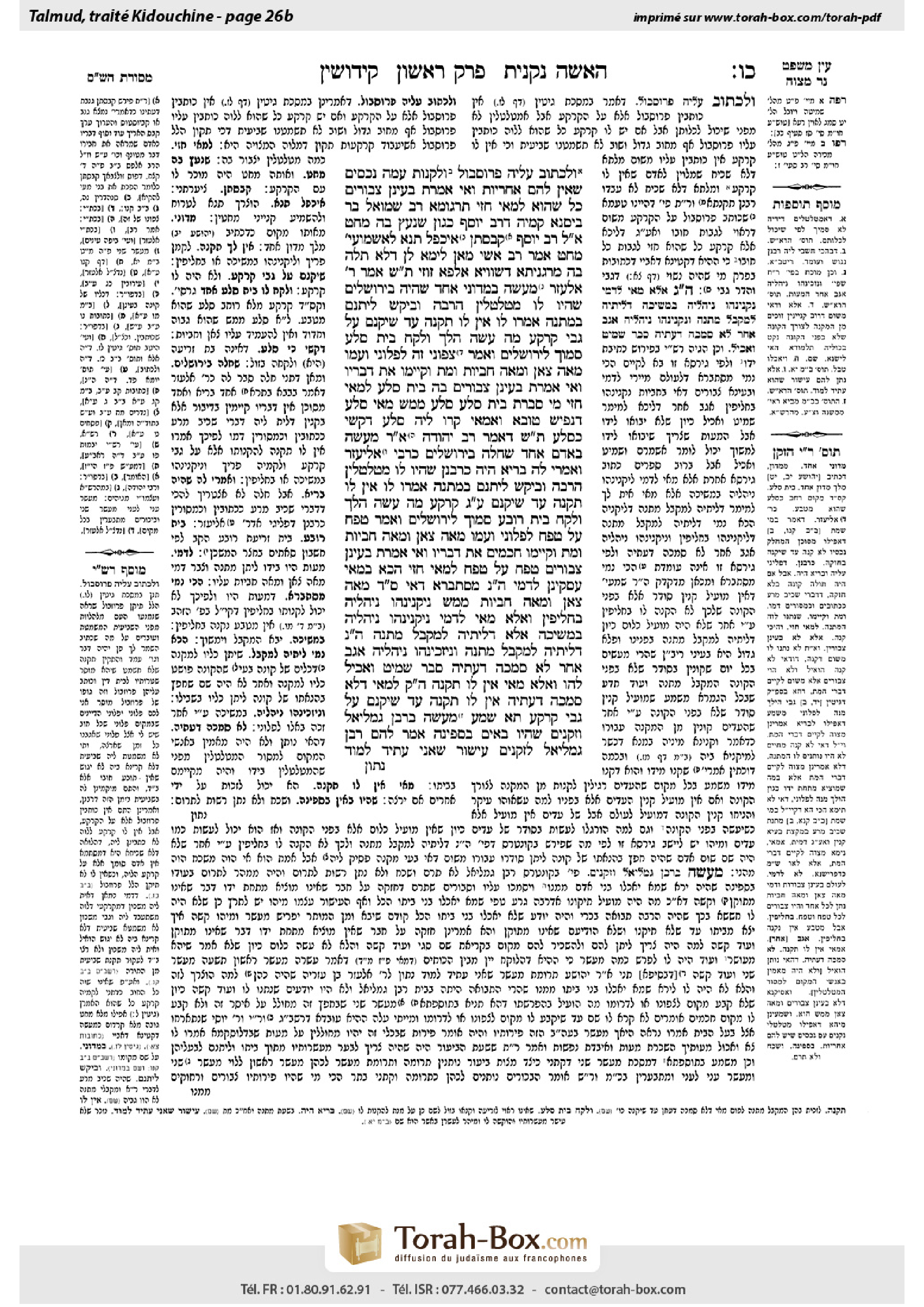
This page of Kiddushin includes the Aramaic text, an English translation and an AI-generated French translation, alongside the scan above.
קידושין כ״ו ב · Aramaic and Hebrew text
וְלִכְתּוֹב עָלֶיהָ פְּרוֹסְבּוּל, וְלִקְנוֹת עִמָּהּ נְכָסִים שֶׁאֵין לָהֶם אַחְרָיוּת. וְאִי אָמְרַתְּ בָּעֵינַן צְבוּרִים, כׇּל שֶׁהוּא לְמַאי חֲזֵי?
תַּרְגְּומַאּ רַב שְׁמוּאֵל בַּר בִּיסְנָא קַמֵּיהּ דְּרַב יוֹסֵף: כְּגוֹן שֶׁנָּעַץ בָּהּ מַחַט. אֲמַר לֵיהּ רַב יוֹסֵף: קְבַסְתַּן! אִיכְּפַל תַּנָּא לְאַשְׁמוֹעִינַן מַחַט? אָמַר רַב אָשֵׁי: מַאן לֵימָא לַן דְּלָא תְּלָה בָּהּ מַרְגָּנִיתָא דְּשָׁוְויָא אַלְפָּא זוּזֵי.
תָּא שְׁמַע, אָמַר רַבִּי אֶלְעָזָר: מַעֲשֶׂה בְּמָדוֹנִי אֶחָד שֶׁהָיָה בִּירוּשָׁלַיִם שֶׁהָיוּ לוֹ מִטַּלְטְלִין הַרְבֵּה, וּבִיקֵּשׁ לִיתְּנָם בְּמַתָּנָה. אָמְרוּ לוֹ: אֵין לוֹ תַּקָּנָה עַד שֶׁיַּקְנֵם עַל גַּבֵּי קַרְקַע. מָה עָשָׂה? הָלַךְ וְלָקַח בֵּית סֶלַע סָמוּךְ לִירוּשָׁלַיִם, וְאָמַר: ״צְפוֹנִי זֶה לִפְלוֹנִי, וְעִמּוֹ מֵאָה צֹאן וּמֵאָה חָבִיּוֹת״, וָמֵת, וְקִיְּימוּ אֶת דְּבָרָיו.
וְאִי אָמְרַתְּ בָּעֵינַן צְבוּרִים בָּהּ, בֵּית סֶלַע לְמַאי חֲזֵי? מִי סָבְרַתְּ בֵּית סֶלַע, סֶלַע מַמָּשׁ? מַאי סֶלַע – דִּנְפִישׁ טוּבָא. וְאַמַּאי קָרוּ לֵיהּ סֶלַע – דִּקְשֵׁי כְּסֶלַע.
תָּא שְׁמַע, דְּאָמַר רַב יְהוּדָה אָמַר רַב: מַעֲשֶׂה בְּאָדָם אֶחָד שֶׁחָלָה בִּירוּשָׁלַיִם – כְּרַבִּי אֱלִיעֶזֶר, וְאָמְרִי לַהּ: בָּרִיא הָיָה – כְּרַבָּנַן,
שֶׁהָיוּ לוֹ מִטַּלְטְלִין הַרְבֵּה וּבִיקֵּשׁ לִיתְּנָם בְּמַתָּנָה, אָמְרוּ לוֹ: אֵין לוֹ תַּקָּנָה עַד שֶׁיַּקְנֵם עַל גַּבֵּי קַרְקַע. מָה עָשָׂה? הָלַךְ וְלָקַח בֵּית רוֹבַע סָמוּךְ לִירוּשָׁלַיִם, וְאָמַר: ״טֶפַח עַל טֶפַח לִפְלוֹנִי וְעִמּוֹ מֵאָה צֹאן וּמֵאָה חָבִיּוֹת״, וָמֵת, וְקִיְּימוּ חֲכָמִים אֶת דְּבָרָיו. וְאִי אָמְרַתְּ בָּעֵינַן צְבוּרִים, טֶפַח עַל טֶפַח לְמַאי חֲזֵי?
הָכָא בְּמַאי עָסְקִינַן, לִדְמֵי. הָכִי נָמֵי מִסְתַּבְּרָא, דְּאִי סָלְקָא דַעְתָּךְ מֵאָה צֹאן וּמֵאָה חָבִיּוֹת מַמָּשׁ, נַיקְנִינְהוּ נִיהֲלֵיהּ בַּחֲלִיפִין.
וְאֶלָּא מַאי, לִדְמֵי? נַיקְנִינְהוּ נִיהֲלֵיהּ בִּמְשִׁיכָה! אֶלָּא: דְּלֵיתֵיהּ לִמְקַבֵּל מַתָּנָה. הָכִי נָמֵי, דְּלֵיתֵיהּ לִמְקַבֵּל מַתָּנָה.
וְנִיזְכִּינְהוּ נִיהֲלֵיהּ אַגַּב אַחֵר? לָא סָמְכָה דַּעְתֵּיהּ, סָבַר שָׁמֵיט וְאָכֵיל לְהוּ.
וְאֶלָּא מַאי ״אֵין לוֹ תַּקָּנָה״? הָכִי קָאָמַר: לְמַאי דְּלָא סָמְכָה דַּעְתֵּיהּ – אֵין לוֹ תַּקָּנָה עַד שֶׁיַּקְנֵם עַל גַּבֵּי קַרְקַע.
תָּא שְׁמַע: מַעֲשֶׂה בְּרַבָּן גַּמְלִיאֵל וּזְקֵנִים שֶׁהָיוּ בָּאִים בִּסְפִינָה, אָמַר לָהֶם רַבָּן גַּמְלִיאֵל לַזְּקֵנִים: עִישּׂוּר שֶׁאֲנִי עָתִיד לָמוֹד
Kiddushin 26b · English translation
and if the debtor possesses land of any area the creditor can write a document that prevents the Sabbatical Year from abrogating an outstanding debt [prosbol] for it so that his loans will not be canceled in the seventh year, and he can acquire property that does not serve as a guarantee along with it. And if you say that we require the movable property to be piled on the land, for what is land of any size fit? What can be piled on a tiny spot of land?
Rav Shmuel bar Bisna interpreted it before Rav Yosef as follows: For example, if one stuck a needle into a tiny patch of land, which he sold by means of the land, the needle is acquired. Rav Yosef said to him: You disgust me [kevastan]. Did the tanna go to all that trouble just to teach us that a needle can be acquired by means of land? Rav Ashi said: Who shall say to us that he did not hang a pearl worth one thousand dinars on the needle? One can acquire an item of high value through land of this size. In any event, the question of whether or not the movable property must be piled onto the land has not been resolved.
Come and hear, as Rabbi Elazar said: There was an incident involving a certain Madonite [Madoni] who was in Jerusalem, as he had a great deal of movable property and wished to give it as a gift. He was ill and did not have time for the recipient to acquire the property by pulling. The Sages said to him: One in this situation has no remedy but to transfer them by means of land. What did he do? He went and acquired a beit sela, apparently meaning land the size of a sela coin, near Jerusalem and said: This northern portion of the beit sela is given to so-and-so, and with it one hundred sheep and one hundred barrels. And the Madonite died, and the Sages fulfilled his statement and gave the gifts.
And if you say that to acquire movable property by way of land we require that the property be actually piled upon it, for what is a beit sela fit? It is impossible to pile one hundred sheep and one hundred barrels on top of such a small plot of land. The Gemara rejects this argument: Do you maintain that a beit sela is referring to a place that is actually the size of a sela coin? No; rather what is the meaning of the term sela? It is referring to a place that is very large and that could hold the many gifts. If that is true, why did they call it sela? This name indicates that it was hard as rock [sela].
Come and hear a proof from a different source, as Rav Yehuda says that Rav says: There was an incident involving a certain person who became sick in Jerusalem, and the assumption that he became sick is in accordance with the opinion of Rabbi Eliezer, who says that a person on his deathbed can transfer property only by means of an accepted standard act of acquisition. And some say he was healthy, and that assumption is in accordance with the opinion of the Rabbis that a person on his deathbed can transfer property by means of speech alone, whereas a healthy person requires an accepted act of acquisition.
The incident happened as follows: This man had a great deal of movable property and he wished to give it away as a gift. The Sages said to him: In this situation one has no remedy but to transfer movable property by means of land. What did he do? He went and acquired land the size of a beit rova near Jerusalem and said: This square handbreadth is given to so-and-so, and with it one hundred sheep and one hundred barrels. And he died, and the Sages fulfilled his statement. And if you say that we require that the property be piled on the land, for what is a square handbreadth fit? Is it possible to place all of these items in such a limited space?
The Gemara rejects this: With what are we dealing here? It is with money, i.e., he sought to give the value of the barrels and sheep, and money of this amount can be placed on a small plot of land. The Gemara comments: So too, it is reasonable that this incident involved money. As, if it enters your mind to say that it involved an actual group of one hundred sheep and one hundred barrels, let him transfer them to the recipient through an act of symbolic exchange. If the incident involved money, which cannot be transferred by symbolic exchange, he had no recourse but to acquire the land.
The Gemara raises a difficulty against this argument: Rather, what will you say, that this is referring to money, which cannot be acquired through symbolic exchange? Even so, he still could have acted differently: Let him transfer it to the recipient through pulling. Rather, you are forced to say that the recipient of this gift was not present, and the man wanted to grant him possession of it without the recipient having to perform a physical act of acquisition. So too, it is possible that the recipient of the gift was not present, and he was unable to transfer it to him through symbolic exchange. Consequently, there is no proof that the incident involved money.
The Gemara asks: Is there no other way to perform this acquisition? But let him transfer it to him by means of another person, i.e., another can pull the property on behalf of the recipient. The Gemara answers: The giver did not rely on that option, as he feared that the third party might seize it and consume it or use the property in some other manner. The giver wanted to be sure that the acquisition would be completed in full.
Rather, what then is the meaning of the statement: He has no remedy? Even if he did not want to use the option of a third party, it was certainly available to him. The Gemara explains that this is what Rav was saying and meant in his description of this incident: In accordance with his decision that he does not rely on another person and does not want to transfer property by means of anyone else, in this situation one has no remedy but to transfer movable property by means of land. In summary, no decisive proof has been cited as to whether or not it is possible to acquire movable property by means of land when the items are not piled upon the land.
Come and hear a proof from the following mishna (Ma’aser Sheni 5:9): There was an incident involving Rabban Gamliel and other Elders who were traveling on a ship. Rabban Gamliel said to the Elders: One-tenth of produce that I will measure out and separate in the future from the produce of my fields
Kiddushin 26b · Traduction française (IA)
Et si le débiteur possède un terrain, quelle qu’en soit la superficie, le créancier peut rédiger à son sujet un document qui empêche l’année sabbatique d’annuler une dette encore due [prosbol], afin que ses prêts ne soient pas annulés la septième année ; il peut également acquérir avec ce terrain des biens mobiliers qui ne servent pas de garantie. Et si tu dis qu’il faut que les biens mobiliers soient empilés sur le terrain, à quoi peut servir un terrain de n’importe quelle superficie ? Que peut-on empiler sur une parcelle minuscule ?
Rav Shmuel bar Bisna l’interpréta devant Rav Yosef ainsi : par exemple, si quelqu’un enfonce une aiguille dans une minuscule parcelle de terrain et la vend par l’intermédiaire du terrain, l’aiguille est acquise. Rav Yosef lui dit : « Tu me répugnes [kevastan]. Le tanna s’est-il donné tant de mal uniquement pour nous enseigner qu’une aiguille peut être acquise par l’intermédiaire d’un terrain ? » Rav Ashi dit : « Qui nous dit qu’il n’a pas suspendu à l’aiguille une perle valant mille dinars ? » On peut acquérir un objet de grande valeur au moyen d’un terrain de cette superficie. Quoi qu’il en soit, la question de savoir si les biens mobiliers doivent ou non être empilés sur le terrain n’a pas été tranchée.
Viens et entends, car Rabbi Elazar a dit : Il y eut une histoire concernant un certain Madonite [Madoni] qui se trouvait à Jérusalem. Il possédait beaucoup de biens mobiliers et souhaitait les donner en cadeau. Il était malade et n’avait pas le temps de laisser le bénéficiaire acquérir les biens en les tirant à lui. Les Sages lui dirent : « Dans une telle situation, il n’a d’autre recours que de les transférer par l’intermédiaire d’un terrain. » Que fit-il ? Il alla acquérir près de Jérusalem un beit sela, apparemment un terrain de la superficie d’une pièce de sela, et dit : « Cette partie septentrionale du beit sela est donnée à untel, ainsi que cent moutons et cent tonneaux. » Le Madonite mourut, et les Sages donnèrent effet à sa déclaration et remirent les cadeaux.
Et si tu dis que, pour acquérir des biens mobiliers par l’intermédiaire d’un terrain, il faut que ces biens soient effectivement empilés dessus, à quoi peut servir un beit sela ? Il est impossible d’empiler cent moutons et cent tonneaux sur une parcelle aussi petite. La Guemara rejette cet argument : Penses-tu qu’un beit sela désigne un endroit ayant réellement la superficie d’une pièce de sela ? Non ; que signifie donc le terme sela ? Il désigne un endroit très vaste, qui pouvait contenir les nombreux cadeaux. Si tel est le cas, pourquoi l’appeler sela ? Ce nom indique qu’il était dur comme la roche [sela].
Viens et entends une preuve tirée d’une autre source, car Rav Yehouda dit au nom de Rav : Il y eut une histoire concernant un certain homme qui tomba malade à Jérusalem. L’hypothèse selon laquelle il était malade correspond à l’opinion de Rabbi Eliezer, qui dit qu’un homme sur son lit de mort ne peut transférer ses biens qu’au moyen d’un acte d’acquisition reconnu. Certains disent qu’il était en bonne santé ; cette version correspond à l’opinion des Sages, selon laquelle un homme sur son lit de mort peut transférer ses biens par la seule parole, tandis qu’un homme en bonne santé a besoin d’un acte d’acquisition reconnu.
L’histoire se déroula ainsi : cet homme possédait beaucoup de biens mobiliers et souhaitait les donner en cadeau. Les Sages lui dirent : « Dans une telle situation, il n’a d’autre recours que de transférer les biens mobiliers par l’intermédiaire d’un terrain. » Que fit-il ? Il alla acquérir près de Jérusalem un terrain de la superficie d’un beit rova et dit : « Cette coudée carrée est donnée à untel, ainsi que cent moutons et cent tonneaux. » Il mourut, et les Sages donnèrent effet à sa déclaration. Et si tu dis qu’il faut que les biens soient empilés sur le terrain, à quoi peut servir une coudée carrée ? Est-il possible de placer tous ces objets dans un espace aussi limité ?
La Guemara rejette cette objection : De quoi s’agit-il ici ? D’argent : il voulait donner la valeur des tonneaux et des moutons, et une somme d’argent de ce montant peut être placée sur une petite parcelle de terrain. La Guemara fait remarquer : Il est également raisonnable que cette histoire ait concerné de l’argent. En effet, si tu envisages qu’il s’agissait réellement de cent moutons et de cent tonneaux, qu’il les transfère au bénéficiaire au moyen d’un échange symbolique. Si l’histoire concernait de l’argent, qui ne peut être transféré par échange symbolique, il n’avait d’autre recours que d’acquérir le terrain.
La Guemara soulève une difficulté contre cet argument : Mais que diras-tu ? Que cela concerne de l’argent, qui ne peut être acquis par échange symbolique ? Même ainsi, il aurait pu agir autrement : qu’il le transfère au bénéficiaire en le tirant à lui. Il faut donc plutôt dire que le bénéficiaire du cadeau n’était pas présent, et que l’homme voulait lui en conférer la propriété sans que celui-ci ait à accomplir un acte matériel d’acquisition. De même, il est possible que le bénéficiaire du cadeau n’ait pas été présent et que l’homme n’ait pas pu le lui transférer par échange symbolique. Par conséquent, rien ne prouve que l’histoire ait concerné de l’argent.
La Guemara demande : N’y a-t-il pas d’autre moyen d’effectuer cette acquisition ? Qu’il le lui transfère par l’intermédiaire d’une autre personne, c’est-à-dire qu’une autre personne tire les biens au nom du bénéficiaire. La Guemara répond : Le donateur ne s’est pas fié à cette possibilité, car il craignait que le tiers ne s’en empare et ne les consomme, ou n’utilise les biens d’une autre manière. Le donateur voulait avoir la certitude que l’acquisition serait pleinement réalisée.
Mais alors, que signifie la déclaration : « Il n’a d’autre recours » ? Même s’il ne voulait pas recourir à un tiers, cette possibilité lui était certainement offerte. La Guemara explique que tel était le sens des paroles de Rav dans sa description de cette histoire : étant donné qu’il avait décidé de ne pas se fier à une autre personne et de ne pas transférer de biens par l’intermédiaire de qui que ce soit, dans une telle situation il n’a d’autre recours que de transférer des biens mobiliers par l’intermédiaire d’un terrain. En résumé, aucune preuve décisive n’a été apportée quant à la possibilité d’acquérir des biens mobiliers par l’intermédiaire d’un terrain lorsque les objets ne sont pas empilés dessus.
Viens et entends une preuve tirée de la Michna suivante (Ma’aser Sheni 5:9) : Il y eut une histoire concernant Rabban Gamliel et d’autres Anciens qui voyageaient sur un bateau. Rabban Gamliel dit aux Anciens : « Un dixième des produits que je mesurerai et prélèverai à l’avenir sur les produits de mes champs
Traduction française générée par IA à partir de l’édition anglaise de Sefaria. Vérifie toujours un passage avec le texte source.
Text from Sefaria: William Davidson Edition - Vocalized Aramaic (CC BY NC); William Davidson Edition - English (CC BY NC).