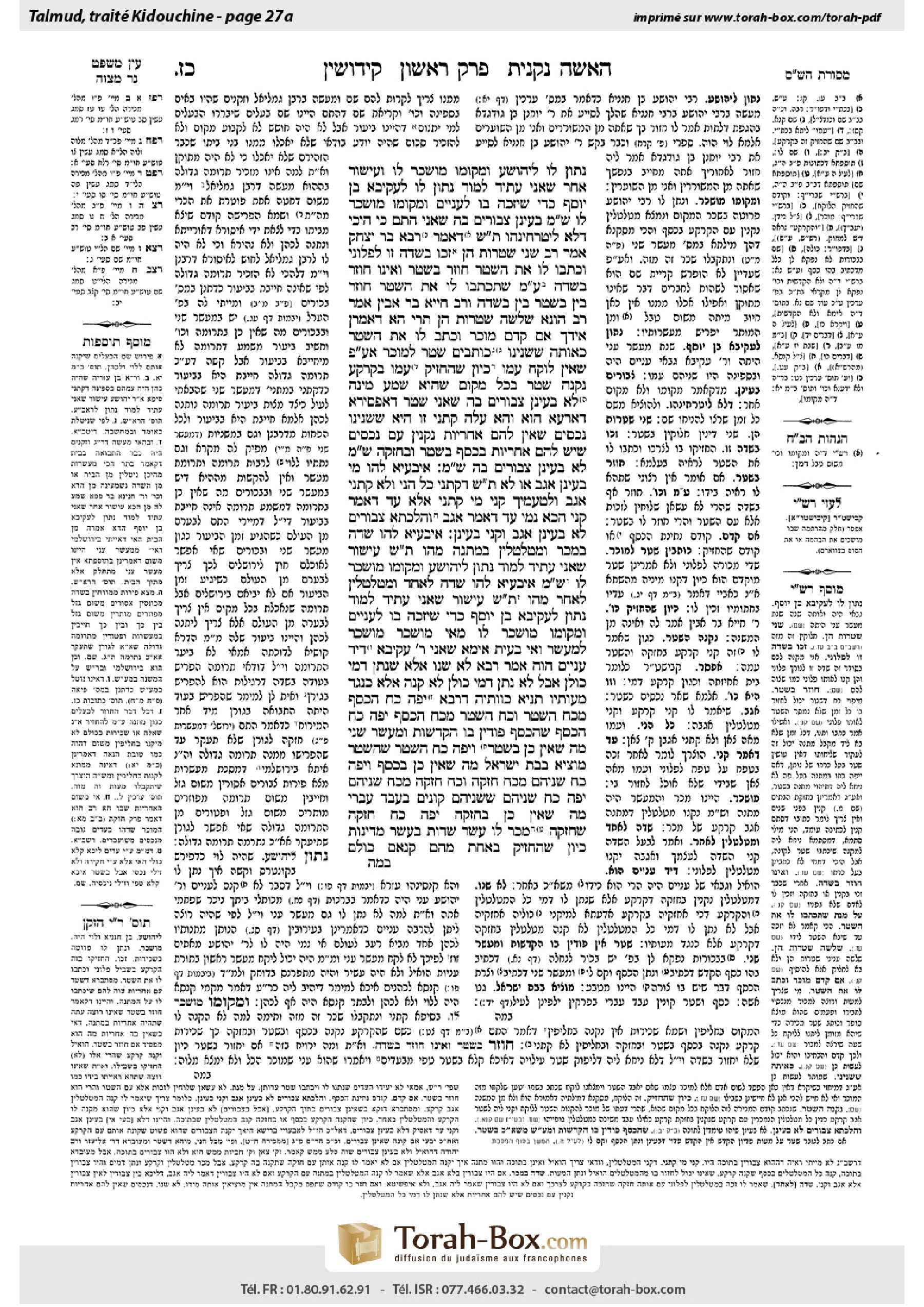
Kiddushin 27a: Talmud study for Daf Yomi
Daf Yomi is the daily study of one Talmud folio. Explore 37 tractates with scans, Hebrew text, Sefaria English and AI-generated French translations where annotated.
Passage selection and English or AI-generated French translation are available where the scan has annotations. Daf Study is independent of Torah-Box and Sefaria.
Browse Kiddushin · קידושין · All tractatesKiddushin 27a text and translations
This page of Kiddushin includes the Aramaic text, an English translation and an AI-generated French translation, alongside the scan above.
קידושין כ״ז א · Aramaic and Hebrew text
נָתוּן לוֹ לִיהוֹשֻׁעַ, וּמְקוֹמוֹ מוּשְׂכָּר לוֹ. וְעִישּׂוּר אַחֵר שֶׁאֲנִי עָתִיד לָמוֹד נָתוּן לוֹ לַעֲקִיבָא בֶּן יוֹסֵף, כְּדֵי שֶׁיִּזְכֶּה בּוֹ לַעֲנִיִּים, וּמְקוֹמוֹ מוּשְׂכָּר לוֹ. שְׁמַע מִינַּהּ בָּעֵינַן צְבוּרִים בַּהּ! שָׁאנֵי הָתָם, כִּי הֵיכִי דְּלָא לַיטְרְחִינְהוּ.
תָּא שְׁמַע, דְּאָמַר רָבָא בַּר יִצְחָק אָמַר רַב: שְׁנֵי שְׁטָרוֹת הֵן: ״זְכוּ בְּשָׂדֶה זוֹ לִפְלוֹנִי וְכִתְבוּ לוֹ אֶת הַשְּׁטָר״ – חוֹזֵר בַּשְּׁטָר, וְאֵינוֹ חוֹזֵר בַּשָּׂדֶה. ״עַל מְנָת שֶׁתִּכְתְּבוּ לוֹ אֶת הַשְּׁטָר״ – חוֹזֵר בֵּין בַּשְּׁטָר בֵּין בַּשָּׂדֶה.
וְרַב חִיָּיא בַּר אָבִין אָמַר רַב הוּנָא: שְׁלֹשָׁה שְׁטָרוֹת הֵן. תְּרֵי – הָא דַּאֲמַרַן, אִידַּךְ: אִם קָדַם מוֹכֵר וְכָתַב לוֹ אֶת הַשְּׁטָר, כְּאוֹתָהּ שֶׁשָּׁנִינוּ: כּוֹתְבִים שְׁטָר לַמּוֹכֵר אַף עַל פִּי שֶׁאֵין לוֹקֵחַ עִמּוֹ. כֵּיוָן שֶׁהֶחְזִיק עִמּוֹ בַּקַּרְקַע – נִקְנָה שְׁטָר בְּכׇל מָקוֹם שֶׁהוּא.
שְׁמַע מִינַּהּ לָא בָּעֵינַן צְבוּרִים בַּהּ! שָׁאנֵי שְׁטָר דְּאַפְסֵירָא דְאַרְעָא הוּא.
וְהָא עֲלַהּ קָתָנֵי: זוֹ הִיא שֶׁשָּׁנִינוּ: נְכָסִים שֶׁאֵין לָהֶם אַחְרָיוּת נִקְנִין עִם נְכָסִים שֶׁיֵּשׁ לָהֶם אַחְרָיוּת בְּכֶסֶף בִּשְׁטָר וּבַחֲזָקָה! שְׁמַע מִינַּהּ: לָא בָּעֵינַן צְבוּרִים בָּהּ, שְׁמַע מִינַּהּ.
אִיבַּעְיָא לְהוּ: מִי בָּעֵינַן ״אַגַּב״ אוֹ לָא? תָּא שְׁמַע, דְּקָתָנֵי כֹּל הָנֵי, וְלָא קָתָנֵי אַגַּב. וּלְטַעְמָיךְ, ״קְנִי״ מִי קָתָנֵי?
אֶלָּא, עַד דְּאָמַר ״קְנִי״? הָכָא נָמֵי, עַד דַּאֲמַר ״אַגַּב״. וְהִלְכְתָא: צְבוּרִים – לָא בָּעֵינַן, ״אַגַּב״ וּ״קְנִי״ – בָּעֵינַן.
אִיבַּעְיָא לְהוּ: שָׂדֶה בְּמֶכֶר וּמְטַלְטְלִין בְּמַתָּנָה מַהוּ? תָּא שְׁמַע: עִישּׂוּר שֶׁאֲנִי עָתִיד לָמוֹד, נָתוּן לִיהוֹשֻׁעַ וּמְקוֹמוֹ מוּשְׂכָּר לוֹ, שְׁמַע מִינַּהּ!
אִיבַּעְיָא לְהוּ: שָׂדֶה לְאֶחָד, וּמְטַלְטְלִין לְאַחֵר מַהוּ? תָּא שְׁמַע: עִישּׂוּר שֶׁאֲנִי עָתִיד לָמוֹד נָתוּן לַעֲקִיבָא בֶּן יוֹסֵף כְּדֵי שֶׁיִּזְכֶּה בּוֹ לַעֲנִיִּים וּמְקוֹמוֹ מוּשְׂכָּר לוֹ.
מַאי ״מוּשְׂכָּר״ – מוּשְׂכָּר לְמַעֲשֵׂר. וְאִי בָּעֵית אֵימָא: שָׁאנֵי רַבִּי עֲקִיבָא, דְּיַד עֲנִיִּים הֲוָה.
אָמַר רָבָא: לֹא שָׁנוּ אֶלָּא שֶׁנָּתַן דְּמֵי כוּלָּן, אֲבָל לֹא נָתַן דְּמֵי כוּלָּן – לֹא קָנָה אֶלָּא כְּנֶגֶד מְעוֹתָיו.
תַּנְיָא כְּווֹתֵיהּ דְּרָבָא: יָפֶה כֹּחַ הַכֶּסֶף מִכֹּחַ הַשְּׁטָר, וְכֹחַ הַשְּׁטָר מִכֹּחַ הַכֶּסֶף. יָפֶה כֹּחַ הַכֶּסֶף – שֶׁהַכֶּסֶף פּוֹדִין בּוֹ הֶקְדֵּשׁוֹת וּמַעֲשֵׂר שֵׁנִי, מַה שֶּׁאֵין כֵּן בִּשְׁטָר. וְיָפֶה כֹּחַ הַשְּׁטָר – שֶׁהַשְּׁטָר מוֹצִיא בְּבַת יִשְׂרָאֵל, מַה שֶּׁאֵין כֵּן בְּכֶסֶף.
וְיָפֶה כֹּחַ שְׁנֵיהֶם מִכֹּחַ חֲזָקָה, וְכֹחַ חֲזָקָה מִכֹּחַ שְׁנֵיהֶם. יָפֶה כֹּחַ שְׁנֵיהֶם – שֶׁשְּׁנֵיהֶם קוֹנִים בְּעֶבֶד עִבְרִי, מַה שֶּׁאֵין כֵּן בַּחֲזָקָה. יָפֶה כֹּחַ חֲזָקָה – שֶׁחֲזָקָה מָכַר לוֹ עֶשֶׂר שָׂדוֹת בְּעֶשֶׂר מְדִינוֹת, כֵּיוָן שֶׁהֶחְזִיק בְּאַחַת מֵהֶם – קְנָאָם כּוּלָּם.
Kiddushin 27a · English translation
is given as first tithe to Yehoshua ben Ḥananya, who was a Levite, and the place of the tithe is rented to him so that he can acquire the tithe by means of the land. And another tenth that I will measure out in the future as the poor man’s tithe is given to Akiva ben Yosef so that he will acquire it on behalf of the poor, and its place is rented to him. One can learn from here that we require the movable property to be piled on the land, as Rabban Gamliel emphasized: Its place. The Gemara rejects this argument: It is different there, as Rabban Gamliel did this so as not to trouble the Sages to whom he was giving the tithes by forcing them to transport the tithes to a different location. For reasons of convenience he transferred to the other Sages ownership of the land where the tithes were already situated.
The Gemara further suggests: Come and hear a solution for this dilemma, as Rava bar Yitzḥak says that Rav says: There are two types of documents. If one says: Acquire this field for so-and-so and write the document for him as proof of the sale of the field, he can retract his agreement with regard to the document. He can change his mind and tell them not to write the document. But he cannot retract his agreement with regard to the field, as the buyer has already acquired it. By contrast, if he said: Acquire this field for so-and-so on the condition that you write him a document, if the document has not yet been given he can retract his agreement both with regard to the document and with regard to the field, as he transfers the field to him only on the condition that he writes a document.
And Rav Ḥiyya bar Avin said that Rav Huna said: There are actually three types of documents. Two types are those that we said, and the other type is as follows. If the seller first wrote him the document, as a seller can write a bill of sale before the transaction and give it when he receives payment. This is as we learned in a mishna (Bava Batra 167b): A scribe may write a deed of sale for the seller of property who requests one, even if the purchaser is not with him when he presents his request. In a case of this kind, once the buyer takes possession of the land from him, the document is acquired by the buyer wherever it is, i.e., even if it is not in the possession of the buyer.
One can learn from here that we do not require that the property be piled on it, as in this case the document is acquired by means of the land wherever the document is located. The Gemara rejects this proof: A document is different, as it is the bridle of the land. Since the document that refers to the land is the means by which one takes possession of the land, it is considered as though the document is part of the land. Therefore, one can take possession of the document by means of the land without it actually having to be placed there. The same does not necessarily apply to other movable property, which does not refer specifically to the land.
The Gemara asks: But it was taught concerning this halakha that a document can effect acquisition wherever it is located: This is what we learned in the mishna: Property that does not serve as a guarantee can be acquired along with property that serves as a guarantee by means of giving money, by means of giving a document, or by means of taking possession of them. This indicates that there is no difference between a document and other types of movable property. Consequently, one can learn from here that we do not require that the property be piled on the land. The Gemara affirms: One can learn from here that this is the case.
A dilemma was raised before the Sages: Do we require that one who sells movable property by means of land state explicitly that this is his intention, or not? The Gemara suggests: Come and hear, as those aforementioned baraitot teach all these halakhot of acquiring movable property through land, and they do not teach the expression: By means of. This indicates that it is not necessary to specify this aspect of the acquisition. The Gemara rejects this proof: And according to your reasoning, is it taught that he must say to him: Acquire it? The baraitot do not state this, and yet everyone agrees that the seller must say to him that he should acquire the land.
Rather, one must say that the acquisition is not effective unless he says: Acquire it, and yet the tanna did not deem it necessary to mention this requirement. Here too, the acquisition is not effective unless he says: By means of. This requirement is not mentioned because these baraitot do not discuss the type of statements he must issue, but simply are referring to the basic legal issues involved. The Gemara concludes: And the halakha is that we do not require that the property be piled on the land, but we require that the seller say that he is transferring the movable property by means of the land, and he must say: Acquire it.
§ A dilemma was raised before the Sages: If a seller wishes to give a field in the form of a sale and with it movable property as a gift, what is the halakha? Can he transfer them together by means of a transaction performed with the land? The Gemara suggests: Come and hear a proof for this dilemma from the incident involving Rabban Gamliel, as he said: One-tenth of produce that I will measure out in the future is given to Yehoshua, and its place is rented to him. Learn from this that even if the field is rented, which is equivalent to a sale, and the tithe is given as a gift, one can transfer the two together.
Another dilemma was raised before the Sages: If one wishes to give a field to one person and movable property to another, what is the halakha? Can one transfer movable property to one person by means of land that is going to be gifted to another? The Gemara suggests: Come and hear that which Rabban Gamliel stated: One-tenth of that which I will measure out in the future is given to Akiva ben Yosef so that he will acquire it on behalf of the poor, and its place is rented to him. Although the gift is for the poor and the place is rented to Rabbi Akiva, the acquisition is effective.
The Gemara rejects this proof: What is the meaning of: Rented, in this case? It means rented for tithe. This land was not rented to Rabbi Akiva for his own use, but only so that he could receive the tithe. Therefore, the land was also given to the poor. And if you wish, say a different refutation: Rabbi Akiva is different, as he was a charity collector, and therefore he was considered like the hand of the poor. Since a charity collector collects charity on behalf of the poor, he has the status of the poor himself. If so, this cannot be compared to a case in which one transfers a certain item to one person and land to someone else.
§ Rava says: The Sages taught that one can acquire movable property by way of land only when he gives all the money for the land and the movable property. But if he did not give the money for all the property, even if they were transferred to him he acquires only the movable property corresponding to the money that he paid.
It is taught in a baraita (Tosefta, Ketubot 2:3) in accordance with the opinion of Rava: The power of money is greater than the power of a document in one way, and the power of a document is greater than the power of money in a different way. The baraita elaborates: The power of money is greater in that money can be used to redeem consecrated property and second tithe, which is not the case with a document. And the power of a document is greater than the power of money, as a document releases a Jewish woman, i.e., a man can divorce his wife with a bill of divorce, which is not the case with money.
The baraita continues: And furthermore, the power of each, money and a document, as a means to transfer ownership is greater than the power of acquisition by means of taking possession, and the power of taking possession is greater than the power of acquisition of each of them. How so? The power of each of them is greater than the power of acquisition of taking possession, as each of them effects acquisition in the case of a Hebrew slave, which is not the case for taking possession (see 14b). The power of taking possession is greater than the power of acquisition of each of them, as with regard to taking possession, if one sold another ten fields in ten countries, once the buyer takes possession of one of the fields he acquires all of them.
Kiddushin 27a · Traduction française (IA)
est donnée comme première dîme à Yehoshua ben Ḥananya, qui était lévite, et l’emplacement où se trouve la dîme lui est loué afin qu’il puisse l’acquérir par l’intermédiaire du terrain. Un autre dixième, que je mesurerai ultérieurement au titre de la dîme du pauvre, est donné à Akiva ben Yosef afin qu’il l’acquière pour le compte des pauvres, et l’emplacement où il se trouve lui est loué. On peut en déduire que les biens mobiliers doivent être entassés sur le terrain, comme l’a souligné Rabban Gamliel : « Son emplacement ». La Guemara rejette cette déduction : ce cas est différent, car Rabban Gamliel a agi ainsi pour éviter aux Sages auxquels il donnait les dîmes la peine de les transporter ailleurs. Pour leur faciliter la tâche, il a transféré aux autres Sages la propriété du terrain où les dîmes se trouvaient déjà.
La Guemara propose ensuite : Venons entendre une réponse à ce dilemme, car Rava bar Yitzḥak dit au nom de Rav : Il existe deux types d’actes. Si quelqu’un dit : « Acquiers ce champ pour untel et rédige-lui un acte comme preuve de la vente du champ », il peut revenir sur son accord concernant l’acte. Il peut changer d’avis et leur dire de ne pas rédiger l’acte. Mais il ne peut pas revenir sur son accord concernant le champ, car l’acheteur l’a déjà acquis. En revanche, s’il dit : « Acquiers ce champ pour untel à condition de lui rédiger un acte », tant que l’acte ne lui a pas encore été remis, il peut revenir sur son accord aussi bien concernant l’acte que concernant le champ, car il ne lui transfère le champ qu’à la condition qu’un acte soit rédigé.
Et Rav Ḥiyya bar Avin dit au nom de Rav Huna : Il existe en réalité trois types d’actes. Les deux premiers sont ceux que nous avons mentionnés, et le troisième est le suivant : le vendeur a d’abord rédigé l’acte pour l’acheteur. En effet, un vendeur peut rédiger un acte de vente avant la transaction et le remettre lorsqu’il reçoit le paiement. C’est ce que nous avons appris dans une Michna (Bava Batra 167b) : Un scribe peut rédiger un acte de vente pour le vendeur d’un bien qui en fait la demande, même si l’acheteur n’est pas présent lorsque le vendeur présente sa demande. Dans un tel cas, dès que l’acheteur prend possession du terrain auprès du vendeur, il acquiert l’acte où qu’il se trouve, c’est-à-dire même s’il n’est pas en sa possession.
On peut en déduire qu’il n’est pas nécessaire que les biens soient entassés sur le terrain, puisque, dans ce cas, l’acte est acquis par l’intermédiaire du terrain où qu’il se trouve. La Guemara rejette cette preuve : un acte est différent, car il est le « mors » du terrain. Puisque l’acte relatif au terrain est le moyen d’en prendre possession, il est considéré comme faisant partie du terrain. On peut donc acquérir l’acte par l’intermédiaire du terrain sans qu’il soit effectivement posé dessus. Cela ne s’applique pas nécessairement aux autres biens mobiliers, qui ne se rapportent pas spécifiquement au terrain.
La Guemara demande : Mais il a été enseigné à propos de cette halakha, selon laquelle un acte peut produire une acquisition où qu’il se trouve. Voici ce que nous avons appris dans la Michna : Les biens qui ne constituent pas une garantie peuvent être acquis avec les biens qui constituent une garantie au moyen du versement d’argent, de la remise d’un acte ou de la prise de possession. Cela indique qu’il n’y a pas de différence entre un acte et les autres types de biens mobiliers. On peut donc en déduire qu’il n’est pas nécessaire que les biens soient entassés sur le terrain. La Guemara confirme : on peut en déduire que c’est bien le cas.
Les Sages ont soulevé un dilemme : celui qui vend des biens mobiliers par l’intermédiaire d’un terrain doit-il déclarer explicitement que telle est son intention, ou non ? La Guemara propose : Venons entendre, car les baraïtot précédemment citées enseignent toutes ces halakhot concernant l’acquisition de biens mobiliers par l’intermédiaire d’un terrain, sans employer l’expression « par l’intermédiaire de ». Cela indique qu’il n’est pas nécessaire de préciser cet aspect de l’acquisition. La Guemara rejette cette preuve : et selon ton raisonnement, est-il enseigné qu’il doit lui dire : « Acquiers-le » ? Les baraïtot ne le précisent pas non plus, et pourtant tous conviennent que le vendeur doit lui dire d’acquérir le terrain.
Il faut plutôt dire que l’acquisition n’est effective que s’il dit : « Acquiers-le », et pourtant le tanna n’a pas jugé nécessaire de mentionner cette exigence. De même ici, l’acquisition n’est effective que s’il dit : « Par l’intermédiaire de ». Cette exigence n’est pas mentionnée, car ces baraïtot ne traitent pas des déclarations qu’il doit formuler, mais exposent simplement les principes juridiques fondamentaux concernés. La Guemara conclut : la halakha est qu’il n’est pas nécessaire que les biens soient entassés sur le terrain, mais il faut que le vendeur déclare qu’il transfère les biens mobiliers par l’intermédiaire du terrain et qu’il dise : « Acquiers-le ».
§ Les Sages ont soulevé un dilemme : si un vendeur souhaite vendre un champ et donner avec celui-ci des biens mobiliers, quelle est la halakha ? Peut-il transférer les deux ensemble au moyen d’une transaction portant sur le terrain ? La Guemara propose : Venons entendre une preuve à ce sujet à partir de l’incident impliquant Rabban Gamliel, car il a dit : « Un dixième des produits que je mesurerai ultérieurement est donné à Yehoshua, et l’emplacement où il se trouve lui est loué. » On peut en déduire que même si le terrain est loué, ce qui équivaut à une vente, et que la dîme est donnée en cadeau, on peut transférer les deux ensemble.
Les Sages ont soulevé un autre dilemme : si quelqu’un souhaite donner un champ à une personne et des biens mobiliers à une autre, quelle est la halakha ? Peut-on transférer les biens mobiliers à une personne par l’intermédiaire d’un terrain qui sera donné à une autre ? La Guemara propose : Venons entendre ce que Rabban Gamliel a déclaré : « Un dixième de ce que je mesurerai ultérieurement est donné à Akiva ben Yosef afin qu’il l’acquière pour le compte des pauvres, et l’emplacement où il se trouve lui est loué. » Bien que le don soit destiné aux pauvres et que l’emplacement soit loué à Rabbi Akiva, l’acquisition est effective.
La Guemara rejette cette preuve : que signifie ici « loué » ? Cela signifie qu’il est loué pour la dîme. Ce terrain n’a pas été loué à Rabbi Akiva pour son usage personnel, mais seulement afin qu’il puisse recevoir la dîme. Par conséquent, le terrain a lui aussi été donné aux pauvres. Et, si tu préfères, donne une autre réfutation : le cas de Rabbi Akiva est différent, car il était collecteur de tsedaka et était donc considéré comme la main des pauvres. Puisqu’un collecteur de tsedaka recueille les dons pour le compte des pauvres, il a lui-même le statut des pauvres. Ce cas ne peut donc pas être comparé à celui où quelqu’un transfère un objet à une personne et un terrain à une autre.
§ Rava dit : Les Sages ont enseigné qu’on peut acquérir des biens mobiliers par l’intermédiaire d’un terrain uniquement lorsqu’on verse la totalité de la somme due pour le terrain et les biens mobiliers. Mais si l’on n’a pas payé la totalité du prix de l’ensemble des biens, même s’ils lui ont été transférés, il n’acquiert les biens mobiliers qu’à hauteur de la somme qu’il a versée.
Il est enseigné dans une baraïta (Tosefta, Ketoubot 2:3), conformément à l’opinion de Rava : le pouvoir de l’argent est supérieur à celui d’un acte sous un rapport, et le pouvoir d’un acte est supérieur à celui de l’argent sous un autre rapport. La baraïta détaille : le pouvoir de l’argent est supérieur en ce qu’il permet de racheter des biens consacrés et la seconde dîme, contrairement à un acte. Et le pouvoir d’un acte est supérieur à celui de l’argent, car un acte libère une femme juive, c’est-à-dire qu’un homme peut divorcer de sa femme au moyen d’un acte de divorce, ce qui n’est pas possible avec de l’argent.
La baraïta poursuit : en outre, le pouvoir de chacun des deux moyens de transférer la propriété, l’argent et l’acte, est supérieur à celui de la prise de possession, tandis que le pouvoir de la prise de possession est supérieur à celui de chacun d’eux. Comment cela ? Le pouvoir de chacun d’eux est supérieur à celui de la prise de possession, car chacun permet l’acquisition dans le cas d’un esclave hébreu, contrairement à la prise de possession (voir 14b). Le pouvoir de la prise de possession est supérieur à celui de chacun d’eux : en effet, lorsqu’il s’agit de la prise de possession, si quelqu’un vend à un autre dix champs situés dans dix pays, dès que l’acheteur prend possession de l’un des champs, il les acquiert tous.
Traduction française générée par IA à partir de l’édition anglaise de Sefaria. Vérifie toujours un passage avec le texte source.
Text from Sefaria: William Davidson Edition - Vocalized Aramaic (CC BY NC); William Davidson Edition - English (CC BY NC).