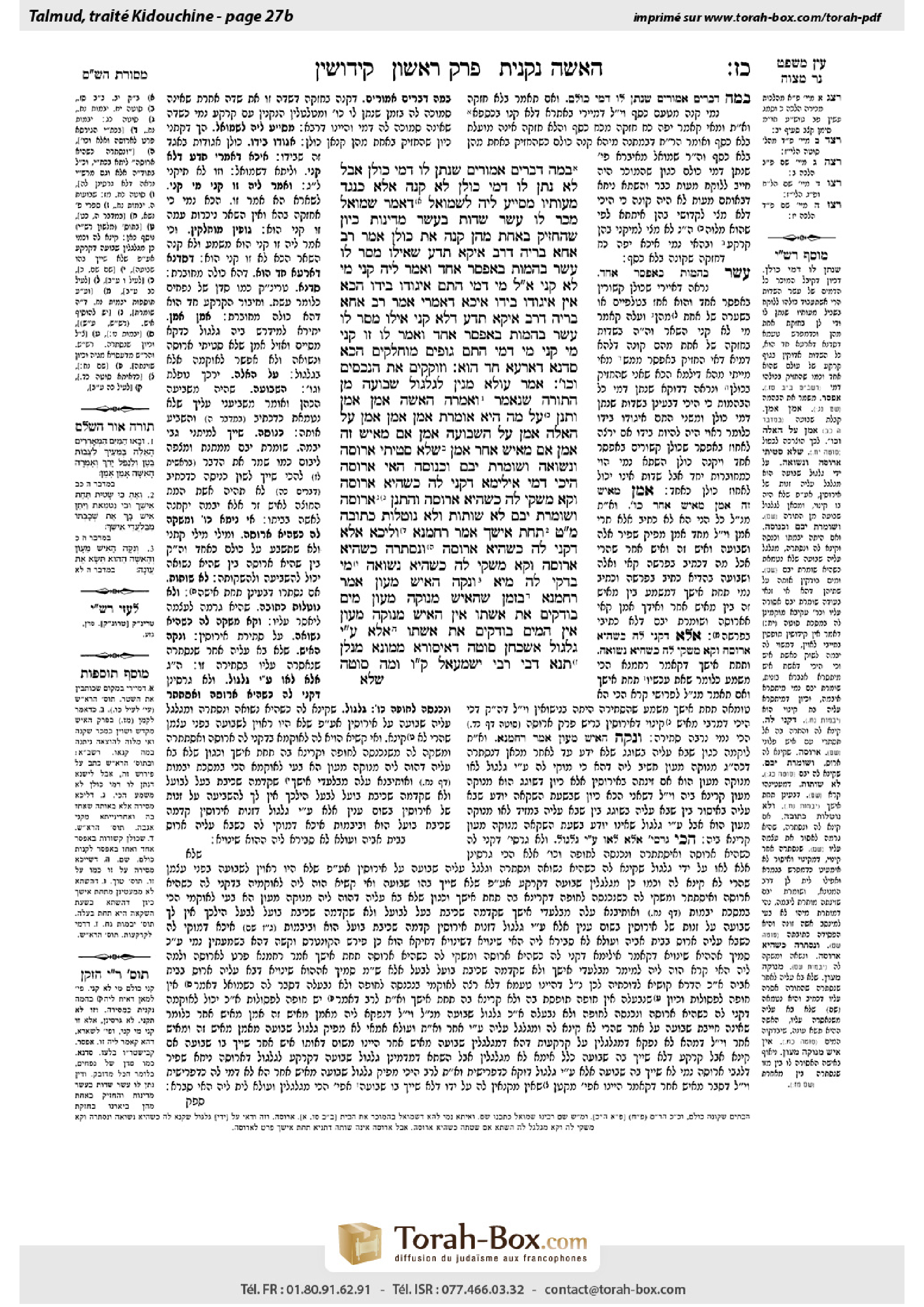
Kiddushin 27b: Talmud study for Daf Yomi
Daf Yomi is the daily study of one Talmud folio. Explore 37 tractates with scans, Hebrew text, Sefaria English and AI-generated French translations where annotated.
Passage selection and English or AI-generated French translation are available where the scan has annotations. Daf Study is independent of Torah-Box and Sefaria.
Browse Kiddushin · קידושין · All tractatesKiddushin 27b text and translations
This page of Kiddushin includes the Aramaic text, an English translation and an AI-generated French translation, alongside the scan above.
קידושין כ״ז ב · Aramaic and Hebrew text
בַּמֶּה דְּבָרִים אֲמוּרִים – שֶׁנָּתַן לוֹ דְּמֵי כוּלָּן, אֲבָל לֹא נָתַן לוֹ דְּמֵי כוּלָּן – לֹא קָנָה אֶלָּא כְּנֶגֶד מְעוֹתָיו. מְסַיַּיע לֵיהּ לִשְׁמוּאֵל, דְּאָמַר שְׁמוּאֵל: מָכַר לוֹ עֶשֶׂר שָׂדוֹת בְּעֶשֶׂר מְדִינוֹת, כֵּיוָן שֶׁהֶחְזִיק בְּאַחַת מֵהֶן – קָנָה אֶת כּוּלָּן.
אָמַר רַב אַחָא בְּרֵיהּ דְּרַב אִיקָא: תֵּדַע, שֶׁאִילּוּ מָסַר לוֹ עֶשֶׂר בְּהֵמוֹת בְּאַפְסָר אֶחָד וַאֲמַר לֵיהּ ״קְנֵי״ – מִי לָא קָנֵי? אֲמַר לֵיהּ: מִי דָּמֵי? הָתָם אִיגּוּדוֹ בְּיָדוֹ, הָכָא אֵין אִיגּוּדוֹ בְּיָדוֹ.
אִיכָּא דְּאָמְרִי: אָמַר רַב אַחָא בְּרֵיהּ דְּרַב אִיקָא: תֵּדַע דְּלָא קָנֵי, אִילּוּ מָסַר לוֹ עֶשֶׂר בְּהֵמוֹת בְּאַפְסָר אֶחָד וְאָמַר לוֹ ״זוֹ קְנֵי״ – מִי קָנֵי?
מִי דָּמֵי? הָתָם גּוּפִים מוּחְלָקִים, הָכָא סַדָּנָא דְאַרְעָא חַד הוּא.
וְזוֹקְקִים אֶת הַנְּכָסִים וְכוּ׳. אָמַר עוּלָּא: מִנַּיִן לְגִלְגּוּל שְׁבוּעָה מִן הַתּוֹרָה?
שֶׁנֶּאֱמַר: ״וְאָמְרָה הָאִשָּׁה אָמֵן אָמֵן״, וּתְנַן: עַל מָה הִיא אוֹמֶרֶת ״אָמֵן אָמֵן״? ״אָמֵן״ עַל הָאָלָה, ״אָמֵן״ עַל ״הַשְּׁבוּעָה״. ״אָמֵן״ אִם מֵאִישׁ זֶה, ״אָמֵן״ אִם מֵאִישׁ אַחֵר. ״אָמֵן״ שֶׁלֹּא סָטִיתִי אֲרוּסָה וּנְשׂוּאָה וְשׁוֹמֶרֶת יָבָם וּכְנוּסָה.
הַאי אֲרוּסָה הֵיכִי דָּמֵי? אִילֵּימָא דְּקַנִּי לַהּ כְּשֶׁהִיא אֲרוּסָה, וְקָא מַשְׁקֵי לַהּ כְּשֶׁהִיא אֲרוּסָה, וְהָתְנַן אֲרוּסָה וְשׁוֹמֶרֶת יָבָם לֹא שׁוֹתוֹת וְלֹא נוֹטְלוֹת כְּתוּבָּה, מַאי טַעְמָא – ״תַּחַת אִישֵׁךְ״ אָמַר רַחֲמָנָא, וְלֵיכָּא.
אֶלָּא דְּקַנִּי לַהּ כְּשֶׁהִיא אֲרוּסָה, וְנִסְתְּרָה כְּשֶׁהִיא אֲרוּסָה, וְקָא מַשְׁקֵי לַהּ כְּשֶׁהִיא נְשׂוּאָה,
מִי בָּדְקִי לַהּ מַיָּא? ״וְנִקָּה הָאִישׁ מֵעָוֹן״ אָמַר רַחֲמָנָא, בִּזְמַן שֶׁהָאִישׁ מְנוּקֶּה מֵעָוֹן – מַיִם בּוֹדְקִים אֶת אִשְׁתּוֹ, אֵין אִישׁ מְנוּקֶּה מֵעָוֹן – אֵין הַמַּיִם בּוֹדְקִים אֶת אִשְׁתּוֹ.
אֶלָּא עַל יְדֵי גִלְגּוּל!
אַשְׁכְּחַן סוֹטָה, דְּאִיסּוּרָא, מָמוֹנָא מְנָלַן? תָּנָא דְּבֵי רַבִּי יִשְׁמָעֵאל: קַל וָחוֹמֶר: וּמָה סוֹטָה
Kiddushin 27b · English translation
In what case is this statement said? It is said in a case when he gave him money for all of the land. But if he did not give him money for all of it, he acquires only the land corresponding to the money that he paid, in accordance with the opinion of Rava. The Gemara comments: The baraita supports the opinion of Shmuel, as Shmuel says: If one sold another ten fields in ten countries, once he takes possession of one of them he acquires all of them.
Rav Aḥa, son of Rav Ika, said: Know that this is true, as, if he handed him ten animals with one bridle [afsar] and said to him: Acquire them, doesn’t he acquire all of them? In this case, too, they are considered like one field. A Sage said to Rav Aḥa, son of Rav Ika: Is it comparable? There, its bond, i.e., the bridle that joins the animals, is in his hand. Here, in the case of ten fields, its bond is not in his hand.
There are those who say that Rav Aḥa, son of Rav Ika, said: Know that he does not acquire all of the fields by taking possession of only one field, as, if one passed to him ten animals with one bridle and said to him: Acquire this one, does he acquire all of them? The same applies here when he takes possession of only one field; it is as though he said to him: Acquire this one, and therefore he does not acquire the other fields in this manner.
The Gemara rejects this argument: Is it comparable? There, the animals are separate entities, and therefore when he says to him: Acquire this one, there is no reason that the other animals should be acquired as well. Here, the mass of the earth is one. Consequently, if he acquires one plot of land, he acquires the other plots along with it.
§ The mishna teaches: And in a legal dispute involving both land and movable property, if the defendant makes a partial admission of the claim with regard to the movable property, thereby rendering himself obligated to take an oath denying any responsibility for the remaining property, the movable property binds the property that serves as a guarantee, i.e., the land, so that he is forced to take an oath concerning the land as well, despite the fact that one is generally not obligated to take an oath for a claim involving land. Ulla says: From where is it derived from the Torah that one can impose the extension of an oath, i.e., if one is required to take an oath for one claim, the other party can obligate him to take an oath with regard to other claims which on their own would not lead to the imposition of an oath?
As it is stated with regard to a sota: “And the woman shall say: Amen, amen” (Numbers 5:22), and we learned in a mishna (Sota 18a): Concerning what does she say the double expression of: Amen, amen? She says amen on the curse, as she accepts the curse upon herself if she is guilty, and amen on the oath, as she declares that she is not defiled. She states: Amen if I committed adultery with this man about whom I was warned, amen if I committed adultery with another man. Amen that I did not stray when I was betrothed nor after I was married, nor as a widow waiting for my yavam to perform levirate marriage, since a woman at that stage is prohibited from engaging in sexual intercourse with any men, nor when married through levirate marriage to the yavam.
The Gemara analyzes this halakha: What are the circumstances with regard to this betrothed woman? If we say that he warned her not to seclude herself with a particular man when she was betrothed, and he gives her the bitter water of a sota to drink when she is betrothed, but didn’t we learn in a mishna (Sota 23b): With regard to a betrothed woman who secluded herself with another man after being warned by her betrothed, and a widow waiting for her yavam to perform levirate marriage who secluded herself with another man after being warned by her yavam, they neither drink the bitter water nor collect payment of their marriage contracts. What is the reason for this? The Merciful One states as part of her oath: “But if you have gone aside, being under your husband” (Numbers 5:20), and that does not apply here, as these women are not yet under their husband’s authority.
Rather, one must say that he warned her when she was betrothed, i.e., he warned her when she was betrothed not to seclude herself with a particular man, and she secluded herself with that man when she was betrothed, and he gave her the water to drink when she was married.
The Gemara asks: But in this case, does the water she is given to drink examine her and cause her death? Doesn’t the Merciful One state: “And the man shall be clear from iniquity” (Numbers 5:31)? This verse indicates: When the man is clear from iniquity, the water examines his wife; but if the man is not clear from iniquity with regard to the matter of illicit sexual intercourse, the water does not examine his wife. Since he suspected her of impropriety when she was betrothed and warned her about a particular man, and she secluded herself with that man regardless of his warning, he was not allowed to engage in intercourse with her. If he did so, he is a sinner himself, and therefore the water will not affect his wife. If so, it is impossible for a betrothed woman to be examined as a sota.
Rather, it is clear that this oath is administered by means of an extension. Although the husband cannot force her to take an oath only with regard to her behavior before they were married, since she must take an oath with regard to her behavior during her marriage, he can extend the oath to include incidents that occurred while she was betrothed.
The Gemara comments: We found a source for the extension of an oath in the case of a sota, which is a halakha involving a prohibition. From where do we derive that an oath can be extended with regard to monetary matters as well? The school of Rabbi Yishmael taught that this can be derived through an a fortiori inference: And just as in the case of a sota,
Kiddushin 27b · Traduction française (IA)
Dans quel cas cette déclaration est-elle faite ? Elle concerne le cas où il lui a donné de l’argent pour la totalité du terrain. Mais s’il ne lui a pas donné d’argent pour la totalité du terrain, il n’acquiert que la partie du terrain correspondant à la somme qu’il a payée, conformément à l’opinion de Rava. La Guemara commente : La baraïta appuie l’opinion de Shmuel, car Shmuel dit : Si quelqu’un vend à un autre dix champs situés dans dix pays différents, dès que l’acheteur prend possession de l’un d’eux, il les acquiert tous.
Rav Aḥa, fils de Rav Ika, dit : Sache que c’est bien le cas : si quelqu’un lui remettait dix animaux attachés à une seule bride [afsar] en lui disant : « Acquiers-les », ne les acquérait-il pas tous ? Ici aussi, ils sont considérés comme un seul champ. Un Sage dit à Rav Aḥa, fils de Rav Ika : Est-ce comparable ? Là-bas, le lien qui les unit, c’est-à-dire la bride qui attache les animaux, est entre ses mains. Ici, dans le cas de dix champs, le lien qui les unit n’est pas entre ses mains.
Certains rapportent que Rav Aḥa, fils de Rav Ika, a dit : Sache qu’il n’acquiert pas tous les champs en prenant possession d’un seul, car si quelqu’un lui remettait dix animaux attachés à une seule bride en lui disant : « Acquiers celui-ci », les acquérait-il tous ? Il en va de même ici : lorsqu’il prend possession d’un seul champ, c’est comme si on lui avait dit : « Acquiers celui-ci » ; il n’acquiert donc pas les autres champs de cette manière.
La Guemara rejette cet argument : Est-ce comparable ? Là-bas, les animaux sont des entités distinctes ; par conséquent, lorsqu’on lui dit : « Acquiers celui-ci », rien ne justifie que les autres animaux soient également acquis. Ici, la masse de terre est continue. Par conséquent, s’il acquiert une parcelle, il acquiert également les autres parcelles.
§ La Michna enseigne : Dans un litige portant à la fois sur un terrain et sur des biens mobiliers, si le défendeur reconnaît une partie de la réclamation concernant les biens mobiliers, ce qui l’oblige à prêter serment en niant toute responsabilité quant au reste des biens, les biens mobiliers entraînent avec eux les biens servant de garantie, c’est-à-dire le terrain ; il est ainsi contraint de prêter serment également au sujet du terrain, bien qu’en règle générale on ne soit pas tenu de prêter serment pour une réclamation portant sur un terrain. Oulla dit : D’où apprend-on dans la Torah qu’on peut étendre un serment, c’est-à-dire que, si une partie est tenue de prêter serment au sujet d’une réclamation, l’autre partie peut l’obliger à prêter serment au sujet d’autres réclamations qui, prises isolément, ne conduiraient pas à l’imposition d’un serment ?
Car il est dit, au sujet d’une sota : « Et la femme dira : Amen, amen » (Nombres 5,22), et nous avons appris dans une Michna (Sota 18a) : À quoi se rapporte la double expression « Amen, amen » qu’elle prononce ? Elle dit amen à la malédiction, car elle accepte la malédiction sur elle-même si elle est coupable, et amen au serment, car elle affirme ne pas s’être souillée. Elle dit : Amen, si j’ai commis l’adultère avec cet homme au sujet duquel j’ai été mise en garde ; amen, si j’ai commis l’adultère avec un autre homme. Amen, si je ne me suis pas égarée lorsque j’étais fiancée, ni après mon mariage, ni lorsque j’étais veuve et attendais que mon yavam accomplisse le mariage léviratique, car une femme à ce stade ne peut avoir de relations sexuelles avec aucun homme, ni lorsque j’étais mariée à mon yavam par le mariage léviratique.
La Guemara examine cette halakha : Dans quelles circonstances s’agit-il de cette femme fiancée ? Si l’on suppose que son fiancé l’a mise en garde, alors qu’elle était fiancée, de ne pas s’isoler avec un homme en particulier, et qu’il lui fait boire les eaux amères de la sota alors qu’elle est encore fiancée, n’avons-nous pas appris dans une Michna (Sota 23b) : Une femme fiancée qui s’est isolée avec un autre homme après que son fiancé l’a mise en garde, ainsi qu’une veuve qui attend que son yavam accomplisse le mariage léviratique et qui s’est isolée avec un autre homme après que son yavam l’a mise en garde, ne boivent pas les eaux amères et ne perçoivent pas le montant de leur contrat de mariage. Pourquoi ? Le Miséricordieux dit, dans le cadre de son serment : « Mais si tu t’es écartée, alors que tu étais sous l’autorité de ton mari » (Nombres 5,20). Cela ne s’applique pas ici, car ces femmes ne sont pas encore sous l’autorité de leur mari.
Il faut plutôt dire qu’il l’a mise en garde alors qu’elle était fiancée : il lui a alors interdit de s’isoler avec un homme en particulier ; elle s’est isolée avec cet homme alors qu’elle était encore fiancée, et il lui a fait boire les eaux alors qu’elle était mariée.
La Guemara demande : Mais, dans ce cas, les eaux qu’on lui fait boire l’éprouvent-elles et provoquent-elles sa mort ? Le Miséricordieux ne dit-il pas : « Et l’homme sera exempt de faute » (Nombres 5,31) ? Ce verset indique que, lorsque l’homme est exempt de faute, les eaux éprouvent sa femme ; mais si l’homme n’est pas exempt de faute en matière de relations sexuelles interdites, les eaux n’éprouvent pas sa femme. Puisqu’il l’a soupçonnée d’inconduite alors qu’elle était fiancée et l’a mise en garde au sujet d’un homme en particulier, et qu’elle s’est isolée avec cet homme malgré sa mise en garde, il ne lui était pas permis d’avoir des relations sexuelles avec elle. S’il l’a fait, il est lui-même fautif, et les eaux n’auront donc pas d’effet sur sa femme. Dès lors, il est impossible qu’une femme fiancée soit éprouvée comme une sota.
Il faut donc plutôt conclure que ce serment est administré par extension. Bien que le mari ne puisse la contraindre à prêter serment qu’au sujet de son comportement antérieur à leur mariage, puisqu’elle doit prêter serment au sujet de son comportement pendant leur mariage, il peut étendre le serment aux faits survenus lorsqu’elle était fiancée.
La Guemara commente : Nous avons trouvé une source à l’extension d’un serment dans le cas d’une sota, une halakha relative à une interdiction. D’où déduisons-nous qu’un serment peut également être étendu aux questions pécuniaires ? L’école de Rabbi Yishmael a enseigné qu’on peut le déduire par un raisonnement a fortiori : de même que dans le cas d’une sota,
Traduction française générée par IA à partir de l’édition anglaise de Sefaria. Vérifie toujours un passage avec le texte source.
Text from Sefaria: William Davidson Edition - Vocalized Aramaic (CC BY NC); William Davidson Edition - English (CC BY NC).