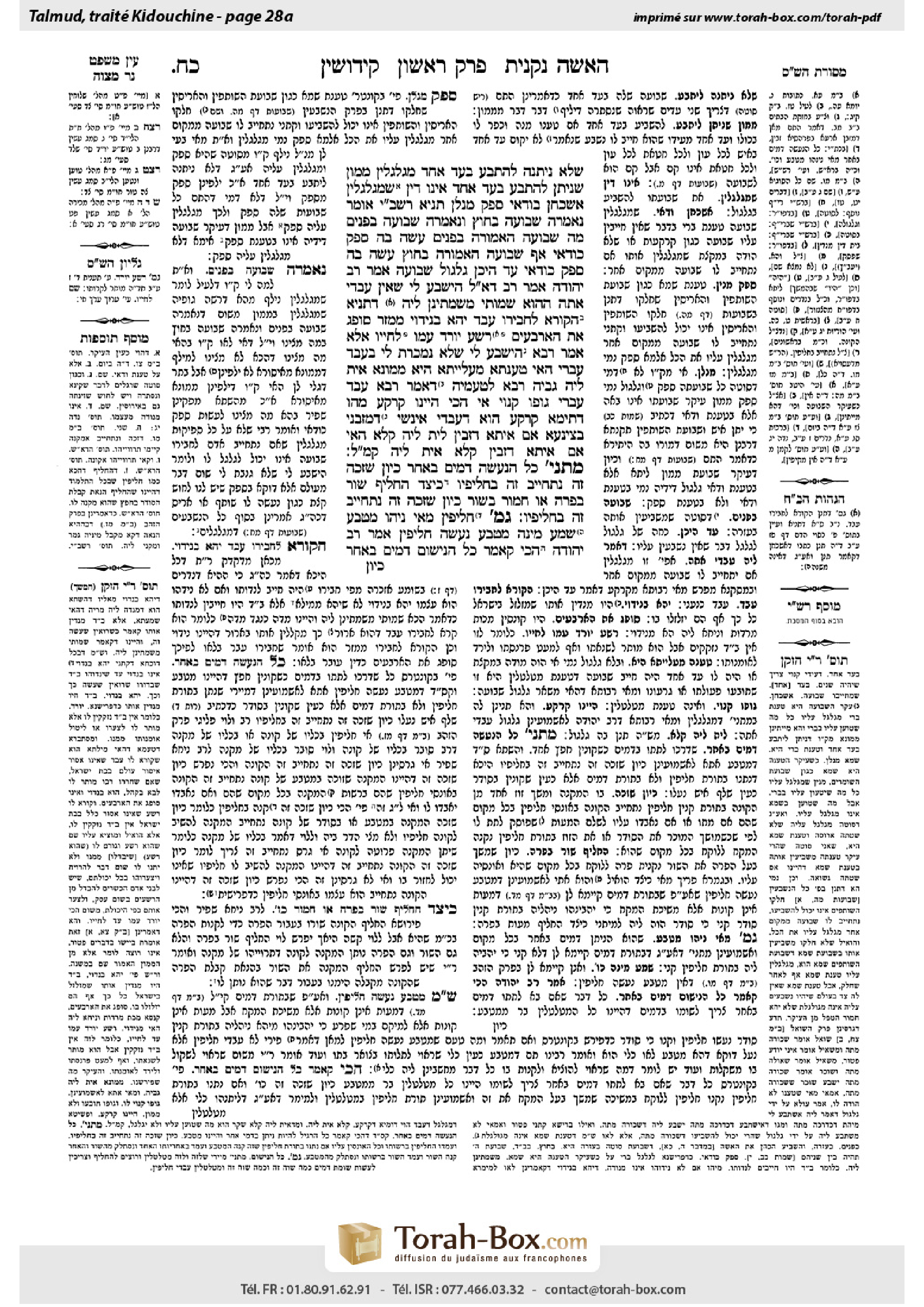
Kiddushin 28a: Talmud study for Daf Yomi
Daf Yomi is the daily study of one Talmud folio. Explore 37 tractates with scans, Hebrew text, Sefaria English and AI-generated French translations where annotated.
Passage selection and English or AI-generated French translation are available where the scan has annotations. Daf Study is independent of Torah-Box and Sefaria.
Browse Kiddushin · קידושין · All tractatesKiddushin 28a text and translations
This page of Kiddushin includes the Aramaic text, an English translation and an AI-generated French translation, alongside the scan above.
קידושין כ״ח א · Aramaic and Hebrew text
שֶׁלֹּא נִיתְּנָה לְהִתָּבַע בְּעֵד אֶחָד – מְגַלְגְּלִין, מָמוֹן, שֶׁנִּיתָּן לְהִתָּבַע בְּעֵד אֶחָד – אֵינוֹ דִּין שֶׁמְגַלְגְּלִין?
אַשְׁכְּחַן בְּוַדַּאי, סָפֵק מְנָלַן?
תַּנְיָא, רַבִּי שִׁמְעוֹן בֶּן יוֹחַאי אוֹמֵר: נֶאֶמְרָה שְׁבוּעָה בַּחוּץ, וְנֶאֶמְרָה שְׁבוּעָה בִּפְנִים. מָה שְׁבוּעָה הָאֲמוּרָה בִּפְנִים – עָשָׂה בָּהּ סָפֵק כְּוַדַּאי, אַף שְׁבוּעָה הָאֲמוּרָה בַּחוּץ – עָשָׂה בָּהּ סָפֵק כְּוַדַּאי.
עַד הֵיכָן גִּלְגּוּל שְׁבוּעָה? אָמַר רַב יְהוּדָה אָמַר רַב: דְּאָמַר לֵיהּ: ״הִישָּׁבַע לִי שֶׁאֵין עַבְדִּי אַתָּה״.
הָהוּא שַׁמּוֹתֵי מְשַׁמְּתִינַן לֵיהּ! דְּתַנְיָא: הַקּוֹרֵא לַחֲבֵירוֹ ״עֶבֶד״ – יְהֵא בְּנִידּוּי. ״מַמְזֵר״ – סוֹפֵג אֶת הָאַרְבָּעִים. ״רָשָׁע״ – יוֹרֵד עִמּוֹ לְחַיָּיו!
אֶלָּא אָמַר רָבָא: הִישָּׁבַע לִי שֶׁלֹּא נִמְכַּרְתָּ לִי בְּעֶבֶד עִבְרִי. הַאי טַעַנְתָּא מְעַלַּיְיתָא הִיא, מָמוֹנָא אִית לֵיהּ גַּבֵּיהּ! רָבָא לְטַעְמֵיהּ, דְּאָמַר רָבָא: עֶבֶד עִבְרִי גּוּפוֹ קָנוּי.
אִי הָכִי, הַיְינוּ קַרְקַע! מַהוּ דְּתֵימָא: קַרְקַע הוּא דְּעָבְדִי אִינָשֵׁי דִּמְזַבְּנִי בְּצִינְעָא, אִם אִיתָא דְּזַבֵּין – לֵית לֵיהּ קָלָא.
הַאי, אִם אִיתָא דְּזַבֵּין – קָלָא אִית לֵיהּ, קָא מַשְׁמַע לַן.
מַתְנִי׳ כׇּל הַנַּעֲשֶׂה דָּמִים בְּאַחֵר, כֵּיוָן שֶׁזָּכָה זֶה – נִתְחַיֵּיב זֶה בַּחֲלִיפָיו. כֵּיצַד? הֶחְלִיף שׁוֹר בְּפָרָה אוֹ חֲמוֹר בְּשׁוֹר, כֵּיוָן שֶׁזָּכָה זֶה – נִתְחַיֵּיב זֶה בַּחֲלִיפָיו.
גְּמָ׳ חֲלִיפִין מַאי נִיהוּ? – מַטְבֵּעַ, שְׁמַע מִינַּהּ: מַטְבֵּעַ נַעֲשֶׂה חֲלִיפִין? אָמַר רַב יְהוּדָה: הָכִי קָאָמַר: כׇּל הַנִּישּׁוֹם דָּמִים בְּאַחֵר,
Kiddushin 28a · English translation
where an oath cannot be imposed by one witness, as two witnesses must testify that the wife secluded herself with the man concerning whom she was warned in order for her to be obligated to take the oath of a sota, and yet one can extend her oath, is it not logical that with regard to a claim involving money, where an oath can be imposed by the testimony of one witness, that one can extend the oath?
The Gemara asks: We found a source for the extension of an oath in the case of a definite claim, i.e., when the plaintiff is certain of his claim. From where do we derive that this halakha of the extension of an oath applies also to uncertain claims, when the plaintiff is not sure the defendant owes him money but merely suspects this to be the case?
The Gemara answers: It is taught in a baraita that Rabbi Shimon ben Yoḥai says: The Torah states an external oath, i.e., an oath administered outside of the Temple, and it states an internal oath, an oath administered inside the Temple courtyard, i.e., the oath of a sota. Just as with regard to an oath stated in the Torah that is taken inside the Temple, the Torah rendered uncertainty like certainty, as in the case of a sota the husband’s claim is based on suspicion and yet he can extend that oath; so too, with regard to an oath stated in the Torah that is taken outside the Temple, the Torah rendered uncertainty to be like certainty, i.e., all oaths can be extended to include even uncertain claims.
§ The Gemara asks: Until where does the extension of an oath reach? It has been established that a plaintiff can attach other claims to the oath that the defendant is required to take, even if they do not relate to the current claim submitted in court. To what extent can the plaintiff impose additional oaths? Rav Yehuda said that Rav said: The halakha is that a plaintiff can even say to a defendant: Take an oath to me that you are not my Canaanite slave. If the defendant is required to take an oath, e.g., concerning denial of a debt, he can be forced to take an oath about this matter as well.
The Gemara asks: But the court ostracizes one who says this to another, as it is taught in a baraita: One who calls another a slave shall be ostracized. One who calls another a mamzer incurs the punishment of forty lashes. If one calls another a wicked person then the insulted person may harass him in all aspects of his life. In light of this halakha, it is clear that the court will not force the accused to respond to this insult by taking an oath.
Rather, Rava said that the plaintiff can extend an oath by stating: Take an oath to me that you were not sold to me as a Hebrew slave. In this case the plaintiff is not questioning the man’s lineage, as he is simply claiming that he was sold to him as a slave and must work for him. The Gemara asks: But there is nothing novel about this halakha, as this is a proper claim that there is money owed to him by the accused. The sale and service of a Hebrew slave can be assessed in monetary terms, and is analogous to all claims of debt, which can be imposed by extension of an oath. The Gemara answers: Rava conforms to his line of reasoning, as Rava says: The Hebrew slave himself is acquired by his master. Consequently, this claim involves not just money but ownership over his person as well.
The Gemara asks: If so, this is similar to a claim concerning ownership of land, and the mishna already taught that an oath can be extended to include a claim concerning land. The Gemara answers: This ruling is necessary lest you say: It is land that people are likely to sell privately, and if it is so that the plaintiff had sold it to him, the sale would not have generated publicity, and the public would not know about it. Therefore, the plaintiff’s claim that the defendant sold land to him is reasonable.
By contrast, in this case, where the plaintiff claims that he purchased the defendant as a Hebrew slave, if it is so that he purchased him as a slave, the sale would have generated publicity. Since this supposed sale is not common knowledge, one might have thought that the defendant cannot be forced to take an oath to deny this claim. Therefore, Rava teaches us that despite the absence of public knowledge, one can extend an oath to this claim as well.
MISHNA: The mishna discusses a transaction involving the barter of two items. With regard to all items used as monetary value for another item, i.e., instead of a buyer paying money to the seller, they exchange items of value with each other, once one party in the transaction acquires the item he is receiving, this party is obligated with regard to the item being exchanged for it. Therefore, if it is destroyed or lost, he incurs the loss. How so? If one exchanges an ox for a cow, or a donkey for an ox, once this party acquires the animal that he is receiving, this party is obligated with regard to the item being exchanged for it.
GEMARA: The Gemara asks: What is the item given in exchange mentioned in the mishna? If it is referring to a coin, for which property is usually exchanged, can one learn from the mishna that a coin can effect exchange, i.e., it is possible to perform the act of acquisition of exchange, either a standard exchange or a symbolic exchange, using coins? This is problematic, as the halakha is that coins cannot be used for this act of acquisition. Rav Yehuda said: The phrase: All items used as monetary value for another item, is not referring to a coin. Rather, this is what the mishna is saying: With regard to all items that can be appraised when used as monetary value for another item, i.e., that their value can be appraised relative to the value of another item, excluding a coin, whose value is apparent,
Kiddushin 28a · Traduction française (IA)
dans le cas où un serment ne peut pas être imposé sur la déposition d’un seul témoin, puisque deux témoins doivent attester que l’épouse s’est isolée avec l’homme au sujet duquel elle avait été mise en garde pour qu’elle soit tenue de prêter le serment de la sota, et où l’on peut pourtant étendre son serment, n’est-il pas logique que, dans le cas d’une réclamation portant sur de l’argent, où le témoignage d’un seul témoin suffit à imposer un serment, on puisse étendre celui-ci ?
La Guemara demande : Nous avons trouvé une source pour l’extension d’un serment dans le cas d’une réclamation certaine, c’est-à-dire lorsque le demandeur est sûr de sa réclamation. D’où déduisons-nous que cette halakha s’applique également aux réclamations incertaines, lorsque le demandeur n’est pas certain que le défendeur lui doive de l’argent, mais le soupçonne seulement ?
La Guemara répond : Il est enseigné dans une baraïta que Rabbi Shimon ben Yoḥai dit : La Torah mentionne un serment extérieur, c’est-à-dire un serment prêté hors du Temple, et un serment intérieur, prêté dans la cour du Temple, à savoir le serment de la sota. De même que, pour un serment mentionné dans la Torah et prêté dans le Temple, la Torah a assimilé l’incertitude à la certitude, puisque, dans le cas d’une sota, la réclamation du mari repose sur un soupçon et qu’il peut pourtant étendre ce serment, de même, pour un serment mentionné dans la Torah et prêté hors du Temple, la Torah assimile l’incertitude à la certitude, c’est-à-dire que tous les serments peuvent être étendus à des réclamations incertaines.
§ La Guemara demande : Jusqu’où peut-on étendre un serment ? Il a été établi qu’un demandeur peut ajouter d’autres réclamations au serment que le défendeur est tenu de prêter, même si elles ne sont pas liées à la réclamation actuellement soumise au tribunal. Dans quelle mesure le demandeur peut-il imposer des serments supplémentaires ? Rav Yehouda a dit au nom de Rav : La halakha est que le demandeur peut même dire au défendeur : « Jure-moi que tu n’es pas mon esclave cananéen. » Si le défendeur est tenu de prêter un serment, par exemple parce qu’il nie une dette, on peut également le contraindre à jurer sur ce point.
La Guemara demande : Mais le tribunal met au ban celui qui dit cela à autrui, comme il est enseigné dans une baraïta : Celui qui traite autrui d’esclave sera mis au ban. Celui qui traite autrui de mamzer encourt la peine de quarante coups de fouet. Si quelqu’un traite autrui de mécréant, la personne insultée peut le harceler dans tous les domaines de sa vie. À la lumière de cette halakha, il est clair que le tribunal ne contraindra pas l’accusé à répondre à cette insulte en prêtant serment.
Au contraire, Rava dit que le demandeur peut étendre un serment en déclarant : « Jure-moi que tu ne m’as pas été vendu comme esclave hébreu. » Dans ce cas, le demandeur ne met pas en doute l’ascendance de l’homme ; il prétend simplement que celui-ci lui a été vendu comme esclave et qu’il doit travailler pour lui. La Guemara demande : Mais cette halakha n’a rien de nouveau, car il s’agit d’une réclamation fondée selon laquelle l’accusé lui doit de l’argent. La vente et le service d’un esclave hébreu peuvent être évalués en termes monétaires et sont analogues à toutes les réclamations de dette, auxquelles on peut ajouter d’autres réclamations par l’extension d’un serment. La Guemara répond : Rava reste fidèle à son raisonnement, car Rava dit : L’esclave hébreu lui-même est acquis par son maître. Par conséquent, cette réclamation porte non seulement sur de l’argent, mais aussi sur la propriété de sa personne.
La Guemara demande : Si tel est le cas, cela ressemble à une réclamation portant sur la propriété d’un terrain, et la Michna a déjà enseigné qu’on peut étendre un serment à une réclamation concernant un terrain. La Guemara répond : Cette précision est nécessaire, de peur que tu ne dises : Les terrains sont des biens que les gens sont susceptibles de vendre en privé ; si le demandeur le lui avait vendu, la vente n’aurait pas été rendue publique et personne n’en aurait eu connaissance. La réclamation du demandeur selon laquelle le défendeur lui a vendu un terrain est donc plausible.
En revanche, dans ce cas, où le demandeur prétend avoir acheté le défendeur comme esclave hébreu, si celui-ci lui avait effectivement été vendu comme esclave, la vente aurait été rendue publique. Puisque cette prétendue vente n’est connue de personne, on aurait pu penser qu’on ne peut pas contraindre le défendeur à prêter serment pour nier cette réclamation. Rava nous enseigne donc que, malgré l’absence de notoriété publique, on peut également étendre un serment à cette réclamation.
MICHNA : La Michna traite d’une transaction consistant à échanger deux objets. Pour tous les objets utilisés comme valeur d’échange contre un autre objet, c’est-à-dire lorsque, au lieu que l’acheteur paie de l’argent au vendeur, les parties échangent des objets de valeur, dès que l’une des parties acquiert l’objet qu’elle reçoit, elle est tenue pour l’objet échangé contre celui-ci. Par conséquent, si cet objet est détruit ou perdu, elle en supporte la perte. Comment cela ? Si l’on échange un bœuf contre une vache, ou un âne contre un bœuf, dès que l’une des parties acquiert l’animal qu’elle reçoit, elle est tenue pour l’objet échangé contre celui-ci.
GUEMARA : La Guemara demande : Quel est l’objet donné en échange dont parle la Michna ? S’il s’agit d’une pièce de monnaie, contre laquelle on échange habituellement des biens, peut-on déduire de la Michna qu’une pièce de monnaie peut servir à effectuer un échange, c’est-à-dire qu’il est possible de procéder à une acquisition par échange, qu’il s’agisse d’un échange ordinaire ou d’un échange symbolique, au moyen de pièces ? Cela pose problème, car selon la halakha, les pièces ne peuvent pas servir à ce mode d’acquisition. Rav Yehouda dit : L’expression « tous les objets utilisés comme valeur d’échange contre un autre objet » ne désigne pas une pièce. La Michna veut plutôt dire ceci : parmi tous les objets qui peuvent être évalués lorsqu’ils sont utilisés comme valeur d’échange contre un autre objet, c’est-à-dire dont la valeur peut être évaluée par rapport à celle d’un autre objet, sont exclues les pièces, dont la valeur est évidente,
Traduction française générée par IA à partir de l’édition anglaise de Sefaria. Vérifie toujours un passage avec le texte source.
Text from Sefaria: William Davidson Edition - Vocalized Aramaic (CC BY NC); William Davidson Edition - English (CC BY NC).