Kiddushin 28b: Talmud study for Daf Yomi
Daf Yomi is the daily study of one Talmud folio. Explore 37 tractates with scans, Hebrew text, Sefaria English and AI-generated French translations where annotated.
Passage selection and English or AI-generated French translation are available where the scan has annotations. Daf Study is independent of Torah-Box and Sefaria.
Browse Kiddushin · קידושין · All tractatesKiddushin 28b text and translations
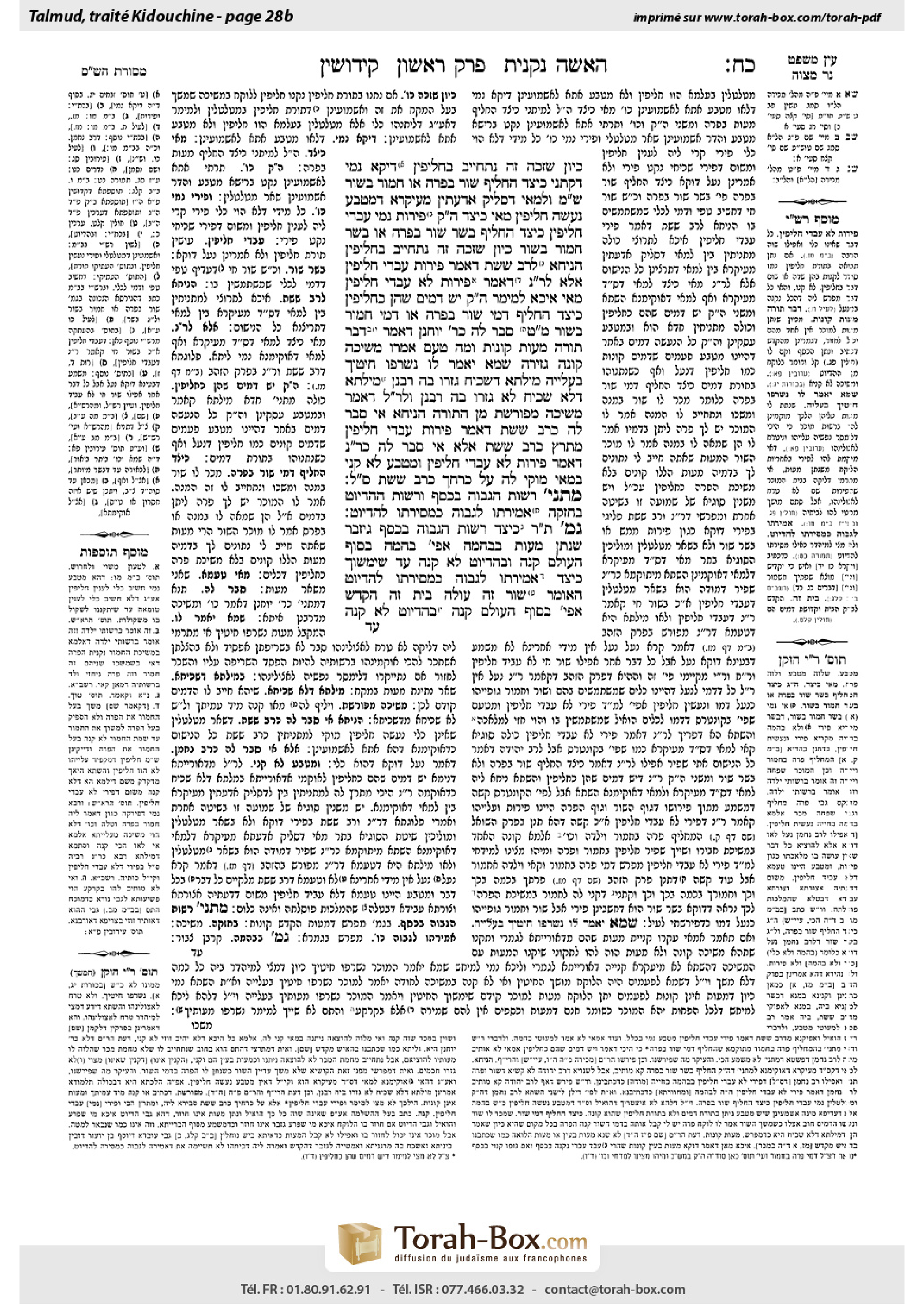
This page of Kiddushin includes the Aramaic text, an English translation and an AI-generated French translation, alongside the scan above.
קידושין כ״ח ב · Aramaic and Hebrew text
כֵּיוָן שֶׁזָּכָה זֶה נִתְחַיֵּיב בַּחֲלִיפִין. דַּיְקָא נָמֵי, דְּקָתָנֵי: כֵּיצַד? הֶחְלִיף שׁוֹר בְּפָרָה אוֹ חֲמוֹר בְּשׁוֹר. שְׁמַע מִינַּהּ.
וּלְמַאי דִּסְלֵיק אַדַּעְתִּין מֵעִיקָּרָא דְּמַטְבֵּעַ נַעֲשֶׂה חֲלִיפִין, מַאי כֵּיצַד? הָכִי קָאָמַר: פֵּירוֹת נָמֵי עָבְדִי חֲלִיפִין. כֵּיצַד? הֶחְלִיף בְּשַׂר שׁוֹר בְּפָרָה אוֹ בְּשַׂר חֲמוֹר בְּשׁוֹר, כֵּיוָן שֶׁזָּכָה זֶה נִתְחַיֵּיב בַּחֲלִיפִין.
הָנִיחָא לְרַב שֵׁשֶׁת, דְּאָמַר: פֵּירוֹת עָבְדִי חֲלִיפִין. אֶלָּא לְרַב נַחְמָן דְּאָמַר: פֵּירוֹת לָא עָבְדִי חֲלִיפִין, מַאי אִיכָּא לְמֵימַר?
הָכִי קָאָמַר: יֵשׁ דָּמִים שֶׁהֵן כַּחֲלִיפִין, כֵּיצַד? הֶחְלִיף דְּמֵי שׁוֹר בְּפָרָה אוֹ דְּמֵי חֲמוֹר בְּשׁוֹר.
מַאי טַעְמָא? סָבַר לַהּ כְּרַבִּי יוֹחָנָן, דְּאָמַר: דְּבַר תּוֹרָה, מָעוֹת קוֹנוֹת. וּמָה טַעַם אָמְרוּ מְשִׁיכָה קוֹנָה? גְּזֵירָה שֶׁמָּא יֹאמַר לוֹ: ״נִשְׂרְפוּ חִיטֶּיךָ בָּעֲלִיָּיה״.
מִילְּתָא דִשְׁכִיחָ[א] גְּזַרוּ בַּהּ רַבָּנַן, מִילְּתָא דְּלָא שְׁכִיחָ[א] לָא גְּזַרוּ בַּהּ רַבָּנַן.
וּלְרֵישׁ לָקִישׁ דְּאָמַר: מְשִׁיכָה מְפוֹרֶשֶׁת מִן הַתּוֹרָה, הָנִיחָא אִי סָבַר לַהּ כְּרַב שֵׁשֶׁת דְּאָמַר פֵּירוֹת עָבְדִי חֲלִיפִין, מְתָרֵץ כְּרַב שֵׁשֶׁת.
אֶלָּא אִי סָבַר לַהּ כְּרַב נַחְמָן דְּאָמַר פֵּירוֹת לָא עָבְדִי חֲלִיפִין, וּמַטְבֵּעַ לָא קָנֵי, בְּמַאי מוֹקֵי לַהּ? עַל כֻּרְחָךְ, כְּרַב שֵׁשֶׁת סְבִירָא לֵיהּ.
מַתְנִי׳ רְשׁוּת הַגָּבוֹהַּ בְּכֶסֶף, וּרְשׁוּת הַהֶדְיוֹט בַּחֲזָקָה. אֲמִירָתוֹ לְגָבוֹהַּ – כִּמְסִירָתוֹ לְהֶדְיוֹט.
גְּמָ׳ תָּנוּ רַבָּנַן: כֵּיצַד רְשׁוּת הַגָּבוֹהַּ בְּכֶסֶף? גִּיזְבָּר שֶׁנָּתַן מָעוֹת בִּבְהֵמָה, אֲפִילּוּ בְּהֵמָה בְּסוֹף הָעוֹלָם – קָנָה. וּבַהֶדְיוֹט – לֹא קָנָה עַד שֶׁיִּמְשׁוֹךְ.
כֵּיצַד אֲמִירָתוֹ לַגָּבוֹהַּ כִּמְסִירָתוֹ לַהֶדְיוֹט? הָאוֹמֵר ״שׁוֹר זֶה עוֹלָה״, ״בַּיִת זֶה הֶקְדֵּשׁ״, אֲפִילּוּ בְּסוֹף הָעוֹלָם – קָנָה. בַּהֶדְיוֹט – לֹא קָנָה
Kiddushin 28b · English translation
once one party in the transaction acquires the item he is receiving, this party is obligated with regard to the item being exchanged for it. The novelty of the mishna is that all items, not only vessels, can be used to perform the act of acquisition of exchange. Therefore, one should not infer that the same is the halakha with regard to coins. The Gemara comments: The language of the mishna is also precise, as it teaches afterward: How so? If one exchanges an ox for a cow, or a donkey for an ox, once this party acquires the animal that he is receiving, this party is obligated with regard to the item being exchanged for it. This clause apparently explains the previous clause, and employs the example of animals, not coins. The Gemara summarizes: Learn from this clause that the mishna is referring to acquisition through the exchange of items, not money.
The Gemara asks: And with regard to what entered our minds initially, that a coin effects symbolic exchange, what is the meaning of the clause: How so, if one exchanged an ox for a cow, once this party acquires the animal that he is receiving, this party is obligated with regard to the item being exchanged for it. This example does not involve a coin. The Gemara explains that it was assumed that this is what the mishna is saying: Not only can a coin be used in the act of acquisition of exchange, but produce can also effect exchange. How so? If one exchanged meat of an ox for a cow, or the meat of a donkey for an ox, once this party acquires the item that he is receiving, this party is obligated with regard to the item being exchanged for it.
The Gemara asks: This works out well according to the opinion of Rav Sheshet, who says: Produce effects exchange, i.e., the mode of acquisition of exchange applies not only to vessels but also to produce and animals. But according to the opinion of Rav Naḥman, who says: Produce does not effect exchange, what can be said?
The Gemara answers: According to this opinion, the mishna is dealing with money alone, and this is what the mishna is saying: There is a transaction involving money that is like an exchange. How so? If one exchanged the monetary value of an ox for a cow, or the monetary value of a donkey for an ox, the transaction is effective. In this case, one sold his ox to another for an agreed sum of money, and after the buyer acquired the ox by pulling it, he then offered to give the seller his cow in exchange for the money that he owes him. In this case the cow is acquired without the seller having to pull it. Although this acquisition initially was to be an exchange, it is ultimately a purchase for money, as the second animal is acquired as a result of the forgiving of the monetary debt.
What is the reason for this ruling in light of the halakha that one cannot acquire movable property by means of money alone? The Gemara explains that Rav Naḥman holds in accordance with the opinion of Rabbi Yoḥanan, who said: By Torah law money effects acquisition, i.e., when one pays money he acquires the item, even if he has not yet performed another act of acquisition. And what is the reason that the Sages said that pulling acquires an item and money does not? This is a rabbinic decree lest the seller say to the buyer after receiving the money: Your wheat was burned in the loft. If a fire breaks out or some other mishap occurs after a seller receives the money, he will not bother to save the goods in his house because they no longer belong to him, and the buyer may incur a loss.
The Sages therefore decreed that acquisition takes effect only when a buyer pulls the item. The reason that the mishna allows a transaction that indicates that one can effect acquisition using only money is because that case of the mishna as explained by Rav Naḥman is an uncommon occurrence. It is rare for one who has sold his animal in exchange for money to change his mind and request an animal from the purchaser instead. With regard to a common occurrence, the Sages issued a decree, whereas in the case of an uncommon occurrence, the Sages did not issue a decree. Consequently, the Sages did not apply their decree to this situation.
The Gemara asks: And how is the mishna explained according to the opinion of Reish Lakish, who disagrees with Rabbi Yoḥanan and says that pulling is explicitly stated in the Torah? Reish Lakish maintains that the acquisition of movable property cannot be performed with money by Torah law, and therefore there can be no distinction between common and uncommon cases. This works out well if Reish Lakish holds in accordance with the opinion of Rav Sheshet, who says that produce effects exchange. If so, he can explain the mishna in accordance with the opinion of Rav Sheshet.
But if he holds in accordance with the opinion of Rav Naḥman, who says that produce does not effect exchange and a coin does not effect acquisition by Torah law or by rabbinic law, in what manner does he establish the mishna? The Gemara answers: Perforce Reish Lakish holds in accordance with the opinion of Rav Sheshet.
MISHNA: The authority of the Temple treasury effects acquisition by means of money to the seller. And the authority, i.e., the mode of acquisition, of a commoner [hedyot] is by possession. Furthermore, one’s declaration to the Most High, i.e., when one consecrates an item through speech, is equivalent to transferring an item to a common person, and the item is acquired by the Temple treasury through his mere speech.
GEMARA: The Sages taught in a baraita (Tosefta 1:6): How does the authority of the Temple treasury effect acquisition by means of money? With regard to the Temple treasurer who gives coins for an animal, even if the animal is at the other end of the world, he acquires it immediately. And with regard to a commoner, he does not acquire the animal until he pulls it.
How is one’s declaration to the Most High equivalent to transferring an item to a common person? With regard to one who says: This ox is a burnt-offering, or: This house is consecrated property, the Temple treasury acquires these even if they are at the other end of the world. There is no need for a further act of acquisition, as that statement alone is sufficient. Whereas with regard to a commoner, he does not acquire property in this manner
Kiddushin 28b · Traduction française (IA)
Dès que l’une des parties à la transaction acquiert l’objet qu’elle reçoit, elle est tenue de remettre l’objet échangé contre celui-ci. La nouveauté de la Michna est que tous les objets, et pas seulement les ustensiles, peuvent servir à effectuer l’acquisition par échange. Il ne faut donc pas en déduire que la même halakha s’applique aux pièces. La Guemara fait remarquer que la formulation de la Michna est également précise, puisqu’elle enseigne ensuite : « Comment cela ? Si l’on échange un bœuf contre une vache, ou un âne contre un bœuf, dès que cette partie acquiert l’animal qu’elle reçoit, elle est tenue de remettre l’objet échangé contre celui-ci. » Cette clause semble expliquer la précédente et prend pour exemple des animaux, non des pièces. La Guemara résume : Déduis de cette clause que la Michna parle d’une acquisition par échange d’objets, et non d’argent.
La Guemara demande : Et selon ce que nous avions pensé au départ, à savoir qu’une pièce produit un échange symbolique, que signifie la clause : « Comment cela ? Si l’on échange un bœuf contre une vache, dès que cette partie acquiert l’animal qu’elle reçoit, elle est tenue de remettre l’objet échangé contre celui-ci » ? Cet exemple ne fait pas intervenir de pièce. La Guemara explique qu’on supposait que la Michna disait ceci : non seulement une pièce peut servir à effectuer une acquisition par échange, mais les produits peuvent également faire l’objet d’un échange. Comment cela ? Si l’on échange la viande d’un bœuf contre une vache, ou la viande d’un âne contre un bœuf, dès que cette partie acquiert l’objet qu’elle reçoit, elle est tenue de remettre l’objet échangé contre celui-ci.
La Guemara demande : Cela convient selon l’opinion de Rav Chéchet, qui dit que les produits peuvent faire l’objet d’un échange, c’est-à-dire que le mode d’acquisition par échange s’applique non seulement aux ustensiles, mais aussi aux produits et aux animaux. Mais que peut-on dire selon l’opinion de Rav Naḥman, qui dit que les produits ne peuvent pas faire l’objet d’un échange ?
La Guemara répond : Selon cette opinion, la Michna traite uniquement d’argent, et voici ce qu’elle enseigne : il existe une transaction impliquant de l’argent qui s’apparente à un échange. Comment cela ? Si l’on échange la valeur monétaire d’un bœuf contre une vache, ou la valeur monétaire d’un âne contre un bœuf, la transaction est effective. Dans ce cas, quelqu’un a vendu son bœuf à un autre pour une somme convenue et, après que l’acheteur a acquis le bœuf en le tirant, il propose de donner sa vache au vendeur en échange de l’argent qu’il lui doit. Dans ce cas, la vache est acquise sans que le vendeur ait à la tirer. Bien que cette acquisition ait d’abord été conçue comme un échange, il s’agit finalement d’un achat contre de l’argent, puisque le second animal est acquis en contrepartie de l’annulation de la dette monétaire.
Quelle est la raison de cette règle, étant donné la halakha selon laquelle on ne peut acquérir des biens meubles au moyen du seul argent ? La Guemara explique que Rav Naḥman suit l’opinion de Rabbi Yoḥanan, qui a dit : Selon la Torah, l’argent produit l’acquisition, c’est-à-dire que lorsqu’on paie, on acquiert l’objet, même si l’on n’a pas encore accompli un autre acte d’acquisition. Et pour quelle raison les Sages ont-ils dit que c’est le fait de tirer l’objet qui permet de l’acquérir, et non le paiement ? Il s’agit d’un décret rabbinique, de peur que le vendeur ne dise à l’acheteur, après avoir reçu l’argent : « Ton blé a brûlé dans le grenier. » Si un incendie se déclare ou qu’un autre accident survient après que le vendeur a reçu l’argent, il ne prendra pas la peine de sauver les marchandises qui se trouvent chez lui, puisqu’elles ne lui appartiennent plus, et l’acheteur risque de subir une perte.
Les Sages ont donc décrété que l’acquisition ne prend effet que lorsque l’acheteur tire l’objet. Si la Michna permet une transaction qui semble indiquer qu’on peut acquérir au moyen du seul argent, c’est parce que le cas de la Michna, tel que l’explique Rav Naḥman, est peu courant. Il est rare que celui qui a vendu son animal contre de l’argent change d’avis et demande plutôt un animal à l’acheteur. Pour une situation courante, les Sages ont institué un décret, mais ils n’en ont pas institué pour une situation peu courante. Par conséquent, ils n’ont pas appliqué leur décret à cette situation.
La Guemara demande : Et comment la Michna s’explique-t-elle selon l’opinion de Reish Lakish, qui s’oppose à Rabbi Yoḥanan et dit que le fait de tirer l’objet est explicitement prescrit dans la Torah ? Reish Lakish soutient que, selon la Torah, on ne peut pas acquérir des biens meubles au moyen d’argent ; il ne peut donc y avoir de distinction entre les situations courantes et celles qui ne le sont pas. Cela convient si Reish Lakish suit l’opinion de Rav Chéchet, qui dit que les produits peuvent faire l’objet d’un échange. Il peut alors expliquer la Michna conformément à l’opinion de Rav Chéchet.
Mais s’il suit l’opinion de Rav Naḥman, qui dit que les produits ne peuvent pas faire l’objet d’un échange et qu’une pièce ne produit pas d’acquisition, ni selon la Torah ni selon le droit rabbinique, comment explique-t-il la Michna ? La Guemara répond : nécessairement, Reish Lakish suit l’opinion de Rav Chéchet.
MICHNA : Le trésor du Temple acquiert par le paiement de l’argent au vendeur. Pour un particulier [hedyot], en revanche, le mode d’acquisition est la prise de possession. En outre, une déclaration adressée au Très-Haut, c’est-à-dire lorsqu’on consacre un objet par la parole, équivaut à transférer un objet à un particulier, et le trésor du Temple acquiert l’objet par la seule parole de celui qui le consacre.
GUEMARA : Les Sages ont enseigné dans une baraïta (Tosefta 1:6) : Comment le trésor du Temple acquiert-il par le paiement de l’argent ? Lorsqu’un trésorier du Temple donne des pièces pour un animal, il l’acquiert immédiatement, même si l’animal se trouve à l’autre bout du monde. Pour un particulier, en revanche, il n’acquiert l’animal qu’en le tirant.
Comment une déclaration adressée au Très-Haut équivaut-elle à transférer un objet à un particulier ? Celui qui dit : « Ce bœuf est un holocauste » ou « Cette maison est un bien consacré » fait acquérir ces biens au trésor du Temple, même s’ils se trouvent à l’autre bout du monde. Aucun autre acte d’acquisition n’est nécessaire, car cette seule déclaration suffit. En revanche, un particulier n’acquiert pas un bien de cette manière.
Traduction française générée par IA à partir de l’édition anglaise de Sefaria. Vérifie toujours un passage avec le texte source.
Text from Sefaria: William Davidson Edition - Vocalized Aramaic (CC BY NC); William Davidson Edition - English (CC BY NC).