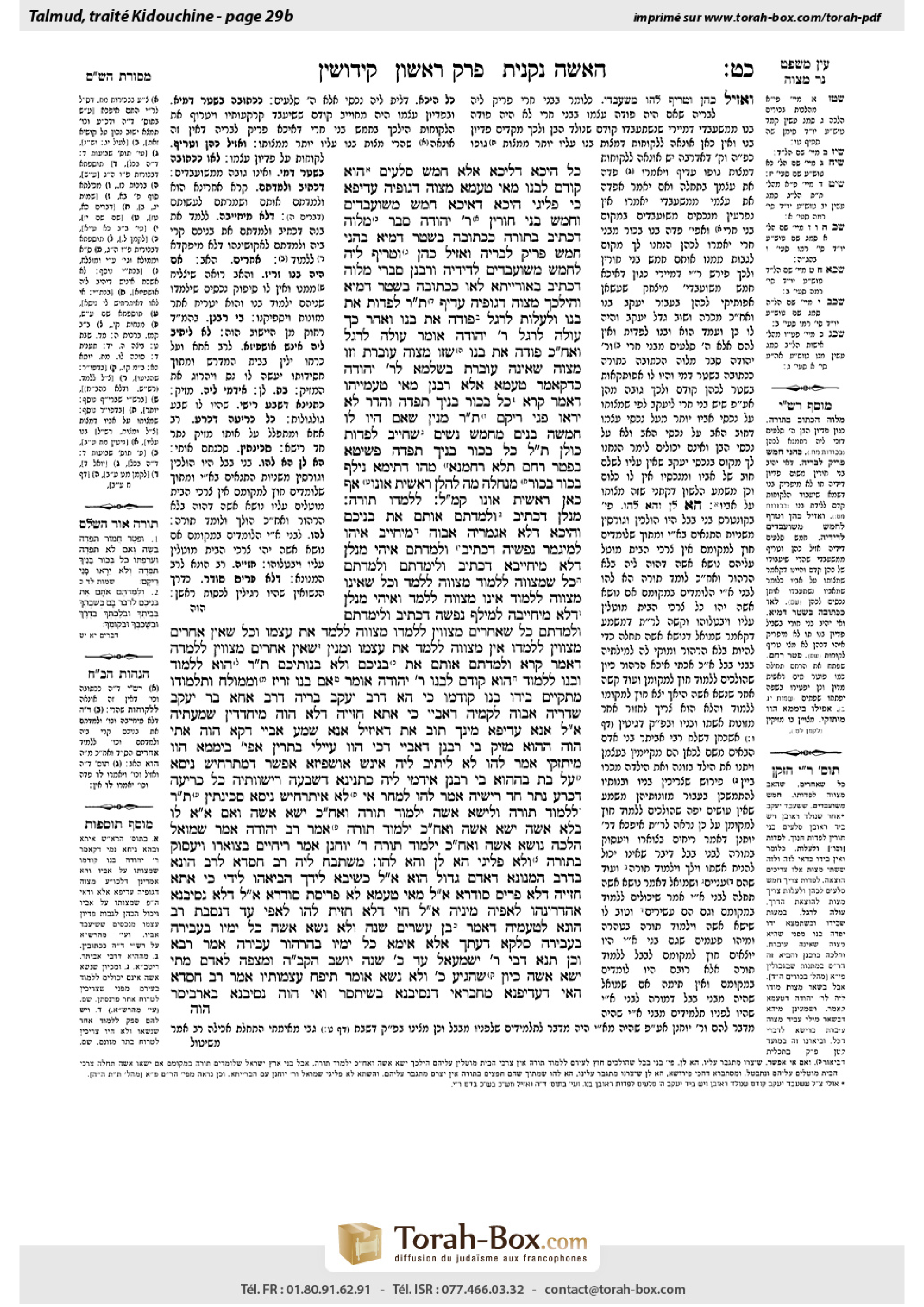
Kiddushin 29b: Talmud study for Daf Yomi
Daf Yomi is the daily study of one Talmud folio. Explore 37 tractates with scans, Hebrew text, Sefaria English and AI-generated French translations where annotated.
Passage selection and English or AI-generated French translation are available where the scan has annotations. Daf Study is independent of Torah-Box and Sefaria.
Browse Kiddushin · קידושין · All tractatesKiddushin 29b text and translations
This page of Kiddushin includes the Aramaic text, an English translation and an AI-generated French translation, alongside the scan above.
קידושין כ״ט ב · Aramaic and Hebrew text
כׇּל הֵיכָא דְּלֵיכָּא אֶלָּא חָמֵשׁ סְלָעִים – הוּא קוֹדֵם לִבְנוֹ. מַאי טַעְמָא? מִצְוָה דְגוּפֵיהּ עֲדִיפָא. כִּי פְּלִיגִי הֵיכָא דְּאִיכָּא חָמֵשׁ מְשׁוּעְבָּדִים וְחָמֵשׁ בְּנֵי חוֹרִין.
רַבִּי יְהוּדָה סָבַר: מִלְוָה (דִּכְתִיב) [הַכְּתוּבָה] בַּתּוֹרָה כִּכְתוּבָה בִּשְׁטָר דָּמְיָא, בְּהָנֵי חָמֵשׁ פָּרֵיק לִבְרֵיהּ וְאָזֵיל כֹּהֵן וְטָרֵיף לֵיהּ לְחָמֵשׁ מְשׁוּעְבָּדִים לְדִידֵיהּ.
וְרַבָּנַן סָבְרִי: מִלְוָה דִּכְתִיב בְּאוֹרָיְיתָא לָאו כִּכְתוּבָה בִּשְׁטָר דָּמְיָא, וְהִילְכָּךְ מִצְוָה דְגוּפֵיהּ עֲדִיף.
תָּנוּ רַבָּנַן: לִפְדּוֹת אֶת בְּנוֹ וְלַעֲלוֹת לָרֶגֶל – פּוֹדֶה אֶת בְּנוֹ וְאַחַר כָּךְ עוֹלֶה לָרֶגֶל. רַבִּי יְהוּדָה אוֹמֵר: עוֹלֶה לָרֶגֶל, וְאַחַר כָּךְ פּוֹדֶה אֶת בְּנוֹ. שֶׁזּוֹ מִצְוָה עוֹבֶרֶת, וְזוֹ מִצְוָה שֶׁאֵינָהּ עוֹבֶרֶת.
בִּשְׁלָמָא לְרַבִּי יְהוּדָה, כִּדְקָאָמַר טַעְמָא. אֶלָּא רַבָּנַן מַאי טַעְמַיְיהוּ? דְּאָמַר קְרָא: ״כׇּל בְּכוֹר בָּנֶיךָ תִּפְדֶּה״, וַהֲדַר: ״לֹא יֵרָאוּ פָנַי רֵיקָם״.
תָּנוּ רַבָּנַן: מִנַּיִן שֶׁאִם הָיוּ לוֹ חֲמִשָּׁה בָּנִים מֵחָמֵשׁ נָשִׁים שֶׁחַיָּיב לִפְדּוֹת כּוּלָּן – תַּלְמוּד לוֹמַר: ״כֹּל בְּכוֹר בָּנֶיךָ תִּפְדֶּה״. פְּשִׁיטָא, בְּפֶטֶר רֶחֶם תְּלָא רַחֲמָנָא!
מַהוּ דְּתֵימָא: נֵילַף בְּכוֹר בְּכוֹר מִנַּחֲלָה, מָה לְהַלָּן ״רֵאשִׁית אֹנוֹ״, אַף כָּאן ״רֵאשִׁית אוֹנוֹ״, קָא מַשְׁמַע לַן.
לְלַמְּדוֹ תּוֹרָה. מְנָלַן? דִּכְתִיב: ״וְלִמַּדְתֶּם אֹתָם אֶת בְּנֵיכֶם״. וְהֵיכָא דְּלָא אַגְמְרֵיהּ אֲבוּהּ מִיחַיַּיב אִיהוּ לְמִיגְמַר נַפְשֵׁיהּ, דִּכְתִיב: ״וּלְמַדְתֶּם״.
אִיהִי מְנָלַן דְּלָא מִיחַיְּיבָא? דִּכְתִיב: ״וְלִימַּדְתֶּם״ ״וּלְמַדְתֶּם״, כֹּל שֶׁמְּצֻוֶּוה לִלְמוֹד – מְצֻוֶּוה לְלַמֵּד, וְכֹל שֶׁאֵינוֹ מְצֻוֶּוה לִלְמוֹד – אֵינוֹ מְצֻוֶּוה לְלַמֵּד.
וְאִיהִי מְנָלַן דְּלָא מִיחַיְּיבָה לְמֵילַף נַפְשַׁהּ? דִּכְתִיב: ״וְלִימַּדְתֶּם״ ״וּלְמַדְתֶּם״, כֹּל שֶׁאֲחֵרִים מְצֻוִּוין לְלַמְּדוֹ – מְצֻוֶּוה לְלַמֵּד אֶת עַצְמוֹ, וְכֹל שֶׁאֵין אֲחֵרִים מְצֻוִּוין לְלַמְּדוֹ – אֵין מְצֻוֶּוה לְלַמֵּד אֶת עַצְמוֹ. וּמִנַּיִן שֶׁאֵין אֲחֵרִים מְצֻוִּוין לְלַמְּדָהּ? דְּאָמַר קְרָא: ״וְלִמַּדְתֶּם אֹתָם אֶת בְּנֵיכֶם״ אֶת בְּנֵיכֶם, וְלֹא בְּנוֹתֵיכֶם.
תָּנוּ רַבָּנַן: הוּא לִלְמוֹד וּבְנוֹ לִלְמוֹד – הוּא קוֹדֵם לִבְנוֹ. רַבִּי יְהוּדָה אוֹמֵר: אִם בְּנוֹ זָרִיז וּמְמוּלָּח וְתַלְמוּדוֹ מִתְקַיֵּים בְּיָדוֹ – בְּנוֹ קוֹדְמוֹ. כִּי הָא דְּרַב יַעֲקֹב בְּרֵיהּ דְּרַב אַחָא בַּר יַעֲקֹב שַׁדְּרֵיהּ אֲבוּהּ לְקַמֵּיהּ דְּאַבָּיֵי. כִּי אֲתָא חַזְיֵיהּ דְּלָא הֲוָה מִיחַדְּדָן שְׁמַעְתֵּיהּ. אֲמַר לֵיהּ: אֲנָא עֲדִיפָא מִינָּךְ, תּוּב אַתְּ, דְּאֵיזִיל אֲנָא.
שְׁמַע אַבָּיֵי דְּקָא הֲוָה אָתֵי. הֲוָה הָהוּא מַזִּיק בֵּי רַבָּנַן דְּאַבָּיֵי, דְּכִי הֲווֹ עָיְילִי בִּתְרֵין אֲפִילּוּ בִּימָמָא הֲווֹ מִיתַּזְּקִי. אֲמַר לְהוּ: לָא לִיתֵּיב לֵיהּ אִינָשׁ אוּשְׁפִּיזָא, אֶפְשָׁר דְּמִתְרְחִישׁ נִיסָּא.
עָל, בָּת בְּהָהוּא בֵּי רַבָּנַן. אִידְּמִי לֵיהּ כְּתַנִּינָא דְּשִׁבְעָה רֵישְׁווֹתֵיהּ. כֹּל כְּרִיעָה דִּכְרַע נְתַר חַד רֵישֵׁיהּ. אֲמַר לְהוּ לִמְחַר: אִי לָא אִיתְרְחִישׁ נִיסָּא סַכֵּינְתִּין.
תָּנוּ רַבָּנַן: לִלְמוֹד תּוֹרָה וְלִישָּׂא אִשָּׁה – יִלְמוֹד תּוֹרָה וְאַחַר כָּךְ יִשָּׂא אִשָּׁה. וְאִם אִי אֶפְשָׁר לוֹ בְּלֹא אִשָּׁה – יִשָּׂא אִשָּׁה וְאַחַר כָּךְ יִלְמוֹד תּוֹרָה. אָמַר רַב יְהוּדָה אָמַר שְׁמוּאֵל: הֲלָכָה, נוֹשֵׂא אִשָּׁה וְאַחַר כָּךְ יִלְמוֹד תּוֹרָה.
רַבִּי יוֹחָנָן אָמַר: רֵיחַיִים בְּצַוָּארוֹ וְיַעֲסוֹק בַּתּוֹרָה?! וְלָא פְּלִיגִי: הָא – לַן, וְהָא – לְהוּ.
מִשְׁתַּבַּח לֵיהּ רַב חִסְדָּא לְרַב הוּנָא בִּדְרַב הַמְנוּנָא דְּאָדָם גָּדוֹל הוּא. אֲמַר לֵיהּ: כְּשֶׁיָּבֹא לְיָדְךָ – הֲבִיאֵהוּ לְיָדִי. כִּי אֲתָא חַזְיֵיהּ דְּלָא פָּרֵיס סוּדָרָא. אֲמַר לֵיהּ: מַאי טַעְמָא לָא פָּרֵיסַתְּ סוּדָרָא? אֲמַר לֵיהּ: דְּלָא נְסֵיבְנָא. אַהְדְּרִינְהוּ לְאַפֵּיהּ מִינֵּיהּ. אֲמַר לֵיהּ: חֲזִי דְּלָא חָזֵית לְהוּ לְאַפַּי עַד דְּנָסְבַתְּ.
רַב הוּנָא לְטַעְמֵיהּ דְּאָמַר: בֶּן עֶשְׂרִים שָׁנָה וְלֹא נָשָׂא אִשָּׁה – כׇּל יָמָיו בַּעֲבֵירָה. בַּעֲבֵירָה סָלְקָא דַּעְתָּךְ?! אֶלָּא אֵימָא: כָּל יָמָיו בְּהִרְהוּר עֲבֵירָה.
אָמַר רָבָא, וְכֵן תָּנָא דְּבֵי רַבִּי יִשְׁמָעֵאל: עַד עֶשְׂרִים שָׁנָה יוֹשֵׁב הַקָּדוֹשׁ בָּרוּךְ הוּא וּמְצַפֶּה לָאָדָם מָתַי יִשָּׂא אִשָּׁה, כֵּיוָן שֶׁהִגִּיעַ עֶשְׂרִים וְלֹא נָשָׂא, אוֹמֵר: תִּיפַּח עַצְמוֹתָיו.
אָמַר רַב חִסְדָּא: הַאי דַּעֲדִיפְנָא מֵחַבְרַאי, דִּנְסֵיבְנָא בְּשִׁיתְּסַר, וְאִי הֲוָה נָסֵיבְנָא בְּאַרְבֵּיסַר
Kiddushin 29b · English translation
that anywhere that there are only five sela available, i.e., enough to redeem only one man, and one is obligated to redeem both himself and his son, he, the father, takes precedence over his son. What is the reason? It is that his own mitzva is preferable to one that he performs on behalf of others. When they disagree is in a case where there is land worth five sela that is liened property that has been sold, i.e., he sold this land to other people but it can be reclaimed by his prior creditor, and five sela which is entirely unsold property.
And the reasoning behind the dispute is as follows: Rabbi Yehuda maintains that a loan that is written in the Torah, i.e., any financial obligation that applies by Torah law, is considered as though it is written in a document, and therefore it can be collected from liened property, like any loan recorded in a document. This means that the liened property worth five sela is available for one’s own redemption, but not for that of his son, as the sale of the property occurred before the birth of his firstborn. Consequently, with these five sela upon which there is no lien he redeems his son, and the priest goes and repossesses the land worth five sela that is liened property for his own redemption. In this manner one can fulfill both mitzvot.
And the Rabbis maintain: A loan that is written in the Torah is not considered as though it is written in a document, since buyers will not be aware of this obligation, so that they should be aware that the land may be repossessed. And therefore there is no advantage for this man to redeem his son with the five sela upon which there is no lien, and his own mitzva is preferable, which means he redeems himself with the free land. With the liened property that is left he cannot redeem his son, as the land was sold before the birth of his firstborn.
The Sages taught: If one has money to redeem his son and to ascend to Jerusalem on the pilgrimage Festival, he redeems his son and then ascends to Jerusalem on the pilgrimage Festival. Rabbi Yehuda says: He ascends to Jerusalem on the pilgrimage Festival and then redeems his son. His reasoning is that this trip to Jerusalem for the pilgrimage Festival is a mitzva whose time soon passes, and this, the redemption of the firstborn son, is a mitzva whose time does not soon pass, as it can be fulfilled later.
The Gemara asks: Granted, according to the opinion of Rabbi Yehuda, it is as he stated in his reasoning, i.e., Rabbi Yehuda provided the rationale for his opinion. But what is the reasoning of the Rabbis, who say that he should first redeem his son? The Gemara answers that the reason is that the verse states: “All the firstborn of your sons you shall redeem” (Exodus 34:20), and it then states, in the same verse: “And none shall appear before me empty,” referring to the pilgrimage Festival in Jerusalem. The order of the verse indicates that one should redeem his firstborn son before traveling to Jerusalem on the pilgrimage Festival.
The Sages taught: From where is it derived that if one had five firstborn sons, from five different women, he is obligated to redeem them all? The verse states: “All the firstborn of your sons you shall redeem” (Exodus 34:20), and the emphasis of “all” includes any of one’s firstborn sons. The Gemara asks: Isn’t it obvious this is the case? After all, the Merciful One made this mitzva dependent upon the opening of the womb, as it states: “Sanctify to Me all the firstborn, whoever opens the womb” (Exodus 13:2). Since each of these sons is the firstborn of his mother, it is clear that the father is required to redeem each of them.
The Gemara answers that this ruling is necessary lest you say that we should derive a verbal analogy between “firstborn” stated here and “firstborn” from the verses dealing with inheritance: Just as there, the verse describes a firstborn who receives a double portion of the inheritance as: “The first fruit of his strength” (Deuteronomy 21:17), i.e., he is the firstborn son to his father, and not the first child born to his mother; so too here, with regard to the redemption of the firstborn son, it is referring to the first fruit of his strength, which would mean that the father need redeem only his oldest child. Therefore, this baraita teaches us that this is not the case. Rather, every firstborn son to his mother must be redeemed.
§ The baraita teaches that a father is obligated to teach his son Torah. The Gemara asks: From where do we derive this requirement? As it is written: “And you shall teach them [velimadtem] to your sons” (Deuteronomy 11:19). And in a case where his father did not teach him he is obligated to teach himself, as it is written, i.e., the verse can be read with a different vocalization: And you shall study [ulmadtem].
From where do we derive that a woman is not obligated to teach her son Torah? As it is written: “And you shall teach [velimadtem],” which can be read as: And you shall study [ulmadtem]. This indicates that whoever is commanded to study Torah is commanded to teach, and whoever is not commanded to study is not commanded to teach. Since a woman is not obligated to learn Torah, she is likewise not obligated to teach it.
The Gemara asks: And from where do we derive that she is not obligated to teach herself? The Gemara answers: As it is written: “And you shall teach [velimadtem],” which can be read as: And you shall study [ulmadtem], which indicates that whoever others are commanded to teach is commanded to teach himself, and whoever others are not commanded to teach is not commanded to teach himself. And from where is it derived that others are not commanded to teach a woman? As the verse states: “And you shall teach them to your sons” (Deuteronomy 11:19), which emphasizes: Your sons and not your daughters.
The Sages taught: If one wishes to study Torah himself and his son also wants to study, he takes precedence over his son. Rabbi Yehuda says: If his son is diligent and sharp, and his study will endure, his son takes precedence over him. This is like that anecdote which is told about Rav Ya’akov, son of Rav Aḥa bar Ya’akov, whose father sent him to Abaye to study Torah. When the son came home, his father saw that his studies were not sharp, as he was insufficiently bright. Rav Aḥa bar Ya’akov said to his son: I am preferable to you, and it is better that I go and study. Therefore, you sit and handle the affairs of the house so that I can go and study.
Abaye heard that Rav Aḥa bar Ya’akov was coming. There was a certain demon in the study hall of Abaye, which was so powerful that when two people would enter they would be harmed, even during the day. Abaye said to the people of the town: Do not give Rav Aḥa bar Ya’akov lodging [ushpiza] so that he will be forced to spend the night in the study hall. Since Rav Aḥa bar Ya’akov is a righteous man, perhaps a miracle will occur on his behalf and he will kill the demon.
Rav Aḥa found no place to spend the night, and he entered and spent the night in that study hall of the Sages. The demon appeared to him like a serpent with seven heads. Rav Aḥa bar Ya’akov began to pray, and with every bow that he bowed one of the demon’s heads fell off, until it eventually died. The next day Rav Aḥa said to the townspeople: If a miracle had not occurred, you would have placed me in danger.
The Sages taught: If one has to decide whether to study Torah or to marry a woman, which should he do first? He should study Torah and afterward marry a woman. And if it is impossible for him to be without a wife, he should marry a woman and then study Torah. Rav Yehuda says that Shmuel says: The halakha is that one should marry a woman and afterward study Torah.
Rabbi Yoḥanan says: How can one do this? With a millstone hanging from his neck, i.e., with the responsibility of providing for his family weighing upon him, can he engage in Torah study? The Gemara comments: And the amora’im do not disagree; this is for us and that is for them. In other words, one statement applies to the residents of Babylonia, whereas the other is referring to those living in Eretz Yisrael.
§ With regard to marriage, the Gemara relates: Rav Ḥisda would praise Rav Hamnuna to Rav Huna by saying that he is a great man. Rav Huna said to him: When he comes to you, send him to me. When Rav Hamnuna came before him, Rav Huna saw that he did not cover his head with a cloth, as Torah scholars did. Rav Huna said to him: What is the reason that you do not cover your head with a cloth? Rav Hamnuna said to him: The reason is that I am not married, and it was not customary for unmarried men to cover their heads with a cloth. Rav Huna turned his face away from him in rebuke, and he said to him: See to it that you do not see my face until you marry.
The Gemara notes: Rav Huna conforms to his standard line of reasoning, as he says: If one is twenty years old and has not yet married a woman, all of his days will be in a state of sin concerning sexual matters. The Gemara asks: Can it enter your mind that he will be in a state of sin all of his days? Rather, say that this means the following: All of his days will be in a state of thoughts of sin, i.e., sexual thoughts. One who does not marry in his youth will become accustomed to thoughts of sexual matters, and the habit will remain with him the rest of his life.
Rava said, and similarly, the school of Rabbi Yishmael taught: Until one reaches the age of twenty years the Holy One, Blessed be He, sits and waits for a man, saying: When will he marry a woman? Once he reaches the age of twenty and has not married, He says: Let his bones swell, i.e., he is cursed and God is no longer concerned about him.
Rav Ḥisda said: The fact that I am superior to my colleagues is because I married at the age of sixteen, and if I would have married at the age of fourteen,
Kiddushin 29b · Traduction française (IA)
que, lorsqu’il n’y a que cinq sela disponibles, c’est-à-dire de quoi racheter un seul homme, et qu’on est tenu de racheter à la fois soi-même et son fils, le père a priorité sur son fils. Pour quelle raison ? Parce que sa propre mitsva est préférable à celle qu’il accomplit pour autrui. Leur désaccord porte sur le cas où il y a un terrain d’une valeur de cinq sela, grevé d’un privilège et vendu — c’est-à-dire qu’il a vendu ce terrain à d’autres, mais que son créancier antérieur peut le faire saisir —, ainsi que cinq sela de biens libres, qui n’ont jamais été vendus.
Voici le raisonnement qui sous-tend leur désaccord : Rabbi Yehouda considère qu’un prêt dont l’obligation découle de la Torah, c’est-à-dire toute obligation financière imposée par la Torah, est considéré comme s’il était inscrit dans un document ; il peut donc être recouvré sur des biens grevés d’un privilège, comme tout prêt consigné dans un document. Cela signifie que le terrain grevé d’un privilège, d’une valeur de cinq sela, peut servir à son propre rachat, mais pas à celui de son fils, puisque le terrain a été vendu avant la naissance de son fils premier-né. Par conséquent, avec les cinq sela qui ne sont grevés d’aucun privilège, il rachète son fils, et le prêtre va saisir le terrain grevé d’un privilège, d’une valeur de cinq sela, pour son propre rachat. De cette manière, il peut accomplir les deux mitsvot.
Les Sages, eux, considèrent qu’un prêt dont l’obligation découle de la Torah n’est pas considéré comme s’il était inscrit dans un document, car les acquéreurs n’ont pas connaissance de cette obligation et ne peuvent donc pas savoir que le terrain risque d’être saisi. Cet homme n’a donc aucun intérêt à racheter son fils avec les cinq sela qui ne sont grevés d’aucun privilège ; sa propre mitsva étant préférable, il se rachète avec les biens libres. Quant aux biens grevés d’un privilège qui restent, il ne peut pas s’en servir pour racheter son fils, puisque le terrain a été vendu avant la naissance de son fils premier-né.
Les Sages ont enseigné : Si quelqu’un dispose de suffisamment d’argent pour racheter son fils et monter à Jérusalem à l’occasion d’une fête de pèlerinage, il rachète son fils, puis monte à Jérusalem à l’occasion de la fête de pèlerinage. Rabbi Yehouda dit : Il monte à Jérusalem à l’occasion de la fête de pèlerinage, puis rachète son fils. Selon lui, le déplacement à Jérusalem pour la fête de pèlerinage est une mitsva dont le moment va bientôt passer, tandis que le rachat du fils premier-né est une mitsva dont le moment ne va pas bientôt passer, car il peut être accompli plus tard.
La Guemara demande : Certes, selon l’avis de Rabbi Yehouda, il a exposé le raisonnement qui fonde son opinion. Mais quel est le raisonnement des Sages, qui disent qu’il doit d’abord racheter son fils ? La Guemara répond que la raison en est que le verset dit : « Tu rachèteras tous les premiers-nés de tes fils » (Exode 34,20), puis ajoute dans le même verset : « Nul ne paraîtra devant moi les mains vides », ce qui se rapporte à la fête de pèlerinage à Jérusalem. L’ordre du verset indique qu’il faut racheter son fils premier-né avant de partir à Jérusalem pour la fête de pèlerinage.
Les Sages ont enseigné : D’où sait-on que si quelqu’un a cinq fils premiers-nés, issus de cinq femmes différentes, il est tenu de les racheter tous ? Le verset dit : « Tu rachèteras tous les premiers-nés de tes fils » (Exode 34,20), et le mot « tous » inclut chacun de ses fils premiers-nés. La Guemara demande : N’est-il pas évident que c’est le cas ? Après tout, le Miséricordieux a fait dépendre cette mitsva de l’ouverture de la matrice, comme il est dit : « Consacre-Moi tout premier-né, tout ce qui ouvre la matrice » (Exode 13,2). Puisque chacun de ces fils est le premier-né de sa mère, il est clair que le père doit racheter chacun d’eux.
La Guemara répond que cette règle est nécessaire, de peur que tu ne dises qu’il faut établir une analogie verbale entre « premier-né », énoncé ici, et « premier-né », dans les versets relatifs à l’héritage : là-bas, le verset décrit le premier-né qui reçoit une double part d’héritage comme « le premier-né de sa vigueur » (Deutéronome 21,17), c’est-à-dire le premier-né de son père et non le premier enfant de sa mère. De même, ici, pour le rachat du fils premier-né, il s’agirait du premier-né de sa vigueur, ce qui signifierait que le père ne doit racheter que son enfant le plus âgé. Cette baraïta nous enseigne donc qu’il n’en est pas ainsi : chaque fils premier-né de sa mère doit être racheté.
§ La baraïta enseigne qu’un père est tenu d’enseigner la Torah à son fils. La Guemara demande : D’où déduisons-nous cette obligation ? De ce qui est écrit : « Vous l’enseignerez [velimadtem] à vos fils » (Deutéronome 11,19). Et si son père ne le lui a pas enseignée, il est tenu de se l’enseigner lui-même, car il est écrit — autrement dit, le verset peut être lu avec une vocalisation différente : « Vous étudierez [ulmadtem]. »
D’où déduisons-nous qu’une femme n’est pas tenue d’enseigner la Torah à son fils ? De ce qui est écrit : « Vous l’enseignerez [velimadtem] », qui peut se lire : « Vous étudierez [ulmadtem] ». Cela indique que celui qui a l’obligation d’étudier la Torah a aussi l’obligation de l’enseigner, tandis que celui qui n’a pas l’obligation d’étudier n’a pas l’obligation de l’enseigner. Puisqu’une femme n’est pas tenue d’étudier la Torah, elle n’est pas non plus tenue de l’enseigner.
La Guemara demande : Et d’où déduisons-nous qu’elle n’est pas tenue de se l’enseigner à elle-même ? La Guemara répond : De ce qui est écrit : « Vous l’enseignerez [velimadtem] », qui peut se lire : « Vous étudierez [ulmadtem] ». Cela indique que celui à qui les autres sont tenus d’enseigner est tenu de s’enseigner lui-même, tandis que celui à qui les autres ne sont pas tenus d’enseigner n’est pas tenu de s’enseigner lui-même. Et d’où déduit-on que les autres ne sont pas tenus d’enseigner à une femme ? Le verset dit : « Vous l’enseignerez à vos fils » (Deutéronome 11,19), en précisant : à vos fils, et non à vos filles.
Les Sages ont enseigné : Si quelqu’un souhaite étudier la Torah et que son fils souhaite lui aussi étudier, le père a priorité sur son fils. Rabbi Yehouda dit : Si son fils est assidu et vif d’esprit, et que son étude portera ses fruits, son fils a priorité sur lui. Cela rappelle l’anecdote racontée au sujet de Rav Yaakov, fils de Rav Aḥa bar Yaakov, dont le père l’envoya étudier la Torah auprès d’Abayé. Lorsque le fils rentra chez lui, son père vit qu’il n’avait pas l’esprit assez vif pour étudier, car il manquait de pénétration. Rav Aḥa bar Yaakov dit à son fils : Je suis plus apte que toi, et il vaut mieux que j’aille étudier. Assieds-toi donc et occupe-toi des affaires de la maison, afin que je puisse aller étudier.
Abayé apprit que Rav Aḥa bar Yaakov arrivait. Un certain démon se trouvait dans la maison d’étude d’Abayé ; il était si puissant que deux personnes qui y entraient étaient blessées, même en plein jour. Abayé dit aux habitants de la ville : Ne donnez pas d’hébergement [ushpiza] à Rav Aḥa bar Yaakov, afin qu’il soit contraint de passer la nuit dans la maison d’étude. Rav Aḥa bar Yaakov étant un homme juste, peut-être un miracle se produira-t-il en sa faveur et tuera-t-il le démon.
Rav Aḥa ne trouva aucun endroit où passer la nuit et entra donc dans la maison d’étude des Sages pour y passer la nuit. Le démon lui apparut sous la forme d’un serpent à sept têtes. Rav Aḥa bar Yaakov se mit à prier ; à chaque prosternation, l’une des têtes du démon tombait, jusqu’à ce qu’il finisse par mourir. Le lendemain, Rav Aḥa dit aux habitants de la ville : Si un miracle ne s’était pas produit, vous m’auriez mis en danger.
Les Sages ont enseigné : Si quelqu’un doit choisir entre étudier la Torah et épouser une femme, que doit-il faire en premier ? Il doit étudier la Torah, puis épouser une femme. S’il lui est impossible de rester sans épouse, il doit épouser une femme, puis étudier la Torah. Rav Yehouda dit au nom de Shmouel : La halakha est qu’il faut épouser une femme, puis étudier la Torah.
Rabbi Yoḥanan dit : Comment peut-on agir ainsi ? Avec une meule suspendue à son cou, c’est-à-dire avec la responsabilité de subvenir aux besoins de sa famille qui pèse sur lui, peut-il étudier la Torah ? La Guemara fait remarquer que les amoraïm ne sont pas en désaccord : ceci vaut pour nous, et cela pour eux. Autrement dit, l’une de ces déclarations s’applique aux habitants de Babylonie, tandis que l’autre concerne ceux qui vivent en Terre d’Israël.
§ À propos du mariage, la Guemara rapporte : Rav Ḥisda faisait l’éloge de Rav Hamnouna auprès de Rav Houna, disant que c’était un grand homme. Rav Houna lui dit : Quand il viendra chez toi, envoie-le-moi. Lorsque Rav Hamnouna se présenta devant lui, Rav Houna vit qu’il ne se couvrait pas la tête d’un tissu, comme le faisaient les érudits de la Torah. Rav Houna lui dit : Pourquoi ne te couvres-tu pas la tête d’un tissu ? Rav Hamnouna lui répondit : Parce que je ne suis pas marié, et il n’était pas d’usage que les hommes non mariés se couvrent la tête d’un tissu. Rav Houna détourna le visage de lui en signe de réprobation et lui dit : Fais en sorte de ne plus voir mon visage avant de t’être marié.
La Guemara note : Rav Houna reste fidèle à son raisonnement habituel, car il dit : Si quelqu’un a vingt ans et ne s’est pas encore marié, tous les jours de sa vie seront marqués par le péché en matière de sexualité. La Guemara demande : Peut-on imaginer qu’il sera dans le péché tous les jours de sa vie ? Il faut plutôt comprendre que tous les jours de sa vie seront marqués par des pensées de péché, c’est-à-dire des pensées sexuelles. Celui qui ne se marie pas dans sa jeunesse s’habituera aux pensées d’ordre sexuel, et cette habitude le suivra jusqu’à la fin de sa vie.
Rava a dit, et de même l’école de Rabbi Yishmaël a enseigné : Jusqu’à ce qu’un homme atteigne l’âge de vingt ans, le Saint, béni soit-Il, l’attend en disant : Quand se mariera-t-il ? Mais dès qu’il atteint vingt ans sans s’être marié, Il dit : Que ses os enflent, c’est-à-dire qu’il soit maudit et que Dieu ne se soucie plus de lui.
Rav Ḥisda a dit : Si je suis supérieur à mes collègues, c’est parce que je me suis marié à l’âge de seize ans ; et si je m’étais marié à l’âge de quatorze ans,
Traduction française générée par IA à partir de l’édition anglaise de Sefaria. Vérifie toujours un passage avec le texte source.
Text from Sefaria: William Davidson Edition - Vocalized Aramaic (CC BY NC); William Davidson Edition - English (CC BY NC).