Kiddushin 30a: Talmud study for Daf Yomi
Daf Yomi is the daily study of one Talmud folio. Explore 37 tractates with scans, Hebrew text, Sefaria English and AI-generated French translations where annotated.
Passage selection and English or AI-generated French translation are available where the scan has annotations. Daf Study is independent of Torah-Box and Sefaria.
Browse Kiddushin · קידושין · All tractatesKiddushin 30a text and translations
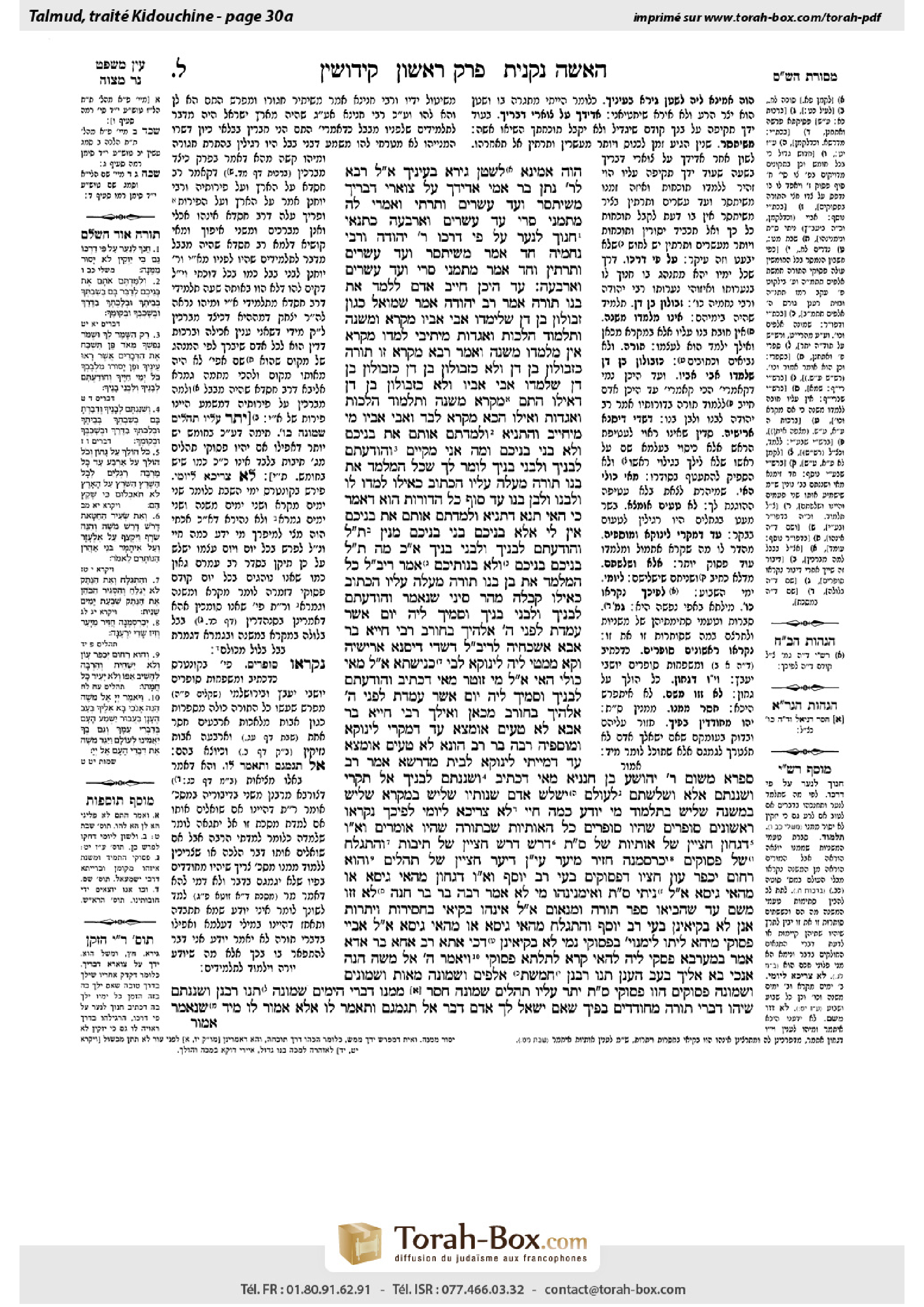
This page of Kiddushin includes the Aramaic text, an English translation and an AI-generated French translation, alongside the scan above.
קידושין ל׳ א · Aramaic and Hebrew text
הֲוָה אָמֵינָא לְשָׂטָן: גִּירָא בְּעֵינָיךְ. אֲמַר לֵיהּ רָבָא לְרַבִּי נָתָן בַּר אַמֵּי: אַדִּידָךְ עַל צַוְּארֵי דִּבְרָיךְ. מִשִּׁיתְּסַר וְעַד עֶשְׂרִים וְתַרְתֵּי וְאָמְרִי לַהּ: מִתַּמְנֵי סְרֵי עַד עֶשְׂרִים וְאַרְבָּעָה.
כְּתַנָּאֵי: ״חֲנֹךְ לַנַּעַר עַל פִּי דַרְכּוֹ״, רַבִּי יְהוּדָה וְרַבִּי נְחֶמְיָה, חַד אָמַר: מִשִּׁיתְּסַר וְעַד עֶשְׂרִים וְתַרְתֵּין, וְחַד אָמַר: מִתַּמְנֵי סְרֵי וְעַד עֶשְׂרִים וְאַרְבְּעָה.
עַד הֵיכָן חַיָּיב אָדָם לְלַמֵּד אֶת בְּנוֹ תּוֹרָה? אָמַר רַב יְהוּדָה אָמַר שְׁמוּאֵל: כְּגוֹן זְבוּלוּן בֶּן דָּן, שֶׁלִּימְּדוֹ אֲבִי אָבִיו מִקְרָא וּמִשְׁנָה וְתַלְמוּד הֲלָכוֹת וְאַגָּדוֹת. מֵיתִיבִי: לִמְּדוֹ מִקְרָא – אֵין מְלַמְּדוֹ מִשְׁנָה, וְאָמַר רָבָא: מִקְרָא – זוֹ תּוֹרָה!
כִּזְבוּלוּן בֶּן דָּן, וְלֹא כִּזְבוּלוּן בֶּן דָּן. כִּזְבוּלוּן בֶּן דָּן – שֶׁלִּמְּדוֹ אֲבִי אָבִיו, וְלֹא כִּזְבוּלוּן בֶּן דָּן, דְּאִילּוּ הָתָם מִקְרָא מִשְׁנָה וְתַלְמוּד הֲלָכוֹת וְאַגָּדוֹת, וְאִילּוּ הָכָא – מִקְרָא לְבַד.
וַאֲבִי אָבִיו מִי מִיחַיַּיב? וְהָתַנְיָא: ״וְלִמַּדְתֶּם אֹתָם אֶת בְּנֵיכֶם״ – וְלֹא בְּנֵי בְנֵיכֶם. וּמָה אֲנִי מְקַיֵּים: ״וְהוֹדַעְתָּם לְבָנֶיךָ וְלִבְנֵי בָנֶיךָ״, לוֹמַר לָךְ: שֶׁכׇּל הַמְלַמֵּד אֶת בְּנוֹ תּוֹרָה – מַעֲלֶה עָלָיו הַכָּתוּב כְּאִילּוּ לִמְּדוֹ לוֹ וְלִבְנוֹ וּלְבֶן בְּנוֹ, עַד סוֹף כׇּל הַדּוֹרוֹת!
הוּא דְּאָמַר כִּי הַאי תַּנָּא, דְּתַנְיָא: ״וְלִמַּדְתֶּם אֹתָם אֶת בְּנֵיכֶם״ – אֵין לִי אֶלָּא בְּנֵיכֶם, בְּנֵי בְנֵיכֶם מִנַּיִן? תַּלְמוּד לוֹמַר: ״וְהוֹדַעְתָּם לְבָנֶיךָ וְלִבְנֵי בָנֶיךָ״. אִם כֵּן מָה תַּלְמוּד לוֹמַר: ״בְּנֵיכֶם״ – בְּנֵיכֶם וְלֹא בְּנוֹתֵיכֶם.
אָמַר רַבִּי יְהוֹשֻׁעַ בֶּן לֵוִי: כׇּל הַמְלַמֵּד אֶת בֶּן בְּנוֹ תּוֹרָה מַעֲלֶה עָלָיו הַכָּתוּב כְּאִילּוּ קִבְּלָהּ מֵהַר סִינַי, שֶׁנֶּאֱמַר: ״וְהוֹדַעְתָּם לְבָנֶיךָ וְלִבְנֵי בָנֶיךָ״, וּסְמִיךְ לֵיהּ: ״יוֹם אֲשֶׁר עָמַדְתָּ לִפְנֵי ה׳ אֱלֹקֶיךָ בְּחֹרֵב״.
רַבִּי חִיָּיא בַּר אַבָּא אַשְׁכְּחֵיהּ לְרַבִּי יְהוֹשֻׁעַ בֶּן לֵוִי דְּשָׁדֵי דִּיסְנָא אַרֵישֵׁיהּ וְקָא מַמְטֵי לֵיהּ לְיָנוֹקָא לְבֵי כְנִישְׁתָּא. אֲמַר לֵיהּ: מַאי כּוּלֵּי הַאי? אֲמַר לֵיהּ: מִי זוּטַר מַאי דִּכְתִיב: ״וְהוֹדַעְתָּם לְבָנֶיךָ״ וּסְמִיךְ לֵיהּ: ״יוֹם אֲשֶׁר עָמַדְתָּ לִפְנֵי ה׳ אֱלֹקֶיךָ בְּחֹרֵב״? מִכָּאן וְאֵילָךְ, רַבִּי חִיָּיא בַּר אַבָּא לָא טָעֵים אוּמְצָא עַד דְּמַקְרֵי לְיָנוֹקָא וּמוֹסְפֵיהּ. רַבָּה בַּר רַב הוּנָא לָא טָעֵים אוּמְצָא עַד דְּמַיְיתֵי לְיָנוֹקָא לְבֵית מִדְרְשָׁא.
אָמַר רַב סָפְרָא מִשּׁוּם רַבִּי יְהוֹשֻׁעַ בֶּן חֲנַנְיָא: מַאי דִּכְתִיב ״וְשִׁנַּנְתָּם לְבָנֶיךָ״ – אַל תִּקְרֵי ״וְשִׁנַּנְתָּם״, אֶלָּא ״וְשִׁלַּשְׁתָּם״.
לְעוֹלָם יְשַׁלֵּשׁ אָדָם שְׁנוֹתָיו: שְׁלִישׁ בַּמִּקְרָא, שְׁלִישׁ בַּמִּשְׁנָה, שְׁלִישׁ בַּתַּלְמוּד. מִי יוֹדֵעַ כַּמָּה חָיֵי? לָא צְרִיכָא לְיוֹמֵי.
לְפִיכָךְ נִקְרְאוּ רִאשׁוֹנִים ״סוֹפְרִים״, שֶׁהָיוּ סוֹפְרִים כׇּל הָאוֹתִיּוֹת שֶׁבַּתּוֹרָה, שֶׁהָיוּ אוֹמְרִים: וָא״ו דְּ״גָחוֹן״– חֶצְיָין שֶׁל אוֹתִיּוֹת שֶׁל סֵפֶר תּוֹרָה. ״דָּרֹשׁ דָּרַשׁ״ – חֶצְיָין שֶׁל תֵּיבוֹת. ״וְהִתְגַּלָּח״ – שֶׁל פְּסוּקִים. ״יְכַרְסְמֶנָּה חֲזִיר מִיָּעַר״ – עַיִ״ן דְּיַעַר חֶצְיָין שֶׁל תְּהִלִּים. ״וְהוּא רַחוּם יְכַפֵּר עָוֹן״ – חֶצְיוֹ דִּפְסוּקִים.
בָּעֵי רַב יוֹסֵף: וָא״ו ״דְּגָחוֹן״, מֵהַאי גִּיסָא אוֹ מֵהַאי גִּיסָא? אֲמַרוּ לֵיהּ: נֵיתֵי סֵפֶר תּוֹרָה וְנִימְנִינְהוּ, מִי לָא אָמַר רַבָּה בַּר בַּר חָנָה: לֹא זָזוּ מִשָּׁם עַד שֶׁהֵבִיאוּ סֵפֶר תּוֹרָה וּמְנָאוּם? אֲמַר לְהוּ: אִינְהוּ בְּקִיאִי בַּחֲסֵירוֹת וִיתֵרוֹת, אֲנַן לָא בְּקִיאִינַן.
בָּעֵי רַב יוֹסֵף: ״וְהִתְגַּלָּח״, מֵהַאי גִּיסָא אוֹ מֵהַאי גִּיסָא? אֲמַר לֵיהּ אַבָּיֵי: פְּסוּקֵי מִיהָא לַיְתוֹ לִימְנִינְהוּ! בִּפְסוּקֵי נָמֵי לָא בְּקִיאִינַן, דְּכִי אֲתָא רַב אַחָא בַּר אַדָּא, אָמַר: בְּמַעְרְבָא פָּסְקִי לֵיהּ לְהַאי קְרָא לִתְלָתָא פְּסוּקֵי: ״וַיֹּאמֶר ה׳ אֶל מֹשֶׁה הִנֵּה אָנֹכִי בָּא אֵלֶיךָ בְּעַב הֶעָנָן״.
תָּנוּ רַבָּנַן: חֲמֵשֶׁת אֲלָפִים וּשְׁמוֹנֶה מֵאוֹת וּשְׁמוֹנִים וּשְׁמוֹנָה פְּסוּקִים הָווּ פְּסוּקֵי סֵפֶר תּוֹרָה, יָתֵר עָלָיו תְּהִלִּים שְׁמוֹנָה, חָסֵר מִמֶּנּוּ דִּבְרֵי הַיָּמִים שְׁמוֹנָה.
תָּנוּ רַבָּנַן: ״וְשִׁנַּנְתָּם״, שֶׁיְּהוּ דִּבְרֵי תוֹרָה מְחוּדָּדִים בְּפִיךְ, שֶׁאִם יִשְׁאַל לְךָ אָדָם דָּבָר אַל תְּגַמְגֵּם וְתֹאמַר לוֹ, אֶלָּא אֱמוֹר לוֹ מִיָּד, שֶׁנֶּאֱמַר:
Kiddushin 30a · English translation
I would say to the Satan: An arrow in your eye, i.e., I would not be afraid of the evil inclination at all. Rava said to Rabbi Natan bar Ami: While your hand is still on your son’s neck, i.e., while you still have authority and control over him, find him a wife. What is the appropriate age? From sixteen until twenty-two, and some say from eighteen until twenty-four.
The Gemara notes that this is like a dispute between tanna’im, based on the verse: “Train a child in the way that he should go” (Proverbs 22:6). Rabbi Yehuda and Rabbi Neḥemya disagreed about the age in which the verse instructs the parent to educate his child: One said that the verse is referring to the ages from sixteen until twenty-two, and one said it is referring to the ages from eighteen until twenty-four. The dispute concerning the correct age for marriage and the dispute about educating a child are the same, as while a father still has a large measure of influence over his son, he must both teach him and find him a wife.
§ The Gemara continues its discussion of a father’s obligation to teach his son Torah. To what extent is a person obligated to teach his son Torah? Rav Yehuda says that Shmuel says: One should emulate the education of, for example, Zevulun ben Dan, a contemporary of Shmuel, whose father’s father taught him Bible, Mishna, Talmud, halakhot, and aggadot. The Gemara raises an objection from a baraita: If a father taught his son Bible, he is not required to teach him Mishna. And Rava said in explanation of this baraita: Bible is the Torah, not the Prophets or Writings, i.e., he is not required to teach him anything else, including Mishna.
The Gemara answers that Shmuel’s statement should be understood as follows: One should teach his son like Zevulun ben Dan was taught in certain aspects, but not like Zevulun ben Dan in other respects. One should teach his son like Zevulun ben Dan in that his father’s father taught him; but not like Zevulun ben Dan, as there he was taught Bible, Mishna, Talmud, halakhot, and aggadot, while here, in this baraita, one is required to teach his son Bible alone.
The Gemara asks: But is one’s father’s father obligated to teach him Torah? But isn’t it taught in a baraita, that the verse: “And you shall teach them to your sons” (Deuteronomy 11:19), indicates: But not your sons’ sons? And how do I realize, i.e., understand, the meaning of the verse: “But make them known to your sons and to your sons’ sons” (Deuteronomy 4:9)? This serves to say to you that whoever teaches his son Torah, the verse ascribes him credit as though he taught him, and his son, and his son’s son, until the end of all generations.
The Gemara answers that the tanna of this baraita stated his opinion in accordance with the opinion of that tanna, as it is taught in another baraita: From the verse “And you shall teach them to your sons” I have derived only that you must teach your sons. From where do I derive that there is an obligation to teach your sons’ sons? The verse states: “But make them known to your sons and to your sons’ sons.” If so, what is the meaning when the verse states: “Your sons” (Deuteronomy 11:19), which implies only sons? This limitation teaches: Your sons, but not your daughters.
Rabbi Yehoshua ben Levi says: Anyone who teaches his son’s son Torah, the verse ascribes him credit as though he received it from Mount Sinai, as it is stated: “But make them known to your sons and to your sons’ sons,” and juxtaposed to it is the phrase in the verse: “The day when you stood before the Lord your God in Horeb” (Deuteronomy 4:10), as Horeb is Mount Sinai.
The Gemara relates: Once Rabbi Ḥiyya bar Abba encountered Rabbi Yehoshua ben Levi, and saw that he had placed an inexpensive covering on his head and brought his child to the synagogue to study. Rabbi Ḥiyya bar Abba said to him: What is the reason for all this fuss, as you are in such a hurry that you do not have time to dress yourself properly? Rabbi Yehoshua ben Levi said to him: Is it insignificant, that which is written: “But make them known to your sons,” and juxtaposed to it is the phrase in the verse that states: “The day when you stood before the Lord your God in Horeb”? The Gemara comments: From this moment onward, Rabbi Ḥiyya bar Abba would not taste meat [umtza], meaning he would not eat breakfast, before he had read to his child and added to the child’s studies from the day before. Similarly, Rabba bar Rav Huna would not taste meat before he had brought his child to the study hall.
§ Rav Safra says in the name of Rabbi Yehoshua ben Ḥananya: What is the meaning of that which is written: “And you shall teach them diligently [veshinnantam] to your sons” (Deuteronomy 6:7)? Do not read this as “veshinnantam,” with the root shin, nun, nun, which indicates a repetition. Rather, read it as veshillashtam, with the root shin, lamed, shin, related to the word three, shalosh. This means that one must study, review, and study again, thereby dividing one’s studies into three parts.
In light of this statement, the Sages said that a person should always divide his years into three parts, as follows: A third for Bible, a third for Mishna, and a third for Talmud. The Gemara asks: How can a person divide his life this way? Who knows the length of his life, so that he can calculate how long a third will be? The Gemara answers: No, it is necessary for one’s days, i.e., one should divide each day of his life in this manner.
Therefore, because they devoted so much time to the Bible, the first Sages were called: Those who count [soferim], because they would count all the letters in the Torah, as they would say that the letter vav in the word “belly [gaḥon]” (Leviticus 11:42) is the midpoint of the letters in a Torah scroll. The words: “Diligently inquired [darosh darash]” (Leviticus 10:16), are the midpoint of the words in a Torah scroll. And the verse that begins with: “Then he shall be shaven” (Leviticus 13:33), is the midpoint of the verses. Similarly, in the expression: “The boar out of the wood [miya’ar] ravages it” (Psalms 80:14), the ayin in the word wood [ya’ar] is the midpoint of Psalms, with regard to its number of letters. The verse: “But He, being full of compassion, forgives iniquity” (Psalms 78:38), is the midpoint of verses in the book of Psalms.
Rav Yosef raises a dilemma: Does the vav of the word “belly [gaḥon]” belong to this side or to this side? Is it part of the first or second half of the Torah? The Sages said to him: Let us bring a Torah scroll and count the letters. Didn’t Rabba bar bar Ḥana say with regard to a different issue: They did not move from there until they brought a Torah scroll and counted the letters? Therefore we can do the same. Rav Yosef said to them: They were experts in the deficient and plene forms of words and therefore could count the letters precisely. We are not experts in this regard, and therefore we would be unable to resolve the question even if we were to count the letters.
Similarly, Rav Yosef raises a dilemma: Does the midpoint of the verses in the Torah, which is “then he shall be shaven,” belong to this side or to this side? Abaye said to him: Even if we cannot count the letters, we can at least bring a Torah scroll to count the verses. Rav Yosef explained: We are not experts about verses either, as when Rav Aḥa bar Adda came from Eretz Yisrael to Babylonia he said: In the West, i.e., Eretz Yisrael, they divide this following verse into three separate verses: “And the Lord said to Moses, behold I come to you in a thick cloud, that the people may hear when I speak with you, and may also believe you forever; And Moses told the words of the people to the Lord” (Exodus 19:9). Perhaps there are other verses that we do not know how to divide properly.
The Sages taught: Five thousand eight hundred and eighty-eight verses are the verses in a Torah scroll. Psalms has eight more verses than that, and Chronicles has eight fewer verses than that.
§ The Sages taught: The verse states: “And you shall teach them diligently [veshinnantam]” (Deuteronomy 6:7). The root shin, nun, nun, of veshinnantam should be understood as meaning sharp, i.e., that matters of Torah should be sharp and clear in your mouth, so that if a person asks you something, do not stutter in uncertainty and say an uncertain response to him. Rather, answer him immediately, as it is stated:
Kiddushin 30a · Traduction française (IA)
Je dirais au Satan : « Une flèche dans ton œil ! », c’est-à-dire que je n’aurais absolument pas peur du mauvais penchant. Rava dit à Rabbi Natan bar Ami : Tant que ta main est encore sur la nuque de ton fils, c’est-à-dire tant que tu as encore autorité sur lui, trouve-lui une épouse. Quel est l’âge qui convient ? De seize à vingt-deux ans, et certains disent de dix-huit à vingt-quatre ans.
La Guemara remarque que cela correspond à une controverse entre tannaïm, fondée sur le verset : « Éduque l’enfant selon la voie qu’il doit suivre » (Proverbes 22:6). Rabbi Yehuda et Rabbi Neḥemya étaient en désaccord sur l’âge auquel le verset demande au parent d’éduquer son enfant : l’un disait que le verset fait référence à la période de seize à vingt-deux ans, l’autre à celle de dix-huit à vingt-quatre ans. Le désaccord sur l’âge qui convient au mariage et celui sur l’éducation d’un enfant sont identiques : tant qu’un père exerce encore une grande influence sur son fils, il doit à la fois l’instruire et lui trouver une épouse.
§ La Guemara poursuit son examen de l’obligation d’un père d’enseigner la Torah à son fils. Dans quelle mesure une personne est-elle tenue d’enseigner la Torah à son fils ? Rav Yehuda dit au nom de Shmuel : Il faut prendre pour modèle, par exemple, l’éducation de Zevulun ben Dan, un contemporain de Shmuel, auquel son grand-père enseigna la Bible, la Michna, le Talmud, les halakhot et les aggadot. La Guemara soulève une objection à partir d’une baraïta : si un père a enseigné la Bible à son fils, il n’est pas tenu de lui enseigner la Michna. Rava expliqua cette baraïta ainsi : par « Bible », on entend la Torah, et non les Prophètes ni les Écrits ; autrement dit, il n’est pas tenu de lui enseigner autre chose, y compris la Michna.
La Guemara répond que la déclaration de Shmuel doit être comprise ainsi : il faut enseigner à son fils comme Zevulun ben Dan a été instruit sous certains aspects, mais pas sous d’autres. Il faut enseigner à son fils comme le grand-père de Zevulun ben Dan l’a instruit ; mais pas comme Zevulun ben Dan a lui-même été instruit, car celui-ci reçut un enseignement portant sur la Bible, la Michna, le Talmud, les halakhot et les aggadot, tandis qu’ici, dans cette baraïta, on est tenu d’enseigner à son fils la Bible seule.
La Guemara demande : Mais le grand-père est-il tenu de lui enseigner la Torah ? N’est-il pas enseigné dans une baraïta que le verset « Vous les enseignerez à vos fils » (Deutéronome 11:19) signifie : mais pas à vos petits-fils ? Et comment comprendre le sens du verset : « Mais fais-les connaître à tes fils et aux fils de tes fils » (Deutéronome 4:9) ? Il vise à t’enseigner que quiconque enseigne la Torah à son fils, le verset lui en attribue le mérite comme s’il l’avait enseignée à son fils, au fils de son fils et jusqu’à la fin de toutes les générations.
La Guemara répond que le tanna de cette baraïta a énoncé son opinion conformément à celle de l’autre tanna, comme on l’enseigne dans une autre baraïta : Du verset « Vous les enseignerez à vos fils », j’ai seulement déduit qu’il faut enseigner à vos fils. D’où déduis-je qu’il y a obligation d’enseigner aux fils de vos fils ? Le verset dit : « Mais fais-les connaître à tes fils et aux fils de tes fils. » Si tel est le cas, que signifie l’expression « vos fils » (Deutéronome 11:19), qui semble désigner uniquement les fils ? Cette restriction enseigne : vos fils, mais pas vos filles.
Rabbi Yehoshua ben Levi dit : Quiconque enseigne la Torah au fils de son fils, le verset lui en attribue le mérite comme s’il l’avait reçue du mont Sinaï, comme il est dit : « Mais fais-les connaître à tes fils et aux fils de tes fils » ; et la phrase qui suit immédiatement est : « Le jour où tu te tenais devant le Seigneur ton Dieu en Horeb » (Deutéronome 4:10), puisque Horeb est le mont Sinaï.
La Guemara rapporte : Un jour, Rabbi Ḥiyya bar Abba rencontra Rabbi Yehoshua ben Levi et vit qu’il avait posé sur sa tête une couverture bon marché et qu’il conduisait son enfant à la synagogue pour étudier. Rabbi Ḥiyya bar Abba lui dit : Pourquoi tout ce remue-ménage ? Tu es si pressé que tu n’as pas le temps de t’habiller convenablement ? Rabbi Yehoshua ben Levi lui répondit : Est-ce donc négligeable, ce qui est écrit : « Mais fais-les connaître à tes fils », suivi immédiatement de la phrase : « Le jour où tu te tenais devant le Seigneur ton Dieu en Horeb » ? La Guemara commente : À partir de ce moment, Rabbi Ḥiyya bar Abba ne goûtait plus de viande [umtza], c’est-à-dire qu’il ne prenait pas de petit-déjeuner avant d’avoir lu avec son enfant et ajouté à ses études celles de la veille. De même, Rabba bar Rav Huna ne goûtait pas de viande avant d’avoir conduit son enfant à la maison d’étude.
§ Rav Safra dit au nom de Rabbi Yehoshua ben Ḥananya : Que signifie ce qui est écrit : « Tu les inculqueras [veshinnantam] à tes fils » (Deutéronome 6:7) ? Ne lis pas « veshinnantam », dont la racine est shin, nun, nun et qui indique la répétition, mais lis plutôt « veshillashtam », dont la racine est shin, lamed, shin, apparentée au mot « trois », shalosh. Cela signifie qu’il faut étudier, réviser et étudier de nouveau, divisant ainsi son étude en trois parties.
À la lumière de cette déclaration, les Sages ont dit qu’une personne doit toujours diviser ses années en trois parties : un tiers pour la Bible, un tiers pour la Michna et un tiers pour le Talmud. La Guemara demande : Comment une personne peut-elle diviser ainsi sa vie ? Qui connaît la durée de sa vie, pour pouvoir calculer ce qu’en représente un tiers ? La Guemara répond : Non, cela concerne ses jours, c’est-à-dire qu’elle doit diviser chaque jour de sa vie de cette manière.
C’est pourquoi, comme ils consacraient tant de temps à la Bible, les premiers Sages étaient appelés les « compteurs » [soferim], car ils comptaient toutes les lettres de la Torah. Ils disaient que la lettre vav du mot « ventre [gaḥon] » (Lévitique 11:42) se trouve au milieu des lettres d’un rouleau de la Torah ; les mots « examiner attentivement [darosh darash] » (Lévitique 10:16) se trouvent au milieu des mots d’un rouleau de la Torah ; et le verset qui commence par « Il se rasera alors » (Lévitique 13:33) se trouve au milieu des versets. De même, dans l’expression « Le sanglier de la forêt [miya’ar] la ravage » (Psaumes 80:14), la lettre ayin du mot « forêt [ya’ar] » se trouve au milieu des Psaumes, d’après le nombre de lettres. Le verset « Mais lui, dans sa compassion, pardonne la faute » (Psaumes 78:38) se trouve au milieu des versets du livre des Psaumes.
Rav Yosef soulève une question : le vav du mot « ventre [gaḥon] » appartient-il à cette moitié-ci ou à cette moitié-là ? Fait-il partie de la première ou de la seconde moitié de la Torah ? Les Sages lui dirent : Apportons un rouleau de la Torah et comptons les lettres. Rabba bar bar Ḥana n’a-t-il pas dit, à propos d’une autre question, qu’ils ne quittèrent pas cet endroit avant d’avoir apporté un rouleau de la Torah et compté les lettres ? Nous pouvons donc faire de même. Rav Yosef leur dit : Ils connaissaient les formes défectives et pleines des mots et pouvaient donc compter les lettres avec précision. Nous ne les connaissons pas suffisamment à cet égard ; même si nous comptions les lettres, nous ne pourrions donc pas résoudre la question.
De même, Rav Yosef soulève une question : le point médian des versets de la Torah, qui est « Il se rasera alors », appartient-il à cette moitié-ci ou à cette moitié-là ? Abaye lui dit : Même si nous ne pouvons pas compter les lettres, nous pouvons au moins apporter un rouleau de la Torah et compter les versets. Rav Yosef expliqua : Nous ne connaissons pas non plus suffisamment les versets, car lorsque Rav Aḥa bar Adda vint d’Eretz Israël en Babylonie, il dit : En Occident, c’est-à-dire en Eretz Israël, ils divisent le verset suivant en trois versets distincts : « Le Seigneur dit à Moïse : Voici, je viens vers toi dans une épaisse nuée, afin que le peuple entende quand je te parlerai et qu’il ait aussi foi en toi pour toujours ; et Moïse rapporta au Seigneur les paroles du peuple » (Exode 19:9). Il se peut qu’il y ait d’autres versets que nous ne savons pas diviser correctement.
Les Sages enseignèrent : Un rouleau de la Torah contient cinq mille huit cent quatre-vingt-huit versets. Les Psaumes en comptent huit de plus, et les Chroniques huit de moins.
§ Les Sages enseignèrent : Le verset dit : « Tu les inculqueras [veshinnantam] » (Deutéronome 6:7). Il faut comprendre la racine shin, nun, nun de « veshinnantam » comme signifiant « aiguisé », c’est-à-dire que les paroles de Torah doivent être aiguisées et claires dans ta bouche, afin que, si quelqu’un te pose une question, tu ne balbuties pas, incertain, et ne lui donnes pas une réponse hésitante. Réponds-lui plutôt immédiatement, comme il est dit :
Traduction française générée par IA à partir de l’édition anglaise de Sefaria. Vérifie toujours un passage avec le texte source.
Text from Sefaria: William Davidson Edition - Vocalized Aramaic (CC BY NC); William Davidson Edition - English (CC BY NC).