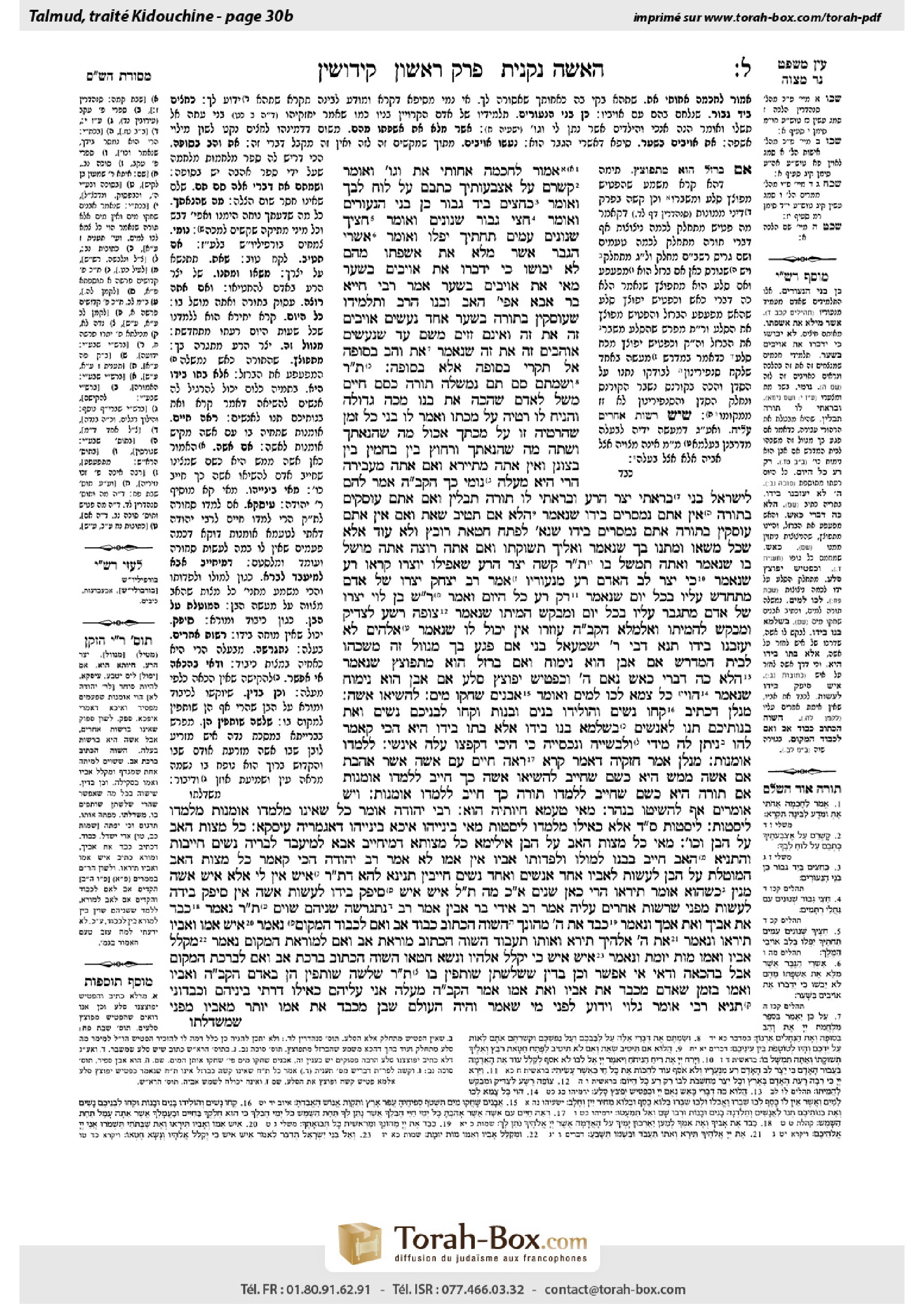
Kiddushin 30b: Talmud study for Daf Yomi
Daf Yomi is the daily study of one Talmud folio. Explore 37 tractates with scans, Hebrew text, Sefaria English and AI-generated French translations where annotated.
Passage selection and English or AI-generated French translation are available where the scan has annotations. Daf Study is independent of Torah-Box and Sefaria.
Browse Kiddushin · קידושין · All tractatesKiddushin 30b text and translations
This page of Kiddushin includes the Aramaic text, an English translation and an AI-generated French translation, alongside the scan above.
קידושין ל׳ ב · Aramaic and Hebrew text
״אֱמֹר לַחׇכְמָה אֲחֹתִי אָתְּ וְגוֹ׳״ וְאוֹמֵר: ״קׇשְׁרֵם עַל אֶצְבְּעֹתֶיךָ כׇּתְבֵם עַל לוּחַ לִבֶּךָ״, וְאוֹמֵר: ״כְּחִצִּים בְּיַד גִּבּוֹר כֵּן בְּנֵי הַנְּעוּרִים״, וְאוֹמֵר: ״חִצֵּי גִבּוֹר שְׁנוּנִים״, וְאוֹמֵר: ״חִצֶּיךָ שְׁנוּנִים עַמִּים תַּחְתֶּיךָ יִפְּלוּ״, וְאוֹמֵר: ״אַשְׁרֵי הַגֶּבֶר אֲשֶׁר מִלֵּא אֶת אַשְׁפָּתוֹ מֵהֶם לֹא יֵבֹשׁוּ כִּי יְדַבְּרוּ אֶת אוֹיְבִים בַּשָּׁעַר״.
מַאי ״אֶת אוֹיְבִים בַּשָּׁעַר״? אָמַר רַבִּי חִיָּיא בַּר אַבָּא: אֲפִילּוּ הָאָב וּבְנוֹ, הָרַב וְתַלְמִידוֹ שֶׁעוֹסְקִין בַּתּוֹרָה בַּשָּׁעַר אֶחָד – נַעֲשִׂים אוֹיְבִים זֶה אֶת זֶה. וְאֵינָם זָזִים מִשָּׁם עַד שֶׁנַּעֲשִׂים אוֹהֲבִים זֶה אֶת זֶה שֶׁנֶּאֱמַר: ״אֶת וָהֵב בְּסוּפָה״, אַל תִּקְרֵי ״בְּסוּפָה״ אֶלָּא ״בְּסוֹפָהּ״.
תָּנוּ רַבָּנַן: ״וְשַׂמְתֶּם״ – סַם תָּם, נִמְשְׁלָה תּוֹרָה כְּסַם חַיִּים. מָשָׁל לְאָדָם שֶׁהִכָּה אֶת בְּנוֹ מַכָּה גְּדוֹלָה וְהִנִּיחַ לוֹ רְטִיָּה עַל מַכָּתוֹ, וְאָמַר לוֹ: בְּנִי, כׇּל זְמַן שֶׁהָרְטִיָּה זוֹ עַל מַכָּתְךָ אֱכוֹל מַה שֶּׁהֲנָאָתֶךָ, וּשְׁתֵה מַה שֶּׁהֲנָאָתֶךָ, וּרְחוֹץ בֵּין בְּחַמִּין בֵּין בְּצוֹנֵן וְאֵין אַתָּה מִתְיָירֵא. וְאִם אַתָּה מַעֲבִירָהּ הֲרֵי הִיא מַעֲלָה נוֹמֵי.
כָּךְ הַקָּדוֹשׁ בָּרוּךְ הוּא אָמַר לָהֶם לְיִשְׂרָאֵל: בָּנַי, בָּרָאתִי יֵצֶר הָרָע וּבָרָאתִי לוֹ תּוֹרָה תַּבְלִין. וְאִם אַתֶּם עוֹסְקִים בַּתּוֹרָה – אֵין אַתֶּם נִמְסָרִים בְּיָדוֹ, שֶׁנֶּאֱמַר: ״הֲלוֹא אִם תֵּיטִיב שְׂאֵת״,
וְאִם אֵין אַתֶּם עוֹסְקִין בַּתּוֹרָה – אַתֶּם נִמְסָרִים בְּיָדוֹ, שֶׁנֶּאֱמַר: ״לַפֶּתַח חַטָּאת רֹבֵץ״, וְלֹא עוֹד אֶלָּא שֶׁכׇּל מַשָּׂאוֹ וּמַתָּנוֹ בְּךָ, שֶׁנֶּאֱמַר: ״וְאֵלֶיךָ תְּשׁוּקָתוֹ״. וְאִם אַתָּה רוֹצֶה אַתָּה מוֹשֵׁל בּוֹ, שֶׁנֶּאֱמַר: ״וְאַתָּה תִּמְשׇׁל בּוֹ״.
תָּנוּ רַבָּנַן: קָשֶׁה יֵצֶר הָרָע, שֶׁאֲפִילּוּ יוֹצְרוֹ קְרָאוֹ רַע, שֶׁנֶּאֱמַר: ״כִּי יֵצֶר לֵב הָאָדָם רַע מִנְּעֻרָיו״. אָמַר רַב יִצְחָק: יִצְרוֹ שֶׁל אָדָם מִתְחַדֵּשׁ עָלָיו בְּכׇל יוֹם, שֶׁנֶּאֱמַר: ״רַק רַע כׇּל הַיּוֹם״.
וְאָמַר רַבִּי שִׁמְעוֹן בֶּן לֵוִי: יִצְרוֹ שֶׁל אָדָם מִתְגַּבֵּר עָלָיו בְּכׇל יוֹם וּמְבַקֵּשׁ הֲמִיתוֹ, שֶׁנֶּאֱמַר: ״צוֹפֶה רָשָׁע לַצַּדִּיק וּמְבַקֵּשׁ לַהֲמִיתוֹ״, וְאִלְמָלֵא הַקָּדוֹשׁ בָּרוּךְ הוּא עוֹזְרוֹ אֵין יָכוֹל לוֹ, שֶׁנֶּאֱמַר: ״אֱלֹהִים לֹא יַעַזְבֶנּוּ בְיָדוֹ״.
תָּנָא דְּבֵי רַבִּי יִשְׁמָעֵאל: בְּנִי אִם פָּגַע בְּךָ מְנֻוּוֹל זֶה – מׇשְׁכֵהוּ לְבֵית הַמִּדְרָשׁ. אִם אֶבֶן הוּא – נִימּוֹחַ, וְאִם בַּרְזֶל הוּא – מִתְפּוֹצֵץ, שֶׁנֶּאֱמַר: ״הֲלוֹא כֹה דְבָרִי כָּאֵשׁ נְאֻם ה׳ וּכְפַטִּישׁ יְפֹצֵץ סָלַע״. אִם אֶבֶן הוּא – נִימּוֹחַ, שֶׁנֶּאֱמַר: ״הוֹי כׇּל צָמֵא לְכוּ לַמַּיִם״ וְאוֹמֵר: ״אֲבָנִים שָׁחֲקוּ מַיִם״.
לְהַשִּׂיאוֹ אִשָּׁה. מְנָלַן? דִּכְתִיב: ״קְחוּ נָשִׁים וְהוֹלִידוּ בָּנִים וּבָנוֹת וּקְחוּ לִבְנֵיכֶם נָשִׁים וְאֶת בְּנוֹתֵיכֶם תְּנוּ לַאֲנָשִׁים״.
בִּשְׁלָמָא בְּנוֹ – בְּיָדוֹ, אֶלָּא בִּתּוֹ – בְּיָדוֹ הִיא? הָכִי קָאָמַר לְהוּ: נִיתֵּן לַהּ מִידֵּי וְ[נַ]לְבְּשַׁיהּ וּנְכַסְּיַיהּ כִּי הֵיכִי דִּ[לְ]קִפְצוּ עֲלַהּ אִינָשֵׁי.
לְלַמְּדוֹ אוּמָּנוּת. מְנָלַן? אָמַר חִזְקִיָּה: דְּאָמַר קְרָא: ״רְאֵה חַיִּים עִם אִשָּׁה אֲשֶׁר אָהַבְתָּ״. אִם ״אִשָּׁה״ מַמָּשׁ הִיא: כְּשֵׁם שֶׁחַיָּיב לְהַשִּׂיאוֹ אִשָּׁה – כָּךְ חַיָּיב לְלַמְּדוֹ אוּמָּנוּת. אִם תּוֹרָה הִיא: כְּשֵׁם שֶׁחַיָּיב לְלַמְּדוֹ תּוֹרָה – כָּךְ חַיָּיב לְלַמְּדוֹ אוּמָּנוּת.
וְיֵשׁ אוֹמְרִים אַף לַהֲשִׁיטוֹ בַּנָּהָר. מַאי טַעְמָא? חַיּוּתֵיהּ הוּא.
רַבִּי יְהוּדָה אוֹמֵר: כֹּל שֶׁאֵינוֹ מְלַמְּדוֹ אוּמָּנוּת – מְלַמְּדוֹ לִיסְטוּת. לִיסְטוּת סָלְקָא דַּעְתָּךְ! אֶלָּא, כְּאִילּוּ מְלַמְּדוֹ לִיסְטוּת.
מַאי בֵּינַיְיהוּ? אִיכָּא בֵּינַיְיהוּ דְּאַגְמְרֵיהּ עִיסְקָא.
כׇּל מִצְוֹת הָאָב עַל הַבֵּן וְכוּ׳. מַאי כׇּל מִצְוֹת הָאָב עַל הַבֵּן? אִילֵּימָא כֹּל מִצְוָתָא דְּמִיחַיַּיב אַבָּא לְמִיעְבַּד לִבְרֵיהּ נָשִׁים חַיָּיבוֹת – וְהָתַנְיָא: הָאָב חַיָּיב בִּבְנוֹ לְמוּלוֹ וְלִפְדוֹתוֹ. אָבִיו – אֵין, אִמּוֹ – לֹא!
אָמַר רַב יְהוּדָה, הָכִי קָאָמַר: כׇּל מִצְוֹת הָאָב הַמּוּטָּלֹת עַל הַבֵּן לַעֲשׂוֹת לְאָבִיו, אֶחָד אֲנָשִׁים וְאֶחָד נָשִׁים חַיָּיבִין. תְּנֵינָא לְהָא דְּתָנוּ רַבָּנַן: ״אִישׁ״ – אֵין לִי אֶלָּא אִישׁ, אִשָּׁה מִנַּיִן? כְּשֶׁהוּא אוֹמֵר ״תִּירָאוּ״ – הֲרֵי כָּאן שְׁנַיִם.
אִם כֵּן מָה תַּלְמוּד לוֹמַר ״אִישׁ״? – אִישׁ סִיפֵּק בְּיָדוֹ לַעֲשׂוֹת, אִשָּׁה אֵין סִיפֵּק בְּיָדָהּ לַעֲשׂוֹת, מִפְּנֵי שֶׁרְשׁוּת אֲחֵרִים עָלֶיהָ. אָמַר רַב אִידִי בַּר אָבִין אָמַר רַב: נִתְגָּרְשָׁה, שְׁנֵיהֶם שָׁוִים.
תָּנוּ רַבָּנַן: נֶאֱמַר: ״כַּבֵּד אֶת אָבִיךָ וְאֶת אִמֶּךָ״, וְנֶאֱמַר: ״כַּבֵּד אֶת ה׳ מֵהוֹנֶךָ״, הִשְׁוָה הַכָּתוּב כִּבּוּד אָב וָאֵם לִכְבוֹד הַמָּקוֹם.
נֶאֱמַר: ״אִישׁ אִמּוֹ וְאָבִיו תִּירָאוּ״, וְנֶאֱמַר: ״אֶת ה׳ אֱלֹהֶיךָ תִּירָא וְאֹתוֹ תַעֲבֹד״, הִשְׁוָה הַכָּתוּב מוֹרָאַת אָב וָאֵם לְמוֹרָאַת הַמָּקוֹם.
נֶאֱמַר: ״מְקַלֵּל אָבִיו וְאִמּוֹ מוֹת יוּמָת״, וְנֶאֱמַר: ״אִישׁ אִישׁ כִּי יְקַלֵּל אֱלֹהָיו וְנָשָׂא חֶטְאוֹ״, הִשְׁוָה הַכָּתוּב בִּרְכַּת אָב וָאֵם לְבִרְכַּת הַמָּקוֹם. אֲבָל בְּהַכָּאָה וַדַּאי אִי אֶפְשָׁר.
וְכֵן בְּדִין, שֶׁשְּׁלָשְׁתָּן שׁוּתָּפִין בּוֹ. תָּנוּ רַבָּנַן: שְׁלֹשָׁה שׁוּתָּפִין הֵן בָּאָדָם: הַקָּדוֹשׁ בָּרוּךְ הוּא, וְאָבִיו, וְאִמּוֹ. בִּזְמַן שֶׁאָדָם מְכַבֵּד אֶת אָבִיו וְאֶת אִמּוֹ אָמַר הַקָּדוֹשׁ בָּרוּךְ הוּא: מַעֲלֶה אֲנִי עֲלֵיהֶם כְּאִילּוּ דַּרְתִּי בֵּינֵיהֶם, וְכִבְּדוּנִי.
תַּנְיָא רַבִּי אוֹמֵר: גָּלוּי וְיָדוּעַ לִפְנֵי מִי שֶׁאָמַר וְהָיָה הָעוֹלָם שֶׁבֵּן מְכַבֵּד אֶת אִמּוֹ יוֹתֵר מֵאָבִיו, מִפְּנֵי
Kiddushin 30b · English translation
“Say to wisdom: You are my sister, and call understanding your kinswoman” (Proverbs 7:4), which indicates that one should be as knowledgeable in the Torah as in the identity of his sister. And it states: “Bind them upon your fingers, you shall write them upon the tablet of your heart” (Proverbs 7:3). And it states: “As arrows in the hand of a mighty man, so are the children of one’s youth” (Psalms 127:4). And it states: “Sharp arrows of the mighty” (Psalms 120:4). And it states: “Your arrows are sharp, the peoples fall under you” (Psalms 45:6). And it states: “Happy is the man who has his quiver full of them; they shall not be put to shame when they speak with their enemies in the gate” (Psalms 127:5).
The Gemara asks: What is the meaning of the phrase “enemies in the gate” with regard to Torah study? Rabbi Ḥiyya bar Abba says: Even a father and his son, or a rabbi and his student, who are engaged in Torah together in one gate become enemies with each other due to the intensity of their studies. But they do not leave there until they love each other, as it is stated in the verse discussing the places the Jewish people engaged in battle in the wilderness: “Therefore it is said in the book of the wars of the Lord, Vahev in Suphah [beSufa], and the valleys of Arnon” (Numbers 21:14). The word “vahev” is interpreted as related to the word for love, ahava. Additionally, do not read this as “in Suphah [beSufa]”; rather, read it as “at its end [besofa],” i.e., at the conclusion of their dispute they are beloved to each other.
The Sages taught: “And you shall place [vesamtem] these words of Mine in your hearts” (Deuteronomy 11:18). Read this as though it stated sam tam, a perfect elixir. The Torah is compared to an elixir of life. There is a parable that illustrates this: A person hit his son with a strong blow and placed a bandage on his wound. And he said to him: My son, as long as this bandage is on your wound and is healing you, eat what you enjoy and drink what you enjoy, and bathe in either hot water or cold water, and you do not need to be afraid, as it will heal your wound. But if you take it off, the wound will become gangrenous.
So too the Holy One, Blessed be He, said to Israel: My children, I created an evil inclination, which is the wound, and I created Torah as its antidote. If you are engaged in Torah study you will not be given over into the hand of the evil inclination, as it is stated: “If you do well, shall it not be lifted up?” (Genesis 4:7). One who engages in Torah study lifts himself above the evil inclination.
And if you do not engage in Torah study, you are given over to its power, as it is stated: “Sin crouches at the door” (Genesis 4:7). Moreover, all of the evil inclination’s deliberations will be concerning you, as it is stated in the same verse: “And to you is its desire.” And if you wish you shall rule over it, as it is stated in the conclusion of the verse: “But you may rule over it” (Genesis 4:7).
The Sages taught: So difficult is the evil inclination that even its Creator calls it evil, as it is stated: “For the inclination of a man’s heart is evil from his youth” (Genesis 8:21). Rav Yitzḥak says: A person’s evil inclination renews itself to him every day, as it is stated: “And that every inclination of the thoughts in his heart was only evil all day [kol hayyom]” (Genesis 6:5). “Kol hayyom” can also be understood as: Every day.
And Rabbi Shimon ben Levi says: A person’s inclination overpowers him every day, and seeks to kill him, as it is stated: “The wicked watches the righteous and seeks to slay him” (Psalms 37:32). And if not for the fact that the Holy One, Blessed be He, assists each person in battling his evil inclination, he could not overcome it, as it is stated: “The Lord will not leave him in his hand” (Psalms 37:33).
A Sage from the school of Rabbi Yishmael taught: My son, if this wretched one, the evil inclination, encounters you, pull it into the study hall, i.e., go and study Torah. If it is a stone it will melt, and if it is iron it will break, as it is stated with regard to the Torah: “Is not My word like fire, says the Lord, and like a hammer that breaks the rock in pieces?” (Jeremiah 23:29). Just as a stone shatters a hammer, so too one can overcome his evil inclination, which is as strong as iron, through Torah study. With regard to the second part of the statement: If it is a stone it will melt, this is as it is stated with regard to the Torah: “Ho, everyone who thirsts, come for water” (Isaiah 55:1), and it states: “The water wears the stones” (Job 14:19), indicating that water is stronger than stone.
§ The baraita (29a) teaches that a father is commanded to marry his son to a woman. The Gemara asks: From where do we derive this matter? As it is written: “Take wives and bear sons and daughters, and take wives for your sons and give your daughters to men” (Jeremiah 29:6).
The Gemara analyzes this verse: Granted with regard to his son, this is in his power, i.e., he can instruct him to marry a woman, as a man is the active agent in a marriage. But with regard to his daughter, is this in his power? She must wait for a man to marry her. The Gemara answers: This is what Jeremiah was saying to them in the aforementioned verse: Her father should give her something for her dowry, and he should dress and cover her with suitable clothing so that men will leap to marry her.
§ The baraita further states that a father is commanded to teach his son a trade. The Gemara asks: From where do we derive this? Ḥizkiyya said: As the verse states: “Enjoy life with the wife whom you love” (Ecclesiastes 9:9). If this verse is interpreted literally, and it is referring to an actual woman, then one can derive as follows: Just as a father is obligated to marry his son to a woman, so too, he is obligated to teach him a trade, as indicated by the term: Life. And if the wife mentioned in this verse is allegorical, and it is the Torah, then one should explain the verse in the following manner: Just as he is obligated to teach him Torah, so too, he is obligated to teach him a trade.
§ The baraita adds: And some say that a father is also obligated to teach his son to swim in a river. The Gemara asks: What is the reason for this? It is necessary for his life, i.e., this is potentially a lifesaving skill.
§ The baraita further teaches that Rabbi Yehuda says: Any father who does not teach his son a trade teaches him banditry. The Gemara asks: Can it enter your mind that he actually teaches him banditry? Rather, the baraita means that it is as though he taught him banditry.
The Gemara asks: What is the difference between the opinion of the first tanna and that of Rabbi Yehuda? Both state that a father must teach his son a trade. The Gemara answers: There is a difference between them in a case where the father teaches him to engage in business. According to the first tanna this is sufficient, whereas Rabbi Yehuda maintains that he must teach him an actual trade.
§ The mishna teaches: With regard to all mitzvot of a father with regard to his son, both men and women are obligated to perform them. The Gemara inquires: What is the meaning of the expression: All mitzvot of a father with regard to his son? If we say that this is referring to all of the mitzvot that a father is required to perform for his son, are women obligated in these? But isn’t it taught in a baraita: A father is obligated with regard to his son to circumcise him, and to redeem him? This indicates that his father, yes, he is obligated to do these, but his mother, no, she is not obligated to perform these mitzvot for her son.
Rav Yehuda said that this is what the mishna is saying: With regard to each mitzva for the father that is incumbent upon the son to perform for his father, both men and women are obligated in them. The Gemara comments: We already learned this, as the Sages taught in a baraita, with regard to the verse: “A man shall fear [tira’u] his mother and his father” (Leviticus 19:3). I have derived only that a man is obligated in this mitzva; from where do I derive that a woman is also obligated? When it says in the same verse: “A man shall fear [tira’u] his mother and his father” (Leviticus 19:3), employing the plural form of the verb, this indicates that there are two that are obligated here, both a man and a woman.
If so, that both of them are obligated, what is the meaning when the verse states: “Man”? In the case of a man, it is in his power to perform this mitzva; whereas with regard to a woman, it is not always in her power to perform this mitzva, because she is under the authority of another person, i.e., her husband. As she is obligated to her husband to maintain her household, she is not always able to find time for her parents. Rav Idi bar Avin says that Rav says: Consequently, if a woman is divorced, then both of them, a daughter and a son, are equal with regard to honoring and fearing their father and mother.
The Sages taught that it is stated: “Honor your father and your mother” (Exodus 20:11), and it is stated: “Honor the Lord with your wealth” (Proverbs 3:9). In this manner, the verse equates the honor of one’s father and mother to the honor of the Omnipresent, as the term “honor” is used in both cases.
Similarly, it is stated: “A man shall fear his mother and his father” (Leviticus 19:3), and it is stated: “You shall fear the Lord your God and Him you shall serve” (Deuteronomy 6:13). The verse equates the fear of one’s father and mother to the fear of the Omnipresent.
Likewise, it is stated: “He who curses his father or his mother shall be put to death” (Exodus 21:17), and it is stated: “Whoever curses his God shall bear his sin” (Leviticus 24:15). The verse equates the blessing, a euphemism for cursing, of one’s father and mother to the blessing of the Omnipresent. But with regard to striking, i.e., with regard to the halakha that one who strikes his father or mother is liable to receive court-imposed capital punishment, it is certainly not possible to say the same concerning the Holy One, Blessed be He.
And so too, the equating of one’s attitude toward his parents to his attitude toward God is a logical derivation, as the three of them are partners in his creation. As the Sages taught: There are three partners in the forming of a person: The Holy One, Blessed be He, who provides the soul, and his father and his mother. When a person honors his father and mother, the Holy One, Blessed be He, says: I ascribe credit to them as if I dwelt between them and they honor Me as well.
It is taught in a baraita that Rabbi Yehuda HaNasi says: It is revealed and known before the One Who spoke and the world came into being that a son honors his mother more than he honors his father, because
Kiddushin 30b · Traduction française (IA)
« Dis à la sagesse : Tu es ma sœur, et appelle l’intelligence ta parente » (Proverbes 7:4), ce qui indique qu’on doit connaître la Torah aussi bien que l’identité de sa sœur. Il est également dit : « Attache-les à tes doigts, inscris-les sur la tablette de ton cœur » (Proverbes 7:3). Il est encore dit : « Comme des flèches dans la main d’un guerrier, ainsi sont les fils de la jeunesse » (Psaumes 127:4). Et encore : « Des flèches acérées du guerrier » (Psaumes 120:4). Et encore : « Tes flèches sont acérées, les peuples tombent sous toi » (Psaumes 45:6). Et encore : « Heureux l’homme qui en a rempli son carquois ; ils ne seront pas confondus lorsqu’ils parleront à leurs ennemis à la porte » (Psaumes 127:5).
La Guemara demande : Que signifie l’expression « ennemis à la porte » dans le contexte de l’étude de la Torah ? Rabbi Ḥiyya bar Abba dit : Même un père et son fils, ou un maître et son élève, qui étudient ensemble la Torah au même endroit deviennent ennemis l’un de l’autre, tant leur étude est intense. Mais ils ne quittent pas cet endroit avant de s’aimer, comme le dit le verset qui évoque les lieux où le peuple juif combattit dans le désert : « C’est pourquoi il est dit dans le livre des guerres de l’Éternel : Vahev en Soupha [beSufa], et les vallées de l’Arnon » (Nombres 21:14). Le mot « vahev » est interprété comme apparenté au mot désignant l’amour, ahava. En outre, ne lis pas « en Soupha [beSufa] », mais « à la fin [besofa] », c’est-à-dire qu’à l’issue de leur dispute, ils sont chers l’un à l’autre.
Les Sages enseignent : « Vous placerez [vesamtem] ces paroles que Je vous adresse dans votre cœur » (Deutéronome 11:18). Lis cela comme s’il était écrit sam tam, un élixir parfait. La Torah est comparée à un élixir de vie. Une parabole l’illustre : Un homme frappa violemment son fils et posa un pansement sur sa blessure. Il lui dit : Mon fils, tant que ce pansement reste sur ta blessure et la soigne, mange ce qui te plaît, bois ce qui te plaît et baigne-toi dans l’eau chaude ou froide ; tu n’as rien à craindre, car il guérira ta blessure. Mais si tu l’enlèves, la blessure se gangrènera.
De même, le Saint, béni soit-Il, dit à Israël : Mes enfants, J’ai créé le mauvais penchant, qui est la blessure, et J’ai créé la Torah comme son antidote. Si vous étudiez la Torah, vous ne serez pas livrés au pouvoir du mauvais penchant, comme il est dit : « Si tu agis bien, ne seras-tu pas relevé ? » (Genèse 4:7). Celui qui étudie la Torah s’élève au-dessus du mauvais penchant.
Et si vous n’étudiez pas la Torah, vous serez livrés à son pouvoir, comme il est dit : « Le péché est tapi à la porte » (Genèse 4:7). De plus, toutes les pensées du mauvais penchant seront dirigées contre vous, comme il est dit dans le même verset : « Son désir se porte vers toi. » Et si tu le veux, tu pourras le dominer, comme il est dit à la fin du verset : « Mais toi, tu peux le dominer » (Genèse 4:7).
Les Sages enseignent : Le mauvais penchant est si redoutable que même son Créateur le qualifie de mauvais, comme il est dit : « Car les penchants du cœur de l’homme sont mauvais dès sa jeunesse » (Genèse 8:21). Rav Yitzḥak dit : Le mauvais penchant d’une personne se renouvelle chaque jour, comme il est dit : « Et que toutes les pensées de son cœur se portaient constamment [kol hayyom] vers le mal » (Genèse 6:5). « Kol hayyom » peut aussi se comprendre ainsi : chaque jour.
Et Rabbi Shimon ben Levi dit : Le penchant d’une personne prend chaque jour le dessus sur elle et cherche à la tuer, comme il est dit : « Le méchant épie le juste et cherche à le faire mourir » (Psaumes 37:32). Et si le Saint, béni soit-Il, n’aidait pas chaque personne à combattre son mauvais penchant, elle ne pourrait pas le vaincre, comme il est dit : « L’Éternel ne le laissera pas entre ses mains » (Psaumes 37:33).
Un Sage de l’école de Rabbi Yishmael enseigna : Mon fils, si ce misérable, le mauvais penchant, te rencontre, entraîne-le dans la maison d’étude, c’est-à-dire va étudier la Torah. S’il est de pierre, il fondra ; s’il est de fer, il se brisera, comme il est dit au sujet de la Torah : « Ma parole n’est-elle pas comme un feu, dit l’Éternel, et comme un marteau qui fracasse le rocher ? » (Jérémie 23:29). De même qu’un marteau brise la pierre, on peut vaincre par l’étude de la Torah son mauvais penchant, qui est dur comme le fer. Quant à la seconde partie de l’enseignement — s’il est de pierre, il fondra —, elle s’accorde avec ce qui est dit au sujet de la Torah : « Ho ! Vous tous qui avez soif, venez vers l’eau » (Isaïe 55:1), et avec ce qui est dit : « L’eau use les pierres » (Job 14:19), ce qui indique que l’eau est plus forte que la pierre.
§ La baraïta (29a) enseigne qu’un père a l’obligation de marier son fils. La Guemara demande : D’où déduisons-nous cette règle ? Comme il est écrit : « Prenez des femmes, engendrez des fils et des filles, prenez des femmes pour vos fils et donnez vos filles à des hommes » (Jérémie 29:6).
La Guemara analyse ce verset : Pour son fils, cela dépend de lui, c’est-à-dire qu’il peut lui ordonner de prendre une femme, car c’est l’homme qui prend l’initiative du mariage. Mais pour sa fille, cela dépend-il de lui ? Elle doit attendre qu’un homme l’épouse. La Guemara répond : Voici ce que Jérémie leur disait dans le verset cité : Que son père lui donne quelque chose pour sa dot, et qu’il l’habille et la couvre de vêtements convenables, afin que des hommes se pressent de l’épouser.
§ La baraïta précise aussi qu’un père a l’obligation d’enseigner un métier à son fils. La Guemara demande : D’où déduisons-nous cela ? Ḥizkiyya dit : Comme l’indique le verset : « Profite de la vie avec la femme que tu aimes » (Ecclésiaste 9:9). Si l’on interprète ce verset au sens littéral, comme parlant d’une femme réelle, on peut en déduire ceci : De même qu’un père a l’obligation de marier son fils, il a aussi l’obligation de lui enseigner un métier, comme l’indique le terme « vie ». Et si la femme mentionnée dans ce verset est allégorique et désigne la Torah, il faut expliquer le verset ainsi : De même qu’il a l’obligation de lui enseigner la Torah, il a aussi l’obligation de lui enseigner un métier.
§ La baraïta ajoute : Certains disent qu’un père a également l’obligation d’apprendre à son fils à nager dans une rivière. La Guemara demande : Pourquoi cela ? C’est nécessaire à sa survie, c’est-à-dire qu’il s’agit d’une compétence qui peut lui sauver la vie.
§ La baraïta enseigne également que Rabbi Yehuda dit : Tout père qui n’enseigne pas un métier à son fils lui enseigne le brigandage. La Guemara demande : Peut-on imaginer qu’il lui enseigne réellement le brigandage ? Il faut plutôt comprendre la baraïta ainsi : c’est comme s’il lui avait enseigné le brigandage.
La Guemara demande : Quelle est la différence entre l’opinion du premier tanna et celle de Rabbi Yehuda ? Tous deux affirment qu’un père doit enseigner un métier à son fils. La Guemara répond : Ils diffèrent dans le cas où le père lui apprend à faire du commerce. Selon le premier tanna, cela suffit, tandis que Rabbi Yehuda estime qu’il doit lui enseigner un véritable métier.
§ La Michna enseigne : Pour toutes les mitsvot d’un père à l’égard de son fils, les hommes comme les femmes sont tenus de les accomplir. La Guemara s’interroge : Que signifie l’expression « toutes les mitsvot d’un père à l’égard de son fils » ? Si elle désigne toutes les mitsvot qu’un père doit accomplir pour son fils, les femmes en sont-elles tenues ? Pourtant, une baraïta enseigne : Un père a l’obligation de circoncire son fils et de le racheter. Cela indique que son père, oui, est tenu de les accomplir, mais que sa mère, non, n’est pas tenue d’accomplir ces mitsvot pour son fils.
Rav Yehuda dit que voici ce qu’enseigne la Michna : Pour chaque mitsva que le fils doit accomplir envers son père, les hommes comme les femmes sont tenus de l’accomplir. La Guemara fait remarquer : Nous l’avons déjà appris, car les Sages ont enseigné dans une baraïta, au sujet du verset : « Que chacun craigne [tira’u] sa mère et son père » (Lévitique 19:3) : Je n’en ai déduit que l’obligation d’un homme d’accomplir cette mitsva ; d’où déduis-je qu’une femme y est également tenue ? Le même verset dit : « Que chacun craigne [tira’u] sa mère et son père » (Lévitique 19:3). L’emploi du verbe au pluriel indique que deux personnes sont tenues ici, l’homme et la femme.
Si tel est le cas, si tous deux sont tenus, que signifie le mot « homme » dans le verset ? Pour un homme, il est en son pouvoir d’accomplir cette mitsva ; pour une femme, en revanche, il n’est pas toujours en son pouvoir de l’accomplir, car elle est sous l’autorité d’une autre personne, c’est-à-dire de son mari. Étant tenue envers son mari de s’occuper du foyer, elle ne trouve pas toujours le temps de s’occuper de ses parents. Rav Idi bar Avin dit au nom de Rav : Par conséquent, si une femme est divorcée, la fille et le fils sont égaux quant à l’honneur et à la crainte dus à leur père et à leur mère.
Les Sages enseignent qu’il est dit : « Honore ton père et ta mère » (Exode 20:11), et qu’il est dit : « Honore l’Éternel de tes biens » (Proverbes 3:9). Ainsi, le verset assimile l’honneur dû à son père et à sa mère à l’honneur dû à l’Omniprésent, puisque le terme « honorer » est employé dans les deux cas.
De même, il est dit : « Que chacun craigne sa mère et son père » (Lévitique 19:3), et il est dit : « Tu craindras l’Éternel, ton Dieu, et tu Le serviras » (Deutéronome 6:13). Le verset assimile la crainte due à son père et à sa mère à la crainte de l’Omniprésent.
De même, il est dit : « Celui qui maudit son père ou sa mère sera mis à mort » (Exode 21:17), et il est dit : « Quiconque maudit son Dieu portera son péché » (Lévitique 24:15). Le verset assimile la « bénédiction » de son père et de sa mère — euphémisme pour la malédiction — à la « bénédiction » de l’Omniprésent. Mais pour ce qui est de frapper, c’est-à-dire de la halakha selon laquelle celui qui frappe son père ou sa mère est passible de la peine capitale prononcée par un tribunal, il est évidemment impossible de dire la même chose au sujet du Saint, béni soit-Il.
De même, l’assimilation de l’attitude envers ses parents à celle envers Dieu découle d’un raisonnement logique, car tous trois sont associés à la création de l’enfant. Comme les Sages l’ont enseigné : Trois partenaires contribuent à la formation d’une personne : le Saint, béni soit-Il, qui donne l’âme, son père et sa mère. Lorsqu’une personne honore son père et sa mère, le Saint, béni soit-Il, dit : Je leur en tiens crédit, comme si J’habitais parmi eux et qu’ils M’honoraient également.
Il est enseigné dans une baraïta que Rabbi Yehuda HaNasi dit : Il est révélé et connu devant Celui qui parla et le monde vint à l’existence qu’un fils honore davantage sa mère que son père, parce que
Traduction française générée par IA à partir de l’édition anglaise de Sefaria. Vérifie toujours un passage avec le texte source.
Text from Sefaria: William Davidson Edition - Vocalized Aramaic (CC BY NC); William Davidson Edition - English (CC BY NC).