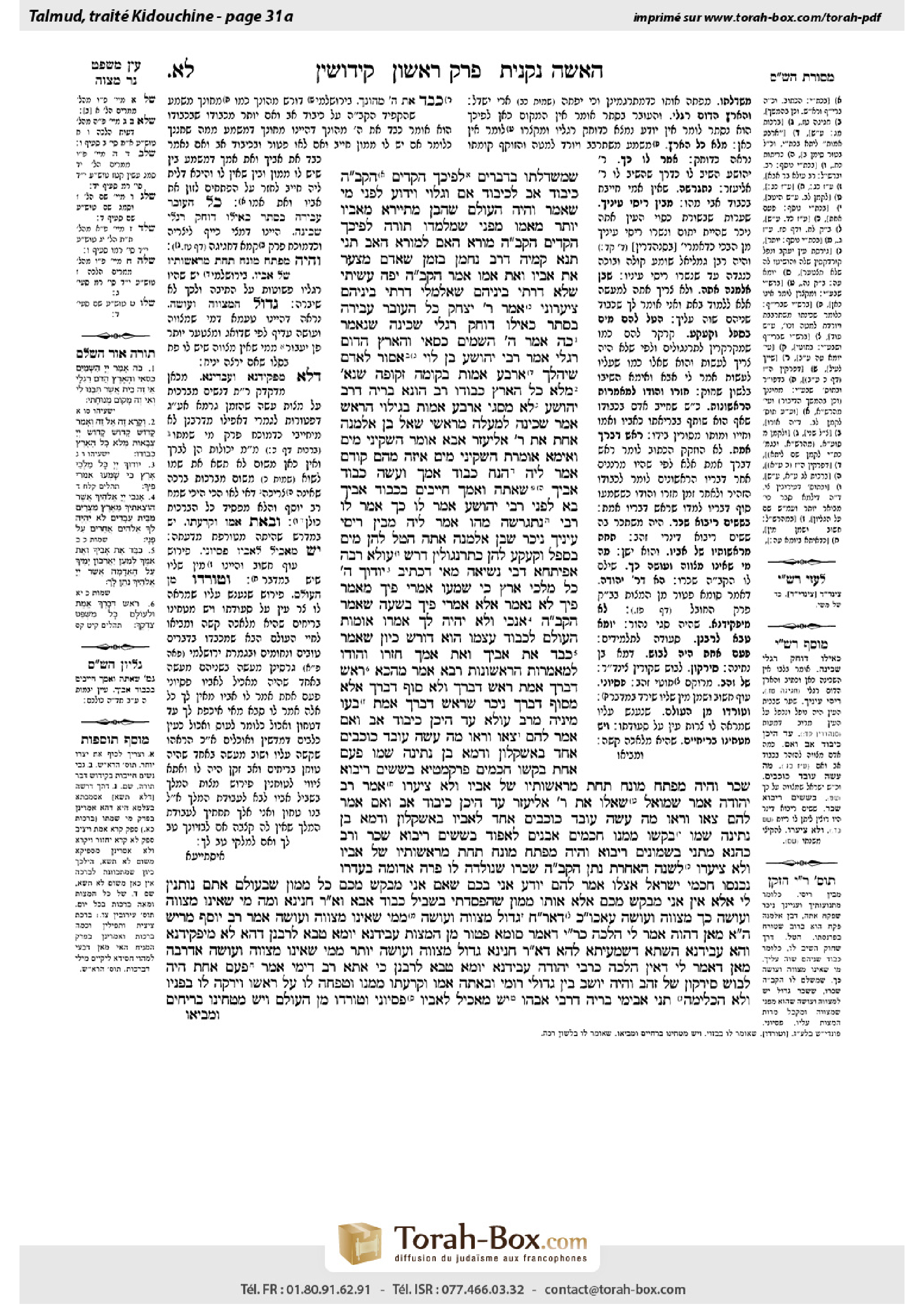
Kiddushin 31a: Talmud study for Daf Yomi
Daf Yomi is the daily study of one Talmud folio. Explore 37 tractates with scans, Hebrew text, Sefaria English and AI-generated French translations where annotated.
Passage selection and English or AI-generated French translation are available where the scan has annotations. Daf Study is independent of Torah-Box and Sefaria.
Browse Kiddushin · קידושין · All tractatesKiddushin 31a text and translations
This page of Kiddushin includes the Aramaic text, an English translation and an AI-generated French translation, alongside the scan above.
קידושין ל״א א · Aramaic and Hebrew text
שֶׁמְּשַׁדַּלְתּוֹ בִּדְבָרִים, לְפִיכָךְ הִקְדִּים הַקָּדוֹשׁ בָּרוּךְ הוּא כִּיבּוּד אָב לְכִיבּוּד אֵם. וְגָלוּי וְיָדוּעַ לִפְנֵי מִי שֶׁאָמַר וְהָיָה הָעוֹלָם שֶׁהַבֵּן מִתְיָירֵא מֵאָבִיו יוֹתֵר מֵאִמּוֹ, מִפְּנֵי שֶׁמְּלַמְּדוֹ תּוֹרָה, לְפִיכָךְ הִקְדִּים הַקָּדוֹשׁ בָּרוּךְ הוּא מוֹרָא הָאֵם לְמוֹרָא הָאָב.
תָּנֵי תַּנָּא קַמֵּיהּ דְּרַב נַחְמָן: בִּזְמַן שֶׁאָדָם מְצַעֵר אֶת אָבִיו וְאֶת אִמּוֹ אָמַר הַקָּדוֹשׁ בָּרוּךְ הוּא: יָפֶה עָשִׂיתִי שֶׁלֹּא דַּרְתִּי בֵּינֵיהֶם, שֶׁאִלְמָלֵי דַּרְתִּי בֵּינֵיהֶם, צִיעֲרוּנִי. אָמַר רַבִּי יִצְחָק: כׇּל הָעוֹבֵר עֲבֵירָה בַּסֵּתֶר – כְּאִילּוּ דּוֹחֵק רַגְלֵי שְׁכִינָה. שֶׁנֶּאֱמַר: ״כֹּה אָמַר ה׳ הַשָּׁמַיִם כִּסְאִי וְהָאָרֶץ הֲדֹם רַגְלָי״.
אָמַר רַבִּי יְהוֹשֻׁעַ בֶּן לֵוִי: אָסוּר לְאָדָם שֶׁיְּהַלֵּךְ אַרְבַּע אַמּוֹת בְּקוֹמָה זְקוּפָה, שֶׁנֶּאֱמַר: ״מְלֹא כׇל הָאָרֶץ כְּבוֹדוֹ״. רַב הוּנָא בְּרֵיהּ דְּרַב יְהוֹשֻׁעַ לָא מְסַגֵּי אַרְבַּע אַמּוֹת בְּגִילּוּי הָרֹאשׁ. אָמַר: שְׁכִינָה לְמַעְלָה מֵרֹאשִׁי.
שָׁאַל בֶּן אַלְמָנָה אַחַת אֶת רַבִּי אֱלִיעֶזֶר: אַבָּא אוֹמֵר: ״הַשְׁקֵינִי מַיִם״ וְאִימָּא אוֹמֶרֶת: ״הַשְׁקֵינִי מַיִם״, אֵיזֶה מֵהֶם קוֹדֵם? אֲמַר לֵיהּ: הַנַּח כְּבוֹד אִמְּךָ וַעֲשֵׂה כְּבוֹד אָבִיךָ, שֶׁאַתָּה וְאִמְּךָ חַיָּיבִים בִּכְבוֹד אָבִיךָ. בָּא לִפְנֵי רַבִּי יְהוֹשֻׁעַ, אָמַר לוֹ כָּךְ.
אָמַר לוֹ: רַבִּי, נִתְגָּרְשָׁה מַהוּ? אֲמַר לֵיהּ: מִבֵּין רִיסֵי עֵינֶיךָ נִיכָּר שֶׁבֶּן אַלְמָנָה אַתָּה. הַטֵּל לָהֶן מַיִם בְּסֵפֶל וְקַעְקֵעַ לָהֶן כְּתַרְנְגוֹלִין.
דָּרֵשׁ עוּלָּא רַבָּה אַפִּיתְחָא דְּבֵי נְשִׂיאָה: מַאי דִּכְתִיב: ״יוֹדוּךָ ה׳ כׇּל מַלְכֵי אָרֶץ כִּי שָׁמְעוּ אִמְרֵי פִיךָ״ – ״מַאֲמַר פִּיךָ״ לֹא נֶאֱמַר, אֶלָּא ״אִמְרֵי פִיךָ״ – בְּשָׁעָה שֶׁאָמַר הַקָּדוֹשׁ בָּרוּךְ הוּא ״אָנֹכִי״ וְ״לֹא יִהְיֶה לְךָ״, אֲמַרוּ אוּמּוֹת הָעוֹלָם: לִכְבוֹד עַצְמוֹ הוּא דּוֹרֵשׁ.
כֵּיוָן שֶׁאָמַר: ״כַּבֵּד אֶת אָבִיךָ וְאֶת אִמֶּךָ״ חָזְרוּ וְהוֹדוּ לְמַאֲמָרוֹת הָרִאשׁוֹנוֹת. רָבָא אָמַר: מֵהָכָא: ״רֹאשׁ דְּבָרְךָ אֱמֶת״ – ״רֹאשׁ דְּבָרְךָ״ וְלֹא ״סוֹף דְּבָרְךָ״? אֶלָּא מִסּוֹף דְּבָרְךָ נִיכָּר שֶׁרֹאשׁ דְּבָרְךָ אֱמֶת.
בְּעוֹ מִינֵּיהּ מֵרַב עוּלָּא: עַד הֵיכָן כִּיבּוּד אָב וָאֵם? אָמַר לָהֶם: צְאוּ וּרְאוּ מָה עָשָׂה נׇכְרִי אֶחָד בְּאַשְׁקְלוֹן, וְדָמָא בֶּן נְתִינָה שְׁמוֹ. פַּעַם אַחַת בִּקְּשׁוּ חֲכָמִים פְּרַקְמַטְיָא בְּשִׁשִּׁים רִיבּוֹא שָׂכָר, וְהָיָה מַפְתֵּחַ מוּנָּח תַּחַת מְרַאֲשׁוֹתָיו שֶׁל אָבִיו, וְלֹא צִיעֲרוֹ.
אָמַר רַב יְהוּדָה אָמַר שְׁמוּאֵל: שָׁאֲלוּ אֶת רַבִּי אֱלִיעֶזֶר: עַד הֵיכָן כִּיבּוּד אָב וָאֵם? אָמַר לָהֶם: צְאוּ וּרְאוּ מָה עָשָׂה נׇכְרִי אֶחָד לְאָבִיו בְּאַשְׁקְלוֹן, וְדָמָא בֶּן נְתִינָה שְׁמוֹ. בִּקְּשׁוּ מִמֶּנּוּ חֲכָמִים אֲבָנִים לָאֵפוֹד בְּשִׁשִּׁים רִיבּוֹא שָׂכָר, וְרַב כָּהֲנָא מַתְנֵי בִּשְׁמוֹנִים רִיבּוֹא, וְהָיָה מַפְתֵּחַ מוּנָּח תַּחַת מְרַאֲשׁוֹתָיו שֶׁל אָבִיו, וְלֹא צִיעֲרוֹ.
לְשָׁנָה הָאַחֶרֶת נָתַן הַקָּדוֹשׁ בָּרוּךְ הוּא שְׂכָרוֹ, שֶׁנּוֹלְדָה לוֹ פָּרָה אֲדֻמָּה בְּעֶדְרוֹ. נִכְנְסוּ חַכְמֵי יִשְׂרָאֵל אֶצְלוֹ, אָמַר לָהֶם: יוֹדֵעַ אֲנִי בָּכֶם שֶׁאִם אֲנִי מְבַקֵּשׁ מִכֶּם כׇּל מָמוֹן שֶׁבָּעוֹלָם אַתֶּם נוֹתְנִין לִי, אֶלָּא אֵין אֲנִי מְבַקֵּשׁ מִכֶּם אֶלָּא אוֹתוֹ מָמוֹן שֶׁהִפְסַדְתִּי בִּשְׁבִיל כְּבוֹד אַבָּא.
וְאָמַר רַבִּי חֲנִינָא: וּמָה מִי שֶׁאֵינוֹ מְצֻוֶּוה וְעוֹשֶׂה – כָּךְ, מְצֻוֶּוה וְעוֹשֶׂה – עַל אַחַת כַּמָּה וְכַמָּה. דְּאָמַר רַבִּי חֲנִינָא: גָּדוֹל מְצֻוֶּוה וְעוֹשֶׂה מִמִּי שֶׁאֵינוֹ מְצֻוֶּוה וְעוֹשֶׂה.
אָמַר רַב יוֹסֵף: מֵרֵישׁ הֲוָה אָמֵינָא: מַאן דַּהֲוָה אָמַר לִי הֲלָכָה כְּרַבִּי יְהוּדָה דְּאָמַר: סוֹמֵא פָּטוּר מִן הַמִּצְוֹת – עָבֵידְנָא יוֹמָא טָבָא לְרַבָּנַן, דְּהָא לָא מִיפְּקִידְנָא וְהָא עָבֵידְנָא. הַשְׁתָּא דְּשַׁמְעִיתַהּ לְהָא דְּאָמַר רַבִּי חֲנִינָא: גָּדוֹל מְצֻוֶּוה וְעוֹשֶׂה יוֹתֵר מִמִּי שֶׁאֵינוֹ מְצֻוֶּוה וְעוֹשֶׂה, אַדְּרַבָּה: מַאן דְּאָמַר לִי דְּאֵין הֲלָכָה כְּרַבִּי יְהוּדָה עָבֵידְנָא יוֹמָא טָבָא לְרַבָּנַן.
כִּי אֲתָא רַב דִּימִי אָמַר: פַּעַם אַחַת הָיָה לָבוּשׁ סִירְקוֹן שֶׁל זָהָב, וְהָיָה יוֹשֵׁב בֵּין גְּדוֹלֵי רוֹמִי. וּבָאתָה אִמּוֹ וּקְרָעַתּוּ מִמֶּנּוּ, וְטָפְחָה לוֹ עַל רֹאשׁוֹ, וְיָרְקָה לוֹ בְּפָנָיו, וְלֹא הִכְלִימָהּ.
תָּנֵי אֲבִימִי בְּרֵיהּ דְּרַבִּי אֲבָהוּ: יֵשׁ מַאֲכִיל לְאָבִיו פַּסְיוֹנֵי וְטוֹרְדוֹ מִן הָעוֹלָם, וְיֵשׁ מַטְחִינוֹ בָּרֵיחַיִם
Kiddushin 31a · English translation
she persuades him with many statements of encouragement and does not treat him harshly. Therefore, in the mitzva of: “Honor your father and your mother” (Exodus 20:11), the Holy One, Blessed be He, preceded the mention of the honor due one’s father before mentioning the honor due one’s mother. The verse emphasizes the duty that does not come naturally. Similarly, it is revealed and known before the One Who spoke and the world came into being that a son fears his father more than his mother, because his father teaches him Torah, and consequently he is strict with him. Therefore, in the verse: “A man shall fear his mother and his father” (Leviticus 19:3), the Holy One, Blessed be He, preceded the mention of fear of the mother before the mention of fear of the father.
A tanna taught a baraita before Rav Naḥman: When a person causes his father and mother suffering, the Holy One, Blessed be He, says: I did well in not dwelling among them, for if I had dwelled among them they would have caused Me suffering as well, as it were. Rabbi Yitzḥak says: Anyone who transgresses in private, it is considered as though he is pushing away the feet of the Divine Presence, i.e., he distances God from him, so to speak. As it is stated: “So says the Lord: The heaven is My throne and the earth is My footstool” (Isaiah 66:1). When someone sins in secret, he demonstrates that he thinks God is absent from that place, and it is as though he pushes His feet away from the earth.
With regard to the same issue, Rabbi Yehoshua ben Levi says: It is prohibited for a person to walk even four cubits with an upright posture, which is considered an arrogant manner, as it is stated: “The entire world is full of His glory” (Isaiah 6:3). One who walks in an arrogant manner indicates a lack of regard for the glory and honor of God that is surrounding him, and thereby chases God from that place, as it were. The Gemara relates: Rav Huna, son of Rav Yehoshua, would not walk four cubits with an uncovered head. He said: The Divine Presence is above my head, and I must act respectfully.
The son of one widow asked Rabbi Eliezer: If my father says to me: Give me water to drink, and my mother also says to me: Give me water to drink, which of them should I honor first? Rabbi Eliezer said to him: Set aside the honor of your mother, and perform the honor of your father, as you and your mother are both obligated in the honor of your father. He came before Rabbi Yehoshua and asked him the same question, and Rabbi Yehoshua said this same answer to him.
The man said to him: My teacher, if one’s mother is divorced, what is the halakha? Rabbi Yehoshua said to him: From your eyelashes, which are filled with tears, it is evident that you are the son of a widow, and you have no father. Why, then, are you asking this question as though it were relevant for you? Consequently, Rabbi Yehoshua answered him sarcastically: Pour water for them into a pitcher and squawk at them as one does to summon chickens. In other words, if one’s mother is divorced, the same honor is due to both parents, and neither takes precedence.
§ Ulla the Great interpreted a verse homiletically at the entrance to the house of the Nasi. What is the meaning of that which is written: “All the kings of the earth shall give You thanks, O Lord, for they have heard the words of Your mouth” (Psalms 138:4)? It is not stated: The word of Your mouth, in the singular. Rather, the verse uses the expression: “The words of Your mouth,” in the plural. To what is this phrase referring? When the Holy One, Blessed be He, said: “I am the Lord your God” (Exodus 20:2), and, in the same verse: “You shall have no other gods before Me,” the nations of the world said: He teaches this for His own honor, as both statements entail respect for God.
Once He said: “Honor your father and your mother” (Exodus 20:11), they returned and conceded the truth of the first statements, which is why the verse uses the plural expression: “Words of Your mouth,” i.e., all the words of God’s mouth. Rava said: This can be derived from here: “The beginning of Your word is truth” (Psalms 119:160). Is the beginning of Your word truth but not the end of Your word? Rather, from the end of Your word it is apparent to everyone that the beginning of Your word is truth.
The Sages raised a dilemma before Rav Ulla: How far must one go to fulfill the mitzva of honoring one’s father and mother? Rav Ulla said to them: Go and see what one gentile did in Ashkelon, and his name was Dama ben Netina. Once the Sages sought to purchase merchandise [perakmatya] from him for six hundred thousand gold dinars’ profit, but the key for the container in which the merchandise was kept was placed under his father’s head, and he was sleeping at the time. And Dama ben Netina would not disturb his father by waking him, although he could have made a substantial profit.
Rav Yehuda says that Shmuel says: They asked Rabbi Eliezer: How far must one go to fulfill the mitzva of honoring one’s father and mother? Rabbi Eliezer said to them: Go and see what one gentile did for his father in Ashkelon, and the name of the son was Dama ben Netina. Once the Sages wished to purchase precious stones from him for the ephod of the High Priest for six hundred thousand gold dinars’ profit, and Rav Kahana taught that it was eight hundred thousand gold dinars’ profit. And the key to the chest holding the jewels was placed under his father’s head, and he would not disturb him.
The next year the Holy One, Blessed be He, gave Dama ben Netina his reward, as a red heifer was born in his herd, and the Jews needed it. When the Sages of Israel came to him he said to them: I know, concerning you, that if I were to ask for all the money in the world you would give it to me. But I ask only that money that I lost due to the honor of Father.
And Rabbi Ḥanina says: And if this is related about one who is not commanded by the Torah to honor his father, as Dama was a gentile, and nevertheless when he performs the mitzva he is given this great reward, all the more so is one rewarded who is commanded to fulfill a mitzva and performs it. As Rabbi Ḥanina says: Greater is one who is commanded to do a mitzva and performs it than one who is not commanded to do a mitzva and performs it.
Rav Yosef, who was blind, said: At first I would say: If someone would tell me that the halakha is in accordance with the opinion of Rabbi Yehuda, who says: A blind person is exempt from fulfilling the mitzvot, I would make a festive day for the rabbis, as I am not commanded and yet I perform the mitzvot. This means my reward is very great. Now that I have heard that which Rabbi Ḥanina says: Greater is one who is commanded to do a mitzva and performs it than one who is not commanded to do a mitzva and performs it, on the contrary: If someone would tell me that the halakha is not in accordance with the opinion of Rabbi Yehuda, and a blind person is obligated in mitzvot, I would make a festive day for the rabbis.
When Rav Dimi came from Eretz Yisrael to Babylonia, he said: Once Dama ben Netina was wearing a fine cloak [sirkon] of gold, and was sitting among the nobles of Rome. And his mother came to him and tore his garment from him and smacked him on the head and spat in his face, and yet he did not embarrass her.
Avimi, son of Rabbi Abbahu, taught: There is a type of son who feeds his father pheasant [pasyonei] and yet this behavior causes him to be removed from the World, i.e., the World-to-Come; and there is one who makes him grind with a millstone, which is difficult work,
Kiddushin 31a · Traduction française (IA)
Elle le persuade par de nombreuses paroles encourageantes et ne le traite pas durement. C’est pourquoi, dans la mitsva : « Honore ton père et ta mère » (Exode 20, 11), le Saint, béni soit-Il, a mentionné d’abord l’honneur dû au père, avant celui dû à la mère. Le verset souligne ainsi le devoir qui ne vient pas naturellement. De même, il est révélé et connu de Celui qui a parlé et le monde est venu à l’existence qu’un fils craint davantage son père que sa mère, parce que son père lui enseigne la Torah et se montre donc sévère envers lui. C’est pourquoi, dans le verset : « Que chacun craigne sa mère et son père » (Lévitique 19, 3), le Saint, béni soit-Il, a mentionné d’abord la crainte de la mère, avant celle du père.
Un tanna enseigna une baraïta devant Rav Naḥman : Quand une personne fait souffrir son père et sa mère, le Saint, béni soit-Il, dit : « J’ai bien fait de ne pas résider parmi eux, car si J’avais résidé parmi eux, ils M’auraient aussi fait souffrir, pour ainsi dire. » Rabbi Yitzḥak dit : Quiconque transgresse en secret, c’est comme s’il repoussait les pieds de la Présence divine, c’est-à-dire qu’il éloigne Dieu de lui, pour ainsi dire. Ainsi qu’il est dit : « Ainsi parle le Seigneur : Le ciel est Mon trône et la terre est Mon marchepied » (Isaïe 66, 1). Quand quelqu’un pèche en secret, il montre qu’il pense que Dieu est absent de cet endroit, et c’est comme s’il repoussait Ses pieds loin de la terre.
À propos de la même question, Rabbi Yehoshua ben Levi dit : Il est interdit à une personne de marcher ne serait-ce que quatre coudées le corps droit, car cela est considéré comme une attitude arrogante, ainsi qu’il est dit : « Toute la terre est pleine de Sa gloire » (Isaïe 6, 3). Celui qui marche avec arrogance montre qu’il ne tient pas compte de la gloire et de l’honneur de Dieu qui l’entourent, et chasse ainsi Dieu de cet endroit, pour ainsi dire. La Guemara rapporte : Rav Huna, fils de Rav Yehoshua, ne marchait pas quatre coudées la tête découverte. Il disait : « La Présence divine est au-dessus de ma tête, et je dois me comporter avec respect. »
Le fils d’une veuve demanda à Rabbi Eliezer : « Si mon père me dit : “Donne-moi de l’eau à boire”, et que ma mère me dit aussi : “Donne-moi de l’eau à boire”, lequel dois-je honorer en premier ? » Rabbi Eliezer lui répondit : « Mets de côté l’honneur dû à ta mère et honore ton père, car toi et ta mère êtes tous deux tenus d’honorer ton père. » Il se présenta devant Rabbi Yehoshua et lui posa la même question ; Rabbi Yehoshua lui donna la même réponse.
L’homme lui dit : « Mon maître, quelle est la halakha si la mère d’une personne est divorcée ? » Rabbi Yehoshua lui répondit : « À tes cils couverts de larmes, on voit clairement que tu es le fils d’une veuve et que tu n’as pas de père. Pourquoi donc poses-tu cette question comme si elle te concernait ? » Rabbi Yehoshua lui répondit alors avec ironie : « Verse-leur de l’eau dans une cruche et glousse après eux comme on le fait pour appeler les poules. » Autrement dit, si la mère est divorcée, les deux parents ont droit au même honneur et aucun ne passe avant l’autre.
§ Ulla le Grand interpréta un verset de manière homilétique à l’entrée de la maison du Nasi. Que signifie ce qui est écrit : « Tous les rois de la terre Te rendront grâce, Seigneur, car ils ont entendu les paroles de Ta bouche » (Psaumes 138, 4) ? Il n’est pas écrit : « La parole de Ta bouche », au singulier. Le verset emploie plutôt l’expression « les paroles de Ta bouche », au pluriel. À quoi cette expression fait-elle référence ? Quand le Saint, béni soit-Il, dit : « Je suis le Seigneur ton Dieu » (Exode 20, 2), puis, dans le même verset : « Tu n’auras pas d’autres dieux devant Moi », les nations du monde dirent : « Il enseigne cela pour Son propre honneur », car ces deux déclarations impliquent de respecter Dieu.
Lorsqu’Il dit : « Honore ton père et ta mère » (Exode 20, 11), elles revinrent sur leur position et reconnurent la vérité des premières déclarations, ce qui explique que le verset emploie le pluriel : « les paroles de Ta bouche », c’est-à-dire toutes les paroles de la bouche de Dieu. Rava dit : On peut le déduire d’ici : « Le début de Ta parole est vérité » (Psaumes 119, 160). Le début de Ta parole serait vérité, mais pas la fin de Ta parole ? Au contraire, la fin de Ta parole montre à tous que le début de Ta parole est vérité.
Les Sages posèrent une question à Rav Ulla : « Jusqu’où faut-il aller pour accomplir la mitsva d’honorer son père et sa mère ? » Rav Ulla leur dit : « Allez voir ce qu’a fait un non-Juif à Ashkelon, du nom de Dama ben Netina. » Un jour, les Sages cherchèrent à lui acheter de la marchandise [perakmatya] avec un bénéfice de six cent mille dinars d’or ; mais la clé du coffre où était rangée la marchandise se trouvait sous la tête de son père, qui dormait. Dama ben Netina ne voulut pas réveiller son père, bien qu’il aurait pu réaliser un bénéfice considérable.
Rav Yehuda dit au nom de Shmuel : On demanda à Rabbi Eliezer : « Jusqu’où faut-il aller pour accomplir la mitsva d’honorer son père et sa mère ? » Rabbi Eliezer leur répondit : « Allez voir ce qu’un non-Juif fit pour son père à Ashkelon ; le fils s’appelait Dama ben Netina. » Un jour, les Sages voulurent lui acheter des pierres précieuses destinées à l’éphod du Grand Prêtre, pour un bénéfice de six cent mille dinars d’or ; Rav Kahana enseigna que le bénéfice aurait été de huit cent mille dinars d’or. La clé du coffre contenant les joyaux se trouvait sous la tête de son père, et il ne voulut pas le déranger.
L’année suivante, le Saint, béni soit-Il, récompensa Dama ben Netina : une génisse rousse naquit dans son troupeau, et les Juifs en avaient besoin. Quand les Sages d’Israël vinrent le trouver, il leur dit : « Je sais que si je vous demandais tout l’argent du monde, vous me le donneriez. Mais je ne demande que l’argent que j’ai perdu par égard pour l’honneur de mon père. »
Et Rabbi Ḥanina dit : Si cela est rapporté à propos de quelqu’un qui n’est pas tenu par la Torah d’honorer son père — car Dama était un non-Juif — et qui reçoit néanmoins une si grande récompense lorsqu’il accomplit cette mitsva, à plus forte raison celui qui est tenu d’accomplir une mitsva et l’accomplit est-il récompensé. Rabbi Ḥanina dit en effet : Celui qui est tenu d’accomplir une mitsva et l’accomplit est plus grand que celui qui n’est pas tenu de l’accomplir et l’accomplit.
Rav Yosef, qui était aveugle, dit : « Au début, je disais : Si quelqu’un me disait que la halakha suit l’opinion de Rabbi Yehuda, qui dit qu’un aveugle est dispensé d’accomplir les mitsvot, j’organiserais une fête pour les rabbins, car je ne serais pas tenu de les accomplir et pourtant je les accomplirais. Cela signifie que ma récompense serait très grande. Maintenant que j’ai entendu ce que dit Rabbi Ḥanina — celui qui est tenu d’accomplir une mitsva et l’accomplit est plus grand que celui qui n’est pas tenu de l’accomplir et l’accomplit —, c’est tout le contraire : si quelqu’un me disait que la halakha ne suit pas l’opinion de Rabbi Yehuda et qu’un aveugle est tenu d’accomplir les mitsvot, j’organiserais une fête pour les rabbins. »
Quand Rav Dimi arriva d’Eretz Yisrael en Babylonie, il dit : « Un jour, Dama ben Netina portait un beau vêtement [sirkon] en or et était assis parmi les nobles de Rome. Sa mère vint à lui, déchira son vêtement, le frappa sur la tête et lui cracha au visage ; pourtant, il ne lui fit pas honte. »
Avimi, fils de Rabbi Abbahu, enseignait : « Il existe un fils qui nourrit son père de faisans [pasyonei], mais dont le comportement lui vaut d’être retranché du Monde, c’est-à-dire du Monde à venir ; et il en est un autre qui lui fait moudre du grain avec une meule, un travail pénible, »
Traduction française générée par IA à partir de l’édition anglaise de Sefaria. Vérifie toujours un passage avec le texte source.
Text from Sefaria: William Davidson Edition - Vocalized Aramaic (CC BY NC); William Davidson Edition - English (CC BY NC).