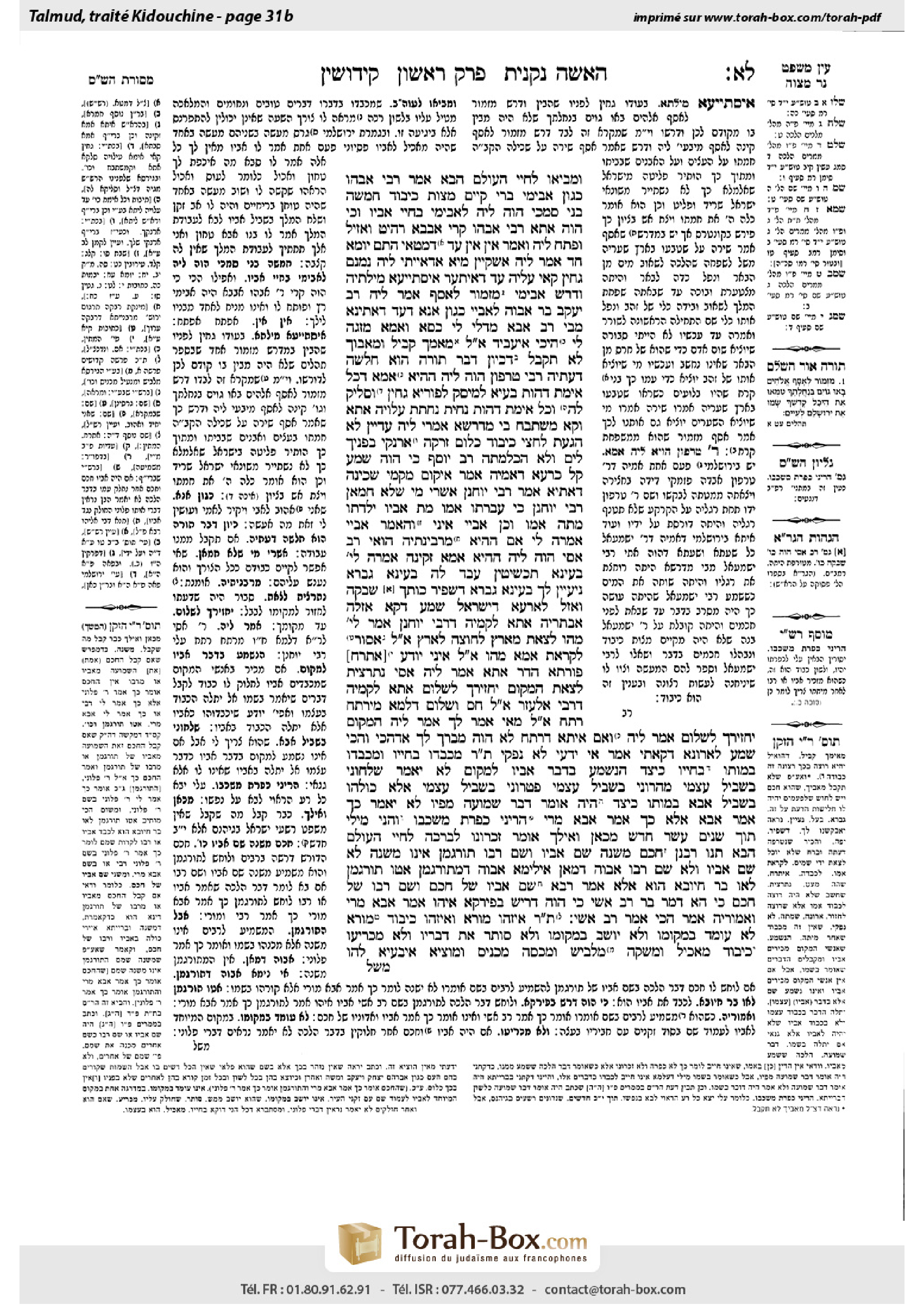
Kiddushin 31b: Talmud study for Daf Yomi
Daf Yomi is the daily study of one Talmud folio. Explore 37 tractates with scans, Hebrew text, Sefaria English and AI-generated French translations where annotated.
Passage selection and English or AI-generated French translation are available where the scan has annotations. Daf Study is independent of Torah-Box and Sefaria.
Browse Kiddushin · קידושין · All tractatesKiddushin 31b text and translations
This page of Kiddushin includes the Aramaic text, an English translation and an AI-generated French translation, alongside the scan above.
קידושין ל״א ב · Aramaic and Hebrew text
וּמְבִיאוֹ לְחַיֵּי הָעוֹלָם הַבָּא.
אָמַר רַבִּי אֲבָהוּ: כְּגוֹן אֲבִימִי בְּרִי קִיֵּים מִצְוַת כִּיבּוּד. חַמְשָׁה בְּנֵי סְמִיכִי הֲוָה לֵיהּ לַאֲבִימִי בְּחַיֵּי אָבִיו, וְכִי הֲוָה אֲתָא רַבִּי אֲבָהוּ, קָרֵי אַבָּבָא, רָהֵיט וְאָזֵיל וּפָתַח לֵיהּ וְאָמַר: אִין, אִין, עַד דְּמָטֵאי הָתָם.
יוֹמָא חַד אֲמַר לֵיהּ: אַשְׁקְיַין מַיָּא. אַדְּאַיְיתִי לֵיהּ נַמְנֵם. גָּחֵין קָאֵי עֲלֵיהּ עַד דְּאִיתְּעַר. אִיסְתַּיַּיעָא מִילְּתֵיהּ וּדְרַשׁ אֲבִימִי ״מִזְמוֹר לְאָסָף״.
אֲמַר לֵיהּ רַב יַעֲקֹב בַּר אֲבוּהּ לְאַבָּיֵי: כְּגוֹן אֲנָא, דְּעַד דְּאָתֵינָא מִבֵּי רַב אַבָּא מְדַלֵּי לִי כָּסָא וְאִמָּא מָזְגָה לִי, הֵיכִי אֶיעֱבֵיד? אֲמַר לֵיהּ: מֵאִמָּךְ קַבֵּיל, וּמֵאֲבוּךְ לָא תְּקַבֵּל דְּכֵיוָן דְּבַר תּוֹרָה הוּא חָלְשָׁה דַּעְתֵּיהּ.
רַבִּי טַרְפוֹן הֲוָה לֵיהּ הָהִיא אִמָּא דְּכֹל אֵימַת דַּהֲוָת בָּעֲיָא לְמֵיסֵק לְפוּרְיָא גָּחִין וּסְלִיק לַהּ, וְכֹל אֵימַת דֵּהוָת נָחִית, נֶחְתַּת עֲלוּיָה. אֲתָא וְקָא מִשְׁתַּבַּח בֵּי מִדְרְשָׁא. אָמְרֵי לֵיהּ: עֲדָיִין לֹא הִגַּעְתָּ לַחֲצִי כִּיבּוּד. כְּלוּם זָרְקָה אַרְנָקִי בְּפָנֶיךָ לַיָּם וְלֹא הִכְלַמְתָּהּ?
רַב יוֹסֵף כִּי הֲוָה שָׁמַע קָל כַּרְעָא דְאִמֵּיהּ, אָמַר: אֵיקוּם מִקַּמֵּי שְׁכִינָה דְּאָתְיָא. אָמַר רַבִּי יוֹחָנָן: אַשְׁרֵי מִי שֶׁלֹּא חֲמָאָן. רַבִּי יוֹחָנָן כִּי עִבְּרַתּוּ אִמּוֹ – מֵת אָבִיו, יְלָדַתּוּ – מֵתָה אִמּוֹ. וְכֵן אַבָּיֵי. אִינִי? וְהָאָמַר אַבָּיֵי: אֲמַרָה לִי אֵם! הָהִיא מְרַבְּיָנְתֵּיהּ הֲוַאי.
רַב אַסִּי הֲוָה לֵיהּ הָהִיא אִמָּא זְקֵינָה. אֲמַרָה לֵיהּ: בָּעֲיָנָא תַּכְשִׁיטִין. עֲבַד לַהּ. בָּעֲיָנָא גַּבְרָא: נְיעַיֵּין לָךְ. בָּעֲיָנָא גַּבְרָא דְּשַׁפִּיר כְּוָתָךְ, שַׁבְקַהּ וַאֲזַל לְאַרְעָא דְיִשְׂרָאֵל.
שְׁמַע דְּקָא אָזְלָה אַבָּתְרֵיהּ. אֲתָא לְקַמֵּיהּ דְּרַבִּי יוֹחָנָן, אֲמַר לֵיהּ: מַהוּ לָצֵאת מֵאֶרֶץ לְחוּצָה לָאָרֶץ? אֲמַר לֵיהּ: אָסוּר. לִקְרַאת אִמָּא מַהוּ? אֲמַר לֵיהּ: אֵינִי יוֹדֵעַ. אִתָּרַח פּוּרְתָּא, הֲדַר אֲתָא. אֲמַר לֵיהּ: אַסִּי, נִתְרַצֵּיתָ לָצֵאת – הַמָּקוֹם יַחֲזִירְךָ לְשָׁלוֹם.
אֲתָא לְקַמֵּיהּ דְּרַבִּי אֶלְעָזָר. אֲמַר לֵיהּ: חַס וְשָׁלוֹם, דִּלְמָא מִירְתָּח רָתַח? אֲמַר לֵיהּ: מַאי אֲמַר לָךְ? אֲמַר לֵיהּ: הַמָּקוֹם יַחֲזִירְךָ לְשָׁלוֹם. אֲמַר לֵיהּ: וְאִם אִיתָא דְּרָתַח – לָא הֲוָה מְבָרֵךְ לֵךְ. אַדְּהָכִי וְהָכִי שְׁמַע לַאֲרוֹנַאּ דְּקָאָתֵי. אָמַר: אִי יְדַעִי לָא נְפַקִי.
תָּנוּ רַבָּנַן: מְכַבְּדוֹ בְּחַיָּיו, וּמְכַבְּדוֹ בְּמוֹתוֹ. בְּחַיָּיו כֵּיצַד? הַנִּשְׁמָע בִּדְבַר אָבִיו לְמָקוֹם, לֹא יֹאמַר: ״שַׁלְּחוּנִי בִּשְׁבִיל עַצְמִי״, ״מַהֲרוּנִי בִּשְׁבִיל עַצְמִי״, ״פִּטְרוּנִי בִּשְׁבִיל עַצְמִי״. אֶלָּא כּוּלְּהוּ: ״בִּשְׁבִיל אַבָּא״.
בְּמוֹתוֹ כֵּיצַד? הָיָה אוֹמֵר דָּבָר שְׁמוּעָה מִפִּיו, לֹא יֹאמַר: ״כָּךְ אָמַר אַבָּא״, אֶלָּא: ״כָּךְ אָמַר אַבָּא מָרִי, הֲרֵינִי כַּפָּרַת מִשְׁכָּבוֹ״. וְהָנֵי מִילֵּי תּוֹךְ שְׁנֵים עָשָׂר חֹדֶשׁ, מִכָּאן וְאֵילָךְ אוֹמֵר: ״זִכְרוֹנוֹ לִבְרָכָה לְחַיֵּי הָעוֹלָם הַבָּא״.
תָּנוּ רַבָּנַן: חָכָם – מְשַׁנֶּה שֵׁם אָבִיו וְשֵׁם רַבּוֹ. תּוּרְגְּמָן – אֵינוֹ מְשַׁנֶּה לֹא שֵׁם אָבִיו וְלֹא שֵׁם רַבּוֹ. אֲבוּהּ דְּמַאן? אִילֵימָא אֲבוּהּ דִּמְתוּרְגְּמָן – אַטּוּ תּוּרְגְּמָן לָאו בַּר חִיּוּבָא הוּא?
אֶלָּא אָמַר רָבָא: שֵׁם אָבִיו שֶׁל חָכָם, וְשֵׁם רַבּוֹ שֶׁל חָכָם. כִּי הָא דְּמָר בַּר רַב אָשֵׁי כִּי הֲוָה דָּרֵישׁ בְּפִירְקָא, אִיהוּ אָמַר: אַבָּא מָרִי, וְאָמוֹרֵיהּ אָמַר: הָכִי אָמַר רַב אָשֵׁי.
תָּנוּ רַבָּנַן: אֵיזֶהוּ מוֹרָא וְאֵיזֶהוּ כִּיבּוּד? מוֹרָא – לֹא עוֹמֵד בִּמְקוֹמוֹ, וְלֹא יוֹשֵׁב בִּמְקוֹמוֹ, וְלֹא סוֹתֵר אֶת דְּבָרָיו, וְלֹא מַכְרִיעוֹ. כִּיבּוּד – מַאֲכִיל וּמַשְׁקֶה, מַלְבִּישׁ וּמְכַסֶּה, מַכְנִיס וּמוֹצִיא.
אִיבַּעְיָא לְהוּ:
Kiddushin 31b · English translation
and this action brings him to the life of the World-to-Come.
Rabbi Abbahu said: One such as Avimi, my son, properly fulfilled the mitzva of honoring his parents. The Gemara relates: Avimi had five sons during his father’s lifetime who were ordained to issue halakhic rulings, and he too was ordained. And yet when Rabbi Abbahu, his father, came and called at the gate to enter, Avimi would himself run and go to open the door for him. And before he arrived there, he would already say: Yes, yes, so that his father would not think that he was being ignored.
One day Rabbi Abbahu said to Avimi his son: Give me water to drink. Before he brought him the water, Rabbi Abbahu dozed off. Avimi bent over and stood over him until his father awoke. The performance of this mitzva aided him, i.e., as a reward God helped him in his studies, and Avimi succeeded in homiletically interpreting the psalm: “A song to Asaph” (Psalms 79).
Rav Ya’akov bar Avuh said to Abaye: With regard to one such as I, so beloved by my parents that before I return from the study hall my father brings me a cup and my mother pours for me, how should I act? Is it disrespectful to accept this honor from them? Abaye said to him: Accept it from your mother, but do not accept it from your father, as, since he is a Torah scholar he will be disheartened if his son does not show him the proper level of respect.
The Gemara relates: Rabbi Tarfon had a certain manner of treating his mother, that whenever she wished to ascend into her bed he would bend over and help her to ascend, and whenever she wished to descend from the bed, she would descend onto him. He came and praised himself in the study hall for performing the mitzva of honoring one’s father and mother so thoroughly. They said to him: You still have not reached even half of the honor due to her. Has it ever happened that she threw a purse into the sea in front of you, and you did not embarrass her?
When Rav Yosef heard his mother’s footsteps, he would say: I will stand before the arriving Divine Presence. Rabbi Yoḥanan said: Fortunate is one who never saw his father and mother, as it is so difficult to honor them appropriately. The Gemara relates that Rabbi Yoḥanan himself never saw his parents. When his mother was pregnant with him, his father died; and when she gave birth to him, his mother died. And the same is true of Abaye. The Gemara asks: Is that so, that Abaye never saw his mother? But didn’t Abaye say on many occasions: My mother told me? The Gemara answers: That mother was actually his foster mother, not his birth mother.
Rav Asi had an elderly mother. She said to him: I want jewelry, and he made jewelry for her. She said to him: I want a man whom I can marry, and he said to her: I will seek one for you. She said to him: I want a husband who is as handsome as you. At this point, he realized that she was senile, and that he would be unable to fulfill all her requests. Therefore, he left her and went to Eretz Yisrael.
Rav Asi heard that she was following him to Eretz Yisrael. He came before Rabbi Yoḥanan and said to him: What is the halakha with regard to leaving Eretz Yisrael to go outside of Eretz Yisrael? Rabbi Yoḥanan said to him: It is prohibited. Rav Asi further asked: If one is going to greet his mother, what is the halakha? Rabbi Yoḥanan said to him: I do not know. Rav Asi waited a little while, and then came back to him. Rabbi Yoḥanan said to him: Asi, you are evidently determined to leave. May the Omnipresent return you in peace, and he said no more.
Rav Asi came before Rabbi Elazar, because he did not know how to interpret Rabbi Yoḥanan’s statement. He said to Rabbi Elazar: God forbid, perhaps he is angry with me that I wished to leave? Rabbi Elazar said to him: What exactly did he say to you? Rav Asi said to him: May the Omnipresent return you in peace. Rabbi Elazar said to him: If it is so that he was angry, he would not have blessed you. Rabbi Yoḥanan certainly gave you permission to leave. In the meantime, while he was traveling to meet her, Rav Asi heard that her coffin was coming, i.e., his mother had died and her coffin was being brought to Eretz Yisrael. He said: Had I known I would not have left, as after his mother’s death he was not obligated to leave Eretz Yisrael to honor her.
The Sages taught: One honors his father in his life and honors him in his death. How does he honor him in his life? One who goes to a place on the command of his father should not say to the people to whom he has been sent, to hurry them along: Send me on my journey on my own behalf, or: Hurry up on my own behalf, or: Allow me to take leave of this business on my own behalf. Rather, he should say all of the above in the following manner: Act in this manner on Father’s behalf, as a mark of respect for his father.
How does he honor him in his death? If he says a matter he heard from his father’s mouth, he should not say: So said Father. Rather, he should say: So said Father, my teacher, may I be an atonement for his resting soul. And this halakha applies within twelve months of his death. From this time onward he says: May his memory be for a blessing, for the life of the World-to-Come.
The Sages taught: A Sage who lectures in public must change the name of his father, i.e., when he quotes his father he should not mention him by name. And similarly, he changes the name of his teacher. The disseminator, who explains the statements of a Sage to the audience, changes neither the name of his father nor the name of his teacher. The Gemara asks: To whose father is this referring? If we say it is referring to the father of the disseminator, whom the Sage mentioned in his lecture, is that to say that the disseminator is not obligated to observe the mitzva of honoring one’s father? How can a disseminator mention his own father by name?
Rather, Rava said: This is referring to the name of the Sage’s father and the name of the Sage’s teacher. This is like that which Mar bar Rav Ashi would do, as when he would teach Torah at his regular lecture and would mention a halakha in the name of his father, Rav Ashi, he would say: So said my father, my teacher; and his disseminator would say: So said Rav Ashi. Although a son may not mention his father’s name, the disseminator of his lecture may do so.
The Sages taught: What is fear and what is honor? Fear of one’s father includes the following: One may not stand in his father’s fixed place, and may not sit in his place, and may not contradict his statements by expressing an opinion contrary to that of his father, and he may not choose sides when his father argues with someone else. What is considered honor? He gives his father food and drink, dresses and covers him, and brings him in and takes him out for all his household needs.
A dilemma was raised before the Sages:
Kiddushin 31b · Traduction française (IA)
et cette action lui procure la vie du monde à venir.
Rabbi Abbahou dit : Quelqu’un comme mon fils Avimi a accompli comme il convient la mitsva d’honorer ses parents. La Guemara rapporte qu’Avimi avait cinq fils du vivant de son père, qui avaient été ordonnés pour rendre des décisions de halakha, et lui-même avait également été ordonné. Pourtant, lorsque Rabbi Abbahou, son père, venait appeler à la porte pour entrer, Avimi courait lui-même lui ouvrir. Avant même d’arriver à la porte, il disait déjà : « Oui, oui », afin que son père ne pense pas qu’on l’ignorait.
Un jour, Rabbi Abbahou dit à son fils Avimi : « Donne-moi de l’eau à boire. » Avant qu’Avimi ne lui apporte l’eau, Rabbi Abbahou s’assoupit. Avimi se pencha et resta debout auprès de lui jusqu’à ce que son père se réveille. L’accomplissement de cette mitsva l’aida : en récompense, Dieu l’assista dans ses études, et Avimi réussit à interpréter par homilétique le psaume « Chant d’Assaf » (Psaumes 79).
Rav Yaakov bar Avouh dit à Abayé : « Dans mon cas, mes parents m’aiment tant que, avant mon retour de la maison d’étude, mon père m’apporte une coupe et ma mère me sert à boire. Comment dois-je agir ? Est-il irrespectueux d’accepter cet honneur de leur part ? » Abayé lui répondit : « Accepte-le de ta mère, mais pas de ton père, car, étant un érudit de la Torah, il sera peiné si son fils ne lui témoigne pas le respect qui convient. »
La Guemara rapporte que Rabbi Tarfon avait une manière particulière de traiter sa mère : chaque fois qu’elle souhaitait monter dans son lit, il se penchait pour l’y aider, et chaque fois qu’elle souhaitait en descendre, elle descendait sur lui. Il vint à la maison d’étude et se vanta d’accomplir avec tant de zèle la mitsva d’honorer son père et sa mère. On lui dit : « Tu n’as même pas atteint la moitié de l’honneur qui lui est dû. Est-il jamais arrivé qu’elle jette une bourse dans la mer devant toi et que tu ne l’humilies pas ? »
Quand Rav Yossef entendait les pas de sa mère, il disait : « Je vais me tenir devant la Présence divine qui approche. » Rabbi Yo’hanan dit : « Heureux celui qui n’a jamais vu son père et sa mère, tant il est difficile de les honorer comme il convient. » La Guemara rapporte que Rabbi Yo’hanan lui-même n’avait jamais vu ses parents. Son père mourut alors que sa mère était enceinte de lui, et sa mère mourut en lui donnant naissance. Il en va de même pour Abayé. La Guemara demande : Est-il vrai qu’Abayé n’a jamais vu sa mère ? Pourtant, Abayé n’a-t-il pas dit à de nombreuses reprises : « Ma mère m’a dit » ? La Guemara répond : cette mère était en réalité sa mère nourricière, et non sa mère biologique.
Rav Assi avait une mère âgée. Elle lui dit : « Je veux des bijoux », et il lui en fabriqua. Elle lui dit : « Je veux un homme que je puisse épouser », et il lui répondit : « Je t’en chercherai un. » Elle lui dit : « Je veux un mari aussi beau que toi. » Il comprit alors qu’elle avait perdu la raison et qu’il ne pourrait pas satisfaire toutes ses demandes. Il la quitta donc et partit en Terre d’Israël.
Rav Assi apprit qu’elle le suivait en Terre d’Israël. Il se présenta devant Rabbi Yo’hanan et lui demanda : « Quelle est la halakha concernant le fait de quitter la Terre d’Israël pour se rendre à l’étranger ? » Rabbi Yo’hanan lui répondit : « C’est interdit. » Rav Assi demanda encore : « Et si l’on part pour accueillir sa mère, quelle est la halakha ? » Rabbi Yo’hanan lui répondit : « Je ne sais pas. » Rav Assi attendit un peu, puis revint auprès de lui. Rabbi Yo’hanan lui dit : « Assi, tu es manifestement déterminé à partir. Que le Tout-Puissant te ramène en paix. » Il n’ajouta rien.
Rav Assi se présenta devant Rabbi Elazar, car il ne savait pas comment interpréter les paroles de Rabbi Yo’hanan. Il lui dit : « À Dieu ne plaise, serait-il en colère contre moi parce que j’ai voulu partir ? » Rabbi Elazar lui demanda : « Que t’a-t-il dit exactement ? » Rav Assi lui répondit : « Que le Tout-Puissant te ramène en paix. » Rabbi Elazar lui dit : « S’il était en colère, il ne t’aurait pas béni. Rabbi Yo’hanan t’a certainement autorisé à partir. » Entre-temps, alors qu’il voyageait pour aller retrouver sa mère, Rav Assi apprit que son cercueil arrivait, c’est-à-dire qu’elle était morte et que son cercueil était amené en Terre d’Israël. Il dit : « Si je l’avais su, je ne serais pas parti », car après la mort de sa mère, il n’était pas tenu de quitter la Terre d’Israël pour l’honorer.
Les Sages ont enseigné : On honore son père de son vivant et après sa mort. Comment l’honore-t-on de son vivant ? Celui qui se rend en un lieu sur l’ordre de son père ne doit pas dire aux personnes auprès desquelles il a été envoyé, pour les presser : « Faites-moi avancer pour mon propre compte », ni : « Dépêchez-vous pour moi », ni : « Permettez-moi de me défaire de cette affaire pour mon propre compte. » Il doit plutôt formuler toutes ces demandes ainsi : « Agissez de cette manière pour mon père », afin de lui témoigner du respect.
Comment l’honore-t-on après sa mort ? S’il rapporte une parole qu’il a entendue de la bouche de son père, il ne doit pas dire : « Ainsi a dit mon père. » Il doit plutôt dire : « Ainsi a dit mon père, mon maître ; que je sois une expiation pour le repos de son âme. » Cette halakha s’applique pendant les douze mois qui suivent sa mort. À partir de là, il dit : « Que sa mémoire soit une bénédiction pour la vie du monde à venir. »
Les Sages ont enseigné : Un Sage qui donne un cours en public doit modifier le nom de son père, c’est-à-dire que, lorsqu’il le cite, il ne doit pas le nommer. De même, il modifie le nom de son maître. Le transmetteur, qui explique à l’auditoire les propos d’un Sage, ne modifie ni le nom de son père ni celui de son maître. La Guemara demande : De quel père s’agit-il ? Si l’on dit qu’il s’agit du père du transmetteur, que le Sage a mentionné dans son cours, cela voudrait-il dire que le transmetteur n’est pas tenu d’observer la mitsva d’honorer son père ? Comment pourrait-il alors nommer son propre père ?
Rava dit plutôt : Il s’agit du nom du père du Sage et de celui du maître du Sage. C’est ce que faisait Mar bar Rav Ashi : lorsqu’il enseignait la Torah dans son cours habituel et mentionnait une halakha au nom de son père, Rav Ashi, il disait : « Ainsi a dit mon père, mon maître » ; et son transmetteur disait : « Ainsi a dit Rav Ashi. » Bien qu’un fils ne puisse pas mentionner le nom de son père, le transmetteur de son cours peut le faire.
Les Sages ont enseigné : Qu’est-ce que la crainte et qu’est-ce que l’honneur ? La crainte envers son père comporte les interdictions suivantes : on ne peut ni se tenir à la place qui lui est réservée, ni s’asseoir à sa place, ni contredire ses propos en exprimant une opinion contraire à la sienne, ni prendre parti lorsqu’il se dispute avec quelqu’un d’autre. Qu’est-ce qui est considéré comme de l’honneur ? On lui donne à manger et à boire, on l’habille et on le couvre, on le fait entrer et sortir pour répondre à tous ses besoins domestiques.
Une question fut posée aux Sages :
Traduction française générée par IA à partir de l’édition anglaise de Sefaria. Vérifie toujours un passage avec le texte source.
Text from Sefaria: William Davidson Edition - Vocalized Aramaic (CC BY NC); William Davidson Edition - English (CC BY NC).