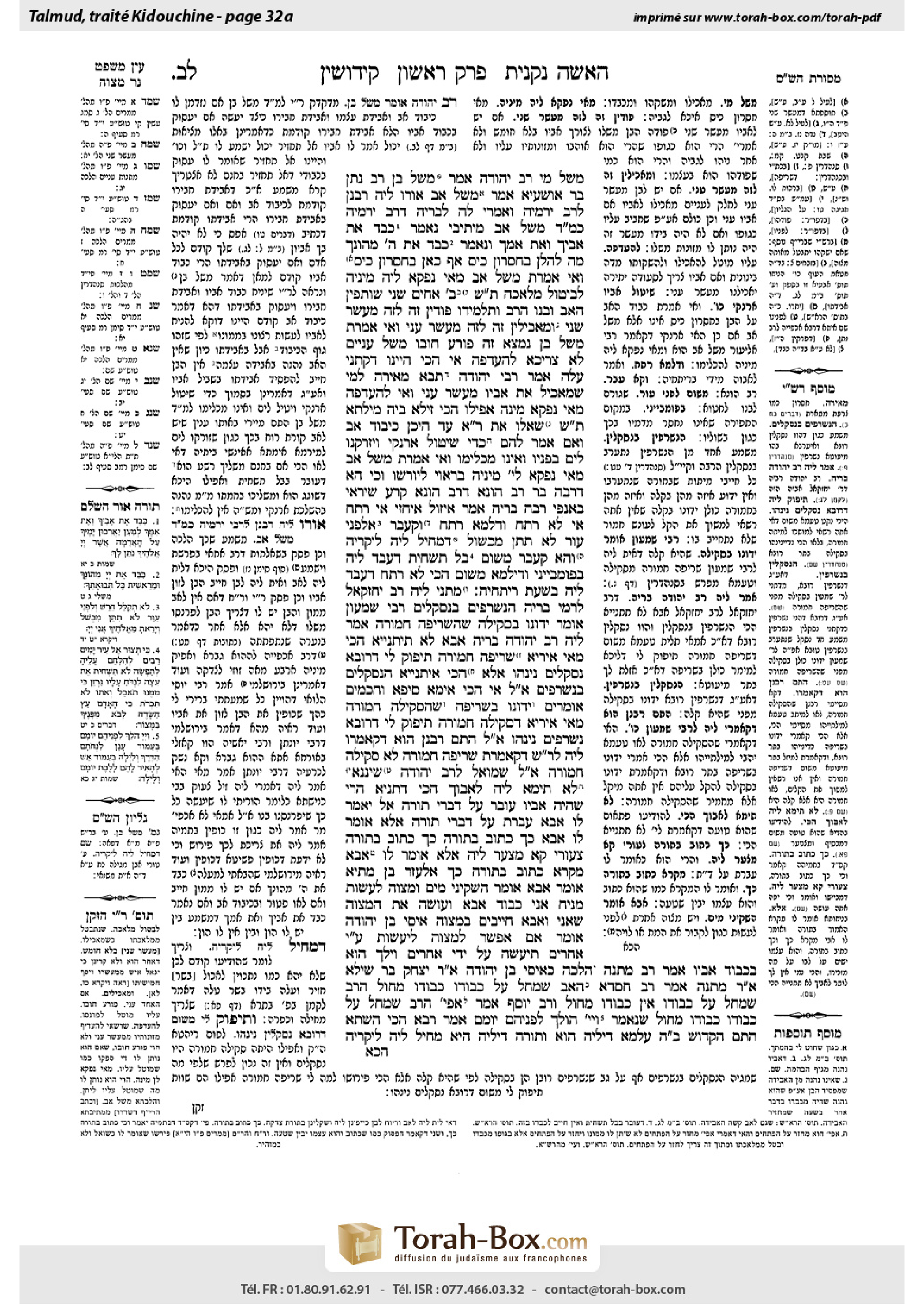
Kiddushin 32a: Talmud study for Daf Yomi
Daf Yomi is the daily study of one Talmud folio. Explore 37 tractates with scans, Hebrew text, Sefaria English and AI-generated French translations where annotated.
Passage selection and English or AI-generated French translation are available where the scan has annotations. Daf Study is independent of Torah-Box and Sefaria.
Browse Kiddushin · קידושין · All tractatesKiddushin 32a text and translations
This page of Kiddushin includes the Aramaic text, an English translation and an AI-generated French translation, alongside the scan above.
קידושין ל״ב א · Aramaic and Hebrew text
מִשֶּׁל מִי? רַב יְהוּדָה אָמַר: מִשֶּׁל בֵּן. רַב נָתָן בַּר אוֹשַׁעְיָא אָמַר: מִשֶּׁל אָב. אוֹרוֹ לֵיהּ רַבָּנַן לְרַב יִרְמְיָה, וְאָמְרִי לַהּ לִבְרֵיהּ דְּרַב יִרְמְיָה, כְּמַאן דְּאָמַר מִשֶּׁל אָב.
מֵיתִיבִי: נֶאֱמַר: ״כַּבֵּד אֶת אָבִיךָ וְאֶת אִמֶּךָ״, וְנֶאֱמַר: ״כַּבֵּד אֶת ה׳ מֵהוֹנֶךָ״. מָה לְהַלָּן בְּחֶסְרוֹן כִּיס, אַף כָּאן בְּחֶסְרוֹן כִּיס. וְאִי אָמְרַתְּ מִשֶּׁל אָב, מַאי נָפְקָא לֵיהּ מִינֵּיהּ? לְבִיטּוּל מְלָאכָה.
תָּא שְׁמַע: שְׁנֵי אַחִים, שְׁנֵי שׁוּתָּפִין הָאָב וּבְנוֹ, הָרַב וְתַלְמִידוֹ – פּוֹדִין זֶה לָזֶה מַעֲשֵׂר שֵׁנִי, וּמַאֲכִילִין זֶה לָזֶה מַעְשַׂר עָנִי.
וְאִי אָמְרַתְּ מִשֶּׁל בֵּן, נִמְצָא זֶה פּוֹרֵעַ חוֹבוֹ מִשֶּׁל עֲנִיִּים! – לָא צְרִיכָא, לְהַעְדָּפָה.
אִי הָכִי, הַיְינוּ דְּקָתָנֵי עֲלַהּ: אָמַר רַבִּי יְהוּדָה: תָּבֹא מְאֵירָה לְמִי שֶׁמַּאֲכִיל אֶת אָבִיו מַעְשַׂר עָנִי. וְאִי לְהַעְדָּפָה, מַאי נָפְקָא מִינַּהּ?! אֲפִילּוּ הָכִי זִילָא בֵּיהּ מִילְּתָא.
תָּא שְׁמַע: שָׁאֲלוּ אֶת רַבִּי אֱלִיעֶזֶר עַד הֵיכָן כִּיבּוּד אָב וָאֵם? אָמַר לָהֶם: כְּדֵי שֶׁיִּטּוֹל אַרְנָקִי וְיִזְרְקֶנּוּ לַיָּם בְּפָנָיו וְאֵינוֹ מַכְלִימוֹ. וְאִי אָמְרַתְּ מִשֶּׁל אָב, מַאי נָפְקָא לֵיהּ מִינֵּיהּ? בְּרָאוּי לְיוֹרְשׁוֹ.
וְכִי הָא דְּרַבָּה בַּר רַב הוּנָא. דְּרַב הוּנָא קְרַע שִׁירָאֵי בְּאַנְפֵּי רַבָּה בְּרֵיהּ. אָמַר: אֵיזִיל אִיחְזֵי אִי רָתַח אִי לָא רָתַח. וְדִלְמָא רָתַח וְקָעָבַר אַ״לִּפְנֵי עִוֵּר לֹא תִתֵּן מִכְשֹׁל״! דְּמָחֵיל לֵיהּ לִיקָרֵיהּ.
וְהָא קָעָבַר מִשּׁוּם ״בַּל תַּשְׁחִית״! דַּעֲבַד לֵיהּ בְּפוּמְבְּיָינֵי. וְדִילְמָא מִשּׁוּם הָכִי לָא רָתַח? דְּעָבֵד לֵיהּ בִּשְׁעַת רִיתְחֵיהּ.
מַתְנֵי לֵיהּ רַב יְחֶזְקֵאל לְרָמִי בְּרֵיהּ: הַנִּשְׂרָפִים בַּנִּסְקָלִים, רַבִּי שִׁמְעוֹן אוֹמֵר: יִדּוֹנוּ בִּסְקִילָה, שֶׁהַשְּׂרֵיפָה חֲמוּרָה.
אֲמַר לֵיהּ רַב יְהוּדָה בְּרֵיהּ: אַבָּא, לָא תַּיתְנְיֵיהּ הָכִי. מַאי אִירְיָא שְׂרֵיפָה חֲמוּרָה, תִּיפּוֹק לִי דְּרוּבָּא נִסְקָלִים נִינְהוּ! אֶלָּא הָכִי אַיתְנְיֵיהּ: הַנִּסְקָלִים בַּנִּשְׂרָפִים.
אֲמַר לֵיהּ: אִי הָכִי אֵימָא סֵיפָא: וַחֲכָמִים אוֹמְרִים יִדּוֹנוּ בִּשְׂרֵיפָה, שֶׁהַסְּקִילָה חֲמוּרָה. מַאי אִירְיָא דִּסְקִילָה חֲמוּרָה? תִּיפּוֹק לִי דְּרוּבָּא נִשְׂרָפִים נִינְהוּ!
אֲמַר לֵיהּ: הָתָם רַבָּנַן הוּא דְּקָאָמְרוּ לֵיהּ לְרַבִּי שִׁמְעוֹן: דְּקָאָמְרַתְּ שְׂרֵיפָה חֲמוּרָה – לָא, סְקִילָה חֲמוּרָה.
אֲמַר לֵיהּ שְׁמוּאֵל לְרַב יְהוּדָה: שִׁינָּנָא, לָא תֵּימָא לֵיהּ לַאֲבוּךְ הָכִי. דְּתַנְיָא: הֲרֵי שֶׁהָיָה אָבִיו עוֹבֵר עַל דִּבְרֵי תוֹרָה, אַל יֹאמַר לוֹ ״אַבָּא עָבַרְתָּ עַל דִּבְרֵי תוֹרָה״, אֶלָּא אוֹמֵר לוֹ: ״אַבָּא כָּךְ כָּתוּב בַּתּוֹרָה״. ״כָּךְ כָּתוּב בַּתּוֹרָה״ – צַעוֹרֵי קָא מְצַעַר לֵיהּ! אֶלָּא אוֹמֵר לוֹ: ״אַבָּא, מִקְרָא כָּתוּב בַּתּוֹרָה כָּךְ״.
אֶלְעָזָר בֶּן מַתְיָא אוֹמֵר: אַבָּא אוֹמֵר: ״הַשְׁקֵינִי מַיִם״, וּמִצְוָה לַעֲשׂוֹת – מַנִּיחַ אֲנִי כְּבוֹד אַבָּא, וְעוֹשֶׂה אֶת הַמִּצְוָה. שֶׁאֲנִי וְאַבָּא חַיָּיבִים בַּמִּצְוָה. אִיסִי בֶּן יְהוּדָה אוֹמֵר: אִם אֶפְשָׁר לַמִּצְוָה לֵיעָשׂוֹת עַל יְדֵי אֲחֵרִים – תֵּיעָשֶׂה עַל יְדֵי אֲחֵרִים, וְיֵלֵךְ הוּא בִּכְבוֹד אָבִיו. אָמַר רַב מַתְנָה: הֲלָכָה כְּאִיסִי בֶּן יְהוּדָה.
אָמַר רַב יִצְחָק בַּר שֵׁילָא אָמַר רַב מַתְנָה אָמַר רַב חִסְדָּא: הָאָב שֶׁמָּחַל עַל כְּבוֹדוֹ – כְּבוֹדוֹ מָחוּל. הָרַב שֶׁמָּחַל עַל כְּבוֹדוֹ – אֵין כְּבוֹדוֹ מָחוּל.
וְרַב יוֹסֵף אָמַר: אֲפִילּוּ הָרַב שֶׁמָּחַל עַל כְּבוֹדוֹ – כְּבוֹדוֹ מָחוּל. שֶׁנֶּאֱמַר: ״וַה׳ הֹלֵךְ לִפְנֵיהֶם יוֹמָם״. אָמַר רָבָא: הָכִי הַשְׁתָּא?! הָתָם, הַקָּדוֹשׁ בָּרוּךְ הוּא עָלְמָא דִּילֵיהּ הוּא, וְתוֹרָה דִּילֵיהּ הִיא – מָחֵיל לֵיהּ לִיקָרֵיהּ,
Kiddushin 32a · English translation
From whose funds must one give his father food and drink? Rav Yehuda says: From the money of the son. Rav Natan bar Oshaya said: From the money of the father. The Sages gave this following ruling to Rav Yirmeya, and some say they gave this following ruling to the son of Rav Yirmeya: The halakha is like the one who says it must be paid from the money of the father.
The Gemara raises an objection from the following baraita: It is stated: “Honor your father and your mother” (Exodus 20:11), and it is stated: “Honor the Lord with your wealth” (Proverbs 3:9), which teaches the following verbal analogy: Just as there one honors God “with your wealth,” i.e., through monetary loss, so too here one must honor his father through monetary loss. And if you say that one honors him from the money of the father, what difference does it make to the son, i.e., what monetary loss does he suffer? The Gemara answers: It makes a difference to him with regard to the neglect of his work. Although he is not required to spend his own money, the son must leave aside his work to honor his father, which will cause him some financial loss.
The Gemara suggests: Come and hear a proof from a baraita: Two brothers, or two partners in the ownership of produce, or a father and son, or a rabbi and his student, may redeem the second tithe for each other without adding one-fifth, as one who redeems the tithe of another, including these individuals, is not required to add one-fifth. And they may feed each other the poor man’s tithe. If one of them is poor, the other may give him the poor man’s tithe that he separated from his produce, and it is not considered as though the pauper ate the poor man’s tithe from his own produce.
The Gemara explains the proof from this baraita. And if you say that the obligation to honor one’s father is from the money of the son, one finds that this son repays his obligation from the produce of the poor, as he is taking care of his father with produce that should go to the poor. The Gemara rejects this proof: No, it is necessary to state this halakha in a case where he has covered all of his father’s basic needs with his own money. At this stage, if his father needs surplus money, he may give it to him from the poor man’s tithe.
The Gemara asks: If so, consider that which is taught with regard to this baraita. Rabbi Yehuda says: May a curse come upon one who feeds his father the poor man’s tithe. And if this halakha, that one may feed his father the poor man’s tithe, was said with regard to a surplus, what difference is there? Since the son has fulfilled his obligation and simply adds something so that his father will have more, why is this person cursed? The Gemara answers: Even so, it is a disrespectful matter for one to feed his father with money that has been designated as charity for the poor.
The Gemara further suggests: Come and hear: They asked Rabbi Eliezer how far one must go in honoring his father and mother. Rabbi Eliezer said to them: Such that the father takes a purse and throw it into the sea in front of his son, and the son does not embarrass him. And if you say that the son honors him from the money of the father, what difference does it make to the son? Why would the son care if his father throws away his own purse? The Gemara answers: This is referring to a son who is fit to inherit from him. Since the son thinks that the money will eventually belong to him, he has cause for anger.
And this is as reflected in an incident involving Rabba bar Rav Huna, when Rav Huna tore silk garments in front of his son Rabba. Rav Huna had said to himself: I will go and see if he becomes angry or does not become angry, i.e., he wanted to test him and see whether his son Rabba would honor him. The Gemara asks: But perhaps his son would become angry and Rav Huna would thereby violate the prohibition of: “Nor put a stumbling block before the blind” (Leviticus 19:14), as by testing his son Rav Huna would have caused him to sin. The Gemara answers: It was a case where the father had forgone his honor from the outset. Consequently, even if the son grew angry with him, he would not have violated the mitzva.
The Gemara asks: But by tearing his clothes, he violates the prohibition: Do not destroy (see Deuteronomy 20:19). The Gemara answers that Rav Huna made a tear at the seam, so that the garment could be repaired. The Gemara asks: Perhaps it was due to that reason that the son did not become angry, because he saw that his father caused no actual damage? The Gemara answers: He did this when the son was already angry for some other reason, so that he would not notice this detail.
The Gemara cites another story involving the mitzva of honoring one’s father and mother. Rav Yeḥezkel taught his son Rami: If people sentenced to be burned became mingled with those sentenced to be stoned Rabbi Shimon says: All of them are judged with the punishment of stoning, as the punishment of burning is more severe. Since the death penalty of each is uncertain, all of them are treated leniently.
Rav Yehuda, who was also Rav Yeḥezkel’s son, said to him: Father, do not teach the mishna this way, as, according to this version, why is this the halakha specifically because burning is more severe than stoning? Let him derive it from the fact that the majority are sentenced to be stoned. The wording of the baraita, which states that those who were supposed to be burned became mixed up with those who were to be stoned, indicates that the people sentenced to stoning are the majority. If so, one should simply follow the majority. Rather, I will teach it this way: If those who are sentenced to be stoned became mixed up with those who are sentenced to be burned, they are all judged with the punishment of stoning even though this is the minority, as they are all treated leniently.
Rav Yeḥezkel said to him: If so, say the latter clause of the mishna: And the Rabbis say that they should be judged with the punishment of burning, as the punishment of stoning is more severe. According to your version, why is this the halakha specifically because stoning is more severe? Let him derive it due to the fact that the majority of people are sentenced to be burned, and one follows the majority.
His son Rav Yehuda said to him: The statement of the Rabbis is not difficult, as there the Rabbis are saying to Rabbi Shimon as follows: That which you said, that burning is more severe, is not the case; rather, stoning is more severe. In other words, the Rabbis were specifically responding to Rabbi Shimon’s reasoning, and therefore they stated the opposite claim and ignored the issue of which group is in the majority.
Later, Shmuel said to Rav Yehuda: Big-toothed one, do not speak to your father like that, as it is disrespectful. As it is taught in a baraita: If one’s father was transgressing a Torah matter, he should not say to him explicitly: Father, you transgressed a Torah matter. Rather, he should say to him: Father, so it is written in the Torah. The Gemara asks: If he says to him directly: This is what is written in the Torah, he will cause him suffering. Rather, he should say to him: Father, this verse is written in the Torah, and he should proceed to quote the verse, from which his father will understand on his own that he has acted improperly.
§ Elazar ben Matya says: If my father says: Give me water, and there is a mitzva for me to perform at the same time, I set aside the honor of my father and perform the mitzva, as my father and I are both obligated in the mitzva. Isi ben Yehuda says: If it is possible for this mitzva to be performed by others, let it be performed by others, and he should go and attend to the honor due to his father, as the honor of his father is his obligation alone. Rav Mattana says: The halakha with regard to this matter is in accordance with the opinion of Isi ben Yehuda.
Rav Yitzḥak bar Sheila says that Rav Mattana says that Rav Ḥisda says: With regard to a father who forgoes his honor, his honor is forgone, and his son does not transgress if he does not treat him in the proper manner. By contrast, with regard to a rabbi who forgoes his honor, his honor is not forgone.
And Rav Yosef says: Even with regard to a rabbi who forgoes his honor, his honor is forgone, as it is stated: “And the Lord went before them by day” (Exodus 13:21). God Himself, the Teacher of the Jewish people, had forgone the honor due Him and took the trouble to guide the people. Rava said: How can these cases be compared? There, with regard to the Holy One, Blessed be He, the world is His and the Torah is His, and therefore He can forgo His honor.
Kiddushin 32a · Traduction française (IA)
Sur quels fonds doit-on payer la nourriture et les boissons de son père ? Rav Yehouda dit : avec l’argent du fils. Rav Natan bar Oshaya dit : avec l’argent du père. Les Sages rendirent cette décision à Rav Yirmeya — certains disent : au fils de Rav Yirmeya — : la halakha suit celui qui affirme que la dépense doit être prise sur l’argent du père.
La Guemara soulève une objection à partir de la baraïta suivante : il est dit : « Honore ton père et ta mère » (Exode 20, 11), et il est dit : « Honore l’Éternel avec tes biens » (Proverbes 3, 9). Cela établit une analogie verbale : de même que, dans le second verset, on honore Dieu « avec tes biens », c’est-à-dire au prix d’une perte financière, de même, ici, on doit honorer son père au prix d’une perte financière. Et si tu dis qu’on l’honore avec l’argent du père, quelle différence cela fait-il pour le fils, autrement dit, quelle perte financière subit-il ? La Guemara répond : il subit une perte du fait qu’il néglige son travail. Bien qu’il ne soit pas tenu de dépenser son propre argent, le fils doit délaisser son travail pour honorer son père, ce qui lui occasionne une certaine perte financière.
La Guemara propose : viens et entends une preuve tirée d’une baraïta : deux frères, deux associés propriétaires de produits agricoles, un père et son fils, ou un maître et son élève peuvent l’un pour l’autre racheter la seconde dîme sans ajouter un cinquième, car celui qui rachète la dîme d’autrui, y compris celle de ces personnes, n’est pas tenu d’ajouter un cinquième. Ils peuvent aussi se donner mutuellement la dîme du pauvre. Si l’un d’eux est pauvre, l’autre peut lui donner la dîme du pauvre qu’il a prélevée sur ses produits ; il n’est alors pas considéré que le nécessiteux a consommé la dîme du pauvre provenant de ses propres produits.
La Guemara explique la preuve tirée de cette baraïta. Si tu dis que l’obligation d’honorer son père est à la charge du fils, il s’ensuit que ce fils s’acquitte de son obligation avec les produits destinés aux pauvres, puisqu’il subvient aux besoins de son père avec des produits qui devraient revenir aux pauvres. La Guemara rejette cette preuve : non, cette halakha est nécessaire dans le cas où il a déjà couvert, avec son propre argent, tous les besoins essentiels de son père. À ce stade, si son père a besoin d’argent supplémentaire, il peut le lui donner à partir de la dîme du pauvre.
La Guemara demande : si c’est ainsi, considérons ce qui est enseigné à propos de cette baraïta. Rabbi Yehouda dit : « Que la malédiction s’abatte sur celui qui nourrit son père avec la dîme du pauvre. » Or, si cette halakha — selon laquelle on peut nourrir son père avec la dîme du pauvre — concerne un surplus, quelle différence cela fait-il ? Puisque le fils s’est acquitté de son obligation et ne fait qu’ajouter quelque chose pour que son père ait davantage, pourquoi cet homme est-il maudit ? La Guemara répond : malgré tout, il est irrespectueux de nourrir son père avec de l’argent destiné aux pauvres.
La Guemara propose encore : viens et entends : on demanda à Rabbi Eliezer jusqu’où va l’obligation d’honorer son père et sa mère. Rabbi Eliezer leur répondit : jusqu’à ce que le père prenne une bourse et la jette à la mer devant son fils, sans que celui-ci lui fasse honte. Et si tu dis que le fils l’honore avec l’argent du père, quelle différence cela fait-il pour le fils ? Pourquoi se soucierait-il que son père jette sa propre bourse ? La Guemara répond : il s’agit d’un fils qui est susceptible d’hériter de son père. Comme le fils pense que l’argent lui appartiendra finalement, il a de quoi se mettre en colère.
C’est ce qu’illustre l’incident de Rabba bar Rav Houna, lorsque Rav Houna déchira des vêtements de soie devant son fils Rabba. Rav Houna se dit : « Je vais voir s’il se met en colère ou non », c’est-à-dire qu’il voulait le mettre à l’épreuve pour voir si son fils Rabba l’honorerait. La Guemara demande : mais peut-être son fils se serait-il mis en colère et Rav Houna aurait ainsi transgressé l’interdit : « Ne place pas d’obstacle devant un aveugle » (Lévitique 19, 14), car en mettant son fils à l’épreuve, Rav Houna l’aurait amené à fauter. La Guemara répond : le père avait renoncé d’emblée à l’honneur qui lui était dû. Par conséquent, même si le fils s’était mis en colère contre lui, il n’aurait pas transgressé la mitsva.
La Guemara demande : mais, en déchirant ses vêtements, il transgresse l’interdit de détruire (voir Deutéronome 20, 19). La Guemara répond que Rav Houna fit une déchirure au niveau de la couture, de sorte que le vêtement puisse être réparé. La Guemara demande : peut-être son fils ne s’est-il pas mis en colère pour cette raison, parce qu’il voyait que son père ne causait aucun dommage réel ? La Guemara répond : Rav Houna fit cela alors que son fils était déjà en colère pour une autre raison, afin que celui-ci ne remarque pas ce détail.
La Guemara rapporte une autre histoire relative à la mitsva d’honorer son père et sa mère. Rav Yeḥezkel enseignait à son fils Rami : si des personnes condamnées à être brûlées se mêlent à des personnes condamnées à être lapidées, Rabbi Shimon dit : toutes sont jugées par la lapidation, car la peine de la brûlure est plus sévère. Puisque la peine de mort applicable à chacune est incertaine, on traite tout le monde avec indulgence.
Rav Yehouda, qui était lui aussi le fils de Rav Yeḥezkel, lui dit : « Père, n’enseigne pas la Michna de cette façon, car, selon cette version, pourquoi cette halakha s’explique-t-elle précisément par le fait que la brûlure est plus sévère que la lapidation ? Il suffit de la déduire du fait que la majorité est condamnée à la lapidation. La formulation de la baraïta, qui dit que ceux qui devaient être brûlés se sont mêlés à ceux qui devaient être lapidés, indique que les personnes condamnées à la lapidation constituent la majorité. Dans ce cas, il suffit de suivre la majorité. J’enseignerai plutôt ainsi : si des personnes condamnées à être lapidées se mêlent à des personnes condamnées à être brûlées, toutes sont jugées par la lapidation, bien qu’elles soient minoritaires, car on traite tout le monde avec indulgence. »
Rav Yeḥezkel lui dit : « Dans ce cas, explique la dernière clause de la Michna : les Sages disent qu’elles doivent être jugées par la brûlure, car la peine de la lapidation est plus sévère. Selon ta version, pourquoi cette halakha s’explique-t-elle précisément par le fait que la lapidation est plus sévère ? Il suffit de la déduire du fait que la majorité des personnes sont condamnées à être brûlées, et qu’on suit la majorité. »
Son fils Rav Yehouda lui dit : « La déclaration des Sages ne pose pas de difficulté, car, dans ce passage, les Sages répondent à Rabbi Shimon en disant : ce que tu as dit, à savoir que la brûlure est plus sévère, n’est pas exact ; c’est plutôt la lapidation qui est plus sévère. Autrement dit, les Sages répondaient spécifiquement au raisonnement de Rabbi Shimon ; c’est pourquoi ils ont avancé l’affirmation contraire et ignoré la question du groupe majoritaire. »
Plus tard, Shmuel dit à Rav Yehouda : « Grand-denté, ne parle pas ainsi à ton père, car c’est irrespectueux. » En effet, il est enseigné dans une baraïta : si son père transgresse une règle de la Torah, il ne doit pas lui dire explicitement : « Père, tu as transgressé une règle de la Torah. » Il doit plutôt lui dire : « Père, c’est ainsi que cela est écrit dans la Torah. » La Guemara demande : s’il lui dit directement : « C’est ce qui est écrit dans la Torah », il lui causera de la peine. Il doit plutôt lui dire : « Père, ce verset est écrit dans la Torah », puis citer le verset ; son père comprendra alors de lui-même qu’il a agi de manière inappropriée.
§ Elazar ben Matya dit : si mon père me dit : « Donne-moi de l’eau », alors qu’une mitsva m’incombe au même moment, je laisse de côté l’honneur dû à mon père et j’accomplis la mitsva, car mon père et moi sommes tous deux tenus de l’accomplir. Isi ben Yehouda dit : s’il est possible que d’autres accomplissent cette mitsva, qu’ils s’en chargent ; lui doit aller s’occuper de l’honneur dû à son père, car l’obligation d’honorer son père ne lui incombe qu’à lui. Rav Mattana dit : la halakha en cette matière suit l’opinion d’Isi ben Yehouda.
Rav Yitzḥak bar Sheila dit au nom de Rav Mattana, qui le dit au nom de Rav Ḥisda : lorsqu’un père renonce à l’honneur qui lui est dû, il y renonce effectivement, et son fils ne transgresse pas s’il ne le traite pas comme il convient. En revanche, lorsqu’un maître renonce à l’honneur qui lui est dû, il n’y renonce pas effectivement.
Et Rav Yosef dit : même lorsqu’un maître renonce à l’honneur qui lui est dû, il y renonce effectivement, comme il est dit : « L’Éternel marchait devant eux le jour » (Exode 13, 21). Dieu Lui-même, le Maître du peuple juif, avait renoncé à l’honneur qui Lui était dû et s’était donné la peine de guider le peuple. Rava dit : « Comment peut-on comparer ces cas ? Là, s’agissant du Saint, béni soit-Il, le monde Lui appartient et la Torah Lui appartient ; Il peut donc renoncer à Son honneur. »
Traduction française générée par IA à partir de l’édition anglaise de Sefaria. Vérifie toujours un passage avec le texte source.
Text from Sefaria: William Davidson Edition - Vocalized Aramaic (CC BY NC); William Davidson Edition - English (CC BY NC).