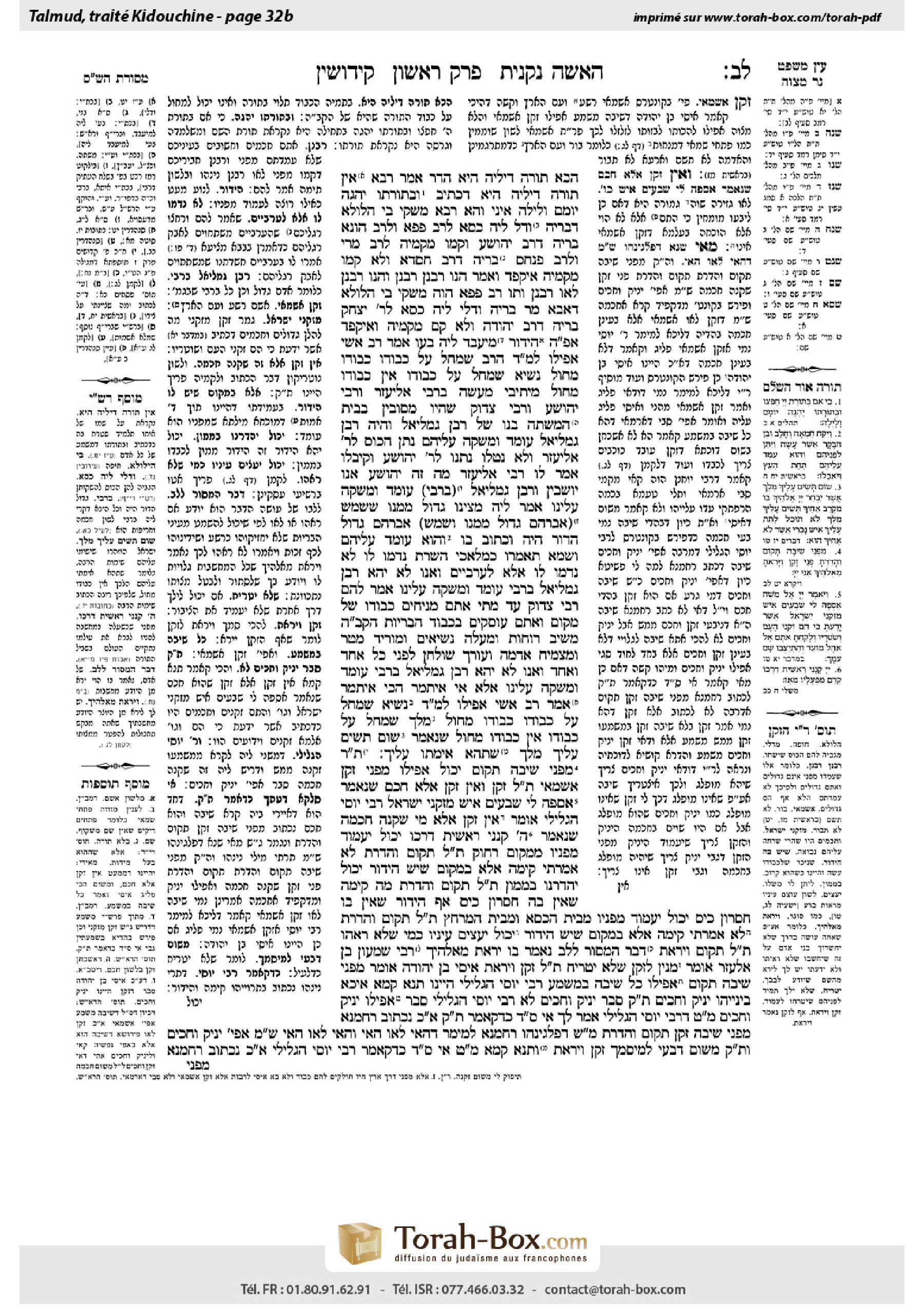
Kiddushin 32b: Talmud study for Daf Yomi
Daf Yomi is the daily study of one Talmud folio. Explore 37 tractates with scans, Hebrew text, Sefaria English and AI-generated French translations where annotated.
Passage selection and English or AI-generated French translation are available where the scan has annotations. Daf Study is independent of Torah-Box and Sefaria.
Browse Kiddushin · קידושין · All tractatesKiddushin 32b text and translations
This page of Kiddushin includes the Aramaic text, an English translation and an AI-generated French translation, alongside the scan above.
קידושין ל״ב ב · Aramaic and Hebrew text
הָכָא תּוֹרָה דִּילֵיהּ הִיא?! הֲדַר אָמַר רָבָא: אִין, תּוֹרָה דִּילֵיהּ הִיא, דִּכְתִיב: ״וּבְתוֹרָתוֹ יֶהְגֶּה יוֹמָם וָלָיְלָה״.
אִינִי?! וְהָא רָבָא מַשְׁקֵי בֵּי הִלּוּלָא דִּבְרֵיהּ וְדַל לֵיהּ כָּסָא לְרַב פָּפָּא וּלְרַב הוּנָא בְּרֵיהּ דְּרַב יְהוֹשֻׁעַ, וְקָמוּ מִקַּמֵּיהּ. לְרַב מָרִי וּלְרַב פִּנְחָס בְּרֵיהּ דְּרַב חִסְדָּא, וְלָא קָמוּ מִקַּמֵּיהּ. אִיקְּפַד וַאֲמַר: הָנוּ רַבָּנַן רַבָּנַן, וְהָנוּ רַבָּנַן לָאו רַבָּנַן?
וְתוּ, רַב פָּפָּא הֲוָה מַשְׁקֵי בֵּי הִלּוּלָא דְּאַבָּא מָר בְּרֵיהּ וְדַלִּי לֵיהּ כָּסָא לְרַבִּי יִצְחָק בְּרֵיהּ דְּרַב יְהוּדָה וְלָא קָם מִקַּמֵּיהּ וְאִיקְּפַד! אֲפִילּוּ הָכִי – הִידּוּר מֶיעְבַּד לֵיהּ בָּעוּ.
אָמַר רַב אָשֵׁי: אֲפִילּוּ לְמַאן דְּאָמַר: הָרַב שֶׁמָּחַל עַל כְּבוֹדוֹ – כְּבוֹדוֹ מָחוּל, נָשִׂיא שֶׁמָּחַל עַל כְּבוֹדוֹ – אֵין כְּבוֹדוֹ מָחוּל. מֵיתִיבִי: מַעֲשֶׂה בְּרַבִּי אֱלִיעֶזֶר וְרַבִּי יְהוֹשֻׁעַ וְרַבִּי צָדוֹק שֶׁהָיוּ מְסוּבִּין בְּבֵית הַמִּשְׁתֶּה בְּנוֹ שֶׁל רַבָּן גַּמְלִיאֵל, וְהָיָה רַבָּן גַּמְלִיאֵל עוֹמֵד וּמַשְׁקֶה עֲלֵיהֶם. נָתַן הַכּוֹס לְרַבִּי אֱלִיעֶזֶר וְלֹא נְטָלוֹ, נְתָנוֹ לְרַבִּי יְהוֹשֻׁעַ וְקִיבְּלוֹ. אָמַר לוֹ רַבִּי אֱלִיעֶזֶר: מָה זֶה יְהוֹשֻׁעַ? אָנוּ יוֹשְׁבִין וְרַבָּן גַּמְלִיאֵל בְּרִיבִּי עוֹמֵד וּמַשְׁקֶה עָלֵינוּ?!
אֲמַר לֵיהּ: מָצִינוּ גָּדוֹל מִמֶּנּוּ שֶׁשִּׁמֵּשׁ, אַבְרָהָם גָּדוֹל מִמֶּנּוּ – וְשִׁמֵּשׁ. אַבְרָהָם גְּדוֹל הַדּוֹר הָיָה, וְכָתוּב בּוֹ: ״וְהוּא עֹמֵד עֲלֵיהֶם״. וְשֶׁמָּא תֹּאמְרוּ: כְּמַלְאֲכֵי הַשָּׁרֵת נִדְמוּ לוֹ – לֹא נִדְמוּ לוֹ אֶלָּא לְעַרְבִיִּים. וְאָנוּ, לֹא יְהֵא רַבָּן גַּמְלִיאֵל בְּרִיבִּי עוֹמֵד וּמַשְׁקֶה עָלֵינוּ?!
אָמַר לָהֶם רַבִּי צָדוֹק: עַד מָתַי אַתֶּם מַנִּיחִים כְּבוֹדוֹ שֶׁל מָקוֹם וְאַתֶּם עוֹסְקִים בִּכְבוֹד הַבְּרִיּוֹת? הַקָּדוֹשׁ בָּרוּךְ הוּא מֵשִׁיב רוּחוֹת, וּמַעֲלֶה נְשִׂיאִים, וּמוֹרִיד מָטָר, וּמַצְמִיחַ אֲדָמָה, וְעוֹרֵךְ שׁוּלְחָן לִפְנֵי כׇּל אֶחָד וְאֶחָד, וְאָנוּ לֹא יְהֵא רַבָּן גַּמְלִיאֵל בְּרִיבִּי עוֹמֵד וּמַשְׁקֶה עָלֵינוּ?
אֶלָּא אִי אִיתְּמַר הָכִי אִיתְּמַר, אָמַר רַב אָשֵׁי: אֲפִילּוּ לְמַאן דְּאָמַר: נָשִׂיא שֶׁמָּחַל עַל כְּבוֹדוֹ – כְּבוֹדוֹ מָחוּל, מֶלֶךְ שֶׁמָּחַל עַל כְּבוֹדוֹ – אֵין כְּבוֹדוֹ מָחוּל, שֶׁנֶּאֱמַר: ״שׂוֹם תָּשִׂים עָלֶיךָ מֶלֶךְ״ – שֶׁתְּהֵא אֵימָתוֹ עָלֶיךָ.
תָּנוּ רַבָּנַן: ״מִפְּנֵי שֵׂיבָה תָּקוּם״ – יָכוֹל אֲפִילּוּ מִפְּנֵי זָקֵן אַשְׁמַאי? תַּלְמוּד לוֹמַר: ״זָקֵן״, וְאֵין זָקֵן אֶלָּא חָכָם, שֶׁנֶּאֱמַר: ״אֶסְפָה לִּי שִׁבְעִים אִישׁ מִזִּקְנֵי יִשְׂרָאֵל״. רַבִּי יוֹסֵי הַגְּלִילִי אוֹמֵר: אֵין זָקֵן אֶלָּא מִי שֶׁקָּנָה חׇכְמָה, שֶׁנֶּאֱמַר: ״ה׳ קָנָנִי רֵאשִׁית דַּרְכּוֹ״.
יָכוֹל יַעֲמוֹד מִפָּנָיו מִמָּקוֹם רָחוֹק? תַּלְמוּד לוֹמַר: ״תָּקוּם וְהָדַרְתָּ״ – לֹא אָמַרְתִּי קִימָה אֶלָּא בִּמְקוֹם שֶׁיֵּשׁ הִידּוּר.
יָכוֹל יְהַדְּרֶנּוּ בְּמָמוֹן? תַּלְמוּד לוֹמַר: ״תָּקוּם וְהָדַרְתָּ״ – מָה קִימָה שֶׁאֵין בָּהּ חֶסְרוֹן כִּיס, אַף הִידּוּר שֶׁאֵין בּוֹ חֶסְרוֹן כִּיס. יָכוֹל יַעֲמוֹד מִפָּנָיו מִבֵּית הַכִּסֵּא וּמִבֵּית הַמֶּרְחָץ? תַּלְמוּד לוֹמַר: ״תָּקוּם וְהָדַרְתָּ״ – לֹא אָמַרְתִּי קִימָה אֶלָּא בִּמְקוֹם שֶׁיֵּשׁ הִידּוּר.
יָכוֹל יַעֲצִים עֵינָיו כְּמִי שֶׁלֹּא רָאָהוּ? תַּלְמוּד לוֹמַר: ״תָּקוּם... וְיָרֵאתָ״ – דָּבָר הַמָּסוּר לַלֵּב נֶאֱמַר בּוֹ: ״וְיָרֵאתָ מֵאֱלֹהֶיךָ״.
רַבִּי שִׁמְעוֹן בֶּן אֶלְעָזָר אוֹמֵר: מִנַּיִן לְזָקֵן שֶׁלֹּא יַטְרִיחַ? תַּלְמוּד לוֹמַר: ״זָקֵן וְיָרֵאתָ״. אִיסִי בֶּן יְהוּדָה אוֹמֵר: ״מִפְּנֵי שֵׂיבָה תָּקוּם״ – אֲפִילּוּ כׇּל שֵׂיבָה בַּמַּשְׁמָע.
רַבִּי יוֹסֵי הַגְּלִילִי הַיְינוּ תַּנָּא קַמָּא? אִיכָּא בֵּינַיְיהוּ יַנִּיק וְחַכִּים. תַּנָּא קַמָּא סָבַר: יַנִּיק וְחַכִּים – לָא, רַבִּי יוֹסֵי הַגְּלִילִי סָבַר: אֲפִילּוּ יַנִּיק וְחַכִּים.
מַאי טַעְמָא דְּרַבִּי יוֹסֵי הַגְּלִילִי? אָמַר לָךְ: אִי סָלְקָא דַעְתָּךְ כִּדְקָאָמַר תַּנָּא קַמָּא – אִם כֵּן נִכְתּוֹב רַחֲמָנָא: ״מִפְּנֵי שֵׂיבָה זָקֵן תָּקוּם וְהָדַרְתָּ״, מַאי שְׁנָא דְּפַלְגִינְהוּ רַחֲמָנָא – לְמֵימַר: דְּהַאי לָאו הַאי, וְהַאי לָאו הַאי. שְׁמַע מִינַּהּ אֲפִילּוּ יַנִּיק וְחַכִּים.
וְתַנָּא קַמָּא, מִשּׁוּם דְּבָעֵי לְמִיסְמַךְ ״זָקֵן״ ״וְיָרֵאתָ״. וְתַנָּא קַמָּא מַאי טַעְמָא? אִי סָלְקָא דַעְתָּךְ כִּדְקָאָמַר רַבִּי יוֹסֵי הַגְּלִילִי – אִם כֵּן נִכְתּוֹב רַחֲמָנָא:
Kiddushin 32b · English translation
By contrast, here, is it his Torah, that the teacher can forgo its honor? Rava then said: Yes, if he studies, it is his Torah, as it is written: “For his delight is the Torah of the Lord, and in his Torah he meditates day and night” (Psalms 1:2). This indicates that at first it is “the Torah of the Lord,” but after he studies, it becomes “his Torah.”
The Gemara asks: Is that so? But Rava served drinks to the guests at his son’s wedding celebration, and he poured a cup for Rav Pappa and Rav Huna, son of Rav Yehoshua, and they stood before him when he approached them. When he poured a cup for Rav Mari and for Rav Pineḥas, son of Rav Ḥisda, they did not stand before him. Rava became angry and said: Are these Sages, i.e., Rav Mari and Rav Pineḥas, Sages, and are those Sages, who stood to honor me, not Sages? Do you think you are so great that you are not required to honor a Sage?
And furthermore, it happened that Rav Pappa was serving drinks to the guests at the wedding celebration [hillula] of Abba Mar, his son, and he poured a cup for Rav Yitzḥak, son of Rav Yehuda, and he did not stand before him, and Rav Pappa became angry. These anecdotes indicate that even when a rabbi forgoes the honor due to him by serving drinks to his guests, his honor is not forgone. The Gemara answers: A rabbi can forgo the full measure of honor due to him, but even so, others are required to perform some act of reverence, such as preparing to stand before him.
Rav Ashi said: Even according to the one who says that if a rabbi forgoes the honor due him, his honor is forgone, if a Nasi forgoes the honor due him, his honor is not forgone. The Gemara raises an objection: There was an incident involving Rabbi Eliezer and Rabbi Yehoshua and Rabbi Tzadok, who were reclining at the wedding of Rabban Gamliel’s son. And Rabban Gamliel, who was Nasi of the Sanhedrin at the time, was standing over them and serving them drinks. He gave the cup to Rabbi Eliezer and he would not accept it; he gave it to Rabbi Yehoshua and he accepted it. Rabbi Eliezer said to him: What is this, Yehoshua? We sit and the esteemed Rabban Gamliel stands over us and serves us drinks?
Rabbi Yehoshua said to him: We found one greater than him who served his guests, as our forefather Abraham was greater than him and he served his guests. Abraham was the greatest man of his generation and it is written about him: “And he stood over them under the tree, and they ate” (Genesis 18:8). And lest you say: His guests appeared to him as ministering angels, and that is why he honored them, in fact they appeared to him only as Arabs. And if so, should not the esteemed Rabban Gamliel stand over us and serve us drinks?
Rabbi Tzadok said to them: For how long will you ignore the honor due to the Omnipresent, and deal with the honor of people? You could cite a proof from God Himself. After all, the Holy One, Blessed be He, makes the winds blow, and raises the clouds, and brings the rain, and causes the earth to sprout, and sets a table before each and every creature. And should not the esteemed Rabban Gamliel stand over us and serve us drinks? This discussion indicates that even a Nasi may forgo the honor due him.
Rather, if it was stated, it was stated as follows: Rav Ashi said: Even according to the one who says that if a Nasi forgoes the honor due him, his honor is forgone, if a king forgoes the honor due him, his honor is not forgone. As it is stated: “You shall set a king over you” (Deuteronomy 17:15), which indicates that his fear should be upon you. The people are commanded to fear a king, and therefore it is not permitted for him to forgo the honor due to him.
§ The Sages taught with regard to the verse: “Before the hoary head you shall stand and you shall revere the face of an elder, and you shall fear your God” (Leviticus 19:32): One might have thought that it is obligatory to stand before a simple [ashmai] elder. Therefore, the verse states: “elder,” and an “elder” means nothing other than a wise man, as it is stated: “Gather unto Me seventy men of the Elders of Israel, whom you know to be the Elders of the people” (Numbers 11:16). Rabbi Yosei HaGelili says: An “elder [zaken]” means nothing other than one who has acquired wisdom. He interprets the word zaken as a contraction of the phrase zeh kanna, meaning: This one has acquired. Elsewhere the word kanna is used in reference to wisdom, as it is stated that wisdom says: “The Lord acquired me [kanani] at the beginning of His way” (Proverbs 8:22).
The baraita continues: One might have thought that one must stand before an elder as soon as he sees him, even from a distance. Therefore the verse states: “You shall stand and you shall revere” (Leviticus 19:32), which teaches: I said that one is obligated to stand only in a place where there is reverence. If he stands while the elder is still far away, it is not clear that he is doing so in his honor.
The baraita continues: One might have thought that he should revere him through money, i.e., that one is required to give an elder money in his honor. Therefore, the verse states: “You shall stand and you shall revere.” Just as standing includes no monetary loss, so too, reverence is referring to an action that includes no monetary loss. One might have thought that one should also stand before him in the lavatory or in the bathhouse. Therefore, the verse states: “You shall stand and you shall revere,” which indicates: I said the mitzva of standing only in a place where there is reverence. It is inappropriate to show respect for someone in places of this kind.
The baraita continues: One might have thought that one may close his eyes like one who does not see the elder. Therefore, the verse states: “Before the hoary head you shall stand and you shall revere the face of an elder, and you shall fear your God” (Leviticus 19:32). With regard to any matter given over to the heart, it is stated: “And you shall fear your God.” This phrase is referring to a situation where it is impossible to prove whether one purposefully made it appear as if he were not aware that he was obligated to perform a mitzva, as only that individual and God know the truth.
The baraita continues: Rabbi Shimon ben Elazar says: From where is it derived that an elder should not trouble others to honor him? The verse states: “And you shall revere the face of an elder, and you shall fear your God.” The phrase “an elder, and you shall fear,” read by itself, without the rest of the verse, indicates that an elder is also commanded to fear God, and not purposefully act in a manner to cause others to have to honor him. In conclusion, the baraita cites another opinion. Isi ben Yehuda says that the verse: “Before the hoary head you shall stand,” indicates that even any person of hoary head is included in this mitzva, not only a Sage.
The Gemara analyzes this baraita. Apparently the opinion of Rabbi Yosei HaGelili is the same as that of the first tanna, as they both say that an elder is a Torah scholar. What does Rabbi Yosei HaGelili add? The Gemara answers: There is a difference between them with regard to one who is young and wise. The first tanna maintains: One who is young and wise is not considered an elder, as the mitzva applies only to one who is both elderly and wise. Rabbi Yosei HaGelili maintains: It is even a mitzva to honor one who is young and wise. According to Rabbi Yosei HaGelili, the mitzva is not referring to old age at all, but only to wisdom.
The Gemara asks: What is the reasoning of Rabbi Yosei HaGelili? He could have said to you that if it enters your mind to explain as the first tanna says, that for the obligation to honor another to be in effect that person must be both elderly and wise, if so, let the Merciful One write: Before the hoary head of an elder you shall stand and you shall revere. What is the difference between the two terms “hoary head” and “elder,” that the Merciful One separates them? This serves to say that this term is not the same as that one, and that term is not the same as this one, i.e., an elder is not required to have a hoary head. Learn from the verse that even one who is young and wise is called an elder.
And the first tanna would say that the verse is written this way because the Torah wants to juxtapose “elder” with “and you shall fear,” in accordance with Rabbi Shimon ben Elazar’s statement above that an elder should not trouble others to honor him. The Gemara asks: And what is the reasoning of the first tanna? Why does he maintain that one is obligated to stand only before an elder, wise man? The Gemara answers: The first tanna maintains that if it enters your mind to explain as Rabbi Yosei HaGelili says, let the Merciful One write:
Kiddushin 32b · Traduction française (IA)
À l’inverse, ici, est-ce sa Torah, pour que le maître puisse renoncer à l’honneur qui lui est dû ? Rava dit alors : Oui, s’il étudie, elle devient sa Torah, comme il est écrit : « Mais son plaisir est dans la Torah du Seigneur, et il médite sa Torah jour et nuit » (Psaumes 1, 2). Cela indique qu’au début, c’est « la Torah du Seigneur », mais qu’après l’avoir étudiée, elle devient « sa Torah ».
La Guemara demande : En est-il vraiment ainsi ? Pourtant, Rava servit à boire aux invités lors du banquet de mariage de son fils. Il versa une coupe à Rav Pappa et à Rav Huna, fils de Rav Yehoshua, et ils se levèrent devant lui lorsqu’il s’approcha d’eux. Mais lorsqu’il versa une coupe à Rav Mari et à Rav Pineḥas, fils de Rav Ḥisda, ceux-ci ne se levèrent pas devant lui. Rava se mit en colère et dit : Rav Mari et Rav Pineḥas sont-ils des Sages, tandis que ceux qui se sont levés pour m’honorer ne seraient pas des Sages ? Vous croyez-vous donc si grands que vous ne soyez pas tenus d’honorer un Sage ?
De plus, Rav Pappa servait à boire aux invités lors du banquet de mariage [hillula] d’Abba Mar, son fils. Il versa une coupe à Rav Yitzḥak, fils de Rav Yehuda, qui ne se leva pas devant lui, et Rav Pappa se mit en colère. Ces anecdotes indiquent que même lorsqu’un rabbin renonce à l’honneur qui lui est dû en servant à boire à ses invités, cet honneur n’est pas pour autant abandonné. La Guemara répond : Un rabbin peut renoncer à la pleine mesure de l’honneur qui lui est dû ; néanmoins, les autres doivent accomplir un certain geste de révérence, par exemple se préparer à se lever devant lui.
Rav Ashi dit : Même selon celui qui affirme qu’un rabbin qui renonce à l’honneur qui lui est dû y renonce effectivement, si un nassi renonce à l’honneur qui lui est dû, cet honneur n’est pas abandonné. La Guemara soulève une objection : Un épisode eut lieu avec Rabbi Eliezer, Rabbi Yehoshua et Rabbi Tzadok, qui étaient accoudés lors du mariage du fils de Rabban Gamliel. Rabban Gamliel, qui était alors le nassi du Sanhédrin, se tenait auprès d’eux et les servait à boire. Il tendit la coupe à Rabbi Eliezer, qui refusa de la prendre ; il la tendit à Rabbi Yehoshua, qui l’accepta. Rabbi Eliezer lui dit : Qu’est-ce que cela, Yehoshua ? Nous sommes assis tandis que l’éminent Rabban Gamliel se tient auprès de nous et nous sert à boire !
Rabbi Yehoshua lui dit : Nous en avons trouvé un plus grand que lui qui servait ses invités : notre ancêtre Abraham, qui était plus grand que lui et servait ses invités. Abraham était le plus grand homme de sa génération, et il est écrit à son sujet : « Il se tenait auprès d’eux sous l’arbre, et ils mangèrent » (Genèse 18, 8). Et si tu dis que ses invités lui apparurent comme des anges de service, et que c’est pour cela qu’il les honora, en réalité, ils ne lui apparurent que comme des Arabes. Dès lors, l’éminent Rabban Gamliel ne doit-il pas se tenir auprès de nous et nous servir à boire ?
Rabbi Tzadok leur dit : Jusqu’à quand négligerez-vous l’honneur dû au Tout-Puissant pour vous occuper de l’honneur des hommes ? Vous pourriez prendre Dieu Lui-même comme preuve. En effet, le Saint, béni soit-Il, fait souffler les vents, fait monter les nuages, apporte la pluie, fait germer la terre et dresse une table devant chacune des créatures. Rabban Gamliel, l’éminent, ne doit-il donc pas se tenir auprès de nous et nous servir à boire ? Cette discussion indique qu’un nassi peut lui aussi renoncer à l’honneur qui lui est dû.
Il faut plutôt comprendre que, si cette déclaration a été formulée, elle l’a été ainsi : Rav Ashi dit : Même selon celui qui affirme qu’un nassi qui renonce à l’honneur qui lui est dû y renonce effectivement, si un roi renonce à l’honneur qui lui est dû, cet honneur n’est pas abandonné. Car il est dit : « Tu établiras un roi sur toi » (Deutéronome 17, 15), ce qui indique que la crainte qu’il inspire doit peser sur toi. Le peuple a l’obligation de craindre le roi ; il ne lui est donc pas permis de renoncer à l’honneur qui lui est dû.
§ Les Sages ont enseigné au sujet du verset : « Tu te lèveras devant la tête chenue, tu révéreras la personne d’un ancien, et tu craindras ton Dieu » (Lévitique 19, 32) : On aurait pu penser qu’il est obligatoire de se lever devant un simple ancien [ashmai]. Le verset dit donc : « ancien », et un « ancien » n’est autre qu’un sage, comme il est dit : « Rassemble auprès de Moi soixante-dix hommes parmi les anciens d’Israël, que tu sais être les anciens du peuple » (Nombres 11, 16). Rabbi Yosei HaGelili dit : Un « ancien [zaken] » n’est autre qu’une personne qui a acquis la sagesse. Il interprète le mot zaken comme une contraction de l’expression zeh kanna, qui signifie : celui-ci a acquis. Ailleurs, le mot kanna est employé à propos de la sagesse, comme il est dit que la sagesse déclare : « Le Seigneur m’a acquise [kanani] au commencement de Sa voie » (Proverbes 8, 22).
La baraïta poursuit : On aurait pu penser qu’il faut se lever devant un ancien dès qu’on le voit, même de loin. Le verset dit donc : « Tu te lèveras et tu révéreras » (Lévitique 19, 32), ce qui enseigne : J’ai dit qu’on est tenu de se lever uniquement dans un endroit où il y a lieu de témoigner de la révérence. Si l’on se lève alors que l’ancien est encore loin, il n’est pas évident qu’on le fasse en son honneur.
La baraïta poursuit : On aurait pu penser qu’il faut le révérer en lui donnant de l’argent, c’est-à-dire qu’on est tenu de donner de l’argent à un ancien en son honneur. Le verset dit donc : « Tu te lèveras et tu révéreras. » De même que le fait de se lever n’entraîne aucune perte d’argent, de même la révérence désigne une action qui n’entraîne aucune perte d’argent. On aurait pu penser qu’il faut également se lever devant lui dans les toilettes ou dans les bains. Le verset dit donc : « Tu te lèveras et tu révéreras », ce qui indique : J’ai dit que la mitsva de se lever ne s’applique que dans un endroit où il y a lieu de témoigner de la révérence. Il est déplacé de témoigner du respect à quelqu’un dans de tels endroits.
La baraïta poursuit : On aurait pu penser qu’on peut fermer les yeux, comme quelqu’un qui ne voit pas l’ancien. Le verset dit donc : « Tu te lèveras devant la tête chenue, tu révéreras la personne d’un ancien, et tu craindras ton Dieu » (Lévitique 19, 32). Pour toute question qui relève du cœur, il est dit : « Et tu craindras ton Dieu. » Cette formule vise une situation où il est impossible de prouver qu’une personne a délibérément donné l’impression de ne pas savoir qu’elle était tenue d’accomplir une mitsva, car seuls cette personne et Dieu connaissent la vérité.
La baraïta poursuit : Rabbi Shimon ben Elazar dit : D’où déduit-on qu’un ancien ne doit pas imposer aux autres la charge de l’honorer ? Le verset dit : « Tu révéreras la personne d’un ancien, et tu craindras ton Dieu. » Les mots « un ancien, et tu craindras », lus isolément, sans le reste du verset, indiquent qu’un ancien a lui aussi l’obligation de craindre Dieu et de ne pas agir délibérément de manière à obliger les autres à l’honorer. En conclusion, la baraïta cite une autre opinion. Isi ben Yehuda dit que les mots du verset « Tu te lèveras devant la tête chenue » indiquent que toute personne aux cheveux blancs est incluse dans cette mitsva, et pas seulement un Sage.
La Guemara analyse cette baraïta. Apparemment, l’opinion de Rabbi Yosei HaGelili est identique à celle du premier tanna, puisqu’ils disent tous deux qu’un ancien est un érudit en Torah. Qu’ajoute Rabbi Yosei HaGelili ? La Guemara répond : Ils diffèrent au sujet d’un homme jeune et sage. Le premier tanna estime qu’un homme jeune et sage n’est pas considéré comme un ancien, car la mitsva ne s’applique qu’à celui qui est à la fois âgé et sage. Rabbi Yosei HaGelili estime qu’il y a également une mitsva d’honorer celui qui est jeune et sage. Selon Rabbi Yosei HaGelili, la mitsva ne concerne pas du tout le grand âge, mais uniquement la sagesse.
La Guemara demande : Quel est le raisonnement de Rabbi Yosei HaGelili ? Il aurait pu te dire que, si l’on envisage d’expliquer le verset comme le fait le premier tanna, à savoir que, pour être tenu d’honorer quelqu’un, celui-ci doit être à la fois âgé et sage, alors le Miséricordieux aurait dû écrire : « Tu te lèveras devant la tête chenue d’un ancien et tu révéreras. » Quelle différence y a-t-il entre les deux expressions, « tête chenue » et « ancien », pour que le Miséricordieux les distingue ? Cela enseigne que ces expressions ne sont pas équivalentes : l’une n’est pas l’autre et l’autre n’est pas l’une, c’est-à-dire qu’un ancien n’a pas besoin d’avoir les cheveux blancs. Déduis donc du verset que même quelqu’un de jeune et de sage est appelé un ancien.
Et le premier tanna dirait que le verset est formulé ainsi parce que la Torah veut rapprocher le terme « ancien » de l’expression « et tu craindras », conformément à la déclaration de Rabbi Shimon ben Elazar rapportée plus haut, selon laquelle un ancien ne doit pas imposer aux autres la charge de l’honorer. La Guemara demande : Et quel est le raisonnement du premier tanna ? Pourquoi estime-t-il qu’on est tenu de se lever uniquement devant un ancien, c’est-à-dire un sage ? La Guemara répond : Le premier tanna estime que, si l’on envisage d’expliquer le verset comme le dit Rabbi Yosei HaGelili, alors le Miséricordieux devrait écrire :
Traduction française générée par IA à partir de l’édition anglaise de Sefaria. Vérifie toujours un passage avec le texte source.
Text from Sefaria: William Davidson Edition - Vocalized Aramaic (CC BY NC); William Davidson Edition - English (CC BY NC).