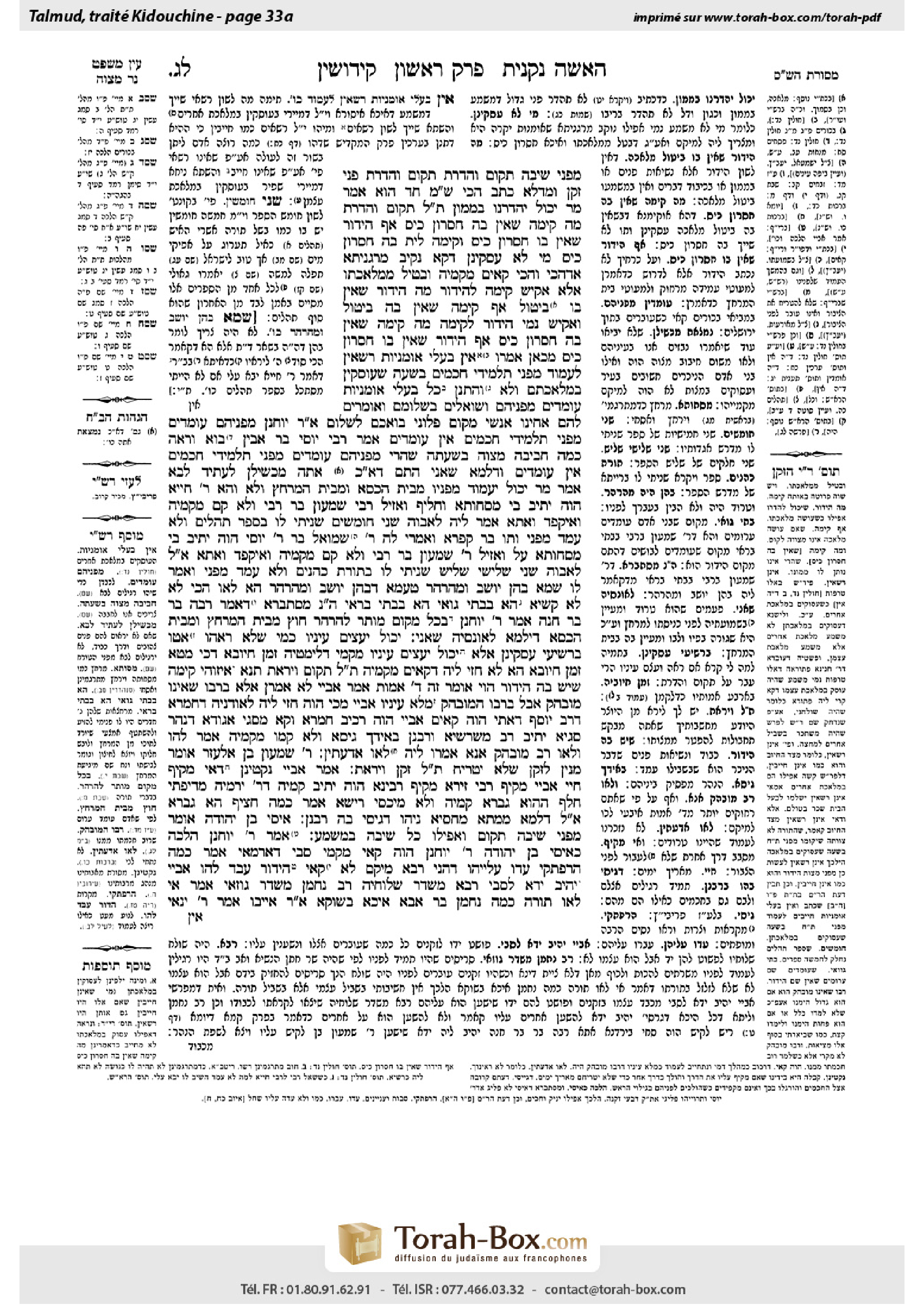
Kiddushin 33a: Talmud study for Daf Yomi
Daf Yomi is the daily study of one Talmud folio. Explore 37 tractates with scans, Hebrew text, Sefaria English and AI-generated French translations where annotated.
Passage selection and English or AI-generated French translation are available where the scan has annotations. Daf Study is independent of Torah-Box and Sefaria.
Browse Kiddushin · קידושין · All tractatesKiddushin 33a text and translations
This page of Kiddushin includes the Aramaic text, an English translation and an AI-generated French translation, alongside the scan above.
קידושין ל״ג א · Aramaic and Hebrew text
״מִפְּנֵי שֵׂיבָה תָּקוּם וְהָדַרְתָּ, תָּקוּם וְהָדַרְתָּ פְּנֵי זָקֵן״ וּמִדְּלָא כְּתַב הָכִי, שְׁמַע מִינַּהּ חַד הוּא.
אָמַר מָר: יָכוֹל יְהַדְּרֶנּוּ בְּמָמוֹן? תַּלְמוּד לוֹמַר: ״תָּקוּם וְהָדַרְתָּ״ – מָה קִימָה שֶׁאֵין בָּהּ חֶסְרוֹן כִּיס – אַף הִידּוּר שֶׁאֵין בּוֹ חֶסְרוֹן כִּיס. וְקִימָה לֵית בַּהּ חֶסְרוֹן כִּיס? מִי לָא עָסְקִינַן דְּקָא נָקֵיב מַרְגָּנִיתָא, אַדְּהָכִי וְהָכִי קָאֵים מִקַּמֵּיהּ וּבָטֵיל מִמְּלַאכְתּוֹ!
אֶלָּא: אַקֵּישׁ קִימָה לְהִידּוּר. מָה הִידּוּר שֶׁאֵין בּוֹ בִּיטּוּל – אַף קִימָה שֶׁאֵין בָּהּ בִּיטּוּל. וְאַקֵּישׁ נָמֵי הִידּוּר לְקִימָה, מָה קִימָה שֶׁאֵין בָּהּ חֶסְרוֹן כִּיס – אַף הִידּוּר שֶׁאֵין בּוֹ חֶסְרוֹן כִּיס. מִכָּאן אָמְרוּ: אֵין בַּעֲלֵי אוּמָּנִיּוֹת רַשָּׁאִין לַעֲמוֹד מִפְּנֵי תַּלְמִידֵי חֲכָמִים בְּשָׁעָה שֶׁעוֹסְקִין בִּמְלַאכְתָּם.
וְלָא? וְהָתְנַן: כׇּל בַּעֲלֵי אוּמָּנִיּוֹת עוֹמְדִים מִפְּנֵיהֶם, וְשׁוֹאֲלִים בִּשְׁלוֹמָם, וְאוֹמְרִים לָהֶם: אַחֵינוּ אַנְשֵׁי מָקוֹם פְּלוֹנִי בּוֹאֲכֶם לְשָׁלוֹם! אָמַר רַבִּי יוֹחָנָן: מִפְּנֵיהֶם עוֹמְדִים, מִפְּנֵי תַּלְמִידֵי חֲכָמִים אֵין עוֹמְדִים.
אָמַר רַבִּי יוֹסֵי בַּר אָבִין: בּוֹא וּרְאֵה כַּמָּה חֲבִיבָה מִצְוָה בִּשְׁעָתָהּ, שֶׁהֲרֵי מִפְּנֵיהֶם עוֹמְדִים, מִפְּנֵי תַּלְמִידֵי חֲכָמִים אֵין עוֹמְדִים. וְדִלְמָא שָׁאנֵי הָתָם, דְּאִם כֵּן, אַתָּה מַכְשִׁילָן לֶעָתִיד לָבֹא.
אָמַר מָר: יָכוֹל יַעֲמוֹד מִפָּנָיו מִבֵּית הַכִּסֵּא וּמִבֵּית הַמֶּרְחָץ. וְלָא? וְהָא רַבִּי חִיָּיא הֲוָה יָתֵיב בֵּי מַסְחוּתָא וְחָלֵיף וְאָזֵיל רַבִּי שִׁמְעוֹן בַּר רַבִּי, וְלָא קָם מִקַּמֵּיהּ וְאִיקְּפַד, וַאֲתָא אֲמַר לֵיהּ לַאֲבוּהּ: שְׁנֵי חוּמָּשִׁים שָׁנִיתִי לוֹ בְּסֵפֶר תְּהִלִּים, וְלֹא עָמַד מִפָּנַי!
וְתוּ: בַּר קַפָּרָא, וְאָמְרִי לַהּ רַבִּי שְׁמוּאֵל בַּר רַבִּי יוֹסֵי, הֲוָה יָתֵיב בֵּי מַסְחוּתָא. עָל וְאָזֵיל רַבִּי שִׁמְעוֹן בַּר רַבִּי וְלָא קָם מִקַּמֵּיהּ, וְאִיקְּפַד, וַאֲתָא אֲמַר לֵיהּ לַאֲבוּהּ: שְׁנֵי שְׁלִישֵׁי שְׁלִישׁ שָׁנִיתִי לוֹ בְּתוֹרַת כֹּהֲנִים – וְלֹא עָמַד מִפָּנַי! וְאָמַר לוֹ: שֶׁמָּא בָּהֶן יוֹשֵׁב וּמְהַרְהֵר.
טַעְמָא דְּבָהֶן יוֹשֵׁב וּמְהַרְהֵר, הָא לָאו הָכִי לָא!
לָא קַשְׁיָא: הָא בְּבָתֵּי גַּוָּאֵי, הָא בְּבָתֵּי בָּרָאֵי.
הָכִי נָמֵי מִסְתַּבְּרָא, דְּאָמַר רַבָּה בַּר בַּר חָנָה אָמַר רַבִּי יוֹחָנָן: בְּכׇל מָקוֹם מוּתָּר לְהַרְהֵר חוּץ מִבֵּית הַמֶּרְחָץ וּמִבֵּית הַכִּסֵּא. דִּילְמָא לְאוּנְסֵיהּ שָׁאנֵי.
יָכוֹל יַעֲצִים עֵינָיו כְּמִי שֶׁלֹּא רָאָהוּ. אַטּוּ בְּרַשִּׁיעֵי עָסְקִינַן?
אֶלָּא: יָכוֹל יַעֲצִים עֵינָיו מִקַּמֵּי דְּלִימְטְיֵהּ זְמַן חִיּוּבָא, דְּכִי מְטָא זְמַן חִיּוּבָא הָא לָא חָזֵי לֵיהּ דְּקָאֵים מִקַּמֵּיהּ, תַּלְמוּד לוֹמַר: ״תָּקוּם וְיָרֵאתָ״.
תָּנָא: אֵיזוֹהִי קִימָה שֶׁיֵּשׁ בָּהּ הִידּוּר – הֱוֵי אוֹמֵר זֶה אַרְבַּע אַמּוֹת. אָמַר אַבָּיֵי: לָא אֲמַרַן אֶלָּא בְּרַבּוֹ שֶׁאֵינוֹ מוּבְהָק, אֲבָל בְּרַבּוֹ הַמּוּבְהָק – מְלֹא עֵינָיו.
אַבָּיֵי מִכִּי הֲוָה חָזֵי לֵיהּ לְאוּדְנֵיהּ דְּחַמְרָא דְּרַב יוֹסֵף דְּאָתֵי, הֲוָה קָאֵים. אַבָּיֵי הֲוָה רְכִיב חֲמָרָא וְקָא מְסַגֵּי אַגּוּדָּא דִּנְהַר סַגְיָא, יָתֵיב רַב מְשַׁרְשְׁיָא וְרַבָּנַן בְּאִידַּךְ גִּיסָא וְלָא קָמוּ מִקַּמֵּיהּ. אֲמַר לְהוּ: וְלָאו רַב מוּבְהָק אֲנָא? אֲמַרוּ לֵיהּ: לָאו אַדַּעְתִּין.
רַבִּי שִׁמְעוֹן בֶּן אֶלְעָזָר אוֹמֵר: מִנַּיִן לְזָקֵן שֶׁלֹּא יַטְרִיחַ – תַּלְמוּד לוֹמַר: ״זָקֵן וְיָרֵאתָ״. אָמַר אַבָּיֵי: נָקְטִינַן דְּאִי מַקֵּיף – חָיֵי. אַבָּיֵי מַקֵּיף, רַבִּי זֵירָא מַקֵּיף.
רָבִינָא הֲוָה יָתֵיב קַמֵּיהּ דְּרַבִּי יִרְמְיָה מִדִּיפְתִּי, חֲלַף הָהוּא גַּבְרָא קַמֵּיהּ וְלָא מִיכַּסֵּי רֵישָׁא. אָמַר: כַּמָּה חֲצִיף הָא גַּבְרָא. אֲמַר לֵיהּ: דִּלְמָא מִמָּתָא מַחְסֵיָא נִיהוּ, דְּגִיסִי בַּהּ רַבָּנַן.
אִיסִי בֶּן יְהוּדָה אוֹמֵר: ״מִפְּנֵי שֵׂיבָה תָּקוּם״ – וַאֲפִילּוּ כׇּל שֵׂיבָה בַּמַּשְׁמָע. אָמַר רַבִּי יוֹחָנָן: הֲלָכָה כְּאִיסִי בֶּן יְהוּדָה. רַבִּי יוֹחָנָן הֲוָה קָאֵי מִקַּמֵּי סָבֵי דְאַרְמָאֵי. אָמַר: כַּמָּה הַרְפַּתְקֵי עֲדוֹ עֲלַיְיהוּ דְּהָנֵי. רָבָא מֵיקָם לָא קָאֵי, הִידּוּר עָבֵד לְהוּ.
אַבָּיֵי יָהֵיב יְדָא לְסָבֵי. רָבָא מְשַׁדַּר שְׁלוּחֵיהּ. רַב נַחְמָן מְשַׁדַּר גּוֹזָאֵי. אָמַר: אִי לָאו תּוֹרָה כַּמָּה נַחְמָן בַּר אַבָּא אִיכָּא בְּשׁוּקָא?
אָמַר רַבִּי אַיְיבוּ אָמַר רַבִּי יַנַּאי:
Kiddushin 33a · English translation
Before the hoary head of an elder you shall stand and revere; you shall stand and revere the face of an elder. From the fact that the Merciful One did not write this and thereby divide the two concepts, learn from it that “elder” and “hoary head” are together referring to one type of person.
The Master said previously in the baraita: One might have thought that he should revere him through money, i.e., he is required to give him money in his honor; therefore, the verse states: “You shall stand and you shall revere” (Leviticus 19:32). Just as standing includes no monetary loss, so too, reverence is referring to an action that includes no monetary loss. The Gemara asks: And does standing include no monetary loss at all? Are we not dealing with a case where he was piercing pearls, a highly remunerative task, and in the meantime he must stand for the elder and thereby neglect his work, which causes him a loss?
Rather, the verse juxtaposes standing to reverence: Just as reverence does not include neglect of work, so too, standing does not include neglect of work; therefore, one who is engaged in work is not obligated to stand before an elder. And the verse also juxtaposes reverence to standing: Just as standing includes no monetary loss, as standing applies only when it does not entail neglect of work, as explained previously, so too, reverence is referring to an action that includes no monetary loss. From here the Sages stated: Craftsmen are not permitted to stand before Torah scholars when they are engaged in their work.
The Gemara asks: And are craftsmen not required to stand before Torah scholars? But didn’t we learn in a mishna (Bikkurim 3:3): When farmers bring their first fruits to Jerusalem, all craftsmen stand before them, and greet them, and say to them: Our brothers from such and such a place, welcome! Since craftsmen would stand even for those engaged in a mitzva, all the more so should they stand for Torah scholars. Rabbi Yoḥanan says: There is no difficulty here, as indeed they stood before those bringing first fruits, and yet they would not stand before Torah scholars.
Based on this Rabbi Yosei bar Avin says: Come and see how beloved is a mitzva performed in its proper time, as the craftsmen stood before those who were fulfilling a mitzva, whereas they did not stand before Torah scholars. The Gemara responds: This does not prove that the same applies to all mitzvot performed in their proper times, as perhaps it is different there, with regard to the bringing of the first fruits; for if so, i.e., if one does not treat those who bring first fruits with such honor, they will not want to come at all, and you will cause them to stumble and sin in the future. Consequently, the Sages instituted that those bringing first fruits should be treated with special honor. This reasoning does not apply to people performing other mitzvot.
The Master said previously: One might have thought that one should also stand before an Elder in the lavatory or in the bathhouse; therefore, the verse said: “You shall stand and you shall revere,” which indicates that the mitzva of standing applies only in a place where there is reverence. The Gemara asks: And does one not show honor in a lavatory? But Rabbi Ḥiyya was sitting in a bathhouse and Rabbi Shimon bar Rabbi Yehuda HaNasi passed by, and he did not stand before him. And Rabbi Shimon bar Rabbi Yehuda HaNasi became angry and went and said to his father, Rabbi Yehuda HaNasi: I taught Rabbi Ḥiyya two of the five parts of the book of Psalms, and yet he did not stand before me. This indicates that a display of honor is appropriate even in a bathhouse.
And furthermore, bar Kappara, and some say it was Rabbi Shmuel bar Rabbi Yosei, was sitting in a bathhouse. Rabbi Shimon bar Rabbi Yehuda HaNasi entered and passed by, and he did not stand before him. Rabbi Shimon became angry and went and said to his father: I taught him two of the nine parts of Torat Kohanim, the halakhic midrash on Leviticus, and yet he did not stand before me. And Rabbi Yehuda HaNasi said to Rabbi Shimon: Perhaps he was sitting and contemplating what you taught him and did not see you come in.
The Gemara explains the proof: The fact that the reason he might have been exempt was that he was sitting and pondering the lessons indicates that if that were not so, Rabbi Yehuda HaNasi would not have justified such behavior. One must stand before a Sage even in a bathhouse.
The Gemara answers that this is not difficult: This halakha, that one is not required to stand in a bathhouse, applies to the inner rooms, where everyone is naked; standing in a place of this kind certainly does not bestow honor. That halakha, that one is obligated to stand in a bathhouse, applies to the outer rooms, where people are still dressed. Standing is a sign of respect in these rooms.
The Gemara comments: So too, it is reasonable that this is the correct explanation, as Rabba bar bar Ḥana says that Rabbi Yoḥanan says: One is permitted to contemplate matters of Torah everywhere, except for the bathhouse and the lavatory. Since Rabbi Yehuda HaNasi suggested that the student might have been sitting and pondering his studies, it can be assumed that the episode occurred in a location where only some of the halakhot governing one’s behavior in a bathhouse apply, i.e., the outer rooms. The Gemara rejects this proof: Perhaps one whose studies are beyond his control is different; it is possible he was so absorbed in Torah study that he forgot that he was in a place where it is prohibited to think about sacred matters.
It is taught in the same baraita: One might have thought that one may close his eyes like one who does not see the elder; therefore, the verse states: “Before the hoary head you shall stand, and you shall revere the face of an elder, and you shall fear your God” (Leviticus 19:32). The Gemara expresses surprise at this statement: Is that to say that we are dealing with wicked people who would intentionally act this way to avoid fulfilling a mitzva?
Rather, this means: One might have thought that one may close his eyes before the obligation to stand arrives, i.e., when the elder is still far off. This would mean that when the obligation does arrive he will not see him, such that he would be required to stand before him. In this manner he thinks that he can avoid the obligation altogether. Therefore the verse states: “You shall stand…and you shall fear,” i.e., one should fear He who knows the secrets of one’s heart.
§ A Sage taught: What is the type of standing that indicates reverence? You must say that this applies when it is clear that one is standing in the elder’s honor, which is within four cubits of him. Abaye said: We said this halakha, that one must stand within four cubits of the elder, only with regard to one who is not his primary teacher; but for his primary teacher he must stand when he is within his range of vision, i.e., as soon as he sees him, even if he is more than four cubits away.
The Gemara likewise reports that Abaye would stand as soon as he saw the ear of Rav Yosef’s donkey coming toward him. The Gemara relates: Abaye was riding a donkey along the bank of the Sagya River. Rav Mesharshiyya and other rabbis were sitting on the other bank of the river, and they did not stand before him. Abaye said to them: Am I not your primary teacher? You are therefore required to stand before me, despite the fact that I am far away. They said to him: That did not enter our minds, i.e., we did not see you at all.
§ It was further stated in the baraita that Rabbi Shimon ben Elazar says: From where is it derived that an elder should not trouble others to honor him? The verse states: “And you shall revere the face of an elder, and you shall fear your God.” Abaye said: We have a tradition that if a Sage circumnavigates an area so that people will not have to stand before him, he will live a long life. The Gemara relates that Abaye would circumnavigate an area, and likewise Rabbi Zeira would circumnavigate an area.
The Gemara cites another incident involving honor one demonstrates for his teacher. Once, when Ravina was sitting before Rabbi Yirmeya of Difti, a certain man passed before him and did not cover his head. Ravina said: How rude is this man, who does not show respect by covering his head in honor of a rabbi. Rabbi Yirmeya of Difti said to him: Perhaps he is from the city of Mata Meḥasya, where rabbis are common and the people living there are consequently not as careful to display honor as those in other places.
§ It was stated previously that Isi ben Yehuda says that as the verse states: “Before the hoary head you shall stand,” it indicates that even anyone of hoary head is included, not only a Torah scholar. Rabbi Yoḥanan said: The halakha is in accordance with the opinion of Isi ben Yehuda. The Gemara relates: Rabbi Yoḥanan himself would stand before Aramean, i.e., gentile, elders. He said: How many experiences [harpatkei] have occurred to these individuals. It is appropriate to honor them, due to the wisdom they have garnered from their long lives. Rava would not stand before them, but he displayed reverence to them.
Abaye would extend a hand to elders so that they could lean on him. Rava would send his agent to help them. Rav Naḥman would send officers [goza’ei], his servants, to assist elders. He said: If not for the Torah, how many people named Naḥman bar Abba would there be in the marketplace? In other words, I am not permitted to treat my Torah study lightly by assisting them myself, as I can perform this mitzva through others.
Rabbi Aivu says that Rabbi Yannai says:
Kiddushin 33a · Traduction française (IA)
« Devant une tête chenue, tu te lèveras et tu la révéreras ; tu te lèveras et tu révéreras le visage d’un ancien. » Puisque le Miséricordieux n’a pas écrit ces deux notions séparément, déduis-en que « ancien » et « tête chenue » désignent ensemble une seule catégorie de personnes.
Le Maître a enseigné précédemment dans la baraïta : On aurait pu penser qu’il fallait l’honorer en lui donnant de l’argent, c’est-à-dire qu’on serait tenu de lui verser de l’argent en son honneur. C’est pourquoi le verset dit : « Tu te lèveras et tu le révéreras » (Lévitique 19:32). De même que se lever n’entraîne aucune perte financière, de même la révérence désigne une action qui n’entraîne aucune perte financière. La Guemara demande : Se lever n’entraîne-t-il vraiment aucune perte financière ? Ne s’agit-il pas d’un cas où l’on est en train de percer des perles, tâche très rémunératrice, et où l’on doit entre-temps se lever pour l’ancien, négligeant ainsi son travail et subissant une perte ?
En réalité, le verset rapproche le fait de se lever de celui de révérer : de même que la révérence n’implique pas de négliger son travail, de même se lever n’implique pas de le négliger ; par conséquent, celui qui travaille n’est pas tenu de se lever devant un ancien. Le verset rapproche également la révérence du fait de se lever : de même que se lever n’entraîne aucune perte financière, puisqu’on ne doit se lever que lorsque cela n’implique pas de négliger son travail, comme cela a été expliqué précédemment, de même la révérence désigne une action qui n’entraîne aucune perte financière. C’est de là que les Sages ont déduit que les artisans ne sont pas autorisés à se lever devant des érudits en Torah lorsqu’ils sont occupés à leur travail.
La Guemara demande : Les artisans ne sont-ils donc pas tenus de se lever devant les érudits en Torah ? N’avons-nous pas appris dans une Michna (Bikkourim 3:3) : Lorsque les cultivateurs apportent leurs prémices à Jérusalem, tous les artisans se lèvent devant eux, les saluent et leur disent : « Nos frères de tel ou tel endroit, bienvenue ! » Puisque les artisans se levaient même devant ceux qui accomplissaient une mitsva, à plus forte raison devraient-ils se lever devant les érudits en Torah. Rabbi Yoḥanan dit : Il n’y a pas de difficulté, car ils se levaient effectivement devant ceux qui apportaient les prémices, mais ne se levaient pas devant les érudits en Torah.
À partir de là, Rabbi Yosei bar Avin dit : Viens et vois combien une mitsva accomplie en son temps est chère, puisque les artisans se levaient devant ceux qui accomplissaient une mitsva, alors qu’ils ne se levaient pas devant les érudits en Torah. La Guemara répond : Cela ne prouve pas que la même règle s’applique à toutes les mitsvot accomplies en leur temps. Peut-être le cas des prémices est-il particulier : en effet, si l’on ne traite pas avec tant d’honneur ceux qui les apportent, ils ne voudront plus venir du tout, et tu les amèneras à trébucher et à pécher à l’avenir. Les Sages ont donc institué que ceux qui apportent les prémices soient traités avec un honneur particulier. Ce raisonnement ne s’applique pas aux personnes qui accomplissent d’autres mitsvot.
Le Maître a enseigné précédemment : On aurait pu penser qu’il fallait aussi se lever devant un ancien dans les toilettes ou dans les bains ; c’est pourquoi le verset dit : « Tu te lèveras et tu le révéreras », ce qui indique que la mitsva de se lever ne s’applique que dans un lieu où l’on peut témoigner de la révérence. La Guemara demande : Ne manifeste-t-on donc aucun honneur dans les bains ? Rabbi Ḥiyya était assis dans les bains lorsque Rabbi Shimon bar Rabbi Yehuda HaNasi passa devant lui, et il ne se leva pas. Rabbi Shimon bar Rabbi Yehuda HaNasi se mit en colère, alla trouver son père, Rabbi Yehuda HaNasi, et lui dit : « J’ai enseigné à Rabbi Ḥiyya deux des cinq parties du livre des Psaumes, et pourtant il ne s’est pas levé devant moi. » Cela montre qu’il convient de manifester de l’honneur même dans les bains.
De plus, bar Kappara — et certains disent que c’était Rabbi Shmuel bar Rabbi Yosei — était assis dans les bains. Rabbi Shimon bar Rabbi Yehuda HaNasi entra et passa devant lui, mais bar Kappara ne se leva pas. Rabbi Shimon se mit en colère, alla trouver son père et lui dit : « Je lui ai enseigné deux des neuf parties de Torat Kohanim, le midrach halakhique sur le Lévitique, et pourtant il ne s’est pas levé devant moi. » Rabbi Yehuda HaNasi dit à Rabbi Shimon : « Peut-être était-il assis à réfléchir à ce que tu lui avais enseigné et ne t’a-t-il pas vu entrer. »
La Guemara explique la preuve : Le fait que la seule raison pour laquelle il aurait pu être dispensé était qu’il était assis à réfléchir aux enseignements indique que, sans cela, Rabbi Yehuda HaNasi n’aurait pas justifié un tel comportement. Il faut se lever devant un Sage même dans les bains.
La Guemara répond que ce n’est pas difficile : la règle selon laquelle on n’est pas tenu de se lever dans les bains s’applique aux salles intérieures, où tout le monde est nu ; se tenir debout dans un tel lieu ne témoigne certainement d’aucun honneur. La règle selon laquelle on est tenu de se lever dans les bains s’applique aux salles extérieures, où les gens sont encore habillés. S’y tenir debout est un signe de respect.
La Guemara fait remarquer : Il est également raisonnable que telle soit la bonne explication, car Rabba bar bar Ḥana dit au nom de Rabbi Yoḥanan : Il est permis de réfléchir à des paroles de Torah partout, sauf dans les bains et les toilettes. Puisque Rabbi Yehuda HaNasi a suggéré que l’élève était peut-être assis à réfléchir à ses études, on peut supposer que l’épisode s’est déroulé dans un lieu où seules certaines des halakhot régissant le comportement dans les bains s’appliquent, c’est-à-dire dans les salles extérieures. La Guemara rejette cette preuve : Peut-être faut-il distinguer le cas de celui qui ne peut maîtriser ses pensées au sujet de ses études ; il est possible qu’il ait été si absorbé par l’étude de la Torah qu’il ait oublié qu’il se trouvait dans un lieu où il est interdit de penser à des sujets sacrés.
La même baraïta enseigne : On aurait pu penser qu’on peut fermer les yeux comme si l’on ne voyait pas l’ancien ; c’est pourquoi le verset dit : « Devant une tête chenue, tu te lèveras, tu révéreras le visage d’un ancien et tu craindras ton Dieu » (Lévitique 19:32). La Guemara s’étonne de cette déclaration : Serait-ce à dire qu’il s’agit de méchants qui agiraient délibérément ainsi pour éviter d’accomplir une mitsva ?
En réalité, cela signifie : On aurait pu penser qu’on peut fermer les yeux avant que l’obligation de se lever ne prenne effet, c’est-à-dire lorsque l’ancien est encore loin. Ainsi, lorsque l’obligation prendrait effet, on ne le verrait pas et l’on ne serait donc pas tenu de se lever devant lui. On penserait ainsi pouvoir éviter entièrement cette obligation. C’est pourquoi le verset dit : « Tu te lèveras… et tu craindras », c’est-à-dire qu’on doit craindre Celui qui connaît les secrets du cœur.
§ Un Sage enseigna : Quel est le type de station debout qui manifeste de la révérence ? Il faut dire que cela s’applique lorsqu’il est évident que l’on se lève en l’honneur de l’ancien, c’est-à-dire à moins de quatre coudées de lui. Abaye dit : Cette halakha, selon laquelle on doit se lever à moins de quatre coudées de l’ancien, ne concerne que celui qui n’est pas son maître principal ; mais pour son maître principal, on doit se lever dès qu’il est dans son champ de vision, c’est-à-dire dès qu’on l’aperçoit, même s’il est à plus de quatre coudées.
La Guemara rapporte de même qu’Abaye se levait dès qu’il apercevait l’oreille de l’âne de Rav Yosef qui s’approchait de lui. La Guemara raconte : Abaye chevauchait un âne le long de la rive du fleuve Sagya. Rav Mesharshiyya et d’autres rabbins étaient assis sur l’autre rive, et ils ne se levèrent pas devant lui. Abaye leur dit : « Ne suis-je pas votre maître principal ? Vous êtes donc tenus de vous lever devant moi, bien que je sois loin. » Ils lui répondirent : « Cela ne nous est pas venu à l’esprit », c’est-à-dire qu’ils ne l’avaient pas vu du tout.
§ La baraïta rapporte également que Rabbi Shimon ben Elazar dit : D’où apprend-on qu’un ancien ne doit pas imposer aux autres de lui témoigner de l’honneur ? Le verset dit : « Tu révéreras le visage d’un ancien et tu craindras ton Dieu. » Abaye dit : Nous avons une tradition selon laquelle un Sage qui fait un détour pour éviter que les gens aient à se lever devant lui vivra longtemps. La Guemara raconte qu’Abaye faisait des détours, et que Rabbi Zeira en faisait lui aussi.
La Guemara cite un autre épisode concernant l’honneur que l’on manifeste à son maître. Un jour, Ravina était assis devant Rabbi Yirmeya de Difti ; un homme passa devant lui sans se couvrir la tête. Ravina dit : « Comme cet homme est grossier, lui qui ne témoigne pas son respect en se couvrant la tête en l’honneur d’un rabbin ! » Rabbi Yirmeya de Difti lui dit : « Peut-être vient-il de la ville de Mata Meḥasya, où les rabbins sont nombreux et où, par conséquent, les habitants veillent moins à manifester leur respect que ceux d’autres endroits. »
§ Il a été enseigné précédemment qu’Isi ben Yehuda dit que, puisque le verset dit : « Devant une tête chenue, tu te lèveras », toute personne aux cheveux blancs est incluse, et pas seulement un érudit en Torah. Rabbi Yoḥanan dit : La halakha est conforme à l’opinion d’Isi ben Yehuda. La Guemara raconte que Rabbi Yoḥanan lui-même se levait devant des anciens araméens, c’est-à-dire des non-Juifs. Il disait : « Que d’expériences [harpatkei] ces personnes ont vécues ! » Il convient de les honorer pour la sagesse qu’elles ont acquise au cours de leur longue vie. Rava ne se levait pas devant eux, mais leur témoignait de la révérence.
Abaye tendait la main aux anciens afin qu’ils puissent s’appuyer sur lui. Rava envoyait son agent pour les aider. Rav Naḥman envoyait des officiers [goza’ei], ses serviteurs, pour prêter assistance aux anciens. Il disait : « Sans la Torah, combien y aurait-il de gens nommés Naḥman bar Abba sur la place du marché ? » Autrement dit, je ne suis pas autorisé à négliger mon étude de la Torah en les aidant moi-même, puisque je peux accomplir cette mitsva par l’intermédiaire d’autres personnes.
Rabbi Aivu dit au nom de Rabbi Yannai :
Traduction française générée par IA à partir de l’édition anglaise de Sefaria. Vérifie toujours un passage avec le texte source.
Text from Sefaria: William Davidson Edition - Vocalized Aramaic (CC BY NC); William Davidson Edition - English (CC BY NC).