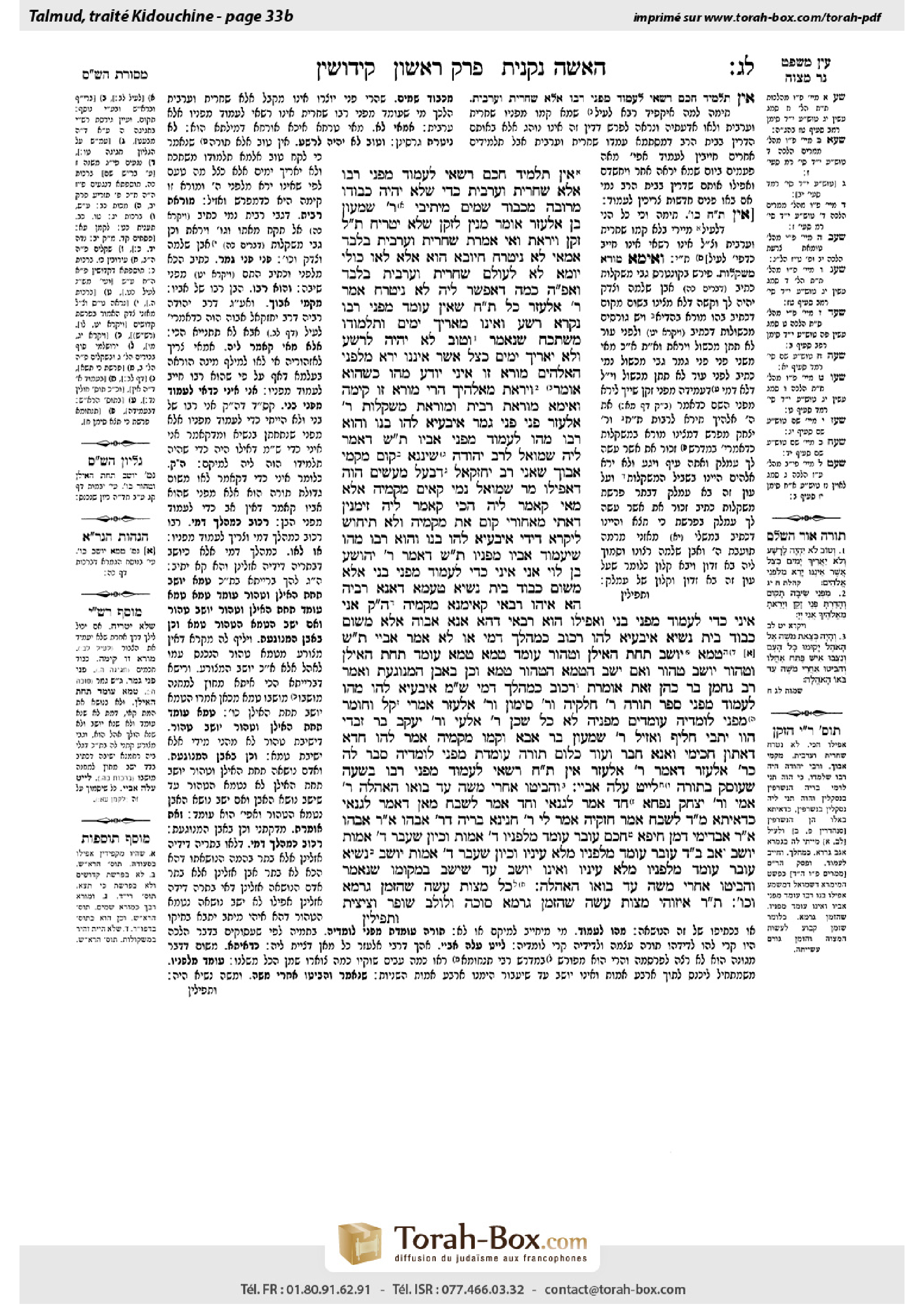
Kiddushin 33b: Talmud study for Daf Yomi
Daf Yomi is the daily study of one Talmud folio. Explore 37 tractates with scans, Hebrew text, Sefaria English and AI-generated French translations where annotated.
Passage selection and English or AI-generated French translation are available where the scan has annotations. Daf Study is independent of Torah-Box and Sefaria.
Browse Kiddushin · קידושין · All tractatesKiddushin 33b text and translations
This page of Kiddushin includes the Aramaic text, an English translation and an AI-generated French translation, alongside the scan above.
קידושין ל״ג ב · Aramaic and Hebrew text
אֵין תַּלְמִיד חָכָם רַשַּׁאי לַעֲמוֹד מִפְּנֵי רַבּוֹ אֶלָּא שַׁחֲרִית וְעַרְבִית, כְּדֵי שֶׁלֹּא יִהְיֶה כְּבוֹדוֹ מְרוּבֶּה מִכְּבוֹד שָׁמַיִם. מֵיתִיבִי, רַבִּי שִׁמְעוֹן בֶּן אֶלְעָזָר אוֹמֵר: מִנַּיִן לְזָקֵן שֶׁלֹּא יַטְרִיחַ – תַּלְמוּד לוֹמַר: ״זָקֵן וְיָרֵאתָ״.
וְאִי אָמְרַתְּ שַׁחֲרִית וְעַרְבִית בִּלְבַד, אַמַּאי לָא נִיטְרַח? חִיּוּבָא הוּא! אֶלָּא לָאו כּוּלֵּי יוֹמָא! לָא, לְעוֹלָם שַׁחֲרִית וְעַרְבִית בִּלְבַד, וַאֲפִילּוּ הָכִי כַּמָּה דְּאֶפְשָׁר לֵיהּ – לָא נִיטְרַח.
אָמַר רַבִּי אֶלְעָזָר: כׇּל תַּלְמִיד חָכָם שֶׁאֵין עוֹמֵד מִפְּנֵי רַבּוֹ נִקְרָא רָשָׁע, וְאֵינוֹ מַאֲרִיךְ יָמִים, וְתַלְמוּדוֹ מִשְׁתַּכֵּחַ, שֶׁנֶּאֱמַר: ״וְטוֹב לֹא יִהְיֶה לָרָשָׁע וְלֹא יַאֲרִיךְ יָמִים כַּצֵּל אֲשֶׁר אֵינֶנּוּ יָרֵא מִלִּפְנֵי הָאֱלֹהִים״, מוֹרָא זוֹ אֵינִי יוֹדֵעַ מַהוּ – כְּשֶׁהוּא אוֹמֵר ״וְיָרֵאתָ מֵאֱלֹהֶיךָ״ – הֲרֵי מוֹרָא זוֹ קִימָה.
וְאֵימָא מוֹרָאַת רִבִּית וּמוֹרָאַת מִשְׁקָלוֹת! רַבִּי אֶלְעָזָר: ״פְּנֵי״ ״פְּנֵי״ גָּמַר.
אִיבַּעְיָא לְהוּ: בְּנוֹ וְהוּא רַבּוֹ, מַהוּ לַעֲמוֹד מִפְּנֵי אָבִיו? תָּא שְׁמַע, דַּאֲמַר לֵיהּ שְׁמוּאֵל לְרַב יְהוּדָה: שִׁינָּנָא, קוּם מִקַּמֵּי אֲבוּךְ. שָׁאנֵי רַב יְחֶזְקֵאל דְּבַעַל מַעֲשִׂים הֲוָה, דַּאֲפִילּוּ מָר שְׁמוּאֵל נָמֵי קָאֵים מִקַּמֵּיהּ.
אֶלָּא מַאי קָאָמַר לֵיהּ? הָכִי קָאָמַר לֵיהּ: זִימְנִין דְּאָתֵי מֵאֲחוֹרַי, קוּם אַתְּ מִקַּמֵּיהּ וְלָא תֵּיחוּשׁ לִיקָרָא דִידִי.
אִיבַּעְיָא לְהוּ: בְּנוֹ וְהוּא רַבּוֹ, מַהוּ שֶׁיַּעֲמוֹד אָבִיו מִפָּנָיו? תָּא שְׁמַע דְּאָמַר רַבִּי יְהוֹשֻׁעַ בֶּן לֵוִי: אֲנִי אֵינִי כְּדַי לַעֲמוֹד מִפְּנֵי בְנִי, אֶלָּא מִשּׁוּם כְּבוֹד בֵּית נָשִׂיא.
טַעְמָא דַּאֲנָא רַבֵּיהּ, הָא אִיהוּ רַבַּאי – קָאֵימְנָא מִקַּמֵּיהּ! הָכִי קָאָמַר: אֲנִי אֵינִי כְּדַי לַעֲמוֹד מִפְּנֵי בְנִי וַאֲפִילּוּ הוּא רַבַּאי, דְּהָא אֲנָא אֲבוּהּ, אֶלָּא מִשּׁוּם כְּבוֹד בֵּית נָשִׂיא.
אִיבַּעְיָא לְהוּ: רָכוּב כִּמְהַלֵּךְ דָּמֵי, אוֹ לָא? אָמַר אַבָּיֵי: תָּא שְׁמַע: טָמֵא יוֹשֵׁב תַּחַת הָאִילָן, וְטָהוֹר עוֹמֵד – טָמֵא.
טָמֵא עוֹמֵד תַּחַת הָאִילָן וְטָהוֹר יוֹשֵׁב – טָהוֹר, וְאִם יָשַׁב הַטָּמֵא – הַטָּהוֹר טָמֵא.
וְכֵן בְּאֶבֶן הַמְנוּגַּעַת. וְאָמַר רַב נַחְמָן בַּר כֹּהֵן: זֹאת אוֹמֶרֶת רָכוּב כִּמְהַלֵּךְ דָּמֵי, שְׁמַע מִינַּהּ.
אִיבַּעְיָא לְהוּ: מַהוּ לַעֲמוֹד מִפְּנֵי סֵפֶר תּוֹרָה? רַבִּי חִלְקִיָּה וְרַבִּי סִימוֹן וְרַבִּי אֶלְעָזָר אָמְרִי: קַל וָחוֹמֶר, מִפְּנֵי לוֹמְדֶיהָ עוֹמְדִים – מִפָּנֶיהָ לֹא כׇּל שֶׁכֵּן?!
רַבִּי אִלְעַי וְרַבִּי יַעֲקֹב בַּר זַבְדִּי הֲווֹ יָתְבִי. חָלֵיף וְאָזֵיל רַבִּי שִׁמְעוֹן בַּר אַבָּא, וְקָמוּ מִקַּמֵּיהּ. אֲמַר לְהוּ: חֲדָא – דְּאַתּוּן חַכִּימֵי וַאֲנָא חָבֵר. וְעוֹד, כְּלוּם תּוֹרָה עוֹמֶדֶת מִפְּנֵי לוֹמְדֶיהָ.
סָבַר לַהּ כְּרַבִּי אֶלְעָזָר. דְּאָמַר רַבִּי אֶלְעָזָר: אֵין תַּלְמִיד חָכָם רַשַּׁאי לַעֲמוֹד מִפְּנֵי רַבּוֹ בְּשָׁעָה שֶׁעוֹסֵק בַּתּוֹרָה. לָיֵיט עֲלַהּ אַבָּיֵי.
״וְהִבִּיטוּ אַחֲרֵי מֹשֶׁה עַד בֹּאוֹ הָאֹהֱלָה״, רַבִּי אַמֵּי וְרַבִּי יִצְחָק נַפָּחָא. חַד אָמַר לִגְנַאי, וְחַד אָמַר לְשֶׁבַח. מַאן דְּאָמַר לִגְנַאי – כִּדְאִיתָא. מַאן דְּאָמַר לְשֶׁבַח, אָמַר חִזְקִיָּה:
אֲמַר לִי רַבִּי חֲנִינָא בְּרֵיהּ דְּרַבִּי אֲבָהוּ, אָמַר רַבִּי אֲבָהוּ, אָמַר רַבִּי אַבְדִּימִי דְּמִן חֵיפָא: חָכָם עוֹבֵר – עוֹמֵד מִלְּפָנָיו אַרְבַּע אַמּוֹת, וְכֵיוָן שֶׁעָבַר אַרְבַּע אַמּוֹת – יוֹשֵׁב. אַב בֵּית דִּין עוֹבֵר – עוֹמֵד מִלְּפָנָיו מְלֹא עֵינָיו, וְכֵיוָן שֶׁעָבַר אַרְבַּע אַמּוֹת יוֹשֵׁב. נָשִׂיא עוֹבֵר – עוֹמֵד מִלְּפָנָיו מְלֹא עֵינָיו, וְאֵינוֹ יוֹשֵׁב עַד שֶׁיֵּשֵׁב בִּמְקוֹמוֹ, שֶׁנֶּאֱמַר: ״וְהִבִּיטוּ אַחֲרֵי מֹשֶׁה עַד בֹּאוֹ הָאֹהֱלָה״.
כׇּל מִצְוַת עֲשֵׂה שֶׁהַזְּמַן גְּרָמָהּ וְכוּ׳. תָּנוּ רַבָּנַן: אֵיזוֹהִי מִצְוַת עֲשֵׂה שֶׁהַזְּמַן גְּרָמָהּ – סוּכָּה, וְלוּלָב, שׁוֹפָר, וְצִיצִית,
Kiddushin 33b · English translation
A Torah scholar is permitted to stand before his teacher only once in the morning and once in the evening, so that the teacher’s honor should not be greater than the honor of Heaven, as one recites the Shema, which is tantamount to greeting God, once in the morning and once in the evening. The Gemara raises an objection from an aforementioned opinion. Rabbi Shimon ben Elazar says: From where is it derived that an elder should not trouble others to honor him? The verse states: “An elder, and you shall fear” (Leviticus 19:32). The collocation of these words comes to teach that the elder, too, must fear God.
The Gemara explains the objection: And if you say one may stand only in the morning and evening, why does the baraita say an elder should not trouble others? Standing for an elder only twice a day is an obligation for the people, not an imposition. Rather, is it not correct to say that one is obligated to stand before one’s teacher at any point during the day? The Gemara answers: No; actually one is obligated to stand only in the morning and evening, and even so, as much as it is possible for the elder, he should not trouble the people to stand.
§ Rabbi Elazar said: Any Torah scholar who does not stand before his teacher is called wicked, and he will not live a long life, and his studies will be forgotten, as it is stated: “But it shall not be well for the wicked, neither shall he prolong his days, which are as a shadow, because he does not fear before [millifnei] God” (Ecclesiastes 8:13). This fear mentioned in the verse, I do not know what it is. When the verse states: “And you shall revere the face [penei] of an elder, and you shall fear your God” (Leviticus 19:32), one can deduce that this fear mentioned in the verse is referring to standing. Consequently, this verse teaches with regard to one who does not stand that he is called wicked, he will not live a long life, and his studies will be forgotten, as indicated by the phrase: “It shall not be well.”
The Gemara asks: But why not say that this is referring to fear of God stated with regard to interest (Leviticus 25:36), or the fear of God stated with regard to weights (Deuteronomy 25:13–16), as the fear of God is mentioned with regard to these prohibitions as well. The Gemara answers: Rabbi Elazar derives this halakha through a verbal analogy of “penei” and “penei,” as explained previously, not from a verbal analogy of the term “fear.”
A dilemma was raised before them: With regard to one who is both a man’s son and his teacher, what is the halakha as to whether that son must stand before his father? The Gemara answers: Come and hear, as Shmuel said to Rav Yehuda: Big-toothed one, stand before your father. Although Rav Yehuda was a great Torah scholar and taught his father, he was still required to stand before him. The Gemara answers: Rav Yeḥezkel, Rav Yehuda’s father, is different, as he was a man of good deeds, and even Mar Shmuel himself would stand before him.
The Gemara asks: Rather, what is Shmuel saying to Rav Yehuda? If he is not teaching him that one who is his father’s teacher must stand before his father, why did Shmuel say this to Rav Yehuda? The Gemara answers that this is what Shmuel said to him: Sometimes your father comes from behind me and I do not see him or stand before him. Nevertheless, you should stand before him and do not be concerned about my honor.
Another dilemma was raised before them, with regard to one who is both a man’s son and his teacher, what is the halakha as to whether the father must stand before his son? The Gemara answers: Come and hear, as Rabbi Yehoshua ben Levi says: It is not appropriate for me to stand before my son solely due to his greatness in Torah, as I am greater than him. But due to the honor of the household of the Nasi I do stand before him, as his son was a son-in-law of the Nasi.
It may be inferred from here that if his son were not in the household of the Nasi he would not stand for him, and the reason was that he could claim: I am his teacher and therefore I am not obligated to stand before him. Accordingly, Rabbi Yehoshua ben Levi is indicating that if he were my teacher I would stand before him. The Gemara rejects this proof: This is what Rabbi Yehoshua ben Levi is saying: It is not appropriate for me to stand before my son, even if he were my teacher, as I am his father. But due to the honor of the household of the Nasi I do stand before him.
A dilemma was raised before them: If one’s teacher is riding on an animal, is that considered like walking, and therefore one must stand before him, or is he not obligated to stand before him, since he is stationary relative to the animal? Abaye said: Come and hear a resolution from a different issue (Nega’im 13:7): If a leper, who is ritually impure and transfers impurity through a tent, i.e., anyone who enters the location of the leper is rendered impure, is sitting under the branches of a tree, which form a tent over him, and a pure person is standing under that tree, the pure person is rendered impure.
If the impure person is standing under the tree and the pure person is sitting there, he remains pure. In this case, as the impure person is not settled there, he does not impart ritual impurity in a tent. But if the impure person sat and established his place there, the pure individual is rendered impure.
That mishna adds: And the same halakha applies with regard to a stone afflicted with a leprous sore (see Leviticus, chapter 14), which also imparts impurity of a tent. If one carrying a stone of this kind sits under a tree, a pure person standing under the tree is rendered impure, whereas if the person carrying the stone stands, he does not render the other individual impure. And Rav Naḥman bar Kohen says: That is to say that riding is considered like walking, as although the stone is stationary relative to the person, it is considered to be moving. Conclude from it that in all cases riding is like walking.
A dilemma was raised before them: What is the halakha as to whether one should stand before a Torah scroll? Rabbi Ḥilkiya and Rabbi Simon and Rabbi Elazar say that this dilemma can be resolved by an a fortiori inference: If one stands before those who study the Torah, is it not all the more so true that one should stand before the Torah itself?
The Gemara relates: Rabbi Elai and Rabbi Ya’akov bar Zavdi were sitting and studying Torah. Rabbi Shimon bar Abba passed before them and they stood before him. Rabbi Shimon bar Abba said to them: You are not obligated to do this, for two reasons. One reason is that you are ordained scholars and I am only an associate, i.e., he had not been ordained. And furthermore, does the Torah stand before those who study it? Since you are engaged in Torah study at the present moment you are not required to stand before a Torah scholar.
The Gemara comments: Rabbi Shimon bar Abba holds in accordance with the opinion of Rabbi Elazar, as Rabbi Elazar says: A Torah scholar may not stand before his teacher when he is studying Torah, because he is engaged in honoring the Torah itself. The Gemara adds: Even so, Abaye cursed anyone who acted in accordance with this ruling, as he would give the appearance of one who disrespected his teacher.
§ The Gemara continues to discuss the mitzva of standing before a Torah scholar. With regard to the verse: “And they looked after Moses until he was gone into the tent” (Exodus 33:8), Rabbi Ami and Rabbi Yitzḥak Nappaḥa disputed its correct interpretation. One said that this is stated unfavorably, and one said that it is meant favorably. The one who said it was stated unfavorably explains the verse as it is interpreted in the midrash. The one who said it was stated favorably interprets the verse in accordance with that which Ḥizkiyya says.
As Ḥizkiyya says: Rabbi Ḥanina, son of Rabbi Abbahu, said to me that Rabbi Abbahu says that Rabbi Avdimi of Haifa says: If a Torah scholar is passing, one stands before him if he passes within four cubits of him, and once he passes four cubits from him he sits. If the president of the court is passing, one stands before him as soon as he comes within his range of vision. And once he passes four cubits from him, he sits. If the Nasi is passing, one stands before him as soon as he comes within his range of vision, and he does not sit until the Nasi sits in his place, as it is stated: “And they looked after Moses until he was gone into the tent,” and only afterward did they sit. According to this interpretation, the verse is praising the behavior of the Jews.
§ The mishna teaches that women are exempt from all positive, time-bound mitzvot. The Sages taught: What is a positive, time-bound mitzva? Examples include residing in a sukka, and taking the lulav, and blowing the shofar on Rosh HaShana, all of which can be performed only at specific times of the year. And another example is donning ritual fringes, as the mitzva applies only during the daytime due to the verse which states: “Fringes, that you may look upon them” (Numbers 15:39), indicating that the fringes should be seen.
Kiddushin 33b · Traduction française (IA)
Un érudit en Torah n’est autorisé à se lever devant son maître qu’une fois le matin et une fois le soir, afin que l’honneur dû au maître ne soit pas supérieur à l’honneur dû au Ciel, puisque l’on récite le Chéma, ce qui équivaut à saluer Dieu, une fois le matin et une fois le soir. La Guemara soulève une objection à partir d’une opinion citée précédemment. Rabbi Shimon ben Elazar dit : D’où apprend-on qu’un ancien ne doit pas imposer aux autres de lui témoigner des marques d’honneur ? Le verset dit : « Devant un ancien, tu te lèveras, et tu craindras » (Lévitique 19:32). La juxtaposition de ces mots vient enseigner que l’ancien, lui aussi, doit craindre Dieu.
La Guemara explique l’objection : Si l’on ne doit se lever que le matin et le soir, pourquoi la baraïta dit-elle qu’un ancien ne doit pas imposer aux autres de lui témoigner des marques d’honneur ? Se lever devant un ancien seulement deux fois par jour est une obligation du peuple, et non une contrainte qu’il lui impose. N’est-il pas plutôt juste d’en conclure que l’on est tenu de se lever devant son maître à n’importe quel moment de la journée ? La Guemara répond : Non ; en réalité, on n’est tenu de se lever que le matin et le soir, et malgré cela, l’ancien ne doit pas imposer au peuple de se lever, autant que cela lui est possible.
§ Rabbi Elazar a dit : Tout érudit en Torah qui ne se lève pas devant son maître est qualifié de méchant ; il ne vivra pas longtemps et ses études seront oubliées, comme il est dit : « Il n’en ira pas bien du méchant, et il ne prolongera pas ses jours, qui sont comme une ombre, car il ne craint pas devant [millifnei] Dieu » (Ecclésiaste 8:13). Je ne sais pas à quoi renvoie cette crainte mentionnée dans le verset. Lorsque le verset dit : « Tu témoigneras du respect devant [penei] un ancien, et tu craindras ton Dieu » (Lévitique 19:32), on peut en déduire que la crainte mentionnée dans le verset renvoie au fait de se lever. Par conséquent, ce verset enseigne que celui qui ne se lève pas est qualifié de méchant, qu’il ne vivra pas longtemps et que ses études seront oubliées, comme l’indique l’expression : « Il n’en ira pas bien. »
La Guemara demande : Mais pourquoi ne pas dire que cela renvoie à la crainte de Dieu mentionnée à propos de l’intérêt (Lévitique 25:36), ou à la crainte de Dieu mentionnée à propos des poids (Deutéronome 25:13–16), puisque la crainte de Dieu est également mentionnée à propos de ces interdictions ? La Guemara répond : Rabbi Elazar déduit cette halakha par une analogie verbale entre « penei » et « penei », comme expliqué précédemment, et non par une analogie verbale fondée sur le terme « crainte ».
Une question fut posée devant eux : Quel est le statut d’un homme qui est à la fois le fils et le maître d’un autre homme : ce fils doit-il se lever devant son père ? La Guemara répond : Écoute, car Shmuel a dit à Rav Yehuda : « Toi, le gros-dent, lève-toi devant ton père. » Bien que Rav Yehuda fût un grand érudit en Torah et qu’il enseignât à son père, il devait néanmoins se lever devant lui. La Guemara répond : Le cas de Rav Yeḥezkel, père de Rav Yehuda, est différent, car il était un homme aux actes méritoires, et même Mar Shmuel lui-même se levait devant lui.
La Guemara demande : Alors, que disait Shmuel à Rav Yehuda ? S’il ne lui enseignait pas que celui qui est le maître de son père doit se lever devant ce dernier, pourquoi Shmuel lui a-t-il dit cela ? La Guemara répond que voici ce que Shmuel lui disait : Il arrive parfois que ton père vienne derrière moi et que je ne le voie pas, si bien que je ne me lève pas devant lui. Malgré cela, toi, lève-toi devant lui et ne te soucie pas de l’honneur qui m’est dû.
Une autre question fut posée devant eux : Quel est le statut d’un homme qui est à la fois le fils et le maître d’un autre homme : le père doit-il se lever devant son fils ? La Guemara répond : Écoute, car Rabbi Yehoshua ben Levi dit : Il ne convient pas que je me lève devant mon fils uniquement en raison de sa grandeur en Torah, car je suis plus grand que lui. Mais je me lève devant lui en raison de l’honneur de la maison du Nassi, car son fils était le gendre du Nassi.
On peut en déduire que si son fils ne faisait pas partie de la maison du Nassi, il ne se serait pas levé devant lui, et que la raison en aurait été qu’il pouvait dire : Je suis son maître et ne suis donc pas tenu de me lever devant lui. Ainsi, Rabbi Yehoshua ben Levi indique que s’il était mon maître, je me lèverais devant lui. La Guemara rejette cette preuve : voici ce que dit Rabbi Yehoshua ben Levi : Il ne convient pas que je me lève devant mon fils, même s’il était mon maître, car je suis son père. Mais je me lève devant lui en raison de l’honneur de la maison du Nassi.
Une question fut posée devant eux : Si le maître de quelqu’un chevauche un animal, cela est-il considéré comme de la marche, de sorte qu’il faut se lever devant lui, ou n’est-on pas tenu de se lever devant lui, puisqu’il est immobile par rapport à l’animal ? Abaye dit : Écoute la réponse tirée d’une autre question (Nega’im 13:7) : si un lépreux, qui est rituellement impur et transmet l’impureté par tente — c’est-à-dire que toute personne qui pénètre à l’endroit où se trouve le lépreux devient impure — est assis sous les branches d’un arbre qui forment une tente au-dessus de lui, et qu’une personne pure se tient sous cet arbre, cette dernière devient impure.
Si la personne impure se tient sous l’arbre et que la personne pure y est assise, celle-ci reste pure. Dans ce cas, comme la personne impure ne s’est pas installée là, elle ne transmet pas l’impureté par tente. Mais si la personne impure s’assied et s’installe à cet endroit, la personne pure devient impure.
Cette Michna ajoute : La même halakha s’applique à une pierre atteinte d’une plaie lépreuse (voir Lévitique, chapitre 14), qui transmet elle aussi l’impureté par tente. Si celui qui porte une pierre de ce type s’assied sous un arbre, une personne pure qui se tient sous l’arbre devient impure ; en revanche, si celui qui porte la pierre se tient debout, il ne rend pas l’autre personne impure. Rav Naḥman bar Kohen dit : On peut en déduire que chevaucher est considéré comme marcher, car, bien que la pierre soit immobile par rapport à la personne, elle est considérée comme étant en mouvement. Déduis-en que, dans tous les cas, chevaucher équivaut à marcher.
Une question fut posée devant eux : Doit-on se lever devant un rouleau de Torah ? Rabbi Ḥilkiya, Rabbi Simon et Rabbi Elazar disent que cette question peut être résolue par un raisonnement a fortiori : si l’on se lève devant ceux qui étudient la Torah, n’est-il pas à plus forte raison vrai que l’on doit se lever devant la Torah elle-même ?
La Guemara rapporte : Rabbi Elai et Rabbi Ya’akov bar Zavdi étaient assis et étudiaient la Torah. Rabbi Shimon bar Abba passa devant eux et ils se levèrent devant lui. Rabbi Shimon bar Abba leur dit : Vous n’êtes pas tenus de le faire, pour deux raisons. La première est que vous êtes des érudits ordonnés, tandis que moi, je ne suis qu’un associé, c’est-à-dire que je n’ai pas reçu l’ordination. De plus, la Torah se lève-t-elle devant ceux qui l’étudient ? Puisque vous étudiez la Torah en ce moment, vous n’êtes pas tenus de vous lever devant un érudit en Torah.
La Guemara commente : Rabbi Shimon bar Abba suit l’opinion de Rabbi Elazar, car Rabbi Elazar dit : Un érudit en Torah ne doit pas se lever devant son maître lorsqu’il étudie la Torah, puisqu’il est occupé à honorer la Torah elle-même. La Guemara ajoute : Malgré cela, Abaye maudissait quiconque agissait conformément à cette décision, car il donnerait l’impression de manquer de respect à son maître.
§ La Guemara poursuit la discussion sur la mitsva de se lever devant un érudit en Torah. À propos du verset : « Ils regardaient Moïse jusqu’à ce qu’il entre dans la tente » (Exode 33:8), Rabbi Ami et Rabbi Yitzḥak Nappaḥa étaient en désaccord sur son interprétation exacte. Selon l’un, ces mots sont formulés en défaveur des Israélites, et selon l’autre, ils sont formulés à leur avantage. Celui qui estime que le verset est formulé en défaveur l’explique comme dans l’interprétation midrashique. Celui qui estime qu’il est formulé à leur avantage interprète le verset conformément à ce que dit Ḥizkiyya.
Car Ḥizkiyya dit : Rabbi Ḥanina, fils de Rabbi Abbahu, m’a dit que Rabbi Abbahu dit que Rabbi Avdimi de Haïfa dit : Lorsqu’un érudit en Torah passe, on se lève devant lui s’il passe à moins de quatre coudées de soi, puis on s’assied lorsqu’il s’est éloigné de quatre coudées. Lorsque le président du tribunal passe, on se lève devant lui dès qu’il entre dans son champ de vision, puis on s’assied lorsqu’il s’est éloigné de quatre coudées. Lorsque le Nassi passe, on se lève devant lui dès qu’il entre dans son champ de vision, et l’on ne s’assied pas avant que le Nassi ne se soit assis à sa place, comme il est dit : « Ils regardaient Moïse jusqu’à ce qu’il entre dans la tente » ; et ce n’est qu’ensuite qu’ils s’assirent. Selon cette interprétation, le verset loue le comportement des Juifs.
§ La Michna enseigne que les femmes sont exemptées de toutes les mitsvot positives dépendant d’un temps fixé. Les Sages ont enseigné : Qu’est-ce qu’une mitsva positive dépendant d’un temps fixé ? Parmi les exemples figurent le fait d’habiter dans une soukka, de prendre le loulav et de sonner du chofar à Roch Hachana, autant de mitsvot qui ne peuvent être accomplies qu’à des moments précis de l’année. Un autre exemple est le port des franges rituelles, car la mitsva ne s’applique que pendant la journée, en raison du verset qui dit : « Des franges, afin que vous les voyiez » (Nombres 15:39), ce qui indique que les franges doivent être vues.
Traduction française générée par IA à partir de l’édition anglaise de Sefaria. Vérifie toujours un passage avec le texte source.
Text from Sefaria: William Davidson Edition - Vocalized Aramaic (CC BY NC); William Davidson Edition - English (CC BY NC).