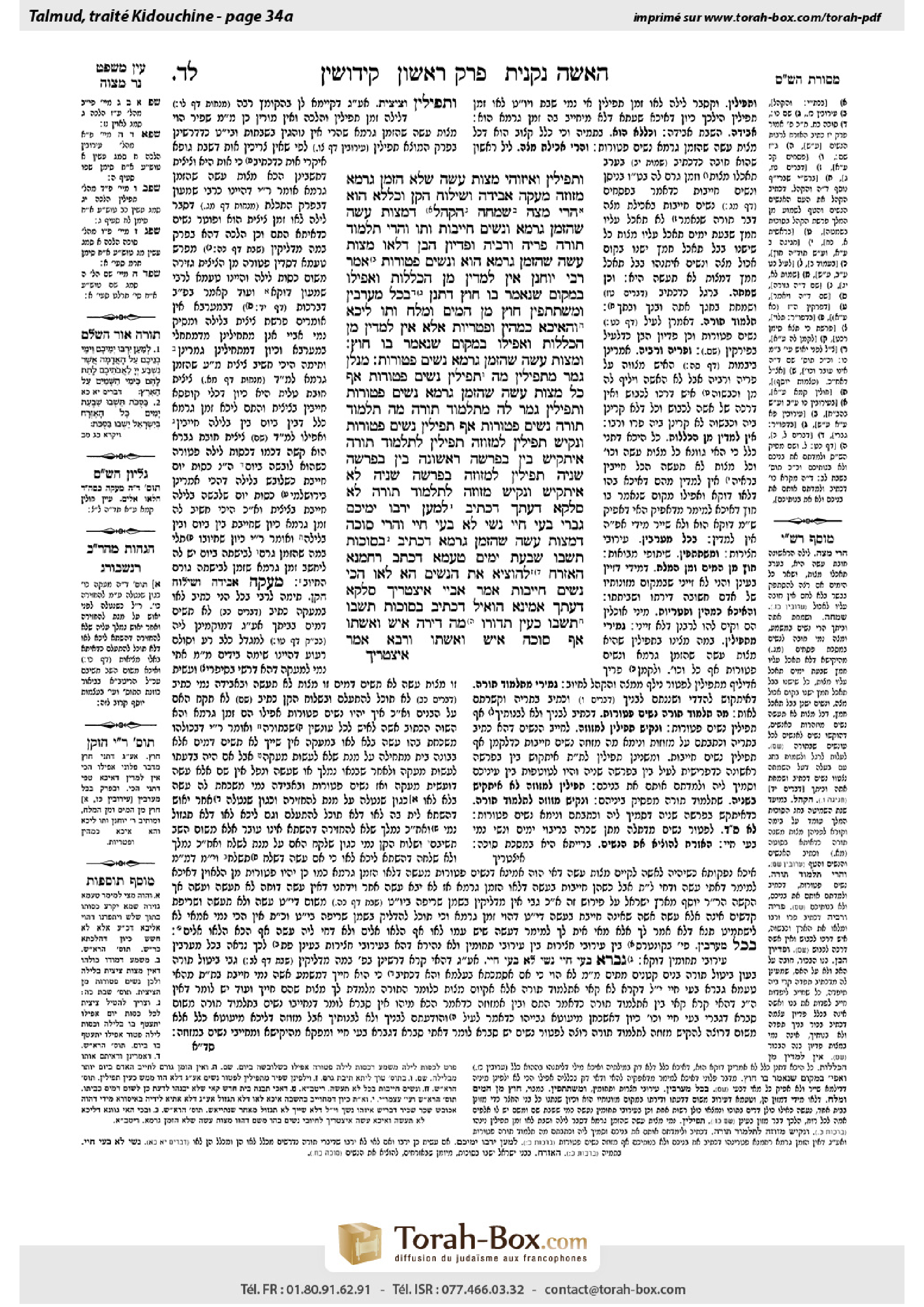
Kiddushin 34a: Talmud study for Daf Yomi
Daf Yomi is the daily study of one Talmud folio. Explore 37 tractates with scans, Hebrew text, Sefaria English and AI-generated French translations where annotated.
Passage selection and English or AI-generated French translation are available where the scan has annotations. Daf Study is independent of Torah-Box and Sefaria.
Browse Kiddushin · קידושין · All tractatesKiddushin 34a text and translations
This page of Kiddushin includes the Aramaic text, an English translation and an AI-generated French translation, alongside the scan above.
קידושין ל״ד א · Aramaic and Hebrew text
וּתְפִילִּין.
וְאֵיזוֹהִי מִצְוַת עֲשֵׂה שֶׁלֹּא הַזְּמַן גְּרָמָהּ – מְזוּזָה, מַעֲקֶה, אֲבֵידָה, וְשִׁילּוּחַ הַקֵּן.
וּכְלָלָא הוּא? הֲרֵי מַצָּה, שִׂמְחָה, הַקְהֵל, דְּמִצְוַת עֲשֵׂה שֶׁהַזְּמַן גְּרָמָא, וְנָשִׁים חַיָּיבוֹת! וְתוּ: וַהֲרֵי תַּלְמוּד תּוֹרָה, פְּרִיָּה וּרְבִיָּה, וּפִדְיוֹן הַבֵּן דְּלָאו מִצְוַת עֲשֵׂה שֶׁהַזְּמַן גְּרָמָהּ הוּא – וְנָשִׁים פְּטוּרוֹת!
אָמַר רַבִּי יוֹחָנָן: אֵין לְמֵדִין מִן הַכְּלָלוֹת, וַאֲפִילּוּ בִּמְקוֹם שֶׁנֶּאֱמַר בּוֹ ״חוּץ״,
דִּתְנַן: בַּכֹּל מְעָרְבִין וּמִשְׁתַּתְּפִין חוּץ מִן הַמַּיִם וּמֶלַח, וְתוּ לֵיכָּא? וְהָאִיכָּא כְּמֵהִין וּפִטְרִיּוֹת! אֶלָּא אֵין לְמֵדִין מִן הַכְּלָלוֹת, וַאֲפִילּוּ בִּמְקוֹם שֶׁנֶּאֱמַר בּוֹ ״חוּץ״.
וּמִצְוַת עֲשֵׂה שֶׁהַזְּמַן גְּרָמָא נָשִׁים פְּטוּרוֹת מְנָלַן? – גָּמַר מִתְּפִילִּין, מַה תְּפִילִּין נָשִׁים פְּטוּרוֹת – אַף כׇּל מִצְוַת עֲשֵׂה שֶׁהַזְּמַן גְּרָמָא נָשִׁים פְּטוּרוֹת. וּתְפִילִּין? – גָּמַר לַהּ מִתַּלְמוּד תּוֹרָה, מָה תַּלְמוּד תּוֹרָה נָשִׁים פְּטוּרוֹת – אַף תְּפִילִּין נָשִׁים פְּטוּרוֹת.
וְנַקֵּישׁ תְּפִילִּין לִמְזוּזָה! תְּפִילִּין לְתַלְמוּד תּוֹרָה אִיתַּקּוּשׁ, בֵּין בְּפָרָשָׁה רִאשׁוֹנָה בֵּין בְּפָרָשָׁה שְׁנִיָּה, תְּפִילִּין לִמְזוּזָה בְּפָרָשָׁה שְׁנִיָּה לָא אִיתַּקּוּשׁ.
וְנַקֵּישׁ מְזוּזָה לְתַלְמוּד תּוֹרָה! לָא סָלְקָא דַּעְתָּךְ, דִּכְתִיב: ״לְמַעַן יִרְבּוּ יְמֵיכֶם״, גַּבְרֵי בָּעוּ חַיֵּי, נְשֵׁי לָא בָּעוּ חַיֵּי?!
וַהֲרֵי סוּכָּה דְּמִצְוַת עֲשֵׂה שֶׁהַזְּמַן גְּרָמָהּ, דִּכְתִיב ״בַּסֻּכֹּת תֵּשְׁבוּ שִׁבְעַת יָמִים״, טַעְמָא דִּכְתַב רַחֲמָנָא הָאֶזְרָח לְהוֹצִיא אֶת הַנָּשִׁים, הָא לָאו הָכִי נָשִׁים חַיָּיבוֹת!
אָמַר אַבָּיֵי: אִיצְטְרִיךְ, סָלְקָא דַּעְתָּךְ אָמֵינָא: הוֹאִיל דִּכְתִיב ״בַּסֻּכֹּת תֵּשְׁבוּ״ – ״תֵּשְׁבוּ״ כְּעֵין תָּדוּרוּ: מָה דִּירָה אִישׁ וְאִשְׁתּוֹ – אַף סוּכָּה אִישׁ וְאִשְׁתּוֹ.
וְרָבָא אָמַר:
Kiddushin 34a · English translation
And the donning of phylacteries (Deuteronomy 6:8), which are not worn at night or on Shabbat and Festivals, is also a positive, time-bound mitzva.
And what is a positive mitzva that is not time bound? Examples include the affixing of a mezuza (Deuteronomy 11:20), the construction of a parapet on a roof (Deuteronomy 22:8), returning a lost item (Deuteronomy 22:1–3), and the release of the mother bird from the nest, i.e., the mitzva of sending away a mother bird when one finds it sitting on chicks or eggs (Deuteronomy 22:6–7).
The Gemara asks: But is this an established principle? But there are the mitzvot of eating matza on the first night of Passover (Exodus 23:15), of rejoicing on a Festival (Deuteronomy 16:9–11), and assembly on Sukkot following the Sabbatical Year (Deuteronomy 31:10–13). And each of these is a positive, time-bound mitzva, and yet women are obligated in them. And furthermore, one can raise a difficulty as follows: But there are the mitzvot of Torah study (Deuteronomy 6:7), procreation (Genesis 1:28), and redemption of the firstborn (Exodus 13:12–13), each of which is not a positive, time-bound mitzva, and yet women are exempt from them.
Rabbi Yoḥanan says: One does not learn practical halakhot from general statements, i.e., when a general statement appears in a mishna and uses the term: All, it is not to be understood as an all-inclusive statement without exceptions. This is the case even in a place where it says: Except, to exclude a specific matter.
A proof for this is as we learned in a mishna (Eiruvin 26b): One can establish a joining of houses in courtyards [eiruv ḥatzerot] and a joining of Shabbat boundaries [eiruv teḥumin], and similarly, one can merge courtyards to permit carrying in a joint alleyway on Shabbat. This can be done with all types of food except for water and salt. This is stated as a halakha with specific exceptions, and yet one can ask: Is there nothing else that cannot be used for an eiruv? But there are truffles and mushrooms, which also cannot be used for an eiruv, because they do not offer nourishment. Rather, conclude from this that one may not learn from general statements, even in a place where it says: Except.
§ The Gemara turns to the sources of this principle. From where do we derive that women are exempt from positive, time-bound mitzvot? It is derived by juxtaposition from the mitzva of phylacteries: Just as women are exempt from donning phylacteries, so too, women are exempt from all positive, time-bound mitzvot. And the exemption of women from donning phylacteries is derived from their exemption from Torah study: Just as women are exempt from Torah study, as derived from Deuteronomy 11:19, so too women are exempt from donning phylacteries, as the two issues are juxtaposed in the Torah (Deuteronomy 6:7–8).
The Gemara asks: And let us say the opposite and juxtapose phylacteries to mezuza, which is also mentioned in that passage. Mezuza is a mitzva in which women are also obligated. Based on this comparison, women would be obligated in phylacteries as well. The Gemara answers: Phylacteries are juxtaposed to Torah study in both the first paragraph and in the second paragraph of Shema, whereas phylacteries are not juxtaposed to mezuza in the second paragraph. It is therefore preferable to compare phylacteries to Torah study.
The Gemara says: But if so, let us juxtapose mezuza to Torah study and say that women are also exempt from the obligation of a mezuza. The Gemara rejects this suggestion: This could not enter your mind, as it is written with regard to the mitzva of mezuza: “That your days may be multiplied” (Deuteronomy 11:21). Can it be said that men need life but women do not need life? Since the reward for the performance of the mitzva of mezuza is extended life, this mitzva applies to women as well.
The Gemara further asks: But there is the mitzva of residing in a sukka, which is a positive, time-bound mitzva, as it is written: “In sukkot you shall reside seven days” (Leviticus 23:42), referring to seven specific days of the year. Nevertheless, the reason women are exempt from this mitzva is that the Merciful One writes in the continuation of the verse: “All the homeborn in Israel shall reside in sukkot.” The definite article “the” is an exclusion, and serves to exclude the women from the obligation to reside in a sukka. It may be derived from here that if that was not so, women would be obligated. This indicates that women do not receive a blanket exemption from every positive, time-bound mitzva.
Abaye said: In the case of residing in a sukka a special verse was necessary to exempt women, as otherwise it might enter your mind to say that since it is written: “In sukkot you shall reside,” this means that you should reside as you dwell in your permanent home: Just as a man and his wife live together in a residence, so too, a man and his wife are obligated to reside together in a sukka.
And Rava said:
Kiddushin 34a · Traduction française (IA)
Le port des tefillin (Deutéronome 6:8), qui ne se portent ni la nuit ni pendant Chabbat et les fêtes, est également une mitsva positive liée au temps.
Et qu’est-ce qu’une mitsva positive qui n’est pas liée au temps ? Parmi les exemples, on trouve la pose d’une mezouza (Deutéronome 11:20), la construction d’un parapet sur un toit (Deutéronome 22:8), la restitution d’un objet perdu (Deutéronome 22:1–3) et le renvoi de la mère oiseau hors du nid, c’est-à-dire la mitsva qui consiste à renvoyer une mère oiseau lorsqu’on la trouve perchée sur des oisillons ou des œufs (Deutéronome 22:6–7).
La Guemara demande : Mais est-ce un principe établi ? Il y a pourtant les mitsvot consistant à manger de la matsa le premier soir de Pessa’h (Exode 23:15), à se réjouir pendant une fête (Deutéronome 16:9–11) et à participer à l’assemblée de Soukkot après l’année sabbatique (Deutéronome 31:10–13). Chacune est une mitsva positive liée au temps, et pourtant les femmes y sont tenues. En outre, on peut soulever la difficulté suivante : il y a pourtant les mitsvot de l’étude de la Torah (Deutéronome 6:7), de la procréation (Genèse 1:28) et du rachat du premier-né (Exode 13:12–13), dont aucune n’est une mitsva positive liée au temps, et pourtant les femmes en sont exemptées.
Rabbi Yoḥanan dit : On ne déduit pas les halakhot pratiques d’énoncés généraux. Autrement dit, lorsqu’un énoncé général apparaît dans une Michna et emploie le terme « tous », il ne faut pas le comprendre comme une affirmation englobant tout, sans exception. Cela vaut même dans un passage où figure le terme « sauf », qui exclut un cas précis.
La preuve en est ce que nous avons appris dans une Michna (Eirouvine 26b) : on peut établir un érouv de cours [eiruv ḥatzerot] et un érouv des limites du Chabbat [eiruv teḥumin] ; de même, on peut fusionner des cours afin de permettre de porter dans une ruelle commune le Chabbat. Cela peut se faire avec toutes sortes d’aliments, à l’exception de l’eau et du sel. Cette halakha est formulée avec des exceptions précises, et pourtant on peut demander : N’y a-t-il rien d’autre qui ne puisse servir à un érouv ? Il y a pourtant les truffes et les champignons, qui ne peuvent pas non plus servir à un érouv, car ils ne nourrissent pas. Il faut plutôt en conclure qu’on ne peut pas tirer de règle des énoncés généraux, même dans un passage où figure le terme « sauf ».
§ La Guemara aborde les sources de ce principe. D’où déduit-on que les femmes sont exemptées des mitsvot positives liées au temps ? On le déduit par juxtaposition avec la mitsva des tefillin : de même que les femmes sont exemptées du port des tefillin, elles sont également exemptées de toutes les mitsvot positives liées au temps. Quant à l’exemption des femmes du port des tefillin, elle se déduit de leur exemption de l’étude de la Torah : de même que les femmes sont exemptées de l’étude de la Torah, comme on le déduit de Deutéronome 11:19, elles sont également exemptées du port des tefillin, puisque les deux sujets sont juxtaposés dans la Torah (Deutéronome 6:7–8).
La Guemara demande : Pourquoi ne pas dire le contraire et juxtaposer les tefillin à la mezouza, également mentionnée dans ce passage ? Les femmes sont également tenues à la mitsva de la mezouza. Selon cette comparaison, elles seraient donc aussi tenues au port des tefillin. La Guemara répond : Les tefillin sont juxtaposés à l’étude de la Torah dans le premier paragraphe comme dans le second paragraphe du Chéma, tandis qu’ils ne sont pas juxtaposés à la mezouza dans le second paragraphe. Il est donc préférable de comparer les tefillin à l’étude de la Torah.
La Guemara dit : Mais si tel est le cas, juxtaposons la mezouza à l’étude de la Torah et disons que les femmes sont également exemptées de l’obligation de poser une mezouza. La Guemara rejette cette proposition : Cette idée ne saurait venir à l’esprit, car il est écrit au sujet de la mitsva de la mezouza : « afin que vos jours se multiplient » (Deutéronome 11:21). Peut-on dire que les hommes ont besoin de vivre, mais pas les femmes ? Puisque la récompense de l’accomplissement de la mitsva de la mezouza est une vie prolongée, cette mitsva s’applique également aux femmes.
La Guemara demande encore : Mais il y a la mitsva de résider dans une soukka, qui est une mitsva positive liée au temps, puisqu’il est écrit : « Vous résiderez dans des soukkot pendant sept jours » (Lévitique 23:42), ce qui renvoie à sept jours précis de l’année. Si les femmes sont exemptées de cette mitsva, c’est pourtant parce que le Miséricordieux écrit dans la suite du verset : « Tous les autochtones d’Israël résideront dans des soukkot. » L’article défini « les » constitue une exclusion et sert à exclure les femmes de l’obligation de résider dans une soukka. On peut en déduire que, sans cette exclusion, les femmes y seraient tenues. Cela indique que les femmes ne bénéficient pas d’une exemption générale de toute mitsva positive liée au temps.
Abayé dit : Pour la résidence dans une soukka, un verset particulier était nécessaire afin d’exempter les femmes ; sinon, on aurait pu penser que, puisqu’il est écrit : « Vous résiderez dans des soukkot », cela signifie qu’il faut y résider comme on habite dans sa demeure permanente. De même qu’un homme et sa femme vivent ensemble dans un logement, de même un homme et sa femme seraient tenus de résider ensemble dans une soukka.
Et Rava dit :
Traduction française générée par IA à partir de l’édition anglaise de Sefaria. Vérifie toujours un passage avec le texte source.
Text from Sefaria: William Davidson Edition - Vocalized Aramaic (CC BY NC); William Davidson Edition - English (CC BY NC).