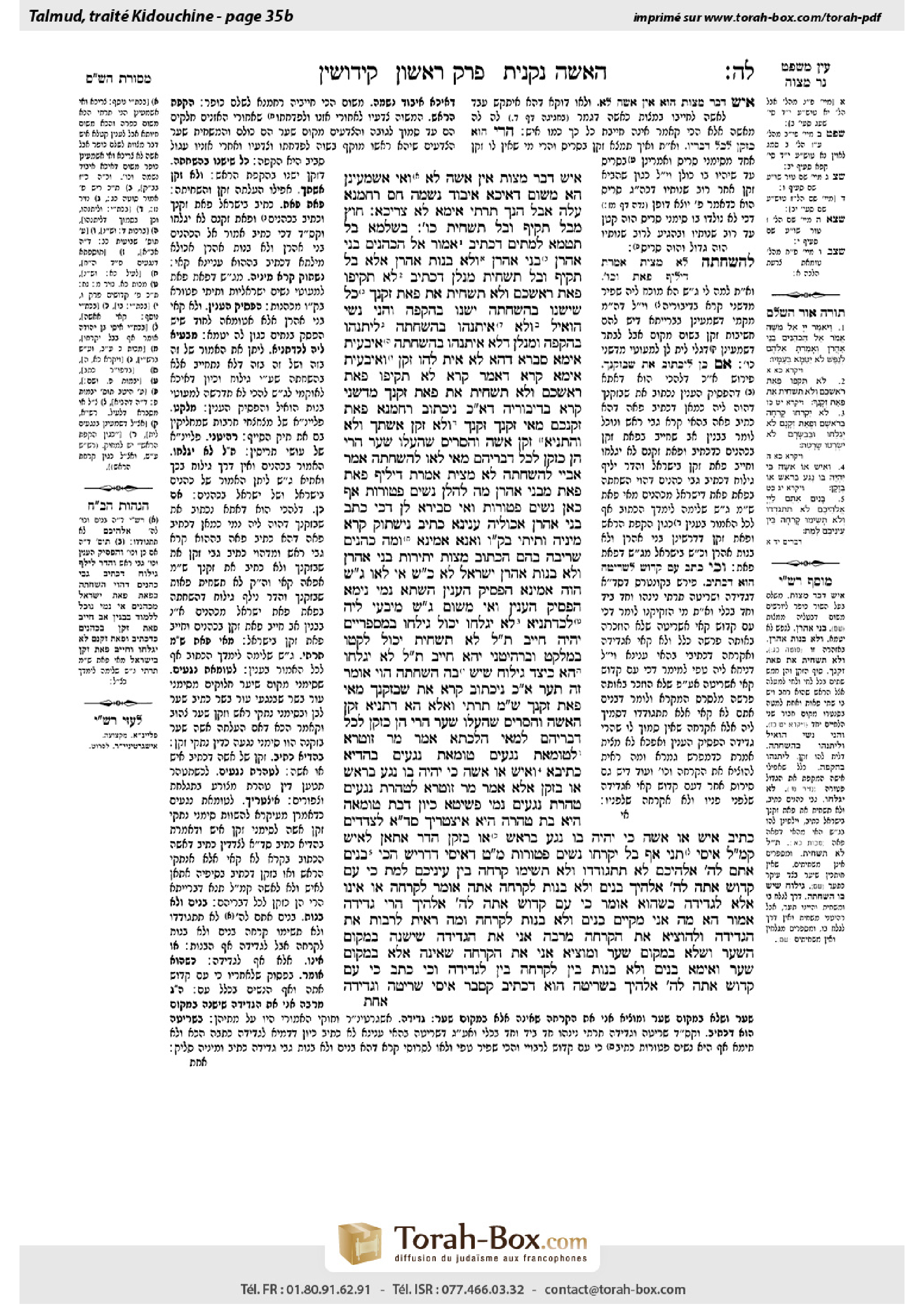
Kiddushin 35b: Talmud study for Daf Yomi
Daf Yomi is the daily study of one Talmud folio. Explore 37 tractates with scans, Hebrew text, Sefaria English and AI-generated French translations where annotated.
Passage selection and English or AI-generated French translation are available where the scan has annotations. Daf Study is independent of Torah-Box and Sefaria.
Browse Kiddushin · קידושין · All tractatesKiddushin 35b text and translations
This page of Kiddushin includes the Aramaic text, an English translation and an AI-generated French translation, alongside the scan above.
קידושין ל״ה ב · Aramaic and Hebrew text
אִישׁ, דְּבַר מִצְוֹת – אִין, אִשָּׁה – לָא. וְאִי אַשְׁמְעִינַן הָא: מִשּׁוּם דְּאִיכָּא אִיבּוּד נְשָׁמָה חָס רַחֲמָנָא עֲלַהּ, אֲבָל הָנָךְ תַּרְתֵּי – אֵימָא לָא, צְרִיכָא.
חוּץ מִ״בַּל תַּקִּיף״ וּ״בַל תַּשְׁחִית״ כּוּ׳. בִּשְׁלָמָא ״בַּל תִּטַּמֵּא לְמֵתִים״, דִּכְתִיב: ״אֱמֹר אֶל הַכֹּהֲנִים בְּנֵי אַהֲרֹן״ – בְּנֵי אַהֲרֹן, וְלֹא בְּנוֹת אַהֲרֹן. אֶלָּא ״בַּל תַּקִּיף״ וּ״בַל תַּשְׁחִית״ מְנָלַן?
דִּכְתִיב: ״לֹא תַקִּפוּ פְּאַת רֹאשְׁכֶם וְלֹא תַשְׁחִית אֵת פְּאַת זְקָנֶךָ״ – כֹּל שֶׁיֶּשְׁנוֹ בְּהַשְׁחָתָה יֶשְׁנוֹ בְּהַקָּפָה. וְהָנֵי נְשֵׁי, הוֹאִיל וְלָא אִיתַנְהוּ בְּהַשְׁחָתָה, לֵיתַנְהוּ בְּהַקָּפָה.
וּמְנָלַן דְּלָא אִיתַנְהוּ בְּהַשְׁחָתָה? אִיבָּעֵית אֵימָא סְבָרָא: דְּהָא לָא אִית לְהוּ זָקָן. וְאִיבָּעֵית אֵימָא קְרָא: דְּאָמַר קְרָא: ״לֹא תַקִּפוּ פְּאַת רֹאשְׁכֶם וְלֹא תַשְׁחִית אֵת פְּאַת זְקָנֶךָ״,
מִדְּשַׁנִּי קְרָא בְּדִיבּוּרֵיהּ, דְּאִם כֵּן נִיכְתּוֹב רַחֲמָנָא: ״פְּאַת זְקַנְכֶם״. מַאי ״זְקָנֶךָ״ – זְקָנֶךָ, וְלֹא זְקַן אִשְׁתְּךָ.
וְלָא? וְהָתַנְיָא: זְקַן אִשָּׁה, וְהַסָּרִיס שֶׁהֶעֱלוּ שֵׂעָר – הֲרֵי הֵן כְּזָקָן לְכׇל דִּבְרֵיהֶם. מַאי לָאו לְהַשְׁחָתָה?
אָמַר אַבָּיֵי: לְהַשְׁחָתָה לָא מָצֵית אָמְרַתְּ, דְּיָלֵיף ״פְּאַת״ ״פְּאַת״ מִבְּנֵי אַהֲרֹן, מָה לְהַלָּן נָשִׁים פְּטוּרוֹת – אַף כָּאן נָשִׁים פְּטוּרוֹת.
וְאִי סְבִירָא לַן דְּכִי כְּתִיב ״בְּנֵי אַהֲרֹן״ – אַכּוּלֵּיהּ עִנְיָנָא כְּתִיב, נִישְׁתּוֹק קְרָא מִינֵּיהּ וְתֵיתֵי בְּקַל וָחוֹמֶר, וַאֲנָא אָמֵינָא: וּמָה כֹּהֲנִים שֶׁרִיבָּה בָּהֶם הַכָּתוּב מִצְוֹת יְתֵירוֹת – ״בְּנֵי אַהֲרֹן״ – וְלֹא בְּנוֹת אַהֲרֹן, יִשְׂרָאֵל לֹא כׇּל שֶׁכֵּן?
אִי לָאו גְּזֵירָה שָׁוָה הֲוָה אָמֵינָא: הִפְסִיק הָעִנְיָן.
הַשְׁתָּא נָמֵי נֵימָא הִפְסִיק הָעִנְיָן! וְאִי מִשּׁוּם גְּזֵירָה שָׁוָה, מִיבְּעֵי לֵיהּ לְכִדְתַנְיָא: ״לֹא יְגַלֵּחוּ״, יָכוֹל גִּילְּחוֹ בְּמִסְפָּרַיִים יִהְיֶה חַיָּיב? תַּלְמוּד לוֹמַר: ״לֹא תַשְׁחִית״.
יָכוֹל לִקְּטוֹ בְּמַלְקֵט וּבְרָהִיטְנֵי יְהֵא חַיָּיב? תַּלְמוּד לוֹמַר: ״לֹא יְגַלֵּחוּ״. הָא כֵּיצַד? גִּילּוּחַ שֶׁיֵּשׁ בּוֹ הַשְׁחָתָה, הֱוֵי אוֹמֵר זֶה תַּעַר.
אִם כֵּן, נִיכְתּוֹב קְרָא: ״אֶת שֶׁבִּזְקָנֶךָ״, מַאי ״פְּאַת זְקָנֶךָ״ – שְׁמַע מִינַּהּ תַּרְתֵּי.
וְאֶלָּא הָא דְּתַנְיָא: זְקַן הָאִשָּׁה וְהַסָּרִיס שֶׁהֶעֱלוּ שֵׂעָר הֲרֵי הֵן כְּזָקָן לְכׇל דִּבְרֵיהֶם, לְמַאי הִלְכְתָא? אָמַר מָר זוּטְרָא: לְטוּמְאַת נְגָעִים.
טוּמְאַת נְגָעִים בְּהֶדְיָא כְּתִיבָא, ״וְאִישׁ אוֹ אִשָּׁה כִּי יִהְיֶה בוֹ נָגַע בְּרֹאשׁ אוֹ בְזָקָן״! אֶלָּא אָמַר מָר זוּטְרָא: לְטׇהֳרַת נְגָעִים.
טׇהֳרַת נְגָעִים נָמֵי פְּשִׁיטָא, כֵּיוָן דְּבַת טוּמְאָה הִיא – בַּת טׇהֳרָה הִיא! אִיצְטְרִיךְ, סָלְקָא דַּעְתָּךְ אָמֵינָא לִצְדָדִים כְּתִיב: ״אִישׁ אוֹ אִשָּׁה כִּי יִהְיֶה בוֹ נָגַע בְּרֹאשׁ״, ״אוֹ בְזָקָן״ – הֲדַר אֲתָאן לְאִישׁ, קָא מַשְׁמַע לַן.
אִיסִי תָּנֵי: אַף ״בַּל יִקְרְחוּ״ – נָשִׁים פְּטוּרוֹת. מַאי טַעְמָא דְּאִיסִי דְּדָרֵישׁ הָכִי? ״בָּנִים אַתֶּם לַה׳ אֱלֹהֵיכֶם לֹא תִתְגֹּדְדוּ וְלֹא תָשִׂימוּ קׇרְחָה בֵּין עֵינֵיכֶם לָמֵת. כִּי עַם קָדוֹשׁ אַתָּה לַה׳ אֱלֹהֶיךָ״, בָּנִים וְלֹא בָּנוֹת – לְקׇרְחָה.
אַתָּה אוֹמֵר לְקׇרְחָה, אוֹ אֵינוֹ אֶלָּא לִגְדִידָה? כְּשֶׁהוּא אוֹמֵר: ״כִּי עַם קָדוֹשׁ אַתָּה לַה׳ אֱלֹהֶיךָ״ – הֲרֵי גְּדִידָה אָמוּר, הָא מָה אֲנִי מְקַיֵּים בָּנִים וְלֹא בָּנוֹת – לְקׇרְחָה.
וּמָה רָאִיתָ לְרַבּוֹת אֶת הַגְּדִידָה וּלְהוֹצִיא אֶת הַקׇּרְחָה? מְרַבֶּה אֲנִי אֶת הַגְּדִידָה, שֶׁיֶּשְׁנָהּ בִּמְקוֹם הַשֵּׂעָר וְשֶׁלֹּא בִּמְקוֹם שֵׂעָר, וּמוֹצִיא אֲנִי אֶת הַקׇּרְחָה שֶׁאֵינָהּ אֶלָּא בִּמְקוֹם שֵׂעָר.
וְאֵימָא: בָּנִים וְלֹא בָּנוֹת – בֵּין לְקׇרְחָה בֵּין לִגְדִידָה, וְכִי כְּתִב: ״כִּי עַם קָדוֹשׁ אַתָּה לַה׳ אֱלֹהֶיךָ״, בִּשְׂרִיטָה הוּא דִּכְתִיב! קָסָבַר אִיסִי שְׂרִיטָה וּגְדִידָה
Kiddushin 35b · English translation
If the animal killed a man, who is commanded in all mitzvot, yes, its owner should have to pay the ransom, but if the animal killed a woman, who is obligated in only some mitzvot, no, he is exempt from the ransom. And conversely: If the Torah had taught us that men and women are equated only in this case of the ransom, one might say that because there is the loss of life the Merciful One has pity on her and therefore the owner of the animal is always obligated to pay the ransom. But with regard to those two other categories, I might say no, a woman is not equated to a man. Therefore it was necessary to mention them all.
§ The mishna teaches that women are obligated in all prohibitions except for the prohibitions of: Do not round the corners of one’s head, and: Do not destroy the corners of your beard, and: Do not contract ritual impurity from a corpse. The Gemara asks: Granted, a woman of priestly lineage is not obligated in the mitzva of: Do not contract ritual impurity from a corpse, as it is written: “Speak to the priests, the sons of Aaron, and say to them: None shall become impure for the dead among his people” (Leviticus 21:1). This verse teaches that the prohibition applies to the sons of Aaron, but not the daughters of Aaron. But from where do we derive the prohibitions of: Do not round the corners of one’s head, and: Do not destroy the corners of your beard?
The Gemara answers that this is as it is written: “You shall not round the corners of your head and you shall not destroy the corners of your beard” (Leviticus 19:27). The juxtaposition of the two prohibitions teaches that anyone who is included in the prohibition against destroying the beard is included in the prohibition against rounding the head. And since these women are not included in the prohibition against destroying, they are also not included in the prohibition against rounding the head.
The Gemara asks: And from where do we derive that women are not obligated in the prohibition against destroying the corners of one’s beard? The Gemara answers: If you wish, propose a logical reason, as ordinarily women do not have a beard. And if you wish, cite a verse that teaches this point, as the verse states: “You shall not round the corners of your head [roshekhem] and you shall not destroy the corners of your beard [zekanekha]” (Leviticus 19:27).
The Gemara explains: From the fact that the verse changed its language, as the term “your head [roshekhem]” is in the plural while “your beard [zekanekha]” is in the singular, it can be inferred that if so, if the prohibition against destroying one’s beard applied to everyone, let the Merciful One write: And you shall not destroy the corners of your beards [zekanekhem], in the plural, so that the end of the verse parallels the beginning. What is indicated by the fact that the verse states: “And you shall not destroy the corners of your beard [zekanekha],” in the singular? This serves to teach: Your beard is included, but not your wife’s beard.
The Gemara asks: And is a woman not included in this prohibition? But isn’t it taught in a baraita (Tosefta, Nega’im 4:8): The beard of a woman and that of a eunuch, if they grow facial hair, are considered like a beard for all matters. What, is it not the case that this statement is referring to the prohibition against destroying?
Abaye said: You cannot say that the baraita is referring to destroying, as it is derived that a woman is exempt through the verbal analogy of “the corners of your beard” (Leviticus 19:27) here and “the corners of their beard” (Leviticus 21:5) from the sons of Aaron: Just as there, in the case of priests, women are certainly exempt from the mitzva, as the verse is referring to the male descendants of Aaron who perform the Temple service and not to women, so too here, with regard to the prohibition against destroying one’s beard, which is stated to all Jews, women are exempt. At this stage the Gemara assumes that the exclusion of women denoted by the verse: “Speak to the priests, the sons of Aaron” (Leviticus 21:1), which excludes women, is applied to all the mitzvot stated in that chapter, including destroying the corners of one’s beard.
The Gemara asks: But if we maintain that when the Merciful One writes: “The sons of Aaron” (Leviticus 21:1), it is written with regard to the entire manner of that chapter, including the prohibition against destroying one’s beard, let the verse, i.e., the Torah, be silent and not state about this prohibition concerning all Jews. And this halakha could be derived through an a fortiori inference, as I could say the following: And if with regard to priests, for whom the verse includes additional mitzvot, this prohibition applies only to the sons of Aaron and not the daughters of Aaron, is it not all the more so the case with regard to Israelites, who have fewer mitzvot, that only men should be obligated and not women?
The Gemara answers: Nevertheless, the verbal analogy is necessary. Were it not for the verbal analogy, I would say that the halakhot of ritual impurity concluded discussion of that matter. In other words, the exclusion of women denoted by the phrase “the sons of Aaron” applies only to the halakhot of impurity, which appear immediately after that phrase. Conversely, the other halakhot mentioned in this chapter, including the prohibition against destroying the beard, apply to women as well.
The Gemara asks: If so, now too, let us say that the halakhot of ritual impurity concluded discussion of that matter, and the daughters of Aaron are also prohibited to destroy their beards. And if you maintain that the reason the prohibition stated with regard to priests does not apply to women is due to the verbal analogy employing the term “the corners of,” which serves to connect the halakha stated with regard to priests with the halakha stated with regard to all Jews, that verbal analogy is necessary for that which is taught in a baraita: The verse states with regard to priests: “Neither shall they shave off the corners of their beard” (Leviticus 21:5). One might have thought that a priest would be liable even if he shaved his beard with scissors. Therefore the verse states, in a command issued to all Jews: “And you shall not destroy the corners of your beard” (Leviticus 19:27). This teaches that one is liable only for destroying the beard to the root, which is not achieved with scissors.
The baraita continues: One might have thought that if he extracted his hairs with tweezers, which uproot hairs, or small planes [uvirhitni], he should likewise be liable for destroying his hair. The verse therefore states: “Neither shall they shave off the corners of their beard,” to teach that shaving alone is prohibited and these actions are not considered shaving. How can both these requirements for the prohibition be met? The verse is referring to a type of shaving that involves destruction. You must say this is shaving with a razor. According to this baraita, the verbal analogy is necessary to define the action included in the prohibition against destroying, not to teach who is included in the prohibition.
The Gemara explains: If it is so that the verbal analogy teaches only which action is included in the prohibition against destroying, let the verse write: That which is of your beard. What is added by the expression “the corners of your beard”? Conclude two conclusions from it, both the definition of the prohibition against shaving and the exemption of women.
The Gemara returns to its question. But that which is taught in the baraita: The beard of a woman and that of a eunuch, if they grew facial hair, are considered like a beard for all matters, with regard to what halakha is this stated? Mar Zutra says: It is stated with regard to ritual impurity from leprosy. A leprous sore in the beard of a woman or a eunuch is treated like an affliction of the beard, not like an affliction on the skin. Different halakhot apply to leprous sores that develop on various parts of the body.
The Gemara objects: Concerning ritual impurity from leprosy, it is written explicitly: “And when a man or woman has a plague upon the head or upon the beard” (Leviticus 13:29). This indicates that there is no difference between a man and woman with regard to the beard in the case of leprosy. The baraita would not state a halakha that is explicit in the verse. Rather, Mar Zutra says: This baraita is referring to ritual purification from leprosy, i.e., women can also be purified from leprosy of the beard.
The Gemara asks: With regard to ritual purification from leprosy it is also obvious: Since impurity applies to a woman, purity likewise applies to her. The Gemara answers: It was necessary to state this with regard to the impurity of afflictions of the beard, as it might enter your mind to say that this verse is written disjunctively, i.e., that the phrase: “And when a man or woman has a plague upon the head,” applies to both a man or a woman; whereas when it states: “Or upon the beard,” we have come back to the case of a man alone. Therefore the baraita teaches us that this phrase is not referring solely to a man, as there is no difference between a man and a woman with regard to leprosy.
Isi taught in a baraita: Women are also exempt from the prohibition: Do not make baldness upon your heads, a prohibition against tearing out one’s hair in grief over someone’s death. The Gemara asks: What is the reason of Isi? The Gemara explains that he teaches as follows: The verse states: “You are the sons of the Lord your God; you shall not cut yourselves, nor make any baldness between your eyes for the dead. For you are a holy people to the Lord your God” (Deuteronomy 14:1–2). This verse, which applies to sons and not daughters, is referring to causing baldness, and therefore this prohibition includes only men.
The Gemara asks: Do you say that this is referring to causing baldness, or is it perhaps referring only to the prohibition against cutting, which appears first? The Gemara answers that when it states: “For you are a holy people to the Lord your God,” it is stated with regard to the prohibition against cutting, and this verse applies to both men and women, as they are all members of God’s people. How then do I realize and explain the emphasis on sons and not daughters? This is referring to the prohibition against causing baldness.
The Gemara asks: And what did you see to include cutting and to exclude causing baldness? Perhaps the opposite is true, and causing baldness applies to men and women whereas cutting applies only to men. The Gemara answers: I include cutting, whose prohibition is broader, as it is applicable both in a place of hair and not in a place of hair; and I exclude causing baldness, which is more limited, as it applies only in a place of hair.
The Gemara asks: But one can say that the limitation of sons and not daughters applies both to causing baldness and to cutting, and when the verse writes: “For you are a holy people to the Lord your God,” that is written with regard to scoring oneself. The prohibition against scoring oneself is derived from a verbal analogy from a verse stated with regard to priests (see Leviticus 21:5), which applies to both men and women. The Gemara answers: Isi maintains that scoring oneself and cutting
Kiddushin 35b · Traduction française (IA)
Si l’animal a tué un homme, qui est astreint à toutes les mitsvot, oui, son propriétaire doit payer la rançon ; mais si l’animal a tué une femme, qui n’est astreinte qu’à certaines mitsvot, non, son propriétaire est dispensé de la rançon. Et inversement : si la Torah nous avait enseigné que les hommes et les femmes sont assimilés uniquement dans ce cas de la rançon, on aurait pu dire que, puisqu’il y a perte d’une vie, le Miséricordieux a pitié d’elle et que le propriétaire de l’animal est donc toujours tenu de payer la rançon. Mais, concernant les deux autres catégories, on aurait pu dire qu’une femme n’est pas assimilée à un homme. Il était donc nécessaire de les mentionner toutes.
§ La Michna enseigne que les femmes sont astreintes à toutes les interdictions, à l’exception des suivantes : « Ne rase pas les coins de ta tête », « Ne détruis pas les coins de ta barbe » et « Ne contracte pas d’impureté rituelle au contact d’un mort ». La Guemara demande : Il est compréhensible qu’une femme de lignée sacerdotale ne soit pas astreinte à la mitsva de ne pas contracter d’impureté rituelle au contact d’un mort, car il est écrit : « Parle aux prêtres, fils d’Aaron, et dis-leur : Qu’aucun d’eux ne se rende impur au contact d’un mort parmi son peuple » (Lévitique 21:1). Ce verset enseigne que l’interdiction s’applique aux fils d’Aaron, mais non à ses filles. Mais d’où déduit-on les interdictions de ne pas raser les coins de la tête et de ne pas détruire les coins de la barbe ?
La Guemara répond que cela découle de ce qui est écrit : « Vous ne raserez pas les coins de votre tête et vous ne détruirez pas les coins de votre barbe » (Lévitique 19:27). Le rapprochement des deux interdictions enseigne que quiconque est concerné par l’interdiction de détruire la barbe est également concerné par celle de raser les coins de la tête. Puisque ces femmes ne sont pas concernées par l’interdiction de détruire la barbe, elles ne sont pas non plus concernées par celle de raser les coins de la tête.
La Guemara demande : Et d’où déduit-on que les femmes ne sont pas astreintes à l’interdiction de détruire les coins de la barbe ? La Guemara répond : Si tu veux, avance une raison logique, car les femmes n’ont généralement pas de barbe. Et si tu veux, cite un verset qui enseigne ce point, car il est écrit : « Vous ne raserez pas les coins de votre tête [roshekhem] et vous ne détruirez pas les coins de votre barbe [zekanekha] » (Lévitique 19:27).
La Guemara explique : Du fait que le verset change de formulation — le terme « votre tête [roshekhem] » est au pluriel, tandis que « votre barbe [zekanekha] » est au singulier —, on peut déduire ceci : si l’interdiction de détruire la barbe s’appliquait à tous, le Miséricordieux aurait écrit : « Et vous ne détruirez pas les coins de vos barbes [zekanekhem] », au pluriel, afin que la fin du verset corresponde à son début. Que nous indique donc le fait que le verset dise : « Et vous ne détruirez pas les coins de votre barbe [zekanekha] », au singulier ? Cela enseigne : votre barbe est incluse, mais pas celle de votre épouse.
La Guemara demande : Une femme n’est-elle donc pas concernée par cette interdiction ? N’est-il pas enseigné dans une baraïta (Tossefta, Negaïm 4:8) que la barbe d’une femme et celle d’un eunuque, si des poils leur poussent au visage, sont considérées comme une barbe à tous égards ? N’est-ce pas l’interdiction de détruire la barbe qui est visée ici ?
Abayé dit : On ne peut pas dire que la baraïta parle de détruire la barbe, car on déduit que les femmes en sont dispensées par l’analogie verbale entre « les coins de ta barbe » (Lévitique 19:27), ici, et « les coins de leur barbe » (Lévitique 21:5), au sujet des fils d’Aaron. De même que là, dans le cas des prêtres, les femmes sont certainement dispensées de la mitsva, puisque le verset parle des descendants masculins d’Aaron qui accomplissent le service au Temple, et non des femmes, de même ici, concernant l’interdiction de détruire la barbe, énoncée pour tous les Juifs, les femmes en sont dispensées. À ce stade, la Guemara suppose que l’exclusion des femmes exprimée par le verset « Parle aux prêtres, fils d’Aaron » (Lévitique 21:1) s’applique à toutes les mitsvot énoncées dans ce chapitre, y compris l’interdiction de détruire les coins de la barbe.
La Guemara demande : Mais si nous soutenons que, lorsque le Miséricordieux écrit « les fils d’Aaron » (Lévitique 21:1), cette expression concerne tout le contenu du chapitre, y compris l’interdiction de détruire la barbe, que le verset — c’est-à-dire la Torah — garde le silence et ne mentionne pas cette interdiction pour tous les Juifs. On pourrait déduire cette halakha par un raisonnement a fortiori : si, concernant les prêtres, auxquels le verset impose des mitsvot supplémentaires, cette interdiction ne s’applique qu’aux fils d’Aaron et non à ses filles, n’est-ce pas à plus forte raison le cas des Israélites, qui ont moins de mitsvot ? Seuls les hommes devraient donc y être astreints, et non les femmes.
La Guemara répond : Néanmoins, l’analogie verbale est nécessaire. Sans elle, j’aurais dit que les lois de l’impureté rituelle clôturent le sujet. Autrement dit, l’exclusion des femmes exprimée par les mots « les fils d’Aaron » ne s’applique qu’aux lois de l’impureté, qui suivent immédiatement ces mots. À l’inverse, les autres lois mentionnées dans ce chapitre, y compris l’interdiction de détruire la barbe, s’appliquent aussi aux femmes.
La Guemara demande : Si c’est ainsi, disons également que les lois de l’impureté rituelle clôturent le sujet, et que les filles d’Aaron sont elles aussi interdites de détruire leur barbe. Et si tu soutiens que l’interdiction énoncée à propos des prêtres ne s’applique pas aux femmes en raison de l’analogie verbale fondée sur l’expression « les coins de », qui relie la halakha énoncée pour les prêtres à celle qui est énoncée pour tous les Juifs, cette analogie verbale est nécessaire pour expliquer ce qui est enseigné dans une baraïta : le verset dit au sujet des prêtres : « Ils ne raseront pas les coins de leur barbe » (Lévitique 21:5). On aurait pu penser qu’un prêtre serait passible même s’il se rasait la barbe avec des ciseaux. Le verset dit donc, dans un commandement adressé à tous les Juifs : « Et tu ne détruiras pas les coins de ta barbe » (Lévitique 19:27). Cela enseigne qu’on n’est passible que si l’on détruit la barbe jusqu’à la racine, ce que les ciseaux ne permettent pas.
La baraïta poursuit : On aurait pu penser que s’il arrachait ses poils avec des pincettes, qui les extirpent, ou avec de petits rabots [uvirhitni], il serait également passible pour avoir détruit sa pilosité. Le verset dit donc : « Ils ne raseront pas les coins de leur barbe », pour enseigner que seul le rasage est interdit et que ces gestes ne sont pas considérés comme un rasage. Comment satisfaire ces deux conditions de l’interdiction ? Le verset parle d’un type de rasage qui implique une destruction. Il faut donc dire qu’il s’agit du rasage au rasoir. Selon cette baraïta, l’analogie verbale est nécessaire pour définir l’acte visé par l’interdiction de détruire, et non pour enseigner qui est concerné par cette interdiction.
La Guemara explique : S’il en est ainsi, si l’analogie verbale n’enseigne que quel acte est visé par l’interdiction de détruire, que le verset dise : « Ce qui est de ta barbe ». Qu’ajoute l’expression « les coins de ta barbe » ? On en déduit deux conclusions : à la fois la définition de l’interdiction de raser et l’exemption des femmes.
La Guemara revient à sa question. Mais la règle enseignée dans la baraïta — la barbe d’une femme et celle d’un eunuque, si des poils leur poussent au visage, sont considérées comme une barbe à tous égards —, à quelle halakha se rapporte-t-elle ? Mar Zutra dit : elle concerne l’impureté rituelle due à la lèpre. Une plaie lépreuse dans la barbe d’une femme ou d’un eunuque est traitée comme une atteinte à la barbe, et non comme une atteinte à la peau. Des halakhot différentes s’appliquent aux plaies lépreuses qui apparaissent sur les diverses parties du corps.
La Guemara objecte : Concernant l’impureté rituelle due à la lèpre, il est écrit explicitement : « Lorsqu’un homme ou une femme aura une plaie à la tête ou à la barbe » (Lévitique 13:29). Cela indique qu’en matière de lèpre, il n’y a pas de différence entre un homme et une femme concernant la barbe. La baraïta n’énoncerait pas une halakha qui figure explicitement dans le verset. Mar Zutra dit plutôt : cette baraïta parle de la purification rituelle de la lèpre, c’est-à-dire que les femmes peuvent elles aussi être purifiées d’une lèpre de la barbe.
La Guemara demande : Concernant la purification rituelle de la lèpre, cela aussi va de soi : puisque l’impureté s’applique à une femme, la purification s’applique également à elle. La Guemara répond : Il était nécessaire de préciser cela au sujet de l’impureté des atteintes de la barbe, car on aurait pu penser que le verset est formulé de manière disjonctive, c’est-à-dire que l’expression « Lorsqu’un homme ou une femme aura une plaie à la tête » s’applique aussi bien à un homme qu’à une femme, tandis qu’avec les mots « ou à la barbe », on reviendrait au cas de l’homme seul. La baraïta nous enseigne donc que cette expression ne vise pas uniquement un homme, car il n’y a pas de différence entre un homme et une femme en matière de lèpre.
Isi enseigna dans une baraïta : les femmes sont également dispensées de l’interdiction « Ne faites pas de tonsure sur votre tête », qui interdit de s’arracher les cheveux en signe de deuil pour un mort. La Guemara demande : Quelle est la raison d’Isi ? La Guemara explique qu’il enseigne ainsi : le verset dit : « Vous êtes les fils de l’Éternel votre Dieu ; vous ne vous ferez pas d’incisions et vous ne vous ferez pas de tonsure entre vos yeux pour un mort. Car vous êtes un peuple saint pour l’Éternel votre Dieu » (Deutéronome 14:1–2). Ce verset, qui s’adresse aux fils et non aux filles, concerne la tonsure ; cette interdiction ne s’applique donc qu’aux hommes.
La Guemara demande : Dis-tu que cela concerne la tonsure, ou peut-être cela ne concerne-t-il que l’interdiction de se faire des incisions, mentionnée en premier ? La Guemara répond que les mots « Car vous êtes un peuple saint pour l’Éternel votre Dieu » se rapportent à l’interdiction de se faire des incisions, et que ce verset s’applique aux hommes comme aux femmes, puisqu’ils sont tous membres du peuple de Dieu. Comment donc comprendre et expliquer la précision « les fils » et non « les filles » ? Elle concerne l’interdiction de se faire une tonsure.
La Guemara demande : Et qu’as-tu vu pour inclure les incisions et exclure la tonsure ? Peut-être est-ce l’inverse : la tonsure s’appliquerait aux hommes et aux femmes, tandis que les incisions ne concerneraient que les hommes. La Guemara répond : J’inclus les incisions, dont l’interdiction a une portée plus large, puisqu’elles peuvent être faites dans une zone avec des poils comme dans une zone sans poils ; et j’exclus la tonsure, dont la portée est plus restreinte, puisqu’elle ne s’applique que dans une zone avec des poils.
La Guemara demande : Mais on pourrait dire que la limitation aux fils et non aux filles s’applique à la fois à la tonsure et aux incisions, et que les mots « Car vous êtes un peuple saint pour l’Éternel votre Dieu » se rapportent aux entailles rituelles. L’interdiction de se faire de telles entailles est déduite par une analogie verbale avec un verset énoncé au sujet des prêtres (voir Lévitique 21:5), et s’applique aux hommes comme aux femmes. La Guemara répond : Isi considère que les entailles rituelles et les incisions
Traduction française générée par IA à partir de l’édition anglaise de Sefaria. Vérifie toujours un passage avec le texte source.
Text from Sefaria: William Davidson Edition - Vocalized Aramaic (CC BY NC); William Davidson Edition - English (CC BY NC).