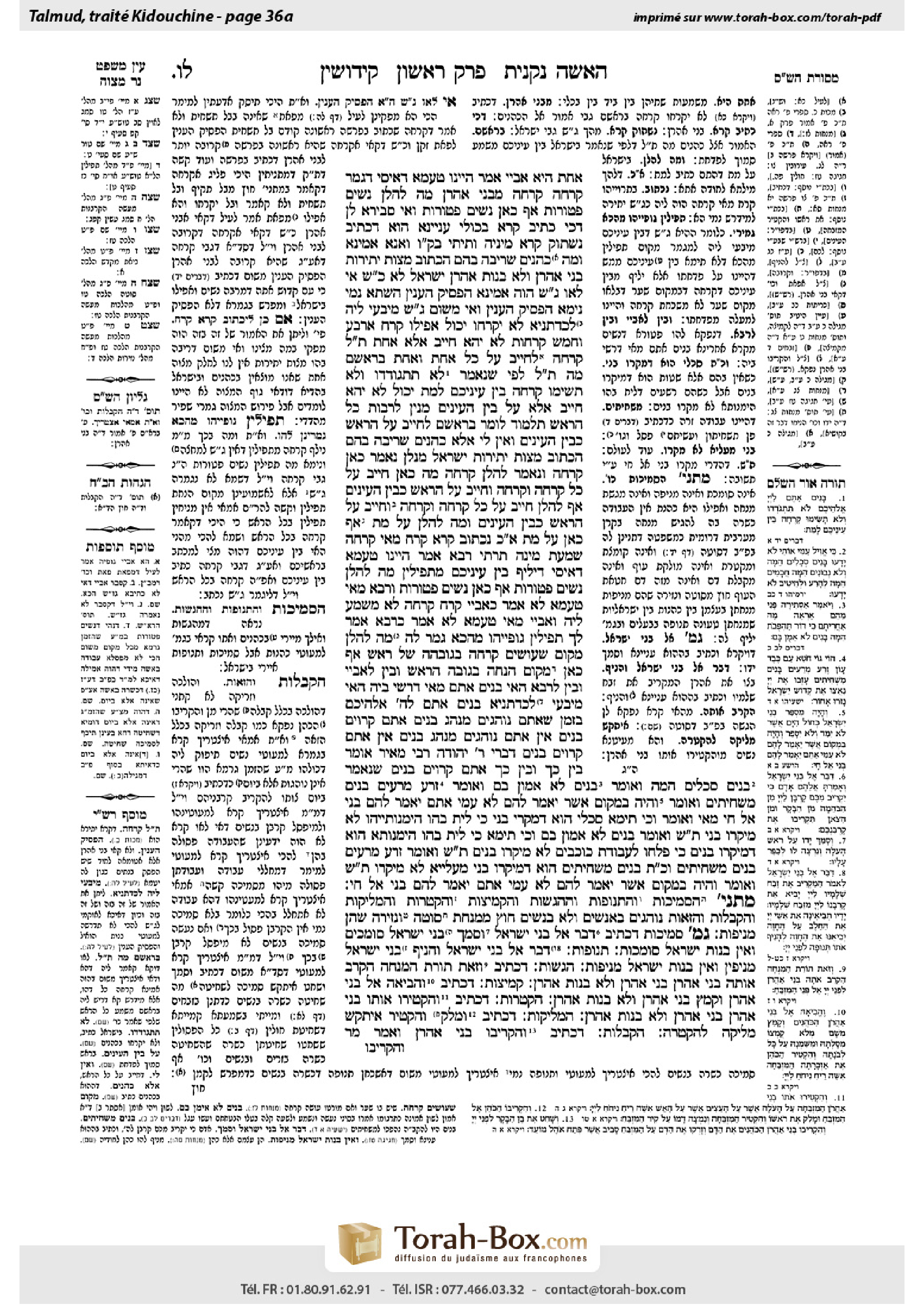
Kiddushin 36a: Talmud study for Daf Yomi
Daf Yomi is the daily study of one Talmud folio. Explore 37 tractates with scans, Hebrew text, Sefaria English and AI-generated French translations where annotated.
Passage selection and English or AI-generated French translation are available where the scan has annotations. Daf Study is independent of Torah-Box and Sefaria.
Browse Kiddushin · קידושין · All tractatesKiddushin 36a text and translations
This page of Kiddushin includes the Aramaic text, an English translation and an AI-generated French translation, alongside the scan above.
קידושין ל״ו א · Aramaic and Hebrew text
אַחַת הִיא.
אַבָּיֵי אָמַר: הַיְינוּ טַעְמָא דְּאִיסִי, דְּגָמַר ״קׇרְחָה״ ״קׇרְחָה״ מִבְּנֵי אַהֲרֹן, מָה לְהַלָּן נָשִׁים פְּטוּרוֹת – אַף כָּאן נָשִׁים פְּטוּרוֹת.
וְאִי סְבִירָא לַן דְּכִי כְּתִיב קְרָא, בְּכוּלֵּי עִנְיָינָא הוּא דִּכְתִיב, נִשְׁתּוֹק קְרָא מִינֵּיהּ וְתֵיתֵי בְּקַל וָחוֹמֶר, וַאֲנָא אָמֵינָא: וּמָה כֹּהֲנִים שֶׁרִיבָּה בָּהֶם הַכָּתוּב מִצְוֹת יְתֵירוֹת – ״בְּנֵי אַהֲרֹן״ – וְלֹא בְּנוֹת אַהֲרֹן, יִשְׂרָאֵל לֹא כׇּל שֶׁכֵּן?
אִי לָאו גְּזֵרָה שָׁוָה הֲוָה אָמֵינָא: הִפְסִיק הָעִנְיָן.
הַשְׁתָּא נָמֵי נֵימָא הִפְסִיק הָעִנְיָן, וְאִי מִשּׁוּם גְּזֵרָה שָׁוָה – מִיבְּעֵי לֵיהּ לְכִדְתַנְיָא: ״לֹא יִקְרְחוּ״, יָכוֹל אֲפִילּוּ קָרַח אַרְבַּע וְחָמֵשׁ קְרָחוֹת לֹא יְהֵא חַיָּיב אֶלָּא אַחַת? תַּלְמוּד לוֹמַר: ״קׇרְחָה״ – לְחַיֵּיב עַל כׇּל אַחַת וְאַחַת.
״בְּרֹאשָׁם״ מָה תַּלְמוּד לוֹמַר? לְפִי שֶׁנֶּאֱמַר: ״לֹא תִתְגֹּדְדוּ וְלֹא תָשִׂימוּ קׇרְחָה בֵּין עֵינֵיכֶם לָמֵת״, יָכוֹל לֹא יְהֵא חַיָּיב אֶלָּא עַל בֵּין הָעֵינַיִם, מִנַּיִן לְרַבּוֹת כָּל הָרֹאשׁ? תַּלְמוּד לוֹמַר: ״בְּרֹאשָׁם״ – לְחַיֵּיב עַל הָרֹאשׁ כְּבֵין הָעֵינַיִם.
וְאֵין לִי אֶלָּא כֹּהֲנִים, שֶׁרִיבָּה בָּהֶם הַכָּתוּב מִצְוֹת יְתֵירוֹת, יִשְׂרָאֵל מְנָלַן? – נֶאֱמַר כָּאן: ״קׇרְחָה״ וְנֶאֱמַר לְהַלָּן: ״קׇרְחָה״, מָה כָּאן חַיָּיב עַל כׇּל קׇרְחָה וְקׇרְחָה, וְחַיָּיב עַל הָרֹאשׁ כְּבֵין הָעֵינַיִם – אַף לְהַלָּן חַיָּיב עַל כׇּל קׇרְחָה וְקׇרְחָה, וְחַיָּיב עַל הָרֹאשׁ כְּבֵין הָעֵינַיִם.
וּמָה לְהַלָּן עַל מֵת, אַף כָּאן עַל מֵת. אִם כֵּן נִכְתּוֹב קְרָא ״קֹרַח״, מַאי ״קׇרְחָה״ – שָׁמְעַתְּ מִינַּהּ תַּרְתֵּי.
רָבָא אָמַר: הַיְינוּ טַעְמָא דְּאִיסִי, דְּיָלֵיף ״בֵּין עֵינֵיכֶם״ מִתְּפִילִּין, מָה לְהַלָּן נָשִׁים פְּטוּרוֹת, אַף כָּאן נָשִׁים פְּטוּרוֹת. וְרָבָא מַאי טַעְמָא לָא אָמַר כְּאַבַּיֵּי? ״קֹרַח״ ״קׇרְחָה״ לָא מַשְׁמַע לֵיהּ.
וְאַבָּיֵי מַאי טַעְמָא לָא אָמַר כְּרָבָא? אָמַר לָךְ: תְּפִילִּין גּוּפַיְיהוּ מֵהָכָא גָּמַר לַהּ: מָה לְהַלָּן מְקוֹם שֶׁעוֹשִׂים קׇרְחָה, בְּגוֹבַהּה שֶׁל רֹאשׁ, אַף כָּאן מְקוֹם הַנָּחָה בְּגוֹבַהּ הָרֹאשׁ.
וּבֵין לְאַבָּיֵי וּבֵין לְרָבָא, הַאי ״בָּנִים אַתֶּם״, מַאי דָּרְשִׁי בֵּיהּ? הַאי מִיבְּעֵי לְכִדְתַנְיָא: ״בָּנִים אַתֶּם לַה׳ אֱלֹהֵיכֶם״, בִּזְמַן שֶׁאַתֶּם נוֹהֲגִים מִנְהַג בָּנִים – אַתֶּם קְרוּיִם בָּנִים, אֵין אַתֶּם נוֹהֲגִים מִנְהַג בָּנִים – אֵין אַתֶּם קְרוּיִם בָּנִים, דִּבְרֵי רַבִּי יְהוּדָה.
רַבִּי מֵאִיר אוֹמֵר: בֵּין כָּךְ וּבֵין כָּךְ אַתֶּם קְרוּיִם בָּנִים, שֶׁנֶּאֱמַר: ״בָּנִים סְכָלִים הֵמָּה״, וְאוֹמֵר: ״בָּנִים לֹא אֵמֻן בָּם״, וְאוֹמֵר: ״זֶרַע מְרֵעִים בָּנִים מַשְׁחִיתִים״, וְאוֹמֵר: ״וְהָיָה בִּמְקוֹם אֲשֶׁר יֵאָמֵר לָהֶם לֹא עַמִּי אַתֶּם יֵאָמֵר לָהֶם בְּנֵי אֵל חָי״.
מַאי ״וְאוֹמֵר״? וְכִי תֵּימָא: סְכָלֵי הוּא דְּמִקְּרוּ בְּנֵי, כִּי לֵית בְּהוּ הֵימָנוּתַיְיהוּ לָא מִיקְּרוּ בְּנֵי – תָּא שְׁמַע, וְאוֹמֵר: ״בָּנִים לֹא אֵמֻן בָּם״,
וְכִי תֵּימָא: כִּי לֵית בְּהוּ הֵימָנוּתָא הוּא דְּמִיקְּרוּ בָּנִים, כִּי פָּלְחוּ לַעֲבוֹדָה זָרָה לָא מִיקְּרוּ בָּנִים – תָּא שְׁמַע, וְאוֹמֵר: ״זֶרַע מְרֵעִים בָּנִים מַשְׁחִיתִים״. וְכִי תֵּימָא: ״בָּנִים מַשְׁחִיתִים״ הוּא דְּמִיקְּרוּ, בְּנֵי מְעַלְּיָיא לָא מִיקְּרוּ – תָּא שְׁמַע, וְאוֹמֵר: ״וְהָיָה בִּמְקוֹם אֲשֶׁר יֵאָמֵר לָהֶם לֹא עַמִּי אַתֶּם יֵאָמֵר לָהֶם בְּנֵי אֵל חָי״.
מַתְנִי׳, הַסְּמִיכוֹת, וְהַתְּנוּפוֹת, וְהַהַגָּשׁוֹת, וְהַקְּמִיצוֹת, וְהַ[הַ]קְטָרוֹת, וְהַמְּלִיקוֹת, וְהַקַּבָּלוֹת, וְהַזָּאוֹת – נוֹהֲגִים בַּאֲנָשִׁים וְלֹא בְּנָשִׁים, חוּץ מִמִּנְחַת סוֹטָה וּנְזִירָה שֶׁהֵן מְנִיפוֹת.
גְּמָ׳ סְמִיכוֹת. דִּכְתִיב: ״דַּבֵּר אֶל בְּנֵי יִשְׂרָאֵל... וְסָמַךְ״ – בְּנֵי יִשְׂרָאֵל סוֹמְכִים, וְאֵין בְּנוֹת יִשְׂרָאֵל סוֹמְכוֹת.
תְּנוּפוֹת. ״דַּבֵּר אֶל בְּנֵי יִשְׂרָאֵל... וְהֵנִיף״ – בְּנֵי יִשְׂרָאֵל מְנִיפִין, וְאֵין בְּנוֹת יִשְׂרָאֵל מְנִיפוֹת.
הַגָּשׁוֹת. דִּכְתִיב: ״וְזֹאת תּוֹרַת הַמִּנְחָה... הַקְרֵב אֹתָהּ בְּנֵי אַהֲרֹן״ – בְּנֵי אַהֲרֹן, וְלֹא בְּנוֹת אַהֲרֹן.
קְמִיצוֹת. דִּכְתִיב: ״וֶהֱבִיאָהּ אֶל בְּנֵי אַהֲרֹן וְקָמַץ״ – בְּנֵי אַהֲרֹן, וְלֹא בְּנוֹת אַהֲרֹן.
הַקְטָרוֹת. דִּכְתִיב: ״וְהִקְטִירוּ אֹתוֹ בְּנֵי אַהֲרֹן״ – בְּנֵי אַהֲרֹן, וְלֹא בְּנוֹת אַהֲרֹן.
הַמְּלִיקוֹת. דִּכְתִיב: ״וּמָלַק... וְהִקְטִיר״, אִיתַּקַּשׁ מְלִיקָה לְהַקְטָרָה.
הַקַּבָּלוֹת. דִּכְתִיב: ״וְהִקְרִיבוּ בְּנֵי אַהֲרֹן״, וְאָמַר מָר:
Kiddushin 36a · English translation
are one prohibition.
Abaye said that this is the reason of Isi for exempting women from the prohibition against baldness: As he learns the prohibition against causing baldness in grief over someone who is dead through a verbal analogy from the prohibition against causing baldness stated with regard to the sons of Aaron. The verse states with regard to priests: “They shall not make baldness upon their head” (Leviticus 21:5). Just as there, with regard to priests, women are exempt, as the expression “the sons of Aaron” serves to exclude the daughters of Aaron, so too here, women are exempt.
The Gemara asks: But if we maintain that when the Merciful One writes: “The sons of Aaron” (Leviticus 21:1), it is written with regard to the entire matter of that chapter, including the prohibition against causing baldness, let the verse be silent about this prohibition concerning all Jews. And this halakha could be derived through an a fortiori inference, as I could say the following: If in the case of priests, for whom the verse includes additional mitzvot, the prohibition against causing baldness applies only to the sons of Aaron and not the daughters of Aaron, is it not all the more so the case with regard to Israelites, who have fewer mitzvot, that only the men should be obligated and not the women?
The Gemara answers: Nevertheless, the verbal analogy is necessary. As, were it not for the verbal analogy I would say that the halakhot of ritual impurity concluded discussion of that matter, and the prohibition against causing baldness applies to all the descendants of Aaron, including women.
The Gemara asks: If so, now too, let us say that the halakhot of ritual impurity concluded discussion of that matter, and it is prohibited for the daughters of Aaron as well to cause baldness. And if you maintain that the reason the prohibition stated with regard to priests does not apply to women is due to the verbal analogy employing the term “make baldness,” which serves to connect the halakha stated with regard to priests with the halakha stated with regard to all Jews, this verbal analogy is necessary for that which is taught in a baraita: The verse states: “They shall not make baldness [yikreḥu korḥa]” (Leviticus 21:5). If the verse had stated only “yikreḥu,” one might have thought that even if one made four or five patches of baldness he would be obligated for only one violation, as there is only one prohibition against making a bald spot. Therefore the verse also states “korḥa,” to render him liable for each and every one of the bald spots.
The baraita continues: What is the meaning when the verse states: “Upon their head” (Leviticus 21:5), with regard to the prohibition against a priest causing baldness? Because it is stated: “You shall not cut yourselves, nor make any baldness between your eyes for the dead” (Deuteronomy 14:1), one might have thought that he is obligated only for removing the hair between the eyes. From where is it derived to include the entire head in this prohibition? When the verse states “upon their head,” it serves to render a priest liable for removing hair on his entire head like the spot between the eyes.
The baraita continues: And I have derived only that this halakha applies to priests, for whom the verse includes additional mitzvot; from where do we derive that it applies to every Israelite, i.e., all Jews are liable for each and every bald spot and for the entire head? It is stated here, with regard to priests, “baldness,” and it is stated there, with regard to non-priests, “baldness.” Just as here, with regard to priests, one is obligated for each and every bald spot, and one is obligated for the entire head like the spot between the eyes, so too there, with regard to all Jews, one is obligated for each and every bald spot, and one is obligated for the entire head like the spot between the eyes.
The baraita continues: And conversely, just as there, in the case of Israelites, it is referring specifically to causing baldness over someone who is dead, so too here, with regard to priests, it is prohibited to cause baldness only over someone who is dead, not in other circumstances. This baraita shows that the verbal analogy is required for the halakhot of bald spots. How, then, can it teach the exemption of women? The Gemara answers: If it is so that it may be used only for one purpose, let the verse be written merely bald [keraḥ]. What is meant by the term “baldness [korḥa]”? Conclude two conclusions from it, both the verbal analogy that exempts women and the halakha that each bald spot constitutes a separate violation.
Rava said that this is Isi’s reason, as he derives the verbal analogy of “between your eyes” with regard to baldness from phylacteries, concerning which it says: “And they shall be for frontlets between your eyes” (Deuteronomy 11:18): Just as there, with regard to phylacteries, women are exempt, so too here, in the case of baldness, women are exempt. The Gemara asks: And what is the reason that Rava did not state the same reason as Abaye? The Gemara answers: Rava does not learn anything from the distinction between keraḥ and korḥa, as he maintains that no halakha can be derived from this slight difference in language.
The Gemara further asks: And what is the reason that Abaye did not state the same reason as Rava? The Gemara answers that Abaye could have said to you: Phylacteries themselves are derived from here, i.e., the meaning of the phrase “between your eyes” stated with regard to phylacteries is understood from the case of baldness: Just as there, with regard to a bald spot, “between your eyes” is referring to a place where baldness is formed, a spot where there is hair, which is on the upper part of the head but not actually between the eyes, so too, the place where phylacteries are donned is on the upper part of the head.
The Gemara asks: And both Abaye and Rava, what do they derive from this verse: “You are the sons to the Lord your God” (Deuteronomy 14:1)? According to the first explanation of Isi’s opinion, the exclusion of women is derived from this phrase, whereas they derive that halakha from a different source. The Gemara answers: This verse is necessary for that which is taught in a baraita: The verse: “You are the sons to the Lord your God,” indicates that when you act like sons and cleave to the Holy One, Blessed be He, you are called sons, but when you do not act like sons you are not called sons. This is the statement of Rabbi Yehuda.
And Rabbi Meir says: Either way you are still called sons, as it is stated: “They are foolish sons” (Jeremiah 4:22). And it also states: “Sons in whom there is no faithfulness” (Deuteronomy 32:20). And it states: “A seed of evildoers, sons who deal corruptly” (Isaiah 1:4). And it states: “And it shall come to pass that, instead of what was said to them: You are not My people, it shall be said to them: Sons of the living God” (Hosea 2:1).
The Gemara asks: Why is it necessary to cite these additional proofs introduced by the phrase: And it states? All these verses apparently make the same point. The Gemara explains why all the quotes are necessary. And if you would say: Granted, when they are foolish they are still called sons, as the verse states: “Foolish sons,” but when they do not have faithfulness they are not called sons; therefore, come and hear another verse. And that verse states: “Sons in whom there is no faithfulness.”
And if you would say: It is when they do not have faithfulness that they are called sons, as stated, but when they worship idols they are not called sons anymore; therefore, come and hear: And the verse states: “A seed of evildoers, sons who deal corruptly,” which alludes to the corruption of idol worship. And if you would say that although they are called “sons who deal corruptly,” they are no longer called full-fledged sons of God once they have sinned, come and hear: And the verse states: “And it shall come to pass that, instead of what was said to them: You are not My people, it shall be said to them: Sons of the living God.” This verse indicates that when the Jews repent they are again called full-fledged sons of God.
MISHNA: With regard to the placing of hands on the head of an offering, and the waving of certain offerings, and the bringing near of meal-offerings to the corner of the altar, and the removal of a handful from meal-offerings, and the burning of sacrificial parts on the altar, and the pinching of bird-offerings, and the collecting of blood of offerings in a vessel, and the sprinkling of blood, these apply to men and not to women. All these mitzvot apply specifically to men and not to women, except for the meal-offering of a sota, and the meal-offering of a nazirite woman, which these women wave.
GEMARA: From where is it derived that placing of hands on the head of an offering applies only to men? As it is written: “Speak to the sons of Israel…and he shall place his hand” (Leviticus 1:2–4), which indicates that the sons of Israel place hands on offerings, but the daughters of Israel do not place hands.
The Gemara explains that the halakha of waving is derived from the following verse: “Speak to the sons of Israel…and he shall wave” (see Leviticus 7:29–30), which likewise teaches that the sons of Israel wave, but the daughters of Israel do not wave.
§ With regard to bringing near, this is as it is written: “And this is the law of the meal-offering: The sons of Aaron shall bring it near” (Leviticus 6:7). This teaches that the sons of Aaron bring the meal-offering near, but not the daughters of Aaron.
With regard to the removal of a handful, this is as it is written: “And he shall bring it to the sons of Aaron, the priests, and he shall remove a handful” (Leviticus 2:2). This teaches that the sons of Aaron take a handful, but not the daughters of Aaron.
With regard to the burning of sacrificial parts, this is as it is written: “And the sons of Aaron shall burn it” (Leviticus 3:5). This teaches that it is the sons of Aaron who burn the parts, but not the daughters of Aaron.
With regard to pinching, this is as it is written: “And he shall pinch…and he shall burn” (Leviticus 1:15). The verse juxtaposes killing to burning, and just as the burning of an offering must be performed by men, so too pinching may be performed only by men.
With regard to receiving, this is as it is written: “And the sons of Aaron shall present the blood” (Leviticus 1:5). And the Master said in explanation of this verse:
Kiddushin 36a · Traduction française (IA)
constituent une seule interdiction.
Abayé dit que telle est la raison pour laquelle Isi exempte les femmes de l’interdiction de se faire une tonsure : il déduit l’interdiction de se faire une tonsure en signe de deuil pour un mort, par une analogie verbale avec l’interdiction de se faire une tonsure énoncée à propos des fils d’Aaron. Le verset dit au sujet des prêtres : « Ils ne se feront pas de tonsure sur la tête » (Lévitique 21:5). De même que là, à propos des prêtres, les femmes sont exemptées, puisque l’expression « les fils d’Aaron » exclut les filles d’Aaron, de même ici, les femmes sont exemptées.
La Guemara demande : Mais si nous considérons que lorsque le Miséricordieux écrit « les fils d’Aaron » (Lévitique 21:1), cette expression concerne tout le sujet de ce chapitre, y compris l’interdiction de se faire une tonsure, que le verset reste silencieux au sujet de cette interdiction pour tous les Juifs. On pourrait déduire cette halakha par un raisonnement a fortiori, en disant ceci : si, dans le cas des prêtres, pour lesquels le verset inclut des mitsvot supplémentaires, l’interdiction de se faire une tonsure ne s’applique qu’aux fils d’Aaron et non aux filles d’Aaron, n’est-il pas d’autant plus évident que, dans le cas des Israélites, qui ont moins de mitsvot, seuls les hommes sont tenus de l’observer, et non les femmes ?
La Guemara répond : Malgré tout, l’analogie verbale est nécessaire. Car, sans cette analogie verbale, j’aurais dit que les lois de l’impureté rituelle concluent le sujet et que l’interdiction de se faire une tonsure s’applique à tous les descendants d’Aaron, femmes comprises.
La Guemara demande : Si c’est ainsi, disons également à présent que les lois de l’impureté rituelle concluent le sujet et qu’il est également interdit aux filles d’Aaron de se faire une tonsure. Et si tu soutiens que l’interdiction énoncée à propos des prêtres ne s’applique pas aux femmes en raison de l’analogie verbale utilisant le terme « se faire une tonsure », qui relie la halakha énoncée à propos des prêtres à celle énoncée à propos de tous les Juifs, cette analogie verbale est nécessaire pour ce qui est enseigné dans une baraïta : le verset dit : « Ils ne se feront pas de tonsure [yikreḥu korḥa] » (Lévitique 21:5). Si le verset avait seulement dit « yikreḥu », on aurait pu penser que, même si quelqu’un se faisait quatre ou cinq plaques chauves, il ne serait passible que d’une seule infraction, puisqu’il n’y a qu’une seule interdiction de se faire une plaque chauve. Le verset dit donc aussi « korḥa », afin de le rendre passible pour chacune des plaques chauves.
La baraïta poursuit : Que signifie l’expression « sur leur tête » (Lévitique 21:5), à propos de l’interdiction faite à un prêtre de se faire une tonsure ? Puisqu’il est dit : « Vous ne vous ferez pas d’incisions, et vous ne vous ferez pas de tonsure entre les yeux pour un mort » (Deutéronome 14:1), on aurait pu penser qu’il n’est passible que s’il enlève les cheveux entre les yeux. D’où apprend-on que cette interdiction s’étend à toute la tête ? Lorsque le verset dit « sur leur tête », cela rend le prêtre passible pour l’enlèvement des cheveux sur toute la tête, comme pour la zone entre les yeux.
La baraïta poursuit : Je n’ai déduit jusqu’ici que cette halakha s’applique aux prêtres, pour lesquels le verset inclut des mitsvot supplémentaires ; d’où déduit-on qu’elle s’applique à chaque Israélite, c’est-à-dire que tous les Juifs sont passibles pour chacune des plaques chauves et pour toute la tête ? Ici, à propos des prêtres, il est dit « tonsure », et là, à propos des non-prêtres, il est également dit « tonsure ». De même qu’ici, à propos des prêtres, on est passible pour chacune des plaques chauves et pour toute la tête, comme pour la zone entre les yeux, de même là, à propos de tous les Juifs, on est passible pour chacune des plaques chauves et pour toute la tête, comme pour la zone entre les yeux.
La baraïta poursuit : Et inversement, de même que là, dans le cas des Israélites, il s’agit spécifiquement de se faire une tonsure pour un mort, de même ici, à propos des prêtres, il est interdit de se faire une tonsure uniquement pour un mort, et non dans d’autres circonstances. Cette baraïta montre que l’analogie verbale est nécessaire pour les lois relatives aux plaques chauves. Comment peut-elle donc enseigner l’exemption des femmes ? La Guemara répond : S’il en était ainsi, si elle ne pouvait servir qu’à une seule fin, que le verset dise simplement « chauve [keraḥ] ». Que signifie alors le terme « tonsure [korḥa] » ? Déduis-en deux conclusions : à la fois l’analogie verbale qui exempte les femmes et la halakha selon laquelle chaque plaque chauve constitue une infraction distincte.
Rava dit que telle est la raison d’Isi, car il déduit l’analogie verbale de l’expression « entre tes yeux », à propos de la tonsure, de celle qui concerne les téfilines, au sujet desquelles il est dit : « Elles seront comme des fronteaux entre tes yeux » (Deutéronome 11:18). De même que là, à propos des téfilines, les femmes sont exemptées, de même ici, dans le cas de la tonsure, les femmes sont exemptées. La Guemara demande : Et pourquoi Rava n’a-t-il pas donné la même raison qu’Abayé ? La Guemara répond : Rava ne déduit rien de la distinction entre keraḥ et korḥa, car il estime qu’aucune halakha ne peut être déduite de cette légère différence de formulation.
La Guemara demande encore : Et pourquoi Abayé n’a-t-il pas donné la même raison que Rava ? La Guemara répond qu’Abayé aurait pu te dire : Les téfilines elles-mêmes sont déduites d’ici, c’est-à-dire que le sens de l’expression « entre tes yeux » à propos des téfilines se comprend à partir du cas de la tonsure. De même que là, à propos d’une plaque chauve, « entre tes yeux » désigne l’endroit où se forme la tonsure, une zone où poussent des cheveux, située sur le haut de la tête et non littéralement entre les yeux, de même l’endroit où l’on pose les téfilines se trouve sur le haut de la tête.
La Guemara demande : Et Abayé et Rava, que déduisent-ils de ce verset : « Vous êtes les fils du Seigneur votre Dieu » (Deutéronome 14:1) ? Selon la première explication de l’opinion d’Isi, l’exclusion des femmes est déduite de cette expression, tandis qu’eux déduisent cette halakha d’une autre source. La Guemara répond : Ce verset est nécessaire pour ce qui est enseigné dans une baraïta : le verset « Vous êtes les fils du Seigneur votre Dieu » indique que lorsque vous agissez comme des fils et vous attachez au Saint, béni soit-Il, vous êtes appelés fils, mais lorsque vous n’agissez pas comme des fils, vous n’êtes pas appelés fils. Telle est la déclaration de Rabbi Yehouda.
Et Rabbi Meïr dit : Dans les deux cas, vous êtes toujours appelés fils, comme il est dit : « Ce sont des fils insensés » (Jérémie 4:22). Il est également dit : « Des fils en qui il n’y a pas de fidélité » (Deutéronome 32:20). Et il est dit : « Une descendance de malfaiteurs, des fils qui agissent de façon corrompue » (Isaïe 1:4). Et il est dit : « Et il arrivera qu’au lieu de leur dire : Vous n’êtes pas Mon peuple, on leur dira : Fils du Dieu vivant » (Osée 2:1).
La Guemara demande : Pourquoi faut-il citer ces preuves supplémentaires introduites par la formule « et il est dit » ? Tous ces versets semblent exprimer la même idée. La Guemara explique pourquoi toutes les citations sont nécessaires. Si tu disais : certes, lorsqu’ils sont insensés, ils sont encore appelés fils, comme le dit le verset : « Des fils insensés », mais lorsqu’ils n’ont pas de fidélité, ils ne sont pas appelés fils ; viens donc entendre un autre verset. Et ce verset dit : « Des fils en qui il n’y a pas de fidélité ».
Et si tu disais : c’est lorsqu’ils n’ont pas de fidélité qu’ils sont appelés fils, comme il est dit, mais lorsqu’ils adorent des idoles, ils ne sont plus appelés fils ; viens donc entendre ce qui suit : le verset dit : « Une descendance de malfaiteurs, des fils qui agissent de façon corrompue », ce qui fait allusion à la corruption de l’idolâtrie. Et si tu disais que, bien qu’ils soient appelés « des fils qui agissent de façon corrompue », après avoir péché ils ne sont plus appelés des fils de Dieu à part entière, viens donc entendre ce qui suit : le verset dit : « Et il arrivera qu’au lieu de leur dire : Vous n’êtes pas Mon peuple, on leur dira : Fils du Dieu vivant. » Ce verset indique que, lorsque les Juifs se repentent, ils sont de nouveau appelés des fils de Dieu à part entière.
Michna : L’imposition des mains sur la tête d’une offrande, la présentation avec balancement de certaines offrandes, l’approche des oblations vers l’angle de l’autel, le prélèvement d’une poignée des oblations, la combustion des parties sacrificielles sur l’autel, la mélika des offrandes d’oiseaux, la réception du sang des offrandes dans un récipient et l’aspersion du sang s’appliquent aux hommes et non aux femmes. Toutes ces mitsvot s’appliquent spécifiquement aux hommes et non aux femmes, à l’exception de l’oblation d’une sota et de celle d’une femme nazir, que ces femmes présentent avec balancement.
Guemara : D’où déduit-on que l’imposition des mains sur la tête d’une offrande ne s’applique qu’aux hommes ? Car il est écrit : « Parle aux fils d’Israël… et il posera sa main » (Lévitique 1:2–4), ce qui indique que les fils d’Israël imposent les mains sur les offrandes, mais que les filles d’Israël ne le font pas.
La Guemara explique que la halakha relative à la présentation avec balancement est déduite du verset suivant : « Parle aux fils d’Israël… et il fera le balancement » (voir Lévitique 7:29–30), qui enseigne également que les fils d’Israël font le balancement, mais que les filles d’Israël ne le font pas.
§ Quant à l’approche, il est écrit : « Et voici la loi de l’oblation : les fils d’Aaron l’approcheront » (Lévitique 6:7). Cela enseigne que les fils d’Aaron approchent l’oblation, mais non les filles d’Aaron.
Quant au prélèvement d’une poignée, il est écrit : « Il l’apportera aux fils d’Aaron, les prêtres, et il en prélèvera une poignée » (Lévitique 2:2). Cela enseigne que les fils d’Aaron prélèvent une poignée, mais non les filles d’Aaron.
Quant à la combustion des parties sacrificielles, il est écrit : « Et les fils d’Aaron le brûleront » (Lévitique 3:5). Cela enseigne que ce sont les fils d’Aaron qui brûlent les parties, mais non les filles d’Aaron.
Quant à la mélika, il est écrit : « Il pincera… et il brûlera » (Lévitique 1:15). Le verset juxtapose la mise à mort à la combustion ; de même que la combustion d’une offrande doit être accomplie par des hommes, de même la mélika ne peut être accomplie que par des hommes.
Quant à la réception, il est écrit : « Et les fils d’Aaron présenteront le sang » (Lévitique 1:5). Et le Maître a dit, pour expliquer ce verset :
Traduction française générée par IA à partir de l’édition anglaise de Sefaria. Vérifie toujours un passage avec le texte source.
Text from Sefaria: William Davidson Edition - Vocalized Aramaic (CC BY NC); William Davidson Edition - English (CC BY NC).