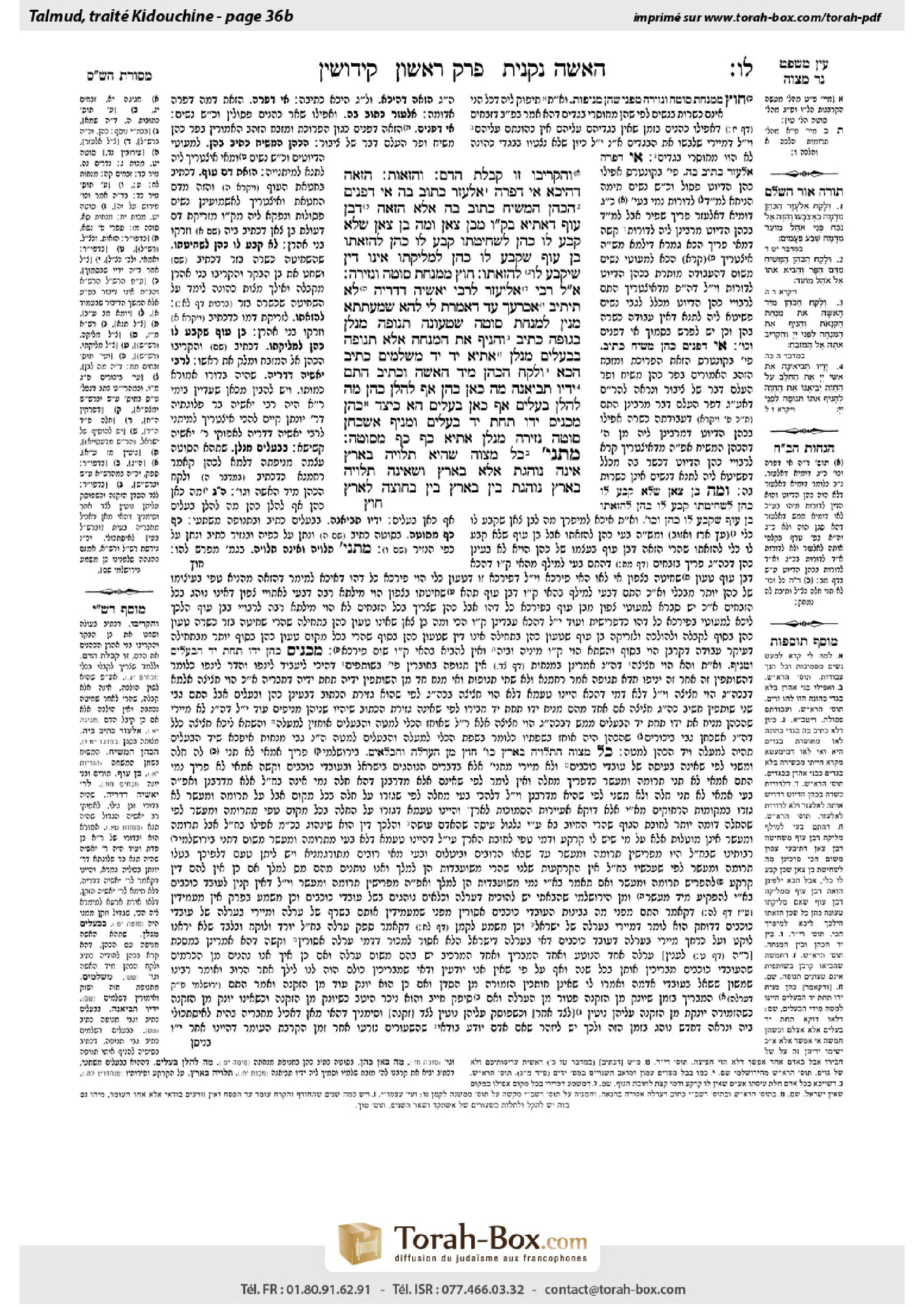
Kiddushin 36b: Talmud study for Daf Yomi
Daf Yomi is the daily study of one Talmud folio. Explore 37 tractates with scans, Hebrew text, Sefaria English and AI-generated French translations where annotated.
Passage selection and English or AI-generated French translation are available where the scan has annotations. Daf Study is independent of Torah-Box and Sefaria.
Browse Kiddushin · קידושין · All tractatesKiddushin 36b text and translations
This page of Kiddushin includes the Aramaic text, an English translation and an AI-generated French translation, alongside the scan above.
קידושין ל״ו ב · Aramaic and Hebrew text
״וְהִקְרִיבוּ״ – זוֹ קַבָּלַת הַדָּם.
וְהַזָּאוֹת. הַזָּאָה דְּהֵיכָא? אִי דְּפָרָה, ״אֶלְעָזָר״ כְּתִיב בַּהּ. אִי דְּפָנִים, ״הַכֹּהֵן הַמָּשִׁיחַ״ כְּתִיב בַּהּ. אֶלָּא הַזָּאָה דְּבֶן עוֹף,
דְּאָתְיָא בְּקַל וָחוֹמֶר מִבֶּן צֹאן. וּמָה בֶּן צֹאן שֶׁלֹּא קָבַע לוֹ כֹּהֵן לִשְׁחִיטָתוֹ – קָבַע לוֹ כֹּהֵן לְהַזָּאָתוֹ, בֶּן עוֹף שֶׁקָּבַע לוֹ כֹּהֵן לִמְלִיקָתוֹ – אֵינוֹ דִּין שֶׁיִּקְבַּע לוֹ לְהַזָּאָתוֹ?
חוּץ מִמִּנְחַת סוֹטָה וּנְזִירָה. אֲמַר לֵיהּ רַבִּי אֶלְעָזָר לְרַבִּי יֹאשִׁיָּה דְּדָרֵיהּ: לָא תֵּיתֵיב אַכַּרְעָךְ עַד דְּאָמְרַתְּ לִי לְהָא שְׁמַעְתְּתָא: מִנַּיִן לְמִנְחַת סוֹטָה שֶׁטְּעוּנָה תְּנוּפָה? מְנָלַן?! בְּגוּפַהּ כְּתִיב: ״וְהֵנִיף אֶת הַמִּנְחָה״! אֶלָּא: תְּנוּפָה בִּבְעָלִים מְנָלַן?
אָתְיָא ״יָד״ ״יָד״ מִשְּׁלָמִים. כְּתִיב הָכָא: ״וְלָקַח הַכֹּהֵן מִיַּד הָאִשָּׁה״ וּכְתִיב הָתָם: ״יָדָיו תְּבִיאֶנָּה״.
מָה כָּאן כֹּהֵן – אַף לְהַלָּן כֹּהֵן, מָה לְהַלָּן בְּעָלִים – אַף כָּאן בְּעָלִים. הָא כֵּיצַד? כֹּהֵן מַכְנִיס יָדוֹ תַּחַת יָד בְּעָלִים וּמֵנִיף.
אַשְׁכְּחַן סוֹטָה, נְזִירָה מְנָלַן? אָתְיָא: ״כַּף״ ״כַּף״ מִסּוֹטָה.
מַתְנִי׳ כׇּל מִצְוָה שֶׁהִיא תְּלוּיָה בָּאָרֶץ – אֵינָהּ נוֹהֶגֶת אֶלָּא בָּאָרֶץ, וְשֶׁאֵינָהּ תְּלוּיָה בָּאָרֶץ – נוֹהֶגֶת בֵּין בָּאָרֶץ בֵּין בְּחוּצָה לָאָרֶץ,
Kiddushin 36b · English translation
“And the sons of Aaron shall present,” this is collecting the blood.
The Gemara discusses the mishna’s ruling that women do not perform sprinkling: To which sprinkling is this referring? If this is the sprinkling of the ashes of the red heifer, “Elazar” is written with regard to that action (Numbers 19:4), i.e., this sprinkling is performed by the deputy High Priest. If even other priests cannot perform it, certainly women cannot. If this is referring to the sprinkling performed inside the Holy of Holies, the phrase: “The anointed priest” (Leviticus 4:16), is written with regard to that rite, and consequently there is no question that women are ineligible. Rather, it is referring to sprinkling the blood of a bird-offering.
The Gemara explains that this is derived through an a fortiori inference from a sheep offering: If with regard to a sheep offering, concerning which the Torah did not establish a priest for its slaughter, since it may be slaughtered by anybody, the Torah nevertheless established a priest for its sprinkling, as the verse states: “And the sons of Aaron, the priests, shall sprinkle its blood” (Leviticus 1:11), is it not logical that with regard to a bird-offering, concerning which the Torah established a priest for its pinching, an act parallel to slaughtering a sheep, the Torah likewise established a priest for its sprinkling? This proves that the sprinkling of the blood of a bird-offering can be performed only by priests, not by women.
§ The mishna teaches that these mitzvot apply specifically to men but not to women, except for the meal-offering of a sota and a nazirite woman, which these women wave. Rabbi Elazar said to Rabbi Yoshiya of his generation, i.e., the amora who was his contemporary, not the tanna with the same name who lived earlier: Do not sit down until you explain this statement to me; from where is it derived that the meal-offering of a sota requires waving? The Gemara expresses surprise: What is the meaning of the question: From where do we derive it? It is written in the chapter dealing with a sota itself: “And he shall wave the meal-offering” (Numbers 5:25). Rather, the question is as follows: From where do we derive that the waving is performed by the owners? Perhaps only the priest waves it?
Rabbi Yoshiya responded: This halakha is derived through the verbal analogy of the term “hand” stated with regard to a sota from the term “hand” stated with regard to a peace-offering. It is written here, with regard to the meal-offering of a sota: “And the priest shall take the meal-offering of jealousy from the woman’s hand and he shall wave the meal-offering” (Numbers 5:25), and it is written there: “His own hands shall bring the offerings of the Lord made by fire; the fat with the breast shall he bring, that the breast may be waved before the Lord” (Leviticus 7:30).
Just as here, with regard to a sota, a priest performs the waving, so too there, with regard to a peace-offering, a priest performs the waving. And just as there, with regard to a peace-offering, the owner performs the waving, as indicated by the verse, so too here, with regard to a sota, the owner performs the waving. How so? How can both the priest and the owner perform the waving? The owner places his hands beneath the peace-offering, and the priest places his hand under the hand of the owner and waves it together with him.
The Gemara asks: We found a source for the meal-offering of a sota; from where do we derive that a nazirite woman also waves her meal-offering? The Gemara answers: It is derived through a verbal analogy of the term “palm” stated with regard to naziriteship from the term “palm” stated with regard to a sota. The verse concerning naziriteship states: “And he shall place them upon the palms of the nazirite” (Numbers 6:19), and the verse concerning a sota states: “And he shall place it on her palms” (Numbers 5:18). Just as a sota waves her meal-offering, so too, a nazirite woman waves hers.
MISHNA: Any mitzva that is dependent on the land [aretz] applies only in Eretz Yisrael, and any mitzva that is not dependent on the land applies both in Eretz Yisrael and outside of Eretz Yisrael.
Kiddushin 36b · Traduction française (IA)
« Et les fils d’Aaron présenteront », cela désigne le prélèvement du sang.
La Guemara examine la décision de la Michna selon laquelle les femmes n’effectuent pas l’aspersion : de quelle aspersion s’agit-il ? S’il s’agit de l’aspersion des cendres de la vache rousse, le nom « Éléazar » figure à propos de cette action (Nombres 19:4), c’est-à-dire que cette aspersion est effectuée par le grand prêtre adjoint. Si même les autres prêtres ne peuvent pas l’effectuer, les femmes, à plus forte raison, ne le peuvent pas. S’il s’agit de l’aspersion effectuée à l’intérieur du Saint des Saints, l’expression « le prêtre oint » (Lévitique 4:16) figure à propos de ce rite ; il ne fait donc aucun doute que les femmes ne sont pas aptes à l’accomplir. Il s’agit plutôt de l’aspersion du sang d’une offrande d’oiseau.
La Guemara explique que cela se déduit par un raisonnement a fortiori à partir d’une offrande de mouton : si, pour une offrande de mouton, à propos de laquelle la Torah n’a pas réservé l’égorgement à un prêtre, puisqu’elle peut être égorgée par n’importe qui, la Torah a néanmoins réservé l’aspersion à un prêtre, comme le dit le verset : « Et les fils d’Aaron, les prêtres, aspergeront son sang » (Lévitique 1:11), n’est-il pas logique que, pour une offrande d’oiseau, à propos de laquelle la Torah a réservé la malkika à un prêtre — un acte parallèle à l’égorgement du mouton —, la Torah ait également réservé l’aspersion à un prêtre ? Cela prouve que l’aspersion du sang d’une offrande d’oiseau ne peut être effectuée que par des prêtres, et non par des femmes.
§ La Michna enseigne que ces mitsvot s’appliquent spécifiquement aux hommes et non aux femmes, à l’exception de l’offrande de farine d’une sota et de celle d’une femme naziréenne, que ces femmes agitent. Rabbi Elazar dit à Rabbi Yoshiya, son contemporain — l’amora de sa génération, et non le tanna du même nom qui vécut auparavant : « Ne t’assieds pas avant de m’avoir expliqué cette déclaration : d’où déduit-on que l’offrande de farine d’une sota doit être agitée ? » La Guemara s’étonne : que signifie la question « d’où le déduit-on » ? Cela est écrit dans le chapitre même consacré à la sota : « Et il agitera l’offrande de farine » (Nombres 5:25). La question est plutôt la suivante : d’où déduit-on que ce sont les propriétaires qui effectuent l’agitation ? Peut-être seul le prêtre l’agite-t-il ?
Rabbi Yoshiya répondit : cette halakha se déduit par analogie verbale entre le terme « main », employé à propos d’une sota, et le terme « main », employé à propos d’un sacrifice de paix. Il est écrit ici, à propos de l’offrande de farine d’une sota : « Le prêtre prendra de la main de la femme l’offrande de farine de jalousie, et il agitera l’offrande de farine » (Nombres 5:25), et il est écrit là : « Ses propres mains présenteront les offrandes du Seigneur consumées par le feu ; il présentera la graisse avec la poitrine, afin que la poitrine soit agitée devant le Seigneur » (Lévitique 7:30).
De même qu’ici, à propos d’une sota, un prêtre effectue l’agitation, de même là, à propos d’un sacrifice de paix, un prêtre effectue l’agitation. Et de même que là, à propos d’un sacrifice de paix, le propriétaire effectue l’agitation, comme l’indique le verset, de même ici, à propos d’une sota, le propriétaire effectue l’agitation. Comment cela se passe-t-il ? Comment le prêtre et le propriétaire peuvent-ils tous deux effectuer l’agitation ? Le propriétaire place ses mains sous le sacrifice de paix, et le prêtre place sa main sous celles du propriétaire et l’agite avec lui.
La Guemara demande : nous avons trouvé une source concernant l’offrande de farine d’une sota ; d’où déduit-on qu’une femme naziréenne agite également son offrande de farine ? La Guemara répond : cela se déduit par analogie verbale entre le terme « paume », employé à propos du naziréat, et le terme « paume », employé à propos d’une sota. Le verset concernant le naziréat dit : « Et il les placera sur les paumes du naziréen » (Nombres 6:19), et celui concernant une sota dit : « Et il le placera sur ses paumes » (Nombres 5:18). De même qu’une sota agite son offrande de farine, de même une femme naziréenne agite la sienne.
MICHNA : Toute mitsva qui dépend de la terre [aretz] ne s’applique qu’en Eretz Israël, et toute mitsva qui ne dépend pas de la terre s’applique aussi bien en Eretz Israël qu’en dehors d’Eretz Israël.
Traduction française générée par IA à partir de l’édition anglaise de Sefaria. Vérifie toujours un passage avec le texte source.
Text from Sefaria: William Davidson Edition - Vocalized Aramaic (CC BY NC); William Davidson Edition - English (CC BY NC).