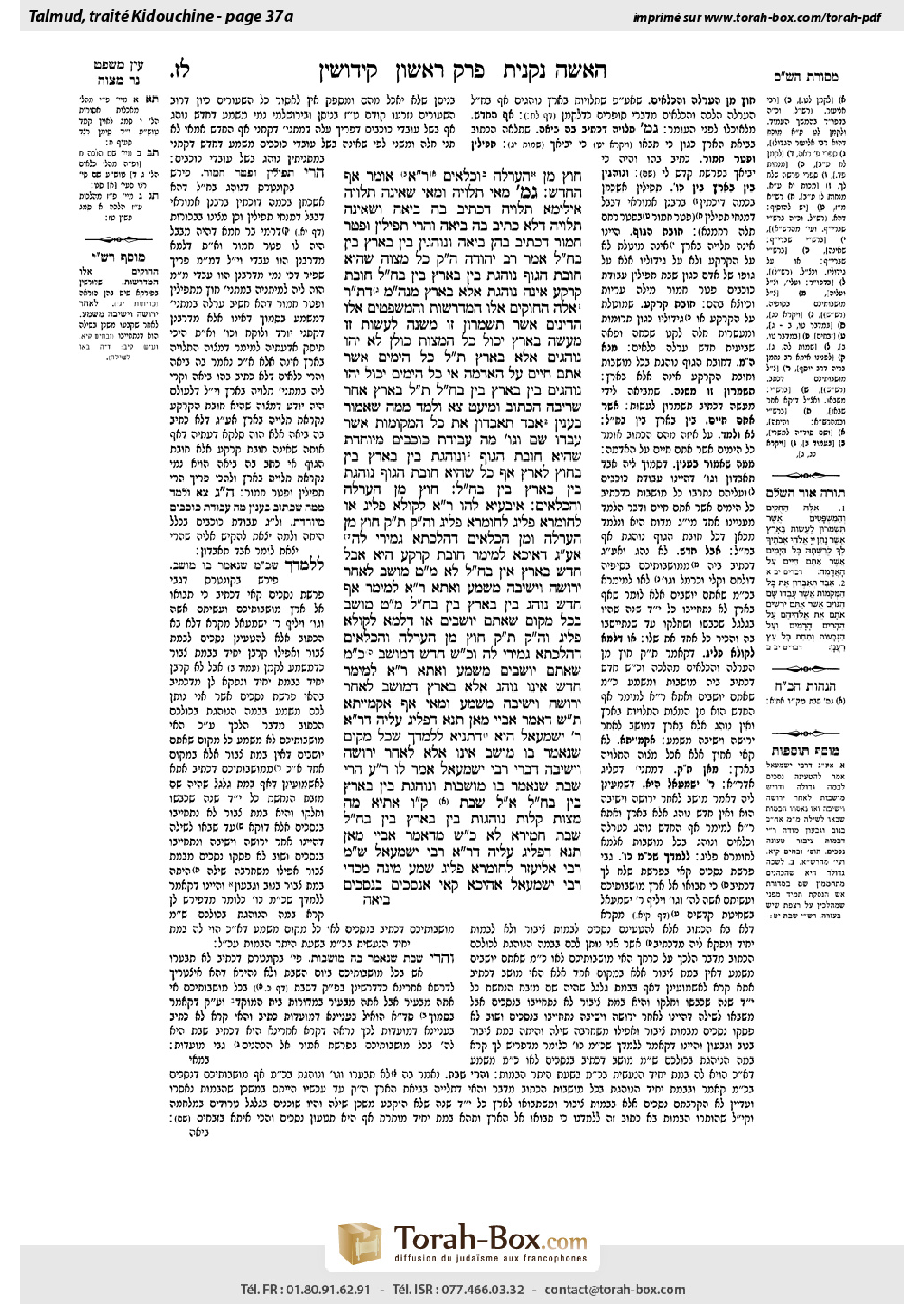
Kiddushin 37a: Talmud study for Daf Yomi
Daf Yomi is the daily study of one Talmud folio. Explore 37 tractates with scans, Hebrew text, Sefaria English and AI-generated French translations where annotated.
Passage selection and English or AI-generated French translation are available where the scan has annotations. Daf Study is independent of Torah-Box and Sefaria.
Browse Kiddushin · קידושין · All tractatesKiddushin 37a text and translations
This page of Kiddushin includes the Aramaic text, an English translation and an AI-generated French translation, alongside the scan above.
קידושין ל״ז א · Aramaic and Hebrew text
חוּץ מִן הָעׇרְלָה וְכִלְאַיִם. רַבִּי אֱלִיעֶזֶר אוֹמֵר: אַף הֶחָדָשׁ.
גְּמָ׳ מַאי תְּלוּיָה וּמַאי שֶׁאֵינָהּ תְּלוּיָה? אִילֵימָא תְּלוּיָה – דִּכְתִיב בַּהּ ״בִּיאָה״, וְשֶׁאֵינָהּ תְּלוּיָה – דְּלָא כְּתִיב בַּהּ ״בִּיאָה״, וַהֲרֵי תְּפִילִּין וּפֶטֶר חֲמוֹר, דִּכְתִיב בָּהֶן ״בִּיאָה״, וְנוֹהֲגִין בֵּין בָּאָרֶץ בֵּין בְּחוּץ לָאָרֶץ!
אָמַר רַב יְהוּדָה: הָכִי קָאָמַר: כׇּל מִצְוָה שֶׁהִיא חוֹבַת הַגּוּף – נוֹהֶגֶת בֵּין בָּאָרֶץ בֵּין בְּחוּץ לָאָרֶץ, חוֹבַת קַרְקַע – אֵינָהּ נוֹהֶגֶת אֶלָּא בָּאָרֶץ.
מְנָא הָנֵי מִילֵּי? דְּתָנוּ רַבָּנַן: ״אֵלֶּה הַחֻקִּים״ – אֵלּוּ הַמִּדְרָשׁוֹת. ״וְהַמִּשְׁפָּטִים״ – אֵלּוּ הַדִּינִים. ״אֲשֶׁר תִּשְׁמְרוּן״ – זוֹ מִשְׁנָה. ״לַעֲשׂוֹת״ – זוֹ מַעֲשֶׂה.
״בָּאָרֶץ״ – יָכוֹל כׇּל הַמִּצְוֹת כּוּלָּן לֹא יְהוּ נוֹהֲגִים אֶלָּא בָּאָרֶץ? תַּלְמוּד לוֹמַר: ״כׇּל הַיָּמִים אֲשֶׁר אַתֶּם חַיִּים עַל הָאֲדָמָה״. אִי כׇּל הַיָּמִים, יָכוֹל יְהוּ נוֹהֲגִים בֵּין בָּאָרֶץ בֵּין בְּחוּצָה לָאָרֶץ? תַּלְמוּד לוֹמַר: ״בָּאָרֶץ״.
אַחַר שֶׁרִיבָּה הַכָּתוּב וּמִיעֵט – צֵא וּלְמַד מִמַּה שֶּׁאָמוּר בָּעִנְיָן: ״אַבֵּד תְּאַבְּדוּן אֶת כׇּל הַמְּקֹמוֹת אֲשֶׁר עָבְדוּ שָׁם וְגוֹ׳״ – מָה עֲבוֹדָה זָרָה מְיוּחֶדֶת, שֶׁהִיא חוֹבַת הַגּוּף, וְנוֹהֶגֶת בֵּין בָּאָרֶץ בֵּין בְּחוּצָה לָאָרֶץ – אַף כֹּל שֶׁהִיא חוֹבַת הַגּוּף נוֹהֶגֶת בֵּין בָּאָרֶץ בֵּין בְּחוּצָה לָאָרֶץ.
חוּץ מִן הָעׇרְלָה וְהַכִּלְאַיִם. אִיבַּעְיָא לְהוּ: רַבִּי אֱלִיעֶזֶר לְקוּלָּא פְּלִיג אוֹ לְחוּמְרָא פְּלִיג?
לְחוּמְרָא פְּלִיג, וְהָכִי קָאָמַר תַּנָּא קַמָּא: חוּץ מִן הָעׇרְלָה וּמִן הַכִּלְאַיִם, דְּהִלְכְתָא גְּמִירִי לָהּ, אַף עַל גַּב דְּאִיכָּא לְמֵימַר חוֹבַת קַרְקַע הִיא. אֲבָל חָדָשׁ, בָּאָרֶץ – אִין, בְּחוּצָה לָאָרֶץ – לָא.
מַאי טַעְמָא? ״מוֹשָׁב״ – לְאַחַר יְרוּשָּׁה וִישִׁיבָה מַשְׁמַע.
וַאֲתָא רַבִּי אֱלִיעֶזֶר לְמֵימַר: אַף חָדָשׁ נוֹהֵג בֵּין בָּאָרֶץ בֵּין בְּחוּצָה לָאָרֶץ. מַאי טַעְמָא? ״מוֹשָׁב״ – בְּכׇל מָקוֹם שֶׁאַתֶּם יוֹשְׁבִים.
אוֹ דִלְמָא לְקוּלָּא פְּלִיג, וְהָכִי קָאָמַר תַּנָּא קַמָּא: חוּץ מִן הָעׇרְלָה וְהַכִּלְאַיִם, דְּהִלְכְתָא גְּמִירִי לַהּ, וְכׇל שֶׁכֵּן חָדָשׁ, דְּ״מוֹשָׁב״ – כׇּל מָקוֹם שֶׁאַתֶּם יוֹשְׁבִים מַשְׁמַע.
וַאֲתָא רַבִּי אֱלִיעֶזֶר לְמֵימַר: חָדָשׁ אֵינוֹ נוֹהֵג אֶלָּא בָּאָרֶץ, דְּ״מוֹשָׁב״ – לְאַחַר יְרוּשָּׁה וִישִׁיבָה מַשְׁמַע. וּמַאי ״אַף״ – אַקַּמַּיְיתָא.
תָּא שְׁמַע, דְּאָמַר אַבָּיֵי: מַאן תַּנָּא דִּפְלִיג עֲלֵיהּ דְּרַבִּי אֱלִיעֶזֶר – רַבִּי יִשְׁמָעֵאל הִיא. דְּתַנְיָא: לְלַמֶּדְךָ, שֶׁכׇּל מָקוֹם שֶׁנֶּאֱמַר בּוֹ ״מוֹשָׁב״ אֵינוֹ אֶלָּא לְאַחַר יְרוּשָּׁה וִישִׁיבָה, דִּבְרֵי רַבִּי יִשְׁמָעֵאל.
אָמַר לוֹ רַבִּי עֲקִיבָא: הֲרֵי שַׁבָּת, שֶׁנֶּאֱמַר בּוֹ ״מוֹשָׁבוֹת״, וְנוֹהֶגֶת בֵּין בָּאָרֶץ בֵּין בְּחוּצָה לָאָרֶץ! אָמַר לוֹ: שַׁבָּת קַל וָחוֹמֶר אָתְיָא, מָה מִצְוֹת קַלּוֹת נוֹהֲגוֹת בֵּין בָּאָרֶץ בֵּין בְּחוּצָה לָאָרֶץ – שַׁבָּת חֲמִירָא לֹא כׇּל שֶׁכֵּן?
מִדְּאָמַר אַבָּיֵי: מַאן תַּנָּא דִּפְלִיג עֲלֵיהּ דְּרַבִּי אֱלִיעֶזֶר – רַבִּי יִשְׁמָעֵאל, שְׁמַע מִינַּהּ רַבִּי אֱלִיעֶזֶר לְחוּמְרָא פְּלִיג, שְׁמַע מִינַּהּ.
מִכְּדֵי רַבִּי יִשְׁמָעֵאל אַהֵיכָא קָאֵי? אַנְּסָכִים. בִּנְסָכִים
Kiddushin 37a · English translation
This is apart from the mitzvot of orla and diverse kinds, which apply even outside of Eretz Yisrael. Rabbi Eliezer says: This is the halakha even with regard to the prohibition to eat from the new crop before the omer offering has been brought on the sixteenth of Nisan.
GEMARA: The Gemara asks: What is meant by mitzvot that are dependent on the land, and what is meant by mitzvot that are not dependent on the land? If we say that a mitzva is called dependent in a case where it is written in a verse with regard to it: Coming to Eretz Yisrael, and a mitzva that is not dependent on the land is one concerning which the verb: Coming, or the verb: Bringing, is not written in a verse with regard to it, that would lead to a difficulty: But aren’t there the mitzvot of donning phylacteries and the redemption of the firstborn donkey, in which the verse states: Bringing, in the passage: “And it shall be when the Lord shall bring you to the land of the Canaanite…And every firstborn of a donkey you shall redeem with a lamb…And it shall be for a sign upon your hand, and for frontlets between your eyes” (Exodus 13:11–16), and yet those mitzvot apply both in Eretz Yisrael and outside of Eretz Yisrael.
Rav Yehuda said that this is what the mishna is saying: Any mitzva that is an obligation of the body, i.e., an obligation upon the person, applies both in Eretz Yisrael and outside of Eretz Yisrael. Conversely, an obligation of the land, that is, a mitzva that applies specifically to the earth and its growths, applies only in Eretz Yisrael.
The Gemara asks: From where are these matters derived? The Gemara answers: This is as the Sages taught in a baraita: The verse states: “These are the statutes and the ordinances that you shall observe to do in the land that the Lord, the God of your fathers, has given you to possess it, all the days that you live upon the earth” (Deuteronomy 12:1). This verse is interpreted as follows: The phrase “these are the statutes” means that these are the expositions that the Sages learn from verses. With regard to the phrase “and the ordinances,” these are monetary laws. With regard to “that you shall observe,” this is referring to the study of matters that must be observed for one to perform them. And as for the phrase “to do,” this is referring to action, the actual performance of mitzvot.
The baraita continues: From the phrase “in the land [ba’aretz],” one might have thought that all mitzvot apply only in Eretz Yisrael. Therefore, the verse also states “all the days that you live upon the earth,” i.e., wherever you live. Furthermore, if the Merciful One had written only the phrase “all the days,” one might have thought that all mitzvot should apply both in Eretz Yisrael and outside of Eretz Yisrael. Therefore, the verse also states “in the land.”
The baraita continues: Once the verse includes areas outside of Eretz Yisrael and also excludes areas outside of Eretz Yisrael, how is it determined which mitzvot apply outside the land and which do not? The baraita answers: Go and learn from what is stated with regard to a different issue that appears in the next verse: “You shall destroy all the places where the nations that you are to dispossess served their gods” (Deuteronomy 12:2). Just as the prohibition of idol worship is distinct in that it is an obligation of the body, and it applies both in Eretz Yisrael and outside of Eretz Yisrael, so too, any mitzva that is an obligation of the body applies both in Eretz Yisrael and outside of Eretz Yisrael. Conversely, mitzvot that are an obligation connected to the land apply only in Eretz Yisrael.
§ The mishna teaches that all mitzvot that are dependent on the land apply only in Eretz Yisrael, apart from orla and the prohibition of diverse kinds. Rabbi Eliezer says: This is the halakha even with regard to the prohibition to eat from the new crop. A dilemma was raised before them: Does Rabbi Eliezer disagree with the first tanna with the intent to rule more leniently or does he disagree with the first tanna with the intent to rule more stringently?
The Gemara elaborates: It is possible that Rabbi Eliezer disagrees with the first tanna with the intent to rule more stringently, and this is what the first tanna is saying: All mitzvot that are dependent on the land apply only in Eretz Yisrael, apart from orla and diverse kinds, as we learned this halakha through a tradition transmitted to Moses from Sinai. Although one could say that each of them is an obligation of the land and should apply only in Eretz Yisrael, nevertheless they are obligatory outside of Eretz Yisrael as well. But the prohibition of the new crop, which is an obligation of the land, yes, it applies in Eretz Yisrael, but outside of Eretz Yisrael, no, it does not apply.
What is the reason of the first tanna? In the verse that states with regard to the new crop: “In all your dwellings” (Leviticus 23:14), the term dwelling does not mean that this halakha applies wherever Jews live. Rather, it means that the mitzva is applicable only in Eretz Yisrael, as this phrase indicates a time after inheritance and settlement of Eretz Yisrael by the Jewish people, when they are actually dwelling in the land, not when they are in the process of conquering it. This is the opinion of the first tanna.
And Rabbi Eliezer comes to say: Even the prohibition with regard to the new crop applies both in Eretz Yisrael and outside of Eretz Yisrael. What is the reason for his opinion? He explains that the term dwelling means wherever you dwell. This is one possible way to understand the dispute, according to which the opinion of Rabbi Eliezer is more stringent than that of the first tanna.
Or perhaps Rabbi Eliezer disagrees with the first tanna with the intent to rule more leniently, and this is what the first tanna is saying: All mitzvot that are dependent on the land apply only in Eretz Yisrael, apart from orla and diverse kinds, as we learned this halakha through tradition, and all the more so apart from the new crop, which applies outside of Eretz Yisrael, as the term dwelling indicates wherever you dwell. This is the opinion of the first tanna.
And Rabbi Eliezer comes to say: The prohibition of the new crop applies only in Eretz Yisrael, as the term dwelling indicates a time after inheritance and settlement of Eretz Yisrael by the Jewish people. The Gemara asks: And accordingly, what is the meaning of the word: Even, with which Rabbi Eliezer begins his statement? It is not referring to orla and diverse kinds, which apply outside of Eretz Yisrael, but to the first clause, which states that a mitzva that is dependent on the land applies only in Eretz Yisrael. Rabbi Eliezer adds that this principle includes the new crop as well.
Having presented the two ways in which one can explain the opinion of Rabbi Eliezer, the Gemara attempts to prove which is correct and suggests: Come and hear a proof from that which Abaye said: Who is the tanna who disagrees with Rabbi Eliezer? It is Rabbi Yishmael. As it is taught in a baraita with regard to the mitzva of bringing libations with offerings: This serves to teach you that wherever the term dwelling is stated, the mitzva in question applies only after the inheritance and settlement of Eretz Yisrael. This is the statement of Rabbi Yishmael.
Rabbi Akiva said to him: But there is the case of Shabbat, in which it is stated: “It is a Shabbat to the Lord in all your dwellings” (Leviticus 23:3), and this mitzva applies both in Eretz Yisrael and outside of Eretz Yisrael. Rabbi Yishmael said to Rabbi Akiva: Shabbat is derived through the following a fortiori inference: If less stringent mitzvot apply both in Eretz Yisrael and outside of Eretz Yisrael, is it not all the more so reasonable that Shabbat, which is a stringent mitzva, should apply everywhere?
The Gemara explains the proof. From the fact that Abaye said: Who is the tanna who disagrees with Rabbi Eliezer, it is Rabbi Yishmael, and Rabbi Yishmael says that the term dwelling means that the mitzva applies after Eretz Yisrael has been entirely settled, one can conclude from it that Rabbi Eliezer disagrees with the first tanna with the intent to rule more stringently, as he evidently maintains that the term dwelling means wherever Jews are located. The Gemara affirms: Conclude from that baraita that it is so.
The Gemara asks an incidental question with regard to Rabbi Yishmael’s opinion. Now, where does Rabbi Yishmael stand, i.e., to which specific mitzva is he referring? He is referring to the obligation to bring libations, from which he learns that all mitzvot that feature the term dwelling apply only after Eretz Yisrael had been conquered and settled. With regard to libations
Kiddushin 37a · Traduction française (IA)
Cela fait exception aux mitsvot de l’orla et des mélanges interdits, qui s’appliquent même hors d’Eretz Israël. Rabbi Eliezer dit : Cette halakha vaut également pour l’interdiction de consommer la nouvelle récolte avant que l’offrande du omer ait été apportée le 16 Nissan.
GUEMARA : La Guemara demande : Que désigne-t-on par mitsvot qui dépendent de la terre, et que désigne-t-on par mitsvot qui n’en dépendent pas ? Si l’on dit qu’une mitsva est considérée comme dépendant de la terre lorsque le verset dit à son sujet qu’elle s’applique à l’entrée en Eretz Israël, et qu’une mitsva qui ne dépend pas de la terre est une mitsva à propos de laquelle le verset ne mentionne ni l’entrée ni l’apport, cela soulève une difficulté : les mitsvot des téfilines et du rachat du premier-né de l’âne ne sont-elles pas mentionnées avec le terme « apporter », dans le passage : « Et quand le Seigneur t’aura fait entrer dans le pays des Cananéens… Tout premier-né d’un âne, tu le rachèteras par un agneau… Et ce sera un signe sur ta main et des fronteaux entre tes yeux » (Exode 13, 11-16) ? Pourtant, ces mitsvot s’appliquent aussi bien en Eretz Israël qu’en dehors d’Eretz Israël.
Rav Yehouda dit que voici ce que veut dire la Michna : Toute mitsva qui constitue une obligation personnelle, c’est-à-dire une obligation qui incombe à la personne, s’applique aussi bien en Eretz Israël qu’en dehors d’Eretz Israël. À l’inverse, une obligation liée à la terre, c’est-à-dire une mitsva qui concerne spécifiquement le sol et ses produits, ne s’applique qu’en Eretz Israël.
La Guemara demande : D’où tire-t-on ces principes ? Elle répond : C’est ce qu’enseignent les Sages dans une baraïta : le verset dit : « Voici les statuts et les règles que vous veillerez à accomplir dans le pays que le Seigneur, Dieu de vos pères, vous a donné pour en prendre possession, tous les jours où vous vivrez sur la terre » (Deutéronome 12, 1). Ce verset s’interprète ainsi : l’expression « voici les statuts » désigne les explications que les Sages tirent des versets. L’expression « et les règles » désigne les lois pécuniaires. « Que vous veillerez » renvoie à l’étude des sujets qu’il faut observer afin de les accomplir. Quant à l’expression « pour accomplir », elle renvoie à l’action, c’est-à-dire à l’accomplissement effectif des mitsvot.
La baraïta poursuit : À partir de l’expression « dans le pays [ba’aretz] », on aurait pu penser que toutes les mitsvot ne s’appliquent qu’en Eretz Israël. Le verset précise donc également : « tous les jours où vous vivrez sur la terre », c’est-à-dire où que vous viviez. En outre, si le Miséricordieux n’avait écrit que l’expression « tous les jours », on aurait pu penser que toutes les mitsvot s’appliquent aussi bien en Eretz Israël qu’en dehors d’Eretz Israël. Le verset précise donc également : « dans le pays ».
La baraïta poursuit : Puisque le verset inclut les territoires situés hors d’Eretz Israël tout en les excluant également, comment détermine-t-on quelles mitsvot s’appliquent hors du pays et lesquelles ne s’y appliquent pas ? La baraïta répond : Va et apprends ce qui est dit à propos d’un autre sujet, dans le verset suivant : « Vous détruirez tous les lieux où les nations que vous allez déposséder ont servi leurs dieux » (Deutéronome 12, 2). De même que l’interdiction de l’idolâtrie se distingue en constituant une obligation personnelle et s’applique aussi bien en Eretz Israël qu’en dehors d’Eretz Israël, de même toute mitsva qui constitue une obligation personnelle s’applique aussi bien en Eretz Israël qu’en dehors d’Eretz Israël. À l’inverse, les mitsvot qui constituent des obligations liées à la terre ne s’appliquent qu’en Eretz Israël.
§ La Michna enseigne que toutes les mitsvot qui dépendent de la terre ne s’appliquent qu’en Eretz Israël, à l’exception de l’orla et de l’interdiction des mélanges interdits. Rabbi Eliezer dit : Cette halakha vaut également pour l’interdiction de consommer la nouvelle récolte. Une question fut soulevée devant eux : Rabbi Eliezer conteste-t-il le premier tanna afin d’adopter une décision plus indulgente, ou bien une décision plus stricte ?
La Guemara développe : Il est possible que Rabbi Eliezer conteste le premier tanna afin d’adopter une décision plus stricte. Voici ce que dit le premier tanna : Toutes les mitsvot qui dépendent de la terre ne s’appliquent qu’en Eretz Israël, à l’exception de l’orla et des mélanges interdits, car nous avons appris cette halakha par une tradition transmise à Moïse au Sinaï. Bien que l’on puisse dire que chacune de ces mitsvot constitue une obligation liée à la terre et ne devrait donc s’appliquer qu’en Eretz Israël, elles sont néanmoins obligatoires également hors d’Eretz Israël. Mais l’interdiction de la nouvelle récolte, qui constitue une obligation liée à la terre, s’applique en Eretz Israël, certes, mais pas hors d’Eretz Israël.
Quelle est la raison du premier tanna ? Dans le verset relatif à la nouvelle récolte, qui dit : « Dans toutes vos demeures » (Lévitique 23, 14), le terme « demeures » ne signifie pas que cette halakha s’applique partout où vivent des Juifs. Il signifie plutôt que la mitsva ne s’applique qu’en Eretz Israël, car cette expression désigne une période postérieure à la prise de possession et à l’installation du peuple juif en Eretz Israël, lorsqu’il habite effectivement le pays, et non lorsqu’il est en train de le conquérir. Telle est l’opinion du premier tanna.
Et Rabbi Eliezer vient enseigner que même l’interdiction relative à la nouvelle récolte s’applique aussi bien en Eretz Israël qu’en dehors d’Eretz Israël. Quelle est la raison de son opinion ? Il explique que le terme « demeures » signifie : où que vous habitiez. C’est une manière possible de comprendre le désaccord, selon laquelle l’opinion de Rabbi Eliezer est plus stricte que celle du premier tanna.
Ou peut-être Rabbi Eliezer conteste-t-il le premier tanna afin d’adopter une décision plus indulgente. Voici ce que dit le premier tanna : Toutes les mitsvot qui dépendent de la terre ne s’appliquent qu’en Eretz Israël, à l’exception de l’orla et des mélanges interdits, comme nous l’avons appris par tradition ; et à plus forte raison, la nouvelle récolte fait exception, puisqu’elle s’applique hors d’Eretz Israël, le terme « demeures » désignant tout lieu où vous habitez. Telle est l’opinion du premier tanna.
Et Rabbi Eliezer vient enseigner que l’interdiction de la nouvelle récolte ne s’applique qu’en Eretz Israël, car le terme « demeures » désigne une période postérieure à la prise de possession et à l’installation du peuple juif en Eretz Israël. La Guemara demande : Dès lors, que signifie le mot « même », par lequel Rabbi Eliezer commence son propos ? Il ne renvoie pas à l’orla et aux mélanges interdits, qui s’appliquent hors d’Eretz Israël, mais à la première proposition, selon laquelle une mitsva qui dépend de la terre ne s’applique qu’en Eretz Israël. Rabbi Eliezer ajoute que ce principe vaut aussi pour la nouvelle récolte.
Après avoir présenté les deux façons d’expliquer l’opinion de Rabbi Eliezer, la Guemara tente d’établir laquelle est correcte et propose : Viens et entends une preuve de ce qu’a dit Abayé : Qui est le tanna qui conteste Rabbi Eliezer ? C’est Rabbi Yichmaël. En effet, il est enseigné dans une baraïta, à propos de la mitsva d’apporter des libations avec les sacrifices : Cela vient t’apprendre que partout où figure le terme « demeures », la mitsva en question ne s’applique qu’après la prise de possession et l’installation en Eretz Israël. Telle est la déclaration de Rabbi Yichmaël.
Rabbi Akiva lui dit : Mais il y a le cas du Chabbat, au sujet duquel il est dit : « C’est un Chabbat pour le Seigneur dans toutes vos demeures » (Lévitique 23, 3), et cette mitsva s’applique aussi bien en Eretz Israël qu’en dehors d’Eretz Israël. Rabbi Yichmaël dit à Rabbi Akiva : Le Chabbat se déduit par l’inférence a fortiori suivante : si des mitsvot moins strictes s’appliquent aussi bien en Eretz Israël qu’en dehors d’Eretz Israël, n’est-il pas d’autant plus raisonnable que le Chabbat, qui est une mitsva plus stricte, s’applique partout ?
La Guemara explique la preuve. Du fait qu’Abayé a dit : « Qui est le tanna qui conteste Rabbi Eliezer ? C’est Rabbi Yichmaël », et que Rabbi Yichmaël affirme que le terme « demeures » signifie que la mitsva ne s’applique qu’après la conquête et l’installation de tout Eretz Israël, on peut conclure que Rabbi Eliezer conteste le premier tanna afin d’adopter une décision plus stricte, puisqu’il soutient manifestement que le terme « demeures » désigne partout où se trouvent les Juifs. La Guemara confirme : Conclus de cette baraïta qu’il en est ainsi.
La Guemara pose une question incidente au sujet de l’opinion de Rabbi Yichmaël. Or, à quelle mitsva Rabbi Yichmaël fait-il référence précisément ? Il parle de l’obligation d’apporter des libations, dont il déduit que toutes les mitsvot où figure le terme « demeures » ne s’appliquent qu’après la conquête et l’installation en Eretz Israël. En ce qui concerne les libations
Traduction française générée par IA à partir de l’édition anglaise de Sefaria. Vérifie toujours un passage avec le texte source.
Text from Sefaria: William Davidson Edition - Vocalized Aramaic (CC BY NC); William Davidson Edition - English (CC BY NC).