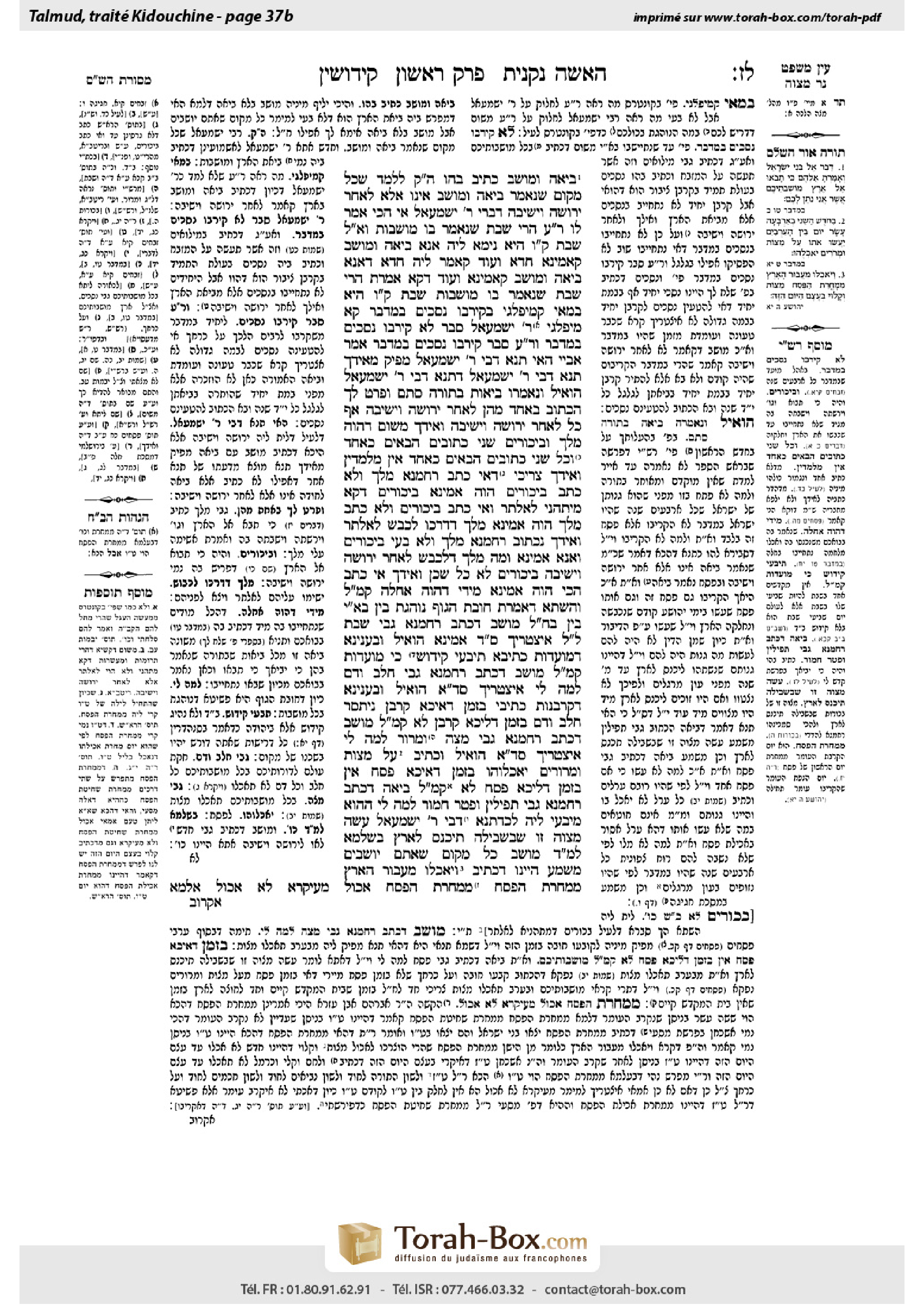
Kiddushin 37b: Talmud study for Daf Yomi
Daf Yomi is the daily study of one Talmud folio. Explore 37 tractates with scans, Hebrew text, Sefaria English and AI-generated French translations where annotated.
Passage selection and English or AI-generated French translation are available where the scan has annotations. Daf Study is independent of Torah-Box and Sefaria.
Browse Kiddushin · קידושין · All tractatesKiddushin 37b text and translations
This page of Kiddushin includes the Aramaic text, an English translation and an AI-generated French translation, alongside the scan above.
קידושין ל״ז ב · Aramaic and Hebrew text
בִּיאָה וּמוֹשָׁב כְּתִיב בְּהוּ?! הָכִי קָאָמַר: לְלַמֵּד שֶׁכׇּל מָקוֹם שֶׁנֶּאֱמַר בִּיאָה וּמוֹשָׁב אֵינוֹ אֶלָּא לְאַחַר יְרוּשָּׁה וִישִׁיבָה, דִּבְרֵי רַבִּי יִשְׁמָעֵאל.
אִי הָכִי, אָמַר לוֹ רַבִּי עֲקִיבָא: הֲרֵי שַׁבָּת שֶׁנֶּאֱמַר בּוֹ ״מוֹשָׁבוֹת״, וְאָמַר לוֹ: שַׁבָּת קַל וָחוֹמֶר הִיא, נֵימָא לֵיהּ: אֲנָא בִּיאָה וּמוֹשָׁב קָאָמֵינָא! חֲדָא וְעוֹד קָאָמַר לֵיהּ, חֲדָא – דַּאֲנָא בִּיאָה וּמוֹשָׁב קָאָמֵינָא. וְעוֹד: דְּקָא אָמְרַתְּ הֲרֵי שַׁבָּת שֶׁנֶּאֱמַר בּוֹ ״מוֹשָׁבוֹת״ – שַׁבָּת קַל וָחוֹמֶר הִיא.
בְּמַאי קָמִיפַּלְגִי? בְּקֵירְבוּ נְסָכִים בַּמִּדְבָּר קָא מִיפַּלְגִי. רַבִּי יִשְׁמָעֵאל סָבַר: לָא קֵירְבוּ נְסָכִים בַּמִּדְבָּר. וְרַבִּי עֲקִיבָא סָבַר: קֵירְבוּ נְסָכִים בַּמִּדְבָּר.
אָמַר אַבָּיֵי: הַאי תָּנָא דְּבֵי רַבִּי יִשְׁמָעֵאל מַפֵּיק מֵאִידַּךְ תָּנָא דְּבֵי רַבִּי יִשְׁמָעֵאל.
דְּתָנָא דְּבֵי רַבִּי יִשְׁמָעֵאל: הוֹאִיל וְנֶאֶמְרוּ בִּיאוֹת בַּתּוֹרָה סְתָם, וּפָרַט לְךָ הַכָּתוּב בְּאֶחָד מֵהֶן לְאַחַר יְרוּשָּׁה וִישִׁיבָה, אַף כֹּל לְאַחַר יְרוּשָּׁה וִישִׁיבָה.
וְאִידַּךְ, מִשּׁוּם דְּהָוֵה מֶלֶךְ וּבִיכּוּרִים שְׁנֵי כְתוּבִים הַבָּאִים כְּאֶחָד, וְכֹל שְׁנֵי כְתוּבִים הַבָּאִים כְּאֶחָד אֵין מְלַמְּדִין.
וְאִידַּךְ: צְרִיכִי, דְּאִי כְּתַב רַחֲמָנָא מֶלֶךְ וְלָא כְּתַב בִּיכּוּרִים, הֲוָה אָמֵינָא: בִּיכּוּרִים, דְּקָא מִיתְהֲנֵי – לְאַלְתַּר. וְאִי כְּתַב בִּיכּוּרִים וְלָא כְּתַב מֶלֶךְ, הֲוָה אָמֵינָא: מֶלֶךְ, דְּדַרְכּוֹ לְכַבֵּשׁ – לְאַלְתַּר.
וְאִידַּךְ: נִכְתּוֹב רַחֲמָנָא מֶלֶךְ וְלָא בָּעֵי בִּיכּוּרִים, וַאֲנָא אָמֵינָא: וּמָה מֶלֶךְ, דִּלְכַבֵּשׁ לְאַחַר יְרוּשָּׁה וִישִׁיבָה, בִּיכּוּרִים – לֹא כׇּל שֶׁכֵּן?
וְאִידַּךְ: אִי כְּתַב הָכִי הֲוָה אָמֵינָא: מִידֵּי דְּהָוֵה אַחַלָּה, קָא מַשְׁמַע לַן.
וְהַשְׁתָּא דְּאָמְרַתְּ חוֹבַת הַגּוּף נוֹהֶגֶת בֵּין בְּאֶרֶץ יִשְׂרָאֵל בֵּין בְּחוּצָה לָאָרֶץ, ״מוֹשָׁב״ דִּכְתַב רַחֲמָנָא גַּבֵּי שַׁבָּת, לְמָה לִי? אִיצְטְרִיךְ, סָלְקָא דַּעְתָּךְ אָמֵינָא: הוֹאִיל וּבְעִנְיָנָא דְמוֹעֲדוֹת כְּתִיבָא, תִּיבְּעֵי קִידּוּשׁ כִּי מוֹעֲדוֹת, קָא מַשְׁמַע לַן.
״מוֹשָׁב״ דִּכְתַב רַחֲמָנָא גַּבֵּי חֵלֶב וָדָם, לְמָה לִי? אִיצְטְרִיךְ, סָלְקָא דַּעְתָּךְ אָמֵינָא: הוֹאִיל וּבְעִנְיָנָא דְקׇרְבָּנוֹת כְּתִיבִי, בִּזְמַן דְּאִיכָּא קׇרְבָּן, נִיתְּסַר חֵלֶב וָדָם, בִּזְמַן דְּלֵיכָּא קׇרְבָּן – לָא, קָא מַשְׁמַע לַן.
״מוֹשָׁב״ דִּכְתַב רַחֲמָנָא גַּבֵּי מַצָּה וּמָרוֹר, לְמָה לִי? אִיצְטְרִיךְ, סָלְקָא דַּעְתָּךְ אָמֵינָא הוֹאִיל וּכְתִיב ״עַל מַצּוֹת וּמְרֹרִים יֹאכְלֻהוּ״, בִּזְמַן דְּאִיכָּא פֶּסַח – אִין, בִּזְמַן דְּלֵיכָּא פֶּסַח – לָא, קָא מַשְׁמַע לַן.
״בִּיאָה״ דִּכְתַב רַחֲמָנָא גַּבֵּי תְּפִילִּין וּפֶטֶר חֲמוֹר, לְמָה לִי? הָהוּא מִיבְּעֵי לֵיהּ לְכִדְתָנָא דְּבֵי רַבִּי יִשְׁמָעֵאל: עֲשֵׂה מִצְוָה זוֹ, שֶׁבִּשְׁבִילָהּ תִּיכָּנֵס לָאָרֶץ.
בִּשְׁלָמָא לְמַאן דְּאָמַר ״מוֹשָׁב״ – כׇּל מָקוֹם שֶׁאַתֶּם יוֹשְׁבִים מַשְׁמַע, הַיְינוּ דִּכְתִיב ״וַיֹּאכְלוּ מֵעֲבוּר הָאָרֶץ מִמׇּחֳרַת הַפֶּסַח״ – מִמָּחֳרַת הַפֶּסַח אֲכוּל, מֵעִיקָּרָא – לָא אֲכוּל. אַלְמָא
Kiddushin 37b · English translation
both the term: Coming, and the term: Dwelling, are written: “When you come into the land of your dwellings” (Numbers 15:2). How, then, can Rabbi Yishmael cite this example to teach about cases where only the term dwelling is written? The Gemara answers that this is what the baraita is saying: This teaches that wherever both coming and dwelling are stated, it applies only after inheritance and settlement of Eretz Yisrael; this is the statement of Rabbi Yishmael.
The Gemara asks: If so, consider that Rabbi Akiva said to him: But there is the verse stated with regard to Shabbat (Leviticus 23:3), in which it is stated “dwellings,” and Rabbi Yishmael said to him: Shabbat is derived through an a fortiori inference. But let Rabbi Yishmael say to Rabbi Akiva instead: I say my principle only when coming and dwelling are both written, and in the case of Shabbat the verse states only the term dwelling. The Gemara answers: Rabbi Yishmael states one reason and adds another reason. One reason is that I say my principle only when coming and dwelling are written together. And another reason: With regard to that which you say that there is the case of Shabbat, in which it is stated “dwellings,” Shabbat is derived through an a fortiori inference.
The Gemara asks: With regard to what do Rabbi Yishmael and Rabbi Akiva disagree? The Gemara answers: They disagree with regard to whether the Jews sacrificed libations in the wilderness. Rabbi Yishmael maintains: They did not sacrifice libations in the wilderness, as the obligation to sacrifice libations came into effect only once they were living in Eretz Yisrael. And Rabbi Akiva maintains: They did sacrifice libations in the wilderness. Rabbi Akiva derives a different halakha from the term dwelling.
Abaye said: This statement of the tanna of the school of Rabbi Yishmael, that only when the terms coming and dwelling are both written does the mitzva takes effect after settling Eretz Yisrael, diverges from another statement of the tanna of the school of Rabbi Yishmael.
This is as the tanna of the school of Rabbi Yishmael taught: Since instances of coming to Eretz Yisrael are mentioned in the Torah in connection to several mitzvot, without specifying precisely when the Jewish people are considered to have arrived there, and the verse specified in one of its references that it applies only after inheritance and settlement of Eretz Yisrael, in the mitzva of appointing a king: “When you come to the land…and you inherit it and settle it” (Deuteronomy 17:14), so too, wherever coming to the land is mentioned without qualification, it means after inheritance and settlement. According to this opinion, there is no need for the verse to also mention the term dwelling.
And the other tanna of the school of Rabbi Yishmael, cited in the dispute with Rabbi Akiva, would say that this is no proof, because there is not only the case of a king but also the mitzva of first fruits, where the verse also uses the terms of coming, inheriting, and dwelling (see Deuteronomy 26:1). Consequently, these are two verses that come as one, i.e., to teach the same matter. And any two verses that come as one do not teach a precedent that applies to other cases.
And the other tanna, i.e., the tanna of the school of Rabbi Yishmael cited by Abaye, would answer: Both these cases are necessary, as one cannot be derived from the other. As, if the Merciful One had written this matter only with regard to a king, and had not written it concerning first fruits, I would say: This delay applies only to the mitzva of appointing a king, whereas with regard to the mitzva of first fruits, since one benefits from eating the fruit he should have to bring it immediately and not wait until the land has been inherited and settled. And conversely, had the Merciful One written this matter only with regard to first fruits and had not written it in the case of a king, I would say that as it is the manner of a king to conquer, one must be appointed immediately, even before entering Eretz Yisrael.
And the other, the tanna of the school of Rabbi Yishmael, cited in the dispute with Rabbi Akiva, would respond: Let the Merciful One write this with regard to a king, and it would not be required to write it in the case of first fruits, as I would say: And if a king, whose task is to conquer Eretz Yisrael, nevertheless is appointed only after inheritance and settlement, with regard to first fruits is it not all the more so reasonable that a similar halakha apply to them? If so, these are two verses that come as one, which do not teach a precedent.
And the other, i.e., the tanna of the school of Rabbi Yishmael cited by Abaye, would say: If the Merciful One had written this only with regard to a king, I would say that the Jews should be obligated in the mitzva of first fruits immediately upon entering Eretz Yisrael, and I would not derive the halakha of first fruits from that of appointing a king, just as it is with regard to the separation of ḥalla, another priestly gift from one’s produce, which applied immediately upon the entrance to Eretz Yisrael. Therefore the verse is necessary, as it teaches us that this is not so.
§ The Gemara asks: And now that you said that an obligation of the body applies both in Eretz Yisrael and outside of Eretz Yisrael, why do I need the term “dwelling” that the Merciful One writes with regard to Shabbat (Leviticus 23:3)? The Gemara answers: It was necessary to say this, as it might enter your mind to say: Since the mitzva of Shabbat was written in the context of the Festivals, it should require sanctification by the court, like the Festivals, which rely on the sanctification of the New Moon by the court. Therefore the verse teaches us that this is not required.
The Gemara further asks: Why do I need the term dwelling, which the Merciful One writes with regard to the consumption of forbidden fat and blood in the verse: “A perpetual statute throughout your generations in all your dwellings, that you shall eat neither forbidden fat nor blood” (Leviticus 3:17)? The Gemara answers: It was necessary to state this, as it might enter your mind to say: Since these prohibitions are written in the context of the offerings, then when there is an offering and the priests sacrifice fat and blood upon the altar, i.e., when the Temple is standing, that is when forbidden fat and blood are forbidden for consumption. But when there is no offering, forbidden fat and blood are not forbidden. The verse therefore teaches us that they are always forbidden.
Additionally, the Gemara asks: Why do I need the term dwelling, which the Merciful One writes with regard to matza and bitter herbs, in the verse: “In all your dwellings you shall eat matza” (Exodus 12:20)? The Gemara answers: It was necessary to state this, as it might enter your mind to say that since it is written: “They shall eat the Paschal offering with matza and bitter herbs” (Numbers 9:11), when there is a Paschal offering, yes, one must eat it with matza and bitter herbs, but when there is no Paschal offering, i.e., when the Temple is not standing, there is no obligation to eat matza and bitter herbs. The verse therefore teaches us that these mitzvot apply every Passover, whether or not the Temple is standing.
The Gemara further asks: Why do I need the term coming, which the Merciful One writes with regard to phylacteries and the firstborn donkey, at the start of the Torah passage which discusses these mitzvot: “And it shall be when the Lord will bring you into the land of the Canaanite” (Exodus 13:11)? The Gemara answers: That verse is necessary for that which the tanna of the school of Rabbi Yishmael taught: Perform this mitzva of donning phylacteries, on account of which you shall be rewarded and enter Eretz Yisrael.
The Gemara asks about the term dwelling, written in connection to the prohibition of the new crop. Granted, according to the one who says that the term dwelling indicates wherever you dwell, this explains the fact that it is written with regard to the Jewish people immediately after they entered Eretz Yisrael: “And they ate the produce of the land on the morrow after the Passover” (Joshua 5:11). This means that on the day after the Passover they ate the produce of Eretz Yisrael, but initially, before that date, they did not eat it. Apparently,
Kiddushin 37b · Traduction française (IA)
Les termes « venue » et « résidence » sont tous deux écrits : « Lorsque vous arriverez dans le pays où vous établirez vos résidences » (Nombres 15:2). Comment Rabbi Yishmael peut-il alors citer cet exemple pour enseigner ce qui se passe dans les cas où seul le terme « résidence » est écrit ? La Guemara répond que voici ce que dit la baraïta : cela enseigne que partout où sont mentionnées à la fois la venue et la résidence, la mitsva ne s’applique qu’après la prise de possession et l’établissement en Eretz Yisrael ; telle est l’opinion de Rabbi Yishmael.
La Guemara demande : Si tel est le cas, considérons ce que Rabbi Akiva lui a dit : « Mais il y a le verset concernant Chabbat (Lévitique 23:3), où figure le terme “résidences”, et Rabbi Yishmael lui a répondu : “Chabbat se déduit par un raisonnement a fortiori.” » Mais Rabbi Yishmael aurait pu répondre à Rabbi Akiva : « Je n’applique mon principe que lorsque les termes “venue” et “résidence” sont tous deux écrits, tandis que, dans le cas de Chabbat, le verset ne mentionne que le terme “résidence”. » La Guemara répond : Rabbi Yishmael avance une raison, puis en ajoute une autre. Première raison : « Je n’applique mon principe que lorsque “venue” et “résidence” sont écrits ensemble. » Autre raison : « Quant à ce que tu dis, à savoir qu’il existe le cas de Chabbat, où figure le terme “résidences”, Chabbat se déduit par un raisonnement a fortiori. »
Sur quoi Rabbi Yishmael et Rabbi Akiva sont-ils en désaccord ? La Guemara répond : ils sont en désaccord sur la question de savoir si les Juifs offraient des libations dans le désert. Rabbi Yishmael estime qu’ils n’y offraient pas de libations, car l’obligation d’en offrir n’est entrée en vigueur qu’une fois qu’ils vivaient en Eretz Yisrael. Rabbi Akiva, lui, estime qu’ils en offraient dans le désert. Rabbi Akiva déduit une autre halakha du terme « résidence ».
Abaye dit : cette déclaration du tanna de l’école de Rabbi Yishmael, selon laquelle la mitsva ne prend effet qu’après l’établissement en Eretz Yisrael lorsque les termes « venue » et « résidence » sont tous deux écrits, diverge d’une autre déclaration du tanna de l’école de Rabbi Yishmael.
En effet, le tanna de l’école de Rabbi Yishmael a enseigné : puisque la Torah mentionne, à propos de plusieurs mitsvot, l’arrivée en Eretz Yisrael sans préciser exactement à quel moment le peuple juif est considéré comme y étant arrivé, et que, dans l’une de ces occurrences, le verset précise que la mitsva ne s’applique qu’après la prise de possession et l’établissement en Eretz Yisrael — à propos de la mitsva de nommer un roi : « Lorsque tu arriveras dans le pays… et que tu en prendras possession et t’y établiras » (Deutéronome 17:14) —, de même, partout où l’arrivée dans le pays est mentionnée sans précision, cela signifie après la prise de possession et l’établissement. Selon cette opinion, il n’est pas nécessaire que le verset mentionne aussi le terme « résidence ».
L’autre tanna de l’école de Rabbi Yishmael, cité dans la controverse avec Rabbi Akiva, dirait que cela ne constitue pas une preuve, car il n’y a pas seulement le cas du roi, mais aussi celui de la mitsva des prémices, pour laquelle le verset emploie également les termes « arriver », « prendre possession » et « s’établir » (voir Deutéronome 26:1). Par conséquent, il s’agit de deux versets qui viennent enseigner une même chose. Or, deux versets qui viennent enseigner une même chose ne constituent pas un précédent applicable à d’autres cas.
L’autre tanna, c’est-à-dire le tanna de l’école de Rabbi Yishmael cité par Abaye, répondrait : les deux cas sont nécessaires, car l’un ne peut pas être déduit de l’autre. En effet, si le Miséricordieux avait écrit cette règle seulement à propos du roi, sans l’écrire pour les prémices, j’aurais dit : ce délai ne concerne que la mitsva de nommer un roi, tandis que, pour la mitsva des prémices, puisque l’on tire profit de la consommation des fruits, il faudrait les apporter immédiatement, sans attendre que le pays ait été pris en possession et que l’on s’y soit établi. À l’inverse, si le Miséricordieux avait écrit cette règle seulement à propos des prémices, sans l’écrire pour le roi, j’aurais dit que, puisque la conquête est le rôle d’un roi, il faut en nommer un immédiatement, même avant d’entrer en Eretz Yisrael.
L’autre tanna, celui de l’école de Rabbi Yishmael cité dans la controverse avec Rabbi Akiva, répondrait : que le Miséricordieux écrive cette règle à propos du roi, sans qu’il soit nécessaire de l’écrire pour les prémices, car j’aurais dit : si même un roi, dont la tâche est de conquérir Eretz Yisrael, n’est nommé qu’après la prise de possession et l’établissement, à plus forte raison une halakha semblable s’appliquerait-elle aux prémices. Si tel était le cas, il s’agirait de deux versets qui viennent enseigner une même chose et qui ne constituent pas un précédent.
L’autre tanna, c’est-à-dire le tanna de l’école de Rabbi Yishmael cité par Abaye, dirait : si le Miséricordieux avait écrit cette règle seulement à propos du roi, j’aurais dit que les Juifs étaient tenus d’accomplir la mitsva des prémices dès leur entrée en Eretz Yisrael et que je ne déduirais pas la halakha des prémices de celle de la nomination d’un roi, comme dans le cas de la séparation de la ḥalla, autre don sacerdotal prélevé sur les produits, qui s’appliquait dès l’entrée en Eretz Yisrael. Le verset est donc nécessaire, car il nous enseigne qu’il n’en est pas ainsi.
§ La Guemara demande : Et maintenant que tu as dit qu’une obligation portant sur la personne s’applique aussi bien en Eretz Yisrael qu’en dehors d’Eretz Yisrael, pourquoi le Miséricordieux a-t-il besoin d’employer le terme « résidence » à propos de Chabbat (Lévitique 23:3) ? La Guemara répond : cela était nécessaire, car tu aurais pu penser que, puisque la mitsva de Chabbat est mentionnée dans le contexte des fêtes, elle exige une sanctification par le tribunal, comme les fêtes, qui dépendent de la sanctification de la nouvelle lune par le tribunal. Le verset nous enseigne donc que cela n’est pas nécessaire.
La Guemara demande encore : pourquoi le Miséricordieux a-t-il besoin d’employer le terme « résidence » à propos de l’interdiction de consommer la graisse interdite et le sang, dans le verset : « C’est une loi perpétuelle, dans toutes vos résidences : vous ne mangerez ni graisse interdite ni sang » (Lévitique 3:17) ? La Guemara répond : cela était nécessaire, car tu aurais pu penser que, puisque ces interdictions sont mentionnées dans le contexte des sacrifices, la graisse interdite et le sang sont prohibés lorsque des sacrifices sont offerts et que les prêtres brûlent la graisse et le sang sur l’autel, c’est-à-dire lorsque le Temple est debout. Mais lorsqu’aucun sacrifice n’est offert, la graisse interdite et le sang ne sont pas interdits. Le verset nous enseigne donc que ces interdictions sont permanentes.
De plus, la Guemara demande : pourquoi le Miséricordieux a-t-il besoin d’employer le terme « résidence » à propos de la matsa et des herbes amères, dans le verset : « Dans toutes vos résidences, vous mangerez de la matsa » (Exode 12:20) ? La Guemara répond : cela était nécessaire, car tu aurais pu penser que, puisqu’il est écrit : « Ils mangeront le sacrifice pascal avec de la matsa et des herbes amères » (Nombres 9:11), lorsqu’il y a un sacrifice pascal, oui, il faut le manger avec de la matsa et des herbes amères ; mais lorsqu’il n’y a pas de sacrifice pascal, c’est-à-dire lorsque le Temple n’est pas debout, il n’y a pas d’obligation de manger de la matsa et des herbes amères. Le verset nous enseigne donc que ces mitsvot s’appliquent à chaque Pessaḥ, que le Temple soit debout ou non.
La Guemara demande encore : pourquoi le Miséricordieux a-t-il besoin d’employer le terme « venue » à propos des tefillin et de l’âne premier-né, au début du passage de la Torah qui traite de ces mitsvot : « Et ce sera lorsque le Seigneur te fera entrer dans le pays du Cananéen » (Exode 13:11) ? La Guemara répond que ce verset est nécessaire pour ce qu’a enseigné le tanna de l’école de Rabbi Yishmael : « Accomplis cette mitsva de mettre les tefillin, grâce à laquelle tu mériteras d’entrer en Eretz Yisrael. »
La Guemara interroge au sujet du terme « résidence », écrit à propos de l’interdiction de la nouvelle récolte. Il est compréhensible que, selon celui qui dit que le terme « résidence » désigne partout où l’on réside, cela explique pourquoi il est écrit à propos des Juifs, immédiatement après leur entrée en Eretz Yisrael : « Ils mangèrent les produits du pays le lendemain de Pessaḥ » (Josué 5:11). Cela signifie que le lendemain de Pessaḥ, ils mangèrent les produits d’Eretz Yisrael, mais qu’auparavant, ils n’en avaient pas mangé. Apparemment,
Traduction française générée par IA à partir de l’édition anglaise de Sefaria. Vérifie toujours un passage avec le texte source.
Text from Sefaria: William Davidson Edition - Vocalized Aramaic (CC BY NC); William Davidson Edition - English (CC BY NC).